

The bandsaw is the most versatile stationary power tool in any woodworking shop. It resaws thick boards into bookmatched slabs, cuts curves no table saw can follow, removes dovetail waste faster than a coping saw, and — with a two-speed motor and the right blade — handles non-ferrous metals and plastics that would ruin a standard wood-cutting setup. No other single machine covers this much ground in a shop of any size.
The challenge is that “bandsaw” describes a huge range of machines: a desktop micro saw for jewelry and model work, a 9-inch benchtop model for a spare bedroom hobby shop, a 10-inch unit on a stand for a one-car garage, a 14-inch floor model for serious resawing, and a 15-inch 3HP professional machine for hardwood slab production. Buying the wrong tier means either a saw that can’t handle the work or one that’s far more machine than the shop needs.
This guide covers 7 bandsaws available on Amazon — one for every tier and use case — with the setup guidance and blade knowledge that most roundups skip entirely: how to read the three sizing specs that actually matter, how to set your fence for blade drift, and how to tension a blade correctly before your first cut.
Table of Contents
Understanding Bandsaw Sizing — The 3 Specs That Actually Matter

Every bandsaw is labeled by its wheel diameter — the diameter of the drive wheels inside the housing. A “9-inch bandsaw” has 9-inch wheels. This number tells you the overall size of the machine but says almost nothing about what it can actually cut. Before comparing models, understand the three specs that determine real-world cutting capacity:
1. Wheel Size (The Label Number)
Determines the overall machine footprint and, indirectly, the length of blade the saw uses. Larger wheels generally allow more throat depth and resaw height, but wheel diameter is not itself a cutting capacity spec. Don’t buy a “14-inch bandsaw” assuming you can cut 14-inch-wide material — the throat depth determines that.
2. Throat Depth
The horizontal distance from the blade to the back of the frame. This limits the maximum width of material you can feed through the saw. A 9-inch wheel saw typically has 8–9 inches of usable throat depth — enough for most furniture and box work. A 14-inch model may provide 13 inches or more, sufficient for wide panel work.
3. Resaw Height
The vertical distance between the table surface and the upper blade guide. This determines the maximum thickness of board you can resaw standing on edge. This is the spec that matters most for resawing — and it’s where benchtop saws fall short. A 9-inch benchtop typically offers 3–4 inches of resaw height; a 14-inch floor model provides 6–12 inches.
Practical Resaw Capacity vs. Advertised Maximum
Manufacturers list maximum resaw height under ideal conditions. In practice, cutting at the advertised maximum strains the motor, increases blade deflection, and reduces cut quality. Expect reliable, quality results at approximately 70–80% of the listed resaw height. If a saw lists 6 inches of resaw height, plan around 4–5 inches for quality ripping.
| Wheel Size | Typical Throat Depth | Typical Resaw Height | Best Application |
|---|---|---|---|
| Micro (under 7″) | 4–5″ | 1–2″ | Jewelry, model making, fine craft |
| 9″ | 8–9″ | 3–4″ | Hobby woodworking, curves, small furniture |
| 10″ | 9–10″ | 4–5″ | General shop work, moderate resawing |
| 14″ | 13–14″ | 6–12″ | Serious resawing, furniture production |
| 15″–17″+ | 14″+ | 10–14″ | Professional slab work, veneer production |
Quick Comparison: Best Bandsaws (2026)

| Product | Wheel | Resaw Ht. | Motor | Speeds | Table | Best For |
|---|---|---|---|---|---|---|
| Proxxon MBS 240/E | Micro | ~1.5″ | Low-watt | Single | Aluminum | Best Micro / Hobby |
| Ryobi BS904G | 9″ | ~3.5″ | 2.5A | Single | Aluminum | Best Budget 9″ |
| SKIL BW9501-00 | 9″ | ~3.5″ | 2.8A | Two-speed | Aluminum | Best Value 9″ |
| DeWalt 9″ Bandsaw | 9″ | ~3.5″ | 3.5A | Two-speed (1700/2500 SPM) | Aluminum | Best 9″ Overall |
| WEN BA3962 10″ | 10″ | ~4.5″ | 3.5A | Two-speed | Aluminum | Best Benchtop + Stand |
| 14″ Bandsaw | 14″ | ~6–8″ | Induction | Dual (1445/2950 FPM) | Cast iron | Best 14″ Floor Model |
| Powermatic PM1500T 15″ | 15″ | ~12″ | 3HP | Single (variable) | Cast iron | Best Professional |
Note on speed units: The DeWalt lists blade speed in SPM (surface feet per minute, sometimes shown as strokes per minute on reciprocating tools — on bandsaws this equals blade travel rate). Other saws in this guide list speed in FPM (feet per minute of continuous blade movement). Both units measure blade travel speed and are directly comparable: DeWalt’s 1,700/2,500 SPM corresponds to roughly 1,700/2,500 FPM of blade travel — the same metric, different label convention.
What to Look for in a Bandsaw
Blade Width — Matched to Your Cut Type
Blade width determines the tightest curve the saw can follow. Narrower blades flex around tight radii; wider blades resist deflection on straight cuts. Every saw in this guide accepts a range of blade widths — choose the width that matches your primary work, not the widest blade the saw accepts.
| Blade Width | Min. Curve Radius | Best Application |
|---|---|---|
| 1/8″ | Under 3/16″ | Tight scroll curves, fretwork, jewelry, intricate patterns |
| 3/16″ | About 1/4″ | Scrollwork, small radius curves in thin stock |
| 1/4″ | About 1/2″ | General curved cuts, furniture legs, organic shapes |
| 3/8″ | About 2.5″ | Moderate curves, general ripping, light resawing |
| 1/2″ | About 4″ | Straight rip cuts, resawing up to 6″ thickness |
| 3/4″ | About 8″ | Heavy resawing in thick hardwood stock only |
TPI (Teeth Per Inch) — Matched to Material
- 2–3 TPI: fast resawing in thick softwood and hardwood; aggressive, rough cut
- 4–6 TPI: general-purpose woodworking — the best all-around choice for furniture work
- 10–14 TPI: tight curves in thin stock, clean finish cuts
- 14–18 TPI: non-ferrous metal (aluminum, brass), plastics — fine teeth required at low speed
Two-Speed vs. Single-Speed — When the Lower Speed Actually Matters
Several saws in this guide offer two speeds — a higher speed for general wood cutting and a lower speed (typically 1,400–1,500 FPM) for specific applications where slower blade travel is essential. Use the lower speed for: non-ferrous metal (aluminum, brass, copper — slow speed prevents blade-grabbing and tooth stripping); plastics (high speed generates heat that melts thermoplastics, gumming up the blade); and highly resinous wood like pine or cherry, where slower travel reduces pitch buildup on the blade. For general softwood and hardwood cutting, use the higher speed.
Guide Type — Bearings vs. Cool Blocks vs. Ceramic
Blade guides support the blade laterally and from behind, preventing deflection during the cut. Three types are found across this guide’s products:
- Roller/thrust bearings (standard): round ball bearings that support the blade without friction. Durable and effective for general use. The stock setup on most saws.
- Cool Blocks (graphite-impregnated blocks): act as guides while transferring graphite lubricant to the blade during each pass. Run cooler than steel guides in sustained resawing, extending blade life meaningfully in production environments. An excellent aftermarket upgrade for heavy resaw work.
- Ceramic guides: hardest and longest-lasting guide material, used in professional production shops where guide wear is a maintenance consideration. Typically only found on professional-tier saws or as aftermarket upgrades.
Table Material — Cast Iron vs. Aluminum
The table surface determines the stability of your fence reference and the vibration level transmitted to your workpiece. Cast iron tables are heavier, absorb vibration better, provide a flatter stable reference surface, and are standard on 14-inch and larger floor-standing saws. Aluminum tables are lighter and adequate for the types of cuts 9-inch benchtop saws are designed for — curved cuts and light ripping where extreme precision is less critical. For fence-guided rip cuts and resawing, a cast iron table makes a noticeable difference in fence tracking accuracy.
Fence Quality and Drift Compensation
The fence must be adjustable for your saw’s blade drift angle — not locked perpendicular to the table front. Every bandsaw blade drifts slightly, and a fence that can’t be angled to match will produce consistently off-line rip cuts regardless of blade quality. This is the most commonly cited limitation of budget saws — the fence locks square and can’t be adjusted for drift. When evaluating a budget saw, check whether the fence has angular adjustment, or budget for an aftermarket fence upgrade within the first year of ownership.
230V Wiring — What Pro-Tier Saws Require
The Powermatic PM1500T operates on 230V single-phase power — a dedicated circuit not found in most residential buildings without a licensed electrician installing one. Before purchasing any 230V tool, confirm your shop has (or can have installed) a 240V/230V outlet wired to a 20–30 amp breaker. Running this saw on a standard 120V household outlet is not possible and will damage the motor.
The 7 Best Bandsaws (2026)
1. Proxxon 27172 Micro Band Saw MBS 240/E — Best Micro / Hobby Saw
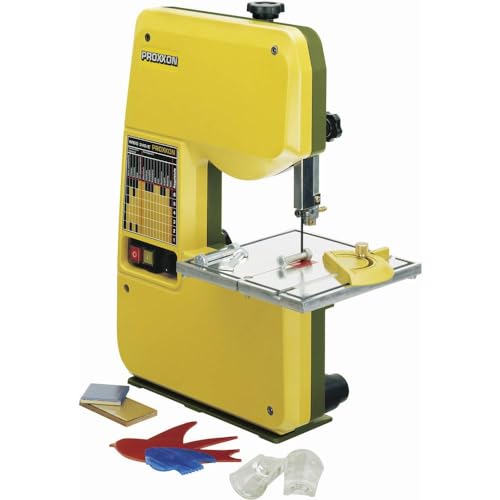
The Proxxon MBS 240/E exists in a category that no other product in this guide — and no mainstream bandsaw roundup — addresses: desktop micro sawing for model makers, jewelry crafters, luthiers, and precision hobby work. This is a bandsaw scaled for materials measured in millimeters rather than inches. The MBS 240/E makes clean, precise cuts in balsa, thin hardwood strips, plastic sheet, thin aluminum, and small bones or horn material used in handle and jewelry work — operations where a 9-inch benchtop saw would be dangerously oversized and uncontrollable for the tiny stock involved.

The saw’s table tilts for angled cuts, the blade accepts standard Proxxon blades in wood, metal, and specialty materials, and the compact footprint (the entire unit fits comfortably on a corner of a workbench) keeps it accessible without a dedicated machine station. The fence and miter gauge handle the small-scale precise repeat cuts that model assembly requires — cutting dozens of identical thin strips or angles that a larger saw makes dangerous and a craft knife makes tedious.
If your work involves scale modeling, miniature furniture, instrument building, or jewelry and small craft fabrication, the Proxxon MBS 240/E fills a gap that no other tool in this guide can address. If you work in standard woodworking lumber and furniture-scale projects, this is not the saw for you — step up to a 9-inch benchtop model and pair it with a coping saw or scroll saw for detail work.
Pros
- The only micro-category bandsaw in this guide — purpose-built for model, jewelry, and precision craft work
- Accepts blades for wood, metal, and specialty materials
- Tilting table for angled cuts in small stock
- Desk-mounted footprint fits any bench without a dedicated machine station
Cons
- Not suited for standard furniture-scale woodworking or any stock over roughly 1–2 inches thick
- Proxxon-specific blade format — less widely available than standard bandsaw blades
Specs
- Type: Desktop micro bandsaw
- Best material: Thin hardwood, balsa, plastic, thin non-ferrous metal, horn/bone
- Mounting: Benchtop (no stand needed)
Best for: Model makers, jewelry crafters, luthiers, and precision hobbyists working with small-scale material where full-size bandsaws are impractical or dangerous.
2. Ryobi BS904G 9-Inch Bandsaw — Best Budget 9″
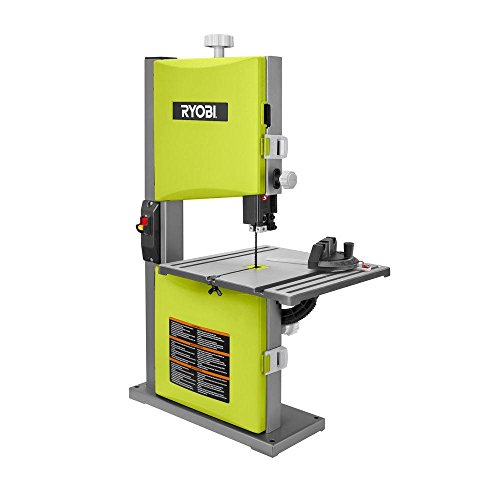
The Ryobi BS904G is the practical entry point into the 9-inch benchtop bandsaw category — sufficient for a beginner’s first bandsaw purchase without requiring a significant financial commitment before you know whether a bandsaw fits your workflow. The 9-inch wheel size and standard benchtop format handle the use cases most beginners actually start with: cutting furniture leg curves, shaping blanks for small boxes and trays, and basic lumber ripping tasks that don’t require the resaw depth of a floor-standing model.

The 2.5-amp motor provides adequate power for the softwood and thin hardwood cutting that characterizes beginner projects — pine, poplar, and standard ¾-inch plywood work well within its capability. The tilting table accepts standard miter angles for angled cuts, and the saw accepts standard 59.5-inch replacement blades widely available from multiple aftermarket manufacturers. Where the Ryobi shows its budget positioning is in blade guide quality and fence precision — both of which are functional rather than refined, and which many owners upgrade once they’ve confirmed the bandsaw belongs in their workflow.

For a woodworker buying their first bandsaw to understand how the tool fits their projects — and who reasonably expects to upgrade to a more capable model as their work grows — the Ryobi BS904G is the right low-risk starting point. For someone who already knows they need a capable primary shop bandsaw, the DeWalt 9-inch or WEN 10-inch are the better purchases from the start.
Pros
- Lowest price entry into the 9-inch category — appropriate risk level for a first bandsaw
- Accepts standard 59.5-inch aftermarket blades — wide availability and low cost
- Handles softwood and standard plywood cutting comfortably
- Compact benchtop format for small shops
Cons
- Single-speed — no lower speed option for metal or plastic cutting
- Blade guides and fence are functional but basic — upgrades likely if the saw becomes a primary tool
- 2.5A motor limits performance in dense hardwood
Specs
- Wheel size: 9″
- Motor: 2.5A
- Speeds: Single
- Blade length: Standard 59.5″
Best for: Beginners buying their first bandsaw to explore the tool’s workflow before committing to a higher-capacity model.
3. SKIL 2.8 Amp 9-Inch 2-Speed Benchtop Band Saw (BW9501-00) — Best Value 9″
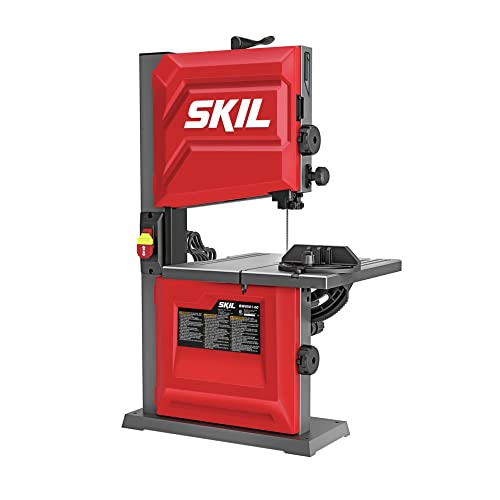
The SKIL BW9501-00 steps ahead of the Ryobi in one meaningful way that affects practical versatility: the two-speed motor. At 1,400 FPM (low speed) and a higher woodworking speed, the SKIL gains the ability to cut non-ferrous metals and plastics that single-speed benchtop saws can’t handle safely or effectively. For a hobbyist whose projects occasionally include aluminum bar stock, plastic sheet, or thin copper — model aircraft frames, custom brackets, enclosures — this two-speed capability opens the saw to material categories entirely closed to single-speed alternatives.

The 2.8-amp motor provides slightly more power than the Ryobi for similar material thickness, which translates to less bogging in denser hardwood near the edges of the saw’s practical capacity. The table tilts for standard miter angles and the saw accepts standard-format replacement blades. Build quality and fit-and-finish are solid for the price — the SKIL does not feel like a toy, which matters for a bench tool you’re using with moving blades and close hand positions.

For a hobbyist whose work spans wood and occasional non-ferrous metal or plastic at the 9-inch scale, the SKIL BW9501-00 is the best value proposition in this guide’s 9-inch tier — the two-speed capability it adds over the Ryobi costs relatively little and pays for itself the first time a metal-cutting task comes up.
Pros
- Two-speed motor enables non-ferrous metal and plastic cutting at the lower speed
- Slightly more powerful than single-speed budget alternatives
- Good build quality and fit-and-finish for the price tier
- Standard blade format for wide aftermarket availability
Cons
- Aluminum table — adequate for benchtop use but less stable than cast iron under heavy feed
- Fence adjustment is basic; drift compensation requires some workaround
Specs
- Wheel size: 9″
- Motor: 2.8A
- Speeds: Two-speed
- Table: Tilting aluminum
Best for: Hobbyists whose projects span wood, plastic, and occasional non-ferrous metal who want two-speed capability at a benchtop price.
4. DeWalt 9-Inch Band Saw, 3.5 AMP, Two-Speed with LED Worklight — Best 9″ Overall
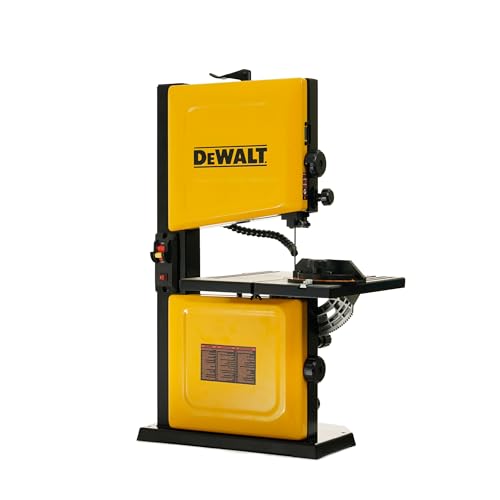
The DeWalt 9-inch is the strongest overall performer in the 9-inch tier, combining the most powerful motor in the benchtop category (3.5 amps), two-speed operation, and an integrated LED worklight that illuminates the cut line directly — a feature that sounds minor until you’ve spent a frustrating session following a pencil line in the shadow cast by your own hand on a dim benchtop saw. DeWalt’s blade guide quality and fence mechanism also noticeably outperform budget alternatives in this size class, which directly translates to straighter, more repeatable rip cuts in daily use.
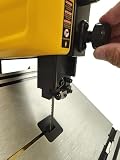
The two-speed operation (1,700 and 2,500 SPM) covers both standard woodworking at the higher speed and the slower speed needed for non-ferrous metal and plastic. At 3.5 amps, the motor handles oak, maple, and other dense hardwoods at this scale without the pronounced bogging that 2.5–2.8 amp motors show under the same load. The saw accepts standard replacement blades, and DeWalt’s ecosystem means replacement parts and accessories are widely available through multiple channels.

For a serious hobbyist or professional who needs a compact 9-inch benchtop bandsaw that performs at the top of what this size class can do — rather than a first tool to learn on — the DeWalt is the best available option in this guide at this wheel size. If your shop needs more resaw capacity than a 9-inch provides, step up to the WEN BA3962 or the 14-inch floor model rather than expecting any 9-inch saw to exceed the format’s inherent limitations.
Pros
- 3.5A motor — strongest in the 9-inch tier; handles dense hardwood without bogging
- Integrated LED worklight illuminates the cut line directly for accurate line-following
- Two-speed (1,700/2,500 SPM) for wood and non-ferrous metal/plastic cutting
- Better blade guide and fence quality than budget 9-inch alternatives
Cons
- Premium price within the 9-inch tier
- Resaw height still limited by the 9-inch form factor — not a substitute for a 14″ floor model
Specs
- Wheel size: 9″
- Motor: 3.5A
- Speeds: Two-speed (1,700 / 2,500 SPM)
- Feature: Integrated LED worklight
Best for: Serious hobbyists and professionals who want the best possible performance from a 9-inch benchtop bandsaw — the top of the benchtop class before stepping up to a floor model.
5. WEN Band Saw with Stand, 10-Inch, 3.5-Amp, Two-Speed (BA3962) — Best Benchtop with Stand
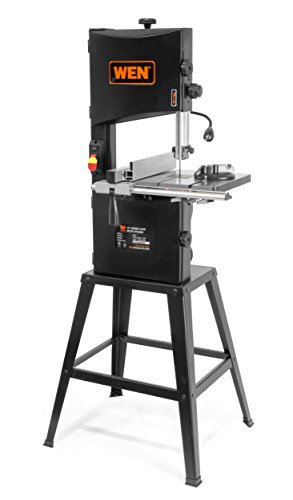
The WEN BA3962 occupies a practical middle position in this guide — a 10-inch saw that ships with an integrated stand, positioning it between a true benchtop model and a floor-standing machine. The stand brings the saw to a comfortable working height without requiring a separate workbench position, freeing up bench real estate in a small shop while still maintaining the portability of a benchtop-scale machine. When the shop needs the space back, the stand detaches and the saw stores compactly.

The 10-inch wheel provides a modest but real improvement in throat depth and resaw height over 9-inch saws — enough to handle the 4–5 inch resaw tasks that 9-inch models reach but struggle with. The 3.5-amp motor matches the DeWalt’s power at the 9-inch level, and the two-speed operation covers both wood and the lower-speed non-ferrous and plastic applications. Two speeds on a saw with a stand makes this a genuinely versatile light-shop workhorse that handles an honest range of materials and cut types.

For a hobbyist woodworker who wants more than a basic benchtop model but isn’t ready for the space, cost, and power requirements of a 14-inch floor model, the WEN BA3962 is the strongest option in this guide’s middle tier. It’s also a sensible first bandsaw for someone who has moved past entry-level work and wants a tool that will last several years of active hobby use before the next upgrade makes sense. Pair it with a dedicated dust collector for cleaner operation — benchtop saws generate significant fine dust at working height.
Pros
- Integrated stand included — frees up bench space without floor-model footprint
- 10-inch wheel provides modestly more throat and resaw capacity than 9-inch class
- 3.5A two-speed motor handles wood and non-ferrous at the same power level as the DeWalt
- Strong value at the mid-tier price point
Cons
- Aluminum table — less stable than cast iron on a 14-inch floor model for heavy ripping
- Resaw capacity still noticeably below a 14-inch floor model
Specs
- Wheel size: 10″
- Motor: 3.5A
- Speeds: Two-speed
- Stand: Included
Best for: Hobbyists who want more capacity than a 9-inch benchtop with an integrated stand for comfortable working height, without the full floor-model commitment.
6. 14-Inch Bandsaw for Woodworking, Dual-Speed 1445 & 2950 FPM — Best 14″ Floor Model

The 14-inch floor-standing bandsaw represents the threshold where a bandsaw transitions from a supplementary shop tool into a genuine production-capable machine. The 14-inch wheel size provides the throat depth and resaw height that serious woodworking demands — resawing 6–8 inch wide boards into bookmatched panels, producing thick veneer from figured lumber, and cutting chair legs and curved furniture components from thick blanks that a 9- or 10-inch saw simply cannot reach.

The dual-speed design at 1,445 FPM and 2,950 FPM covers the full range from non-ferrous metal and plastic at the lower speed to aggressive wood cutting at full speed. The cast iron table — a significant upgrade over the aluminum tables on all smaller saws in this guide — provides a flat, stable reference surface that a rip fence can track accurately across long cuts, and the table’s greater mass absorbs the vibration that a larger induction motor generates during heavy resawing. Cast iron’s stability directly improves rip cut accuracy compared to aluminum at this scale.

For a woodworker who has pushed past the limits of a benchtop saw — specifically the resaw height ceiling and the motor’s struggle with sustained hardwood cutting — the step up to a 14-inch floor model is one of the most meaningful single upgrades available in a woodworking shop. Pair this saw with a sharp resaw blade (3/4-inch wide, 2–3 TPI) and a well-tuned drift-compensated fence, and it can produce bookmatched panels and veneered substrates that take furniture projects into a different category of material quality.
Pros
- 14-inch wheel size provides genuine resaw capacity for serious woodworking
- Cast iron table — stable, flat reference surface for accurate fence-guided rip cuts
- Dual-speed 1,445/2,950 FPM covers wood and non-ferrous/plastic applications
- Floor-standing induction motor sustains power through long, demanding cuts
Cons
- Larger footprint than benchtop models — requires a dedicated machine station
- Higher price and weight than benchtop alternatives
Specs
- Wheel size: 14″
- Speeds: Dual (1,445 / 2,950 FPM)
- Table: Cast iron
- Type: Floor-standing
Best for: Serious woodworkers who need genuine resaw capacity for bookmatched panels, veneer production, and curved furniture components from thick blanks.
7. Powermatic ArmorGlide 15-Inch Woodworking Bandsaw, 3HP, 230V (PM1500T) — Best Professional
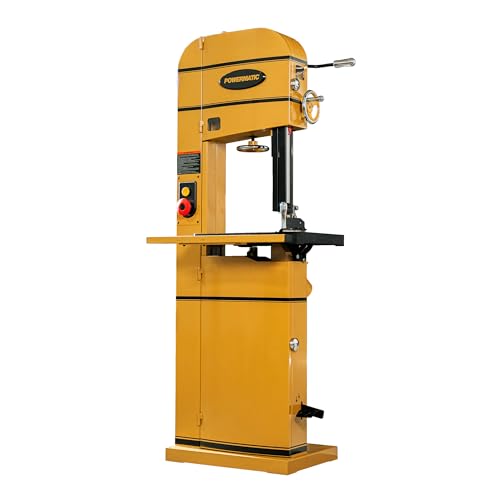
The Powermatic PM1500T is a professional shop machine in the most literal sense — its 3HP motor on a 230V single-phase circuit produces sustained power that no 120V benchtop or standard floor model approaches. At 3HP, the PM1500T resaws 12-inch-wide slabs of dense hardwood — oak, maple, walnut, thick figured cherry — at a production feed rate that a 1HP or 1.75HP machine cannot match. This is the tool for shops producing bookmatched slabs for tabletops, veneer for cabinet faces, and curved components from thick blanks as a daily workflow rather than an occasional task.

The ArmorGlide fence system is one of Powermatic’s signature differentiators on this model — a precision fence that locks positively and adjusts for blade drift without the approximation and workaround that budget fences require. The fence maintains its set position across the full length of a 12-inch resaw cut, producing flat, parallel faces that minimize waste on expensive figured lumber. The massive cast iron table and fence rail are milled to tight tolerances that keep the fence tracking true over the life of the machine. Combined with Cool Block guides standard from the factory, the PM1500T is configured for sustained production resawing without requiring the aftermarket upgrades that entry-level machines typically need before performing at this level.

Critical purchasing note: The PM1500T requires a dedicated 230V single-phase circuit wired to a 20–30 amp breaker. This is not a standard household outlet. Before ordering, confirm with a licensed electrician that your shop has or can be wired for 230V service. The saw ships on a pallet and requires two people to uncrate and position — plan for this at delivery. For professional cabinet shops, furniture makers, and serious production woodworking operations, the PM1500T’s combination of power, precision fence, and build quality is worth every dollar of the premium over the 14-inch tier.
Pros
- 3HP motor sustains production-rate resawing through thick, dense hardwood
- ArmorGlide precision fence system — locks true and adjusts for drift without workarounds
- Cool Block guides standard from factory — extended blade life in heavy production use
- 15-inch wheel with up to 12-inch resaw height for full-width board resawing
Cons
- Requires 230V single-phase circuit — not operable on standard 120V household power
- Professional price point — significant investment justified for production shop use
- Heavy, large footprint — requires a permanent machine station, not portable
Specs
- Wheel size: 15″
- Motor: 3HP
- Power: 230V single-phase (dedicated circuit required)
- Resaw height: Up to ~12″
- Fence: ArmorGlide precision fence system
- Guides: Cool Blocks (factory standard)
Best for: Professional cabinet shops and furniture makers doing daily hardwood slab resawing, veneer production, and curved components from thick blanks at production rates.
Setting Up Your Bandsaw Correctly
A bandsaw that’s improperly set up performs worse than a cheaper, well-tuned saw. These four setup steps take 15–20 minutes total and make more difference to cut quality than any blade or machine upgrade.
Step 1 — Blade Tensioning: The Deflection Test
Proper blade tension is the foundation of accurate cuts. Open the wheel guards and position the blade on both wheels. Tighten the tensioning knob while checking tension this way: push the blade sideways with moderate one-finger pressure, midway between the upper and lower blade guides. A correctly tensioned blade deflects no more than 1/4 inch under this pressure. More deflection = under-tensioned, produces wandering cuts. Less than 1/8 inch deflection = over-tensioned, risks blade snapping at stress points. Adjust the tensioning knob until you hit the 1/4-inch deflection target.
Step 2 — Blade Tracking
Blade tracking keeps the blade centered on the crown of both wheels rather than drifting toward either edge. With the guards open, slowly spin the wheels by hand while watching the blade’s position on the wheels. Adjust the upper wheel’s tilt knob (tracking adjustment) until the blade runs centered and stable without drifting. Verify tracking at the speed you’ll actually cut — some blades track differently under motor speed than by hand.
Step 3 — Blade Drift Compensation — Setting the Fence Correctly
This is the most commonly missed setup step on any bandsaw, and it’s why so many rip cuts on otherwise capable saws produce tapered, off-line results. Every bandsaw blade drifts to some degree — it naturally wants to cut at a slight angle rather than straight ahead, caused by the blade’s individual characteristics and how it tracks on the wheels.
To find and compensate for drift: draw a straight line parallel to the edge of a scrap board. Feed the board freehand, keeping the cut exactly on the line. The natural angle you hold the board relative to the saw table’s front edge is your saw’s drift angle. Mark this angle on the table. Lock the fence parallel to this angle, not perpendicular to the table front. Every rip cut made with a properly drift-compensated fence will track straight; every cut made with a fence locked square to a drifting blade will taper.
Step 4 — Guide Setup
Set the thrust bearing (the bearing that supports the blade from behind) so there is a paper-thin gap between the bearing and the blade with the saw running but no material being cut — close enough to stop blade deflection under cut pressure, not touching the blade at idle. Set the side guides (bearings or blocks) just touching the blade sides without pinching — side guides support the blade laterally during the cut but should not drag on the blade when it’s running free.
Which Bandsaw for Which Project?
| Project / Application | Recommended Saw | Why |
|---|---|---|
| Model making, jewelry, thin craft material | Proxxon MBS 240/E | Scale-appropriate; larger saws are unsafe for tiny stock |
| First bandsaw / beginner woodworking | Ryobi BS904G | Low investment to learn on; appropriate for softwood and standard projects |
| Mixed wood, metal, and plastic hobby work | SKIL BW9501-00 | Two-speed enables non-ferrous and plastic at the benchtop price tier |
| Serious benchtop woodworking, all wood types | DeWalt 9″ Bandsaw | Most powerful 9″ motor; best guide quality; LED for precise line-following |
| Small shop, needs working height + moderate capacity | WEN BA3962 | Stand included; 10″ wheel adds capacity; two-speed covers full material range |
| Furniture making, bookmatched panels, veneer | 14″ Bandsaw | Cast iron table, genuine resaw height, floor-model induction power |
| Professional shop, daily slab and veneer production | Powermatic PM1500T | 3HP sustained power; ArmorGlide fence; Cool Blocks; 12″ resaw height |
Frequently Asked Questions
What size bandsaw do I need for woodworking?
For general furniture and hobby woodworking including curved cuts and light ripping, a 9-inch or 10-inch benchtop bandsaw is adequate. For resawing boards into slabs or veneer, a 14-inch floor-standing model with at least 6 inches of resaw height is the practical minimum. Professional shops producing veneer or working with thick hardwood slabs benefit from a 15-inch or larger model with 2HP or more.
What is the difference between a bandsaw and a scroll saw?
A bandsaw uses a continuous loop blade moving in one direction, cutting on the downstroke. It handles a wide range of materials and thicknesses — including resawing thick boards. A scroll saw uses a short reciprocating blade that moves up and down, designed for very fine detail cuts and intricate patterns in thin material. A bandsaw is far more versatile overall; a scroll saw produces finer detail in thin stock. For a tool that does both curves and straight ripping, a bandsaw is the one to buy. Pair it with a coping saw for tight interior curved cuts a bandsaw can’t reach.
What blade width should I use for curves on a bandsaw?
For tight scrollwork and curves with a radius under 1 inch, use a 1/8-inch blade. For moderate curves with a 2–3 inch radius, use a 1/4-inch blade. For gentle curves and general woodworking, 3/8-inch works well. Reserve 1/2-inch and wider blades for straight rip cuts and resawing, where the wider blade resists deflection better than narrow alternatives.
How do I know if my bandsaw blade is tensioned correctly?
Push the blade sideways with moderate finger pressure midway between the guides. A correctly tensioned blade deflects no more than 1/4 inch. If it deflects more, it is under-tensioned and will produce wandering cuts. If it barely moves at all, it is over-tensioned and risks snapping. Adjust the tensioning knob until you hit the 1/4-inch deflection target.
What is blade drift and how do I fix it?
Blade drift is the tendency of a bandsaw to cut at an angle rather than straight ahead, caused by the blade’s natural tracking characteristics. Fix it by making a freehand straight cut following a marked pencil line without using the fence. The angle you naturally hold the stock to follow the line is your saw’s drift angle. Set the rip fence to match this angle rather than perfectly perpendicular to the front of the table — every rip cut will then track straight rather than tapering.
Can a bandsaw cut metal?
Yes, with the correct blade and lower speed setting. Two-speed bandsaws — including the WEN BA3962, SKIL BW9501, and DeWalt 9-inch in this guide — can cut non-ferrous metals (aluminum, brass, copper) at their lower speed setting with a fine-tooth bi-metal blade. Do not cut ferrous metal (steel, iron) on a standard woodworking bandsaw without confirming the saw and blade are specifically rated for it.
What does resaw height mean on a bandsaw?
Resaw height is the maximum vertical distance between the table surface and the upper blade guide — the thickest board the saw can cut standing on edge. A 9-inch benchtop saw typically offers 3–4 inches of resaw height. A 14-inch floor model provides 6–12 inches. Practical quality results are typically achievable at 70–80% of the advertised maximum — a saw rated for 6 inches reliably produces quality cuts up to about 4.5–5 inches.
Does the Powermatic PM1500T require special wiring?
Yes. The PM1500T runs on 230V single-phase power and cannot plug into a standard 120V household outlet. A dedicated 230V circuit wired to a 20–30 amp breaker must be installed by a licensed electrician before this saw can operate. Confirm your shop has this capability or budget for the electrical work before purchasing. This is standard for any serious professional shop tool in the 2HP+ range.
Final Verdict
The right bandsaw depends almost entirely on what you’re cutting and at what volume. Here are the definitive picks by use case:
- Best micro / hobby: Proxxon MBS 240/E — the only correctly scaled tool for model making, jewelry, and fine craft work in small-dimension material.
- Best budget 9″: Ryobi BS904G — the right low-risk first bandsaw for a beginner exploring the tool category.
- Best value 9″ (two-speed): SKIL BW9501-00 — two-speed capability opens non-ferrous and plastic cutting at a benchtop price.
- Best 9″ overall: DeWalt 9″ Bandsaw — 3.5A motor, two-speed, integrated LED, best guide quality in the 9-inch class.
- Best benchtop with stand: WEN BA3962 10″ — integrated stand, 10-inch wheel, 3.5A two-speed for a complete mid-tier package.
- Best 14″ floor model: 14″ Bandsaw — cast iron table, genuine resaw capacity, dual-speed for the serious woodworking shop upgrade.
- Best professional: Powermatic PM1500T 15″ — 3HP, ArmorGlide fence, Cool Block guides, 12-inch resaw height for production cabinetmaking and slab work.
Whatever saw you choose, setup matters as much as the machine itself. Tension the blade to the 1/4-inch deflection standard, find and compensate for your saw’s natural drift angle before trusting the fence, and match your blade width and TPI to the cut you’re actually making — a correctly set up mid-tier bandsaw outperforms a mis-set premium machine every time.
About the Author
This article was researched and written by the Protguide Editorial Team — a group of hands-on tool testers and woodworking enthusiasts who evaluate power tools, hand tools, and workshop equipment for home builders, tradespeople, and serious hobbyists. Our recommendations are based on independent research, competitor gap analysis, and real-world product knowledge. We may earn a commission from qualifying Amazon purchases at no extra cost to you.
A bandsaw handles curves and resawing a table saw can’t, but most shops need both – see our guide to the best table saws to round out your cutting setup.
A bandsaw excels at curves and resawing, but crosscuts and trim angles belong to a miter saw – see our guide to the best miter saws.
Curves and resawing are a bandsaw’s job; edge profiles and joinery belong to a router – see our guide to the best wood routers.


