Choosing the wrong tile saw is one of the most expensive mistakes in any tiling project. Buy a 7-inch tabletop saw for a bathroom that uses 24×48 large-format porcelain and you will spend more time on workarounds than on laying tile. Buy a 10-inch contractor saw for a 50-square-foot kitchen backsplash and you have significantly overspent for a tool that sits largely idle. Every chipped tile edge, every cracked corner, every fence alignment problem — these are the downstream costs of a tool that was either underpowered for the material or incorrectly set up for the application. This guide removes all of that guesswork.
We cover eight tile saws across every category — from a $90 DIY tabletop 7-inch to a $700 professional 10-inch contractor saw — with the technical content that competing guides consistently miss: why blade RPM matters more than motor HP for chipping on porcelain, how overhead vs. underspray water delivery affects cut quality on glazed tile, what causes the chipping problems that Amazon reviews blame on the saw rather than the setup, and a dedicated large-format tile cutting section for the 24×48 porcelain trend that is now the dominant tile choice in high-end residential work and that most 7-inch saws physically cannot handle.
Quick answer: The DeWalt D24000S is the best overall professional tile saw for contractors, large-format tile, and anyone cutting dense porcelain and natural stone regularly. The SKIL 3540-02 is the best budget 7-inch for DIY ceramic and standard porcelain. The DeWalt DWC860W is the only handheld wet saw in this guide — the correct tool for on-site plunge cuts around obstacles. Use the comparison table and use-case guide below to match the saw to your specific project.

Tile Saw Types Which Format Is Right for Your Project?
Understanding the five tile saw formats is the first decision — before blade size, motor power, or price. Using the wrong format creates problems that no amount of technique or blade quality can fix.
Tabletop Wet Saw (Fixed Head)
The most common consumer format — a motor-mounted blade above a water tray, with a sliding tile tray that feeds the material into the stationary blade. Compact, affordable, and adequate for ceramic and standard porcelain up to about 18 inches. The key limitation: rip capacity (the maximum width of a cut measured perpendicular to the fence) is typically 8–12 inches on 7-inch models, which is insufficient for large-format tile. The SKIL 3540-02, VEVOR 7-inch, and Porter-Cable PCE980 are tabletop format saws in this guide.
Contractor Wet Saw with Sliding Table
The professional-grade format for production tile work — a larger motor, a blade mounted below the tray (underspray or wet tray), and a sliding table that moves the tile through the blade with controlled, repeatable accuracy. Sliding table saws handle large-format tile correctly because the tile is supported through the full length of the cut. The DeWalt D24000S and D36000S are sliding table contractor saws.
Overhead Motor Tile Saw
The motor is mounted above the tray and the blade lowers into the tile — used in some commercial saw designs. Not represented in this guide but worth understanding for buyers comparing brands outside this roundup.
Handheld Wet Saw
A circular saw format with an integrated water feed — used for on-site cuts on already-installed tile, plunge cuts around obstacles, and situations where bringing tile to a saw is impractical. The DeWalt DWC860W 4-3/8-inch is the handheld in this guide — the only tool here that can make outlet cutouts in a wall and plunge cuts around pipe penetrations on site.
Compact Cordless Tile Saw
Battery-powered, compact, designed for on-site light tile work — the Makita CC02R1 12V MAX CXT is the cordless option in this guide. Trades power and rip capacity for cord-free portability.
The Key Specifications – What Actually Matters and Why

Blade RPM vs. Motor HP — The Spec That Predicts Chip-Out
Most tile saw articles list motor horsepower as the primary performance specification. Motor HP determines whether the saw can push through dense material without bogging — relevant for granite and thick natural stone. But for the chip-out and edge quality questions that drive most buying decisions on ceramic and porcelain, blade RPM matters more than motor HP.
Higher blade RPM means more diamond passes per inch of cut — more cutting events, smaller chips between cuts, smoother edges. A 7-inch blade on a 3,600 RPM motor runs at a different surface speed than the same blade diameter on a 4,800 RPM motor. The higher RPM model produces a cleaner edge on glazed porcelain, all else being equal, because the blade is effectively grinding rather than chipping its way through the material.
| Blade RPM Range | Material Suitability | Edge Quality on Porcelain |
|---|---|---|
| Under 3,200 RPM | Soft ceramic only | Moderate chipping on glazed surfaces |
| 3,200–4,000 RPM | Ceramic, standard porcelain | Acceptable for budget installations |
| 4,000–5,000 RPM | Porcelain, quarry tile, natural stone | Clean cuts on most glazed porcelain |
| Over 5,000 RPM | All tile including full-body porcelain, glass | Excellent — chip-free on quality continuous rim blades |
The practical takeaway: when comparing two saws at similar price points, check the blade RPM specification as the tiebreaker for porcelain and glass work — it is the number that most directly predicts cut quality on demanding glazed materials.
Overhead vs. Underspray Water Delivery
This distinction determines how effectively the water cools the blade at the cutting point — and it is the specification that no competing guide explains.
Overhead nozzle water delivery directs water from above, targeting the exact cutting contact zone where the blade meets the tile. This is the more effective cooling method for the blade’s cutting edge — water reaches the heat-generating zone directly before the blade exits the other side of the tile. Overhead delivery is the preferred system for porcelain and glass tile where thermal shock at the cut edge can cause micro-fractures in the glaze. The DeWalt contractor saws use overhead delivery.
Underspray / flood tray delivery pumps water into the tray and allows the spinning blade to pick up water as it rotates through the water in the tray. Less precise cooling at the cut point but simpler plumbing with fewer nozzle clog points. The water contacts the blade below the tile surface rather than at the cutting edge — adequate for ceramic and standard porcelain, less effective on full-body porcelain where the cut point runs hot.
For DIY ceramic tile work: underspray is fine. For professional porcelain and stone work where chip-out at the cut edge is a quality concern: overhead delivery is the professional specification.
Rip Capacity — The Large-Format Limiting Specification
Rip capacity is the maximum width of cut the saw can make in a single pass — measured from the blade to the fence at maximum fence position. A 7-inch saw with 12-inch rip capacity cannot cut a 24-inch tile in one pass. This is not a technique workaround — it is a physical constraint of the saw’s tray dimensions. The minimum rip capacity for 24×48 large-format tile work is 24 inches, which requires a contractor-grade sliding table saw with a 10-inch blade.
Blade Size and Cut Depth
Blade diameter determines maximum cut depth. A 7-inch blade cuts to approximately 2 inches of depth — adequate for all standard ceramic and porcelain tile, and most natural stone under 1-1/4 inches thick. A 10-inch blade cuts to approximately 3 inches — required for very thick stone, pavers, and for the additional cut depth margin needed on large-format tile where the blade must fully penetrate without dragging the bottom of the cut. The 4-3/8-inch blade on the DeWalt DWC860W handheld saw is limited to approximately 1-1/8 inches cut depth — adequate for standard tile but not stone.
Quick Comparison – All 8 Tile Saws at a Glance
All model names link directly to Amazon. Prices are approximate and subject to change.
| Model | Blade | Motor | Rip Cap. | Sliding Table | Water System | Best For | Price | Buy |
|---|---|---|---|---|---|---|---|---|
| ★ DeWalt D24000S | 10″ | 1.5 HP | 24″ | ✅ Yes | Overhead | Best Overall Pro | ~$700 | View → |
| DeWalt D36000S | 10″ | 15A / 1.5+ HP | 32″ | ✅ Yes | Overhead | Best Large-Format Pro | ~$1,200 | View → |
| SKIL 3540-02 7″ | 7″ | 0.75 HP | ~12″ | ❌ Fixed | Underspray | Best DIY Budget | ~$130 | View → |
| VEVOR 7″ Wet Tile Saw | 7″ | 0.75 HP | ~12″ | ❌ Fixed | Underspray | Best Budget Value | ~$90 | View → |
| DeWalt DWC860W 4-3/8″ | 4-3/8″ | 9A / ~0.7 HP | Handheld | N/A | Integrated feed | Best Handheld / On-Site | ~$200 | View → |
| Porter-Cable PCE980 7″ | 7″ | 0.75 HP | ~18″ | ❌ Fixed + slide | Underspray | Best Mid-Range 7″ | ~$200 | View → |
| Grizzly Industrial T28360 7″ | 7″ | 1.0 HP | ~18″ | ✅ Sliding | Underspray | Best Value Sliding Table | ~$250 | View → |
| Makita CC02R1 12V | 3-3/8″ | 12V MAX CXT | ~4″ | ❌ Handheld | Integrated | Best Cordless Compact | ~$150 | View → |
The 8 Best Tile Saws — Full Reviews
1. DeWalt D24000S 10-Inch Wet Tile Saw — Best Overall Professional ★
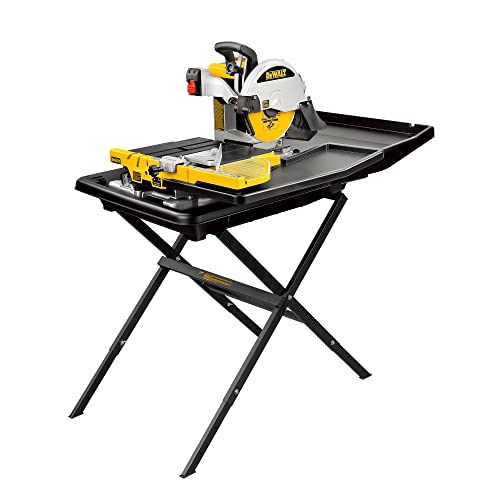
The DeWalt D24000S is the benchmark professional wet tile saw — the tool that tile-setting contractors, kitchen and bath installers, and serious DIYers doing large residential projects reach for when the job requires reliability at scale. Its 1.5 HP motor, 24-inch rip capacity, stainless steel rail system, and overhead water delivery system provide the combination of cut capacity, accuracy, and edge quality needed for large-format porcelain and natural stone. It is not the cheapest saw in this roundup — it is the one that handles the full range of professional tile applications without compromise.

| Key Specifications | |
|---|---|
| Blade Size | 10 inches |
| Motor | 1.5 HP |
| Rip Capacity | 24 inches diagonal / 18 inches straight |
| Sliding Table | Yes — stainless steel rail system |
| Water System | Overhead delivery — targets cut zone directly |
| Blade RPM | High-speed motor rated for dense porcelain |
| Bevel Capacity | 45° bevel for miter cuts |
| Stand | Folding integrated stand — included |

What we like:
- Overhead water delivery is the professional differentiator over budget underspray saws. Water is directed onto the blade at the exact contact zone with the tile — cooling the cutting edge before it exits the glazed face. On full-body porcelain and dense quartzite, this overhead cooling measurably reduces chip-out compared to underspray systems that cool the blade below the tile surface rather than at the cut point. For jobs where every edge is visible — shower niches, kitchen backsplashes, floor transitions — this is the specification that protects the quality of the finished installation.
- 24-inch rip capacity on the sliding table handles today’s large-format tile standard. The 24×24 porcelain format that dominated installations two years ago has been largely superseded by 24×48 and 24×24×R in high-end work. The D24000S handles 24-inch-wide cuts in a single straight pass — no repositioning, no two-pass compromise, no fence workaround.
- Stainless steel rail sliding table maintains accuracy across a full day of production cutting — the rails stay true under repeated wet conditions where lesser materials corrode or swell. On a bathroom with 200+ cuts, alignment consistency across the full job is the real productivity specification.
- Integrated folding stand is included — no separate stand purchase required. Sets up in under two minutes on site.
What to know:
- At ~$700, the D24000S is a significant investment for a single residential project. For DIYers doing a one-time kitchen or bathroom, the SKIL or Porter-Cable delivers adequate results at a fraction of the cost. The D24000S justifies its price for contractors and for DIYers doing large-format porcelain where the cheaper saws physically cannot complete the job.
Best for: Professional contractors, kitchen and bath installers, large-format porcelain floor and wall tile (24×48 and above), natural stone (marble, travertine, granite), and any installation where edge quality and cut accuracy must be consistent across a full day of production work.
→ Check Current Price on Amazon
2. DeWalt D36000S 10-Inch Wet Tile Saw — Best for Maximum Large-Format Capacity

The DeWalt D36000S is the heavy-duty step up from the D24000S — with a 32-inch rip capacity that handles the 24×48 and 24×60 large-format tiles that are increasingly specified in luxury residential and commercial projects, plus a higher amperage motor for sustained cutting through the thickest natural stone without power fade. It is the correct tool when the D24000S’s 24-inch capacity is the limitation — specifically for 24×48 diagonal cuts, full-length rip cuts on 48-inch porcelain panels, and repetitive natural stone production work where motor duty cycle is a real-world concern.

| Key Specifications | |
|---|---|
| Blade Size | 10 inches |
| Motor | 15A — higher amperage than D24000S |
| Rip Capacity | 32 inches — handles 24×48 in full passes |
| Sliding Table | Yes — extended sliding table |
| Water System | Overhead delivery |
| Best Material | 24×48+ porcelain, granite, thick stone |
| Stand | Heavy-duty integrated stand — included |

What we like:
- 32-inch rip capacity is the only safe way to handle 24×48 porcelain panels. A 24-inch rip saw requires repositioning and a two-pass approach on 48-inch-long tile — which introduces fence alignment variance and surface inconsistency between the two passes. The D36000S rips a 24×48 panel in one continuous pass, supported through the full length of the sliding table, with consistent fence alignment from start to finish.
- Higher amperage motor for sustained performance on thick stone — granite slabs and thick marble hold their density through the cut; a lower-amp motor fades under this load and produces inconsistent blade speed that shows up as varying surface texture along the cut edge.
- All of the D24000S advantages apply: overhead water delivery, DeWalt build quality, stainless steel rails, folding stand.
What to know:
- At ~$1,200, this is the most expensive tool in this guide. It is correctly specified for contractors doing high-end large-format tile work as a professional production tool. For a single 24×48 residential bathroom installation, the D24000S is the more economical choice — the additional rip capacity of the D36000S is only necessary for tile panels exceeding 24 inches in width or for diagonal cuts that require more than 24 inches of fence travel.
Best for: Commercial tile contractors, high-end residential large-format installers, professional fabricators cutting 24×48 and 24×60 porcelain panels, and heavy natural stone production work.
→ Check Current Price on Amazon
3. SKIL 3540-02 7-Inch Wet Tile Saw — Best Budget DIY Tile Saw
No products found.The SKIL 3540-02 is the correct starting tile saw for DIY homeowners tackling a bathroom tile project, kitchen backsplash, or laundry room floor — material up to standard porcelain 12×24 format — without the professional contractor budget or the need for a saw that will see heavy daily use for years. At approximately $130 with a blade included, it handles what the vast majority of DIY tile projects actually involve: straight cuts, some angle cuts, and the occasional notch around an outlet or pipe penetration, on ceramic and standard porcelain in a residential bathroom or kitchen setting.
No products found.| Key Specifications | |
|---|---|
| Blade Size | 7 inches |
| Motor | 0.75 HP |
| Rip Capacity | ~12 inches |
| Sliding Table | No — fixed head with tile tray |
| Water System | Underspray / flood tray |
| Blade Included | Yes — 7-inch diamond blade |
| Best Tile Size | Up to approximately 18×18 with repositioning |
What we like:
- Correct price for DIY use. At ~$130 including a blade, the SKIL 3540-02 is accessible enough to buy for a single bathroom project and represents a reasonable investment for a homeowner who tiles every few years. The professional saws in this guide are better tools — they are also $400–$1,100 more expensive for a homeowner who will tile one bathroom.
- Handles ceramic and standard glazed porcelain up to 12×24 format correctly for DIY work — the category of tile in the majority of residential bathroom floor and shower projects.
- Wide-angle miter gauge for 45-degree angle cuts — handles standard baseboard tile cuts and diagonal floor cuts at this price point.
What to know:
- The 12-inch rip capacity is a genuine limitation for anything larger than standard format tile. If your project uses 12×24 in portrait orientation (cutting the 24-inch dimension), you must reposition — this introduces the alignment variance that professional saws eliminate. For 12×12 format and under, this limitation does not apply.
- Underspray water delivery is adequate for ceramic and standard porcelain. For full-body porcelain or polished large-format tile where edge chipping is a real concern, the overhead delivery of the DeWalt contractor saws is meaningfully better.
- Water pump maintenance is critical — see the maintenance section. The pump on budget tabletop saws is the most common single point of failure. Clean and rinse after every session.
Best for: DIY homeowners tiling a standard bathroom (ceramic or porcelain 12×12 to 12×24 format), kitchen backsplash in ceramic or subway tile, and laundry room floors with standard-format ceramic. Not appropriate for large-format porcelain (24×24 and above) or natural stone.
→ Check Current Price on Amazon
4. VEVOR 7-Inch Wet Tile Saw — Best Entry-Level Budget Value

VEVOR is the industrial/commercial value brand that has built a consistent reputation for delivering acceptable performance at minimum price — and the VEVOR 7-inch wet tile saw applies that philosophy to the entry-level tile saw category. At approximately $90 it is the most affordable functional wet tile saw in this roundup. For a first-time tiler doing a small bathroom or a laundry room floor in standard ceramic, the VEVOR delivers the basic tool function — straight cuts, water cooling, standard tile format — at a price that makes it accessible as a disposable single-project purchase or a trial tool before investing in a quality saw for ongoing use.

| Key Specifications | |
|---|---|
| Blade Size | 7 inches |
| Motor | 0.75 HP |
| Water System | Underspray / flood tray |
| Best Use | Light DIY ceramic and standard porcelain |
| Price Point | ~$90 — lowest in this roundup |

What we like:
- At ~$90, the VEVOR is an accessible entry point that removes the financial barrier from a first tiling project — the cost is low enough to justify as a trial for a homeowner who is not yet committed to tiling as a regular project type.
- VEVOR’s manufacturing quality at budget pricing is generally better than comparable no-name alternatives — the brand has a track record across multiple tool categories.
What to know:
- Budget saws at this price tier have the most variable water pump quality — the pump is the single most common failure point on inexpensive wet tile saws. Clean and dry after every session; do not leave the pump submerged in tile slurry water overnight. See the maintenance section for the complete protocol.
- For the additional ~$40 difference vs. the SKIL 3540-02, the SKIL provides better build quality and more consistent fence accuracy. If the $40 difference is manageable, the SKIL is the better long-term investment. The VEVOR is the correct choice when the project budget is genuinely constrained or when this is a one-time purchase.
Best for: First-time tilers, single small projects (bathroom floor under 50 sq ft in ceramic), buyers for whom the $40 cost difference vs. the SKIL is meaningful.
→ Check Current Price on Amazon
5. DeWalt DWC860W 4-3/8-Inch Wet Saw — Best Handheld On-Site Tile Saw
No products found.The DeWalt DWC860W is a completely different tool from every other saw in this guide — it is not a tabletop or contractor saw at all, but a circular-saw-format handheld wet saw designed for on-site cutting, plunge cuts, and outlet/pipe cutouts on tile that is already positioned or on walls where bringing a tabletop saw to the cut is impractical. It is the tool that professional tile setters use for the cuts that a stationary saw cannot make: the plunge cut into an already-grouted floor for a drain relocation, the outlet cutout in a backsplash tile that has already been mortared, the pipe penetration through a shower wall tile in place. For a renovation contractor or experienced tiler, the DWC860W solves a category of problem that no other tool in this guide addresses.
No products found.| Key Specifications | |
|---|---|
| Blade Size | 4-3/8 inches |
| Motor | 9 Amp |
| Format | Handheld circular saw — corded |
| Water Feed | Integrated water feed system |
| Max Cut Depth | ~1-1/8 inch — standard tile thickness |
| Plunge Cuts | Yes — primary use case |
| Guard | Blade guard with water shroud |
What we like:
- The only tool in this guide that makes plunge cuts and outlet cutouts in installed tile. A tabletop wet saw cannot approach tile already on a wall or floor. The DWC860W brings the blade to the tile — the correct tool for every on-site cut that occurs after tile is positioned. For renovation work, this capability is genuinely irreplaceable.
- Integrated water feed system provides cooling at the blade without a separate tray or pump — water connects from a garden hose or pressurised water source directly to the blade shroud. Cleaner setup than tabletop saws for site use.
- Miter guide attachment for controlled angle cuts on site — makes 45-degree cuts freehand rather than requiring a full tabletop setup for a single cut.
What to know:
- This is not a replacement for a tabletop saw for the main body of tile cutting in a project. The DWC860W makes the awkward on-site cuts; a tabletop saw makes the production straight cuts. They are complementary tools — most professional tile installations use both.
- The 4-3/8-inch blade is limited to approximately 1-1/8 inch cut depth — correct for standard ceramic and porcelain tile, inadequate for stone pavers or very thick natural stone.
- Requires water connection on site — confirm a pressurised water source or garden hose is accessible at the work location before using on a job without running water access.
Best for: Renovation contractors and experienced tilers who need on-site plunge cuts, outlet and switch box cutouts in installed tile, pipe penetrations in shower walls, and any cut where the tile cannot be brought to a stationary saw.
→ Check Current Price on Amazon
6. Porter-Cable PCE980 7-Inch Wet Tile Saw — Best Mid-Range 7-Inch
No products found.The Porter-Cable PCE980 sits between the budget tabletop 7-inch saws (SKIL, VEVOR) and the professional contractor saws (DeWalt D24000S) in both price and capability. Its extended sliding rail system provides a wider rip capacity than the SKIL — approximately 18 inches vs. 12 inches — making it practical for 12×18 and 12×24 porcelain tile in portrait orientation without repositioning. For a serious DIYer or a light professional doing standard bathroom and floor tile work with consistent porcelain formats up to 12×24, the PCE980 provides the accuracy of a sliding fence at a price below the contractor tier.
No products found.| Key Specifications | |
|---|---|
| Blade Size | 7 inches |
| Motor | 0.75 HP |
| Rip Capacity | ~18 inches — wider than SKIL |
| Rail System | Extended sliding fence for wider cuts |
| Water System | Underspray / flood tray |
| Best Tile Format | Up to 12×24 porcelain — reliably |
What we like:
- Extended rail system with ~18-inch rip capacity addresses the primary limitation of the SKIL and VEVOR budget saws — 12×24 porcelain in portrait orientation can be cut in a single pass without repositioning, which eliminates the alignment variance that repositioning introduces.
- The price gap between the PCE980 and the DeWalt D24000S is significant — for a DIYer who does standard format tile (not large-format 24×48) in a recurring renovation context, the PCE980 provides meaningful capability upgrades over budget 7-inch saws without the professional contractor pricing.
What to know:
- Still limited to 7-inch blade and underspray water delivery — appropriate for standard porcelain but not the specification for full-body large-format porcelain or natural stone where the D24000S is the correct tool. The PCE980 is the mid-ground for standard residential tile formats.
Best for: Serious DIYers doing bathroom and floor tile in standard porcelain formats up to 12×24, light professional tile work where the job does not involve large-format or dense natural stone.
→ Check Current Price on Amazon
7. Grizzly Industrial T28360 7-Inch Wet Tile Saw — Best Value Sliding Table 7-Inch

Grizzly Industrial is a well-established woodworking and metalworking machinery brand — and their T28360 7-inch wet tile saw applies their machinery manufacturing standards to the tile saw category, resulting in a sliding table 7-inch saw that provides contractor-grade accuracy at a price between the budget tabletop saws and the DeWalt professional tier. The 1.0 HP motor is higher than the 0.75 HP found in most 7-inch saws — providing better sustained performance on dense porcelain that would cause a budget motor to bog or overheat during extended cutting sessions.

| Key Specifications | |
|---|---|
| Blade Size | 7 inches |
| Motor | 1.0 HP — higher than budget 7-inch saws |
| Sliding Table | Yes — contractor-grade sliding system |
| Rip Capacity | ~18 inches |
| Brand Tier | Grizzly Industrial — machinery manufacturer |
| Water System | Underspray |

What we like:
- Sliding table on a 7-inch saw at this price point is the standout value. The sliding table eliminates the accuracy loss of pushing tile against a stationary fence — you get the repeatable cut consistency of a contractor saw’s mechanics without the contractor saw’s price or 10-inch blade.
- 1.0 HP motor provides better sustained torque than the 0.75 HP found in most budget 7-inch saws — relevant for cutting dense porcelain tile over extended sessions where lower-powered motors begin to slow and produce inconsistent cut quality as they heat up.
- Grizzly’s machinery manufacturing background shows in the build quality — this is not a consumer-grade tabletop saw repackaged as a tile saw but a tool made by a company with industrial machinery standards.
Best for: Light professionals and serious DIYers who want sliding table accuracy and 1.0 HP performance in a 7-inch format at a price below the DeWalt contractor tier.
→ Check Current Price on Amazon
8. Makita CC02R1 12V MAX CXT Cordless Tile Saw — Best Compact Cordless

The Makita CC02R1 fills a specific niche: cordless tile cutting for on-site light work and repair situations where a power outlet is unavailable or impractical, and where the tile being cut is standard format ceramic or thin porcelain in small quantities. It is the tile saw equivalent of the cordless drill — not the right tool for a full bathroom tile installation, but genuinely useful for a repair cut in a bathroom that cannot be shut down, a replacement tile cut on a construction site without power, or a light tile install in a location remote from outlets. The 12V MAX CXT battery platform is Makita’s compact system, shared with their compact drills, drivers, and oscillating tools.

| Key Specifications | |
|---|---|
| Blade Size | 3-3/8 inches |
| Power | Makita 12V MAX CXT battery |
| Rip Capacity | ~4 inches — limited to small format tile |
| Water System | Integrated water feed |
| Weight | Compact — designed for handheld use |
| Platform | Makita 12V MAX CXT — 70+ tools |

What we like:
- Cord-free tile cutting is a genuine capability gap that no other tool in this guide addresses. For a repair tile cut on a running bathroom floor, or a trim cut on site without a power drop, the CC02R1 provides the function that a corded saw physically cannot deliver.
- Makita 12V MAX CXT platform compatibility — for existing Makita 12V users, the battery is already in the collection. The tool-only pricing makes this a low-incremental-cost addition to a compact Makita kit.
What to know:
- The 3-3/8-inch blade is the smallest in this guide — maximum rip capacity is approximately 4 inches, which limits this tool to small-format tile cuts: subway tile, mosaic, 4×4 ceramic, and border cuts on standard tile. It is not a tool for full-format tile installation.
- Battery-powered cutting of tile generates significant heat faster than corded — the battery warms under sustained tile-cutting load. For more than 10–15 cuts in sequence, allow the battery to rest or have a second battery charged.
Best for: Makita 12V MAX CXT users who need cordless tile cutting capability for repair work, light on-site cuts, and situations without power outlet access. Not a replacement for any corded saw for primary tile installation work.
→ Check Current Price on Amazon
Diamond Blade Selection Guide – The Specification Competitors Skip
The tile saw only cuts as well as the blade allows — and the wrong blade on an excellent saw produces worse results than the right blade on a budget saw. Here is what the blade rim profile determines and which profile is correct for each material.
Continuous Rim
A smooth, uninterrupted rim around the full circumference of the blade — no gaps, no segments. The continuous rim provides the smoothest possible cut on glazed and polished surfaces because there is no interruption point where the rim leaves and re-enters the material. Mandatory for glass tile (where any rim gap causes fracture rather than cut), polished porcelain (where a segmented blade leaves micro-chips in the glaze that are visible in raking light), and glazed ceramic where cut edge quality is critical. Slower feed rate required — the continuous rim cannot clear slurry as efficiently as a segmented blade, so water cooling and slow feed rates are essential. Never rush a continuous rim blade.
Turbo Rim
A scalloped or serrated continuous rim — faster than a pure continuous rim, still producing clean edges on most porcelain and natural stone. The turbo profile provides turbulent water flow in the cutting zone, which cools more effectively than a pure continuous rim under faster feed rates. The all-purpose professional choice for dense porcelain, quarry tile, marble, and travertine.
Segmented Rim
Separate segments around the blade circumference with gaps between them — the fastest cutting blade type. Each segment clears slurry in the gaps, enabling aggressive feed rates and fast material removal. Correct for rough materials where cut edge quality is secondary: granite slabs, slate, exterior paving stone, concrete backer board. Too aggressive for finished tile faces where chip-out at the cut edge is visible in the installation.
| Material | Correct Blade Rim | Feed Rate |
|---|---|---|
| Glass tile (any format) | Continuous rim — mandatory | Very slow — 2–3 seconds per inch |
| Polished porcelain | Continuous or fine turbo rim | Slow — 1–2 seconds per inch |
| Standard glazed ceramic | Turbo or continuous rim | Moderate |
| Full-body porcelain (matte) | Turbo rim | Slow to moderate |
| Marble | Turbo rim | Slow — stone is brittle at edges |
| Travertine | Turbo rim | Moderate — fill holes before cutting |
| Granite | Turbo or segmented | Moderate — dense material |
| Slate | Segmented | Moderate to fast |
| Concrete backer board | Segmented or dedicated backer board blade | Fast |
When to Replace a Diamond Blade
A diamond blade that needs replacing shows clear symptoms: the saw cuts noticeably slower than when the blade was new; chipping increases on material that previously cut cleanly; you smell burning during the cut despite adequate water flow; the cut edge shows uneven grinding texture rather than a clean line. The cost-per-cut calculation: a quality turbo rim blade at $25–$40 typically produces 50–100 linear feet of clean porcelain cuts before performance degrades. A premium professional blade at $80–$120 may produce 200+ feet — but only if properly cooled and not rushed. Forcing the tile through a slow or worn blade is the most common cause of both blade degradation and chip-out.
Blade glazing: A brand-new blade that cuts slowly is likely glazed — the diamond segments have become coated with a thin layer of the matrix material before the diamonds are exposed. Fix by making several passes through an abrasive dressing stone or a few cuts through a soft masonry brick — this abrades the coating and exposes the fresh diamond segments.
Large-Format Tile Cutting Guide (24×48 and Beyond)
The 24×48 porcelain format is now the dominant specification in high-end residential and commercial tile installations — and it is the format that most commonly exposes the limitations of the wrong saw. No competitor guide has a dedicated section on this despite it being the most frequently asked tile saw question in 2025–2026.
Why a 7-Inch Saw Cannot Handle Large-Format Tile
A standard 7-inch tabletop saw with a 12-inch rip capacity cannot cut a 24-inch-wide tile panel in a single pass. More significantly, most 7-inch saw trays are only 18–20 inches long — a 48-inch tile panel overhangs both ends of the tray simultaneously during the cut, with the overhanging portion unsupported. Unsupported tile overhangs flex during the cut under their own weight, introducing a lateral force that deflects the tile off the fence line — producing a curved rather than straight cut edge. On a 48-inch porcelain panel, a 1mm fence deflection at mid-cut is visible as a bowed edge in the finished installation.
Minimum Requirements for Large-Format Tile
For 24×48 porcelain and larger: 10-inch blade (for adequate rip capacity and cut depth), minimum 24-inch rip capacity on the sliding table, 1.5 HP motor or higher (to push through full-body porcelain at these dimensions without power fade), and a sliding table long enough to support the tile through the full cut length. Only the DeWalt D24000S (24-inch rip) and D36000S (32-inch rip) in this guide meet all of these requirements.
Outfeed Support for 48-Inch Panels
Even with a saw that has sufficient rip capacity, a 48-inch panel extending beyond the output side of the sliding table needs support. Place a roller stand or foam pad at the same height as the saw table on the outfeed side before beginning the cut. Do not have an assistant hold the tile — human hand support introduces irregular lateral forces. A rigid, level outfeed support eliminates flex and fence deviation through the full cut length.
Feed Rate on Large-Format Porcelain
Slower is always correct on large-format porcelain. The blade must fully cut through the tile’s full body before exiting the far edge — if the feed rate is too fast, the blade exits the far edge with significant material still attached, which chips the glaze on the exit face. Use a consistent, very slow feed rate — 2–3 seconds per inch is appropriate for 10mm full-body porcelain. Never force or rush. If the blade hesitates or the motor note changes, slow down further.
Diagonal Cuts on 24×48 Panels
A 45-degree diagonal cut on a 24×48 panel requires a full-face diagonal line marked across the tile, the miter fence set and verified with a test cut on scrap, and outfeed support on both the entry and exit sides. This cut cannot safely be made alone — the panel is too large to control, guide, and support simultaneously with two hands. Have a second person support the panel on the outfeed side throughout the cut.
Tile Saw Setup and Calibration – Why Most Chip Problems Are the Saw, Not the Blade
The majority of tile edge chipping in installations is attributed to blade quality — but the actual root cause is usually saw calibration. A misaligned fence causes the tile to push sideways against the blade during the cut, which creates lateral force that chips the exit edge. Correcting this before starting the job eliminates most chip problems regardless of blade quality.
How to Square the Fence
Hold a reliable square against the flat body of the blade (not the teeth) and check that the fence runs parallel to the blade from entry to exit through the full length of the tray travel. Even 1/16-inch of misalignment across 18 inches of cut produces a visible bowed edge on the finished tile. Adjust the fence until it runs precisely parallel to the blade body at both the near and far ends of the tray. Verify before starting every job — saw vibration during transit can shift fence alignment between sessions.
Blade Height Setting
Set blade height so the blade just clears the bottom of the tray while fully penetrating the tile thickness from above. A blade set higher than necessary puts more of the blade rim in contact with the tile surface, which increases chip potential at the entry and exit points. Lower blade height consistently produces cleaner edges — reduce to the minimum height that achieves clean full penetration.
Water Level
Fill to the marked water level — not over, not under. Overfilling causes overspray from the spinning blade that reduces visibility and creates more mess without improving cooling. Underfilling starves the pump, which runs dry, overheats, and fails. The mark is calibrated to the pump’s optimal intake level for that saw — use it.
Test Cut Protocol
Always run one test cut on a piece of the same tile material before starting the production cuts. The test cut confirms fence alignment, blade depth, water flow, and appropriate feed rate — all on scrap rather than your project tile. If the test cut shows chipping, fence deviation, or rough cut surface, identify and correct the cause before cutting project material. This five-minute step prevents waste on an expensive tile installation.
Cutting Techniques — Straight Cuts, Plunge Cuts, Notches, Glass Tile
Clean Straight Cuts
Mark the cut line on the tile face with a pencil or wet-erase marker. Set the fence to the cut width and lock. Begin the cut with a slow, steady feed rate — let the blade do the work, do not push. Maintain consistent feed pressure through the full cut and allow the blade to exit cleanly through the far tile edge. Never pause the feed mid-cut — stopping the forward motion while the blade continues spinning burns the cut surface and degrades the blade faster.
Plunge Cuts — Outlet Cutouts and Pipe Penetrations
A wet tabletop tile saw cannot make true interior plunge cuts — the blade must enter from the edge of the tile. For outlet box cutouts and pipe penetrations in a tabletop saw, approach from two perpendicular directions: make the horizontal cut from one edge, then the vertical cut from an adjacent edge, intersecting at the corner of the cutout. The inside corner of the cutout where the two saw cuts meet is then finished with an angle grinder or a holesaw — the corner cannot be accessed with a straight blade cut. For true plunge cuts in installed tile, the DeWalt DWC860W handheld is the correct tool — it can start a cut from the tile face rather than the edge.
L and U Notch Cuts
L-notch (single inside corner): two saw cuts from perpendicular edges meeting at the corner. Support the waste piece through the second cut — the waste can snap prematurely and catch the blade, which creates both a tool hazard and chips the cut edge on the keeper piece. Hold the waste lightly until the very end of the second cut, then allow it to separate cleanly.
Glass Tile — Completely Different Technique
Glass tile requires technique modifications that no competing guide addresses in the context of a tile saw review. Glass shatters under heat and mechanical shock rather than cutting cleanly. The correct approach: apply a strip of masking tape across the cut line on the glazed face of the tile before cutting — this prevents blade-face contact from scratching the polished glass surface and reduces shock fracture at the entry point. Use only a continuous rim blade — segmented and turbo rims shatter glass rather than cut it. Run the slowest possible feed rate: 3–5 seconds per inch minimum. Do not allow the blade to dwell on the glass at any point during the cut — a paused blade on glass creates a heat fracture. Keep fresh, clean water flowing at maximum rate.
Bevel and Miter Cuts
Set the bevel angle using the saw’s built-in bevel guide — verify with a test cut before running project material. The critical check: confirm the water nozzle or delivery system still reaches the blade contact point at the new bevel angle. Some saws have water delivery systems that work at 90 degrees but miss the cutting zone at 45 degrees — this allows the blade to run hot and chips the cut edge. Adjust the water nozzle position if needed before starting the cut series.
Tile Saw Maintenance — Water Pump Care and Blade Life
The water pump is the most common single point of failure on wet tile saws — and the most commonly neglected component. Tile slurry (fine ground tile particles suspended in the cutting water) dries into a concrete-hard deposit inside the pump housing, on the impeller, and in the filter screen. A single neglected cleanup session can partially block the pump and reduce water delivery — which means the blade runs hot, chips increase, and blade life shortens. This is the most-cited complaint in Amazon reviews for tile saws across all price tiers, and it is entirely preventable.
Water Change Frequency
Change the water after every full day of cutting. After cutting dense stone — granite, quartzite, thick marble — change the water every 2–3 hours regardless of session length. Dense stone generates significantly more fine slurry per linear inch of cut than ceramic or standard porcelain. This slurry builds up in the water, increases friction on the blade, reduces cooling effectiveness, and clogs the pump impeller faster than tile slurry.
Pump Cleaning Protocol
After every session, regardless of session length: drain the tray water (which contains suspended tile particles that settle into hard deposits overnight), remove the pump from the tray, and rinse the pump body and impeller housing under running water. Remove and clean the filter screen — slurry particles accumulate on the filter faster than anywhere else in the pump system. If the filter is not cleaned regularly, it progressively restricts the pump’s intake, reducing water output until the pump fails to prime. A clean pump filter takes 30 seconds. A pump replacement costs $20–$60 and requires a saw teardown.
Tray Cleaning
Rinse the tile tray and sliding rails after every session. Dried tile slurry on the tray surface reduces the smoothness of the tile’s sliding motion during subsequent cuts — this introduces micro-variations in feed rate that affect cut quality. On saws with aluminum sliding rails, dried slurry grit acts as an abrasive that accelerates rail wear.
Blade Storage
Never store a wet diamond blade flat on a surface — the water retained in the blade’s expansion slots creates differential drying tension that can cause the blade body to warp slightly. A warped blade produces a wavy cut line rather than a straight edge. Store diamond blades vertically — hang them on a hook or store them edge-up on a blade rack. Allow blades to dry completely before storage.
Use-Case Guide — Best Tile Saw by Application
| Application | Best Saw | Why |
|---|---|---|
| DIY bathroom floor (ceramic, 12×12) | SKIL 3540-02 or VEVOR 7″ | Handles standard ceramic format, affordable for one-time use |
| Kitchen backsplash (glass, ceramic, subway) | SKIL 3540-02 with continuous rim blade | Glass tile technique: continuous rim blade + slow feed + masking tape on face |
| Bathroom floor and shower (porcelain 12×24) | Porter-Cable PCE980 or Grizzly T28360 | Extended rip capacity and sliding table for repeatable accurate cuts |
| Large-format floor tile (24×48+) | DeWalt D24000S or D36000S | Only saws in this guide with rip capacity and motor for large-format panels |
| Natural stone (marble, travertine, granite) | DeWalt D24000S with turbo rim blade | Motor HP critical for dense stone; budget saws bog and crack material |
| On-site plunge cuts and outlet cutouts | DeWalt DWC860W handheld | Only tool here that brings the blade to installed tile |
| Repair cuts without power access | Makita CC02R1 12V cordless | Cordless for locations without outlets; limited to small format tile |
Frequently Asked Questions — Tile Saws
What is the best tile saw for cutting porcelain?
For standard porcelain (12×12 to 12×24 format): the Porter-Cable PCE980 or Grizzly T28360 provide the sliding table accuracy needed for consistent porcelain cuts at mid-range pricing. For full-body large-format porcelain (24×24 and above): the DeWalt D24000S is the correct saw — the 1.5 HP motor, overhead water delivery, and 24-inch rip capacity handle dense full-body porcelain at production volume without the blade bogging or edge quality degrading. Use a turbo rim blade for porcelain; continuous rim for polished or glazed porcelain face.
Can I cut large-format tile (24×48) with a 7-inch wet saw?
No — not safely or accurately. A 7-inch saw with 12-inch rip capacity cannot complete a single pass across a 24-inch tile width. Even with repositioning, the tile overhangs both ends of the tray simultaneously during a 48-inch cut, causing flex and fence deviation that makes accurate cuts impossible. The minimum specification for 24×48 tile is a 10-inch blade, 24-inch rip capacity, and a sliding table long enough to support the tile through the full cut length. Only the DeWalt D24000S and D36000S in this guide meet these requirements.
What diamond blade should I use for glass tile?
Continuous rim diamond blade — mandatory. Segmented and turbo rim blades shatter glass rather than cut it because the blade segments strike the glass at intervals rather than providing continuous cutting contact. Additionally: apply masking tape across the cut line on the glazed face before cutting (prevents surface scratching and reduces fracture risk at the entry point), run the slowest possible feed rate (3–5 seconds per inch), keep water flow at maximum, and never allow the blade to dwell on the glass mid-cut. Glass tile cutting is the most technique-dependent application in this guide — the right blade and slow feed rate are the two non-negotiable requirements.
How often should I change the water in my tile saw?
After every full day of cutting on ceramic or porcelain. After every 2–3 hours of cutting on dense natural stone — granite, quartzite, and thick marble generate significantly more fine slurry per inch of cut than standard tile. After the water change, clean and rinse the pump and filter screen. This is the single maintenance step most commonly skipped by tile saw owners — and the single most common cause of premature pump failure. Dried tile slurry in the pump housing becomes concrete-hard overnight.
Can a wet tile saw make plunge cuts?
Standard tabletop wet tile saws cannot make true interior plunge cuts — the blade must enter from the tile edge. For outlet box cutouts and pipe penetrations, approach from two perpendicular edges and finish the inside corners with an angle grinder. The DeWalt DWC860W handheld wet saw is the only tool in this guide that can make true plunge cuts — starting the cut from the tile face for penetrations in installed tile.
What is the difference between a 7-inch and 10-inch tile saw?

A 7-inch saw suits ceramic and standard porcelain up to 12×24 format — adequate for most residential DIY tile installations. A 10-inch saw provides greater rip capacity (24+ inches), deeper cut depth, and higher motor power for large-format porcelain (24×24 and above) and natural stone. A 10-inch contractor saw also uses a sliding table for repeatable accurate cuts across a full production installation. The choice is determined by tile format and project scale — not by personal preference.
Do I need a wet saw for ceramic tile, or can I use a snap cutter?
For straight cuts on standard ceramic tile (wall tile, 4×4, 6×6, standard subway tile): a snap cutter (manual tile cutter) produces clean results and is significantly faster for straight cuts — no water, no electricity, portable. A wet saw is required for: cuts that end before the tile edge (outlet cutouts, notches), very dense porcelain that a snap cutter cannot score cleanly, natural stone that cracks rather than snapping cleanly, any cut requiring angle or curve work. If your project is primarily straight cuts on ceramic, a snap cutter handles 70–80% of the work. A wet saw handles the remaining 20% and all porcelain and stone work.
Why is my tile saw chipping the tile?
The three most common causes, in order of frequency: misaligned fence (the tile is being pushed laterally against the blade during the cut — square the fence before every session), worn or incorrect blade (a worn blade chips more than a fresh blade; an aggressive segmented rim blade chips glazed tile that requires a continuous rim), and excessive feed rate (forcing the tile through the blade faster than the cutting speed allows — slow down the feed rate). Less common: insufficient water cooling (check pump function and water level), blade glazing on a new blade (dress by cutting through an abrasive block). Correct fence alignment first — it is the cause of most chip problems that owners attribute to blade quality.
Final Verdict — Best Tile Saw for Every Buyer
Every product in this guide is linked directly to Amazon below. Match the saw to your specific tile format, project scale, and budget using the guide above.
| Best For | Our Pick | Key Reason | Buy on Amazon |
|---|---|---|---|
| Best Overall Professional | DeWalt D24000S 10″ | 1.5 HP, 24″ rip, overhead water, sliding table — handles large-format and natural stone | Buy Now → |
| Best for Maximum Large-Format | DeWalt D36000S 10″ | 32″ rip capacity — the only saw here for 24×48 diagonal cuts and 24×60 panels | Buy Now → |
| Best DIY Budget | SKIL 3540-02 7″ | ~$130, reliable for ceramic and standard porcelain to 12×24, blade included | Buy Now → |
| Best Entry-Level Value | VEVOR 7″ Wet Tile Saw | ~$90 — lowest entry price for functional wet cutting on standard ceramic | Buy Now → |
| Best Handheld / On-Site | DeWalt DWC860W 4-3/8″ | Only tool here for on-site plunge cuts, outlet cutouts, and pipe penetrations | Buy Now → |
| Best Mid-Range 7″ | Porter-Cable PCE980 7″ | Extended rip capacity (~18″) for 12×24 porcelain without repositioning | Buy Now → |
| Best Value Sliding Table 7″ | Grizzly Industrial T28360 7″ | 1.0 HP + sliding table in 7″ format — contractor-grade accuracy at mid price | Buy Now → |
| Best Cordless Compact | Makita CC02R1 12V MAX CXT | Cord-free tile cutting for repair work and sites without power access | Buy Now → |
The most important buying decision in this guide is tile format — not brand, not price. A 7-inch saw handling 24×48 porcelain is not a budget trade-off; it is the wrong tool that will produce the wrong results regardless of how it is used. Confirm your tile size against the rip capacity and motor specifications before purchasing. For standard format residential tile (ceramic and porcelain up to 12×24), the SKIL and Grizzly saws handle the work correctly. For large-format porcelain and natural stone, the DeWalt D24000S is the minimum correct specification.