Every woodworking mistake that shows up in the final piece – a joint that does not close, a shoulder that is not square, a line of inlay that drifts off course – starts not at the chisel or the saw but at the marking stage. The marking tools you use, and how precisely you use them, are what determine whether the saw and chisel have accurate reference lines to follow or approximate guides to interpret. In hand-tool woodworking this distinction is not stylistic. A marking knife line is not just a visual guide – it is a physical groove that the saw or chisel registers against, actively preventing tear-out and physically constraining the cut. A pencil line is an approximation. A knife line is a command.
This guide covers twelve of the best marking tools for woodworking in 2026 – from a $8 pack of carpenter pencils to a $90 precision wheel marking gauge – with the technical content that no competing guide provides: a full explanation of knife walls and why they matter in joinery, an honest comparison of wheel vs. pin vs. cutting gauges, a decision matrix for pencil vs. knife marking, a dedicated dovetail layout workflow, material-specific guidance for hardwoods, softwoods, plywood and MDF, and a section for left-handed woodworkers that no other tool review site addresses. Whether you are cutting your first dovetail or refining a production furniture workflow, this guide has the specific recommendation for your situation.

Quick answer: A quality wheel marking gauge plus a sharp marking knife covers 80% of precision woodworking layout. The Clarke Brothers Wheel Marking Gauge Kit is the best-value wheel gauge for most woodworkers. The Narex 8105 10 is the professional-standard marking knife at an accessible price. Read the full guide to match every tool to your specific work.
Why Marking Precision Determines Joinery Quality
Before reviewing any specific tool, understanding why marking precision matters in practical terms — not just in theory — is the foundation for making the right purchasing decisions.
The Tolerance Stack Problem
In a typical mortise-and-tenon joint, four shoulders must each be cut accurately. If each shoulder has a 0.5mm positional error, the assembled joint can show 2mm of total error — visible as a gap or a twisted assembly. This is the tolerance stack: errors from each marked and cut surface accumulate in the assembled piece. Precision marking at each stage does not just improve individual cuts — it prevents compounding error across an entire joint or piece of furniture.
What a Knife Wall Is and Why It Changes Everything
A knife wall is the single most important concept in precision hand-tool joinery — and the concept that most beginning woodworkers have never encountered because it is absent from almost every tool review guide.
A pencil mark has width. Even a sharp pencil leaves a line 0.3–0.5mm wide. A craftsman with a saw can cut to the left of the line, to the right, or through the middle — three meaningfully different outcomes from one pencil mark. A knife line has essentially zero width. There is one correct position: the groove itself. This is why knife marking is mandatory for any cut where precision matters.
But a knife line alone is not enough. The knife wall takes it one step further:
- Mark the line with a marking knife, flat side against a reference square
- Use a wide chisel, flat side toward the waste, to pare a small triangular chip from the waste side of the knife line
- This creates a small vertical face — the knife wall — precisely at the marked line
- When the saw is placed against this vertical face, it cannot drift left or right — the wall physically constrains the blade
- The knife line has also severed the wood fibres across the grain, so when the saw teeth exit the cut, they exit into already-severed fibres rather than tearing live wood
The result: a shoulder that is exactly where it was marked, with a clean, tear-out-free surface. Without a knife wall, even experienced woodworkers find their saws drifting a fraction of a millimetre off the line — enough to prevent a joint from closing flush.
The Six Categories of Woodworking Marking Tools

A complete woodworking marking toolkit comprises six distinct tool categories, each serving a different function in the layout sequence. Understanding what each does — and what it cannot do — prevents buying the wrong tool for a specific task.
1. Marking pencils — rough layout, site work, initial reference marks, non-critical dimensions, curved line tracing. Not for precision joinery cut lines.
2. Marking knives — precision line work, knife walls, joinery shoulder lines, cross-grain cuts where tear-out prevention matters. The most important precision layout tool in furniture making.
3. Marking gauges — scribing lines parallel to an edge or face at a set distance. The wheel gauge is the professional standard; the mortise gauge scribes two parallel lines simultaneously for mortise and tenon layout.
4. Combination squares — checking and marking 90° and 45° angles simultaneously, transferring measurements from face to face, and serving as a depth gauge. The most versatile single layout tool in a workshop.
5. Sliding bevels and speed squares — setting and transferring irregular angles (dovetail ratios, custom bevels), framing and site work, angle reference.
6. Marking awls — point registration for drill starts, layout reference points on end grain, scribing positions that resist wandering under drill pressure.
The Marking Sequence on a Typical Joint

Understanding how these tools work together in sequence clarifies why each is necessary:
- Square and plane the part to a reference face and edge
- Use a combination square to mark the shoulder line across the face with a knife
- Use a marking gauge to scribe the depth line on all four faces
- Use a sliding bevel set to the dovetail ratio to mark the angle lines with a knife
- Use a marking awl to register the start point for any drill work
- Create knife walls at all critical lines before sawing or chiselling
Pencil vs. Knife – When to Use Each
This is the most common practical question in woodworking layout — and the answer is simpler than most guides make it.

The rule: If the mark defines where a saw, chisel, or plane will stop — use a knife. If the mark is a reference, dimension note, part identification, or rough guide — use a pencil.
| Marking Task | Pencil or Knife? | Why |
|---|---|---|
| Cross-cutting a board to rough length | Pencil | Rough cut — precision not required |
| Shoulder line for mortise or tenon | Knife | Precision cut — knife wall needed |
| Part identification symbols (face marks) | Pencil | Reference only — not a cut line |
| Gauge line parallel to edge | Knife wheel/pin on gauge | Precision reference — knife edge preferred |
| Dovetail angle layout | Knife | Saw must follow this line exactly |
| Marking a circle for a turned part | Pencil (then awl for centre) | Template guide — knife impractical on curves |
| Sheet goods cut lines (table saw) | Pencil | Machine cutting — knife wall not required |
| Template tracing on curved work | Clutch pencil (fine) | Knife cannot follow complex curves cleanly |
| Baseline for a dovetail joint | Knife | Both saw and chisel register against this line |
Quick Comparison – All 12 Marking Tools at a Glance
| Model | Type | Precision Level | Best For | Price | Buy |
|---|---|---|---|---|---|
| ★ Clarke Brothers Wheel Gauge Kit | Wheel marking gauge | ★★★★★ | All parallel scribing — face & end grain | ~$70 | View → |
| Woodpeckers Marking Gauge | Wheel marking gauge | ★★★★★ | High-precision furniture workshop | ~$90 | View → |
| Crown Tools Mortise Gauge | Dual-pin mortise gauge | ★★★★ | Mortise & tenon, dovetail baseline | ~$35 | View → |
| Narex 8105 10 Marking Knife | Bevel-edge marking knife | ★★★★★ | Knife walls, shoulder lines, joinery | ~$25 | View → |
| O’SKOOL Marking Knife | Double-bevel marking knife | ★★★★ | General woodworking layout, left/right use | ~$20 | View → |
| Shinwa Combination Square | Combination square | ★★★★★ | 90°/45° marking, shoulder reference | ~$75 | View → |
| Empire E3992 12″ Rafter Square | Aluminum rafter/speed square | ★★★★ | 90° layout, site and DIY work | ~$20 | View → |
| Swanson Speed Square Pro 7″ | Speed square | ★★★ | Site work, framing, bevel angles | ~$20 | View → |
| General Tools Digital T-Bevel | Digital sliding T-bevel | ★★★★ | Angle transfer, dovetail layout | ~$25 | View → |
| DIXON Industrial Carpenter Pencils | Carpenter pencil | ★★ | Rough layout, site work, sheet goods | ~$8 | View → |
| Staedtler Mars Technico | Clutch pencil 2mm | ★★★ | Precision pencil work, template tracing | ~$12 | View → |
| Stanley 69-122 Scratch Awl | Marking awl | ★★★★ | Drill start registration, end grain layout | ~$10 | View → |
The 12 Best Woodworking Marking Tools — Full Reviews
1. Clarke Brothers Wheel Marking Gauge Kit 7″ — Best Overall Marking Gauge ★
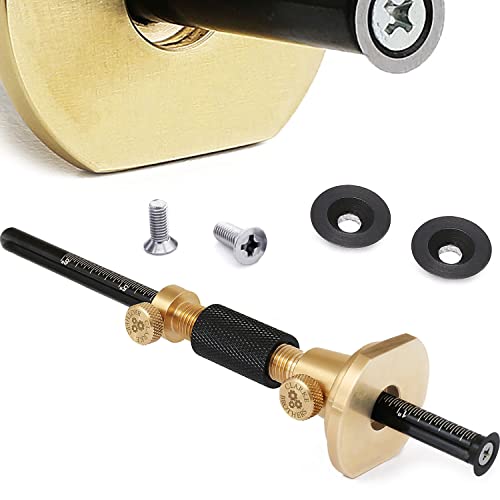
The Clarke Brothers Wheel Marking Gauge Kit earns the best overall position in this roundup by delivering the features that matter most in a marking gauge — a hardened steel wheel that severs fibres cleanly on both face and end grain, a micro-adjust mechanism for precise setting, a solid fence that registers consistently under marking pressure, and kit accessories that make it immediately useful across multiple gauge applications. For most woodworkers moving from a pin gauge to their first quality wheel gauge, this is the correct starting point: professional-grade performance without the premium pricing of the Woodpeckers alternative.

| Key Specifications | |
|---|---|
| Type | Wheel marking gauge |
| Beam Length | 7 inches |
| Wheel Type | Hardened steel — severs fibres cleanly |
| Adjustment | Micro-adjust mechanism |
| Fence Material | Solid hardwood |
| Kit Contents | Gauge + accessories for multiple applications |
| Best For | All parallel scribing — face grain and end grain |

What we like:
- The wheel severs fibres rather than displacing them — this is the fundamental advantage over pin gauges. A pin gauge drags a point through the wood surface. On face grain in softwood, this produces an acceptable scribed line. On end grain, on dense hardwood, or on any material with alternating hard and soft grain — the pin deflects toward the softer material rather than following the set line. The wheel rolls along the surface and severs fibres cleanly regardless of hardness variation across the grain. For woodworkers who have struggled with pin gauge lines that wander on end grain, the first use of a wheel gauge produces a visibly different result.
- Micro-adjust mechanism for fine-increment setting — the ability to make small corrections to gauge distance without resetting from scratch is the practical feature that separates quality marking gauges from budget alternatives. Setting a gauge to exactly the width of a specific chisel for mortise layout requires incremental adjustment; the micro-adjust wheel makes this accurate and repeatable.
- Kit format provides immediate versatility — the accessories extend the gauge’s applications beyond standard parallel scribing without requiring separate tool purchases.
- The 7-inch beam is the correct length for the majority of furniture and cabinet work — long enough for wide stock, compact enough for precise fence control.
What to know:
- As with all marking gauges, set and lock the fence firmly before marking — a fence that shifts mid-mark produces a drifting line that is worse than a pencil mark. Test the lock on scrap before committing to project material.
Best for: Most woodworkers upgrading from a pin gauge to their first wheel gauge — the best combination of performance, kit accessories, and value in this roundup.
→ Check Current Price on Amazon
2. Woodpeckers Marking Gauge — Best Premium Precision Marking Gauge
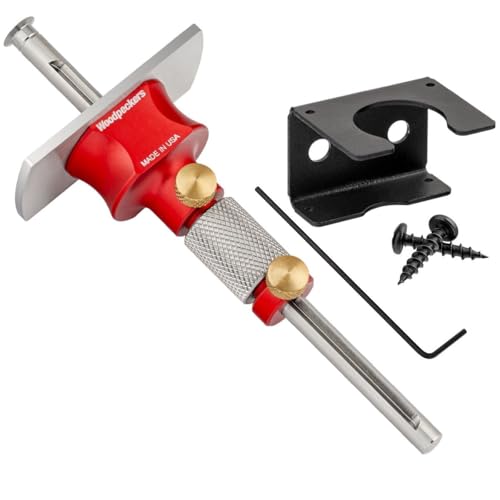
Woodpeckers is the American precision woodworking tool brand that professional furniture makers, instrument makers, and serious hobbyists reach for when they want the highest available accuracy in a marking tool. The Woodpeckers Marking Gauge applies CNC-machined aluminum construction, ultra-fine hardened wheel, and their signature precision tolerances to the marking gauge category. For a woodworker whose joinery requires consistent accuracy across dozens of parts on a production run — or whose standards demand the finest possible scribed line every time — the Woodpeckers is the investment that removes marking gauge variability from the equation entirely.

| Key Specifications | |
|---|---|
| Type | Wheel marking gauge — premium |
| Body Material | CNC-machined aluminum |
| Wheel | Ultra-fine hardened steel — finest line width |
| Precision | Production-grade consistency |
| Made In | USA — Woodpeckers precision standard |
| Best For | High-precision furniture, production joinery, instrument making |

What we like:
- CNC-machined aluminum construction maintains dimensional accuracy that wood-bodied gauges cannot match. A wooden beam gauge body can change fractionally with humidity — a 7-inch wooden beam expanding or contracting 0.1mm with seasonal humidity change means a marking gauge set on a dry winter day may produce a slightly different setting on a humid summer day. An aluminum body does not change with humidity. For production furniture work where a gauge must hold its setting across weeks of work on the same component run, this matters.
- Ultra-fine wheel diameter produces the narrowest possible scribed line — the goal of a marking gauge in precision joinery is to mark a line that has a single, unambiguous interpretation. The Woodpeckers’ fine wheel achieves this more completely than any other gauge in this roundup.
- Woodpeckers’ precision tolerance manufacturing standard is verified and trusted across the professional woodworking community — Fine Woodworking, The Wood Whisperer, and Rob Cosman have all used and referenced Woodpeckers tools as professional standards.
What to know:
- Premium price — the most expensive marking gauge in this roundup. Justified for professional furniture makers, production shops, and serious hobbyists who will use this tool daily for years. For occasional use, the Clarke Brothers kit delivers excellent wheel gauge performance at significantly lower cost.
Best for: Professional furniture makers, production joinery workshops, and serious hobbyists who want the highest precision available in a marking gauge and will use it daily.
→ Check Current Price on Amazon
3. Crown Tools Mortise Gauge — Best Traditional Mortise Gauge
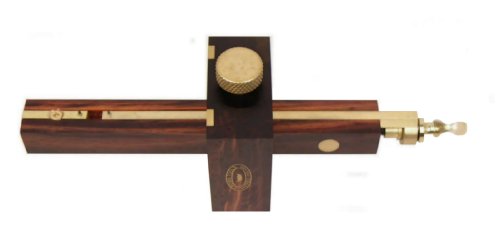
The Crown Tools Mortise Gauge addresses a specific layout requirement that a standard marking gauge — wheel or pin — fundamentally cannot: scribing two parallel lines simultaneously for mortise and tenon layout. This is not a feature difference. It is a functional difference. A standard gauge marks one line; a mortise gauge marks both sides of a mortise or tenon simultaneously, at exactly the set spacing, from the same fence reference. Crown Tools is a Sheffield-made hand-tool manufacturer with over 100 years of production history — this is a genuine traditional tool, not a budget import wearing a quality brand’s name.

| Key Specifications | |
|---|---|
| Type | Dual-pin mortise gauge |
| Pins | Two independently adjustable hardened steel pins |
| Fence Material | Rosewood — traditional premium material |
| Function | Scribes two parallel lines simultaneously |
| Made In | Sheffield, England — Crown Tools |
| Best For | Mortise and tenon layout, dovetail baseline |
What a mortise gauge does that a standard gauge cannot — explained:
A mortise gauge marks both sides of a mortise or tenon simultaneously. This matters for two reasons that no other approach replicates:
- Both lines are from the same fence reference. If you mark the first side of a mortise with a standard gauge, reposition, and mark the second side, you introduce the possibility of fence seating error between the two marks. With a mortise gauge, both lines are laid down in a single pass — there is no second positioning, no second source of error.
- You can set the pin spacing directly to your chisel width. Place the chisel between the two pins and set the gauge until the pins engage both faces of the chisel blade. The mortise will then be exactly as wide as the chisel that cuts it — no slopping, no need to measure the chisel and transfer that dimension to the gauge separately.
What we like:
- Rosewood fence is traditional and functional — the density and smooth finish of rosewood provides stable, consistent reference contact on both flat and slightly irregular edge profiles.
- Two independently adjustable pins rather than one fixed and one moveable — this allows the gauge to be set asymmetrically from a reference face, which is necessary when a mortise must be offset from the edge centre (as in haunched tenon joints).
- Sheffield manufacture — Crown Tools’ production quality shows in the pin hardness and the smoothness of the setting mechanism. These are not pins that will bend or dull after a season of use.
Critical technique note — always mark from the same face:
- The most common mortise gauge error: marking the mortise from one face and the tenon from the opposite face. Even a perfectly set gauge will produce a misaligned joint if the fence references opposite faces. Always mark both the mortise and the matching tenon with the gauge fence against the face-marked (reference) face of each component. This is the single most important mortise gauge technique rule.
Best for: Traditional hand-tool woodworkers, furniture makers doing mortise-and-tenon joinery, and anyone laying out dovetail baselines who wants the traditional dual-pin approach to matched scribing.
→ Check Current Price on Amazon
4. Narex 8105 10 Marking Knife — Best Value Professional Marking Knife
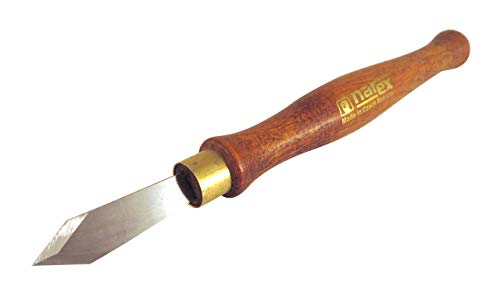
The Narex 8105 10 is the professional-standard marking knife at an accessible price point — the single most recommended marking knife in independent woodworking communities for the combination of O1 tool steel quality, sharpenable-to-a-mirror-edge blade geometry, flat back reference surface, and a handle that registers precisely against a combination square. If you own a pencil and are considering a marking knife for the first time, the Narex 8105 is the correct entry point: it outperforms craft knives, box cutters, and budget alternatives in every functional specification, and it is sharpenable to the same standard as professional instrument-making tools.

| Key Specifications | |
|---|---|
| Type | Single bevel marking knife — Western style |
| Blade Steel | O1 tool steel — sharpenable to high polish |
| Bevel Side | Right-hand (standard) |
| Flat Back | Yes — references against square and fence |
| Handle | Beech wood — shaped for finger registration |
| Made In | Czech Republic — Narex |

Why blade steel matters — O1 tool steel explained:
O1 is an oil-hardening tool steel with excellent edge-holding and, critically, the ability to be sharpened to a very high polish on standard waterstones. A marking knife’s most important performance characteristic is not the edge it arrives with — it is the edge it can hold after sharpening with basic sharpening equipment. O1 responds to basic 1,000–8,000 grit waterstone sharpening with an edge that shaves arm hair cleanly and produces a clean-severing knife mark in wood. Box cutters and craft knives use softer steel that cannot be brought to the same degree of sharpness — their marks are dragged rather than cut.
What we like:
- Flat back is the functional reference surface. The flat (unbevelled) side of a marking knife must be perfectly flat to register accurately against a combination square or marking gauge fence. The Narex flat back is ground flat from the factory — no lapping required before use. This is not universal among marking knives at this price point.
- O1 tool steel sharpenable on basic equipment — a 1,000-grit waterstone for the primary bevel, an 8,000-grit for the polished edge, and a leather strop for final alignment. No specialist equipment required.
- Handle geometry is shaped for a two-finger grip that keeps the blade indexed against a square without the knife walking during the stroke.
- At ~$25, the Narex 8105 represents the best price-to-performance ratio of any marking knife in this roundup — professional tool quality at a hobbyist-accessible price.
Left-handed user note:
- The Narex 8105 10 is a right-hand bevel knife — the bevel is on the right side, correct for right-handed woodworkers. Left-handed woodworkers should seek the Narex left-hand version (the 8105 11, sold separately) or consider the O’SKOOL double-bevel knife reviewed below which works in either direction.
Best for: Any woodworker who wants a professional-quality marking knife for joinery, furniture making, and knife wall technique — the best-value marking knife available in 2026.
→ Check Current Price on Amazon
5. O’SKOOL Marking Knife — Best Double-Bevel / Left-Handed Friendly Marking Knife
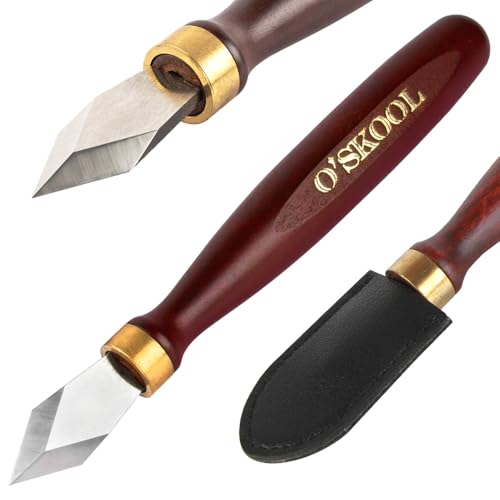
The O’SKOOL Marking Knife fills the specific slot that the Narex single-bevel cannot: a double-bevel striking knife that works equally well in either direction — making it the correct choice for left-handed woodworkers, for bidirectional marking where a single-bevel knife requires repositioning, and for beginners who are not yet certain which hand orientation their marking workflow will settle into. A double-bevel knife has a symmetrical cross-section — both sides are bevelled — which means the flat-side-against-the-fence reference technique of a single-bevel knife does not apply directly. The knife is instead used with the tip registered in the groove from the first pass, making subsequent passes in the same line rather than referencing against a square on every stroke.

| Key Specifications | |
|---|---|
| Type | Double-bevel marking / striking knife |
| Bevel | Symmetrical — works left or right |
| Handedness | Left-hand and right-hand compatible |
| Best Use | General woodworking layout, bidirectional marking |
| Handle | Hardwood — comfortable grip |

Single-bevel vs. double-bevel — the honest comparison:
A single-bevel marking knife (Narex 8105) is more accurate for initial line placement because the flat back references directly against a square face or rule edge — the knife tip arrives exactly at the square edge, not a fraction inside or outside it. A double-bevel knife arrives at a point that is the apex of both bevels — the initial placement requires more care to ensure the tip is exactly at the reference edge rather than slightly offset by the bevel geometry.
However, once a line is established, a double-bevel knife re-registers in the groove from the first pass — and in this mode the accuracy advantage of the single-bevel is eliminated because the groove itself is the reference. For woodworkers who make their initial line lightly and then deepen it in subsequent passes, the double-bevel technique produces equivalent results.
What we like:
- Works in both directions — no knife repositioning when marking lines from right to left (the direction that is awkward with a right-hand bevel knife).
- The correct choice for left-handed woodworkers who cannot easily source a purpose-made left-hand bevel knife.
- Accessible price point — an affordable alternative or companion to the Narex for beginners building their first marking tool kit.
Best for: Left-handed woodworkers, beginners learning marking knife technique, and woodworkers who mark frequently in both directions and want a single knife that handles both without repositioning.
→ Check Current Price on Amazon
6. Shinwa Combination Square — Best Precision Combination Square
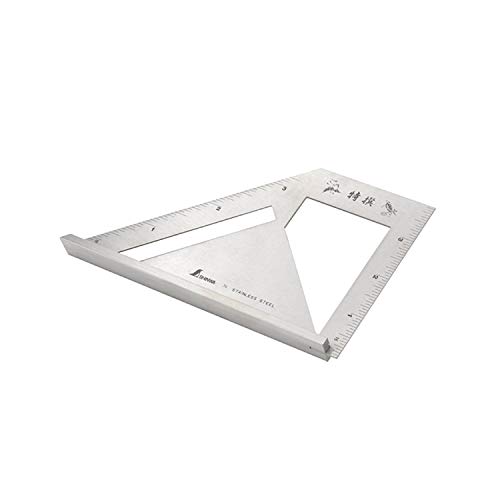
The Shinwa Combination Square is the professional precision standard for woodworking layout — the square that professional furniture makers and cabinetmakers in Japan and internationally use as their primary layout reference. Shinwa’s manufacturing tolerance produces squares accurate to within tolerances that exceed what most woodworking joinery requires, and their etched graduations (not printed, not adhesive labels) remain readable and accurate through years of workshop use. For a woodworker whose work depends on a reliable, consistent right angle at every layout step, the Shinwa is the reference tool that professional endorsements across Fine Woodworking, Stumpy Nubs, and Japanese woodworking communities converge on.

| Key Specifications | |
|---|---|
| Type | Combination square — 90°/45° |
| Blade | Hardened steel — etched graduations |
| Head | Cast iron — 90° and 45° reference faces |
| Accuracy | Professional tolerance — verified by independent testing |
| Graduation Type | Etched — permanent, not printed or adhesive |
| Spirit Level | Integrated in head |
| Made In | Japan — Shinwa precision standard |

What a combination square does that a try square cannot:
A fixed try square checks and marks 90°. A combination square checks 90° and 45° simultaneously, transfers measurements (extend the blade to a set dimension and use the blade tip as a marking reference), functions as a depth gauge for stopped mortises and rebates, and — with a spirit level in the head — provides horizontal and vertical reference. The sliding blade unlocks the combination square as a measurement transfer tool: set the blade tip to a specific distance from the head, lock, and mark from the blade tip on multiple components identically. This function alone makes a combination square more versatile than a fixed try square for furniture work.
What we like:
- Etched graduations do not wear off or peel. Printed graduations on budget squares wear away with use and cleaning — the scale becomes illegible within a year of regular workshop use. Shinwa’s etched graduations are permanent: the scale is in the steel, not on it.
- Cast iron head maintains its reference faces accurately — cast iron is dimensionally stable and does not distort under workshop temperature and humidity variation.
- 45° face on the head is accurate to the same tolerance as the 90° — on a budget combination square, the 45° face is frequently less accurate than the 90°. On the Shinwa, both faces are held to the same manufacturing tolerance.
How to verify your combination square’s accuracy:
- Mark a line against the square on a flat board surface. Flip the square end-for-end (same face, reversed direction) and check whether the blade aligns with the original mark. Any gap means the square is out of 90° by half the gap amount. A quality Shinwa will show no visible gap on this test.
Best for: Any woodworker who wants the most versatile, precision layout tool in their marking kit — the single best upgrade from a basic try square for furniture and cabinet work.
→ Check Current Price on Amazon
7. Empire E3992 12-Inch Aluminum Hi-Vis Rafter Square — Best Site and DIY Layout Square
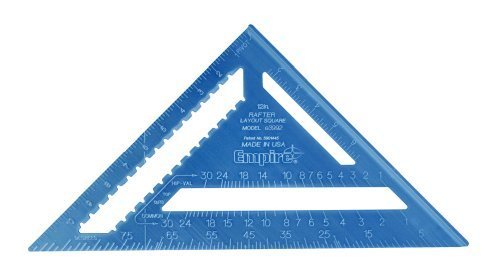
The Empire E3992 occupies the practical DIY and site work square position in this roundup — a 12-inch aluminum rafter square with high-visibility markings for fast layout on lumber, sheet goods, and framing members. The rafter/speed square format provides an extended 12-inch reference edge that handles wider stock than a 7-inch speed square, and the Hi-Vis markings are large enough to read quickly without stopping to look closely — the practical advantage for site work or workshop projects where pace matters more than the micrometer accuracy of a Shinwa combination square.
| Key Specifications | |
|---|---|
| Type | Aluminum rafter/layout square |
| Size | 12 inches |
| Material | Aluminum — lightweight, rust-free |
| Markings | Hi-Vis — large, easy-read graduations |
| Features | Rafter tables, degree markings, scribe notch |
| Best For | Site work, carpentry, DIY layout, sheet goods |
What we like:
- 12-inch reference edge handles wider lumber. A 7-inch speed square cannot fully contact the face of a 2×10 or 2×12 framing member — the reference edge is shorter than the board face. The 12-inch Empire square contacts the full face of standard dimensional lumber, making it the correct square for framing and structural layout work.
- Hi-Vis markings are large enough to read at a quick glance during active layout — on a construction site or in a busy workshop, not having to stop and squint at fine graduations saves time across a full day of marking.
- Aluminum construction is lighter than cast iron and immune to rust — for site work where tools get wet and are transported between locations, this is a practical advantage over precision steel squares.
What to know:
- The Empire rafter square is a layout and framing square — not the precision reference for fine furniture joinery. For furniture-grade 90° checking and marking, the Shinwa Combination Square is the correct tool. The Empire is the correct tool for carpentry, construction, and general DIY work where precision requirements are less stringent.
Best for: Carpentry, construction site layout, DIY home improvement, and any work where a large, fast-reading square on wider lumber matters more than fine-tolerance accuracy.
→ Check Current Price on Amazon
8. Swanson Speed Square Pro 7-Inch — Best Speed Square for Site and Workshop
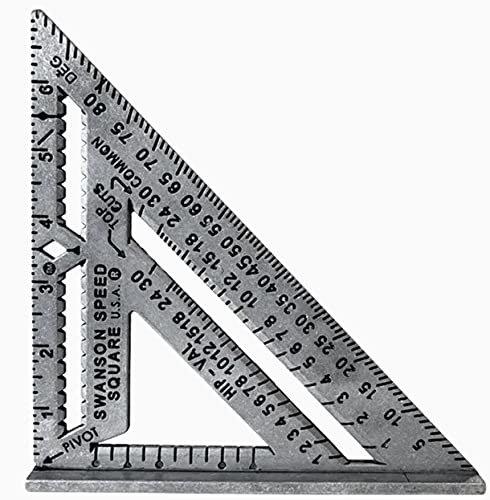
The Swanson Speed Square is the original patented speed square — the triangular layout square that Swanson invented in 1925 and that has been the standard framing and carpentry layout tool ever since. The 7-inch Pro version provides degree markings around the hypotenuse for fast bevel and rafter angle layout, a fence lip for riding against board edges, and the compact triangular format that fits in an apron pocket and deploys instantly for marking and guiding circular saw cuts. It is the bridge tool between construction and woodworking — equally at home on a framing site and in a shop for bevel cuts and angle transfer.

| Key Specifications | |
|---|---|
| Type | Speed square / triangular layout square |
| Size | 7 inches |
| Degree Markings | 0–90° on hypotenuse for bevel layout |
| Fence Lip | Yes — rides against board edge |
| Material | Aluminum alloy |
| Special Feature | Common rafter tables on body |

What we like:
- Degree markings for bevel angle layout — set any angle from 0 to 90° by reading directly off the hypotenuse while the fence lip holds the square against the board edge. For marking rafter cuts, bevel cuts on trim, and chamfer angles, the speed square provides this function faster than a protractor or T-bevel for standard degree angles.
- The fence lip allows the speed square to serve as a circular saw guide — place the fence against the board edge and run the saw base plate along the square body for a guided straight cross-cut or angled cut. This is a function no combination square or T-bevel provides.
- Compact and apron-pocket portable — the 7-inch format fits in a tool belt pocket and is accessible in seconds, which is why it became the standard pocket square for framing carpenters.
Best for: Framing, carpentry, site work, and workshop bevel cuts — the tool that sits in the apron pocket for fast 90° and degree-angle marking across a full day of varied work.
→ Check Current Price on Amazon
9. General Tools Digital T-Bevel Gauge & Protractor with 8″ Blade — Best Angle Transfer Tool

The General Tools Digital T-Bevel is the angle transfer tool that no speed square or combination square replaces — and the digital display is the upgrade that traditional T-bevels cannot provide. A T-bevel is the only tool that sets to an arbitrary angle and holds it for transfer to another surface: correct for dovetail ratios, compound bevel setups, copying angles from existing joints, and any layout task where the angle is not a standard 0°, 45°, or 90° that a fixed square provides. The digital version displays the set angle on an LCD readout — confirming the exact degree value without estimation or calculator conversion from a ratio.

| Key Specifications | |
|---|---|
| Type | Digital sliding T-bevel with protractor |
| Blade Length | 8 inches |
| Display | Full LCD — reads angle to 0.1° |
| Range | 0–360° — full protractor capability |
| Lock | Blade locking mechanism to hold set angle |
| Best For | Dovetail angle setting, compound bevel, angle copying |

Why the digital display matters for dovetail layout specifically:
Traditional dovetail layout uses ratios — 1:6 for hardwood, 1:8 for softwood. Converting a ratio to a degree angle requires a calculator (arctan(1/6) = 9.46°). A traditional T-bevel set from a printed ratio diagram involves visual estimation. The General Tools digital T-bevel reads the set angle directly — set it to 9.5° for hardwood dovetails, confirm on the LCD display, lock, and mark. No conversion, no estimation, no printed diagram needed.
What we like:
- Digital LCD reads to 0.1° — more precise than visual reading of a traditional protractor head.
- Full 360° range — not just a 0–90° protractor but a full-range angle gauge that handles compound bevels, odd-angle returns, and custom geometry layout.
- 8-inch blade is long enough to mark across the full width of most furniture components — a 4-inch traditional T-bevel blade is too short for marking dovetail angles across wide tail boards.
- Functions as both a T-bevel (slide the blade to any angle, lock, transfer) and a protractor (place the body flat on a surface, read the angle of any existing surface or bevel).
Best for: Dovetail angle layout, compound bevel work, copying angles from existing joints, and any woodworking task where the angle is irregular and must be precisely set and transferred.
→ Check Current Price on Amazon
10. DIXON Industrial Carpenter Pencils — Best Carpenter Pencil for Site and Rough Layout
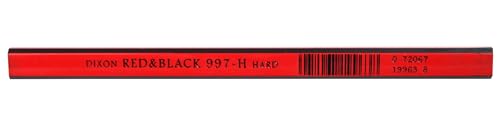
The DIXON carpenter pencil is the correct rough layout tool for site work, framing marks, sheet goods cut lines, and any marking task where a knife line is not required and where the marking surface is too rough or too porous for a mechanical pencil to work effectively. The flat rectangular cross-section of a carpenter pencil is not accidental — it serves a specific purpose. The flat profile sits stable on a timber face without rolling off. It can be sharpened with a blade or knife to a chisel tip — the flat edge of the chisel tip produces a slightly tighter line than a rounded tip would from the same graphite hardness. DIXON’s industrial grade means harder casing that resists snapping during the sharpening process that breaks cheaper carpenter pencils.

| Key Specifications | |
|---|---|
| Type | Flat-section carpenter pencil — industrial grade |
| Cross-Section | Flat rectangular — stable on surfaces, sharpenable to chisel tip |
| Graphite | Wide flat graphite core — visible on rough lumber |
| Casing | Hardwood — resists splitting during sharpening |
| Pack Size | Industrial multi-pack — genuine consumable |
| Best For | Framing, rough lumber, sheet goods, site work |

The right way to sharpen a carpenter pencil — the chisel tip technique:
Use a blade (utility knife or marking knife) to whittle the wood casing from one flat face only — do not sharpen from all sides as you would a round pencil. This exposes the flat graphite core from one direction, creating a chisel edge rather than a point. The chisel edge has two advantages: it produces a slightly tighter line on the flat face than a rounded point would from the same graphite, and it can be oriented edge-on to the marking direction to maximise the line’s tightness for the last few passes before switching to a knife.
What we like:
- Industrial grade casing — softer casing on budget carpenter pencils splits when the blade tip reaches the graphite during sharpening. The DIXON casing sharpens cleanly across the full sharpening stroke.
- Wide graphite core produces a line visible on rough pressure-treated lumber, CCA timber, and OSB where fine pencil marks are invisible.
- Multi-pack at commodity pricing — carpenter pencils are true consumables. Buying in bulk is the correct approach; running out mid-project is the avoidable alternative.
Best for: Framing layout, rough lumber marking, sheet goods cut lines, site work — any marking task where rough visibility matters more than fine precision.
→ Check Current Price on Amazon
11. Staedtler Mars Technico Clutch Pencil 2mm — Best Precision Marking Pencil
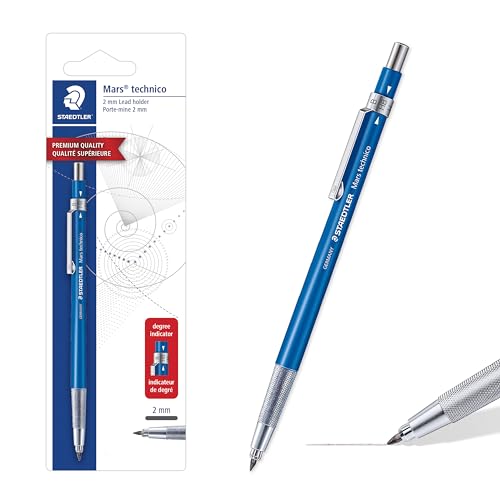
The Staedtler Mars Technico is the precision pencil that bridges the gap between the rough carpenter pencil and the marking knife — a 2mm clutch pencil with an integrated cap sharpener that produces a fine, consistent point for marking tasks where a knife line is impractical but a carpenter pencil is too coarse. For curved layout lines (template tracing, compass arcs, irregular profile marking), the marking knife cannot follow complex curves cleanly. The Staedtler’s sharpenable 2mm lead at a fine point follows curves correctly while producing a line meaningfully tighter than any standard pencil. For MDF and veneered plywood surfaces where knife lines are difficult to see, the Staedtler produces a clean, visible reference mark.
| Key Specifications | |
|---|---|
| Type | Clutch pencil — 2mm lead |
| Lead Diameter | 2mm — sharpenable to fine point |
| Integrated Sharpener | Yes — in cap |
| Best For | Curved layout, template tracing, MDF marking |
| Lead Grade | HB standard (replaceable with H for finer lines) |

What we like:
- The clutch format holds a 2mm lead — standard mechanical pencil leads are 0.5mm or 0.7mm and snap under the lateral pressure of marking against a template edge. The 2mm lead in a clutch holder survives template edge marking without breaking.
- Integrated cap sharpener maintains the point without requiring a separate pencil sharpener on the bench — the cap pulls off, lead inserts into the sharpener cone, and a sharp point is restored in seconds.
- For MDF marking specifically: marking knives leave no visible mark on MDF because the randomly-oriented surface fibres do not take a clean groove. A fine 2mm clutch pencil produces a visible, reasonably tight reference line that knife marking cannot achieve on this material.
Best for: Curved line marking, template tracing, MDF and plywood surface marking, and any precision pencil work where the carpenter pencil is too coarse and a knife is impractical.
→ Check Current Price on Amazon
12. Stanley 69-122 6-1/16-Inch Wood Handle Scratch Awl — Best Marking Awl
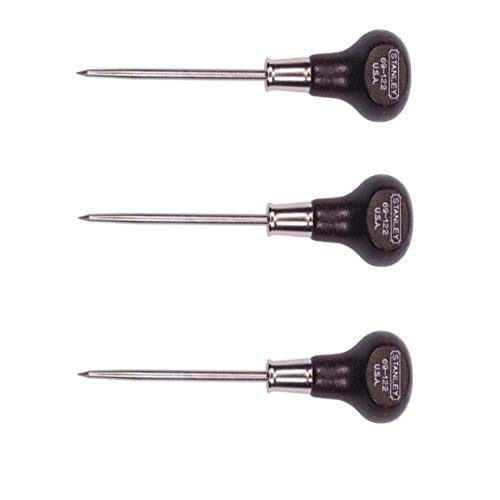
The Stanley 69-122 Scratch Awl is the point-registration tool that prevents the two most common starting errors in drilling and layout: drill bit wander at the start of a hole, and compass leg slipping off a marked centre point. A drill bit placed on a flat wood surface does not start cleanly — the rotating tip wanders across the surface until it finds a grain depression deep enough to register. An awl point placed first creates a positive registration point: a small conical depression that the drill bit’s centre point drops into and stays in. On end grain this function is even more important because end grain surface structure provides no natural registration for a drill tip.

| Key Specifications | |
|---|---|
| Type | Scratch awl |
| Length | 6-1/16 inches overall |
| Handle | Wood — comfortable grip for point pressure |
| Point | Hardened steel — maintains point sharpness |
| Best For | Drill start registration, layout centre points, end grain marking |
What we like:
- The wood handle provides comfortable palm pressure for the firm point-set that creates a registration depression — the awl must be pressed firmly enough to create a depression the drill tip can seat in, not just touched to the surface. The wood handle’s rounded palm contact transfers this force comfortably for repeated use across a layout session.
- Hardened steel point maintains its sharpness through the hard end-grain work that blunts softer points quickly. End grain is the most demanding surface for an awl because the fibres are cut across rather than split along the grain direction.
- The awl’s registration point also serves as a compass leg receptor — when scribing circles with a marking gauge beam compass, the awl point placed first gives the compass leg a precise, stable centre to pivot from without slipping.
What we like:
- Stanley’s long-term brand reliability applies here — the 69-122 has been in continuous production across years with consistent quality. For a tool that costs under $10, it performs the registration function completely and reliably.
Best for: Drill bit centre-point registration, compass pivot points, end grain layout marks, and any marking task where a precise indented point is needed rather than a line.
→ Check Current Price on Amazon
Marking Gauges Deep Dive — Wheel vs. Pin vs. Cutting vs. Mortise
The marking gauge category has more technical nuance than any other tool in this guide — and competitors consistently undersell or misrepresent the differences. Here is the full honest comparison.
Pin Gauges
A sharp steel pin drags through the wood surface, displacing and separating fibres to create a scribed line. On face grain in softwood and medium-density hardwood, this produces an acceptable line — the fibres are soft enough that the pin separates them cleanly. The limitation becomes clear on end grain: as the pin crosses alternating hard (late wood) and soft (early wood) annual rings on end grain, it deflects toward the softer ring rather than cutting straight across both. The result is a line that wanders slightly across the ring boundaries — a deviation that is small but visible on finished furniture parts. Pin gauges are also more prone to following grain lines on highly figured or interlocked-grain woods.
Wheel Gauges
A hardened steel wheel rolls along the wood surface, severing fibres cleanly as it goes rather than displacing them. On end grain, the wheel rolls across the hard and soft ring boundaries without deflecting — the severing action is perpendicular to the surface regardless of surface hardness variation. On face grain with interlocked or irregular grain patterns, the wheel cuts rather than follows, producing consistent lines on material that defeats pin gauges. The wheel gauge is the professional standard for good reason — it simply produces more consistent results across the full range of wood species, grain orientations, and hardness levels that furniture makers encounter.
Cutting Gauges
A small knife blade oriented across the grain severs a defined groove on the first pass — the blade is wide enough to sever a complete groove cleanly rather than a single scribed line. Most useful for inlay work where the gauge must define both the depth and the width of a stringing channel simultaneously, and for cross-grain marking where a clean, defined groove is the requirement rather than a scribed reference line. Less common in general furniture work but indispensable for inlay and marquetry.
Mortise Gauge — Setting It Correctly
Setting a mortise gauge to exactly the width of a chisel is the correct technique — and most guides do not explain it clearly. Here is the exact procedure:
- Place the chisel between the two pins, flat face of the chisel toward the fence
- Adjust the moveable pin until both pins engage the faces of the chisel with zero play
- Lock the pin setting
- Set the fence distance from the outer pin to position the mortise correctly on the workpiece edge
- Test on scrap — confirm the marked width matches the chisel exactly before marking project material
- Mark mortise and tenon from the same reference face on both components
Combination Squares in Depth — The Most Versatile Layout Tool
The combination square deserves its own section because it is the most functionally versatile marking tool in a woodworking kit — and most users underutilise it by treating it only as a 90° checking tool.
Functions Most Users Miss
Measurement transfer: Extend the blade to any dimension and lock. The blade tip is now a precise distance gauge — set from the head face to the blade tip. Run the head face against a reference edge and mark from the blade tip on multiple components to transfer the same dimension repeatedly and identically without remeasuring each time.
Depth gauge for stopped work: Set the blade to the required depth. Drop the blade tip into a mortise, hole, or rebate and read whether the head face is level with the work surface — if it is, the depth is correct. This function eliminates the need for a separate depth gauge for the majority of furniture work.
The 45° face: The opposite face of the combination square head provides a 45° reference for marking mitre cuts and checking mitre joint angles on assembled pieces. Verify the 45° face against a known mitre before using it for precision work — budget combination squares frequently have less accurate 45° faces than 90° faces.
Combination Square Accuracy Verification
Verify your combination square before relying on it for precision joinery — even premium squares can be slightly off from new or can go out over time:
- Mark a line across a flat, planed board with the square head against the face edge
- Flip the square end-for-end (reverse the direction of the head on the same edge, same face)
- Check whether the blade aligns with the original line
- Any gap between the blade and the original line means the square is out of 90° by half the visible gap
A Shinwa combination square will pass this test with no visible gap. If yours fails, either return it or adjust your marking technique to compensate for the known error until a replacement is available.
The Dovetail Layout System — A Complete Marking Workflow
Dovetail joinery is the most demanding marking application in furniture making — and the joint that most clearly demonstrates why a complete marking toolkit matters. Each step of the dovetail layout sequence uses a specific tool from this guide, in order.
Why Dovetails Are the Most Demanding Marking Application
A dovetail joint has zero adjustability during assembly — unlike a mortise and tenon that can be shimmed, or a biscuit joint that has some lateral float, a mismarked dovetail either fits or it does not. Every marking error is amplified into the joint. The sawing follows the knife lines: if the knife lines are accurate, the joint closes. If they are not, the joint either gaps or cannot assemble.
The Complete Dovetail Marking Sequence
- Baseline — Combination Square + Marking Knife: Mark the baseline (the full depth of the joint) across all four faces of the tail board using the combination square and marking knife. The blade length is set to the thickness of the pin board. This is the line below which all saw cuts must stop — the most important reference line in the whole joint.
- Tail angle — Digital T-Bevel + Marking Knife: Set the General Tools digital T-bevel to the correct dovetail ratio: 9.5° (1:6) for hardwood, 7.1° (1:8) for softwood. Mark the tail lines from the baseline using the knife against the T-bevel edge. Work from the face side of the board — all tail lines are marked on the same face.
- Half-pin width — Marking Gauge: Set the wheel marking gauge to approximately one-third the tail board thickness. Scribe from each end of the board at the baseline to define the half-pin width.
- Transfer to pin board — Marking Knife: Hold the completed tail board end-grain-face-to-face against the pin board’s end grain. Scribe around the tail profiles with the Narex marking knife held exactly vertical. This transfer step requires the knife to be genuinely vertical — any lean introduces error in the pin spacing.
- Knife walls at baseline — Marking Knife + Chisel: Before sawing, establish knife walls at all baseline marks on both tail and pin boards. Pare a small chip from the waste side of each baseline. The saw registers against this wall for all shoulder cuts.
Dovetail Ratio Reference
| Ratio | Angle | Best For | Notes |
|---|---|---|---|
| 1:5 | 11.3° | Dense exotic hardwoods | Steep — very strong but visually prominent |
| 1:6 | 9.5° | Standard hardwood (oak, walnut, cherry) | Professional standard for furniture hardwoods |
| 1:7 | 8.1° | Mixed hardwood and softwood | Good general-purpose ratio |
| 1:8 | 7.1° | Softwood (pine, cedar, spruce) | Traditional English softwood ratio — prevents short grain breakout |
Material-Specific Marking Guidance
Hardwoods — Oak, Maple, Cherry, Walnut
Marking knives perform best in hardwoods — the dense fibres take a clean severed groove that holds its edges clearly. Wheel gauge preferred over pin gauge — hardwood’s alternating dense and lighter growth rings cause pin deflection that the wheel eliminates. Sharpen the marking knife to 25° bevel for hardwood — the density supports a fine edge without rolling. Knife wall technique is especially important on hard maple — the wood is so dense that an unsupported saw line will deflect at the first encounter with a hard ring.
Softwoods — Pine, Cedar, Spruce
Softwood requires slightly more care with the marking knife — the very soft early wood (springwood) tears easily between the harder late wood rings. Score the early wood rings first with a very light knife stroke before committing to the full-depth line. Use the 1:8 dovetail ratio for softwood to prevent short grain breakout at the pin tips. Pin gauges are acceptable on softwood face grain — the fibres are soft enough to displace cleanly without the ring-boundary deflection that affects hardwoods.
Plywood and Sheet Goods
Carpenter pencil is the primary marking tool for cut lines on sheet goods — knife marks are invisible on veneered plywood faces, and precision joinery technique is not required for machine cuts. For router template work, a marking knife around template edges on the face veneer severs the top ply and defines a crisp limit line before routing — preventing veneer tearout at the router bit’s exit point.
MDF
Marking knife is ineffective on MDF — the randomly-oriented wood fibres provide no grain structure for a clean knife groove. Use the Staedtler Mars Technico or a fine mechanical pencil for reference marks. Router and CNC work on MDF uses measured layout lines as references rather than knife-registered lines.
Left-Handed Woodworker Guidance
This is the section absent from every competing marking tool guide — left-handed woodworkers face genuine challenges with asymmetric marking tools that right-hand-dominant reviews do not address.
The Single-Bevel Marking Knife Problem
Standard Western marking knives (including the Narex 8105 10 reviewed above) have a single bevel on the right side — correct for right-handed woodworkers making cuts from left to right with the flat back registered against the square. A left-handed woodworker using the same knife marks from right to left — with the bevel on the wrong side. The bevel is now between the knife tip and the square face rather than away from it, which means the knife is lifting away from the reference rather than registering against it. The resulting line is less accurate and less consistent than a right-handed user’s line with the same knife.
Solutions for Left-Handed Woodworkers
- Use a double-bevel knife: The O’SKOOL Marking Knife in this roundup is double-bevel — symmetrical, works in either direction. The slight sacrifice in initial line placement accuracy vs. a single-bevel is eliminated once the groove is established. This is the most practical solution for most left-handed woodworkers.
- Purchase a left-hand bevel version: Narex offers the 8105 11 — the mirror-image left-hand bevel version of the 8105 10. Same steel, same geometry, left-hand orientation.
- Learn to use the right-hand knife from the opposite direction: Some left-handed woodworkers become proficient with a right-hand bevel knife by holding it differently — keeping the flat back registered on the square while approaching the cut from the opposite direction. This requires practice but results in the use of the same professional knife without sourcing a specialty version.
Frequently Asked Questions — Marking Tools for Woodworking
What is the best marking tool for woodworking?
For precision joinery: a quality wheel marking gauge (Clarke Brothers or Woodpeckers) plus a sharp marking knife (Narex 8105 10) covers the majority of furniture and cabinet marking requirements. These two tools — a wheel gauge for parallel lines and a marking knife for cross-grain shoulder and joinery lines — are the foundation of any serious hand-tool woodworking toolkit. A combination square (Shinwa) provides the 90° reference that both tools need to work from. These three tools together address 80% of woodworking layout tasks.
What is the difference between a marking gauge and a mortise gauge?
A marking gauge marks one line at a set distance from an edge or face — the standard parallel scribing tool. A mortise gauge marks two parallel lines simultaneously at a set spacing — specifically designed for mortise and tenon layout where both sides of the joint must be marked from the same face reference in a single pass. A mortise gauge can also be used as a standard single-line gauge by using only one pin. The Crown Tools Mortise Gauge in this guide can do both; the Clarke Brothers and Woodpeckers wheel gauges mark only one line.
Should I use a pencil or marking knife for woodworking?
Use a pencil for rough layout, dimension references, part identification, and any mark that is a guide rather than a cut line. Use a marking knife for any mark that defines where a saw, chisel, or plane will stop — shoulder lines, gauge lines for joinery depth, dovetail angle lines, and any cross-grain line that will define a finished surface. The rule is simple: if a cutting tool must follow that line precisely, use a knife. If the mark is for visual reference only, a pencil is correct.
What is a knife wall and how do I make one?
A knife wall is a small vertical face cut into the wood at the exact marked line, used to guide and register saw cuts in precision joinery. To make one: mark the line with a sharp marking knife. Place a wide chisel with the flat side facing the waste material, edge sitting in the knife groove. Tap the chisel lightly to pare a small triangular chip from the waste side of the groove. This creates a vertical wall on the keeper side of the line — a physical guide that a saw blade registers against, preventing lateral drift and eliminating tear-out at the exit face of the cut.
What marking gauge do professional woodworkers use?
Wheel gauges — specifically the Veritas Wheel Marking Gauge and Woodpeckers Marking Gauge — are the two most commonly cited professional recommendations across independent woodworking communities including Fine Woodworking, Rob Cosman, Paul Sellers, and The Wood Whisperer. Both use a hardened steel wheel that severs fibres cleanly on face grain and end grain without the ring-boundary deflection of pin gauges. The Woodpeckers is the premium US-made choice; the Veritas is the premium Canadian-made choice; the Clarke Brothers kit in this guide is the best-value wheel gauge option for most woodworkers.
How do I set a marking gauge accurately?
For distance from edge: hold the fence against the edge, tap the beam to the approximate position, lock lightly. Place the gauge against a steel rule or digital caliper to verify the exact distance from fence to wheel. Make micro-adjustments, verify again, then lock firmly. Test on scrap — confirm the scribed line is exactly at the intended distance. For a mortise gauge set to chisel width: place the chisel between the pins, set until both pins engage the chisel faces without play, lock the pin setting, then set the fence distance separately.
What is the best dovetail angle for hardwood?
1:6 ratio — approximately 9.5 degrees — is the professional standard for furniture hardwoods including oak, walnut, cherry, maple, and ash. This ratio provides the mechanical interlock of the dovetail profile without producing the short grain at the pin tips that steeper angles cause. For softwoods (pine, cedar, spruce), use 1:8 (approximately 7.1 degrees) to prevent short grain breakout. Set the General Tools Digital T-Bevel to the specific degree value and confirm on the LCD display before marking — this eliminates the ratio-to-angle conversion error that affects traditional T-bevel setup from printed diagrams.
Can I use a box cutter or craft knife instead of a marking knife?
For occasional rough layout — yes, a craft knife produces a knife line. For precision joinery that requires a consistent, registrable knife wall — no. Box cutters and craft knives use softer steel that cannot be sharpened to the same edge quality as O1 tool steel. Their flat back is frequently not flat enough to register accurately against a square face. And the blade width of a snap-off blade changes every time a segment is broken — introducing inconsistency in how the knife registers against a square. A dedicated marking knife (Narex 8105 at ~$25) is a one-time purchase that outperforms craft knives in every relevant specification.
What is the difference between a wheel gauge and a pin gauge?
A pin gauge drags a hardened point through the wood surface, displacing fibres to create a groove. A wheel gauge rolls a hardened steel wheel along the surface, severing fibres cleanly. On face grain in softwood the difference is subtle. On end grain, on dense hardwood, or on figured or interlocked grain, the difference is significant: the pin deflects toward softer material and can follow grain rather than following the set line. The wheel severs regardless of hardness variation. Wheel gauges produce more consistent lines across the full range of materials and grain orientations a furniture maker works with.
Why does my combination square give inaccurate results?
Three common causes: the square is genuinely out of 90° (verify using the flip test described in the combination square section above), the blade is not fully locked before marking (the blade can creep if the lock knob is only partially tightened — tighten firmly before every use), or the head is rocking on the board surface because there is debris between the head face and the board (clean both surfaces before marking). If the flip test confirms the square is out of 90°, the square needs adjustment or replacement. A premium square like the Shinwa should not go out of 90° under normal use — if it has, it has been dropped or stressed beyond its calibration tolerance.
What is the complete beginner marking toolkit for hand-tool woodworking?
The minimum useful kit: a wheel marking gauge (Clarke Brothers), a marking knife (Narex 8105 10), and a combination square (Shinwa). These three tools cover the fundamental layout tasks of furniture making — parallel scribing, cross-grain shoulder lines, and 90°/45° angle reference. Add a digital T-bevel (General Tools) for dovetail layout and a scratch awl (Stanley 69-122) for drill registration when the scope of work expands to include angled joinery. The carpenter pencil (DIXON) and clutch pencil (Staedtler) are supplementary marking tools that complete the kit for both rough and precision pencil work.
Final Verdict — Best Marking Tools for Woodworking by User Type
Use the table below to find your best match and check the current Amazon price directly.
| Best For | Our Pick | Key Reason | Buy on Amazon |
|---|---|---|---|
| Best Overall Marking Gauge | Clarke Brothers Wheel Marking Gauge Kit | Wheel gauge performance, micro-adjust, kit accessories — best all-round value | Buy Now → |
| Best Premium Marking Gauge | Woodpeckers Marking Gauge | CNC aluminum, ultra-fine wheel, US-made precision standard for production work | Buy Now → |
| Best Mortise Gauge | Crown Tools Mortise Gauge | Dual independent pins, rosewood fence, Sheffield made — simultaneous mortise scribing | Buy Now → |
| Best Marking Knife (Value) | Narex 8105 10 | O1 tool steel, flat back reference, sharpenable to mirror edge — professional standard at $25 | Buy Now → |
| Best Knife for Left-Handed / Both Directions | O’SKOOL Marking Knife | Double-bevel — left and right hand compatible, no repositioning | Buy Now → |
| Best Combination Square | Shinwa Combination Square | Japanese precision tolerance, etched graduations, 90°/45°, depth gauge — professional reference | Buy Now → |
| Best Site / DIY Square | Empire E3992 12″ Aluminum Square | 12″ edge for wide lumber, Hi-Vis markings, lightweight aluminum — carpentry and DIY | Buy Now → |
| Best Speed Square | Swanson Speed Square Pro 7″ | Degree markings, fence lip for saw guide, pocket-portable — framing and site work | Buy Now → |
| Best Angle Transfer Tool | General Tools Digital T-Bevel | LCD angle readout to 0.1°, 8″ blade, full 360° range — dovetail angles and bevel transfer | Buy Now → |
| Best Carpenter Pencil | DIXON Industrial Carpenter Pencils | Hard casing, flat section, chisel-tip sharpenable — framing and rough layout | Buy Now → |
| Best Precision Pencil | Staedtler Mars Technico | 2mm clutch lead, integrated sharpener — curved layout, template tracing, MDF marking | Buy Now → |
| Best Marking Awl | Stanley 69-122 Scratch Awl | Drill start registration, wood handle, hardened point — the missing tool in most beginner kits | Buy Now → |
The single most impactful upgrade for most woodworkers — the one that produces the most immediate, visible improvement in joinery quality — is switching from a pin gauge to a wheel gauge. If you currently own a pin marking gauge and have struggled with inconsistent lines on end grain or interlocked hardwoods, the Clarke Brothers Wheel Marking Gauge Kit is the place to start. Add the Narex 8105 marking knife and learn the knife wall technique, and you will have the two tools that define precision hand-tool joinery at a combined cost under $100.