

Pocket hole joinery is one of the best-kept secrets in woodworking. In the time it takes to explain a mortise-and-tenon joint, you can cut a dozen pocket holes and have a face frame clamped and assembled. No complex layout, no special chisels, no long glue-up wait – just a jig, a step bit, and a self-tapping screw that pulls two boards together with a mechanical grip that would take traditional joinery skills years to match in speed.
But not all pocket hole jigs are equal, and choosing the wrong one can mean loose joints, inconsistent pocket depth, or a drill guide that wears out halfway through your first cabinet build. The difference between a $25 budget jig and a $150 production jig is real — and so is the difference between a jig optimized for narrow face frame stiles, one designed for ¾-inch plywood cabinet boxes, and one built specifically for 2×4 framing lumber.
This guide covers 10 of the best pocket hole jigs – from Kreg’s entry-level R3 to the heavy-duty HD for thick stock, quality alternatives like the Massca M2 and Trend dual-column jig, and even a premium dowelling jig for woodworkers who want a stronger mechanical joint for fine furniture work. Whatever your project, your material thickness, or your budget, there’s a right tool on this list.

Quick Comparison: Best Pocket Hole Jigs (2026)
| Product | Thickness Range | Guide Holes | Clamp Type | Face Plug | Best For |
|---|---|---|---|---|---|
| Kreg R3 | ½″–1½″ | Single | Separate clamp | No | Best Overall / Portable |
| Kreg 720PRO | ½″–1½″ | Dual | GripMaxx integrated | Yes | Best for Production |
| Kreg 520PRO | ½″–1½″ | Single/Dual | VersaGrip integrated | No | Best Mid-Range |
| Kreg HD Heavy Duty | 1½″–3½″ | Dual | Integrated toggle | No | Best for Thick Stock |
| Massca Pro M2 | ½″–1½″ | Dual | Magnetic clamp compatible | No | Best Kreg Alternative |
| WEN WA1527 | ½″–1½″ | Dual | Toggle clamp integrated | No | Best Budget |
| General Tools 850 | ½″–1¼″ | Triple (3) | Separate clamp | No | Best Compact / Travel |
| BORA Pro Compact | ½″–1½″ | Dual | Integrated clamp | No | Best Compact Pro |
| Trend Dual Column | ½″–1½″ | Dual column | Separate clamp | No | Best for Accuracy |
| JessEm 08350MK Dowelling | ½″–1½″+ | Dowel (5mm–12mm) | Self-centering | N/A | Best Alternative Joinery |
How Pocket Hole Joinery Works – And When to Use It
A pocket hole jig guides a special stepped drill bit at a precise 15-degree angle into the face of a board. The stepped bit creates two things simultaneously: a flat-bottomed recess (the “pocket”) and a pilot hole through the bottom of that pocket. When you drive a self-tapping screw through that pocket into the adjacent board, the screw travels at an angle that engages long-grain wood fiber — providing far more holding power than a perpendicular face screw driving straight into end grain.
How Strong Are Pocket Hole Joints?
Pocket hole joints sit in the moderate-to-high strength range for furniture-grade work. In shear (forces trying to slide the joint apart sideways), pocket screws perform very well – comfortably handling the loads of most furniture applications including dining tables, benches, beds, and cabinet carcasses. In tension (forces trying to pull the joint apart along the screw axis), pocket screws are adequate for static loads but weaker under repeated dynamic stress than a mortise-and-tenon or loose tenon joint.
For practical reference: pocket hole joinery is stronger than a butt joint reinforced only with wood glue, roughly equivalent to a well-executed biscuit joint, and noticeably weaker than mortise-and-tenon or box joints under sustained structural load. For the vast majority of furniture and cabinet applications – where joints experience mostly static load in shear — pocket holes are entirely sufficient.
Where Pocket Holes Excel
- Face frames: the #1 use case — fast, consistent, invisible when pockets face the cabinet interior
- Cabinet carcass assembly: ¾-inch plywood panels assembled quickly with consistent alignment
- Furniture frames: tables, benches, bed frames, shelving units
- Quick shop jigs and fixtures where speed and serviceability matter more than heirloom quality
- Deck framing when using the Kreg HD with thick-stock lumber
Where Pocket Holes Don’t Belong
- Structural load-bearing joints under sustained dynamic stress (chair joints, rocker legs)
- Any joint where the pocket hole would be visible in a finished surface without plugging
- Outdoor applications without weather-resistant (stainless or ACQ-rated) screws
- End-grain-to-end-grain connections — screws have very poor holding in end grain regardless of angle
Pocket Holes with Glue: When to Add It
This is one of the most misunderstood aspects of pocket hole joinery. Adding wood glue at the joint significantly increases strength — but only under the right conditions. Glue works on long-grain-to-long-grain joints (side grain touching side grain), where it bonds effectively and can approach the strength of the wood itself. Glue does not bond on end-grain-to-long-grain connections because end grain absorbs glue into the wood fibers rather than creating a surface bond. Pocket screws alone are adequate for removable assemblies and most furniture applications. For cabinet face frames and furniture joints where you want maximum rigidity and no future movement, apply a thin bead of wood glue to the mating long-grain surfaces before driving the pocket screws.

What to Look for in a Pocket Hole Jig
Material Thickness Range – The Starting Point
Before anything else, match the jig to your material. Most pocket hole jigs cover ½-inch to 1½-inch stock — which handles plywood, dimensional lumber up to 1×, and most furniture-grade boards. If you’re working with 2×4 or 2×6 framing lumber (actual thickness 1½ to 3½ inches), you need the Kreg HD system specifically — no standard pocket hole jig reaches the depth required for thick stock, and using one will produce a dangerously shallow pocket that can’t engage a proper screw length.
The Step Drill Bit — Not Optional
The stepped drill bit is the most important accessory in the system, and it cannot be substituted with a standard twist bit. The step bit’s design simultaneously creates the flat-bottomed pocket recess and the pilot hole in a single plunge. A standard twist bit creates only a round-sided hole — no flat pocket floor, no proper pilot — which results in the screw head not seating flush, misaligned pocket entry, and blowout on the opposite face. Always confirm your jig includes a step bit, or budget for one separately. Most quality jigs include it; some budget kits do not.
Drill Guide Material: Hardened Steel vs. Mild Steel
The drill guide bushing is the part of the jig that the step bit passes through on every stroke. In mild steel, this bushing wears over hundreds of holes, allowing the bit to wobble slightly — which produces off-angle pockets and inconsistent pocket depth. In hardened steel, the guide stays true for thousands of holes under regular use. Carbide-lined guides last longest of all and are found in high-production professional jigs. For occasional DIY use, mild steel is adequate. For cabinet shops and regular production, hardened steel is the minimum acceptable standard.
Single vs. Double Pocket Holes Per Joint
The number of pocket holes you drill into each joint depends on how wide the workpiece is. The standard rule: for stock under 2½ inches wide (narrow face frame stiles, thin rails), one pocket hole is sufficient. For stock 2½ inches and wider, always drill two pockets spaced apart — one hole alone doesn’t provide enough resistance to rotational movement in wider stock, and the joint will rack and gap over time. Most jigs above $40 offer dual guide holes drilled in a single setup. Budget single-guide jigs require repositioning to drill a second pocket, which introduces alignment error.
Fixed 15° Angle vs. Adjustable
The vast majority of pocket hole work is done at the standard 15-degree drilling angle, and every jig in this guide uses 15 degrees as its primary or only angle. Some specialty jigs offer adjustable angles for non-standard joint configurations — angled rail joints, compound angles in chair construction — but for 99% of face frame, cabinet, and furniture work, fixed 15 degrees is exactly right. Don’t pay a premium for angle adjustment unless you have a specific application that needs it.
Integrated Clamp vs. Separate Clamp
A pocket hole jig needs to hold the workpiece firmly during drilling — any movement produces a misaligned pocket. Jigs fall into two categories: those with an integrated clamp (the clamp is part of the jig body — you adjust the jig, clamp, and drill in a single workflow) and those that require a separate face clamp positioned alongside. Integrated clamp jigs are faster for production use where you’re drilling dozens of holes. Separate-clamp jigs are typically lighter and more portable but require a second hand or a bench-mounted clamp during drilling.
Portable/Clamp-On vs. Benchtop
Portable jigs clamp directly onto the workpiece — you bring the jig to the board wherever it is. Ideal for on-site cabinetry installation, large panels that can’t be moved to a bench, and single-hole drilling tasks. Benchtop jigs sit on a workbench surface, the workpiece feeds into them, and they typically have material stops for repeatable positioning across multiple identical pieces. For face frame production runs of 30+ holes, the benchtop format dramatically outperforms portable jigs in speed and consistency.
Face Plug Drilling Capability
Some pocket holes end up on visible surfaces — front faces of cabinets, visible sides of furniture. Filling those pockets with wood plugs produces a clean, professional finish. The Kreg 720PRO includes a dedicated face-plug drilling guide that lets you drill a matching plug hole in the joint face using the same jig — a convenience that saves time and ensures the plug hole is properly sized and positioned. If your work involves visible pocket holes that need plugging, prioritize this feature.
The 10 Best Pocket Hole Jigs (2026)
1. Kreg R3 Pocket-Hole Jig — Best Overall / Best Portable

The Kreg R3 is where most serious woodworkers start — and where many stay for years. Its compact, lightweight body contains two hardened-steel drill guide bushings that maintain accuracy through thousands of pocket holes, and the self-indexing collar system allows the jig to clamp to any workpiece in seconds using a Kreg face clamp (sold separately) or a standard bar clamp. The R3 covers the full standard thickness range of ½ inch to 1½ inches, handles both single-hole and repositioned dual-hole drilling, and accepts any Kreg step bit and accessories — so it grows with your toolkit rather than becoming obsolete when your projects get more ambitious.
The R3’s portability is its defining advantage. It weighs under a pound and stores in the included compact carrying case along with the step bit, stop collar, hex key, and a square driver bit. You can take it to an on-site kitchen installation, pull it out for a single pocket hole repair, or use it as a first jig in a shop that eventually adds a benchtop model for production runs — without the R3 becoming redundant. The body is constructed from glass-reinforced nylon, which absorbs the minor impacts and drops that inevitably happen in active shops without cracking or losing alignment.

The R3’s limitation compared to the 520PRO and 720PRO is the absence of an integrated clamp — you need a separate Kreg face clamp or a C-clamp to hold the workpiece during drilling. This adds a step that integrated-clamp jigs eliminate. For occasional DIY use and portable applications, this is a minor inconvenience. For high-volume production drilling — a full kitchen’s worth of face frame pocket holes — the extra clamp setup between each hole becomes a genuine productivity constraint, and stepping up to the 720PRO makes sense.
Pros
- Hardened-steel drill guide bushings — long-term accuracy under regular use
- Lightest and most portable quality jig in this guide — ideal for on-site work
- Complete kit: step bit, stop collar, driver bit, hex key, carrying case
- Fully Kreg-ecosystem compatible — accepts all Kreg accessories
- Excellent entry price for the build quality delivered
Cons
- No integrated clamp — requires a separate face clamp for every hole drilled
- Single guide position requires repositioning for dual-hole drilling on wider stock
Specs
- Material thickness: ½″ to 1½″
- Guide holes: Single position (dual possible with repositioning)
- Guide material: Hardened steel bushings
- Body: Glass-reinforced nylon
- Includes: Step bit, stop collar, driver bit, hex key, case
Best for: Woodworkers at every level who want a portable, accurate, ecosystem-compatible pocket hole jig for furniture, face frames, and on-site cabinet installation.
2. Kreg 720PRO — Best for Production Work

The Kreg 720PRO is the definitive choice for woodworkers who drill pocket holes regularly and need a tool that keeps up with production workflow. Its GripMaxx clamping surface — a textured rubber-like material on the clamp jaw — is a meaningful innovation over previous Kreg designs. Where smooth plastic clamp faces allow melamine-coated particle board and slippery hardwoods to shift during drilling, the GripMaxx surface holds them firmly without leaving marks. The integrated clamp engages with a single lever pull, eliminating the separate-clamp step entirely and reducing time-per-hole in a production face frame run by a third compared to clamp-separately jigs.

The 720PRO includes two major features absent from every other jig in this guide. The first is dual guide holes in a single setup — both pockets are drilled simultaneously for wide-stock joints, with perfectly consistent spacing every time. The second is a dedicated face plug drilling guide — a built-in feature that lets you drill a precisely sized plug hole in the face of a joint for clean, professional pocket hole concealment without removing the jig or repositioning. The adjustable material stop allows repeatable setup for production runs of identical parts — drill the same pocket position on 20 face frame stiles in sequence without resetting for each piece.

The dust collection port connects to a shop vac, which matters more than it might seem — pocket drilling generates a dense, tightly-packed chip column that can bind the step bit if not cleared. With a vacuum connected, chips evacuate continuously and drill speed stays consistent throughout the pocket depth. The 720PRO is the heaviest and least portable jig in the Kreg lineup — it belongs on a workbench, not in a job site bag. But in that context, it is the fastest, most consistent, most feature-complete pocket hole jig available on Amazon.
Pros
- GripMaxx clamping surface holds slippery materials that standard clamps release
- Integrated clamp — one lever pull, no separate clamp needed
- Dual simultaneous pocket holes for wide stock in one setup
- Face plug drilling guide built in — clean concealment without repositioning
- Dust port for shop vac connection — continuous chip evacuation
- Adjustable material stop for repeatable production drilling
Cons
- Most expensive standard-range jig in this guide
- Heaviest and least portable — benchtop use only
Specs
- Material thickness: ½″ to 1½″
- Guide holes: Dual simultaneous
- Clamp: GripMaxx integrated (lever-pull)
- Face plug guide: Yes (built-in)
- Dust port: Yes (shop vac compatible)
Best for: Cabinet makers, face frame shops, and serious furniture builders who need maximum production speed, dual-pocket drilling, and plug-concealment capability in a single benchtop tool.
3. Kreg 520PRO — Best Mid-Range
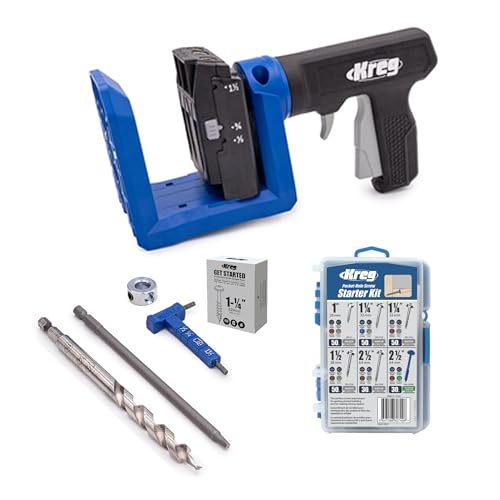
The Kreg 520PRO sits between the R3’s portability and the 720PRO’s production capability, hitting a practical middle ground that suits most woodworking shops and serious DIYers. The defining feature is the VersaGrip rotating handle — it swings to multiple positions so you can drill comfortably regardless of where the workpiece is oriented, whether flat on a bench, standing vertically against a wall, or in the awkward angled position common when adding pocket holes to a partially assembled cabinet. In testing, this feature noticeably reduces hand fatigue compared to fixed-handle designs during longer drilling sessions.

The 520PRO’s integrated auto-material gauge reads the workpiece thickness and automatically sets the drill guide position — removing the manual setup step that causes the most user error on beginner-friendly jigs. Clamp the jig to the workpiece, let it read the thickness, drill — it’s a faster workflow than any manual-adjustment jig when you’re switching between different material thicknesses on the same project. The jig drills both single and dual pocket holes, and the integrated clamp mechanism holds the workpiece firmly through the drill stroke without a separate clamp. Like the 720PRO, it accepts all Kreg accessories including stop collars, face clamps, and screw organizers.

The 520PRO doesn’t include the 720PRO’s face plug drilling guide or the adjustable material stop for production runs of identical parts — the two features that justify the 720PRO’s higher price for high-volume face frame work. For a woodworker building furniture projects and occasional cabinets rather than running a production cabinet shop, those omissions are acceptable trade-offs. The 520PRO is lighter than the 720PRO and more field-deployable, making it the better choice for woodworkers who work in multiple locations or move frequently between shop and on-site installations.
Pros
- VersaGrip rotating handle adapts to any drilling angle or workpiece orientation
- Auto material gauge eliminates manual thickness setup — fastest setup of any jig in this guide
- Integrated clamp — no separate clamp needed
- Single and dual pocket hole capable
- Lighter than 720PRO — more portable for multi-location work
Cons
- No face plug drilling guide (720PRO exclusive)
- No adjustable material stop for production runs
- No dust collection port
Specs
- Material thickness: ½″ to 1½″
- Guide holes: Single and dual
- Clamp: Integrated with auto-gauge
- Handle: VersaGrip rotating
- Face plug guide: No
Best for: Serious hobbyists and semi-professional woodworkers who want Kreg quality with integrated clamping and auto-setup — without paying for the 720PRO’s full production feature set.
4. Kreg Jig HD Heavy Duty — Best for Thick Stock
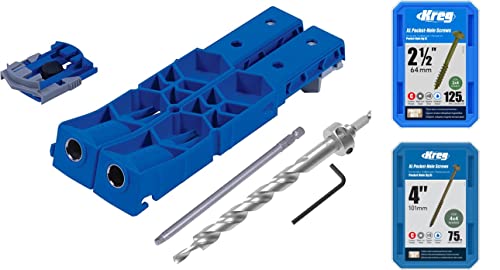
The Kreg HD is a completely different tool from every other jig in this guide — not because of brand or quality, but because it solves a problem none of the other tools can address: pocket holes in 2×4 and 2×6 dimensional lumber. Standard pocket hole jigs are engineered for ½-inch to 1½-inch stock — perfect for plywood, furniture boards, and face frames. The moment you try to use a standard jig on a 2×4 (actual thickness 1½ inches), you’re already at the extreme edge of its range. For anything thicker — 2×6, 4×4, stair stringers, heavy outdoor furniture — standard jigs physically cannot drill a proper pocket hole. The Kreg HD covers 1½ inches to 3½ inches, using a dedicated larger-diameter step bit and Kreg HD screws in ⅜-inch diameter up to 4 inches long.

The applications for the HD are distinct from standard pocket hole work: deck framing (connecting 2×8 joists to 2×10 ledger boards), outdoor furniture (heavy cedar or redwood benches and tables), timber-frame style furniture with thick structural members, workbench construction, and stair construction. In all of these, standard joinery options either require significant skill (mortise and tenon in thick stock) or heavy metal hardware (post connectors, joist hangers). The Kreg HD provides a cleaner, faster alternative that produces a strong, wood-to-wood mechanical joint. The dual guide holes drill two pockets simultaneously — critical for the joint stability and clamp force needed in thick structural lumber.

An important note on screws: the Kreg HD requires Kreg’s own HD pocket screws — the ⅜-inch diameter, coarse-thread design that provides the grip needed in thick wood. Standard 3/16-inch Kreg screws will not provide the joint strength the HD system is designed for. Kreg HD screws are available in bulk packs on Amazon. For outdoor applications, use Kreg’s exterior-rated HD screws with corrosion-resistant coating. The Kreg HD is not a tool for ¾-inch plywood — it has a minimum thickness of 1½ inches by design, and using it on thin stock will produce an over-drilled pocket that the screw head cannot seat into.
Pros
- The only tool in this guide that handles 2×4 to 4×4 thick stock (1½″–3½″)
- Dual simultaneous pocket holes for maximum joint strength in thick lumber
- Enables fast, clean wood-to-wood joints in deck framing and timber furniture
- Integrated toggle clamp holds thick stock firmly during drilling
- Strong outdoor furniture and structural applications with correct HD screws
Cons
- Minimum 1½″ thickness — cannot be used on standard furniture stock
- Requires Kreg HD screws (⅜″ diameter) — not compatible with standard pocket screws
- Single-purpose tool — only for thick-stock applications
Specs
- Material thickness: 1½″ to 3½″
- Guide holes: Dual simultaneous
- Screw compatibility: Kreg HD ⅜″ screws only
- Clamp: Integrated toggle
- Applications: 2×4, 2×6, 4×4 lumber; deck framing; outdoor furniture
Best for: Deck builders, outdoor furniture makers, and structural woodworkers who need strong pocket hole joints in 2×4 through 4×4 dimensional lumber.
5. Massca Pro M2 Aluminum — Best Kreg Alternative
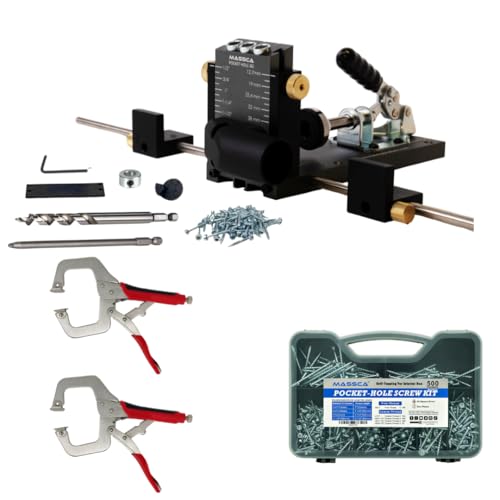
The Massca M2 makes the most compelling case for buying a non-Kreg pocket hole jig. Its full aluminum body is the primary differentiator — at a price well below the Kreg 720PRO, the M2 offers a more rigid construction than any plastic-body Kreg jig and a feel in hand that immediately communicates durability. The dual pocket hole guides are spaced for standard joint work on ¾-inch plywood and solid wood, and the hardened steel bushings maintain guide accuracy through extended use. For a woodworker who builds furniture and cabinets regularly but doesn’t need the 720PRO’s face plug drilling or production material stop, the M2 delivers 85% of the performance at a substantially lower cost.

Massca includes a clamping magnet built into the jig body — a clever feature that holds the jig against a standard steel bar clamp or C-clamp without slipping during drilling setup, effectively giving you single-handed positioning while the other hand manages the clamp. This partially compensates for the lack of an integrated integrated clamp lever. The jig comes with a step drill bit, stop collar, driver bit, and a bag of sample pocket screws. The aluminum body does make the M2 slightly heavier than the plastic Kreg R3, but significantly more resistant to dents and deformation from accidental impact.

The honest limitation of the M2 relative to the Kreg ecosystem is accessories and system integration. Kreg’s face clamp, bench clamp adapters, material stops, plug cutters, and screw organizers are designed to work as a system — they attach to Kreg jigs and to each other. The Massca is compatible with many of these accessories through standard clamp sizing, but not all. If you anticipate building out a full pocket hole workstation over time with specialized accessories, Kreg’s ecosystem has more depth. If you want an excellent standalone pocket hole jig that performs at a high level and doesn’t require investing in a broader accessory ecosystem, the M2 is the strongest buy.
Pros
- Full aluminum body — most rigid construction at this price point
- Dual pocket holes in a single setup — no repositioning for wide stock
- Magnetic clamp feature for single-handed positioning
- Hardened steel drill guides for long-term accuracy
- Significantly less expensive than Kreg 720PRO with comparable core performance
Cons
- No integrated clamp lever — requires separate clamp
- Smaller accessory ecosystem than Kreg
- No face plug drilling guide
Specs
- Material thickness: ½″ to 1½″
- Body: Aluminum
- Guide holes: Dual simultaneous
- Guide material: Hardened steel
- Includes: Step bit, stop collar, driver bit, screws
Best for: Woodworkers who want premium aluminum construction and dual-pocket performance without committing to the Kreg ecosystem — excellent for furniture and cabinet building at a competitive price.
6. WEN WA1527 Pocket Hole Jig — Best Budget

The WEN WA1527 delivers more value per dollar than any other pocket hole jig in this guide, and it does so by focusing on the fundamentals that a first-time pocket hole user actually needs. The integrated toggle clamp locks the workpiece into the jig body in a single motion — no separate face clamp required, which is a genuine convenience at a price point where some competitors still require an additional clamp purchase. The dual guide holes allow two-pocket drilling on wider stock without repositioning. The adjustable material gauge sets jig depth for stock between ½ and 1½ inches, and a workpiece thickness gauge is marked directly on the jig body for quick setup.

WEN includes everything you need to start drilling immediately: a step bit, a stop collar, an L-shaped base that mounts the jig to a benchtop surface for production use, a driver bit, and a bag of pocket screws in multiple lengths. The L-base is a particularly useful inclusion — it transforms the jig into a benchtop-mounted unit for repetitive drilling without the jig moving between holes, which eliminates the most common beginner frustration with portable jigs. The guide body is metal rather than the glass-reinforced nylon of the Kreg R3, providing better rigidity at the guide position. Steel (not hardened steel) bushings are adequate for the project volumes typical of this price tier.

Where the WEN shows its budget positioning is in guide bushing longevity and adjustment precision. The material thickness adjustment is a clamping-bolt system rather than a smooth dial — functional but less refined than Kreg’s indexed adjustments. After extended production use (hundreds of holes on hardwood), the guide bushings will wear more quickly than hardened steel alternatives. For the woodworker building one or two furniture pieces a year, a first cabinet project, or a complete beginner exploring the technique before investing in premium tools, the WEN WA1527 is the honest best choice — it teaches the correct process, produces quality joints, and costs very little to find out if pocket hole joinery is part of your workflow.
Pros
- Integrated toggle clamp — no separate clamp required at any price point
- L-base for benchtop mounting included — adds production stability
- Dual guide holes for wide-stock joints without repositioning
- Complete kit: everything needed to start immediately
- Best price-to-functionality ratio in this guide
Cons
- Standard steel (not hardened) guide bushings — shorter lifespan under heavy production use
- Less refined thickness adjustment than Kreg models
Specs
- Material thickness: ½″ to 1½″
- Guide holes: Dual
- Clamp: Integrated toggle
- Includes: Step bit, stop collar, driver bit, L-base, screws
- Body: Metal
Best for: Beginners, first-time furniture builders, and budget-conscious woodworkers who want an integrated-clamp dual-guide jig with everything included for a minimal initial investment.
7. General Tools Woodworking Pocket Hole Jig Kit — Best Compact
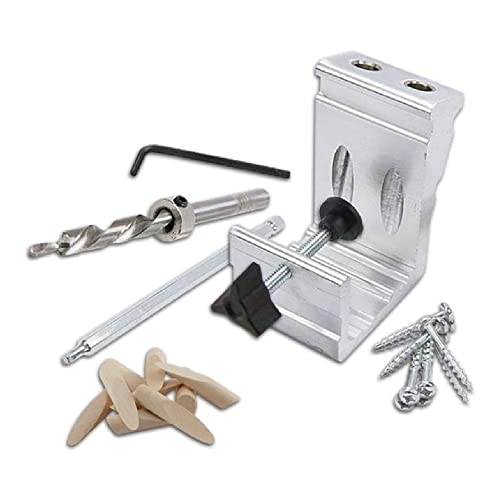
The General Tools 850 occupies a unique position in this lineup: it’s the smallest, lightest pocket hole jig here, yet it offers three guide positions in a single body — more than any other jig in this guide. The three hole positions accommodate narrow stock (single pocket on thin stiles), medium stock (dual pockets in the center positions), and the widest position for boards over 3 inches wide. The entire kit stores in a compact case roughly the size of a large paperback book, making it the most practical option for site-work tool bags, travel kits, and woodworkers with limited bench space who don’t need a dedicated benchtop pocket hole station.

The 850 covers ½-inch to 1¼-inch stock — note the slightly reduced upper limit compared to most competitors at 1½ inches. This means standard 1× lumber (nominal 1 inch, actual ¾ inch) and ¾-inch plywood are well within range, but 1½-inch thick stock (actual thickness of 2× lumber) is outside the design envelope. For furniture-scale work this is rarely a limitation; if your projects ever include thick stock, the Kreg R3 or WEN WA1527 at 1½-inch max is the safer choice. The kit includes the step drill bit, stop collar, driver bit, and a small quantity of pocket screws — everything needed to start work immediately.

Like the Kreg R3, the General Tools 850 requires a separate clamp to hold the workpiece during drilling — no integrated clamp is included. It accepts standard C-clamps, Kreg face clamps, and bar clamps. The three-guide-position design makes it subtly more versatile than the Kreg R3 for varying stock widths, though the hardened-steel guides in the Kreg provide longer-term accuracy in the guide bushings. For a portable kit that handles most furniture and woodworking tasks in a minimal package, the General Tools 850 earns its place in any active workshop as a job-site companion to a benchtop primary jig.
Pros
- Three guide positions — widest stance selection among all jigs in this guide
- Smallest, lightest jig reviewed — ideal for site work and travel
- Complete kit in a compact carry case
- Good price relative to build quality
Cons
- Maximum 1¼″ thickness — cannot handle true 1½″ thick stock
- No integrated clamp — requires separate clamp for every hole
Specs
- Material thickness: ½″ to 1¼″
- Guide holes: Triple-position (3 holes)
- Clamp: Separate clamp required
- Includes: Step bit, stop collar, driver bit, screws, case
Best for: Woodworkers who need the most compact, portable pocket hole solution for on-site installation work and travel, and who primarily work with ¾-inch plywood and furniture-scale boards.
8. BORA Pro Compact Pocket Hole Jig Kit — Best Compact Pro
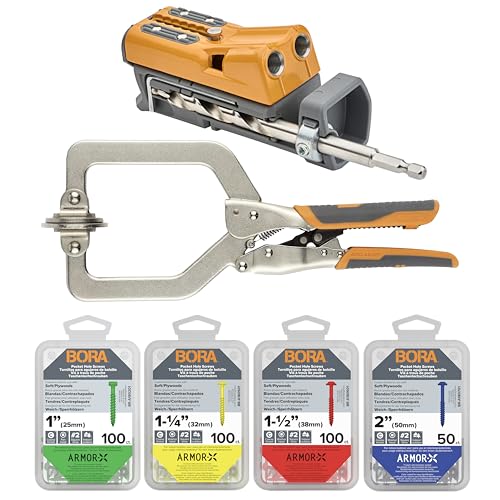
The BORA Pro Compact is the most recent entrant in this guide and represents a thoughtful approach to the compact-professional category — a jig that takes up minimal space on the bench or in a bag while offering features that budget compact jigs omit. The integrated clamping system holds the workpiece without a separate clamp, which separates it immediately from the General Tools 850 and the Kreg R3 in terms of single-handed workflow convenience. The dual guide holes produce two simultaneous pockets on wider stock, and the material thickness adjustment is a smooth direct-read mechanism that minimizes setup time between different stock thicknesses.

The BORA’s compact footprint and integrated clamp combination makes it particularly useful in two scenarios: finishing cabinet installations on site, where space constraints prevent using a full benchtop jig, and workshop use on awkwardly shaped or partially assembled pieces where bringing the full 720PRO into position is impractical. The kit includes a step bit sized for the BORA system, a stop collar, screws, and a driver bit. The build quality reflects BORA’s professional tool positioning — tighter tolerances and more refined fit-and-finish than the WEN or General Tools alternatives, though it lacks the hardened steel guide quality of the premium Kreg models.

The BORA Pro occupies a practical gap between the Kreg R3 (portable, no integrated clamp) and the Kreg 520PRO (integrated clamp, larger, more expensive). If you want integrated clamping in a compact body and you’re not locked into the Kreg ecosystem, the BORA Pro delivers that combination at a competitive price. Its accessories are less interchangeable with the Kreg and Massca ecosystems, so consider it as a self-contained system rather than a building block in a broader pocket hole workstation setup.
Pros
- Integrated clamp in a compact body — best of both worlds for portable use
- Dual guide holes for wide-stock joints in a single setup
- Smooth material thickness adjustment mechanism
- Professional build quality in a compact format
- Complete kit with all essentials included
Cons
- Smaller accessory ecosystem than Kreg
- Guide material quality below premium Kreg and Massca hardened-steel standards
Specs
- Material thickness: ½″ to 1½″
- Guide holes: Dual
- Clamp: Integrated
- Includes: Step bit, stop collar, screws, driver bit
Best for: Woodworkers and cabinet installers who want integrated clamping and dual-pocket capability in the smallest possible package — without the size or price of the Kreg 520PRO.
9. Trend Pocket Hole Jig Kit with Dual Column Jig — Best for Accuracy
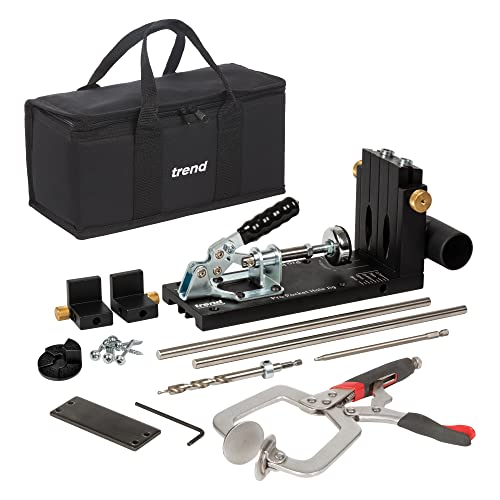
Trend is a UK-based professional tooling brand whose products are standard equipment in European cabinetmaking shops, and the dual-column pocket hole jig reflects that professional heritage. The dual-column guide system is the key differentiator: instead of a single guide body that the step bit enters from one side, the Trend jig guides the bit through two precisely aligned columns that constrain the bit’s path along its entire length — eliminating the side-load deflection that causes slight angle variation in single-guide pocket holes. On production work where dozens of pockets need to be identical for consistent joint alignment across an entire face frame, this extra guide stability produces measurably more repeatable pocket geometry.

The Trend jig covers the standard ½-inch to 1½-inch thickness range and produces two simultaneous pocket holes per drilling operation. The adjustable fence accommodates different material widths and provides a consistent stop position for production runs. The jig body is engineered from precision-machined aluminum — comparable to the Massca M2’s construction quality but with the dual-column guide architecture. Trend includes a professional-grade step bit in the kit, and the system is compatible with standard pocket screws from Kreg and other manufacturers.

The Trend requires a separate clamp — it’s designed to be bench-mounted with a Kreg bench clamp or similar, rather than integrating a clamp into the jig body. This makes it slightly less convenient for casual occasional use than the integrated-clamp models, but in a shop setting where it’s bench-mounted semi-permanently, the separate clamp step is a minor routine. For furniture makers and cabinet shops who care deeply about joint precision and consistency — and who are willing to accept the separate-clamp workflow in exchange for the most accurate pocket geometry available at this price — the Trend dual-column is the standout accuracy-focused choice in this guide.
Pros
- Dual-column guide system — most accurate and consistent pocket geometry available at this price
- All-aluminum precision-machined body for rigidity and long-term stability
- Dual simultaneous pocket holes
- Compatible with Kreg and third-party pocket screws
- Professional European cabinet shop pedigree
Cons
- No integrated clamp — bench-mount or separate clamp required
- Smaller North American ecosystem and brand recognition than Kreg
Specs
- Material thickness: ½″ to 1½″
- Guide system: Dual-column precision guide
- Guide holes: Dual simultaneous
- Body: Precision-machined aluminum
- Clamp: Separate (bench-mount compatible)
Best for: Cabinetmakers and precision-focused furniture builders who prioritize the most consistent pocket geometry available and are comfortable with a bench-mounted separate-clamp workflow.
10. JessEm 08350MK Dowelling Jig Master Kit — Best Alternative Joinery
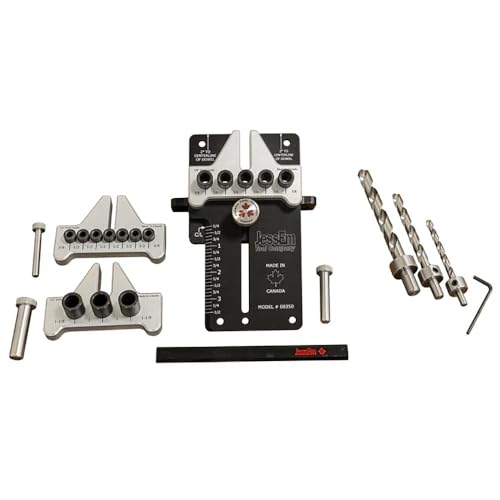
The JessEm dowelling jig is the only tool in this guide that doesn’t drill pocket holes — and it earns its place here because it answers a specific question many woodworkers ask after getting comfortable with pocket holes: what should I use when pocket holes aren’t the right joint? Dowel joints are the correct answer when pocket holes fall short — specifically for edge-to-edge panel glue-ups (where dowels add alignment precision that pocket holes can’t match), for chair joints under dynamic lateral load (where dowels outperform pocket screws in tension), and for any joint that will be visible and cannot accommodate a pocket hole pocket in any face.

The JessEm 08350MK Master Kit is a self-centering dowel jig — it automatically centers the guide on the workpiece edge regardless of thickness, which eliminates the most common dowel-joint error (off-center holes that cause misaligned panels and twisted joints). The kit includes multiple bushing sizes for 5mm, 6mm, 8mm, 10mm, and 12mm dowels, covering everything from small jewelry box joinery to 12mm structural furniture dowels. The self-centering mechanism works on stock from ¾ inch up through wide panel glue-up work. The aluminum body is precision-machined, and the guide bushings maintain tight tolerances through extended use.

Dowel joinery requires a different mindset than pocket holes — you drill both mating pieces, insert dowels with glue, and clamp until cured. It’s slower than pocket hole assembly but produces a stronger, cleaner joint with no visible fastener and no pocket to plug. For fine furniture — dining tables, case pieces, chairs — the JessEm provides an elegant step up from pocket hole work without requiring a full dedicated dowel joiner machine. For woodworkers who want both systems, the JessEm and Kreg R3 together cover the full spectrum of joint types needed in most furniture and cabinetry work, at a total investment that remains reasonable.
Pros
- Self-centering guide — eliminates off-center hole error that ruins dowel joints
- Five bushing sizes (5mm–12mm) — covers the full range of furniture dowel applications
- Stronger joint than pocket screws under lateral and tension load
- Produces invisible joints — no pocket to plug, no screw head to conceal
- Precision-machined aluminum body for long-term accuracy
Cons
- Slower assembly than pocket holes — requires clamping and glue cure time
- Different technique than pocket holes — steeper learning curve for beginners
- Does not drill pocket holes — a complementary tool, not a substitute
Specs
- Joint type: Dowel (not pocket hole)
- Dowel sizes: 5mm, 6mm, 8mm, 10mm, 12mm
- Centering: Self-centering on workpiece edge
- Body: Precision-machined aluminum
- Best application: Panel glue-ups, chair joints, fine furniture
Best for: Woodworkers who want to expand beyond pocket holes into stronger mechanical joints for fine furniture, panel glue-ups, and visible joints that cannot use screws.
Pocket Screw Selection Guide – Complete Reference
Choosing the wrong screw length is the most common pocket hole mistake — too short and the screw doesn’t reach the mating board; too long and it drives through the edge or face. Here is the complete screw length chart for standard pocket hole work:
| Material Thickness | Screw Length | Thread Type (Wood) | Notes |
|---|---|---|---|
| ½″ (12mm) | ¾″ | Coarse (softwood) / Fine (hardwood) | Thin plywood, veneered panels |
| ⅝″ (16mm) | 1″ | Coarse / Fine | Baltic birch, medium plywood |
| ¾″ (19mm) | 1¼″ | Coarse / Fine | Standard cabinet plywood, 1× lumber — most common |
| 1″ (25mm) | 1½″ | Coarse / Fine | Thicker furniture boards, hardwood |
| 1¼″ (32mm) | 2″ | Coarse / Fine | Heavy panel material |
| 1½″ (38mm) | 2½″ | Coarse / Fine | Nominal 2× lumber, thick butcher block |
| 2½″ (64mm) — HD only | 3″ HD screw | Coarse (HD ⅜″ diameter) | Kreg HD system only |
| 3½″ (89mm) — HD only | 4″ HD screw | Coarse (HD ⅜″ diameter) | Kreg HD system only; 4×4 lumber |

Coarse Thread vs. Fine Thread — The Rule
Coarse thread: Use for softwoods (pine, spruce, cedar, fir), plywood, MDF, and particle board. The wider thread spacing grips soft wood fibers effectively and resists pull-out. Standard choice for the vast majority of DIY and cabinet work.
Fine thread: Use for hardwoods (oak, maple, walnut, cherry, hickory, birch). Dense hardwood fibers can split under the wedge action of coarse threads. Fine threads cut rather than displace dense fiber — producing a stronger joint without cracking. If you’re building furniture from solid hardwood and notice joint faces cracking slightly near the pocket, switching to fine thread screws typically resolves it immediately.
Exterior / weather-resistant screws: For any outdoor application — deck furniture, garden structures, outdoor benches — use stainless steel pocket screws or ACQ-rated coated screws. Standard zinc-coated screws will rust when exposed to moisture, and rust staining through your pocket plugs or joint faces is difficult to reverse.
→ Browse Kreg coarse-thread pocket screws on Amazon
→ Browse fine-thread pocket screws for hardwood on Amazon
Hiding Pocket Holes: Wood Plugs and Placement Strategy
Pocket holes don’t have to be visible. Professional cabinet makers use three strategies to manage pocket hole appearance:
Strategy 1: Invisible Placement
Position every pocket hole on a face that will never be seen — inside cabinet boxes, underside of shelves, back of face frame stiles. On a well-planned cabinet, no pocket hole needs to face a visible surface. This is the fastest approach and requires no plugging.
Strategy 2: Wood Plug Filling
Pre-made pocket hole plugs — available in oak, maple, pine, and other common species — press into the pocket opening with a dab of glue, then sand flush. The plug is slightly visible as a small oval insert in the surface, which many woodworkers find acceptable or even attractive in rustic and farm-style pieces. Kreg offers plug packs in multiple species. A step up is cutting your own plugs with a plug cutter from matching wood — the grain direction can be matched closely enough to make the plug nearly invisible. Browse wood pocket hole plugs on Amazon.
Strategy 3: Face Plug Drilling (Kreg 720PRO)
The Kreg 720PRO’s built-in face plug guide drills a clean, precisely sized hole on the face of the joint — the same side that will be seen — into which a face plug is glued flush. This produces a fully professional, nearly invisible result when matching grain plugs are used. It requires planning the joint so the face plug access is reachable, and it adds a step to each joint. For high-end furniture and visible cabinet sides, the result is worth it.
Pocket Hole Jig for Thick Stock: The 2×4 and 2×6 Problem
This is the single most common question that pocket hole guides fail to answer clearly. A standard pocket hole jig — including the Kreg R3, 520PRO, 720PRO, Massca M2, WEN WA1527, and every other non-HD jig in this guide — has a maximum stock thickness of 1½ inches. A 2×4 in actual dimension is 1½ inches thick. This means a standard jig is literally at its absolute limit on a 2×4 and cannot be used at all on a 2×6 (actual thickness 1½ inches nominally listed, but often 1⅝ inches in practice) or anything thicker.
Using a standard jig beyond its rated thickness produces a shallow pocket that the screw cannot properly bridge — the resulting joint is weak and unreliable. If your project involves 2×4 framing lumber, 4×4 posts, heavy-duty outdoor furniture, or timber-style joinery, the Kreg HD Heavy Duty is the only correct answer from this guide.
Step-by-Step: How to Use a Pocket Hole Jig
Step 1 — Set the Jig for Material Thickness
Adjust the drill guide to your material thickness. Most jigs have a direct-read gauge — align the guide to the thickness marking. On the Kreg 520PRO, the auto material gauge reads thickness automatically when you clamp the workpiece. If your jig has a manual adjustment bolt, loosen it, slide the guide to the correct marking, and retighten. This is the setup step most beginners skip and then wonder why their screws aren’t seating correctly.
Step 2 — Set the Drill Bit Stop Collar
The stop collar on the step bit determines how deep the pocket is drilled — it stops the drill from plunging too far. Match the collar position to the thickness marking on the bit itself. Loosen the collar with the included hex key, slide it to the correct line, and retighten firmly. A loose stop collar that shifts during drilling produces inconsistent pocket depth across your workpiece — a common frustration that is entirely preventable.
Step 3 — Clamp the Workpiece Firmly
Any movement during drilling produces a misaligned pocket. On integrated-clamp jigs (720PRO, 520PRO, WEN WA1527, BORA), engage the clamp fully before drilling. On separate-clamp jigs (R3, Massca, General Tools, Trend), position the face clamp and tighten until the workpiece is immovable. Test this by pushing the workpiece sideways with your free hand before starting the drill — if it moves, your joint will be off.
Step 4 — Drill at Medium Speed, Clear Chips Frequently
Run your drill at medium speed — approximately 1,500 to 2,000 RPM. High RPM burns the wood and wears the step bit faster than necessary. Pocket drilling generates a dense column of tightly packed wood chips; retract the bit every ½ inch of depth to clear them. Letting chips pack tightly causes the bit to bind, which loads the bit sideways and can produce a slightly angled pocket. Jigs with dust ports (Kreg 720PRO) connected to a shop vac handle chip evacuation automatically.
Step 5 — Assemble with the Correct Screw
Match screw length to material thickness using the chart above. Position the mating board at 90 degrees (or your desired angle), clamp it to prevent movement during screw driving, and drive the pocket screw to full engagement. Do not overdrive — the screw head should be fully seated in the pocket without stripping the pocket floor or mushrooming the wood fibers around the hole.
The Most Common Mistakes
- Wrong screw length: too short doesn’t reach the mating board; too long exits through the edge or face
- Not clamping the mating board during assembly: the screw’s driving action pulls the boards against each other as it seats — without a clamp holding alignment, the boards shift and the joint gaps on one side
- Wrong thread type: coarse thread in hardwood causes splitting; fine thread in softwood leaves less withdrawal resistance
- Stop collar shift: check that the stop collar is tight before every drilling session
Use-Case Guide — Best Pocket Hole Jig for Every Application
Face Frame Cabinetry
Face frames use narrow stiles (typically 1½ to 2 inches wide) and rails in ¾-inch hardwood or plywood. Precision matters — every joint needs to be flush and tight. The Kreg 720PRO is the top choice: its GripMaxx clamp holds narrow hardwood stiles without slipping, the dual guides drill both pockets simultaneously on wider rails, and the material stop makes production runs of identical parts fast and consistent.
Cabinet Carcass (Box) Assembly
Cabinet boxes in ¾-inch plywood require consistent pocket depth and dual holes per joint for panel stability. The Kreg 520PRO or Massca M2 handle this excellently — both offer dual simultaneous pockets with fast setups. The Massca’s aluminum construction holds up well through a full kitchen cabinet run.
DIY Furniture (Tables, Benches, Shelving)
For furniture projects in softwood and ¾-inch plywood, the Kreg R3 or WEN WA1527 are the practical choices. Both handle furniture-scale stock reliably. The WEN’s integrated clamp and L-base add convenience at a lower price; the Kreg R3 offers better long-term guide accuracy with its hardened bushings.
Deck Framing and Thick Outdoor Lumber
No debate here: the Kreg HD Heavy Duty is the only option for 2×4 and larger dimensional lumber. Use with Kreg HD exterior-rated screws for structural outdoor applications.
On-Site Cabinet Installation
The BORA Pro Compact or Kreg R3 for site work — compact enough for a tool bag, fast to deploy, and capable of adding pocket holes to installed or partially assembled cabinetry in confined spaces.
Precision Furniture and Fine Woodworking
For joints that need maximum accuracy and zero visible fasteners, combine the Trend Dual Column for pocket hole work with the JessEm 08350MK for dowel joints where pocket holes are structurally or aesthetically unsuitable.
Beginner First Project
The WEN WA1527 — integrated clamp, complete kit, L-base included, honest price. Enough to build a bookshelf, an entryway bench, a simple plywood cabinet, or a workbench top and understand whether pocket hole joinery is a technique worth investing in further.
Frequently Asked Questions
What is a pocket hole jig used for?
A pocket hole jig guides a stepped drill bit at a precise 15-degree angle into a board, creating an angled pocket and pilot hole. A self-tapping pocket screw driven through that pocket into the adjacent board pulls the joint together mechanically — without traditional clamps, without mortise-and-tenon skills, and in a fraction of the time of other joinery methods. The technique is used for building cabinet face frames, furniture frames, panel assembly, and structural outdoor projects with thick-stock jigs like the Kreg HD.
Are pocket hole joints strong enough for furniture?
Yes — for the vast majority of furniture applications. Pocket hole joints provide moderate-to-high shear strength (resistance to forces trying to slide the joint sideways), which is the primary load type in most furniture. They are adequate for dining tables, benches, bed frames, bookshelves, and cabinet carcasses. They are less suitable for joints under sustained dynamic tension — specifically chair joints that experience repeated racking forces — where mortise-and-tenon or dowel joints perform better. For maximum strength in any application, use wood glue on long-grain mating surfaces in combination with pocket screws.
What screw length do I need for ¾-inch wood?
1¼-inch pocket screws are the standard choice for ¾-inch stock — the most common thickness in furniture and cabinet work. Use coarse thread for pine, plywood, and softwoods. Use fine thread for oak, maple, walnut, and other hardwoods. Confirm by placing the screw alongside the joint before driving — the tip should be entirely within the mating board with at least ½ inch of thread engaged, and the head should seat cleanly in the pocket without pulling through the floor of the pocket.
Can I use a regular drill bit with a pocket hole jig?
No — a regular twist bit cannot be substituted for a pocket hole step bit. The stepped design simultaneously creates the flat-bottomed pocket (where the screw head seats) and the pilot hole through the pocket floor in a single plunge. A standard twist bit creates only a cylindrical hole with no flat bottom and no stepped geometry. The result is a screw head that cannot seat flush, pockets with angled walls that misalign the screw path, and blowout on the exit face. Always use the correct step bit for your jig — they are inexpensive and last thousands of holes before needing replacement.
Is Kreg the best pocket hole jig, or are there good alternatives?
Kreg makes excellent jigs and the most complete ecosystem of compatible accessories. For buyers who want integrated production workflow — benchtop clamping, material stops, face plug drilling, dust collection — the Kreg 720PRO is the strongest overall choice. For buyers who want premium construction without the Kreg price, the Massca M2 aluminum body and the Trend dual-column jig are both excellent alternatives. For budget or occasional use, the WEN WA1527 performs the core function well at a fraction of the Kreg price.
Can I use a pocket hole jig on MDF?
Yes, but with important caveats. MDF holds screws moderately well through its face and long grain, but the edge holds screws poorly — the porous, fiber-and-resin core at the edge has much lower screw withdrawal resistance than solid wood or plywood. For MDF edge-to-face joints (such as cabinet box corners), always combine pocket screws with wood glue — the glue on the face-grain surface bonds well and compensates for the reduced edge-grain holding power. Use coarse thread screws and avoid overtightening, which can strip the MDF edge material around the pocket.
Do I need glue with pocket hole screws?
Not always — it depends on the joint type and load requirements. Pocket screws alone provide adequate strength for most furniture and cabinet applications. Adding glue to long-grain mating surfaces (side grain to side grain) significantly increases joint rigidity and is recommended for structural furniture joints, dining table aprons, and cabinet face frame joints that will experience regular stress. Do not apply glue to end-grain surfaces — end grain absorbs glue without forming a surface bond, and it doesn’t add strength. For removable or serviceable joints (shop fixtures, adjustable shelving), pocket screws alone are correct — glue makes disassembly impossible.
What is the difference between a Kreg R3 and Kreg 720PRO?
The R3 is a portable single-guide jig that requires a separate clamp and produces one pocket per setup position — best for on-site work and occasional furniture builds. The 720PRO is a benchtop production jig with an integrated GripMaxx clamp, dual simultaneous pocket guides, a face plug drilling guide, a material stop for production runs, and a dust port — best for cabinet shops and regular production face frame work. The R3 is the right starting point; the 720PRO is the right investment when pocket hole work becomes a regular production activity.
Final Verdict
Pocket hole joinery rewards the right tool choice more than almost any other woodworking technique — the difference between a worn budget jig and a properly calibrated quality jig shows up in every joint you make. Here are the definitive picks by buyer type:
- Best overall portable: Kreg R3 — hardened guides, full Kreg ecosystem compatible, packs small, works everywhere.
- Best for face frame and production cabinet work: Kreg 720PRO — GripMaxx clamp, dual simultaneous pockets, face plug drilling, material stop, dust port. The professional standard.
- Best mid-range with integrated clamp: Kreg 520PRO — VersaGrip rotating handle, auto material gauge, single + dual pocket capability.
- Best for 2×4, 2×6, and thick outdoor lumber: Kreg HD Heavy Duty — the only correct tool for structural thick-stock pocket joinery.
- Best Kreg alternative (aluminum construction): Massca Pro M2 — full aluminum body, dual guides, hardened steel bushings at a competitive price.
- Best budget: WEN WA1527 — integrated clamp, dual guides, L-base, complete kit. Best value in this guide.
- Best compact / portable: General Tools 850 — three guide positions in the smallest package available.
- Best compact with integrated clamp: BORA Pro Compact — dual guides and integrated clamp in a site-work-friendly body.
- Best for joint accuracy and precision woodworking: Trend Dual Column — dual-column guide architecture for the most repeatable pocket geometry available at this price.
- Best when pocket holes aren’t the right joint: JessEm 08350MK Dowelling Jig — self-centering, five dowel sizes, the strongest visible-joint alternative to pocket holes for fine furniture.
Whatever jig you choose, use the correct screw length for your material thickness, match thread type to your wood species, and always clamp the mating board during assembly. Those three habits eliminate 95% of pocket hole joint problems before they happen.


