
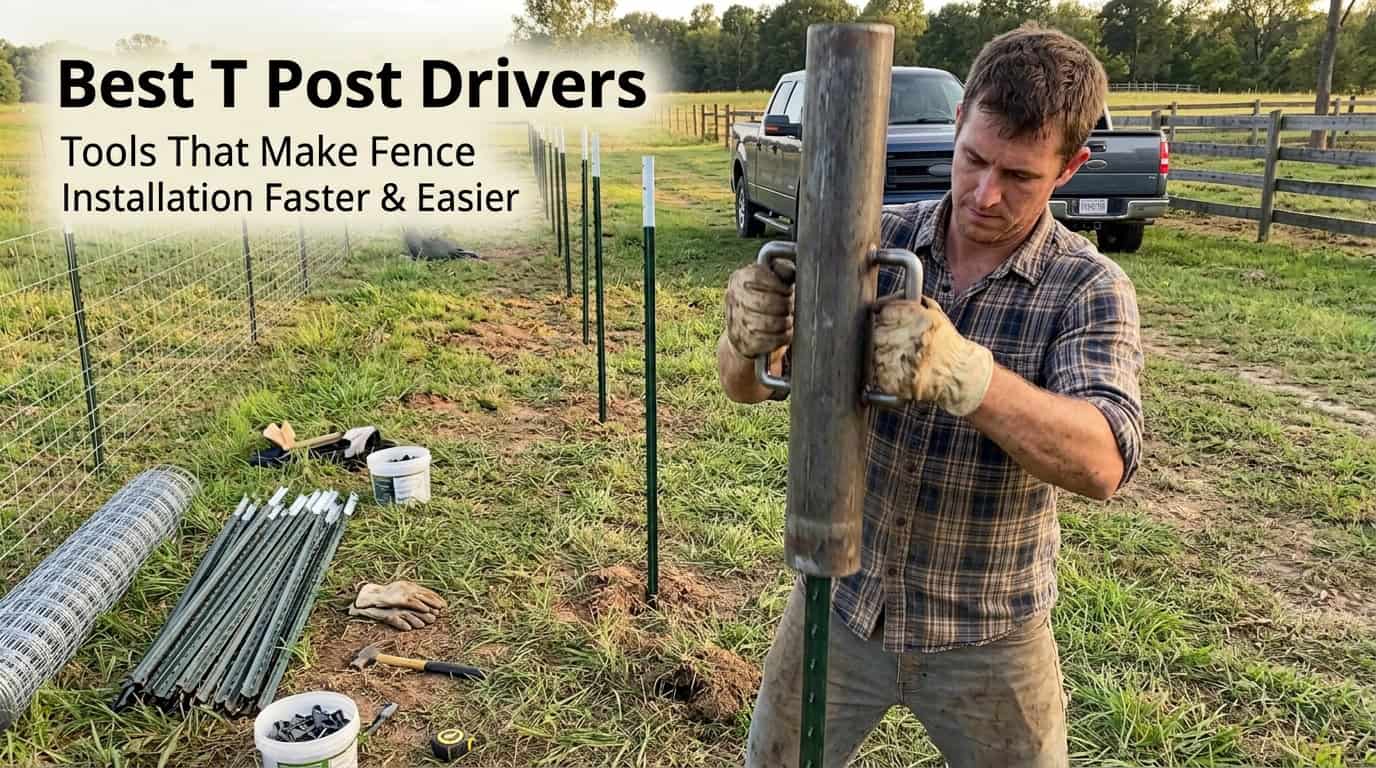
Most “best T post driver” guides treat gas-powered units as the automatic upgrade over manual ones and stop there. That’s not quite right. The correct tool depends on how many posts you’re driving and what your soil is actually like — and getting that match wrong means either overpaying for power you don’t need or showing up to a hard-clay fence line with a tool that can’t finish the job.
This guide covers the real decision science that most roundups skip: exactly when manual driving is genuinely the better choice, why blows-per-minute matters less than most listings suggest, how 2-stroke and 4-stroke engines actually trade off for this specific tool, a five-minute soil test to run before you buy anything, and the installation depth and spacing standards that determine whether your fence holds regardless of which driver you use. Eight products below — two manual, six gas-powered — organized by exactly which job each one solves.
Quick Comparison Table
| Product | Type | Power / Weight | Best For |
|---|---|---|---|
| Sekcen Fence Post Driver, 8 lb | Manual | 8 lb | Small gardens, occasional light repairs |
| Enhance Anti-Slip Handle Driver | Manual | Mid-weight manual | Under 30 posts, soft-to-medium soil |
| Titan PGD3875 Light-Duty | Gas | Entry gas | Homeowners upgrading from manual |
| Titan PGD1032 | Gas | Mid-tier | Titan build quality without the Honda premium |
| Titan PGD2000X (Honda GX) | Gas | 35 lb head, 1.3 HP Honda | Contractors, large acreage, hard soil |
| JKCHENPRO 52cc 2-Stroke | Gas (2-stroke) | 52cc | Maximum power-per-dollar |
| G2XD 4-Stroke T-Post Package | Gas (4-stroke) | Bundled with T-post sleeve | No fuel mixing, all-in-one package |
| XtremepowerUS 38cc | Gas (2-stroke) | 38cc | Best overall — varied terrain, large jobs |
Manual vs. Gas: The Actual Decision Threshold

Manual post drivers weigh 12 to 30 pounds, have no engine, need no fuel, and require essentially no maintenance beyond wiping off dirt after use. For under roughly 30 posts in soft, sandy, or loamy soil, that simplicity genuinely beats a gas unit — the ground offers little resistance either way, so the labor savings from an engine barely register, while the manual driver stays lighter to carry, cheaper to buy, and silent to operate.
The physical demand of a manual driver becomes the limiting factor specifically at higher volumes. Lifting and dropping 20-plus pounds of steel repeatedly, for dozens of posts, compounds into real fatigue — field reports describe breaking a sweat “even on a cool day” well before finishing a long fence line. That’s the point where gas power starts earning its added weight and cost.
| Post Count | Soil Type | Recommended Driver |
|---|---|---|
| Under 30 posts | Soft, sandy, or loamy | Manual — gas is over-buying for this job |
| 30–100 posts | Medium or mixed soil | Entry-to-mid gas driver |
| 100+ posts, or contractor use | Hard, compacted, or rocky | Commercial gas driver |
BPM vs. Driving-Head Weight: What Actually Determines Power
Gas post drivers generate force through rapid impact cycles rather than one heavy blow. Documented rates run from roughly 1,500 blows per minute on some heavier commercial 4-stroke units up to 6,500–8,500 BPM on smaller high-frequency 2-stroke models. Higher BPM alone doesn’t mean “more powerful” — it means faster cycling.
A heavier driving head delivering fewer, more forceful strikes (like a 35 lb head on a Honda-powered commercial unit) breaks through compacted clay or small rock better than a lighter, higher-frequency 2-stroke unit, because each individual strike carries more force. In soft or sandy soil, where posts go in easily regardless, higher BPM simply gets you through each post faster. The practical rule: for hard, rocky, or clay-heavy ground, prioritize driving-head weight and torque over raw BPM. For soft ground, BPM is mostly a speed convenience.
2-Stroke vs. 4-Stroke Engines for Post Drivers

2-stroke engines (JKCHENPRO 52cc, XtremepowerUS 38cc) are lighter and mechanically simpler for their displacement, generally delivering more power per dollar. The tradeoff: they require correctly pre-mixed fuel — typically a 50:1 gas-to-oil ratio — and getting that ratio wrong risks engine seizure or fouling. They also run louder with more visible exhaust, worth considering if you’re driving posts for hours near livestock, a house, or a neighboring property.
4-stroke engines (G2XD package, and the Honda GX in the Titan PGD2000X) run on straight gasoline with a separate oil reservoir, removing the fuel-mixing step entirely. They’re generally quieter with lower vibration, but heavier for the same displacement and typically pricier — a genuine Honda GX engine specifically commands a premium for its reliability reputation.
If you only drive posts occasionally and don’t want to think about mixing ratios, 4-stroke removes that failure point completely. If upfront price and weight matter more than fuel simplicity, a 2-stroke unit delivers more power-to-weight for the money.
The Five-Minute Soil Test to Run Before You Buy

Before committing to a driver — or a full fence line — drive a single test stake or scrap T-post by hand at several points along your planned route. Soil resistance can vary dramatically even across one property, especially near old construction fill, root systems, or low spots that hold more moisture.
- Sandy or loamy soil: accepts posts with minimal resistance. A manual driver performs nearly as well as gas here — buying a commercial gas unit for pure sand or loam is solving a problem you don’t have.
- Compacted clay or hardpan: this is where gas-powered units earn their keep. Repeated high-frequency impact fractures compacted soil structure that a manual driver’s single heavier blows struggle against.
- Rocky soil: the real limit for any post driver. If a post stops cold against a rock, don’t force it — you risk bending the post or damaging the driver. Reposition the post an inch or two first. For solid rock, stop, pull the post, and use a digging bar to create a pilot hole before resuming.
Embedment Depth and Post Spacing
A T-post should be driven until its spade (anchor plate) is completely buried beneath the soil — typically 18 to 24 inches of total depth for adequate holding stability against wind, livestock pressure, and wire tension. A post embedded to only 10–12 inches will lean and loosen far sooner than one driven to full depth, even if it looks “done” standing upright.
Standard spacing for barbed wire or field fence runs 8 to 12 feet between posts. High-tensile fencing can sometimes allow wider spacing; heavy livestock enclosures often need tighter spacing for adequate containment strength. The studded side of the T-post should face the fence wire, so clips hook and lock behind the studs rather than letting wire slide.
Before buying, confirm your chosen driver has enough power to reach full embedment depth in your specific soil — a driver that stalls out at 12 inches in your ground isn’t finishing the job even if the post appears to be standing.
Best Manual Budget: Sekcen Fence Post Driver, 8 lb

At 8 lb, this is the lightest manual driver in this guide — easier to lift repeatedly than heavier steel pounders, though it delivers less force per strike as a result. It’s a metal pounder/rammer built with handles for U-channel and wooden fence posts, and it requires zero maintenance beyond wiping it down after use.

This is the right tool for small gardens, occasional light repairs, or as a way to find out whether manual driving suits you before spending more on a gas unit. In soft or loamy soil, the lighter weight means less fatigue per post, though it will take more strikes per post than a heavier manual driver in firmer ground.
Best for: small gardens, occasional repairs, light soil. Not for: hard or compacted soil, or projects over roughly 20–30 posts.
Best Manual Ergonomics: Enhance Fence Post Driver with Anti-Slip Handles
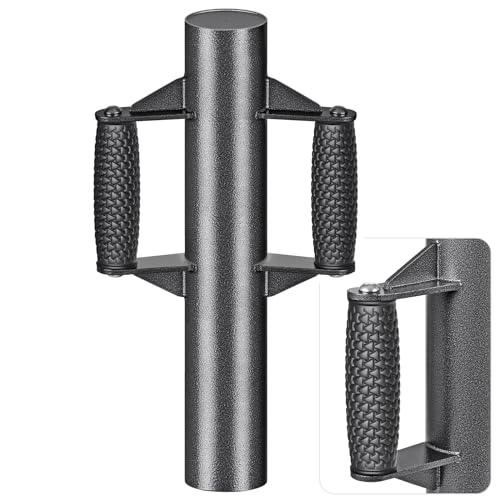
This model directly addresses the two most common manual-driver complaints: grip slippage during repeated strikes, and vibration transfer into the hands and wrists over a long session. The anti-slip handle design keeps grip stable even as hands sweat or gloves get dusty.

Field guidance for any manual driver applies here too: relax your grip specifically on the downstroke to reduce vibration fatigue, and where possible, hold closer to the driver’s shaft rather than gripping only the handles — the handles transfer more shock than the shaft itself.
Best for: small-to-medium fence jobs (under 30 posts) in soft-to-medium soil where hand comfort over a longer session matters. Not for: hard, compacted, or rocky soil, or high post-count projects.
Best Entry Gas: Titan PGD3875 Gas-Powered Light-Duty Post Driver

This is the bridge product for buyers moving up from manual driving without jumping straight to commercial-grade pricing. It brings genuine gas power and higher BPM cycling to speed up mid-sized projects, without the weight and cost of a full Honda-engine commercial unit.

This sits squarely in the 30–100 post, medium-soil range from the decision framework above. It’s the right upgrade for a homeowner or small-acreage owner who has outgrown manual driving but doesn’t need commercial-contractor durability.
Best for: homeowners and small-acreage owners moving up from manual, medium soil, moderate post counts. Not for: daily commercial/contractor use or consistently hard, rocky ground.
Best Mid-Tier Gas: Titan PGD1032 Gas Powered Post Driver

Positioned between Titan’s entry-level PGD3875 and the commercial Honda-engine PGD2000X, this model delivers genuine Titan build quality — the same brand reliability reputation found across the lineup — without the price premium that comes specifically from a Honda GX engine.

For buyers who want more capability than the entry-level unit but don’t need the absolute top-tier commercial specification, this is the practical middle option — genuinely useful across a wider range of soil conditions than the light-duty model.
Best for: buyers wanting real Titan build quality above entry-level, without paying for the Honda engine premium. Not for: buyers on the tightest budget, or those who specifically want Honda GX reliability.
Best Commercial / Honda Reliability: Titan Post Driver PGD2000X
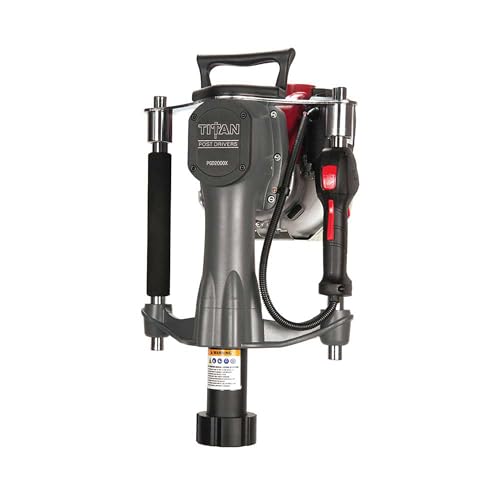
This is the commercial benchmark in this guide: a genuine 1.3 HP Honda GX engine — widely regarded as the reliability standard in small gas engines — paired with a 35 lb driving head. That combination of weight and engine torque is exactly what the BPM-vs-weight section above recommends for hard or compacted soil: fewer, heavier strikes that punch through resistance a lighter high-frequency unit would struggle with.

The Honda GX engine is specifically worth the premium for buyers running this tool daily or near-daily — contractors and large-acreage ranchers who need the engine to start reliably every time, year after year, rather than sitting unused for months between projects.
Best for: fencing contractors, large-acreage ranchers, hard or rocky soil, daily professional use. Not for: occasional small residential jobs — this is more tool and expense than a small project needs.
Best Budget 2-Stroke Power: JKCHENPRO 52cc 2-Stroke Gas Powered T Post Driver
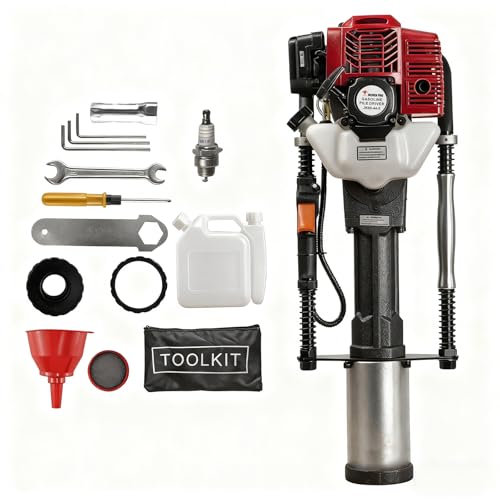
At 52cc, this is the largest displacement 2-stroke engine in this guide, delivering strong power-per-dollar. As covered in the engine comparison above, that comes with the standard 2-stroke tradeoffs: pre-mixed fuel at the correct ratio (commonly 50:1) is required, and running it louder and with more visible exhaust than a comparable 4-stroke is part of the deal.

For buyers comfortable maintaining fuel mix ratios and prioritizing maximum power for the price over fuel-handling convenience, this is a strong value pick — genuine gas-driver capability without commercial-tier pricing.
Best for: budget-conscious buyers wanting maximum power-per-dollar and comfortable with 2-stroke fuel mixing. Not for: buyers who want to avoid fuel-mixing entirely, or noise-sensitive environments near neighbors or livestock.
Best 4-Stroke Package: G2XD 4-Stroke Post Driver — T-Post Package
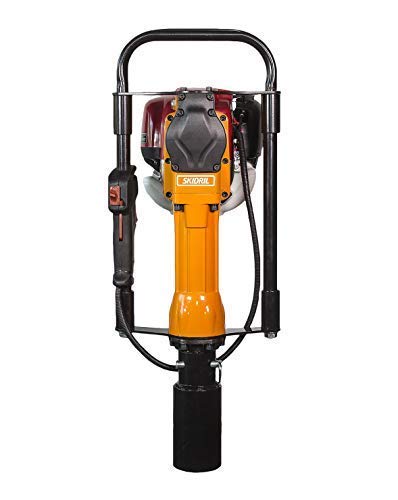
This 4-stroke unit removes the fuel-mixing step entirely — straight gasoline with a separate oil reservoir — and runs quieter with lower vibration than a comparable 2-stroke, per the engine comparison above. It’s bundled specifically as a T-Post Package, meaning the correct adapter sleeve for T-posts ships included rather than requiring a separate purchase.

That bundling matters: not every gas post driver includes T-post-specific sleeves by default, and buyers who assume compatibility without checking can end up needing an extra purchase before they can actually use the tool. This package solves that upfront.
Best for: buyers who want 4-stroke’s fuel-mixing-free operation and a complete out-of-box T-post setup. Not for: buyers prioritizing absolute minimum weight or lowest price over fuel convenience.
Best Overall: XtremepowerUS 38cc Gas-Powered T Post Driver
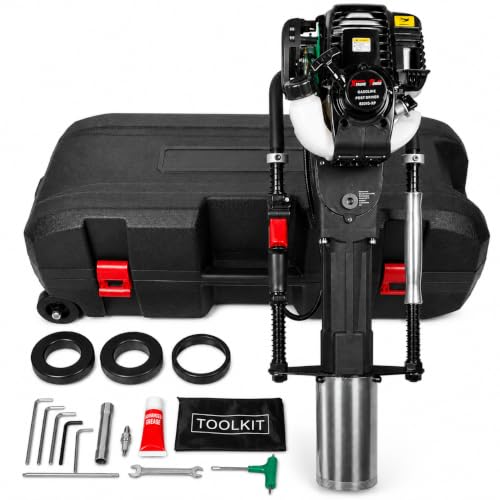
This model is widely recommended as the best overall gas T-post driver for large-scale fencing projects across varied terrain, without being tied to a power source. At 38cc, it strikes a strong balance between power, weight, and price that suits the widest range of buyers in this guide.

Its versatility across soil types and terrain — rather than excelling narrowly at one job — is exactly why it earns the “best overall” position: it handles the 30–100 post medium-soil range comfortably and has enough capability to stretch into harder ground without needing the full commercial Honda-engine tier.
Best for: large-scale fencing projects, varied and inconsistent terrain, buyers who want one broadly capable gas driver rather than a narrow specialist. Not for: buyers who specifically need Honda GX-level reliability for daily professional use, or those who want to avoid 2-stroke fuel mixing.
Adapter and Sleeve Compatibility for Round and Wood Posts
Many gas-powered post drivers use a core driving head paired with interchangeable adapter sleeves, commonly sized around 1″, 2″, and 3″ diameters, allowing the same tool to drive T-posts, round metal posts, and wood or vinyl fence posts. If your project mixes T-post fence line sections with round-post gate posts or wood corner posts, confirm adapter availability and sizing before buying — a driver without the correct sleeve simply can’t be used safely on that post type.
The G2XD package above specifically includes its T-post sleeve out of the box, which is a genuine practical advantage: not every gas driver ships with T-post-specific adapters included by default, and buyers sometimes discover this only after unboxing.
Safety and Required PPE
Regardless of driver type, wear a hard hat, safety glasses, sturdy closed-toe boots, and gloves. Avoid loose clothing or jewelry near any gas-powered unit with moving or vibrating parts, and keep bystanders at a safe distance — posts and drivers can shift unpredictably on strike.
Gas-powered specific: hearing protection is genuinely necessary for extended use given the noise levels involved. Vibration fatigue compounds over hours — use a relaxed grip on the downstroke and hold the driver’s shaft rather than only its handles where possible, since the handles transfer more shock.
Manual driver specific: the main hazard is bounce-back when the driver strikes a rock or unexpectedly hard obstruction — a driver that doesn’t penetrate can kick upward unpredictably. Maintain a stable, balanced stance, especially on uneven ground.
Maintenance Reality: Manual vs. Gas
Manual drivers need almost nothing beyond wiping off dirt and debris after use — no engine, no fuel system, and no wear parts beyond the driving cylinder itself over years of use.
Gas-powered drivers require standard small-engine upkeep: correct fuel (straight gas with separate oil for 4-stroke, correctly-ratioed pre-mix for 2-stroke), periodic oil changes on 4-stroke models, air filter cleaning or replacement, spark plug inspection, and off-season storage prep — draining fuel or using a stabilizer to prevent the carburetor from gumming up between uses. A gas unit that sits unused for eleven months and won’t start reliably in month twelve negates its power advantage entirely if this upkeep gets skipped.
Frequently Asked Questions
Is a manual or gas T post driver better?
It depends on post count and soil type, not on which one is generally “better.” For under 30 posts in soft, sandy, or loamy soil, a manual driver is genuinely the better choice — lighter, cheaper, and requiring zero maintenance. Gas power earns its cost and weight specifically at higher post counts or in hard, compacted, or rocky soil.
How many blows per minute does a gas post driver need?
Documented rates run from roughly 1,500 BPM on heavier commercial units up to 6,500–8,500 BPM on lighter, high-frequency models. Higher BPM means faster cycling, not necessarily more power — for hard or rocky soil, a heavier driving head delivering fewer, more forceful strikes typically outperforms a lighter, higher-BPM unit.
What’s the difference between 2-stroke and 4-stroke post drivers?
2-stroke engines are lighter and deliver more power per dollar but require correctly pre-mixed fuel (commonly 50:1) and run louder with more exhaust. 4-stroke engines run on straight gas with a separate oil reservoir, removing the mixing step, and operate quieter with lower vibration, but cost more and weigh more for the same displacement.
How do I know if my soil needs a gas-powered post driver?
Drive a single test stake by hand at several points along your planned fence line before buying. Sandy or loamy soil accepts posts easily with either driver type. Compacted clay or hardpan is where gas power becomes genuinely necessary. Rocky soil is the limit for any driver — stop and pre-drill with a digging bar rather than forcing a post against solid rock.
How deep should a T-post be driven?
Until the spade (anchor plate) is completely buried — typically 18 to 24 inches of total depth — for adequate holding stability against wind, livestock pressure, and wire tension.
How far apart should T-posts be spaced?
Standard spacing for barbed wire or field fence is 8 to 12 feet between posts. High-tensile fencing can sometimes allow wider spacing, while heavy livestock enclosures often need tighter spacing.
What safety gear do I need to use a post driver?
A hard hat, safety glasses, sturdy closed-toe boots, and gloves at minimum, for both manual and gas units. Add hearing protection for gas-powered units during extended use, and maintain a safe bystander distance since posts and drivers can shift unexpectedly on strike.
Can a T post driver also drive wood or round posts?
Many gas-powered drivers use interchangeable adapter sleeves (commonly sized around 1″, 2″, and 3″) that allow the same core unit to drive T-posts, round metal posts, and wood or vinyl posts. Confirm adapter availability and sizing before buying if your project mixes post types.
Final Verdict
Small garden or light repair, under 20 posts: Sekcen Fence Post Driver, 8 lb
Under 30 posts, want better hand comfort: Enhance Anti-Slip Handle Driver
Moving up from manual, moderate post count: Titan PGD3875 Light-Duty
Want more capability without the Honda premium: Titan PGD1032
Contractor, large acreage, hard or rocky soil: Titan PGD2000X (Honda GX)
Maximum power-per-dollar, comfortable with fuel mixing: JKCHENPRO 52cc 2-Stroke
Want fuel-mixing-free operation with T-post sleeve included: G2XD 4-Stroke T-Post Package
Best all-around for varied terrain and large jobs: XtremepowerUS 38cc
Match the tool to your post count and your soil, not to whichever driver looks most powerful on the spec sheet. Run the five-minute soil test before you buy, confirm your driver reaches full embedment depth in your actual ground, and the rest of the job comes down to steady, consistent technique.


