Recessed lighting, plumbing penetrations, electrical device boxes, door locksets, tile backsplash cutouts — every one of these projects needs a clean, perfectly round hole that a spade bit, jigsaw, or rotary tool simply can’t produce. A hole saw solves this in seconds, but here’s what most buying guides won’t tell you upfront: there is no single “best” hole saw kit. The right kit depends entirely on what material you’re cutting, and buying the wrong cutting technology for your material means slow cuts, burned teeth, or a cracked tile before you’ve finished the job.
Bi-metal hole saws handle wood, drywall, and thin metal. Carbide-tipped saws are built for hardened steel, stainless, and abrasive composite materials. Diamond hole saws are the only correct choice for porcelain, ceramic, glass, and natural stone. Get the category right, and even a mid-tier kit performs well. Get it wrong, and even a premium kit will frustrate you.
This guide covers 11 hole saw kits available on Amazon right now — spanning general-purpose bi-metal sets, dedicated electrician’s kits, heavy-duty carbide options, and diamond kits for tile and stone — with the buying knowledge to match the right kit to your actual project.
Quick Comparison: Best Hole Saw Kits
| Product | Type | Pieces | Size Range | Arbor System | Best For |
|---|---|---|---|---|---|
| Bosch HSBIM9 | Bi-metal | 9 pc | 6 sizes | Standard threaded | Best Overall |
| DEWALT D180002 | Bi-metal | Electrician’s set | 7/8″–2-1/2″ | Standard threaded | Best for Electricians |
| Milwaukee BIG HAWG | Carbide teeth | 10 pc | Multiple | Quick-change hex | Best for Heavy-Duty Metal |
| 9-Piece Carbide Kit | Carbide-tipped | 9 pc | Multiple | Standard threaded | Best Carbide Value |
| Diamond Hole Saw Kit 7pcs | Diamond | 7 pc | 20–100mm | Standard shank | Best for Tile/Stone |
| HYCHIKA 17 Pcs | Bi-metal (HSS) | 17 pc | 3/4″–2-1/2″ | Standard threaded | Best Wide Size Range |
| Luckyway 24PCS Pro | Bi-metal | 24 pc | Widest coverage | Standard threaded | Best Large Kit / Value |
| Diamond Drill Bits Set | Diamond | 10 pc | Small precision sizes | Hex shank | Best Diamond Drill Bit Set |
| Spyder 18-Piece | Tungsten carbide | 18 pc | Pro-grade range | Standard threaded | Best Carbide Pro Kit |
| Bosch HDG11 | Diamond | 11 pc | Multiple | Standard shank | Best Bosch Diamond Kit |
| Ideal 36-314 TKO | Bi-metal | Master electrician kit | Comprehensive | Standard threaded | Best Master Electrician Kit |
Bi-Metal vs. Carbide vs. Diamond — Which Do You Need?

Before comparing individual kits, understand that the cutting material of the saw itself matters more than brand, price, or piece count. Here’s what each technology is actually built for.
Bi-Metal Hole Saws
Bi-metal saws combine a flexible spring-steel body with a high-speed steel (HSS) cutting edge welded to the tooth line — the “bi” in bi-metal. This is the all-purpose default: effective on wood, plywood, drywall, PVC, thin sheet metal, and light-gauge conduit. It’s the most affordable technology and the right choice for the vast majority of home and light commercial projects. Its limitation is abrasive or hardened materials — cutting stainless steel, cast iron, or cement board repeatedly will dull bi-metal teeth much faster than carbide.
Carbide-Tipped Hole Saws
Carbide-tipped saws braze small tungsten carbide teeth onto the cutting rim, or in some designs use a carbide-grit rim. Carbide is significantly harder than HSS and holds an edge far longer under abrasive wear. This is the right choice for hardened metal, stainless steel, cast iron, fiberglass, cement board, and composite materials that would rapidly dull a bi-metal saw. Carbide kits cost more per saw, but for anyone cutting stainless or abrasive material regularly, the extended tooth life pays for the price difference many times over.
Diamond Hole Saws
Diamond hole saws don’t have teeth at all — they cut by abrasion, using a rim embedded or electroplated with industrial diamond grit that grinds through material rather than biting into it. This is the only correct technology for porcelain tile, ceramic, glass, natural stone, granite, and quartz. Attempting to cut these materials with a toothed bi-metal or carbide saw will crack or shatter the material almost immediately — diamond is not optional here, it’s mechanically necessary.
Material-to-Technology Decision Table
| Material | Recommended Type | Why |
|---|---|---|
| Wood, plywood, OSB | Bi-metal | Fast, clean cuts; no need for abrasion-resistant teeth |
| Drywall | Bi-metal | Soft material; any hole saw type works, bi-metal is cheapest |
| PVC / plastic conduit | Bi-metal | Standard teeth handle plastic easily at moderate speed |
| Mild steel / sheet metal | Bi-metal (occasional) / Carbide (frequent) | Bi-metal works but dulls faster than carbide under repeated use |
| Stainless steel | Carbide | Stainless work-hardens rapidly; carbide resists edge dulling |
| Cast iron | Carbide | Highly abrasive; destroys bi-metal teeth quickly |
| Cement board / fiberglass | Carbide | Abrasive fibers wear standard teeth extremely fast |
| Porcelain tile, ceramic | Diamond | Toothed saws crack tile; diamond grinds cleanly |
| Glass | Diamond | Only diamond can cut glass without shattering it |
| Natural stone, granite, quartz | Diamond | Extremely hard, abrasive stone requires diamond abrasion cutting |
What to Look for in a Hole Saw Kit

Arbor Compatibility — The Most Overlooked Spec
The arbor is the shaft that holds the hole saw and connects it to your drill chuck, and compatibility between saws and arbors is a genuine source of buyer frustration. Most bi-metal and carbide hole saws thread onto a standard 5/8″-18 UNF arbor thread — this is the de facto industry standard, and saws from Bosch, DEWALT, and most third-party manufacturers are interchangeable on a standard arbor. Smaller saws (typically under 1 inch) often use a different thread pitch and require an arbor adapter, which most complete kits include.
Some manufacturers use proprietary quick-change systems instead of threading. Milwaukee’s BIG HAWG line uses a quick-change hex arbor that lets you swap saw sizes in seconds without threading and unthreading — genuinely faster in production use, but it locks you into Milwaukee’s specific arbor ecosystem for future saw purchases. Diablo uses a similar quick-change concept. If you’re buying into one of these systems, confirm future replacement saws you want to add are available in that same quick-change format.
Electrician’s Kit vs. General-Purpose Kit
This distinction causes real buyer confusion. Electrician-specific kits — like the DEWALT D180002 and Ideal 36-314 TKO in this guide — intentionally cover a narrow size range, typically 7/8″ to 2-1/2″. This isn’t a limitation; it’s a deliberate design matching the exact sizes electricians need for conduit knockouts, Romex connector holes, and device box cutouts. If you buy an electrician’s kit expecting general home-project versatility, you’ll find yourself missing common sizes like 1-3/4″, 3″, or 4″ that general-purpose kits include. Conversely, if you’re an electrician buying a large general-purpose kit, you’re paying for a dozen sizes you’ll rarely touch. Match the kit type to your actual work.
Tooth Pattern and TPI (Teeth Per Inch)
Higher-end bi-metal saws use a variable/alternating tooth pattern — larger teeth alternating with smaller teeth around the cutting rim, sometimes branded (Bosch calls theirs “Progressor”). The mechanical logic: larger teeth remove material fast in thick stock, while the smaller teeth in between produce a cleaner finish and prevent the saw from grabbing too aggressively in thin sheet metal. A saw with only large teeth cuts thick wood quickly but can grab and stall in thin metal; a saw with only fine teeth is slow in thick material but leaves a clean edge in sheet stock. Variable tooth patterns give you both behaviors in one saw.
Cutting Depth and Extension Arbors
Most standard bi-metal hole saws cut to a depth of roughly 1.5 to 2-3/8 inches — sufficient for a single stud wall, standard door thickness, or typical sheet material. If your project requires cutting through a double-stud wall, thick timber, or a deep bore (long conduit runs, deep post applications), you need either a deep-cut saw specifically rated for the extra depth or an extension arbor that extends the saw’s reach beyond the standard arbor length. Check the rated cutting depth against your actual material thickness before you start a job — running out of depth mid-cut and needing to switch tools is a common and avoidable frustration.
Slug/Plug Removal System
Every hole saw cut leaves a cylindrical “slug” or “plug” of material trapped inside the saw body, which must be removed before the next cut. Basic saws require prying the slug out with a flathead screwdriver through a side notch. Better-designed saws include side ejection slots at multiple points around the body, giving you more leverage angles to pop the slug free. Some premium kits include a spring ejector system that automatically pushes the slug out as you retract the saw — the fastest and most convenient method, particularly valuable if you’re making many cuts in a single job.
Diamond Hole Saw: Wet vs. Dry Cutting
Diamond hole saws perform dramatically better with continuous water cooling. Water flushes away the ground material (slurry), cools the diamond rim to prevent premature wear, and significantly reduces the risk of cracking brittle materials like porcelain and glass from heat stress. Many diamond hole saw kits include a water feed adapter or a guide jig that doubles as a small water reservoir. Dry-rated diamond bits exist and are convenient for quick jobs without water access, but they wear faster and carry a higher risk of cracking tile — for any job involving more than a couple of holes, set up a water source if at all possible.
Pilot Bit Wear
The small pilot drill bit at the center of a hole saw arbor establishes the hole and keeps the saw centered — and it dulls faster than the saw’s main cutting teeth, particularly when cutting metal repeatedly. A dull pilot bit causes the saw to wander or “walk” before the teeth fully engage, producing an off-center or oval hole. Kits that include spare pilot bits are a genuine practical advantage for anyone doing metal work regularly.
Stainless Steel — A Special Case
Stainless steel work-hardens as it’s cut — the friction and heat from a dull bit or slow feed rate actually makes the material harder at the cut surface, compounding the dulling problem. A standard bi-metal saw can handle occasional stainless cuts if you use adequate cutting fluid and moderate speed, but frequent stainless work will chew through bi-metal teeth quickly. If stainless steel is a regular part of your work — plumbing, appliance installation, commercial kitchen equipment — a carbide-tipped kit is worth the investment.
The 11 Best Hole Saw Kits (2026)
1. Bosch HSBIM9 9 pc. General-Purpose Bi-Metal Hole Saw Kit — Best Overall

The Bosch HSBIM9 earns the top spot in this guide by getting the fundamentals right without unnecessary bulk. The kit’s Progressor variable tooth design alternates large and small teeth around the cutting rim — the large teeth bite aggressively into thick material for fast material removal, while the smaller teeth in between produce a cleaner edge and prevent the saw from grabbing violently when it breaks through thin stock. In side-by-side testing against other bi-metal kits, this tooth pattern consistently produces faster cut times without sacrificing edge quality.

Six of the most commonly needed hole saw sizes are included, covering the range most home and light commercial projects actually need — electrical boxes, plumbing penetrations, and general wood/thin metal work. The kit includes two universal arbors sized to cover the full saw range plus a pilot bit, all threading onto the standard 5/8″-18 UNF pattern that’s compatible with virtually any additional bi-metal saw you might add later. The 8% cobalt bi-metal alloy construction provides notably better heat resistance than standard HSS, which translates directly into longer tooth life when cutting metal.

At its price point, this kit delivers performance that punches well above expectations — you’re getting genuine Bosch engineering (the same Progressor tooth technology found in their premium single saws) in an affordable multi-piece set. The compact case keeps the six saws, two arbors, and pilot bit organized without excess bulk. For anyone who wants one reliable kit that handles the majority of everyday drilling tasks without needing to think too hard about which saw to reach for, this is the safest and best-performing choice in this guide.
Pros
- Progressor variable tooth pattern cuts faster with a cleaner finish
- 8% cobalt alloy resists heat buildup better than standard bi-metal
- Standard 5/8″-18 UNF arbor threading — compatible with future saw additions
- Compact, well-organized 9-piece kit covers the most common project sizes
- Excellent value relative to Bosch’s premium single-saw pricing
Cons
- Only 6 saw sizes — general-purpose users may want a wider range
- Standard bi-metal limits — not suited for stainless or heavily abrasive materials
Specs
- Type: Bi-metal, 8% cobalt alloy
- Pieces: 9 (6 saws, 2 arbors, pilot bit)
- Tooth design: Progressor variable pattern
- Arbor: Standard 5/8″-18 UNF threaded
Best for: Homeowners and general contractors who want one reliable, well-engineered kit covering the most common wood, drywall, and light metal drilling tasks.
2. DEWALT Hole Saw Kit, Standard Electrician’s Set (D180002) — Best for Electricians
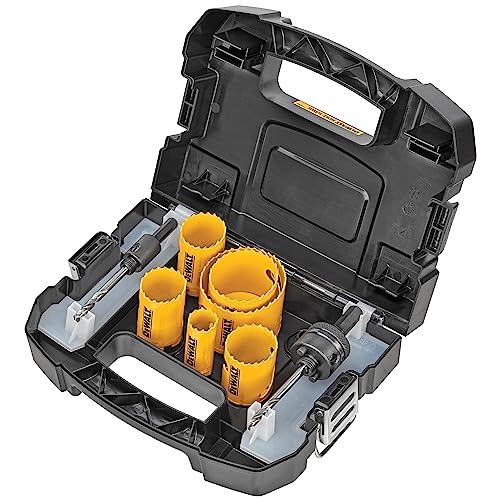
The DEWALT D180002 is purpose-built for the exact work electricians do every day — and its narrow, focused size range is a feature, not a limitation. Rather than including a dozen sizes you’ll rarely use, this kit covers the specific diameters that match conduit knockouts, Romex cable connectors, and standard device box cutouts. If you’re an electrician or do frequent electrical rough-in work, every saw in this kit sees regular use rather than sitting unused in the case.

DEWALT’s bi-metal construction on this set is built for the specific demands of electrical work: cutting through wood studs, drywall, and occasionally thin steel electrical boxes or conduit without excessive tooth wear. The saws bore cleanly through standard 2×4 studs in a single pass — important when you’re running multiple circuits through a wall and need consistent, fast hole placement. The standard threaded arbor system means this kit integrates seamlessly with any other bi-metal saws you already own or add later.

The compact case is sized for a tool bag or truck organizer rather than a full workshop kit — appropriate given that electricians are moving between job sites regularly and don’t want to carry sizes they won’t use. For anyone doing residential or commercial electrical rough-in work, this focused kit is more practical day-to-day than a large general-purpose set with sizes that don’t match your actual work.
Pros
- Size range precisely matched to electrical conduit, Romex, and device box work
- Bores through 2×4 studs in a single pass
- Compact case appropriate for job-site tool bags
- Standard threaded arbor — compatible with other bi-metal saws
- DEWALT build quality and brand reliability
Cons
- Narrow size range unsuitable for general home projects outside electrical work
- Standard bi-metal — not built for stainless or heavy abrasive cutting
Specs
- Type: Bi-metal
- Configuration: Standard electrician’s set
- Size range: 7/8″–2-1/2″ (conduit/box-focused)
- Arbor: Standard threaded
Best for: Electricians and electrical contractors doing regular conduit, Romex, and device box installation who want a focused kit without unused sizes.
3. Milwaukee 49-56-9290 10 PC BIG HAWG Hole Saw w/Carbide Teeth Kit — Best for Heavy-Duty Metal
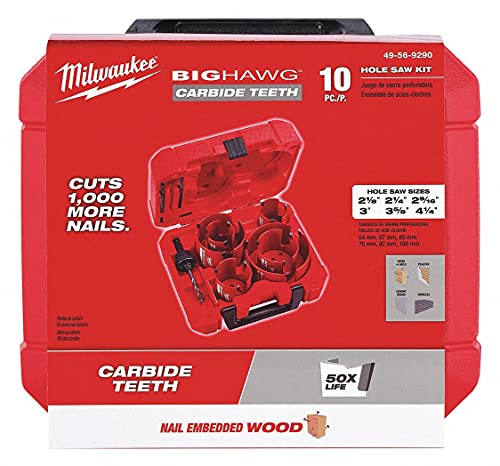
The Milwaukee BIG HAWG line represents a genuine step up in both cutting technology and system design for anyone doing serious metal fabrication work. The carbide teeth hold an edge dramatically longer than bi-metal when cutting stainless steel, cast iron, or heavily abrasive materials — where a bi-metal saw might need replacement after a handful of stainless cuts, the BIG HAWG’s carbide teeth keep cutting cleanly through significantly more material before dulling.

The standout system feature is Milwaukee’s quick-change hex arbor — instead of threading and unthreading each saw onto a standard arbor, the BIG HAWG saws snap onto a hex-drive arbor in seconds. On a job with multiple hole sizes to cut, this speeds up the workflow noticeably compared to traditional threaded systems. The trade-off, worth knowing before you buy: this is a proprietary arbor format. Standard threaded bi-metal saws from other brands won’t work with the BIG HAWG quick-change arbor, and BIG HAWG saws won’t thread onto a standard arbor either. If you buy into this system, future saw purchases need to stay within Milwaukee’s BIG HAWG line to maintain arbor compatibility.
The 10-piece kit covers a solid working range of sizes with the quick-change arbor included, and Milwaukee’s slug ejection design uses multiple leverage points for fast plug removal between cuts — a genuine time-saver on jobs involving many holes. For metal fabricators, HVAC technicians, and anyone whose work regularly involves stainless steel or other hardened, abrasive materials, the carbide teeth and quick-change convenience justify the premium over a standard bi-metal kit.
Pros
- Carbide teeth dramatically outlast bi-metal on stainless and hardened metal
- Quick-change hex arbor speeds up multi-size jobs significantly
- Multiple slug ejection leverage points for fast plug removal
- Genuinely built for heavy-duty, repeated metal cutting
Cons
- Proprietary quick-change arbor locks you into Milwaukee’s BIG HAWG ecosystem
- Premium price relative to standard bi-metal kits
- Overkill for occasional wood/drywall-only use
Specs
- Type: Carbide teeth
- Pieces: 10
- Arbor: Milwaukee quick-change hex (proprietary)
- Best material: Stainless steel, cast iron, hardened metal
Best for: Metal fabricators, HVAC technicians, and tradespeople who regularly cut stainless steel or hardened metal and want the fastest possible size-change workflow.
4. 9-Piece Carbide Hole Saw Kit — Best Carbide Value

This 9-piece carbide-tipped kit delivers the core benefit of carbide cutting technology — long tooth life on hardened and abrasive materials — at a price point well below premium branded carbide sets like the BIG HAWG or Spyder lines. The carbide teeth handle stainless steel, cast iron, and abrasive composite materials with far less wear than any bi-metal saw would show under equivalent use, making this a practical entry point into carbide cutting for anyone who needs it occasionally rather than as their daily primary tool.

The kit uses standard threaded arbor compatibility, which is a meaningful practical advantage over proprietary quick-change systems — these saws will work with arbors you may already own from other bi-metal kits, and any additional saws you add later in standard threading will work with this kit’s included arbor as well. This keeps your overall hole saw investment flexible rather than locking you into one brand’s ecosystem.

For DIYers and occasional professionals who need carbide capability for the occasional stainless steel sink cutout, cast iron pipe penetration, or cement board hole — but don’t cut these materials often enough to justify a premium branded carbide system — this kit provides genuine carbide performance without the premium price or arbor lock-in of the top-tier options.
Pros
- Genuine carbide tooth performance at a budget-friendly price
- Standard threaded arbor — no proprietary system lock-in
- Handles stainless, cast iron, and abrasive composite materials well
- Good entry point into carbide cutting for occasional heavy-material use
Cons
- Build quality and edge longevity below premium branded carbide (BIG HAWG, Spyder)
- Fewer sizes than the largest kits in this guide
Specs
- Type: Carbide-tipped
- Pieces: 9
- Arbor: Standard threaded
- Best material: Stainless steel, cast iron, abrasive composites
Best for: DIYers and occasional professionals who need carbide capability for periodic hardened-metal work without committing to a premium branded system.
5. Diamond Hole Saw Kit – 7pcs (20/35/50/68/100mm) — Best for Tile/Stone
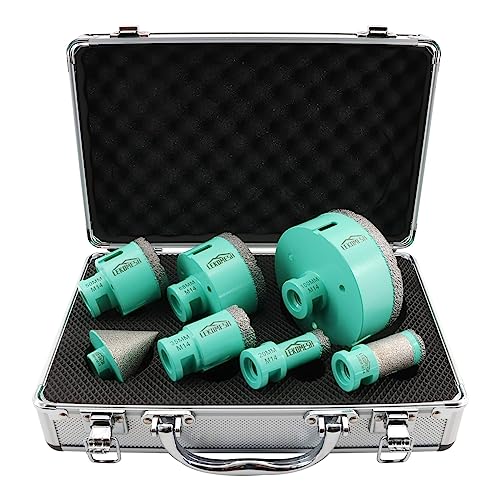
This diamond hole saw kit is purpose-built for the material category where toothed saws simply don’t work: porcelain, ceramic tile, marble, granite, stone, and quartz. The diamond-coated rim cuts by abrasion rather than tooth-biting, which is the only way to bore a clean hole through these hard, brittle materials without cracking or shattering them. The kit covers five practical diameters — 20mm, 35mm, 50mm, 68mm, and 100mm — spanning small plumbing fixture penetrations up to larger recessed fixture or drain cutouts.

Two accessories elevate this kit above basic diamond hole saw sets. The included 25mm drilling cutter handles smaller precision holes that the main saw sizes don’t cover, and the 50mm diamond chamfer bit lets you bevel and smooth the edge of a cut hole — a genuinely useful detail for tile work where a raw cut edge can be sharp or prone to chipping over time. For anyone installing a tile backsplash with outlet or plumbing cutouts, or drilling shower fixture penetrations through porcelain tile, this combination covers the full workflow from rough cut to finished edge.

As with all diamond hole saws, performance and bit life improve dramatically with water cooling during the cut — keep a spray bottle or slow-drip water source running continuously rather than attempting a dry cut, particularly on the larger diameters where heat buildup is more pronounced. Feed pressure should be light; let the diamond grit do the grinding rather than forcing the cut, which risks cracking the tile before the hole is complete.
Pros
- Five practical diameters covering common tile and stone project needs
- Included chamfer bit for clean, beveled finished edges
- 25mm drilling cutter adds small-hole precision capability
- The correct, safe technology for porcelain, ceramic, marble, and granite
Cons
- Requires water cooling for best results and longest bit life
- Not suitable for wood, metal, or general-purpose drilling
Specs
- Type: Diamond
- Pieces: 7
- Sizes: 20/35/50/68/100mm + 25mm drilling cutter + 50mm chamfer bit
- Best material: Porcelain, ceramic tile, marble, granite, stone, quartz
Best for: Tile installers and DIYers cutting fixture, outlet, or drain penetrations through porcelain, ceramic, or natural stone tile.
6. Bi-Metal Hole Saw Kit, HYCHIKA 17 Pcs High Speed Steel — Best Wide Size Range
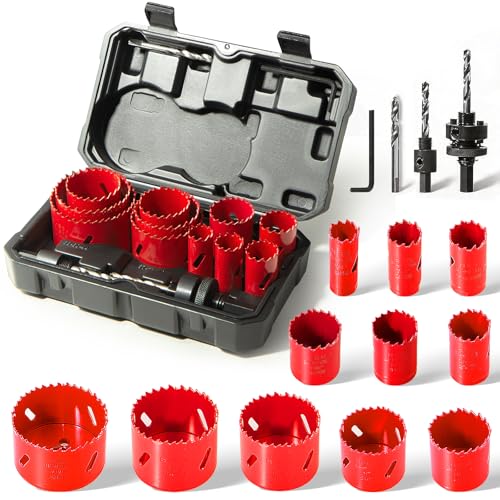
The HYCHIKA 17-piece kit fills the gap between a compact 9-piece set and a full 24-piece mega-kit, covering a genuinely useful 3/4″ to 2-1/2″ size range with enough granularity that you’re rarely stuck between two sizes that don’t quite fit your project. High-speed steel bi-metal construction handles the standard range of wood, drywall, PVC, and thin sheet metal applications that make up the bulk of everyday drilling tasks.

The kit includes a one-size-fits-all arbor system designed to work across the full saw range without needing to swap arbors between different diameter saws — a practical convenience for anyone working through a project that requires several different hole sizes in sequence. Standard accessories are included: spare drill bits for pilot bit replacement, a hex key for arbor adjustment, and a storage case that keeps all 17 pieces organized rather than loose in a toolbox.

This is a strong middle-ground choice for homeowners and general contractors who find a 9-piece kit too limited but don’t need the extensive size coverage (and higher price) of a 24-piece set. The included spare pilot bits are a genuinely useful inclusion — as covered in the buying guide above, pilot bits dull faster than the main teeth and having replacements on hand avoids a mid-project trip to the hardware store.
Pros
- 17 pieces covering a genuinely useful 3/4″–2-1/2″ range without excessive redundancy
- Spare pilot bits included — addresses a commonly overlooked wear point
- One-size arbor system simplifies switching between saw sizes
- Organized storage case keeps all pieces accounted for
Cons
- Standard bi-metal — not suited for stainless or heavily abrasive materials
- No larger sizes for bigger recessed lighting or plumbing projects
Specs
- Type: Bi-metal, high-speed steel
- Pieces: 17
- Size range: 3/4″–2-1/2″
- Includes: Spare pilot bits, hex key, storage case
Best for: Homeowners and general contractors who want broader size coverage than a compact kit without stepping up to a full mega-kit.
7. Luckyway Hole Saw Kit Pro, 24PCS — Best Large Kit / Value
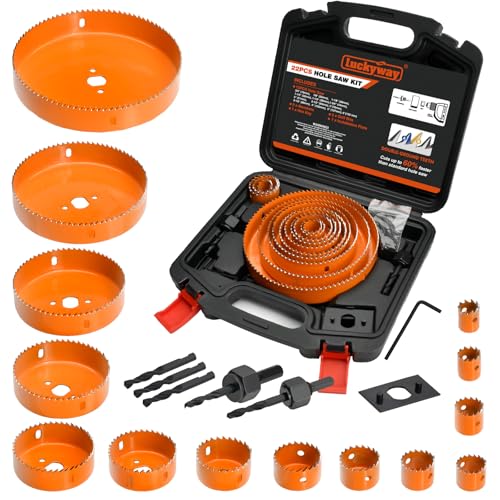
For anyone who wants to buy a hole saw kit once and have virtually every common size on hand for years of future projects, the Luckyway 24-piece kit is the most comprehensive option in this guide. The size coverage spans from small electrical and plumbing diameters up through large recessed lighting and drain-fixture sizes, meaning that whatever project comes up — this weekend or three years from now — there’s a good chance the right size is already in the case.

Bi-metal construction throughout keeps the kit versatile across wood, drywall, PVC, and thin metal applications, and the standard threaded arbor system means every saw in the kit is compatible with arbors you may already own. The value proposition here is straightforward: purchased individually, 24 hole saws covering this size range would cost significantly more than this complete kit, even before accounting for the included arbors, pilot bits, and hex key.

The trade-off with any large kit like this is that you’ll likely use a subset of sizes regularly and rarely touch several others — that’s the nature of comprehensive coverage. For homeowners who do occasional but varied DIY projects, landlords managing multiple properties with unpredictable maintenance needs, or anyone who values having the right size on hand over carrying a minimal kit, the size and value here are hard to beat.
Pros
- Most comprehensive size coverage in this guide — 24 pieces
- Strong value compared to purchasing equivalent sizes individually
- Standard threaded arbor — compatible with other bi-metal saws
- Good long-term investment for varied, unpredictable project needs
Cons
- Bulkiest kit in this guide — larger case, more to store
- Many sizes will see infrequent use for most buyers
- Standard bi-metal — not for stainless or heavily abrasive materials
Specs
- Type: Bi-metal
- Pieces: 24
- Size range: Widest coverage in this guide
- Arbor: Standard threaded
Best for: Homeowners, landlords, and DIYers who want comprehensive size coverage for unpredictable future projects at strong overall value.
8. Diamond Drill Bits Set, 10 PCS Diamond Hole Saw Set — Best Diamond Drill Bit Set
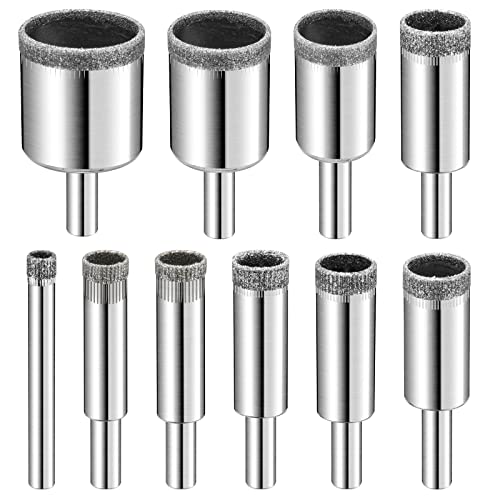
This 10-piece diamond drill bit set fills a different niche than the larger diamond hole saw kit in this guide — rather than larger-diameter hole saws for fixture and drain cutouts, this set focuses on smaller precision diameters suited to glass, ceramic tile, and delicate stone drilling where a large hole saw would be overkill. These smaller diamond bits are the right tool for anything from drilling a small cable pass-through in a glass shower panel to creating mounting holes in a tile or stone surface for hardware.

The hex shank design fits standard drill chucks directly without needing a separate arbor system, which simplifies the workflow for smaller precision holes — chuck the bit directly into your drill and go, rather than assembling an arbor and saw combination. The range of 10 diameters gives you granular size options for matching specific hardware, fixture, or cable diameters precisely rather than settling for the nearest available size in a larger hole saw kit.

As with any diamond cutting tool, water cooling significantly improves both cut quality and bit longevity — for glass in particular, dry drilling risks cracking the material from localized heat buildup around the bit. Use light, steady pressure and let the diamond grit do the cutting work; forcing the bit through the material increases both crack risk and heat-related bit wear. This set is a natural complement to a larger diamond hole saw kit — the larger kit handles fixture-sized cutouts, while this set handles the smaller, more precise holes that come up in glass and tile work.
Pros
- Hex shank fits directly into standard drill chucks — no arbor assembly needed
- 10 diameters for precise matching to hardware and fixture sizes
- Excellent for glass, delicate tile, and small precision stone drilling
- Complements larger diamond hole saw kits for full size coverage
Cons
- Small diameters only — not a substitute for larger fixture/drain cutout saws
- Requires water cooling for best results, particularly on glass
Specs
- Type: Diamond
- Pieces: 10
- Shank: Hex (direct drill chuck fit)
- Best material: Glass, ceramic tile, delicate stone (small diameters)
Best for: Precision drilling in glass, tile, and stone where a small, exact-diameter hole is needed rather than a large fixture cutout.
9. Spyder 18-Piece Tungsten Carbide Tipped Hole Saw Kit — Best Carbide Pro Kit

Spyder has built a strong reputation specifically in the carbide hole saw category, and this 18-piece kit represents the most size-comprehensive carbide option in this guide. Every saw uses tungsten carbide teeth rather than bi-metal, meaning the entire kit — not just a subset of sizes — is built for hardened metal, stainless steel, and abrasive material cutting. For a metal fabrication shop, HVAC contractor, or plumbing professional who needs carbide performance across a wide range of sizes rather than just one or two, this comprehensive carbide coverage is a genuine advantage over smaller carbide sets.

The tungsten carbide construction resists the rapid edge dulling that stainless steel and cast iron cause in standard bi-metal saws, maintaining cutting performance across significantly more holes before requiring replacement. This durability difference becomes financially meaningful quickly in professional use — the reduced frequency of saw replacement offsets the higher upfront cost of carbide within a relatively short period of regular use.

The standard threaded arbor compatibility (rather than a proprietary quick-change system) means this kit integrates with arbors and saws you may already own, and any additional carbide or bi-metal saws you add later in standard threading remain compatible. For professionals who need broad carbide size coverage without committing to a single-brand proprietary arbor ecosystem, the Spyder 18-piece kit is the strongest all-around choice in this guide’s carbide category.
Pros
- Full 18-piece kit entirely in tungsten carbide — no bi-metal compromise sizes
- Widest carbide size coverage in this guide
- Standard threaded arbor — no proprietary system lock-in
- Strong value for professionals doing regular hardened-metal work across varied sizes
Cons
- Premium price reflecting full carbide construction across all 18 pieces
- More kit than needed for buyers who only occasionally cut hard metal
Specs
- Type: Tungsten carbide tipped
- Pieces: 18
- Arbor: Standard threaded
- Best material: Stainless steel, cast iron, hardened and abrasive metals
Best for: Metal fabricators, HVAC and plumbing professionals who need comprehensive carbide size coverage for regular hardened-metal cutting work.
10. BOSCH HDG11 11-Piece Diamond Hole Saw — Best Bosch Diamond Kit
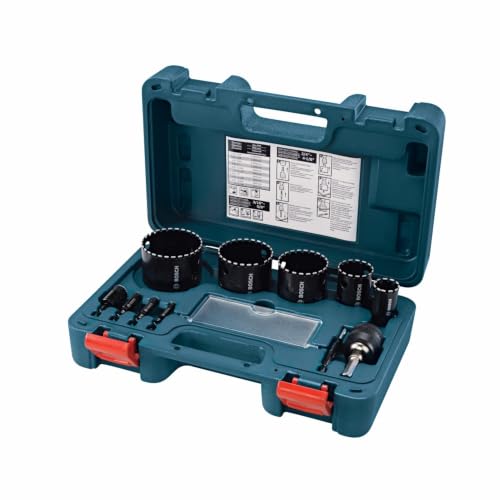
The Bosch HDG11 brings Bosch’s manufacturing quality and brand reliability to the diamond hole saw category, offering 11 pieces of diamond-grit cutting tools sized for common tile, glass, and stone applications. As with Bosch’s bi-metal offerings, the build quality and consistency here reflect a manufacturer with decades of experience in cutting tool engineering — a meaningful consideration in the diamond hole saw category, where bit quality varies enormously between manufacturers and cheap diamond coatings can wear away far faster than advertised.
The kit includes a guide plate accessory that helps stabilize the bit at the start of a cut — diamond hole saws don’t have a pilot drill bit the way bi-metal saws do, so starting the cut cleanly on a smooth, hard surface like porcelain or glass can be tricky without a stabilizing guide. This guide plate addresses that starting-point challenge directly, reducing the tendency for the bit to skate across the tile surface before it bites in, which is one of the most common sources of scratched tile surfaces during diamond hole saw use.

For tile installers, bathroom remodelers, and DIYers who want Bosch’s manufacturing consistency in their diamond hole saw kit rather than an unfamiliar budget brand, the HDG11 is a dependable choice. As with all diamond hole saws, use water cooling for the best cut quality and longest bit life, and let the guide plate do its job stabilizing the starting cut rather than forcing the bit before it’s established a groove.
Pros
- Bosch manufacturing quality and consistency in the diamond category
- Included guide plate stabilizes cut starts on smooth, hard surfaces
- 11 pieces covering common tile, glass, and stone project sizes
- Trusted brand reliability for a category where quality varies widely
Cons
- Premium price relative to generic diamond hole saw kits
- Requires water cooling for best results, as with all diamond bits
Specs
- Type: Diamond
- Pieces: 11
- Includes: Guide plate for stabilized cut starts
- Best material: Porcelain tile, glass, ceramic, stone
Best for: Tile installers and remodelers who want Bosch’s manufacturing reliability and a stabilizing guide plate for clean diamond hole saw starts.
11. Ideal Electrical 36-314 TKO™ Master Electrician’s Kit — Best Master Electrician Kit
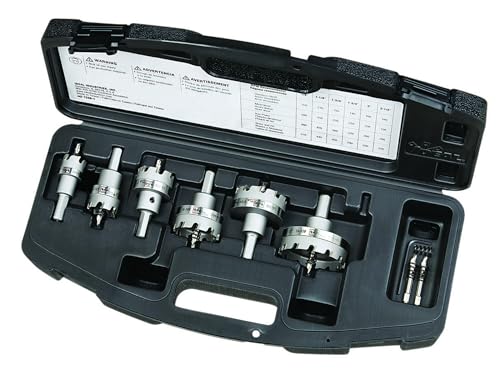
Ideal’s TKO Master Electrician’s Kit is the comprehensive option for electrical professionals who want broader size coverage than a basic electrician’s set while staying focused entirely on electrical-relevant sizes — no wasted saws for tile, no oversized diameters for general home projects. The kit expands meaningfully on the standard electrician’s range, adding sizes for larger device boxes, junction boxes, and specialty electrical fixture cutouts that a basic 3-piece or 6-piece electrician’s kit doesn’t cover.
Ideal Electrical has built its reputation specifically around tools for electrical trade professionals, and the bi-metal construction here is engineered for the repeated, high-volume use pattern of a working electrician — cutting through wood studs, drywall, and occasional thin sheet metal boxes day after day without excessive tooth wear. The standard threaded arbor system integrates with any other bi-metal saws in your kit, and the case is organized specifically around an electrician’s typical workflow of moving between conduit, box, and connector sizes throughout a job.

For a master electrician or electrical contracting business outfitting a crew, this kit provides the comprehensive electrical-specific size range that a basic DEWALT or Klein starter kit doesn’t fully cover, without the wasted expense of a general-purpose kit’s non-electrical sizes. It’s the natural upgrade path for anyone who started with a basic electrician’s kit and found themselves reaching for a size that wasn’t included.
Pros
- Comprehensive electrical-specific size range beyond basic electrician’s kits
- Ideal Electrical’s trade-focused engineering and reliability
- No wasted non-electrical sizes — every saw sees regular use in electrical work
- Standard threaded arbor compatible with other bi-metal saws
Cons
- Not suited for general home projects outside electrical applications
- Standard bi-metal — not for stainless or heavy abrasive cutting
Specs
- Type: Bi-metal
- Configuration: Master electrician’s kit — comprehensive range
- Arbor: Standard threaded
- Brand focus: Electrical trade professionals
Best for: Master electricians and electrical contracting crews who need broader electrical-specific size coverage than a basic starter kit provides.
Speed (RPM) Reference by Material
Running a hole saw too fast is one of the most common causes of premature tooth wear, burned material, and poor cut quality. Match your drill speed to the material you’re cutting.
| Material | Recommended RPM | Notes |
|---|---|---|
| Wood, plywood, OSB | 500–1,000 RPM | Most bi-metal saws perform well across this range |
| Metal (bi-metal or carbide) | 150–300 RPM | Use cutting fluid on metal to reduce heat and extend tooth life |
| Tile / stone (diamond, wet) | Under 800 RPM | Keep water flowing continuously; never run diamond bits dry on tile |
| PVC / plastic | 300–600 RPM | Excess speed generates friction heat that can melt or deform plastic |
Why slower is usually better: running a hole saw too fast generates excess heat at the cutting edge, which dulls teeth prematurely (bi-metal and carbide) or increases crack risk (diamond on brittle materials). If you see smoke or smell burning material, you’re running too fast, applying too much pressure, or both.
Pilot-bit-first technique: mark your center point clearly, then drill the pilot bit fully through the material at a moderate, controlled speed before allowing the saw teeth to fully engage. Pushing the saw teeth into contact before the pilot bit has established the hole causes the entire saw to “walk” across the surface, producing an off-center or oval hole and scratching the surrounding material.
Common Project Size Reference
Not sure what size hole saw a specific project needs? Here’s a practical reference for the most common home and trade applications.
| Application | Typical Size |
|---|---|
| Recessed / can lights | 4″, 5″, 6″ (always verify exact fixture specification before cutting) |
| Standard electrical device boxes | 1-3/4″–2-1/8″ |
| Romex / conduit knockouts | 7/8″, 1-1/8″, 1-3/8″ (matches the standard electrician’s kit range) |
| Door lockset (standard) | 2-1/8″ |
| Deadbolt cross-bore (some hardware) | 1″ |
| PVC / plumbing pipe penetrations | 1-1/2″, 2″, 3″, 4″ (match pipe OD plus clearance) |
| Tile backsplash outlet/switch cutouts | 2″–2-1/2″ (diamond hole saw, sized to device box) |
Technique Guide: Clean Cuts and Removing Stuck Slugs
Starting the Cut
Mark your center point clearly and ensure the pilot bit is fully through the material before allowing the saw teeth to engage under full pressure. Start at a moderate, controlled speed and apply light, steady downward force — let the teeth do the cutting rather than forcing the saw through the material.
Why Slugs Get Stuck
The cylindrical “slug” of material trapped inside the saw body after a cut can jam for a few common reasons: resinous or wet wood swells slightly once cut, increasing friction against the saw body’s interior walls; metal shavings from the cut wedge into the gaps between the slug and the saw wall, increasing friction; and on deep cuts, the slug simply has more surface area in contact with the saw body, requiring more force to dislodge.
Removal Methods
Most kits include a side ejection slot — insert a flathead screwdriver through the slot and pry against the slug to pop it loose. Kits with multiple slots around the body (as found on several kits in this guide, including the Bosch HSBIM9 and Milwaukee BIG HAWG) give you more leverage angle options if the first attempt doesn’t free the slug. Some premium saws include a spring ejector system that automatically pushes the slug free as you withdraw the saw — the fastest method and worth prioritizing if you’re making many cuts in a single job. As a last resort on a stubborn slug, tapping the saw body firmly (teeth-up) against a hard surface can jar it loose, though this should be a backup method rather than routine practice.
Diamond Hole Saw Technique
Keep water flowing continuously throughout the cut — this cools the diamond rim, flushes away ground material (slurry), and significantly reduces crack risk in brittle materials like porcelain and glass. Use light, consistent pressure and periodically back the saw off slightly to let water clear the accumulated slurry from the cut channel. Never force a dry cut on tile or stone if it can be avoided — the combination of heat buildup and lack of lubrication dramatically increases both cracking risk and bit wear.
Deep Cuts and Extension Arbors
When a project requires cutting deeper than your saw’s rated depth — double-stud walls, thick timber, or deep bore applications — attach an extension arbor rather than attempting to force an undersized saw through material it wasn’t designed to fully penetrate. Forcing a shallow saw through material beyond its depth typically results in an incomplete or ragged cut and unnecessary strain on both the saw and your drill.
Frequently Asked Questions
What’s the difference between a bi-metal and carbide hole saw?
Bi-metal saws combine a flexible spring-steel body with a high-speed steel cutting edge — affordable and effective for wood, drywall, PVC, and thin metal, but they dull relatively quickly on hardened or abrasive materials. Carbide-tipped saws braze tungsten carbide teeth onto the cutting rim, holding an edge dramatically longer under abrasive wear from stainless steel, cast iron, and composite materials. Carbide costs more but pays for itself quickly if you’re regularly cutting hard or abrasive material.
Can I use a regular hole saw on tile or porcelain?
No — a standard bi-metal or carbide-toothed hole saw will crack or shatter porcelain, ceramic, and stone almost immediately because these materials are brittle and the tooth-biting cutting action generates stress fractures. You need a diamond hole saw, which cuts by abrasion rather than biting into the material, for any porcelain, ceramic, glass, or natural stone application.
Do I need water when cutting tile with a diamond hole saw?
Water cooling isn’t strictly mandatory for every cut, but it dramatically improves results and is strongly recommended for any job beyond a single quick hole. Water cools the diamond rim, flushes away ground material, and significantly reduces the risk of cracking the tile from heat buildup. Dry-rated diamond bits exist for quick, occasional use without water access, but they wear faster and carry higher crack risk — set up a water source (spray bottle, slow drip, or a guide jig with built-in reservoir) whenever possible.
Why does my hole saw slug get stuck inside?
The cylindrical plug of cut material can jam inside the saw body due to wood swelling from moisture or resin content, metal shavings wedging into the gap between the slug and the saw wall, or simply high friction on deep cuts with more surface contact area. Use the side ejection slot with a flathead screwdriver to pry it free, or look for a saw with a spring ejector system that removes slugs automatically.
What size hole saw do I need for a recessed light?
Most residential recessed/can lights use 4″, 5″, or 6″ openings, but this varies by fixture manufacturer and model — always check the specific installation instructions for your exact fixture before cutting, since an incorrect size can mean the trim won’t seat properly or the housing won’t fit securely.
Can hole saws cut stainless steel?
Yes, but the tooth material matters significantly. Standard bi-metal saws can handle occasional stainless steel cuts with adequate cutting fluid and moderate, controlled speed, but stainless work-hardens quickly and will dull bi-metal teeth fast under repeated use. If stainless steel is a regular part of your work, a carbide-tipped hole saw is a better long-term investment — the carbide teeth resist the rapid edge dulling that stainless causes in standard bi-metal.
What RPM should I use for cutting metal with a hole saw?
150–300 RPM is the general recommendation for cutting metal with a bi-metal or carbide hole saw. Running faster generates excess heat that dulls teeth prematurely and can cause the saw to grab or bind in the material. Use cutting fluid to reduce friction and heat buildup, particularly on stainless steel or thicker metal stock.
Are all hole saw arbors interchangeable between brands?
Most bi-metal and carbide hole saws use a standard 5/8″-18 UNF threaded arbor, which is compatible across most brands including Bosch, DEWALT, and many third-party manufacturers. However, some manufacturers — notably Milwaukee’s BIG HAWG line — use proprietary quick-change hex arbor systems that are not compatible with standard threaded arbors or saws from other brands. Check the arbor system before mixing saws from different product lines, particularly with quick-change systems.
Final Verdict
The right hole saw kit depends primarily on what material you’re cutting and how narrow or broad your project needs are. Here are the clear picks by buyer type:
- Best overall: Bosch HSBIM9 — Progressor variable tooth design, cobalt bi-metal, standard arbor compatibility.
- Best for electricians (basic): DEWALT D180002 — focused size range matched exactly to conduit and box work.
- Best for master electricians: Ideal 36-314 TKO — comprehensive electrical-specific size coverage for professional crews.
- Best for heavy-duty metal: Milwaukee BIG HAWG — carbide teeth with the fastest quick-change arbor system available.
- Best carbide value: 9-Piece Carbide Kit — genuine carbide performance without arbor lock-in or premium pricing.
- Best carbide pro kit: Spyder 18-Piece — the widest all-carbide size range for professional hardened-metal work.
- Best for tile and stone: Diamond Hole Saw Kit 7pcs — five practical diameters plus a chamfer bit for finished edges.
- Best Bosch diamond kit: Bosch HDG11 — trusted build quality with a guide plate for stabilized cut starts.
- Best diamond drill bit set: Diamond Drill Bits Set 10pcs — precision small-diameter drilling for glass and delicate tile.
- Best wide bi-metal range: HYCHIKA 17 Pcs — the sweet spot between compact and comprehensive.
- Best large kit / value: Luckyway 24PCS Pro — the widest general-purpose size coverage for long-term project flexibility.
Whichever kit you choose, match the cutting technology to your material first — bi-metal for wood and general use, carbide for hardened and abrasive metal, diamond for tile and stone — and the rest of the buying decision becomes much simpler.