
A cheap lawn mower doesn’t have to mean a bad one. The gap between a $150 mower and a $700 mower has more to do with runtime, deck width, and how much self-propulsion you’re getting than it does with whether the thing will actually cut your grass. What separates a good budget mower from a frustrating one usually comes down to matching the machine to your yard instead of just buying the cheapest listing you find.
This roundup covers eleven mowers across gas, corded electric, and cordless battery platforms, plus one dethatcher that’s worth having alongside a mower if your lawn has a thatch problem a blade alone won’t fix. We’re organizing these by what yard and use case each one actually fits, not stacking them all against a single “best” pick.
Quick Comparison

| Model | Power Type | Deck Width | Best For |
|---|---|---|---|
| Worx WG752 40V 3-in-1 | Cordless battery | 21″ | Best overall cordless |
| Baikemon 40V 19″ | Cordless battery | 19″ | Best budget cordless |
| GF8A131 Brushless 13″ | Cordless battery | 13″ | Best for tiny yards |
| SENIX 144cc 20″ Push | Gas | 20″ | Best cheap gas mower |
| AMERISUN 144cc 21″ 2-in-1 | Gas | 21″ | Best value gas mower |
| PowerSmart EasyCut 18″ | Gas | 18″ | Lightest gas mower |
| STEELITE 20V 13″ | Corded/battery electric | 13″ | Best with backup battery included |
| Greenworks 40V 16″ Push | Cordless battery | 16″ | Best for seniors |
| Worx 40V 14″ 2-in-1 | Cordless battery | 14″ | Lightest cordless mower |
| Greenworks 80V 21″ Push | Cordless battery | 21″ | Most power on battery |
| YARDMAX 201cc CVT High Wheel | Gas, self-propelled | 22″ | Best for uneven or hilly yards |
| WORX WG850 Dethatcher | Corded electric | 12″ scarifying width | Companion tool, not a mower |
1. Worx WG752 40V 21″ 3-in-1 — Best Overall Cordless

A 21-inch deck on a cordless mower is where a lot of battery-powered machines start to struggle, because wider decks pull more from the battery per pass. The WG752 is rated for up to half an acre on a charge, which lines up with what most suburban lots actually need without forcing you to plan the mow around a mid-yard recharge. The 3-in-1 function means you can mulch, bag, or side-discharge depending on how tall the grass has gotten since your last pass.
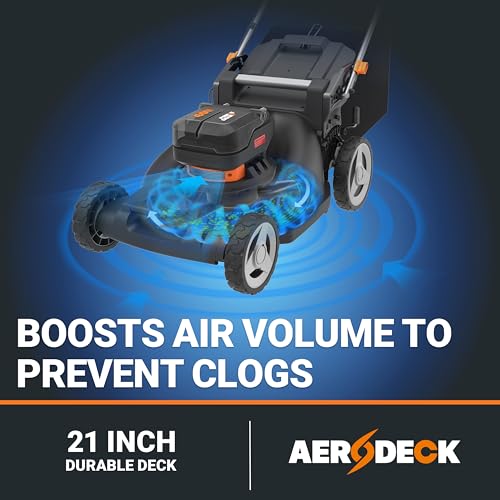
If you’ve let the lawn go two or three weeks longer than you should have, switch to side-discharge for that first pass instead of mulching. Mulching tall, wet clippings into a short mower like this tends to clog the deck, and you’ll spend more time clearing it than you saved skipping the bag.
Bottom Line: The width-to-runtime balance here is the reason it’s the default pick for a typical quarter-to-half-acre suburban yard.
Skip this if: your lot is under a quarter acre — a smaller-deck cordless mower like the Worx 14″ or the GF8A131 will be lighter to push and cost less.
Pros: 21″ deck covers ground fast for a battery mower, 3-in-1 mulch/bag/discharge, no gas or extension cord to manage.
Cons: Half-acre runtime claim assumes moderate grass height and dry conditions — tall or wet grass will pull that number down.
Buy it on Amazon today with FREE returns
2. Baikemon 40V 19″ — Best Budget Cordless
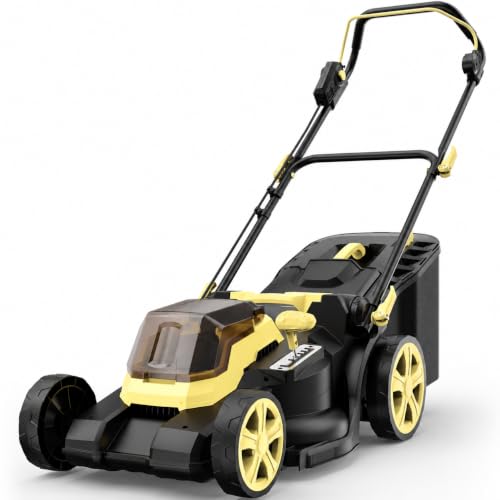
The Baikemon undercuts the Worx and Greenworks cordless options on price while still running a 40V battery platform and a 19-inch deck, which covers most standard residential lots without the premium pricing of the more established brands on this list. It’s a straightforward push mower with no self-propulsion, so expect more effort on inclines than you’d get from the self-propelled gas options here.
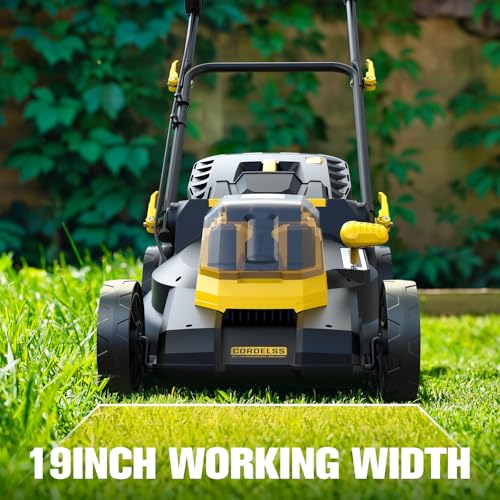
Because it’s a smaller company than Worx or Greenworks, replacement batteries and parts are less widely stocked, so factor that into the long-term cost if the included battery eventually needs replacing.
Skip this if: you want an established brand with easy-to-find replacement batteries down the line — the Worx or Greenworks options on this list have wider parts availability.
Pros: Lower price than comparable 40V cordless mowers, 19″ deck handles standard yards, no gas or cord.
Cons: No self-propulsion. Replacement batteries and parts are harder to source than for bigger brands.
Buy it on Amazon today with FREE returns
3. GF8A131 Brushless 13″ — Best for Tiny Yards
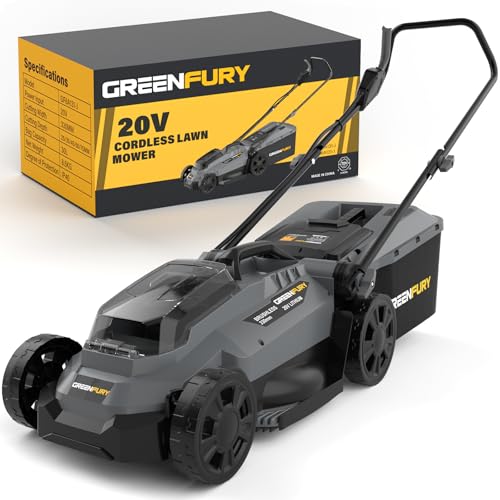
At 13 inches wide, this is the narrowest deck on this list, which sounds like a downside until you’re mowing a small city lot or a strip of grass between a driveway and a fence line. A wide deck on a small, oddly-shaped yard just means more time spent maneuvering around obstacles instead of actually cutting grass. The brushless motor also means less heat buildup and a longer motor life than a brushed equivalent at this price point.
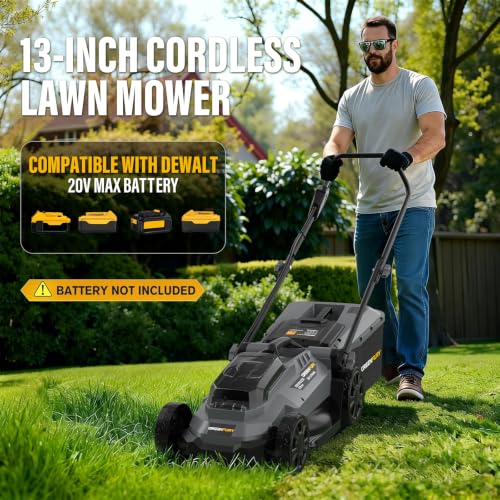
This isn’t the mower for a quarter-acre lot. The narrow deck that makes it maneuverable in tight spaces will mean a lot more passes back and forth on anything bigger than a small front yard.
Skip this if: your yard is bigger than a small city lot — the narrow deck means significantly more time and passes on larger properties.
Pros: Lightweight and maneuverable in tight spaces, brushless motor for longer service life, easy to store.
Cons: 13″ deck is too narrow for anything beyond a small yard. Shorter runtime than the wider-deck cordless models here.
Buy it on Amazon today with FREE returns
4. SENIX 144cc 20″ Push — Best Cheap Gas Mower
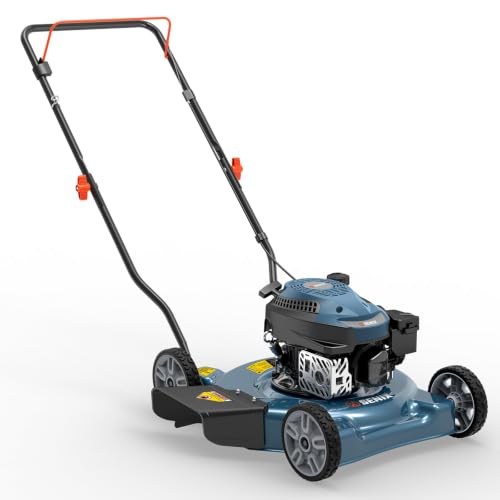
If your yard has thick or wet grass that a battery mower would bog down in, gas power still has an edge, and the SENIX gets you a 144cc engine and a 20-inch deck without the price premium of the bigger-name gas brands. There’s no self-propulsion, so you’re pushing it yourself, but the deck width and engine size are enough for a standard residential lot without straining.
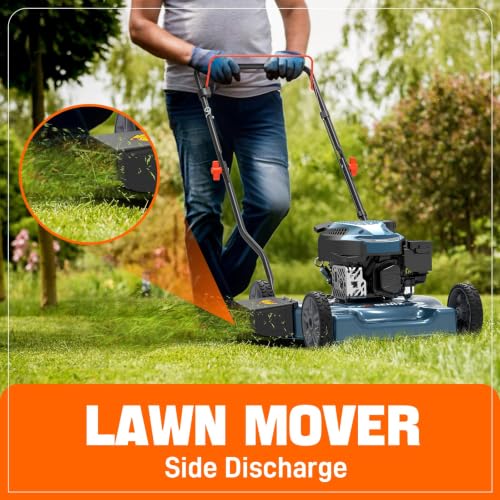
Like any gas push mower, budget for basic maintenance: oil changes, air filter cleaning, and fresh gas if it sits over winter. Skipping that upkeep is what makes cheap gas mowers feel unreliable after a season or two.
Skip this if: you don’t want to deal with oil, gas, and basic small-engine upkeep — a cordless option on this list will be lower-maintenance.
Pros: 144cc engine handles thick or wet grass better than most battery mowers, 20″ deck covers ground efficiently, lower price than name-brand gas mowers.
Cons: No self-propulsion. Requires routine small-engine maintenance to stay reliable.
Buy it on Amazon today with FREE returns
5. AMERISUN 144cc 21″ 2-in-1 — Best Value Gas Mower

The AMERISUN steps up to a 21-inch deck over the SENIX’s 20 inches, which covers more ground per pass on a standard lot. The 2-in-1 mulch/bag function covers the two most common ways homeowners actually manage clippings, without the side-discharge chute you don’t need if you’re not bagging for pickup.

Skip this if: you specifically want side-discharge for clearing tall grass fast — this one is mulch/bag only.
Pros: 21″ deck for faster coverage, mulch and bag functions cover most homeowner needs, competitive price for a 144cc engine.
Cons: No side-discharge option. No self-propulsion, so expect more effort pushing than the self-propelled YARDMAX on this list.
Buy it on Amazon today with FREE returns
6. PowerSmart EasyCut 18″ — Lightest Gas Mower
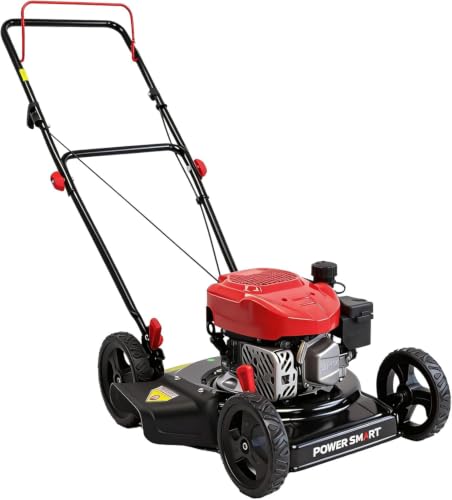
An 18-inch deck is smaller than most gas mowers on this list, which usually means less power, but it also means less weight to push and easier storage if your garage or shed is tight on space. This is the gas option to reach for if you want the cutting power of an engine without the bulk of a full-size 20-21 inch deck.
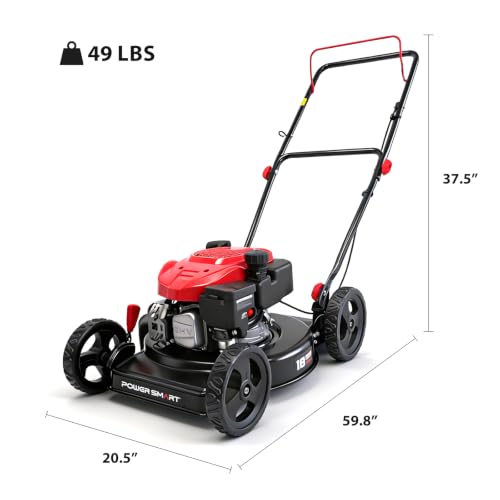
Skip this if: you have a larger yard and want fewer passes — the 20-21″ gas models on this list cover more ground per pass.
Pros: Lighter and easier to push than full-size gas mowers, compact for storage, still gas-powered for thicker grass.
Cons: Smaller 18″ deck means more passes on larger lots. No self-propulsion.
Buy it on Amazon today with FREE returns
7. STEELITE 20V 13″ — Best with Backup Battery Included
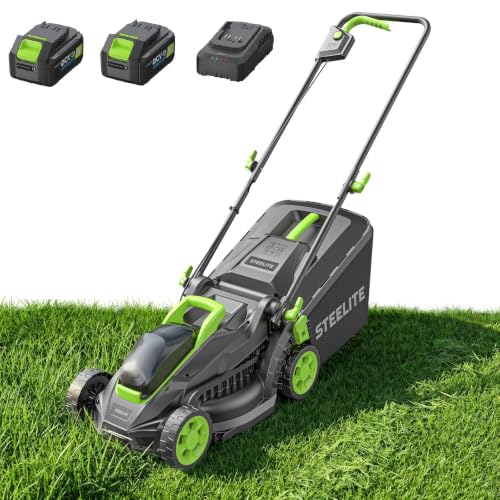
This is the only mower on this list that ships with two batteries instead of one, which matters more than it sounds like on a 20V platform with a narrower 13-inch deck. Lower-voltage cordless mowers tend to run shorter per charge than the 40V and 80V options here, so having a charged second battery ready to swap in means you’re not waiting out a recharge mid-yard.
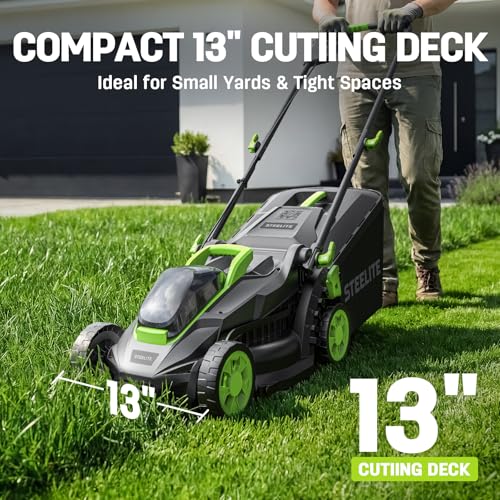
Bottom Line: The included second battery offsets the lower voltage’s shorter runtime, which is the real reason to pick this over a single-battery 20V mower.
Skip this if: you have a yard bigger than a small lot — the 20V platform and 13″ deck are built for small spaces, not acreage.
Pros: Two batteries included so you’re not stuck waiting on a recharge, lightweight 13″ deck, lower price point.
Cons: 20V platform is underpowered for anything beyond a small yard. Narrow deck means more passes.
Buy it on Amazon today with FREE returns
8. Greenworks 40V 16″ Push — Best for Seniors

At 16 inches wide with a 40V battery, this Greenworks sits in the middle ground between the tiny 13″ mowers and the full 21″ decks on this list, which makes it light enough to maneuver without straining but still wide enough to get a small-to-medium yard done in a reasonable number of passes. No pull cord, no gas fumes, and no cord to drag around a yard, which matters more for anyone who’s dealt with the physical strain of a traditional gas push mower.

Skip this if: you need to cover more than half an acre — the smaller battery and deck on this model are built for lighter-duty yards, not large properties.
Pros: Lightweight and easy to maneuver, no pull-start or gas fumes, established Greenworks battery ecosystem for easy replacement.
Cons: 16″ deck means more passes than the wider 21″ cordless options on this list. No self-propulsion.
Buy it on Amazon today with FREE returns
9. Worx 40V 14″ 2-in-1 — Lightest Cordless Mower
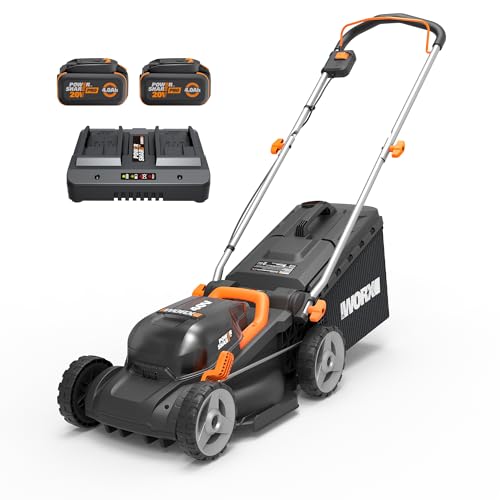
This is the lightest mower on this list by deck size, and it’s built for exactly the kind of small yard or apartment-adjacent patch of grass where a bigger mower would be overkill to store and awkward to maneuver around tight corners. The 2-in-1 mulch/bag function covers what most small-yard owners actually need without the added weight of a discharge chute.
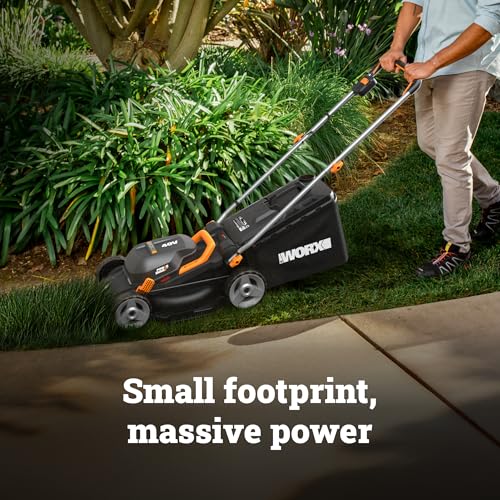
Skip this if: your yard is bigger than a small lot — this is built for compact spaces, not standard suburban acreage.
Pros: Lightest cordless mower on this list, easy to store, simple mulch/bag operation.
Cons: 14″ deck is too narrow for anything beyond a small yard. Shorter runtime than the wider-deck 40V options here.
Buy it on Amazon today with FREE returns
10. Greenworks 80V 21″ Push — Most Power on Battery

Stepping up to an 80V platform gives this Greenworks noticeably more torque than the 40V mowers on this list, which shows up most when you’re cutting thick or overgrown grass instead of a well-maintained lawn. A 21-inch deck paired with that extra power makes this the closest a battery mower on this list gets to gas-mower performance without the maintenance.

Skip this if: budget is the top priority — 80V platforms and batteries cost more than the 40V options on this list.
Pros: More torque than 40V cordless options, 21″ deck for efficient coverage, no gas maintenance.
Cons: Higher price than the 40V mowers on this list. 80V batteries cost more to replace if needed down the line.
Buy it on Amazon today with FREE returns
11. YARDMAX 201cc CVT High Wheel FWD 3-in-1 — Best for Uneven or Hilly Yards
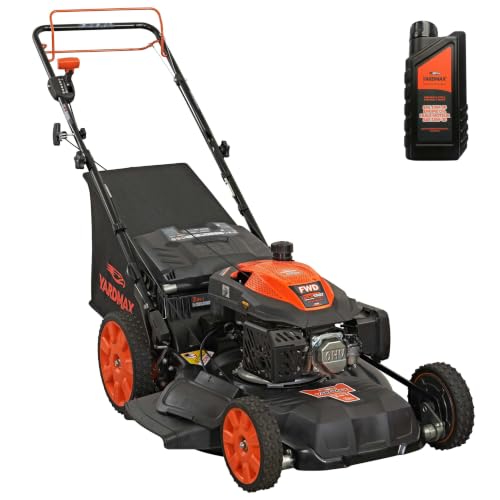
Every other mower on this list is a push mower. The YARDMAX is self-propelled with a front-wheel-drive CVT transmission and six speed settings, which is the real reason to consider it if your yard has slopes, uneven ground, or enough square footage that pushing a mower the whole time becomes a workout you didn’t sign up for. The high rear wheels also handle rougher terrain better than the smaller wheels on the mowers above.
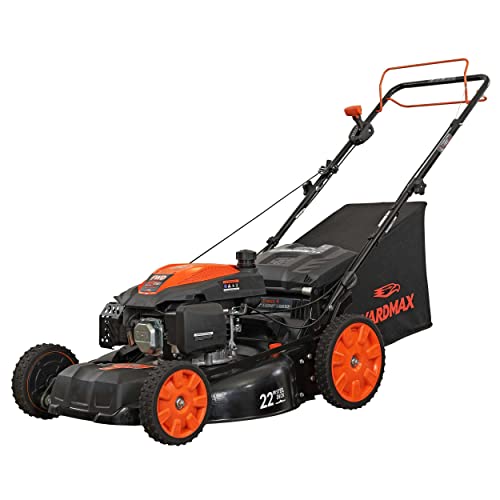
On a flat, small, well-maintained lawn, self-propulsion is a convenience feature you might not need. On a sloped half-acre lot, it’s the difference between mowing being a chore and mowing being a workout you’re too tired for the rest of the day.
Bottom Line: If your yard has any real slope or size to it, the self-propelled drive is worth the jump in price over every push mower on this list.
Skip this if: your yard is small and flat — self-propulsion and the larger 201cc engine are more mower than you need, and a lighter push mower will be easier to store.
Pros: Self-propelled FWD drive with six speeds, handles slopes and uneven terrain well, 3-in-1 mulch/bag/discharge, 22″ deck covers ground fast.
Cons: Heavier and larger than every other mower on this list. Requires the same gas engine maintenance as the other gas models here.
Buy it on Amazon today with FREE returns
12. WORX WG850 Dethatcher — Companion Tool, Not a Mower
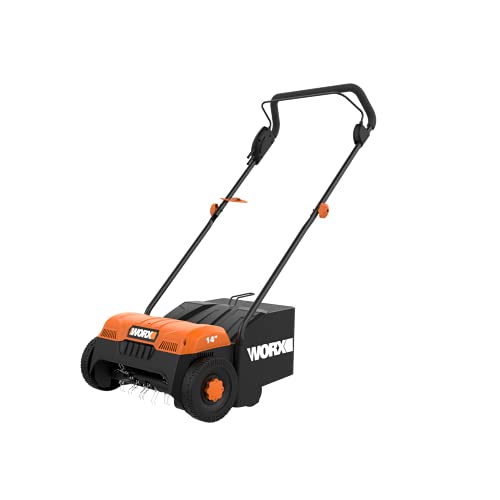
This one doesn’t belong in a “best mowers” ranking because it isn’t a mower, it’s a dethatcher. We’re including it here because a lot of thin, patchy lawns that people blame on their mower are actually a thatch buildup problem that no amount of mowing fixes. The WG850 pulls that dead layer of grass and debris out from between the soil and the living grass so water and nutrients can actually reach the roots.
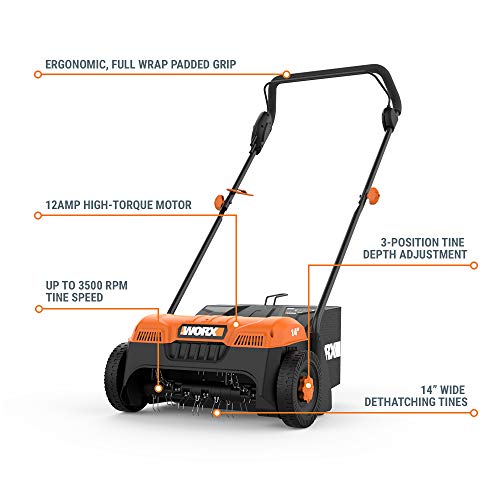
Run this in early spring or fall, not in the middle of summer heat, since pulling up that layer stresses the lawn and it needs cool, wet conditions to recover.
Skip this if: you’re looking for a mower — this won’t cut grass, it’s strictly a lawn health tool used alongside one.
Pros: Fixes thatch buildup that mowing alone can’t address, corded electric means consistent power with no battery to manage, lighter and easier to store than a gas dethatcher.
Cons: Not a substitute for a mower — it’s a seasonal, occasional-use tool. Corded means you’re limited by extension cord reach.
Buy it on Amazon today with FREE returns
Gas vs. Corded Electric vs. Cordless Battery
Gas: Best raw power for thick, wet, or overgrown grass, and no runtime limit as long as you’ve got fuel. The tradeoff is engine maintenance: oil, air filters, spark plugs, and fuel that goes stale if the mower sits over winter without being drained or treated. The SENIX, AMERISUN, PowerSmart, and YARDMAX on this list are all gas.
Cordless battery: No gas, no cord, no maintenance beyond charging. Runtime and power scale with battery voltage — 40V platforms like the Worx and Greenworks mowers here suit standard residential lots, while the 80V Greenworks steps up in torque for thicker grass. The tradeoff is upfront cost and the fact that a dead battery mid-mow means you’re done until it charges, unless you’ve got a spare like the STEELITE includes.
Corded electric: The WG850 dethatcher on this list runs corded, which means consistent power with zero runtime limit, but you’re tethered to an outlet and extension cord reach, which rules it out for anything beyond a small yard.
Buying Guide

Deck Width
13″ to 16″ suits small yards, patios-adjacent strips, and tight spaces where maneuverability matters more than speed. 18″ to 21″ is the standard range for most suburban lots and covers ground efficiently without becoming hard to store. Anything over 21″ starts moving into self-propelled territory, like the YARDMAX, because pushing that much deck unassisted gets tiring fast.
Self-Propulsion
Every mower on this list is a push mower except the YARDMAX. Self-propulsion matters most on sloped or uneven yards, or on lots large enough that pushing the full distance becomes physically demanding. On a small, flat yard, it’s a feature you’re paying for and not using.
Runtime and Battery Voltage
Cordless mower runtime scales with battery voltage and deck width together. A 40V mower with a 21″ deck, like the Worx WG752, will drain faster per pass than the same voltage on a 14″ deck. If your yard is on the larger end for a battery mower, a spare battery, like the one included with the STEELITE, avoids getting stuck mid-mow.
Mulch, Bag, or Discharge
Mulching cuts clippings fine and drops them back into the lawn as natural fertilizer, which works well if you mow regularly and don’t let grass get too tall between cuts. Bagging collects clippings for disposal, which matters if you’re managing a yard where clippings on the surface bother you or the HOA. Side-discharge clears tall or wet grass fast without clogging the deck, which is useful for that first mow after letting the lawn go too long.
Frequently Asked Questions
How big of a yard can a cordless battery mower handle?
Most 40V mowers on this list are rated for up to half an acre on a single charge under normal conditions. Wet or tall grass, hills, and a wider deck all reduce that runtime, so a yard right at that half-acre mark may need a mid-mow battery swap.
Do I need a self-propelled mower for a flat yard?
No. Self-propulsion earns its cost on slopes, uneven terrain, or larger lots. A flat quarter-to-half-acre yard is manageable with any of the push mowers on this list.
How often should I dethatch my lawn?
Once a year is typical for most lawns, done in early spring or fall when the grass can recover from the stress of the process. Lawns with heavy thatch buildup or high-traffic areas may need it more often.
Is a gas or battery mower better for thick grass?
Gas mowers generally handle thick, wet, or overgrown grass better than battery mowers because they don’t lose power as the load increases the way a battery motor can. If your grass regularly gets ahead of your mowing schedule, a gas mower or a higher-voltage battery mower like the 80V Greenworks will handle it better than a lower-voltage cordless mower.
How long do mower batteries last?
Most lithium-ion mower batteries hold a useful charge for several years of regular seasonal use before capacity noticeably declines. Storing the battery at partial charge over winter, rather than fully drained or fully charged, generally extends its lifespan.
Bottom Line
For most standard suburban yards, the Worx WG752 hits the best balance of deck width and cordless runtime. If your lot has slopes or real size to it, the YARDMAX self-propelled is worth the jump in price. Budget-first buyers should look at the Baikemon for cordless or the SENIX for gas. Small yards and tight spaces are better served by the GF8A131 or the Worx 14″. And if your lawn looks thin or patchy no matter how often you mow, pair whichever mower you choose with the WORX WG850 dethatcher to actually fix the underlying problem.


