
The lawn mower category has quietly split into two genuinely different products wearing the same name. A 2026 battery mower with a 60V or 80V system is not a slower, quieter version of a gas mower – independent lab testing now shows more than a dozen tested battery walk-behind mowers outperforming the top-rated gas model on cutting evenness, mulching, and bagging performance. Meanwhile, gas mowers retain a real and specific advantage: unlimited runtime with zero charging downtime, which still matters on large properties and during the thick, fast growth weeks of spring.
This guide covers eleven of the best lawn mowers available – gas push mowers, three distinct battery voltage classes, two cross-platform models that run on batteries you may already own from Dewalt or Makita tools, and a flail mower for the overgrown-lot scenario that no rotary mower should ever be asked to handle. We cover what competing roundups consistently skip: a plain-language way to compare gas engine displacement against battery voltage, the real mechanical difference between front-wheel and rear-wheel self-propelled drive, an honest 10-year cost comparison between gas and battery ownership, and a direct explanation of when you need a flail mower instead of a rotary mower.

Quick answer: The EGO POWER+ is the best overall pick for most mid-size lawns. The Greenworks 80V Self-Propelled is the right choice for half-acre-plus properties. The SENIX 201cc 3-in-1 delivers the most raw power for thick grass and overgrowth among gas options. The MechMaxx 27″ Flail Mower is the correct tool — not a rotary mower — for reclaiming an overgrown lot. Read the full guide below to match your specific yard to the right machine.
Quick navigation: Gas vs. Battery — What Testing Shows | CC vs. Voltage Explained | FWD vs. RWD Self-Propelled | Battery Platform Compatibility | Flail vs. Rotary | Runtime Table | 10-Year Cost Comparison | Comparison Table | Full Reviews | FAQs
Gas vs. Battery in 2026 – What Independent Testing Actually Shows

The gas-versus-battery debate has shifted meaningfully in the last few years, and the data backs it up. Independent lab testing across dozens of models found that more than a dozen of the best battery walk-behind mowers currently tested now beat the top-rated gas model on overall performance — cutting evenness, mulching quality, bagging, and handling. This is not a marginal or close result in every category; in several head-to-head comparisons, battery models scored decisively higher.
The average tested battery walk-behind mower now runs 45 to 50 minutes per charge — and because the majority of new-build American homes sit on lots under a quarter acre, that runtime comfortably covers the typical lawn in a single charge, including sloped sections.
Where gas still wins decisively:
- Zero downtime. Refuel and keep mowing — no recharge wait, which matters most for large properties or when you need to finish a job in one sitting regardless of size.
- Large acreage. For half an acre and above, sustained gas power without runtime anxiety remains the simpler choice unless you commit to a swappable-battery system.
- Sustained torque in heavy growth. Thick, wet, or significantly overgrown grass rewards a gas engine’s ability to maintain blade speed under heavy load for as long as needed.
Where battery wins decisively:
- Noise. Measurably quieter at the operator’s ear in independent testing — relevant for early morning mowing, HOA noise rules, and reduced fatigue.
- Maintenance. No oil changes, spark plugs, air filters, or fuel stabilizer — blade sharpening is essentially the only required upkeep.
- Storage footprint. Many battery mowers fold and stand vertically, a meaningful space saver in a garage or shed compared to a gas mower that must stay wheels-down.
- Total cost of ownership. Once fuel and annual maintenance accumulate, the higher upfront price of a battery mower is frequently recovered within just a few years.
CC vs. Voltage – How to Compare Power Across Gas and Battery

This is the comparison almost no buying guide attempts, and it is the reason so many shoppers cannot tell whether a “60V” mower is actually as strong as the “160cc” gas mower they are also considering. Voltage describes the battery system’s electrical output — it is not a direct, one-to-one measure of cutting power on its own. The more honest comparison point is torque, but since most listings still lead with voltage or cc displacement, here is the practical equivalence range based on real-world performance testing.
| Gas Engine Class | Approximate Battery Equivalent | Best Suited For |
|---|---|---|
| 125–140cc | 40V entry-class | Small flat lawns, light regular cutting |
| 150–160cc | 56–60V mid-class | Most homeowner lawns, moderate overgrowth tolerance |
| 170–196cc | 60–80V upper-class / “Pro” rated torque | Larger lawns, thicker grass, occasional missed-week overgrowth |
| 200cc+ | 80V+ premium / commercial-adjacent torque | Heavy growth, larger properties, minimal performance compromise vs. gas |
A real example from independent testing illustrates why torque matters more than the voltage number alone: one tested battery mower delivered more torque than a competing name-brand “Fuel”-tier battery mower, despite carrying a slightly lower gas-equivalent cc rating on paper. Torque — not voltage, and not the cc-equivalent marketing number — is what actually determines whether a mower bogs down in thick grass or keeps cutting cleanly.
Direct buying rule: don’t compare mowers by voltage number alone. A 40V mower from one brand and a 60V mower from another can have closer real-world cutting performance than the voltage gap suggests, or a wider gap than expected, depending on motor and battery cell quality. Check the torque specification or cc-equivalent rating whenever it’s published, rather than assuming higher voltage always means proportionally more cutting power.
Front-Wheel Drive vs. Rear-Wheel Drive Self-Propelled Mowers

Self-propelled mowers use one of two drive configurations, and the difference is mechanical, not cosmetic — it directly affects how the mower handles on your specific yard.
Front-Wheel Drive (FWD)
Power is delivered to the front wheels, which pull the mower forward. This makes turning at the end of a row noticeably easier — lifting the rear of the deck slightly disengages the drive resistance, letting you pivot the mower around a tree, bed, or obstacle with less effort than a rear-drive system. FWD is the better choice for flat to gently rolling lawns with a lot of turning, trimming around obstacles, and navigating tight spaces between landscaping features.
Rear-Wheel Drive (RWD)
Power is delivered to the rear wheels, which push the mower forward while the front wheels are pulled along. Because the engine or motor’s weight sits directly over the rear-drive wheels, RWD presses those wheels into the ground with more downward force — translating to meaningfully better traction on slopes, uneven ground, and thicker or wetter grass where wheel slip becomes a real risk with FWD.
Practical decision rule: if your lawn is flat with many turns around beds, trees, and obstacles, prioritize FWD for ease of maneuvering. If your lawn has any real slope or uneven terrain, prioritize RWD for traction. This specification is not always obvious from marketing copy — confirm the drive type directly on the product listing or manufacturer spec sheet before buying if it matters for your specific yard.
Battery Platform Cross-Compatibility — The Money-Saving Factor Almost Nobody Explains
Most cordless tool owners already have batteries sitting in a garage from a drill, an impact driver, or a string trimmer on a specific platform — Dewalt 20V MAX, Makita 18V LXT, Ego, Ryobi, and others. A growing category of lawn mowers is specifically engineered to accept batteries from a major tool platform, rather than locking you into a brand-proprietary mower-only battery purchase. This is one of the highest-value purchase factors in this entire category, and it is almost never addressed directly in competing reviews.
Two configurations exist in this roundup:
- Native dual-battery slot designs: a third-party mower brand builds dual battery slots that accept two of a major brand’s standard tool batteries — for example, two Dewalt 20V MAX packs combining to deliver 40V output. The mower itself is not made by Dewalt, but it runs on the batteries you may already own from Dewalt drills, saws, or other tools.
- Same-brand crossover: the mower manufacturer’s own battery ecosystem already spans drills, saws, and other tools, so existing owners of that brand’s batteries add the mower at effectively tool-only pricing — Makita’s 18V LXT platform, used in the Makita mower in this roundup, is one of the largest battery ecosystems in the world.
The real savings are significant: a replacement battery pack for a proprietary mower-only system commonly costs $150–$300. If you already own two to four compatible packs from other tools, that cost is effectively eliminated from the mower purchase entirely.
Direct buying rule: before purchasing any cordless mower, check what battery platform you already own across your other power tools, and specifically look for cross-compatible models if a match exists. This single factor can be the biggest cost variable in your entire purchase decision — more significant than the sticker price difference between competing mowers.

Swappable / Removable Battery Systems vs. Fixed Onboard Batteries
Most battery mowers have a battery that slots in and stays mounted on the deck as the sole power source for that specific mowing session. A newer design approach instead uses a large-capacity removable battery pack — commonly in the 12Ah range — that can be swapped for a second, fully charged pack mid-job, extending a single mowing session indefinitely in a way that more closely resembles refueling a gas mower than charging a typical battery mower.
The advantage is direct: it removes the single biggest limitation of battery mowers — finite runtime — for large lawns or time-pressured mowing sessions, without sacrificing the lower maintenance and quieter operation that battery power provides. The tradeoff is real too: a second battery pack is an added cost on top of the mower itself, and mowers built around this swappable approach are typically positioned at a premium price point reflecting that added capability.
Best for: larger lawns where a single charge doesn’t comfortably finish the job in one pass, or households who want gas-like flexibility for finishing a job in one sitting without taking on gas-engine maintenance.
When Do You Need a Flail Mower Instead of a Rotary Mower?
This is a distinction that almost no lawn mower buying guide addresses, and it matters significantly for anyone dealing with a genuinely overgrown property rather than a maintained lawn.
A standard rotary mower — gas or battery, push or self-propelled, every other product in this roundup — uses one or more blades spinning on a horizontal plane. This is efficient and correct for a maintained lawn cut regularly at normal grass height. It is not the right tool for heavy brush, small saplings, thick weeds, briars, or grass that has grown well beyond 6–8 inches, because a rigid rotary blade can stall, clog, or be physically damaged trying to process that volume and density of material in a single pass.
A flail mower uses many small blades mounted on a horizontal rotating shaft, with each blade swinging independently rather than being fixed rigidly to the deck. This design handles thick brush, briars, small saplings, and severely overgrown vegetation that would stall or jam a rotary deck almost immediately. Flail mowers also produce a finer mulch from woody material than a rotary blade can, and the independently-pivoting blades can deflect on hard impact — striking a rock or a buried obstacle — rather than transferring the full force back through a rigid blade the way a rotary mower does, which is a meaningful safety advantage on rough or unfamiliar terrain.
Direct buying rule: if your property is a maintained lawn that gets mowed regularly, a rotary mower — gas or battery — is the correct tool, full stop. If you are clearing an overgrown lot, reclaiming a neglected property, managing pasture edges, or regularly dealing with vegetation taller than 8–10 inches with woody stems, the MechMaxx flail mower reviewed in this guide is the right category of tool. Pushing any rotary mower in this roundup into that role will typically result in stalling, clogging, or outright blade damage — this is not a power problem that a stronger rotary mower solves, it is a fundamentally different cutting mechanism problem.
Real-World Runtime — How Much Lawn Can You Actually Mow on One Charge?
| Battery Class | Typical Runtime | Approximate Lawn Coverage |
|---|---|---|
| 40V | 30–40 minutes | Up to roughly 1/4 acre |
| 56–60V | 40–50 minutes | 1/4 to 1/3 acre |
| 80V | 45–60+ minutes | 1/3 to 1/2 acre or more |
| Swappable / removable battery (with a spare on hand) | Effectively unlimited with battery swaps | Any size, limited only by the number of charged spare packs available |
Independent testing puts the average battery walk-behind mower’s runtime at 45 to 50 minutes per charge — sufficient for the average new-build American lawn, which now sits under a quarter acre on most newly developed residential lots, even accounting for some sloped terrain.
Direct tip: if your lawn regularly takes longer than your mower’s rated runtime, don’t assume you’ll simply “finish it next charge.” Either buy a second battery, choose a swappable-battery model like the Honda reviewed below, or step up a voltage class. Interrupted mowing across two separate sessions produces uneven results when grass dries or grows differently between the two passes — it is a real practical problem, not just an inconvenience.
Total Cost of Ownership — Gas vs. Battery Over 10 Years
| Cost Factor | Gas Mower | Battery Mower |
|---|---|---|
| Upfront price | Lower — often $200–$400 | Higher — often $350–$700+ |
| Annual fuel / electricity | ~$40–$80/year | ~$5–$15/year |
| Annual maintenance | Oil change, spark plug, air filter, blade sharpening (~$30–$60/year plus your time) | Blade sharpening only (~$10–$20/year) |
| Battery replacement | N/A | Typically one replacement needed within 10 years ($100–$300) |
| 10-year estimated total | Notably higher once fuel and maintenance accumulate | Often lower overall, despite the higher upfront cost |
A documented industry cost analysis found that fuel and maintenance savings on battery mowers can outweigh the higher upfront price within just a few years of ownership. This math favors battery most clearly for small-to-mid lawns mowed weekly through the growing season. For very large properties already well-served by an efficient gas mower, the cost gap narrows, since fuel cost per session scales with mowing time regardless of mower type and the upfront battery premium is harder to recover proportionally on a bigger investment.
Maintenance Checklist — What Changes Between Gas and Battery
Gas Mower Seasonal Maintenance
- Change oil at the start of each season, or per the manufacturer’s hour interval
- Replace or clean the air filter
- Replace the spark plug annually or per the recommended interval
- Stabilize or drain fuel before off-season storage
- Sharpen and balance the blade one to two times per season
- Clean dried clipping buildup from the underside of the deck regularly
Battery Mower Maintenance
- Sharpen the blade one to two times per season — same requirement as a gas mower
- Clean clipping buildup from the underside of the deck regularly
- Store the battery at room temperature — never in extreme heat or cold
- Avoid fully draining the battery before long-term storage; follow the manufacturer’s recommended storage charge level
- No oil, no spark plug, and no fuel system maintenance required at all
Mulching vs. Bagging vs. Side-Discharge — Practical Guidance
Mulching finely chops clippings and returns them to the lawn as a natural fertilizer source. It is the best mode for regular weekly mowing where clippings stay short, and it reduces both yard waste and the lawn’s overall feeding needs across a season.
Bagging collects clippings for disposal or composting. It is necessary when clippings have grown long after a missed mowing week, when seed heads or weeds need physical removal rather than redistribution across the lawn, or simply when a more immediately manicured appearance matters for the day.
Side-discharge ejects clippings out the side of the deck without collecting them. This is the fastest and least clog-prone option for tall, thick, or wet grass, though it leaves visible rows of clippings on the surface that need raking or a follow-up mulching pass for a fully clean look.
Most “3-in-1” mowers — including several reviewed in this guide — allow switching between all three modes. Buying a 3-in-1 model gives you the flexibility to match the mode to that specific mowing day’s grass condition, rather than committing permanently to a single approach regardless of how the lawn looks that week.
Noise — Why It Matters Beyond Personal Annoyance
Battery mowers run measurably quieter at the operator’s ear than gas mowers, confirmed across independent lab testing. The practical implications go beyond comfort: early morning or evening mowing is far more neighbor-friendly with a battery mower, some HOAs and municipalities enforce time-of-day noise ordinances that are easier to comply with on a quieter machine, and extended mowing sessions are less fatiguing without needing hearing protection. For any gas mower rated as unsatisfactory or less than satisfactory for noise in independent testing, wearing hearing protection during operation is a reasonable, practical step rather than an overreaction.
Storage Footprint — An Underrated Practical Factor
Many battery mowers support vertical fold-and-stand storage, reducing their garage or shed footprint significantly compared to a gas mower, which must generally remain wheels-down because of its fuel and oil systems. This is directly relevant for buyers with limited garage space, a small shed, or a townhome storage situation where every square foot of floor space counts. Before assuming this applies universally, check whether a specific battery model explicitly supports vertical storage — not every design folds flat safely, and forcing a non-rated mower into a vertical position can risk oil or fluid leakage in hybrid designs, or simple instability and tipping.
Quick Comparison — All 11 Lawn Mowers at a Glance
| Model | Power Type | Power Class | Deck Size | Drive | Best For | Buy |
|---|---|---|---|---|---|---|
| PowerSmart EasyCut 18″ | Gas | Entry cc | 18″ | Push | Best Budget Gas / Small Yards | View → |
| SENIX 201cc 22″ 3-in-1 | Gas | 201cc — pro-level | 22″ | Push, 3-in-1 | Best Gas for Overgrowth / Power | View → |
| Houselife 40V (Dewalt-compatible) | Battery — cross-platform | 2× Dewalt 20V MAX = 40V | — | Push | Best for Existing Dewalt Owners | View → |
| ★ EGO POWER+ | Battery — premium | 56V-class | — | Self-propelled | Best Overall | View → |
| Greenworks 80V 21″ Self-Propelled | Battery — top class | 80V | 21″ | Self-propelled | Best for Half-Acre+ Lawns | View → |
| Honda HRX-BE 21″ (12Ah) | Battery — premium swappable | High-capacity 12Ah | 21″ | Self-propelled | Best Premium / Swappable Battery | View → |
| WORX Nitro 21″ | Battery — mid-range | Nitro-class | 21″ | Self-propelled | Best Mid-Range Value Battery | View → |
| Makita XML09Z 36V (18V×2 LXT) | Battery — cross-platform | 2× 18V LXT = 36V | — | Self-propelled | Best for Existing Makita Owners | View → |
| NovorikX 60V 5Ah Self-Propelled | Battery — budget | 60V | — | Self-propelled | Best Budget Self-Propelled | View → |
| MechMaxx 27″ Flail Mower | Specialty — flail | — | 27″ | Walk-behind | Best for Overgrown Lots / Brush | View → |
| BILT HARD 201cc | Gas | 201cc — pro-level | 21″ | Push | Best Budget Gas with Pro Engine | View → |
The 11 Best Lawn Mowers of 2026 — Full Reviews
1. PowerSmart EasyCut 18-Inch Gas Lawn Mower — Best Budget Gas for Small Yards
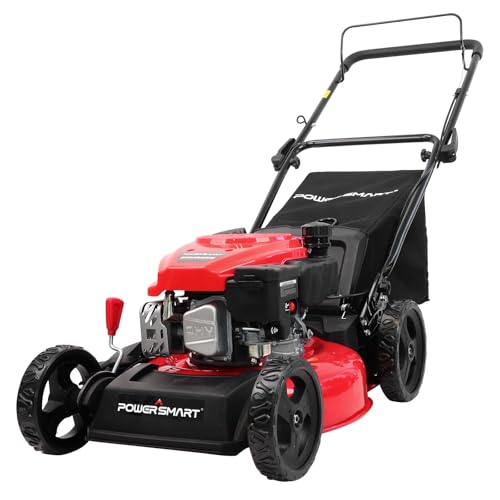
The PowerSmart EasyCut is the most compact gas mower in this roundup, built specifically around an 18-inch deck for buyers with small or narrow yards where a full-size 21–22 inch deck offers no real advantage and only adds bulk and weight. For a small property mowed regularly without serious overgrowth concerns, this is a straightforward, accessible gas mower that gets the basic job done without the cost or complexity of a larger pro-level engine.

| Key Specifications | |
|---|---|
| Power Type | Gas |
| Deck Size | 18 inches |
| Drive Type | Push |
| Best Lawn Size | Small yards |

What we like:
- The 18-inch deck is genuinely correctly sized for small yards — a smaller deck is easier to maneuver around tight beds, narrow side yards, and compact urban or townhome lots than the 21–22 inch decks most other mowers in this roundup use.
- Gas power means no charging downtime or runtime anxiety, even on a small lawn — start it, mow, and you’re done in one pass with no battery management required.
- Accessible entry price point for a gas mower, appropriate for a property that does not need a pro-level 200cc engine.
What to know:
- As with any gas mower, factor in the seasonal maintenance checklist covered earlier in this guide — oil changes, spark plug replacement, and fuel stabilization are ongoing requirements that a battery mower does not carry.
Best for: Small yards and narrow lots where an 18-inch deck is the right fit, and buyers who want straightforward, accessible gas power without pro-level engine displacement or pricing.
→ Check Current Price on Amazon
2. SENIX 201cc 22″ 3-in-1 Gas Lawn Mower — Best Gas for Overgrowth and Maximum Power

The SENIX 201cc sits at the pro-level engine displacement tier described in the cc-to-voltage comparison earlier in this guide — 200cc-plus is the class that handles heavy growth and larger properties with minimal performance compromise, and the SENIX delivers exactly that. Paired with a 22-inch deck and genuine 3-in-1 capability (mulch, bag, or side-discharge), it is the strongest, most versatile gas mower in this roundup for anyone dealing with thick grass, a missed mowing week, or a larger lawn where raw sustained power matters more than any other single specification.

| Key Specifications | |
|---|---|
| Power Type | Gas — 201cc engine |
| Deck Size | 22 inches |
| Modes | 3-in-1 — mulch, bag, side-discharge |
| Best Lawn Size | Larger lawns, thick or overgrown grass |

What we like:
- 201cc places this firmly in the pro-level power tier — per the cc-to-voltage comparison table earlier in this guide, this displacement class is the gas equivalent of 80V-plus premium battery torque, meaning minimal performance compromise even in heavy or overgrown grass.
- Genuine 3-in-1 versatility means you can mulch on a normal weekly cut, switch to bagging after a missed week when clippings are long, or side-discharge through especially thick or wet grass without clogging — matching the cutting mode to the day’s actual grass condition rather than being locked into one approach.
- 22-inch deck covers more ground per pass than the smaller 18-inch and 21-inch decks elsewhere in this roundup, meaningfully reducing total mowing time on a larger property.
What to know:
- This is a gas mower at the higher-power end of this roundup — expect the full gas maintenance schedule (oil, spark plug, air filter, fuel management) rather than the minimal upkeep of a battery model.
Best for: Larger lawns, thick or fast-growing grass, occasional overgrowth from a missed mowing week, and buyers who specifically want maximum gas power and full mulch/bag/discharge flexibility.
→ Check Current Price on Amazon
3. Houselife 40V Cordless Lawn Mower (Dewalt 2×20V MAX Compatible) — Best for Existing Dewalt Battery Owners
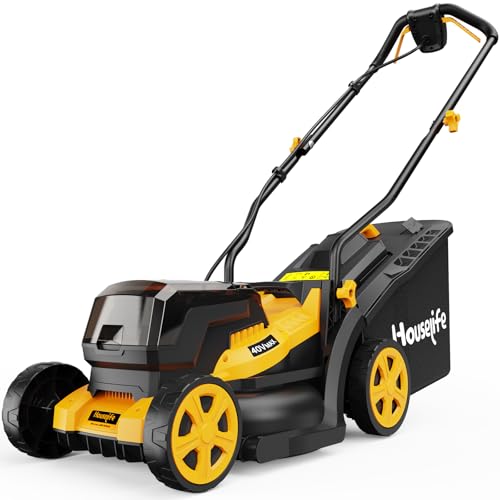
The Houselife 40V is the direct embodiment of the battery cross-compatibility advantage explained earlier in this guide — it runs on two standard Dewalt 20V MAX batteries combined to deliver 40V output, rather than requiring a proprietary mower-only battery purchase. For the enormous population of homeowners who already own Dewalt 20V MAX drills, impact drivers, or other tools, this mower can be added to the collection at effectively tool-only pricing, sidestepping one of the biggest hidden costs in the cordless mower category entirely.

| Key Specifications | |
|---|---|
| Power Type | Battery — cross-platform |
| Battery Compatibility | 2× Dewalt 20V MAX batteries = 40V combined output |
| Drive Type | Push |
| Platform | Dewalt 20V MAX — one of the largest cordless tool platforms |

What we like:
- Real, significant savings for existing Dewalt 20V MAX owners. A replacement battery pack for a proprietary mower-only system commonly costs $150–$300 — if you already own two compatible Dewalt 20V packs from a drill or saw, that cost is effectively eliminated from this purchase.
- Dewalt 20V MAX is one of the largest cordless tool battery platforms on the market, meaning a large share of DIY homeowners and tradespeople already have compatible batteries sitting in a garage or toolbox.
- 40V combined output places this in the mid-class power tier per the cc-to-voltage comparison earlier in this guide — comparable to a 150–160cc gas engine, sufficient for most homeowner lawns with moderate overgrowth tolerance.
What to know:
- If you do not already own Dewalt 20V MAX batteries, factor the cost of acquiring two packs into your total purchase price comparison — the cross-platform advantage is specifically for existing Dewalt owners, not a universal discount.
Best for: Homeowners and DIYers who already own Dewalt 20V MAX batteries from other tools and want to add lawn mowing capability without purchasing a proprietary mower-only battery system.
→ Check Current Price on Amazon
4. EGO POWER+ Electric Lawn Mower — Best Overall ★

The EGO POWER+ earns the best overall position in this roundup through the combination of strong, consistent cutting performance, genuine self-propelled ease of use, and one of the most established and trusted brand reputations in the battery mower category. EGO’s broader ecosystem — string trimmers, leaf blowers, chainsaws, and more, all sharing the same battery platform — means a single battery investment extends well beyond the mower itself, addressing the cross-compatibility advantage covered earlier in this guide from within a single premium brand rather than across third-party platforms.

| Key Specifications | |
|---|---|
| Power Type | Battery — premium 56V-class |
| Drive Type | Self-propelled |
| Ecosystem | EGO POWER+ — shared battery across trimmers, blowers, and more |
| Best Lawn Size | Small to medium-large lawns |

What we like:
- Independently tested as a top performer among battery mowers for cutting power, mulching quality, and overall handling — EGO consistently ranks among the highest-scoring battery mowers in independent lab comparisons against both gas and battery competitors.
- Self-propelled operation significantly reduces physical effort on anything beyond a very small lawn, letting the drive wheels do the forward work rather than requiring you to push the full deck weight through grass.
- EGO’s shared battery ecosystem across trimmers, blowers, and chainsaws means a single battery investment pays dividends across your entire outdoor power tool collection, not just the mower.
- 56V-class power places this solidly in the mid-to-upper power tier per the cc-to-voltage comparison earlier in this guide, comfortably handling moderate overgrowth without bogging down.
What to know:
- Premium pricing relative to entry-level battery mowers in this roundup — justified by the consistent top-tier independent test performance and broader ecosystem value, but a real factor for strictly budget-focused buyers.
Best for: Most homeowners with small to medium-large lawns who want the most reliable, best-tested all-around battery mower available, especially those who already own or plan to invest in other EGO POWER+ outdoor tools.
→ Check Current Price on Amazon
5. Greenworks 80V 21″ Self-Propelled Cordless Lawn Mower — Best for Half-Acre-Plus Lawns

The Greenworks 80V sits at the top of the battery voltage classes covered in this guide’s runtime table — 80V systems typically deliver 45 to 60-plus minutes of runtime and comfortably cover a third to half an acre or more on a single charge, the largest realistic coverage of any non-swappable battery mower in this roundup. Paired with a 21-inch self-propelled deck, this is the correct battery mower recommendation for any property pushing toward the upper end of what battery power can reasonably handle in a single mowing session.
| Key Specifications | |
|---|---|
| Power Type | Battery — 80V top class |
| Deck Size | 21 inches |
| Drive Type | Self-propelled |
| Best Lawn Size | 1/3 to 1/2 acre or more |

What we like:
- 80V is the highest standard (non-swappable) battery class in this roundup — per the runtime table earlier in this guide, this voltage tier extends realistic single-charge coverage to a third or half an acre or more, well beyond what 40V or 56–60V systems can comfortably handle.
- Self-propelled operation at the larger 21-inch deck size is a meaningful comfort factor — a full-size deck at this power level would be noticeably tiring to push manually over a half-acre lawn, and the self-propel drive removes that burden.
- Battery power at this voltage class delivers gas-comparable cutting performance per the independent testing findings covered earlier in this guide, without the fuel and maintenance costs of an equivalent gas mower.
What to know:
- For lawns regularly exceeding a single charge’s coverage even at 80V, consider pairing with a second battery or evaluate the Honda’s swappable-battery approach reviewed below for genuinely unlimited single-session runtime.
Best for: Half-acre and larger properties where 40V or 56–60V battery mowers would require multiple charges, and buyers who want the strongest standard battery class without stepping up to a swappable-battery premium model.
→ Check Current Price on Amazon
6. Honda HRX-BE 21-Inch Walk-Behind 12Ah Battery-Powered Lawn Mower — Best Premium / Swappable Battery
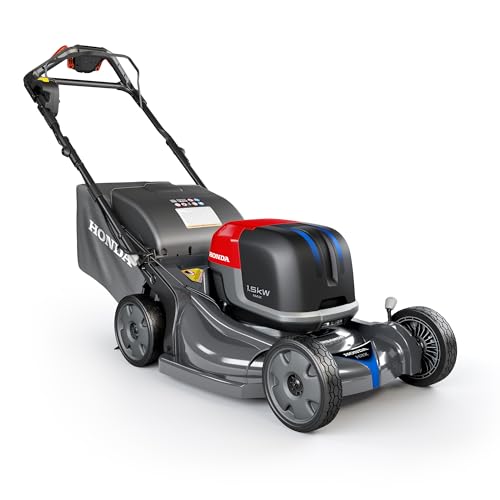
The Honda HRX-BE applies Honda’s long-standing reputation for engine and power equipment reliability to a battery mower built around a genuinely different approach: a large 12Ah removable battery pack designed to be swapped for a second charged pack mid-job, rather than committing to a single fixed onboard charge. This is the swappable-battery category explained earlier in this guide — it directly removes the single biggest limitation of battery mowers, finite runtime, without sacrificing the lower maintenance and quieter operation that make battery power appealing in the first place.

| Key Specifications | |
|---|---|
| Power Type | Battery — premium, swappable 12Ah pack |
| Deck Size | 21 inches |
| Drive Type | Self-propelled |
| Brand | Honda — established power equipment reliability reputation |

What we like:
- Swappable 12Ah battery removes runtime as a limiting factor entirely. Per the swappable-battery section earlier in this guide, this design lets you change to a second charged pack mid-mow, extending a single session indefinitely in a way that more closely resembles refueling a gas mower than waiting through a recharge cycle.
- Honda’s brand reputation for power equipment reliability — built over decades on the gas engine side — extends directly to this battery platform, providing buying confidence for a category where long-term reliability data is still developing for many newer entrants.
- 21-inch self-propelled deck at a high-capacity battery class delivers strong all-around performance suited to both regular maintenance lawns and the occasional larger or time-pressured mowing session.
What to know:
- A second battery pack is an additional cost on top of the mower itself, and this swappable-battery approach is positioned at a premium price point reflecting that capability — confirm whether a spare pack is included or sold separately before purchasing.
Best for: Larger lawns where a single charge doesn’t comfortably finish the job, and buyers who specifically want Honda’s reliability reputation combined with gas-like session flexibility without taking on gas-engine maintenance.
→ Check Current Price on Amazon
7. WORX Nitro Cordless Lawn Mower — Best Mid-Range Value Battery Mower

The WORX Nitro line represents WORX’s upgraded brushless motor tier, positioned squarely in the mid-range value segment of this roundup. At a 21-inch deck and explicitly positioned for lawns up to a half acre, the Nitro delivers solid, dependable cutting performance for the large majority of typical homeowner lawns without reaching for flagship pricing — a sensible middle ground between entry-level battery mowers and the premium EGO and Greenworks options reviewed above.

| Key Specifications | |
|---|---|
| Power Type | Battery — Nitro brushless mid-range class |
| Deck Size | 21 inches |
| Drive Type | Self-propelled |
| Best Lawn Size | Up to 1/2 acre |

What we like:
- Brushless motor technology at a mid-range price point — brushless motors run more efficiently and last longer than brushed alternatives, and WORX’s Nitro tier brings this upgrade to a more accessible price than the flagship brands in this roundup.
- 21-inch deck explicitly rated for half-acre coverage hits the sweet spot for the majority of suburban residential lawns without requiring an 80V or swappable-battery premium purchase.
- Self-propelled drive at this deck size meaningfully reduces physical effort compared to push-only alternatives at a similar price point.
What to know:
- As a mid-range option, expect solid rather than flagship-tier performance — appropriate and sufficient for typical lawn conditions, but buyers regularly dealing with thick overgrowth may prefer the higher power classes reviewed elsewhere in this guide.
Best for: Typical suburban lawns up to half an acre, and buyers who want dependable brushless battery performance without paying flagship pricing.
→ Check Current Price on Amazon
8. Makita XML09Z 36V (18V×2) LXT Lawn Mower — Best for Existing Makita LXT Owners
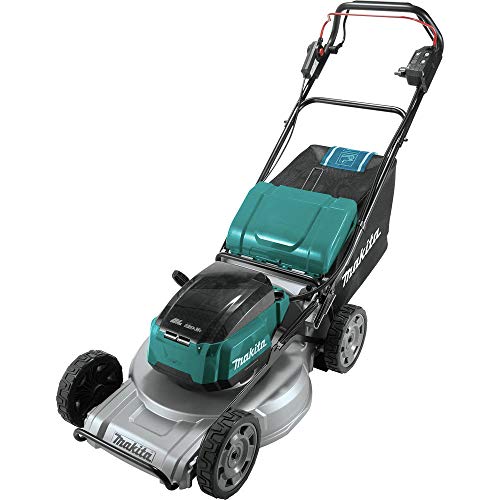
The Makita XML09Z is the second cross-platform compatibility story in this roundup, and arguably the strongest one — Makita’s 18V LXT system is one of the largest cordless tool battery ecosystems in the world, spanning drills, saws, grinders, and dozens of other tools across both DIY and professional trade use. This mower runs on two standard 18V LXT batteries combined to deliver 36V output, meaning any existing LXT battery owner can add genuine lawn mowing capability at essentially tool-only pricing.

| Key Specifications | |
|---|---|
| Power Type | Battery — cross-platform Makita LXT |
| Battery Compatibility | 2× 18V LXT batteries = 36V combined output |
| Drive Type | Self-propelled |
| Platform | Makita 18V LXT — one of the world’s largest cordless tool ecosystems |

What we like:
- Makita 18V LXT is genuinely one of the largest cordless tool platforms globally — for the very large number of homeowners and tradespeople who already own LXT batteries from drills, impact drivers, or saws, this mower eliminates the proprietary mower-only battery cost discussed earlier in this guide entirely.
- 36V combined output from two LXT packs delivers solid mid-class cutting performance, comparable to the lower end of the 150–160cc gas equivalent range covered in the cc-to-voltage comparison earlier in this guide.
- Self-propelled drive reduces physical effort, and Makita’s professional-trade reputation for tool durability extends to this mower platform.
- Existing LXT battery owners can run this mower, their drill, their grinder, and other LXT tools all from the same charger and battery pool — a genuinely unified ecosystem rather than a single-purpose purchase.
What to know:
- If you do not already own Makita 18V LXT batteries, factor the cost of acquiring two compatible packs into your total price comparison against other mowers in this roundup — as with the Houselife/Dewalt pairing above, the value proposition here is specifically for existing platform owners.
Best for: Homeowners and tradespeople who already own Makita 18V LXT batteries and want to extend that investment to lawn mowing without a separate proprietary battery purchase.
→ Check Current Price on Amazon
9. NovorikX 60V 5Ah Self-Propelled Electric Cordless Lawn Mower — Best Budget Self-Propelled Battery Mower
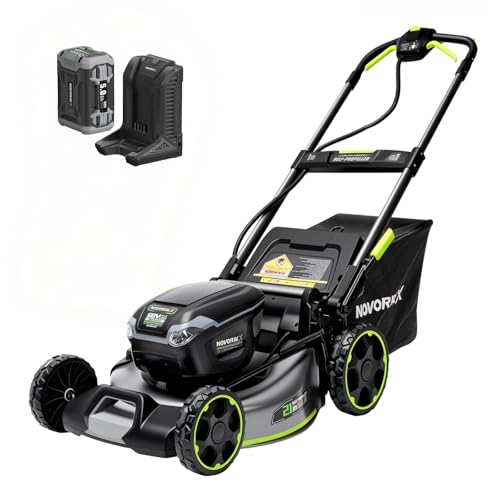
The NovorikX 60V is the accessible entry point into self-propelled battery mowing in this roundup — a 60V system with a 5Ah battery pack at a price point well below the established premium brands reviewed above. For buyers who specifically want the reduced physical effort of self-propelled drive, but do not need or want to pay for EGO, Greenworks, or Honda brand pricing, this is a sensible mid-power, budget-friendly option that still clears the meaningful step up from a basic push mower.

| Key Specifications | |
|---|---|
| Power Type | Battery — 60V class |
| Battery Capacity | 5Ah |
| Drive Type | Self-propelled |
| Positioning | Budget-accessible self-propelled tier |

What we like:
- Self-propelled drive at a meaningfully lower price than the premium brands in this roundup — the physical-effort reduction of self-propelled operation is normally associated with higher-priced mowers, and the NovorikX brings that benefit to a more accessible price tier.
- 60V power class with a 5Ah battery places this in the mid-class performance tier per the cc-to-voltage and runtime tables earlier in this guide — sufficient for typical homeowner lawns with moderate overgrowth tolerance.
- A sensible entry point for buyers transitioning from a basic push mower who want to try self-propelled operation without committing to flagship pricing.
What to know:
- As a newer or budget-tier brand relative to the established names in this roundup, available long-term reliability data is more limited — a reasonable consideration if reliability track record specifically matters more to you than upfront price.
Best for: Budget-conscious buyers who specifically want self-propelled operation without premium-brand pricing, and typical homeowner lawns that don’t require the highest battery voltage classes in this roundup.
→ Check Current Price on Amazon
10. MechMaxx 27″ Walk-Behind Flail Mower — Best for Overgrown Lots and Brush
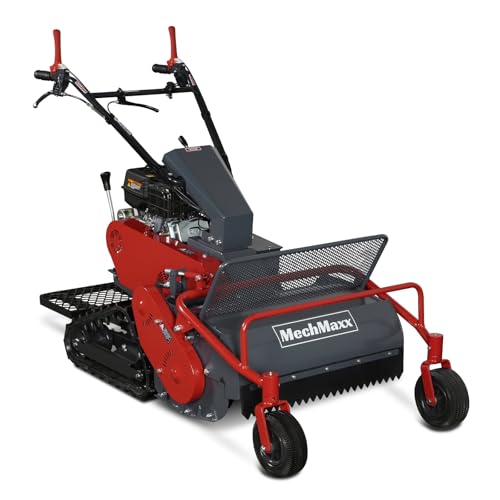
The MechMaxx is the specialty pick in this roundup, and it is the only mower here that should ever be used on a genuinely overgrown lot, thick brush, small saplings, or vegetation taller than 8–10 inches with woody stems. Per the dedicated flail-versus-rotary explanation earlier in this guide, none of the ten rotary mowers reviewed above — gas or battery, regardless of power class — are the correct tool for this scenario. The MechMaxx’s many independently-pivoting blades on a horizontal rotating shaft handle thick, woody, overgrown material that would stall, clog, or physically damage a rigid rotary blade almost immediately.

| Key Specifications | |
|---|---|
| Cutting Mechanism | Flail — many independently-pivoting blades |
| Deck Size | 27 inches |
| Drive Type | Walk-behind |
| Best Use Case | Overgrown lots, brush, saplings, vegetation over 8–10 inches |

What we like:
- Genuinely handles overgrowth that would stall every other mower in this roundup. Per the flail-versus-rotary section above, this is not a power problem that a stronger rotary mower solves — it is a fundamentally different cutting mechanism designed specifically for thick brush, briars, and small saplings.
- Independently-pivoting blades deflect on hard impact rather than transferring full force back through a rigid blade — a meaningful safety advantage when clearing rough or unfamiliar terrain where buried rocks or obstacles are a real risk.
- 27-inch deck covers substantial ground per pass, appropriate for the larger overgrown areas this tool is built to address — reclaiming a neglected lot, managing pasture edges, or clearing a property after extended neglect.
- Flail mowers also produce a finer mulch from woody material than a rotary blade can manage, leaving a cleaner result even after processing genuinely heavy vegetation.
What to know:
- This is not a substitute for a regular lawn mower on a maintained lawn — use one of the ten rotary mowers reviewed above for regular weekly mowing, and reserve the MechMaxx specifically for overgrowth and brush-clearing tasks.
Best for: Overgrown lots, neglected properties being reclaimed, pasture edge management, and any vegetation taller than 8–10 inches with woody stems that no rotary mower in this guide — gas or battery — should be used on.
→ Check Current Price on Amazon
11. BILT HARD 21-Inch 201cc 4-Cycle Engine Push Lawn Mower — Best Budget Gas with a Pro-Level Engine

The BILT HARD pairs the same 201cc pro-level engine displacement as the SENIX reviewed earlier in this guide with a more accessible price point and a straightforward push-only configuration, making it the value pick for buyers who specifically want strong gas engine power without paying for 3-in-1 versatility or self-propelled drive they may not need. At a 21-inch deck and 4-cycle engine design, it delivers the same gas-equivalent power tier described in the cc-to-voltage comparison — minimal performance compromise on thick grass or larger lawns — at a lower entry cost than the SENIX.

| Key Specifications | |
|---|---|
| Power Type | Gas — 201cc 4-cycle engine |
| Deck Size | 21 inches |
| Drive Type | Push |
| Positioning | Budget price, pro-level engine displacement |

What we like:
- 201cc engine displacement at a budget price point — this is the same pro-level power tier as the more expensive SENIX reviewed earlier in this guide, meaning buyers get genuine gas power without paying for 3-in-1 mode switching or self-propelled drive they may not need.
- 4-cycle engine design is the standard, reliable gas mower engine configuration, requiring straightforward maintenance per the gas mower checklist covered earlier in this guide.
- 21-inch deck is the most common deck size across both gas and battery mowers, balancing coverage per pass against maneuverability for the typical homeowner lawn.
What to know:
- Push-only configuration means more physical effort than the self-propelled battery options in this roundup — a reasonable tradeoff for the lower price, but worth considering if your lawn is large or sloped enough that self-propelled drive would meaningfully reduce fatigue.
Best for: Budget-conscious buyers who specifically want pro-level 201cc gas engine power without the higher price of 3-in-1 versatility or self-propelled drive, on lawns where push-mowing remains manageable.
→ Check Current Price on Amazon
Frequently Asked Questions — Best Lawn Mowers of 2026
Is a battery lawn mower as powerful as a gas lawn mower?
Yes, for most residential lawns. Independent testing now shows more than a dozen tested battery walk-behind mowers outperforming the top-rated gas model on cutting evenness, mulching, and bagging. The key is matching the battery class to the job: 40–60V systems compare to 125–170cc gas engines, while 80V and high-torque systems compare to 196–200cc-plus pro-level gas engines.
What size lawn mower do I need for my yard?
For lawns under a quarter acre, an 18–21 inch push mower in the 40–56V battery class or a 125–160cc gas engine is sufficient. For a quarter to half acre, a self-propelled mower in the 56–80V class or a 160–200cc gas engine is the better fit. For half an acre or more, prioritize an 80V or higher battery class, a 200cc-plus gas engine, or a swappable-battery model that removes runtime as a limiting factor.
How long does a battery lawn mower run on one charge?
The average battery walk-behind mower runs 45 to 50 minutes per charge based on independent lab testing, which is enough to cover the average new-build American lawn at under a quarter acre. Higher voltage classes like 80V typically extend this toward 60 minutes or more, while swappable-battery systems can extend a single mowing session indefinitely by changing packs.
Can I use my Dewalt or Makita batteries in a lawn mower?
Yes, with the right mower. Some manufacturers build mowers with dual battery slots specifically designed to accept two standard packs from a major platform, such as two Dewalt 20V MAX batteries to create 40V output, or two Makita 18V LXT batteries to create 36V output. If you already own compatible batteries from drills or other tools, this can eliminate the cost of a proprietary mower-only battery system entirely.
What is the difference between front-wheel drive and rear-wheel drive self-propelled mowers?
Front-wheel drive mowers are pulled forward by the front wheels and are easier to maneuver and turn, since lifting the rear slightly reduces drive resistance. Rear-wheel drive mowers are pushed forward by the rear wheels, with the engine or motor weight pressing those wheels into the ground for better traction on slopes and uneven terrain. Choose front-wheel drive for flat lawns with lots of turning around obstacles, and rear-wheel drive for any yard with real slope.
Do I need a flail mower or a regular lawn mower?
A standard rotary mower is correct for a maintained lawn cut regularly at normal grass height. A flail mower, which uses many small independently-pivoting blades instead of one or two rigid blades, is the right tool for overgrown lots, thick brush, small saplings, briars, and vegetation taller than about 8–10 inches with woody stems. Pushing a rotary mower into overgrowth like this typically results in stalling, clogging, or blade damage.
How much does it cost to maintain a gas lawn mower vs. a battery mower per year?
A gas mower typically costs $30–60 per year in maintenance (oil, spark plug, air filter, blade sharpening) plus $40–80 per year in fuel. A battery mower typically costs $10–20 per year for blade sharpening alone, plus minimal electricity, with one battery replacement commonly needed around the 10-year mark at $100–300. Fuel and maintenance savings on battery mowers can outweigh the higher upfront cost within just a few years of regular use.
Are battery lawn mowers as loud as gas mowers?
No. Battery mowers run measurably quieter at the operator’s ear than gas mowers in independent testing. This matters for early morning or evening mowing near neighbors, for HOA or municipal noise ordinance compliance, and for reduced fatigue during extended use without hearing protection.
How often should I replace a lawn mower battery?
Most lithium-ion lawn mower batteries last 3–5 years of regular seasonal use before capacity degrades enough to warrant replacement, typically costing $100–300 for a mower-specific pack, or significantly less if the mower uses a cross-compatible platform battery you already own for other tools.
Should I buy a push mower or a self-propelled mower?
Push mowers are lighter, less expensive, and sufficient for small, flat lawns. Self-propelled mowers reduce physical effort significantly and are the better choice for lawns a quarter acre or larger, any sloped terrain, or for anyone who finds pushing a mower physically tiring, since the drive wheels do most of the forward work.
Final Verdict — Best Lawn Mower for Every Yard and Budget
| Best For | Our Pick | Key Reason | Buy on Amazon |
|---|---|---|---|
| Best Overall | EGO POWER+ | Top independently-tested battery performance, self-propelled, broad ecosystem | Buy Now → |
| Best for Half-Acre+ Lawns | Greenworks 80V 21″ Self-Propelled | Highest standard battery voltage class, 45-60+ min runtime | Buy Now → |
| Best Gas for Overgrowth / Power | SENIX 201cc 22″ 3-in-1 | Pro-level 201cc engine, full mulch/bag/discharge flexibility | Buy Now → |
| Best Budget Gas (Small Yards) | PowerSmart EasyCut 18″ | Compact 18″ deck, accessible price, ideal for small lots | Buy Now → |
| Best Budget Gas with Pro Engine | BILT HARD 201cc | Pro-level 201cc displacement at a lower price than the SENIX | Buy Now → |
| Best for Existing Dewalt Owners | Houselife 40V (Dewalt-compatible) | Runs on 2× Dewalt 20V MAX batteries you may already own | Buy Now → |
| Best for Existing Makita Owners | Makita XML09Z 36V (18V×2 LXT) | Runs on 2× Makita 18V LXT batteries — world’s largest cordless platform | Buy Now → |
| Best Premium / Swappable Battery | Honda HRX-BE 21″ (12Ah) | Swappable battery removes runtime limits; Honda reliability reputation | Buy Now → |
| Best Mid-Range Value Battery | WORX Nitro 21″ | Brushless motor, self-propelled, rated for up to 1/2 acre at mid pricing | Buy Now → |
| Best Budget Self-Propelled | NovorikX 60V 5Ah | Self-propelled drive at a meaningfully lower price than premium brands | Buy Now → |
| Best for Overgrown Lots / Brush | MechMaxx 27″ Flail Mower | The only correct tool here for thick brush, saplings, and tall overgrowth | Buy Now → |
Start by checking what battery platform you already own across your other power tools — if you have Dewalt or Makita batteries sitting in a garage, the cross-platform mowers in this guide can change the entire cost equation in your favor. Then match your actual lawn size and condition to the right power class using the tables throughout this guide, and be honest about whether you’re dealing with a maintained lawn or a genuinely overgrown lot that needs a flail mower instead of a rotary mower. Getting these two decisions right matters more than any single spec on any individual product page.