If you’ve ever tried to rip a full sheet of plywood with a regular circular saw, you already know the problem. The saw drifts, the cut wanders, and by the time you’ve finished, the edge looks like it belongs on a demolition job rather than a finished cabinet. A table saw solves the problem in a shop – but not on a job site, not in a small garage workshop, and not when the sheet is too big to handle alone.
That’s exactly what a track saw is built for. It rides on a precision aluminum guide rail, and the result is a perfectly straight, splinter-free cut every single time – with one person, on the floor, on sawhorses, or on a job site. After deep research I’ve picked the 8 best across every category: best overall, best cordless, best budget, best premium, and everything in between.
Quick Comparison: Best Track Saws (2026)
| Product | Type | Power | RPM | Cut @ 90° | Weight | Best For |
|---|---|---|---|---|---|---|
| Makita SP6000J1 | Corded | 12A | 2,000–5,200 | 2-3/16″ | 9.7 lbs | Best Overall |
| DeWalt DWS520K | Corded | 12A | 1,750–4,000 | 2-1/8″ | 11.5 lbs | Best Corded Runner-Up |
| Milwaukee 2831-21 | Cordless | M18 18V | Variable / 5,600+ RPM | 2-1/8″ | ~8.8 lbs | Best Cordless Overall |
| Bosch GKT13-225L | Corded | 13A | 3,600–6,250 | 2-3/16″ | 10.3 lbs | Best Pro Corded |
| Makita XPS01PTJ | Cordless | 18V×2 (36V) | 2,500–6,300 | 2-3/16″ | 11.2 lbs | Best Cordless Value |
| Metabo HPT C3606DPA | Cordless | 36V MultiVolt | Variable / 5,200 RPM | 2-3/8″ on track | 9.7 lbs | Best Single-Battery Cordless |
| WEN CT1065 | Corded | 10A | Up to 5,500 | 2-1/3″ | 8.7 lbs | Best Budget |
| Festool TS 55 REQ | Corded | 10A | 2,000–5,200 | 2-3/16″ | 9.9 lbs | Best Premium |
What to Look for in a Track Saw – What Most Guides Don’t Explain

Most buying guides for track saws cover amps and RPM, then jump straight into product reviews. That skips several specs that have a far bigger impact on how the saw actually works on your projects. Here’s what genuinely matters before you spend a dollar.
Plunge Mechanism: Pivot vs. Parallel
Most track saws use a pivot (hinge) mechanism — you press down on the rear of the saw and the front dips into the material. It’s simple, fast, and natural-feeling. DeWalt’s DWS520K uses a different approach called a parallel plunge: the entire saw base drops straight down, keeping your hand position level throughout the entire cut. In practice, the parallel plunge feels more controlled for longer ripping cuts because your wrist doesn’t rotate as the blade enters and exits the material. It’s a mild preference difference, but worth knowing before you buy.
Blade Size and Arbor: 160mm vs. 165mm
This is the spec that trips up buyers the most. Every track saw on this list except the Festool TS 55 REQ uses a 165mm (6-1/2″) blade with a 20mm arbor — the standard across Makita, DeWalt, Milwaukee, Bosch, Metabo HPT, and WEN. The Festool uses a 160mm (6-1/4″) blade, also on a 20mm arbor. Those 5mm are not interchangeable. Festool blades don’t fit 165mm saws and vice versa. This matters when you shop for replacement blades or want to upgrade to a premium aftermarket blade like the Diablo D0648TSF or Makita B-07353. For Festool owners, the blade options are narrower and more expensive.
Track Length: Which Rail Do You Actually Need?
Manufacturers often bury track length options in a footnote, but it determines what cuts you can actually make.
- 39″–55″ (1,000–1,400mm): Handles most cuts in a 4×8 sheet, cross-cuts, furniture panels, and door trimming. This is the right starting length for most users.
- 59″–63″ (1,500mm): Better for 8-foot rip cuts along the long edge of a sheet, stair stringers, and flooring planks. DeWalt’s DWS520K kit includes a 59″ rail.
- 102″–110″ (2,600–2,800mm): Full 8-foot rip cuts in one pass without repositioning. Essential for cabinet shops and high-volume work. Two 55″ rails connected with a joiner achieve the same result.
Rail Compatibility: Festool Standard vs. Proprietary
Festool’s guide rail profile has become the de facto industry standard. Makita, Bosch, Milwaukee, and Metabo HPT rails are all interchangeable with Festool rails and their accessories — parallel guides, corner stops, and connector sets. DeWalt is the major exception: their double-edged track uses a proprietary profile that is not compatible with Festool or Makita accessories. This matters if you want to expand your track system later with third-party clamps, angle stops, or additional rail lengths.
Corded vs. Cordless: The Platform Decision Framework
The question isn’t simply “corded or cordless” — it’s “which platform do you already own?” If you already run Milwaukee M18 tools, the 2831-21 means one charger and shared batteries across your entire kit. If you’re deep in Makita’s 18V LXT ecosystem, the XPS01PTJ is the natural fit. Own DeWalt 20V or FlexVolt tools? Wait for the DCS520 series cordless model. If you own no cordless platform at all, a corded track saw — particularly the Makita SP6000J1 — gives you superior consistent power without the battery investment. The corded option also makes more sense if you’re primarily working in a fixed shop rather than on a job site.
Track Saw vs. Circular Saw – When You Actually Need a Track Saw

A circular saw and a track saw can both make straight cuts — but the comparison ends there in practice. With a circular saw, even paired with a quality straight-edge clamp, every cut is only as straight as your ability to hold the saw against the guide. Any deviation, any moment of drift, and you’ve ruined an edge. With a track saw, the saw physically cannot leave the rail. The result is identical every time.
Use a circular saw when: you’re rough-cutting framing lumber, you need to break down basic material where edge quality doesn’t matter, or you already own one and your project doesn’t involve expensive sheet goods.

Use a track saw when: you’re working with hardwood plywood, Baltic birch, melamine, or veneered panels where tear-out wastes expensive material; when you’re working alone with large sheets; when you’re making repeated cuts to identical dimensions for furniture or cabinetry; or when you’re on a finished job site where a circular saw’s messier cuts or cord management would be a problem.
Track Saw vs. Table Saw — Can It Replace One?
For home shops with limited space, this is one of the most practical questions in woodworking. The honest answer: a track saw handles the majority of what a table saw does for sheet goods. Rips, cross-cuts, and bevel cuts up to 47° are all doable with a track saw and a good guide rail setup. What a track saw won’t replace: dado cuts, very narrow rips (under 2″), repetitive production work that benefits from a fence stop, or operations that require the workpiece to move through the blade rather than the blade moving through the workpiece.
For a home woodworker building furniture and doing renovation work, a track saw paired with a quality miter saw handles 90% of the cutting needs a table saw would cover — without the footprint, cost, or safety complexity of a full table saw setup.
The 8 Best Track Saws — Full Reviews
1. Makita SP6000J1 — Best Overall Track Saw

The Makita SP6000J1 has been the benchmark for mid-range track saws for years, and it still earns the top spot in 2026. The combination of a 12A direct-drive motor, electronic speed control that holds RPM constant under load, magnesium components for low weight, and a guide rail profile that’s compatible with the entire Festool accessory ecosystem gives you professional-grade results at a fraction of the Festool price.
The variable speed dial runs from 2,000 to 5,200 RPM, which covers the full range from finish-cut furniture work at low speed to fast sheet goods breakdown at the top end. The built-in depth stop allows a 1/16″ preliminary scoring cut before the full plunge — that single feature alone eliminates almost all tear-out on veneered plywood and melamine without needing to score manually. The riving knife rides in the kerf and prevents blade bind, reducing the primary cause of track saw kickback. It ships with a 55″ guide rail and a stackable interlocking case. Weight with the kit is 16.5 lbs, but the saw itself is just 9.7 lbs — one of the lightest corded full-size track saws available.

The Makita rail uses the same profile as Festool, which means every Festool parallel guide, corner connector, and angle stop works natively with this saw. That’s a major long-term value point — you can build out a complete Festool-compatible workshop track system around a Makita saw at a significantly lower cost. Aftermarket blades are widely available and inexpensive: the Makita B-07353 56T and the Diablo D0648TSF 48T are the two best upgrade options for this saw.

| Spec | Detail |
|---|---|
| Motor | 12 Amps |
| Speed | 2,000–5,200 RPM (variable) |
| Blade | 6-1/2″ (165mm), 20mm arbor |
| Cut Depth @ 90° | 2-3/16″ |
| Cut Depth @ 45° | 1-9/16″ |
| Bevel Range | -1° to 48° |
| Weight (saw only) | 9.7 lbs |
| Track Included | Yes — 55″ (1,400mm) |
What we like:
- Electronic speed control holds RPM constant under load — essential for splinter-free cuts in hardwood
- Built-in depth stop for a preliminary scoring cut eliminates tear-out on veneer and melamine
- Festool-compatible rail profile — full accessory ecosystem available
- Riving knife prevents blade bind and reduces kickback risk
- One of the lightest corded track saws at 9.7 lbs (saw only)
What we don’t like:
- 55″ track requires a second rail purchase for full 8-foot rips without repositioning
- Track and additional rails are sold separately beyond the included 55″
Bottom line: The right track saw for the majority of woodworkers, cabinet makers, and finish carpenters. Professional performance, Festool compatibility, and a sensible price point make this the single easiest recommendation on this list.
Check Price on Amazon — Makita SP6000J1
2. DeWalt DWS520K — Best Corded Runner-Up

DeWalt’s DWS520K stands apart from the competition in two specific ways that make it the right choice for a certain type of buyer. First, its parallel plunge mechanism — rather than the pivot-down action most track saws use — drops the entire saw base straight into the material. Experienced track saw users describe this as feeling more controlled on long ripping cuts because your grip position stays level throughout the entire plunge. Second, the DWS520K kit comes with both a 59″ and a 102″ guide rail, which means you can make full 8-foot rip cuts on day one without buying any additional accessories. That dual-track inclusion makes the price point more competitive than it looks at first glance.
The 12A motor delivers up to 4,000 RPM no-load — slightly lower ceiling than the Makita SP6000, but the saw’s continuous anti-kickback mechanism and riving knife more than compensate in terms of safety and confidence on long cuts. The zero-clearance track system and dual anti-splinter edges on the rail produce the same clean, tear-out-free cuts you expect from any quality track saw. The double-edged track is a particularly useful feature for pro users — you can cut from either side, which doubles the effective track life before the splinter guard wears out.
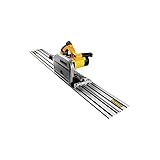
The key trade-off with the DeWalt is rail compatibility. Unlike Makita, Bosch, Milwaukee, and Metabo HPT, DeWalt’s track profile is proprietary. It will not accept Festool parallel guides, Makita rail connectors, or any third-party Festool-compatible accessory. If you plan to build out a track system with corner pieces, angle guides, or extra rails, you’re committed to DeWalt’s own accessory line. That’s fine if you’re staying in the DeWalt ecosystem — but worth understanding before you buy.

| Spec | Detail |
|---|---|
| Motor | 12 Amps (1,300W) |
| Speed | 1,750–4,000 RPM (variable) |
| Blade | 6-1/2″ (165mm), 20mm arbor |
| Cut Depth @ 90° | 2-1/8″ on track |
| Cut Depth @ 45° | 1-5/8″ |
| Bevel Range | 0° to 47° |
| Weight | 11.5 lbs |
| Tracks Included | Yes — 59″ + 102″ (both included) |
What we like:
- Parallel plunge mechanism is uniquely ergonomic and controlled on long cuts
- Both 59″ and 102″ tracks included — ready for full sheet rips out of the box
- Double-edged track extends track life by allowing cuts from either side
- Continuous anti-kickback mechanism and riving knife for safety
- Zero-clearance cutting system produces clean, splinter-free edges
What we don’t like:
- Proprietary track — not compatible with Festool, Makita, or Milwaukee accessories
- RPM ceiling (4,000) is lower than the Makita SP6000 — marginally slower on dense hardwood
- Heavier than the Makita at 11.5 lbs
Bottom line: The best buy if you want both tracks included and appreciate the ergonomics of the parallel plunge. A strong pro-grade corded option — just go in knowing the track ecosystem is DeWalt-exclusive.
Check Price on Amazon — DeWalt DWS520K
3. Milwaukee 2831-21 — Best Cordless Track Saw Overall
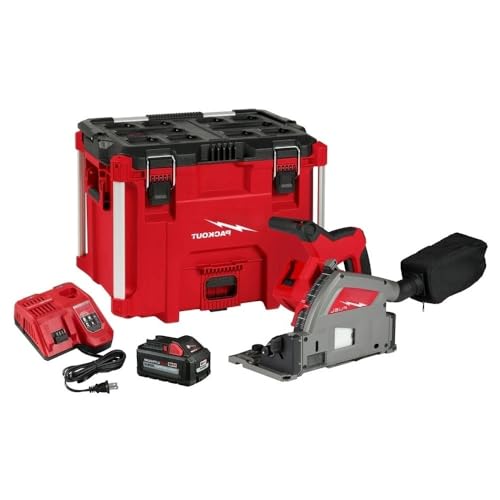
Milwaukee entered the track saw market later than Festool and Makita, but the M18 FUEL 2831-21 immediately became one of the strongest cordless options available. The POWERSTATE brushless motor delivers up to 5,600 RPM — more than enough for clean, finish-quality cuts through sheet goods and solid hardwood on the M18 battery platform. The REDLINK PLUS electronics protect the motor from overload, overheating, and over-discharge, which matters more in a track saw than almost any other tool because the saw frequently sustains the motor under load during long, slow ripping cuts.
The smooth pivot plunge action on the 2831-21 is one of its standout qualities — reviewers consistently describe it as the easiest, most friction-free plunge of any track saw they’ve used. The micro-adjust depth knob allows precise depth settings, and the riving knife keeps the kerf open during cuts to prevent blade bind. Bevel stops are at 22.5°, 45°, and 48°. Dust collection efficiency is rated at over 90% when connected to a shop vac, which is important for working in confined spaces or on finished floors.

Rail compatibility is worth noting here. Milwaukee’s guide rails use a profile that is interchangeable with Festool and Makita rails — so if you’ve already invested in Makita or Festool tracks, you can run the Milwaukee 2831 on them without any adapter. That’s a significant advantage over the DeWalt. The kit includes a 6.0Ah HO battery and a rapid charger, which gives you serious runtime for job site use — no cord management on finished floors, no extension cord across a third-story room.

| Spec | Detail |
|---|---|
| Platform | M18 FUEL (18V brushless) |
| Speed | Variable / up to 5,600 RPM |
| Blade | 6-1/2″ (165mm), 20mm arbor |
| Cut Depth @ 90° | 2-1/8″ |
| Cut Depth @ 45° | ~1-9/16″ |
| Bevel Stops | 22.5°, 45°, 48° |
| Dust Collection | >90% efficiency with shop vac |
| Includes | Saw, 6.0Ah HO battery, rapid charger, PACKOUT XL box |
What we like:
- POWERSTATE brushless motor — consistent power delivery on long hardwood rips
- REDLINK PLUS overload protection — extends motor and battery life under sustained load
- Festool/Makita-compatible rail profile — works with your existing track system
- Smoothest plunge action in the cordless category
- 90%+ dust collection efficiency — critical for job site use on finished surfaces
What we don’t like:
- Track sold separately — budget for a 55″ rail in addition to the kit price
- Heavier than corded competitors when loaded with the 6.0Ah battery
- Higher price point than the Makita XPS01PTJ
Bottom line: If you’re already on the M18 platform and do finish carpentry, cabinet installation, or flooring work, the 2831-21 is the most compelling cordless track saw available. The combination of smooth plunge action, rail compatibility, and FUEL motor performance is hard to beat.
Check Price on Amazon — Milwaukee 2831-21
4. Bosch GKT13-225L — Best Pro Corded Track Saw
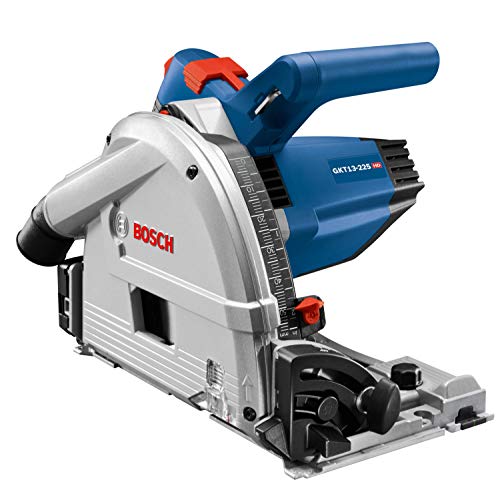
The Bosch GKT13-225L is the most powerful corded track saw on this list with its 13A motor pushing the blade from 3,600 to 6,250 RPM — a higher top speed than any other model here. That extra headroom matters when you’re cutting dense hardwoods like maple, hickory, or thick laminated materials where lower-powered saws start to bog. The magnesium baseplate keeps the weight at a manageable 10.3 lbs despite the larger motor, and the constant electronics maintain speed under load with overload protection built in.
The plunge mechanism on the Bosch is forward-push rather than pivot-down — you push the saw forward to plunge the blade into the material rather than pressing down from the rear. It takes a few cuts to get used to the feel, but it’s regarded by experienced users as a safer mechanism since it naturally encourages two-handed operation throughout the plunge. The depth scale reads in both metric and imperial and has a dual-pointer system for tracking depth with and without a guide rail — a small but genuinely useful feature when switching between on-track and freehand use.

Rail compatibility is fully Festool-standard — Bosch’s track profile matches Festool’s, which means the entire ecosystem of Festool parallel guides, connectors, and accessories works natively. The kit includes a 48T blade, a vacuum hose adapter, and the L-BOXX-4 carrying case. Bosch offers four different track lengths plus a range of optional attachments including an angle guide and rip fence, giving this system one of the most complete professional accessory lineups of any brand other than Festool itself.

| Spec | Detail |
|---|---|
| Motor | 13 Amps |
| Speed | 3,600–6,250 RPM (variable) |
| Blade | 6-1/2″ (165mm), 20mm arbor |
| Cut Depth @ 90° | 2-3/16″ |
| Cut Depth @ 45° | ~1-9/16″ |
| Bevel Range | -1° to 47° |
| Weight | 10.3 lbs |
| Includes | Saw, 48T blade, vacuum adapter, L-BOXX-4 case (track sold separately) |
What we like:
- Most powerful motor on this list — 13A with 6,250 RPM top speed
- Festool-compatible rail system with full accessory ecosystem
- Dual-scale depth indicator for on-track and freehand use
- Constant electronics maintain speed under heavy load
- Overload protection prevents motor damage on demanding cuts
What we don’t like:
- Forward-push plunge takes adjustment — not immediately intuitive if you’re used to pivot saws
- Track sold separately — add the cost of the rail to the budget
- More expensive than the Makita SP6000J1 for a comparable feature set
Bottom line: The Bosch GKT13-225L is the professional corded pick for users who want maximum motor power and Festool rail compatibility without buying into the Festool price ecosystem. The ideal choice for high-volume professional use cutting dense materials.
Check Price on Amazon — Bosch GKT13-225L
5. Makita XPS01PTJ — Best Cordless Value Track Saw

Makita’s XPS01PTJ is an engineering solution for a specific problem: how do you get 36V track saw performance out of an 18V battery ecosystem? The answer is X2 technology — two 18V LXT batteries running in series to deliver 36V effective power. For anyone already invested in Makita’s 18V LXT platform (one of the largest cordless ecosystems in the world), this means running a full-size, full-power track saw on the same batteries as your drill, impact driver, and circular saw — no new platform, no new charger.
The brushless motor with Automatic Speed Change Technology runs from 2,500 to 6,300 RPM, which is a higher ceiling than the corded SP6000 and one of the fastest in the cordless category. Automatic Speed Change detects load increases mid-cut and adjusts torque delivery in response, which prevents the bogging on dense hardwood that plagues less sophisticated cordless saws. The kit includes two 5.0Ah batteries and a charger. Makita claims up to 125 cuts per charge in 1/2″ plywood sheets using both batteries — enough for serious production work. The rail profile matches Festool and is fully compatible with the same accessory ecosystem as the corded SP6000.

The trade-off is that the X2 design requires two batteries simultaneously, which means battery drain doubles with every cut. Long sessions with thick hardwood will cycle through both batteries faster than a single 36V or 40V design would. Running two 5.0Ah batteries, the saw also weighs in at 11.2 lbs — heavier than some would prefer for overhead or vertical work. But for horizontal sheet breakdown in a shop or on a job site, the balance and ergonomics are comfortable enough that most users don’t notice.

| Spec | Detail |
|---|---|
| Platform | 18V×2 LXT (36V effective), brushless |
| Speed | 2,500–6,300 RPM (variable) |
| Blade | 6-1/2″ (165mm), 20mm arbor |
| Cut Depth @ 90° | 2-3/16″ |
| Cut Depth @ 45° | 1-9/16″ |
| Bevel Range | -1° to 48° |
| Weight (with batteries) | 11.2 lbs |
| Includes | Saw, 2× 5.0Ah batteries, charger (rail sold separately) |
What we like:
- Uses existing Makita 18V LXT batteries — no new platform investment required
- Automatic Speed Change Technology adjusts torque mid-cut for consistent performance
- Highest RPM ceiling of any corded or cordless saw on this list at 6,300 RPM
- Festool-compatible rail profile — full accessory ecosystem available
- Up to 125 cuts per charge in 1/2″ plywood with two 5.0Ah packs
What we don’t like:
- Requires two batteries simultaneously — runtime is lower per battery set than single-pack systems
- Heavier than Milwaukee or Metabo HPT cordless options when fully loaded
- Rail sold separately — no track included in any kit configuration
Bottom line: The best cordless track saw value for Makita LXT users. You’re getting genuine 36V performance from batteries you already own. For anyone who doesn’t have an existing Makita platform, the Milwaukee 2831-21 is a more straightforward single-battery investment.
Check Price on Amazon — Makita XPS01PTJ
6. Metabo HPT C3606DPA — Best Single-Battery Cordless Track Saw

The Metabo HPT MultiVolt track saw fills a gap that no other cordless saw on this list covers: it delivers pro-grade performance from a single 36V battery — no second pack required, no worrying about both batteries being charged at the same time. The brushless motor reaches up to 5,200 RPM across 12 selectable speed settings, which gives it more granular speed control than the Milwaukee or Makita cordless options. That 12-step dial lets you dial in exactly the right speed for veneer, solid hardwood, melamine, or laminate flooring — not just a high-low toggle.
The standout spec is the cutting depth: Metabo HPT’s C3606DPA cuts over 2-1/2″ at 90° off-track (2-3/8″ on-track), which is deeper than the Makita SP6000, DeWalt DWS520, Milwaukee 2831, and most of the other saws on this list. That extra 1/4″–3/8″ of depth is meaningful when you’re cutting through thicker dimensional lumber, solid wood butcher block tops, or stacked sheet goods. The bevel range of -1° to 46° covers all standard applications. The MultiVolt battery system is also dual-compatible: the same 4.0Ah 36V battery in this kit runs in any Metabo HPT 18V tool at 8.0Ah capacity, giving it broad platform utility.

Fine Woodworking’s hands-on review found the saw “very well balanced in use” with a smooth brushless motor, and managed 144 linear feet of cuts in 3/4″ Baltic birch on a single charge before needing a recharge. The stock blade produced slightly more chipout than expected on hardwood-veneer plywood, but upgrading to an aftermarket 48–56T blade solved the issue immediately — a common characteristic of most saws in this category regardless of brand. The kit includes the saw, 4.0Ah battery, rapid charger, and stackable hard case. It carries a lifetime tool body warranty, which no other manufacturer on this list matches.

| Spec | Detail |
|---|---|
| Platform | 36V MultiVolt brushless |
| Speed | Variable / up to 5,200 RPM (12 settings) |
| Blade | 6-1/2″ (165mm) |
| Cut Depth @ 90° (off-track) | >2-1/2″ |
| Cut Depth @ 90° (on-track) | 2-3/8″ |
| Cut Depth @ 45° | 1-3/4″ |
| Bevel Range | -1° to 46° |
| Weight | 9.7 lbs (tool only) |
| Includes | Saw, 4.0Ah battery, rapid charger, stackable case |
| Warranty | Lifetime tool body warranty |
What we like:
- Deepest cut capacity on this list — over 2-1/2″ off-track, 2-3/8″ on-track
- 12 selectable speed settings for the most precise material-matching of any saw here
- Single-battery operation — no second pack required
- Lifetime tool body warranty — best warranty on this list
- MultiVolt battery works as 8.0Ah in any 18V Metabo HPT tool
What we don’t like:
- Stock blade produces slightly more chipout — upgrade blade recommended for veneer work
- Smaller platform ecosystem than Milwaukee M18 or Makita LXT
- Track sold separately
Bottom line: The Metabo HPT C3606DPA is the best single-battery cordless track saw available on Amazon right now. The deepest cut capacity, finest speed control, and lifetime warranty make it an exceptional value — especially for users not locked into a competing platform. If you’re buying your first cordless track saw with no existing battery ecosystem, this is seriously worth considering over the Milwaukee or Makita.
Check Price on Amazon — Metabo HPT C3606DPA
7. WEN CT1065 — Best Budget Track Saw
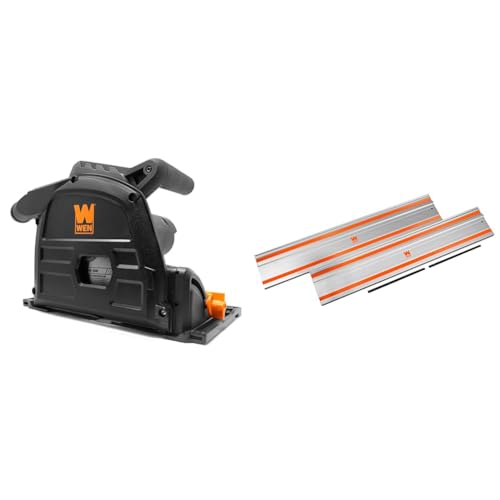
The WEN CT1065 is the only genuinely useful budget track saw available on Amazon. At its price point, the expectation should be calibrated accordingly: this is not a precision instrument for furniture-grade hardwood work or professional job site use. It is, however, a real track saw that actually cuts straight when paired with a WEN guide rail — which is exactly what a casual DIYer who breaks down plywood a few times per year needs.
The 10A motor spins the 6-1/2″ 24T carbide blade at up to 5,500 RPM, which is enough power for plywood, MDF, softwood framing material, and standard dimensional lumber. The depth gauge adjusts from 0 to 2-1/3″ at 90° — actually a deeper cut capacity than some more expensive saws — and the 12 × 6-5/8″ base with precision grooves glides smoothly along compatible WEN tracks. Bevel capacity is 0–45° left. The saw also works as a standalone plunge circular saw without a track, which adds some versatility. Weight is 8.7 lbs — the lightest corded option on this list.
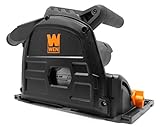
The trade-offs are real and worth being direct about. There is no riving knife, which increases the risk of blade bind and kickback when cutting thicker, denser material. The depth adjustment mechanism can feel sticky compared to the tool-free dials on Makita or DeWalt. The WEN track’s splinter guard is less durable than premium options and can detach over time. Dust collection is functional but mediocre. And the WEN track system is proprietary — you can’t use Festool or Makita rail accessories. For occasional DIY plywood breakdowns and door trimming, none of these limitations matter much. For anything more demanding, step up to the Makita SP6000J1.

| Spec | Detail |
|---|---|
| Motor | 10 Amps |
| Speed | Up to 5,500 RPM |
| Blade | 6-1/2″ (165mm), 20mm arbor, 24T |
| Cut Depth @ 90° | 2-1/3″ |
| Cut Depth @ 45° | 1-5/8″ |
| Bevel Range | 0° to 45° left |
| Weight | 8.7 lbs |
| Track Included | No (WEN CT9502 or CT9110 sold separately) |
What we like:
- Lowest price point of any functional track saw on Amazon
- Lightest corded option on this list at 8.7 lbs
- Deep cut capacity at 2-1/3″ — deeper than some pricier competitors
- Works as a standalone plunge saw without a track
- Compatible with standard 165mm aftermarket blades
What we don’t like:
- No riving knife — higher kickback risk in dense or wet wood
- Sticky depth adjustment mechanism
- WEN proprietary track — not compatible with Festool or Makita accessories
- Stock splinter guard durability is limited
- Mediocre dust collection
Bottom line: The right choice for homeowners and occasional DIYers who need to rip plywood or trim doors a handful of times per year and can’t justify $350+ for a track saw. Not recommended for woodworking projects where edge quality, veneer, or hardwood work is involved.
Check Price on Amazon — WEN CT1065
8. Festool TS 55 REQ — Best Premium Track Saw

The Festool TS 55 REQ is the saw every other track saw on this list is measured against. Its precision-milled aluminum guide rail system, micro-adjustable splinter guard, spring-loaded riving knife, FastFix blade-change system, and MMC electronics (Multiple Material Control) represent a level of engineering refinement that no other manufacturer has fully replicated. When professionals in cabinet shops, high-end residential renovation, and furniture manufacturing say they won’t work without a Festool — this is why. The cut quality is simply in a different class: the combination of the micro-adjustable splinter guard calibrated precisely to the blade, the spring-loaded riving knife that descends simultaneously with the blade, and the MMC electronics that hold RPM absolutely constant under load produces glue-ready edges in veneered plywood and melamine with zero tear-out.
The 10A motor with MMC electronics runs from 2,000 to 5,200 RPM. That’s a lower power draw than the Bosch or DeWalt, but the MMC system’s ability to maintain a perfectly constant speed under load means the blade never bogs or surges during a cut — which is a bigger quality factor than peak motor output. The FastFix system locks both the switch and the arbor simultaneously, making blade changes genuinely fast and safe. The slip clutch minimizes kickback risk in a way no other mechanism on this list replicates. The Festool guide rail system is the gold standard: precisely machined, consistent along its full length, with an anti-tip groove that keeps the saw on the rail even during bevel cuts.

There are two important things to know before buying the Festool TS 55 REQ. First, the blade size is 160mm (6-1/4″), not the 165mm standard used by every other saw on this list. Festool blades and standard 165mm blades are not interchangeable, and Festool blades cost significantly more than Diablo or Makita aftermarket options. Second, the guide rails are sold separately — budget an additional $100–$180 per rail on top of the saw price. The TS 55 REQ is not a tool you buy to save money. It’s a tool you buy because the quality of your work depends on the quality of your cuts, and nothing else makes the same guarantee.
| Spec | Detail |
|---|---|
| Motor | 10 Amps (1,200W) |
| Speed | 2,000–5,200 RPM (MMC electronics) |
| Blade | 6-1/4″ (160mm) — proprietary, 20mm arbor |
| Cut Depth @ 90° | 2-3/16″ (55mm) |
| Cut Depth @ 45° | ~1-9/16″ |
| Bevel Range | 0° to 47° |
| Weight | 9.9 lbs |
| Track Included | Depends on kit — rails sold separately typically |
| Warranty | 3 years |
What we like:
- Best-in-class cut quality — glue-ready edges on veneered plywood and melamine
- MMC electronics hold RPM absolutely constant under load — no bogging, no surging
- Micro-adjustable splinter guard eliminates tear-out better than any other system
- Spring-loaded riving knife descends with the blade — best kickback protection available
- FastFix blade-change system — safe, fast, tool-assisted
- Best guide rail precision in the industry — the benchmark for the category
- 3-year warranty — best corded warranty on this list
What we don’t like:
- Most expensive saw on this list by a wide margin
- Proprietary 160mm blade — narrower selection and higher blade cost than 165mm standard
- Guide rails sold separately — significant additional cost per rail length
- Overkill for occasional DIY or home shop use
Bottom line: If your material costs more than the saw, buy the Festool. For professional cabinet shops, furniture makers, and finish carpenters where cut quality directly affects the value of the finished work, the TS 55 REQ remains the definitive standard. For everyone else, the Makita SP6000J1 delivers 90% of the Festool result at a fraction of the price.
Check Price on Amazon — Festool TS 55 REQ
Track Saw Safety – What Every User Should Know
Track saws are safer than table saws by design — the blade is enclosed in the cut, there’s no outfeed hazard, and the riving knife prevents most blade-bind situations. But they have specific hazards that are easy to overlook, especially for users switching from circular saws.
Always complete the plunge before moving the saw forward. Starting to push the saw before the blade has fully plunged into the material is the most common cause of track saw kickback. The blade must be fully at cutting depth and spinning at speed before any forward motion begins.
Check the splinter guard before every session. The rubber splinter guard on the edge of the track is what creates the zero-clearance cut. If it’s torn, missing, or peeling away from the track, your cut quality drops significantly and the blade edge becomes exposed. Inspect it before every use and replace it when it starts to deteriorate.
Connect a shop vac when cutting MDF, melamine, or any engineered wood. Fine dust from MDF contains formaldehyde-based binders that are a genuine respiratory hazard. All track saws on this list have a dust port — use it. Most connect to a standard 1-1/4″ or 1-7/8″ shop vac hose.
Use the riving knife. If your saw has one (Makita SP6000, DeWalt DWS520, Festool TS 55, Milwaukee 2831), make sure it’s properly engaged before cutting. The riving knife rides in the blade’s kerf and prevents the cut material from pinching the blade — the primary mechanical cause of kickback in a track saw.
Eye and ear protection are non-negotiable. Track saws run at high RPM with a partially exposed blade. Flying debris from the entry and exit cut points is a real hazard. Ear protection matters too: sustained operation above 85 dB causes cumulative hearing damage, and most track saws exceed that at the operator’s ear without hearing protection.

Frequently Asked Questions
What is the difference between a track saw and a circular saw?
A circular saw is a freehand tool — even with a straight-edge clamp guide, the operator’s ability to hold the saw against the guide determines cut straightness. A track saw physically rides on a precision aluminum guide rail that eliminates drift entirely. The result is a consistently straight, splinter-free cut regardless of the operator’s technique. Track saws also have plunge capability — you can start a cut in the middle of a panel without needing access from an edge, which circular saws cannot do safely.
Are track saw rails universal?
Not entirely. Festool’s guide rail profile is the de facto industry standard — Makita, Bosch, Milwaukee, and Metabo HPT rails are all interchangeable with Festool rails and accessories. DeWalt uses a proprietary double-edged track design that is not compatible with Festool, Makita, or any other brand’s accessories. WEN also uses a proprietary rail. If rail accessory compatibility matters to you, stay with Makita, Bosch, Milwaukee, Metabo HPT, or Festool.
Can a track saw replace a table saw?
For most home shop and renovation applications, yes. A track saw handles rips, cross-cuts, and bevel cuts in sheet goods and dimensional lumber just as well as a table saw — with less setup, less space, and more portability. What a track saw won’t replace: dado cuts, repetitive narrow rips (under 2″), and high-volume production work where a fence stop speeds up repeated identical cuts. For a home woodworker or renovator, a track saw plus a miter saw covers the vast majority of what a table saw does.
What blade should I use in a track saw?
For finish cuts in veneered plywood and hardwood: 48–56T ATB with thin kerf (1.6–2.2mm). The Diablo D0648TSF 48T and Makita B-07353 56T are the two most widely recommended aftermarket options for standard 165mm saws. For rough breakdown in plywood: 24–40T. For melamine and laminate with zero chip-out on both faces: 60–80T alternating top bevel. Festool TS 55 owners need specific 160mm blades — the standard Festool FS 160/2 48T is the baseline.
Does a track saw need a guide rail to work?
No — all track saws on this list can operate as freehand plunge circular saws without a rail. The quality of a freehand cut depends on the operator’s skill, just like a standard circular saw. The guide rail is what gives the track saw its defining advantage: perfectly straight, repeatable cuts regardless of technique. For precision work, always use the rail.
What track length do I need?
A 55″ (1,400mm) rail handles the majority of cuts on standard 4×8 sheets and is the right starting length for most users. For full 8-foot rip cuts in a single pass, you need 102″–110″ of rail length — either a single long rail or two 55″ rails connected with a joiner. If you do a lot of floor work, door trimming, or stair work, a second 55″ rail and a connector set gives you the most flexibility.
Final Verdict
Track saws have a clear hierarchy, and the right choice comes down to how you work and what you’re already using.
For the majority of woodworkers and carpenters, the Makita SP6000J1 is the answer. It’s the right combination of motor power, electronic refinement, Festool-compatible rail system, and value that no other saw in the mid-range category matches. If you work cordless on the Milwaukee platform, the Milwaukee 2831-21 gives you that same quality level without a cord. If you need the deepest cut capacity in a single-battery cordless package, the Metabo HPT C3606DPA is genuinely underrated and worth a serious look. For occasional DIY use with a tight budget, the WEN CT1065 gets the job done. And for professionals where every cut matters — the Festool TS 55 REQ remains the benchmark the entire category is built around.
| Pick | Product | Why |
|---|---|---|
| Best Overall | Makita SP6000J1 | Proven, precise, Festool-compatible, best value in the category |
| Best Corded Runner-Up | DeWalt DWS520K | Two tracks included, unique parallel plunge mechanism |
| Best Cordless Overall | Milwaukee 2831-21 | Best M18 performance, smoothest plunge, rail-compatible |
| Best Pro Corded | Bosch GKT13-225L | Most powerful motor, Festool-compatible, full accessory system |
| Best Cordless Value | Makita XPS01PTJ | 36V power from existing 18V LXT batteries |
| Best Single-Battery Cordless | Metabo HPT C3606DPA | Deepest cut capacity, 12-speed dial, lifetime warranty |
| Best Budget | WEN CT1065 | Only genuine budget track saw on Amazon that actually works |
| Best Premium | Festool TS 55 REQ | The benchmark. Best cut quality, best rail system, best safety |