

A swimming pool sitting unused for half the year is a significant investment recovering zero enjoyment. The right heater transforms a June-through-August amenity into a genuine nine or ten-month season – and in warmer climates, a year-round feature. But “right heater” means something completely different for a 10,000-gallon above-ground pool in Florida than for a 30,000-gallon inground pool in Colorado. Pick the wrong technology for your climate and usage pattern, and you’ll either freeze in the shoulder months because the machine can’t perform, or spend $400 per month on gas for a pool you use twice a week when a heat pump would do the same job for $60.
Table of Contents
- Introduction
- The Three Heater Types – And Which One You Actually Need
- BTU Sizing: The Formula Every Buyer Needs
- Operating Cost Reality: Gas vs. Heat Pump vs. Electric
- Climate Compatibility: The Map Nobody Draws
- Quick Comparison Table
- Top 12 Pool Heaters – In-Depth Reviews
- Salt Pool Warning: What Gas Heaters Won’t Tell You
- Installation Cost Reality
- Inverter vs. Fixed-Speed Heat Pumps
- The Pool Cover Multiplier
- Buying Guide Checklist
- FAQ
- Conclusion
The Right Pool Heater Extends Your Season by Months – The Wrong One Costs Thousands Extra Every Year
There are three fundamentally different technologies in this category – gas heaters (fastest heating, highest running cost), heat pumps (slowest heating, lowest running cost), and electric resistance heaters (simplest installation, highest cost per BTU for large pools) – and the decision between them matters far more than the brand on the front panel. Choosing the wrong type will cost you more in one season than the price difference between any two models in this roundup.
After researching and comparing all 12 products in this roundup across BTU output, efficiency ratings, real-world operating costs, and climate compatibility, our top picks are: the Hayward W3H150FDN for the best mid-size gas heater for inground pools, the Aquastrong 80,000 BTU Inverter Heat Pump for the best heat pump for warm-climate frequent swimmers, and the Pentair EC-462024 for the best compact premium gas option. Read on for the full breakdown and the sizing formula you’ll wish every article had included.
The Three Pool Heater Technologies – And Which One You Actually Need

Most pool heater articles skip this section or reduce it to one paragraph. It’s the most important information in this entire guide, because the technology decision determines whether you’ll spend $80 or $450 per month on heating – and no amount of BTU comparison changes that fundamental gap.
Gas Heaters (Natural Gas or Propane)
Gas heaters burn natural gas or propane through a combustion chamber, heat a copper or cupro-nickel heat exchanger, and deliver that heat to pool water as it passes through. They are the speed champions: most residential gas heaters raise pool temperature at 1.5–2°F per hour regardless of outside air temperature. That speed advantage is the decisive factor in cold climates and for weekend or occasional swimmers who need a cold pool ready in hours, not days. Thermal efficiency runs 80–95% on modern units – meaning 80–95 cents of every dollar of gas becomes heat in your pool water.
Running cost: approximately $3–$9 per hour depending on gas prices, BTU output, and natural gas vs. propane. Natural gas is substantially cheaper than propane – if you have a natural gas line, use it.
Best for: Cold climates, occasional or weekend pool use, fast warm-up requirements, spa heating, any situation where the pool isn’t being heated daily.
Heat Pumps (Air-to-Water)
Heat pumps don’t generate heat – they extract it from the ambient air and transfer it to pool water through a refrigerant cycle. Because they move existing heat rather than creating it from fuel combustion, they’re dramatically more efficient: for every $1 of electricity used, you receive $3–$7 worth of heat. This efficiency ratio – called the Coefficient of Performance or COP – is what makes heat pumps the long-term cost winner for frequent swimmers in suitable climates.
The critical limitation: heat pumps become less effective below 50°F ambient air temperature and are essentially non-functional below 45°F. In cold winters, a heat pump cannot maintain pool temperature. Running cost: approximately $0.45–$1.20 per hour depending on model and electricity rates – vs. $3–$9 for gas.
Best for: Warm climates (consistent above 50°F), frequent or daily swimmers, pools heated 15+ days per month, long-term cost minimization.
Electric Resistance Heaters
Electric resistance heaters use electric elements to heat water directly – like a large immersion heater. They are 100% efficient (all electricity becomes heat) but produce no multiplication effect like heat pumps do. This means they require substantial electrical power to heat large volumes of water and cost significantly more per BTU than heat pumps. The EcoSmart SMART POOL 18, the 9KW 220V unit, and the 120V 30,000 BTU unit in this roundup are all electric resistance – a critical distinction most buyer articles never clarify.
Electric resistance is practical and cost-effective for small above-ground pools, spas, and hot tubs. For pools over 8,000 gallons, running cost becomes substantial. Their advantage: simple installation, no gas line needed, and 120V options allow true plug-in setup without electrical panel upgrades.
Best for: Small above-ground pools, spas and hot tubs, portability, budget-constrained installations, pools under 8,000 gallons.
| Factor | Gas Heater | Heat Pump | Electric Resistance |
|---|---|---|---|
| Heating speed | Fast (1.5–2°F/hr) | Slow (1–1.5°F/hr) | Moderate for size |
| Avg. hourly cost | $3–$9 | $0.45–$1.20 | $0.18–$1.50+ |
| Works in cold weather | Yes – all temps | Diminishes below 50°F | Yes |
| Efficiency | 80–95% thermal | 300–700% (COP 3–7) | 100% (no multiplier) |
| Typical lifespan | 8–12 years | 10–15 years | 5–10 years |
| Best pool size | Any | 8,000+ gallons | Up to 8,000 gallons |
BTU Sizing: The Formula Every Pool Buyer Needs

Contractors frequently tell buyers to “call for a sizing analysis.” Here’s the formula they use – so you can size correctly before you buy and avoid being oversold on BTU output you don’t need.
Pool Gallons × 8.34 × Desired °F Rise Per Hour = Minimum BTU Required
It takes approximately 8.34 BTU to raise 1 gallon of water by 1°F. The formula applies to gas heaters directly. For heat pumps, which run continuously to maintain temperature rather than heating from cold in hours, you need roughly half the BTU for equivalent sustained performance.
Worked examples:
- 15,000-gallon inground pool, want 2°F/hour rise: 15,000 × 8.34 × 2 = 250,200 BTU → choose 250K+ BTU gas heater
- 20,000-gallon pool, heat pump maintaining temperature (1°F/hr): 20,000 × 8.34 × 1 = 166,800 BTU → 80,000–120,000 BTU heat pump sufficient (runs continuously)
- 8,000-gallon above-ground pool: 8,000 × 8.34 × 1.5 = 100,080 BTU → 100K–135K BTU gas heater, or 55,000 BTU heat pump
| Pool Size | Gas Heater BTU | Heat Pump BTU | Products in This Roundup |
|---|---|---|---|
| Up to 8,000 gal | 100,000–135,000 | Electric resistance viable | EcoSmart 18, 9KW, 120V 30K BTU |
| 8,000–15,000 gal | 105,000–150,000 | 55,000–80,000 | Raypak 105K, Hayward 135/150, Pentair 125K, FH255, Aquastrong 80K |
| 15,000–25,000 gal | 250,000–336,000 | 80,000–120,000 | Raypak 336K, Aquastrong 80K |
| 25,000+ gal | 400,000+ | 120,000+ | Jandy JXI400N |
Operating Cost Reality: The Numbers Nobody Puts in Their Reviews
The operating cost difference between gas and heat pump is not a marginal consideration – it’s often $200–$400 per month. Here’s what heating actually costs across all three technology types:
| Heater Type | Avg. Hourly Cost | 6 Hrs/Day Cost | 30-Day Season Cost |
|---|---|---|---|
| Gas (natural gas) | $3.00–$5.00 | $18–$30 | $540–$900 |
| Gas (propane) | $5.00–$9.00 | $30–$54 | $900–$1,620 |
| Heat pump (fixed speed) | $0.63–$1.20 | $3.80–$7.20 | $114–$216 |
| Heat pump (inverter) | $0.45–$0.90 | $2.70–$5.40 | $81–$162 |
| Electric resistance (mid-size) | $1.50–$4.00 | $9–$24 | $270–$720 |
Based on national average electricity rates ($0.16–$0.18/kWh) and natural gas prices. Propane costs 2–3× natural gas. Your local utility rates will shift these numbers – use them for comparison, not absolute budgeting.
The 10-year ownership picture: heating a 20,000-gallon pool for a full season can cost approximately $2,000 with gas and as little as $600 with a high-efficiency heat pump. Over two swim seasons, an inverter heat pump typically recovers its additional upfront cost in gas savings alone – and then runs cost-efficiently for another 8–12 years.
Climate Compatibility: Match the Technology to Where You Live
Climate is the single most misunderstood factor in pool heater selection. A heat pump that works beautifully in Tampa becomes essentially useless during a Minnesota winter.
| Climate Zone | Examples | Recommended Type | Why |
|---|---|---|---|
| Year-round warm | FL, TX Gulf, AZ, SoCal, Hawaii | Heat pump primary | Ambient stays above 60°F – heat pump at peak COP year-round |
| Mixed / seasonal | Carolinas, Mid-Atlantic, Pacific NW, Gulf Coast | Heat pump (+ gas backup optional) | Heat pump covers 8–10 months; gas backup handles cold snaps |
| Cold / transitional | Mountain West, Midwest, Northeast, New England | Gas primary | Regular temps below 50°F render heat pumps ineffective |
| Small / above-ground | Any climate, pools under 8,000 gal | Electric resistance or small heat pump | Small water volume makes electric resistance cost-viable; 120V options available |
| California / low-NOx regions | CA, some metro areas in CO, TX | Heat pump preferred or required | State rules are tightening on new gas pool heater installations – check local permitting before buying gas |
Quick Comparison Table: All 12 Pool Heaters
| # | Product | Type | BTU / Power | Pool Size | Best For | Link |
|---|---|---|---|---|---|---|
| 1 | Hayward W3H150FDN | Gas NG | 150,000 BTU | Up to 15,000 gal | Best mid-size gas heater | Amazon |
| 2 | Jandy JXI400N | Gas NG | 400,000 BTU | 30,000–50,000 gal | Best large gas heater | Amazon |
| 3 | Raypak 105,000 BTU | Gas NG | 105,000 BTU | 8,000–10,000 gal | Best entry gas heater | Amazon |
| 4 | Raypak PR336AENC49 | Gas NG | 336,000 BTU | 25,000–35,000 gal | Best commercial-grade gas | Amazon |
| 5 | Aquastrong 80K Inverter HP | Heat Pump | 80,000 BTU | 12,000–16,000 gal | Best inverter heat pump | Amazon |
| 6 | Hayward W3H135FDN | Gas NG | 135,000 BTU | 10,000–13,000 gal | Best budget gas heater | Amazon |
| 7 | EcoSmart SMART POOL 18 | Electric Resistance | 18,000W / 240V | Up to 6,000–8,000 gal | Best small pool electric | Amazon |
| 8 | Pentair EC-462024 125K | Gas NG | 125,000 BTU | 10,000–12,500 gal | Best compact premium gas | Amazon |
| 9 | 1500W Immersion Heater | Electric Immersion | 1,500W / 120V | Spas / hot tubs | Best for spas/tiny pools | Amazon |
| 10 | FH255 55,000 BTU Heat Pump | Heat Pump | 55,000 BTU | 6,000–10,000 gal | Best budget heat pump | Amazon |
| 11 | Pool Heater 9KW 220V | Electric Resistance | 9,000W / 220V | Up to 5,000 gal | Best compact inline electric | Amazon |
| 12 | 120V 30,000 BTU Electric | Electric Resistance | 30,000 BTU / 120V | Up to 8,000 gal | Best plug-in / no hardwire | Amazon |
Top 12 Pool Heaters – In-Depth Reviews
1. Hayward W3H150FDN – Best Mid-Size Gas Heater for Inground Pools
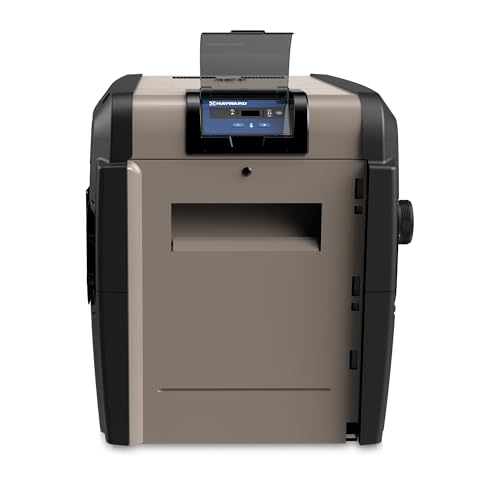
Type: Natural Gas | BTU: 150,000 | Efficiency: 81% thermal | Max Pool: ~15,000 gallons | Heat Exchanger: Copper | Connection: 2″ plumbing | Low NOx: Yes – ASME certified | Ignition: Electronic | Price Range: $$$
The Hayward W3H150FDN is the natural mid-point of Hayward’s H-Series lineup – the workhorse gas heater for pools in the 10,000–15,000 gallon range that need reliable, fast heating without the cost and footprint of a larger unit. Hayward’s H-Series has been the benchmark residential gas pool heater for decades, and this current generation maintains that reputation with an ASME-certified low-NOx design that meets California SCAQMD requirements and most state air quality standards – meaning it won’t be restricted or require replacement when regulations tighten. The electronic ignition and polymer header design resist corrosion better than older metal header alternatives.

At 150,000 BTU, this heater raises a 15,000-gallon pool at approximately 1.7°F per hour – sufficient to bring a pool from overnight ambient temperature to comfortable swimming temperature in 3–5 hours. The digital temperature display and LED indicator make monitoring straightforward, and Hayward’s automation compatibility with major pool control systems (AquaConnect, OmniLogic) allows remote scheduling and monitoring via smartphone. The unit is weather-resistant and rated for both indoor and outdoor installation with appropriate venting.

Real-world operating cost: Approximately $3.50–$5.50/hour on natural gas; $80–$130 per month at 4 hours/day active heating. Best managed with a pool cover to reduce run time significantly.
Salt pool compatibility: Copper heat exchanger – compatible with salt pools but monitor for accelerated corrosion over time. Cupro-nickel upgrade available as an option on some markets.
Pros:
- Low NOx ASME certified – compliant in California and most restrictive air quality districts
- Hayward H-Series reliability – one of the most field-proven residential gas heater designs available
- Automation compatible with all major pool control systems
- Electronic ignition – no pilot light to maintain or relight
- Compact footprint for a 150K BTU unit
Cons:
- 81% efficiency – slightly below the 95%+ ratings of premium condensing units
- Copper heat exchanger – not ideal for high-salt or harsh water chemistry without additional monitoring
- Gas operating costs remain significant compared to heat pump over a full season
Best For: Inground pools of 10,000–15,000 gallons in mixed or cold climates; weekend swimmers needing fast warm-up; pool owners who require low-NOx compliance for their region.
2. Jandy JXI400N 400K BTU – Best Large Gas Heater

Type: Natural Gas | BTU: 400,000 | Efficiency: Up to 84% | Max Pool: 30,000–50,000 gallons | Heat Exchanger: Cupro-nickel available | Footprint: 38% smaller than standard 400K units | Automation: iAquaLink compatible | Price Range: $$$$
The Jandy JXI400N is the premium large-pool gas heater for residential applications – packing 400,000 BTU into a footprint 38% smaller than comparable-output competitors. For large inground pools (25,000–50,000 gallons), resort-style backyard pools, or combined pool-and-spa setups requiring the heating output to manage both simultaneously, the JXI400N delivers the BTU range needed to achieve meaningful temperature rises within a practical timeframe. A 30,000-gallon pool that might take 10+ hours to heat with a 150K unit can reach target temperature in approximately 5–6 hours with the JXI400N.

The compact design is genuinely valuable for equipment pads with limited space – a 400K BTU unit that fits where others won’t makes the difference between a viable installation and a costly pad expansion. Jandy’s iAquaLink automation integration allows complete remote control via smartphone – temperature setting, scheduling, and diagnostics. The VersaFlo hydraulic system accommodates variable-speed pump installations, which are now required in many states. Available with cupro-nickel heat exchanger for salt pool and aggressive water chemistry applications – strongly recommended for saltwater pools.

Real-world operating cost: Approximately $7–$12/hour at full output on natural gas. Budget $200–$400/month for active heating on a large pool. A pool cover reduces this by 40–70%.
Salt pool compatibility: Specify cupro-nickel heat exchanger at purchase – this is the correct configuration for any saltwater pool and significantly extends service life.
Pros:
- 400,000 BTU in a 38% smaller footprint – the compact solution for large pools
- iAquaLink compatibility for full remote automation and monitoring
- VersaFlo variable-speed pump compatibility – meets modern efficiency requirements
- Cupro-nickel heat exchanger option for superior salt and chemical resistance
- Premium Jandy build quality – commercial-grade reliability in a residential package
Cons:
- Highest purchase price in the gas heater section of this roundup
- 400K BTU gas operating costs are substantial – best offset with consistent cover use
- Professional installation required; gas line sizing for 400K BTU requires verification
Best For: Large inground pools of 25,000+ gallons, combined pool-and-spa installations, properties where equipment pad space is limited and output density matters, buyers who need smart home automation integration.
3. Raypak 105,000 BTU Natural Gas – Best Entry Gas Heater for Smaller Inground Pools
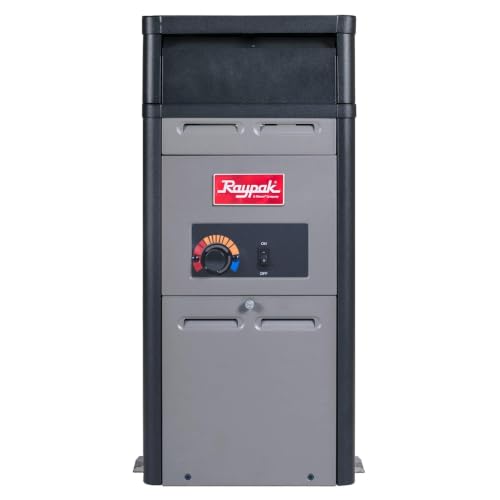
Type: Natural Gas | BTU: 105,000 | Efficiency: 82% thermal | Max Pool: ~10,000 gallons | Heat Exchanger: Copper | Display: Digital with LCD | Ignition: Electronic | Price Range: $$
Raypak is one of the most field-proven brands in pool heating – their heaters are found in commercial aquatic facilities and residential pools alike, with a reputation for durability that spans decades. The 105,000 BTU model is their entry residential gas offering, sized for smaller inground pools and larger above-ground pools in the 8,000–10,000 gallon range. At this BTU level, it raises a 10,000-gallon pool at approximately 1.5°F per hour – adequate for routine temperature maintenance and seasonal start-up warming.

The digital control panel with LCD display gives clear temperature readout and set-point control without the cryptic LED blink codes that afflict cheaper units. The copper heat exchanger is standard at this price tier – suitable for most pool chemistries with proper water balance maintenance. Raypak’s cabinet and burner design are well-regarded for weather resistance; units installed outdoors in varied climates consistently show 10+ year service lives with basic maintenance. Electronic ignition eliminates the standing pilot light, reducing gas consumption during non-heating periods.

Real-world operating cost: Approximately $2.50–$4.00/hour on natural gas; $60–$100 per month at 4 hours/day active heating for a 10,000-gallon pool.
Pros:
- Raypak brand reliability – decades of field-proven residential and commercial performance
- Digital LCD display for clear temperature monitoring
- Electronic ignition – energy saving during non-heating periods
- Most affordable gas heater entry point for smaller inground pools
- Compact footprint suits smaller equipment pads
Cons:
- 105K BTU limits pool size – not suitable for pools over 10,000 gallons if rapid heating is needed
- Copper heat exchanger – monitor water chemistry and salt concentration carefully
- 82% efficiency – not the highest in the category
Best For: Small to mid-size inground pools (8,000–10,000 gallons) in mixed or cold climates, buyers who want Raypak brand reliability at the lowest possible entry price, seasonal swimmers needing dependable fast heating.
4. Raypak PR336AENC49 336,000 BTU – Best Commercial-Grade Residential Gas Heater
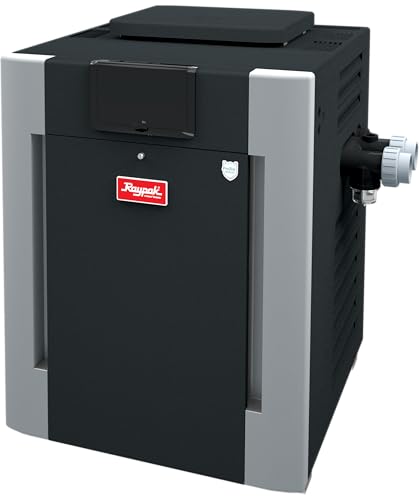
Type: Natural Gas | BTU: 336,000 | Efficiency: 82–84% thermal | Max Pool: 25,000–35,000 gallons | Heat Exchanger: Copper (cupro-nickel upgrade available) | Weight: ~220 lbs | Warranty: 2 years | Price Range: $$$
The Raypak PR336AENC49 sits at the upper end of the residential gas heater market – 336,000 BTU of proven Raypak output designed for large pools in the 25,000–35,000 gallon range. At this BTU level, a 25,000-gallon pool heats at approximately 1.8°F per hour – enough to raise a cold spring pool to comfortable swimming temperature over a weekend. This is the correct sizing for large residential inground pools in cold climates where fast, reliable heating is prioritized over operating cost minimization.
Raypak’s commercial heritage shows in the build quality: the PR336 uses the same fundamental engineering as models found in hotel pools and aquatic centers, adapted for residential installation. The digital control system displays target and actual temperature clearly, and the corrosion-resistant cabinet handles outdoor installation in challenging environments. At approximately 220 lbs, professional installation is required – this is not a DIY project. Two-year warranty coverage is standard for the commercial-grade tier.

Real-world operating cost: Approximately $6–$10/hour on natural gas at full output. Budget for a pool cover – at this BTU level, cover discipline produces substantial cost savings.
Pros:
- Commercial-grade Raypak build quality in a residential-market unit
- 336,000 BTU handles large residential pools with meaningful heating speed
- Proven field reliability in demanding applications
- Digital controls with clear temperature display
- 2-year warranty – strong coverage for this product category
Cons:
- 220 lbs – professional installation only; no DIY option
- Gas operating costs at 336K BTU are significant for full-season heating
- Copper heat exchanger standard – specify cupro-nickel for salt pools
Best For: Large inground pools (25,000–35,000 gallons) in cold or mixed climates where fast reliable heating and commercial-grade durability are the priority over operating cost minimization.
5. Aquastrong 80,000 BTU Inverter Heat Pump – Best Inverter Heat Pump
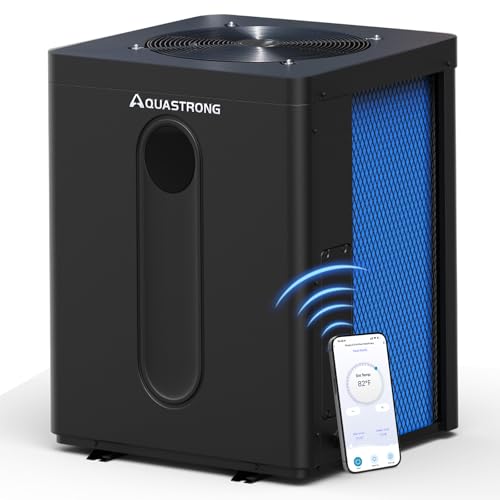
Type: Inverter Heat Pump (top discharge) | BTU: 80,000 | COP: Up to 6.5 | Power: 240V | Min Air Temp: ~45°F | Max Pool: 12,000–16,000 gallons | Heat Exchanger: Titanium | Noise: ~52 dB | Price Range: $$$
The Aquastrong 80,000 BTU Inverter is the most technologically advanced heat pump in this roundup and the recommended choice for warm-climate pool owners who heat frequently. The variable-speed inverter compressor – the defining feature – modulates output continuously to match exactly the heating demand at any given moment. Rather than cycling on at 100% capacity and off repeatedly, the inverter runs at 30–50% capacity to maintain temperature, consuming 25–30% less electricity than equivalent fixed-speed units over a full season while extending compressor life significantly. The top-discharge airflow design prevents recirculation of exhaust air in confined equipment pad areas – a meaningful installation advantage over front or side discharge alternatives.

The titanium heat exchanger is the correct specification for any heat pump – titanium resists both salt water corrosion and aggressive water chemistry far better than copper or cupro-nickel, and is standard on quality heat pumps for good reason. At COP 6.5 at peak efficiency conditions (80°F ambient air), this machine delivers $6.50 worth of heat for every $1 of electricity – a 650% efficiency ratio that makes it the lowest operating-cost heating option in this roundup by a significant margin. At approximately $0.45–$0.90/hour depending on electricity rates and ambient conditions, it costs 5–10× less to operate than an equivalent-pool gas heater.

Real-world operating cost: $0.45–$0.90/hour depending on ambient temperature and electricity rates. At 4 hours/day maintenance heating: approximately $54–$108/month – vs. $300–$600/month for a comparable gas heater.
Salt pool compatibility: Titanium heat exchanger – fully compatible with saltwater chlorination systems. This is the superior choice for salt pools.
Pros:
- Inverter compressor – 25–30% more efficient than fixed-speed heat pumps and longer-lasting
- COP up to 6.5 – the highest efficiency ratio in this roundup
- Titanium heat exchanger – salt pool and aggressive chemistry compatible
- Top discharge design – suitable for equipment pads with limited clearance
- Dramatically lower operating cost than any gas heater for frequent swimmers in warm climates
Cons:
- Effective only when ambient air is above ~45°F – not suitable for cold-climate year-round use
- Slow initial warm-up: expect 24–48 hours to raise a cold pool vs. 3–6 hours for gas
- Requires 240V dedicated circuit – electrical infrastructure cost if upgrading from gas
Best For: Warm-climate pool owners (FL, TX, AZ, SoCal, mixed-season South) who heat their pool 15+ days per month and want the lowest possible long-term operating cost. The top pick for daily or frequent swimmers where ambient temps consistently exceed 50°F.
6. Hayward W3H135FDN H-Series – Best Budget Gas Heater for Smaller Pools

Type: Natural Gas | BTU: 135,000 | Efficiency: 81% thermal | Max Pool: ~13,500 gallons | Heat Exchanger: Copper | Low NOx: Yes | Ignition: Electronic | Price Range: $$–$$$
The Hayward W3H135FDN is the step below the W3H150FDN in Hayward’s H-Series lineup – sharing the same proven design and low-NOx certification at a slightly lower BTU output and price point. For pools in the 10,000–13,500 gallon range, the difference between 135K and 150K BTU is approximately 15 minutes of heating time per degree rise – noticeable but not transformative. The 135FDN is the right choice when the pool is at the lower end of the H-Series sizing range and budget matters.

All the reliability markers of the H-Series apply here: electronic ignition, polymer header, low-NOx certification, Hayward automation compatibility, and weather-resistant cabinet construction. The digital temperature display provides accurate set-point control. For pool owners who have an existing Hayward ecosystem – pumps, filters, automation – the H-Series heater integrates seamlessly with existing controls via Hayward’s OmniLogic or ProLogic systems.

Real-world operating cost: Approximately $3.00–$5.00/hour on natural gas. For a 12,000-gallon pool at 4 hours/day: approximately $72–$120 per month during heating season.
Pros:
- H-Series proven reliability at a lower price point than the 150FDN
- Low-NOx certified – SCAQMD compliant for California and similar districts
- Hayward ecosystem integration for homes with existing Hayward automation
- Electronic ignition and polymer header for long-term durability
- Best purchase value in Hayward’s residential gas lineup for smaller pools
Cons:
- 135K BTU limits pool size – appropriate for 10,000–13,500 gal only
- Not the right choice if pool is 15,000+ gallons – step up to the 150FDN or 200FDN
Best For: Inground pools of 10,000–13,500 gallons in mixed or cold climates where Hayward’s brand reliability and low-NOx compliance are priorities and the pool size fits the 135K BTU output range.
7. EcoSmart SMART POOL 18 – Best Electric Resistance Heater for Small Pools
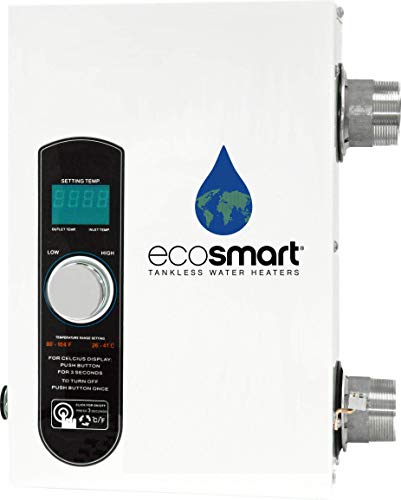
Type: Electric Resistance (tankless-style inline) | Power: 18,000W / 240V | BTU equivalent: ~61,400 BTU | Max Pool: 6,000–8,000 gallons (warm climate) | Breaker Required: 240V, 100A dedicated | Temperature Range: 80–104°F | Price Range: $$
EcoSmart is one of the most recognized names in tankless water heating, and the SMART POOL 18 applies their inline heating expertise to pool applications. At 18,000W (approximately 61,400 BTU equivalent), it’s appropriate for small above-ground pools in warm climates and works well as a booster or supplemental heater for spa sections of combination pool-spa installations. The digital temperature control and self-modulating technology adjust power draw to maintain the target temperature precisely – not just blasting full power continuously.

Installation requires a 240V, 100A dedicated breaker – a significant electrical infrastructure requirement that may not be available in all home panel configurations without upgrade. The unit installs in-line with your existing pool plumbing – a straightforward connection that doesn’t require gas line work or exhaust venting. The compact design takes up minimal equipment pad space. For small pool owners in states where gas installation is regulated or where a gas line isn’t available, the SMART POOL 18 provides electric heating without the minimum flow rate requirements of a heat pump.

Real-world operating cost: Approximately $2.16–$3.24/hour at 18kW and $0.12–$0.18/kWh. For a 6,000-gallon pool: $52–$78/month at 4 hours/day. Significantly more than a heat pump but substantially less than gas for equivalent small pool sizes.
Pros:
- No gas line needed – purely electric, simpler installation than gas
- EcoSmart brand reliability and tankless technology expertise
- Self-modulating power draw for efficient temperature maintenance
- Compact design minimizes equipment pad footprint
- Digital temperature control with precise set-point
Cons:
- 100A dedicated 240V breaker required – major electrical infrastructure demand
- Electric resistance – higher operating cost than a heat pump for equivalent heating
- Limited to 6,000–8,000 gallon pools in warm climates; inadequate for larger pools
Best For: Small above-ground pools (6,000–8,000 gallons) in warm climates where a gas line isn’t available, or as supplemental heating for a spa section where targeted spot heating is needed.
8. Pentair EC-462024 125K Natural Gas – Best Compact Premium Gas Heater

Type: Natural Gas | BTU: 125,000 | Efficiency: 84% thermal | Max Pool: ~12,500 gallons | Heat Exchanger: Cupro-nickel | Design: MasterTemp compact | Automation: IntelliTouch / EasyTouch compatible | Price Range: $$$
The Pentair EC-462024 is based on Pentair’s MasterTemp platform – one of the most respected gas pool heater designs in the professional installation market. At 125,000 BTU in a compact housing, it’s engineered for smaller inground pools and installations where equipment pad footprint is a constraint. The 84% efficiency rating is slightly above the Hayward H-Series equivalent, and the cupro-nickel heat exchanger – standard on this unit – provides meaningfully better resistance to salt water and aggressive water chemistry without requiring an upgrade specification at purchase.

Pentair’s IntelliTouch and EasyTouch automation integration makes the EC-462024 a natural fit for homes with existing Pentair pool control systems. The unit’s low NOx burner design meets California and South Coast AQMD requirements. Pentair’s service network is one of the largest in the pool industry – dealer availability, warranty service, and parts supply are consistently strong, which matters for a piece of equipment expected to run for 10+ years. The one-touch temperature adjustment and diagnostic display simplify operation and troubleshooting.

Real-world operating cost: Approximately $2.80–$4.50/hour on natural gas. For a 12,000-gallon pool at 4 hours/day: approximately $67–$108 per month during active heating season.
Salt pool compatibility: Cupro-nickel heat exchanger standard – this is the correct specification for salt pools and is already included at no additional cost.
Pros:
- Cupro-nickel heat exchanger standard – salt pool ready out of the box
- 84% efficiency – above average for this BTU class
- MasterTemp platform – proven, widely serviced, extensive parts availability
- Pentair IntelliTouch/EasyTouch automation compatibility
- Low NOx certified – compliant in California and most restricted air quality districts
Cons:
- 125K BTU appropriate only for pools under 12,500 gallons for adequate heating speed
- Premium Pentair pricing vs. comparable BTU from budget brands
Best For: Smaller inground pools (10,000–12,500 gallons) in mixed or cold climates where Pentair ecosystem integration, salt pool compatibility, and premium build quality justify the purchase price.
9. 1500W Submersible Immersion Pool Heater – Best for Spas, Hot Tubs & Tiny Pools
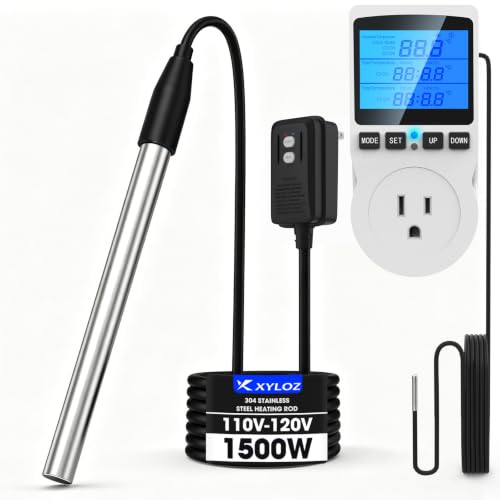
Type: Electric Immersion (submersible) | Power: 1,500W / 120V | BTU equivalent: ~5,100 BTU | Use Case: Spas, hot tubs, small stock tanks, tiny above-ground pools | Connection: Standard 120V household outlet | Price Range: $
The 1500W fully submersible immersion heater serves a specific and practical use case: heating spas, hot tubs, portable swimming pools under 1,000 gallons, stock tank pools, and similar small water vessels where a simple, low-cost heating solution is needed and a standard 120V outlet is the only available power source. The submersible design places the heating element directly in the water – the most direct possible heat transfer method – and requires no plumbing modifications or inline installation.

At 1,500W on a standard 120V outlet, it draws approximately 12.5 amps – within the range of a typical 15A household circuit. Operating cost is approximately $0.18–$0.27/hour, or $4.32–$6.48/day at 24-hour operation – practical for maintaining a small spa at temperature. For above-ground pools over 2,000 gallons, this unit will struggle to raise water temperature meaningfully against ambient heat loss – it’s genuinely sized for spas and small vessels only.

Real-world operating cost: $0.18–$0.27/hour; approximately $4–$6/day at continuous operation. Practical for small spas and stock tank pools.
Pros:
- Lowest purchase price in the roundup by a significant margin
- 120V standard outlet – no electrical work required
- Fully submersible – no plumbing modifications or inline installation
- Portable – move between vessels; suitable for multiple small pools or spas
- Lowest operating cost for small vessels due to low wattage
Cons:
- 5,100 BTU equivalent – not suitable for any pool over ~1,500 gallons for meaningful heating
- Submersible design requires careful waterproofing and GFCI outlet compliance
- No thermostat control on basic models – monitor temperature manually
Best For: Spas, hot tubs, stock tank pools, portable kiddie pools, and any small water vessel under 1,500 gallons where a simple 120V plug-in heating solution is needed.
10. Swimming Pool Heat Pump FH255 55,000 BTU – Best Budget Heat Pump for Above-Ground Pools
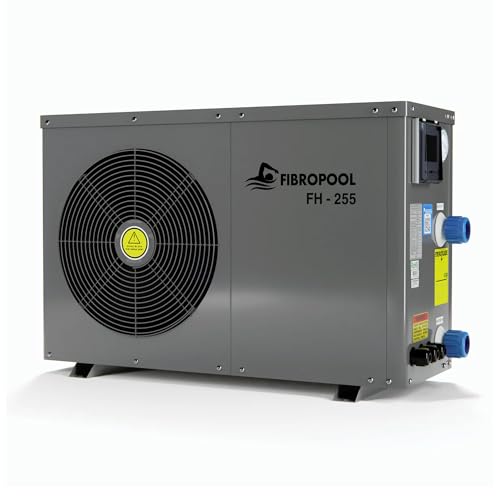
Type: Heat Pump (fixed speed) | BTU: 55,000 | COP: ~5.0 at 80°F | Power: 240V | Min Air Temp: ~45°F | Max Pool: 6,000–10,000 gallons | Compatible: Above-ground and inground | Price Range: $$
The FH255 55,000 BTU Heat Pump is the most accessible price entry into genuine heat pump technology for above-ground and smaller inground pool owners. At 55,000 BTU with a COP of approximately 5.0 at standard test conditions, it delivers $5 worth of heat for every $1 of electricity – far more efficient than any electric resistance heater and dramatically cheaper to operate than gas for pools it can appropriately serve. The compatibility with both above-ground and inground pool plumbing connections makes it versatile across installation types.

At 55,000 BTU, this heat pump appropriately serves pools in the 6,000–10,000 gallon range when used in warm climates to maintain temperature – rather than repeatedly heating from cold. The best usage pattern: set a target temperature, run the heat pump in maintenance mode daily with a pool cover on overnight, and let the continuous operation maintain warmth rather than fighting a cold pool each morning. In this mode, a 55,000 BTU heat pump on a 8,000-gallon pool in a 65°F ambient climate runs approximately 4–6 hours per day and costs $2–$5 per day to operate.

Real-world operating cost: Approximately $0.30–$0.75/hour; $1.80–$4.50/day at 6 hours operation. For a 8,000-gallon pool in a warm climate: $54–$135/month during heating season.
Pros:
- Most accessible heat pump price point – lowest cost entry to heat pump technology
- COP ~5.0 – 500% efficiency; dramatically more efficient than electric resistance or gas
- Compatible with both above-ground and inground pool plumbing
- 240V installation – simpler than the 100A requirement of some electric resistance units
- Correct technology for warm-climate frequent swimmers with smaller pools
Cons:
- Fixed-speed compressor – less efficient than inverter models during temperature maintenance mode
- 55,000 BTU limits to pools under 10,000 gallons for adequate performance
- Ineffective below ~45°F – not suitable for cold climates or cold-season heating
Best For: Above-ground and smaller inground pool owners (6,000–10,000 gallons) in warm climates who want the long-term cost efficiency of heat pump technology at the lowest possible entry price.
11. Pool Heater 9KW 220V Electric – Best Compact Inline Electric for Small Pools

Type: Electric Resistance (inline) | Power: 9,000W / 220V | BTU equivalent: ~30,700 BTU | Max Pool: Up to 5,000 gallons | Connection: 220V, 40A dedicated breaker | Price Range: $
The 9KW 220V electric pool heater is the compact inline solution for very small above-ground pools, kiddie pools, stock tanks, and similar small water installations where a 220V outlet is available. The inline design connects directly to the pool’s plumbing circulation – water flows through the heating chamber and returns to the pool warmer, maintaining consistent temperature without manual intervention. At 9KW (approximately 30,700 BTU equivalent), it raises small pools meaningfully while drawing 40 amps from a 220V circuit.

For pools under 3,000 gallons, this unit provides adequate heating capability on a budget. For pools between 3,000–5,000 gallons in warm climates with good overnight cover discipline, it maintains temperature reasonably. The compact physical size makes it suitable for tight equipment installations and above-ground pool setups where larger equipment doesn’t fit or isn’t justified by pool size.

Real-world operating cost: Approximately $1.08–$1.62/hour at 9kW; $4.32–$6.48/day at 4 hours operation.
Pros:
- Budget purchase price for small pool electric heating
- Compact inline design – minimal equipment space required
- No gas line required – purely electric installation
- 220V requirement is more accessible than the 100A demand of higher-wattage units
Cons:
- Electric resistance – 5× higher operating cost than equivalent heat pump
- 30,700 BTU – limited to pools under 5,000 gallons for meaningful temperature control
- Not suitable as primary heating for full-size swimming pools
Best For: Very small above-ground pools (under 5,000 gallons) in warm climates; budget-constrained installations where 220V is available but a heat pump purchase isn’t justified by pool size.
12. 120V Electric Pool Heater 30,000 BTU – Best Plug-In Heater for Above-Ground Pools
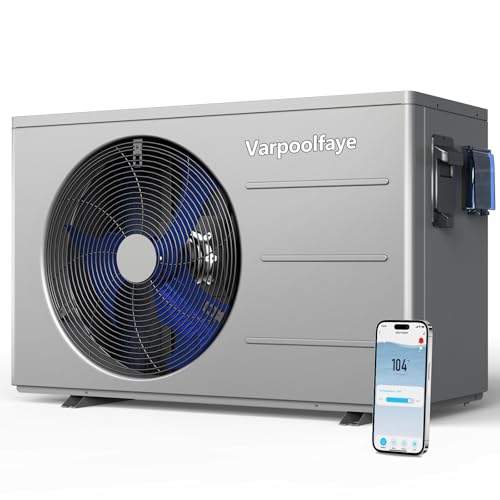
Type: Electric Resistance (inline) | Power: 120V standard outlet | BTU: 30,000 BTU | Max Pool: Up to 8,000 gallons (per listing) | Breaker Required: Standard 15–20A household circuit | Installation: No hardwiring – plug-in | Price Range: $
The 120V 30,000 BTU pool heater addresses the most common above-ground pool owner constraint: no 240V outlet available, no gas line, and a desire to heat the pool with the standard power outlets already in the yard. The 120V plug-in design requires no electrical panel work, no licensed electrician, and no permit in most jurisdictions – connect it to the pool plumbing circulation system and plug into any 15–20A outdoor outlet.

At 30,000 BTU from a 120V outlet (approximately 8,800W – which exceeds what a standard 15A circuit can sustain at full draw for extended periods; verify actual draw specs), this heater maintains pool temperature in small above-ground pools in warm climates. For pools under 5,000 gallons in climates where ambient temperatures rarely drop below 60°F at night, it provides a meaningful and simple heating solution. The listing claims 8,000-gallon compatibility – in practice, realistic consistent heating in an 8,000-gallon pool would require a warmer climate, good cover discipline, and modest target temperatures.

Real-world operating cost: At 120V / standard outlet draw rates, operating costs are modest for small pools. Verify actual amperage draw before assuming compatibility with existing circuits – 30,000 BTU from 120V requires careful electrical verification.
Pros:
- True plug-in installation – no electrician, no hardwiring, no permit in most areas
- Lowest installation cost of any heater in this roundup
- Suitable for renters and temporary setups – fully portable
- No gas line or 240V service required
Cons:
- Electric resistance – higher operating cost than heat pump for equivalent heating
- 120V limits available power – verify circuit capacity before sustained operation
- Best for small pools under 5,000 gallons in warm climates; limited in cold or large pool scenarios
Best For: Above-ground pool owners in warm climates (FL, TX, AZ, SoCal) who want the simplest possible installation – plug-in only – for a pool under 5,000 gallons and do not have access to 240V service or a gas line.
Salt Pool Warning: What Gas Heater Manufacturers Don’t Emphasize
Salt chlorination systems have become the standard in residential pool design – quieter chemistry, gentler on skin, and no handling of chlorine tabs. But salt water is significantly more corrosive than traditional chlorinated fresh water, and this has a direct impact on pool heater lifespan and selection.
Gas heaters in salt pools: Standard copper heat exchangers corrode acceleratedly in salt water. Expect approximately 40% shorter service life compared to a fresh-water installation – a gas heater that might last 10 years in a traditional chlorine pool may last 6 years in a salt pool. If you select a gas heater for a salt pool, specify the cupro-nickel heat exchanger upgrade – Raypak, Hayward, and Pentair all offer this. The Pentair EC-462024 includes cupro-nickel as standard; the Hayward models and Raypak units require specification at purchase. Cupro-nickel significantly extends service life in salt applications.
Heat pumps in salt pools: Modern heat pumps use titanium heat exchangers as standard – titanium is essentially impervious to salt water corrosion and is the preferred heat exchanger material for all pool applications, salt or fresh. The Aquastrong Inverter and FH255 both use titanium. For any salt pool owner, a heat pump with a titanium heat exchanger is the superior long-term investment from a corrosion and lifespan perspective.
Installation Cost Reality: The Full Picture Before You Buy
Pool heater listings show unit prices. The total installed cost includes labor, plumbing, electrical or gas work, and permits – and the gap between unit price and installed cost can be substantial.
| Scenario | Unit Cost | Install Labor | Permit | Total Range |
|---|---|---|---|---|
| Gas (existing gas line + pad) | $800–$2,500 | $500–$1,500 | $150–$400 | $1,450–$4,400 |
| Gas (new gas line needed) | $800–$2,500 | $1,500–$3,500 | $200–$500 | $2,500–$6,500 |
| Heat pump (existing 240V circuit) | $1,200–$4,000 | $500–$1,200 | $150–$400 | $1,850–$5,600 |
| Heat pump (new 240V circuit needed) | $1,200–$4,000 | $1,500–$3,000 | $200–$500 | $2,900–$7,500 |
| Electric resistance (small pool, 120V) | $100–$500 | $100–$300 | Often none | $200–$800 |
Inverter vs. Fixed-Speed Heat Pumps: The Upgrade Worth Understanding
Most budget heat pumps use a fixed-speed compressor – it operates at 100% capacity when on and shuts completely off when the target temperature is reached. Think of it like driving with your accelerator pressed to the floor until you hit 60 mph, then cutting the engine entirely, then repeating. Effective, but wasteful when you just need to nudge the temperature up a degree.
Inverter heat pumps – like the Aquastrong 80,000 BTU in this roundup – use a variable-speed compressor that modulates output continuously from approximately 20% to 100% of rated capacity. When the pool needs a significant temperature rise, the inverter runs at full power. When maintaining temperature on a warm day, it runs at 25–30% capacity continuously, using a fraction of the electricity. The result: 25–30% less electricity consumed over a full heating season versus a fixed-speed unit of equivalent BTU rating, combined with dramatically less compressor on/off cycling that extends component life.
The Pool Cover Multiplier: The Single Best Investment for Any Pool Owner
No heater upgrade – no higher BTU rating, no efficiency improvement, no technology switch – produces a cost impact comparable to using a pool cover consistently. Surface evaporation accounts for approximately 70% of pool heat loss. A cover that stops evaporation stops most of your heating bill from escaping.
A quality solar blanket reduces heating costs by 50–90% – not 5%, not 15%, but potentially eliminating most of the heating expense entirely when used overnight. The practical implication: a $100 solar blanket paired with a 55,000 BTU heat pump will maintain lower monthly operating costs than a $4,000 gas heater without a cover. The cover is not an optional accessory – it’s a financial decision that pays back in weeks.
Solar blankets work in two ways: they stop evaporative heat loss at the surface, and their bubble design passively absorbs solar radiation and contributes modest additional warming during daylight hours. Cost: $50–$400 for residential pool sizes. Return on investment: measured in weeks, not years.
Buying Guide Checklist: Confirm These Before Purchasing
- Technology first: Gas for cold climates and occasional/weekend use. Heat pump for warm climates and frequent/daily swimmers. Electric resistance for small above-ground pools and spas only. Don’t select based on BTU alone without confirming technology fit for your climate and usage.
- Usage frequency: Heat 15+ days/month → heat pump wins on lifetime cost. Under 8 days/month → gas heater’s lower purchase price and fast warm-up make more practical sense.
- Climate verification: Heat pumps need consistent ambient temps above 50°F. If your swim season includes periods below this threshold, gas is required for reliable heating.
- BTU sizing: Use the formula: Pool gallons × 8.34 × desired °F rise per hour = minimum BTU. Don’t overbuy – oversized units cost more without proportional speed improvement.
- Salt pool: Always specify titanium heat exchanger (heat pump) or cupro-nickel (gas). Standard copper corrodes significantly faster in saltwater applications.
- Fuel/power infrastructure: Confirm which you have before buying – natural gas line, propane tank, 240V circuit, or 120V only. Adding infrastructure adds $800–$3,500 to total installed cost.
- Inverter vs. fixed speed (heat pumps): Inverter for frequent temperature maintenance; fixed for occasional use or budget-constrained purchase. Inverter saves 25–30% on operating costs for regular swimmers.
- Efficiency ratings: Gas: look for 84%+ thermal efficiency; heat pumps: COP 5.0+ represents good value; inverter models reach COP 6.0–7.0.
- Low-NOx compliance: Required in California and several other states for new gas heater installations. All Hayward H-Series and Pentair MasterTemp units in this roundup are compliant.
- Pool cover: Budget for a solar blanket alongside the heater. It’s the most impactful efficiency investment available and reduces operating costs 50–90%.
- Installation permits: Gas line work and major electrical connections require permits in most jurisdictions ($150–$400). Your contractor should manage applications.
Frequently Asked Questions
Conclusion: The Right Heater for the Right Pool and Climate
The pool heater decision is more consequential than almost any other pool equipment choice – the operating cost difference between the right and wrong technology can amount to $2,000–$5,000 over a single heating season. Getting this right requires matching technology to climate, BTU to pool size, and usage pattern to the economics that favor each type.
For inground pools in mixed or cold climates where fast heating and all-temperature reliability matter: the Hayward W3H150FDN is the best mid-size gas heater for 10,000–15,000-gallon pools, and the Jandy JXI400N is the premium large-pool choice for 25,000+ gallon applications. Both offer low-NOx certification and established brand support.
For warm-climate daily swimmers who want the lowest possible long-term operating cost: the Aquastrong 80,000 BTU Inverter Heat Pump is the standout choice – inverter technology, titanium heat exchanger, and COP 6.5 efficiency that delivers $6.50 of heat per $1 of electricity. The FH255 55,000 BTU is the right budget heat pump entry for smaller pools.
For small above-ground pools and spas: the EcoSmart SMART POOL 18 and the 120V plug-in 30,000 BTU serve their respective use cases – the SMART POOL 18 for 6,000–8,000 gallon pools with 240V service, and the plug-in unit for the simplest possible installation on standard household current.
Whatever you choose – buy a pool cover at the same time. It costs less than one month of gas heating and reduces operating costs by 50–90%. No heater upgrade comes close to that return.
Check current prices on Amazon:
| Product | Best For | Link |
|---|---|---|
| Hayward W3H150FDN | Best Mid-Size Gas Heater | 🛒 View on Amazon |
| Jandy JXI400N | Best Large Gas Heater | 🛒 View on Amazon |
| Raypak 105,000 BTU | Best Entry Gas Heater | 🛒 View on Amazon |
| Raypak PR336AENC49 | Best Commercial-Grade Gas | 🛒 View on Amazon |
| Aquastrong 80K Inverter Heat Pump | Best Inverter Heat Pump | 🛒 View on Amazon |
| Hayward W3H135FDN | Best Budget Gas Heater | 🛒 View on Amazon |
| EcoSmart SMART POOL 18 | Best Small Pool Electric | 🛒 View on Amazon |
| Pentair EC-462024 125K | Best Compact Premium Gas | 🛒 View on Amazon |
| 1500W Immersion Heater | Best for Spas & Tiny Pools | 🛒 View on Amazon |
| FH255 55,000 BTU Heat Pump | Best Budget Heat Pump | 🛒 View on Amazon |
| Pool Heater 9KW 220V | Best Compact Inline Electric | 🛒 View on Amazon |
| 120V 30,000 BTU Electric | Best Plug-In / No Hardwire | 🛒 View on Amazon |


