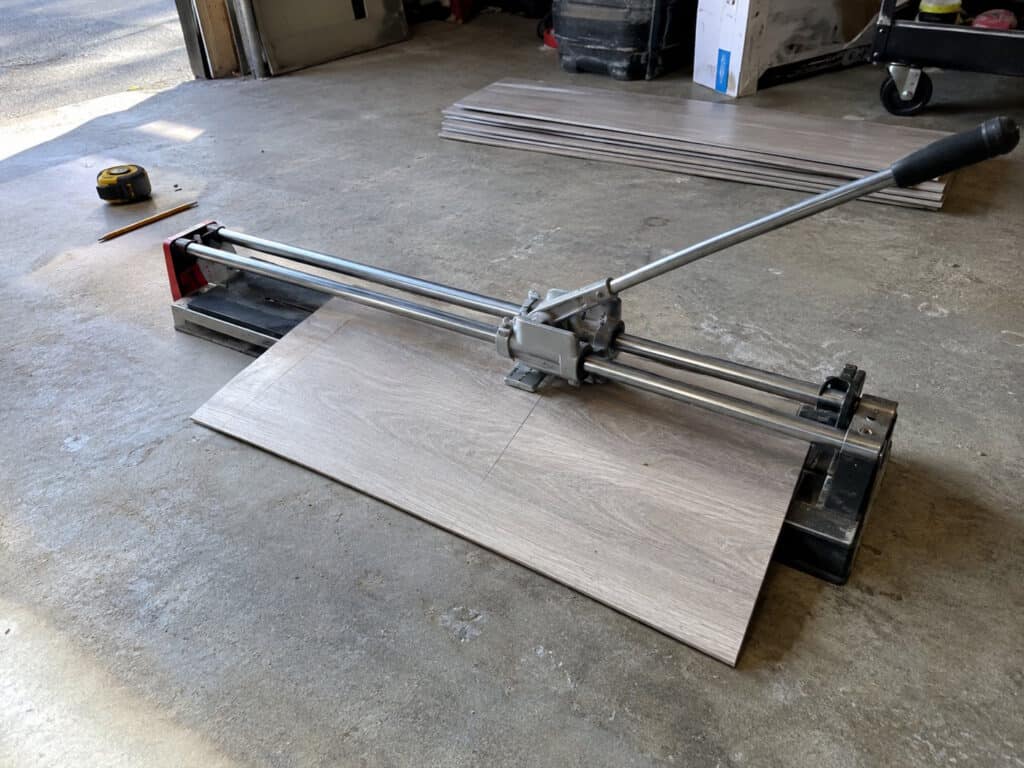
A manual tile cutter scores a line across the glaze with a carbide wheel, then a breaking foot presses down and the tile snaps clean along that line. No water, no slurry, no motor noise, and a straight cut takes a few seconds once you’ve set the fence. For straight cuts on ceramic and most porcelain, it’s faster than a wet saw. This guide compares 10 manual tile cutters on Amazon, from a 14-inch cutter for backsplash tile to 48-inch rails for large-format porcelain, plus the nipper you’ll need for the cuts a snap cutter can’t make.
Quick Picks
- Best overall: QEP 10630 24-Inch Professional Tile Cutter
- Best pro pull-handle cutter: Sigma 2B3 26-Inch Pull Tile Cutter
- Best for walls and backsplashes: Sigma 2G 37cm Tile Cutter
- Best value mid-size: VEVOR 32-Inch Tile Cutter with Laser Guide
- Best for 48-inch porcelain: SHIJING 48-Inch Tile Cutter with Laser Guide
- Best budget: TILER 14-Inch Manual Tile Cutter
Quick Comparison
| Product | Straight Cut | Diagonal | Max Tile Thickness | Listed Weight | Best For |
|---|---|---|---|---|---|
| QEP 10630 | 24″ | 16″ | Check listing | 18.3 lb | Best Overall |
| Sigma 2B3 | 26″ (66 cm) | 18″ (46 cm) | 19 mm | 11 lb | Pro Pull Handle |
| QEP 10800 | 28″ | 20″ | Check listing | Not listed | Heavy-Duty Push Cutter |
| Sigma 2G | 14.5″ (37 cm) | 10″ (25 cm) | Check listing | 6.5 lb | Walls and Backsplashes |
| VEVOR 32″ Laser | 32″ | Check listing | Check listing | Not listed | Best Value Mid-Size |
| VEVOR 48″ | 48″ | Check listing | 4-15 mm | Not listed | Budget Large Format |
| SHIJING 48″ Laser | 48″ | Check listing | Check listing | 41.4 lb | 48-Inch Porcelain |
| SHIJING 24″ Laser | 24″ | Check listing | 0.23-0.67″ | 21.5 lb | Thin Tile |
| TILER 14″ | 14″ | Check listing | 0.47″ | Not listed | Best Budget |
| QEP 9″ Nipper | Curves and notches | – | 1/8-1/4″ | – | Must-Have Extra |
Push Handle vs. Pull Handle
Most cutters on Amazon, including the QEP, VEVOR, SHIJING and TILER models here, are push cutters. You start the wheel at the near edge of the tile and push it away from you, then press down on the handle to snap. Sigma’s cutters are pull cutters: you start at the far edge and draw the handle toward you.
The difference shows up in control. Pulling keeps your weight over the handle and your wrist in a straighter line, which some tile setters prefer for an even score on hard porcelain. Pushing is more intuitive the first time you pick one up and is what most homeowner cutters use. Neither style cuts tile the other can’t. Buy the size and build you need first, and treat the handle style as a preference.
Match the Cutter Length to Your Largest Tile
A cutter’s rated length is its longest straight cut. The diagonal capacity is always shorter, because a square tile set at 45 degrees takes up more room on the base. The QEP 10630 is a good example: 24 inches straight, 16 inches diagonal. If you plan diagonal layouts, check the diagonal number against your tile, not the headline length.
As a rule of thumb, buy a cutter at least a few inches longer than your biggest tile’s straight cut. A 12 x 24 plank cut lengthwise needs a 24-inch-plus cutter. A 24 x 48 porcelain panel needs a 48-inch rail. Longer rails also need better support underneath. That’s why the 48-inch cutters here have adjustable feet and side supports: a long tile that sags off the end of the base will snap off the line.
What a Manual Tile Cutter Can’t Do
A snap cutter makes straight cuts edge to edge. It won’t make L-shaped cuts around a door jamb, notches for an outlet, curves around a toilet flange or holes for pipes. For those you need tile nippers, an angle grinder with a diamond blade (see our angle grinder guide), or a wet saw.
Snap cutters also struggle with very thin slivers, since there isn’t enough tile on the narrow side to break cleanly, and with heavily textured or uneven-surface tile, where the wheel skips across the high spots. VEVOR states plainly that its 48-inch cutter isn’t meant for marble, granite, uneven surface tiles or microcrystalline stone. For natural stone and thick outdoor pavers, a wet saw is the right tool. Our best tile saw guide covers those.
Most tile jobs end up using both: a snap cutter for the dozens of straight cuts along the walls, and a saw or grinder for the handful of notches.
1. QEP 10630 24-Inch Professional Tile Cutter – Best Overall
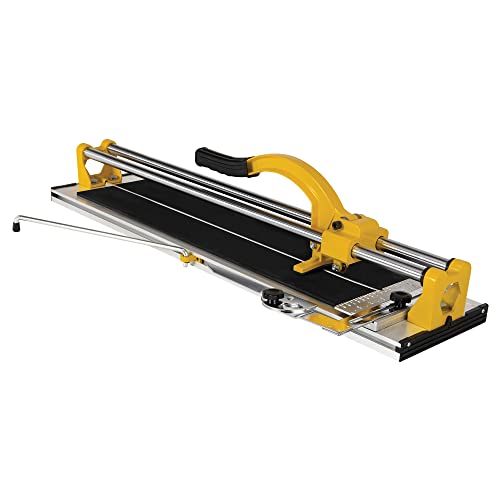
The QEP 10630 hits the size most floor and shower jobs need. It rips ceramic and porcelain tile up to 24 inches and cuts 16 inches on the diagonal, which covers 12 x 24 planks lengthwise and 16-inch squares corner to corner. The scoring wheel is a 7/8-inch titanium-coated tungsten carbide wheel. A larger wheel like this rolls over the glaze more evenly than the small wheels on budget cutters, which helps on hard porcelain.

The scoring head runs on a ball-bearing slide, and side arm extensions fold out to support tile that’s wider than the base. The listing weight is 18.3 pounds, heavy enough to stay put on the floor while you press down to snap, but still a one-hand carry. It holds 4.3 stars across 259 ratings.
Compared with the cheaper 24-inch SHIJING below, the QEP has the bigger wheel and a brand with replacement parts sold in US stores. The SHIJING adds a laser guide and a split breaking plate for thin tile. Bob Vila also lists the QEP 10630 among its top tile cutter picks (Bob Vila, retrieved 2026-10-14).
Pros: 24-inch rip and 16-inch diagonal covers most floor tile; large 7/8-inch titanium-coated wheel; ball-bearing slide; fold-out side arm extensions.
Cons: No laser guide; too short for 24 x 48 panels; max tile thickness isn’t stated on the listing.
Skip it if: you’re laying 48-inch porcelain. You’ll need the SHIJING or VEVOR 48-inch rails.
2. Sigma 2B3 26-Inch Pull Tile Cutter – Best Pro Pull-Handle Cutter

The 2B3 is the mid-size pull cutter from Italian maker Sigma. It cuts 66 cm (26 inches) straight and 46 cm (about 18 inches) on the diagonal, and handles tile up to 19 mm thick, according to UK retailer ProTilerTools (ProTilerTools, retrieved 2026-10-14). The frame and sliding guide are hardened aluminum alloy, and the measuring square pivots from +45 to -45 degrees with quick stops at common angles.
The same retailer lists a 5-year guarantee and notes that most spare parts are available. That matters on a tool you’ll keep for years: you replace the scoring wheel or a worn part instead of the whole cutter. The Amazon listing gives the weight as 11 pounds, light for a 26-inch cutter. It has 4.3 stars across 616 ratings.
The catch is price. It costs well over three times as much as the QEP 10630, which cuts nearly the same length. You’re paying for the pull-handle feel, the aluminum frame and parts support over many years.
Pros: Pull handle for a controlled score; 66 cm straight and 46 cm diagonal; handles tile up to 19 mm thick; spare parts available; light 11-pound listing weight.
Cons: Most expensive cutter here; the Amazon listing has almost no detail, so check specs before you buy.
Skip it if: you’re tiling one bathroom. The QEP 10630 does the same straight cuts for a fraction of the price.
3. QEP 10800 28-Inch Rip / 20-Inch Diagonal Tile Cutter – Best Heavy-Duty Push Cutter

The QEP 10800 is the step up from the 10630 for people who cut tile every week. QEP describes it as built with Ishii engineering, on a wide cast aluminum base with heavy rubber pads to keep it from sliding. It cuts up to 28 inches straight and 20 inches on the diagonal.
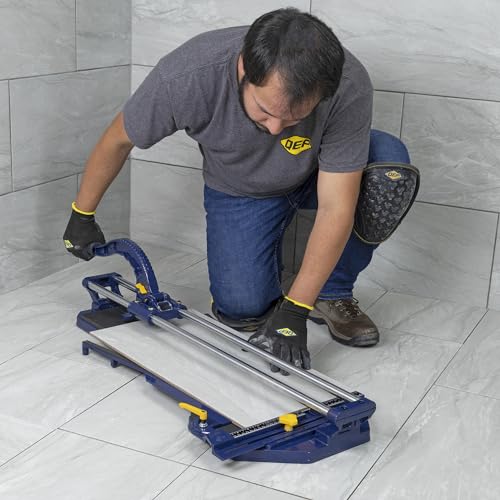
The scoring head runs on dual chrome-plated rail bars with linear ball-bearing slides. The 7/8-inch titanium-coated wheel adjusts to four heights, so you can move it out of the way to snap without the wheel dragging across the tile. A large bicycle-grip handle gives more leverage for repeated cuts, and side arm extensions support large tiles. It holds 4.2 stars across 87 ratings.
Dual rails are the reason to pay more than the 10630. Two rails keep the head from twisting on a long score, which helps keep the line straight on dense porcelain.
Pros: Dual chrome rails with linear bearings; wheel adjusts to 4 heights; 28-inch rip and 20-inch diagonal; non-slip cast aluminum base.
Cons: More than twice the price of the 10630; the Amazon listing doesn’t give a weight or max tile thickness.
Skip it if: you’re doing one project. The 10630 gets you 24 inches for much less.
4. Sigma 2G 37cm Tile Cutter – Best for Walls and Backsplashes
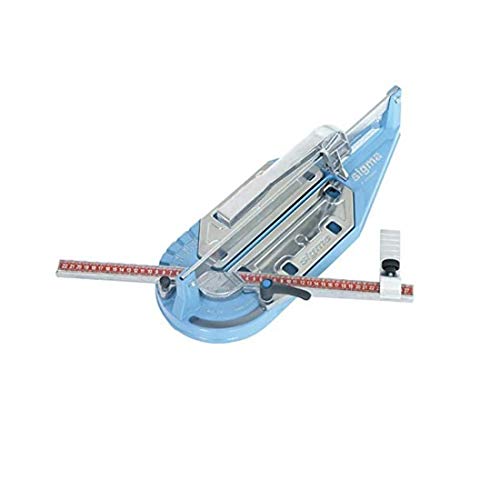
Wall tile, subway tile and backsplash tile rarely need more than a 14-inch cut, and hauling an 18-pound cutter up a ladder or onto a countertop gets old fast. The Sigma 2G cuts 37 x 37 cm (about 14.5 inches) straight and 25 x 25 cm diagonally. A quick-positioning button sets angle cuts from 0 to 45 degrees.
The listing claims it weighs under 5 pounds, but the item weight in the same listing says 6.47 pounds. Either way, it’s the lightest Sigma here and easy to set on a countertop next to the wall you’re tiling. Measurements are metric only, so you’ll read the scale in centimeters. It has the best rating in this guide, 4.6 stars across 571 ratings.
Against the TILER 14-inch, the Sigma costs several times more but brings the pull handle and Sigma’s build quality. The TILER is fine for a single backsplash. The Sigma is the one to keep in the truck.
Pros: Highest Amazon rating in this guide; light enough for countertop and ladder work; 0-45 degree angle stops; pull handle.
Cons: Metric-only scale; 14.5-inch cut won’t handle floor planks; the listing’s weight figures don’t match.
Skip it if: you need to cut floor tile over 14 inches. Look at the QEP 10630 or Sigma 2B3.
5. VEVOR 32-Inch Tile Cutter with Laser Guide – Best Value Mid-Size

This VEVOR is the most-reviewed tile cutter we found on Amazon, with 1,263 ratings averaging 4.0 stars. It gives you 32 inches of cut, longer than the QEP 10630, for less money. The frame is all steel and the sliding head runs on 23 ball bearings, with a built-in oil can to keep them moving.
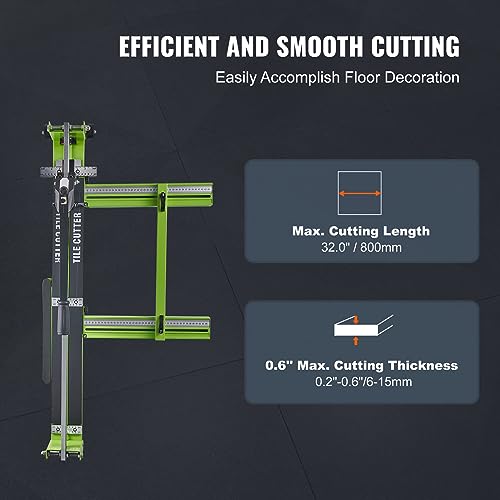
A laser projects the cut line onto the tile, and three aluminum rulers help repeat the same cut across a row. The laser helps with marked cuts, but you’ll still want to check the first tile of every batch against your mark, because a laser that shifts slightly in its housing will move every cut with it.
A 4.0-star average across that many reviews tells you most buyers are happy, but a meaningful share aren’t. Common budget-cutter complaints apply here: check that the rail is square out of the box before your first real tile.
Pros: 32-inch cut for less than the 24-inch QEP; laser line guide; all-steel frame; most-reviewed cutter we found.
Cons: Lower average rating than the QEP and Sigma models; listing doesn’t clearly state diagonal capacity or max tile thickness.
Skip it if: you want a cutter you can rebuild with brand parts for years. The QEP or Sigma models are the better long-term buy.
6. VEVOR 48-Inch Manual Tile Cutter – Best Budget Large Format

If you’re laying 24 x 48 porcelain once and don’t want to spend much, this is the cheapest 48-inch rail here. It cuts up to 1,200 mm (48 inches) in tile from 4 to 15 mm thick. An infrared line guide marks the cut, and a metal ridge under the wheel path supports the score line. The sliding head runs on ball bearings.
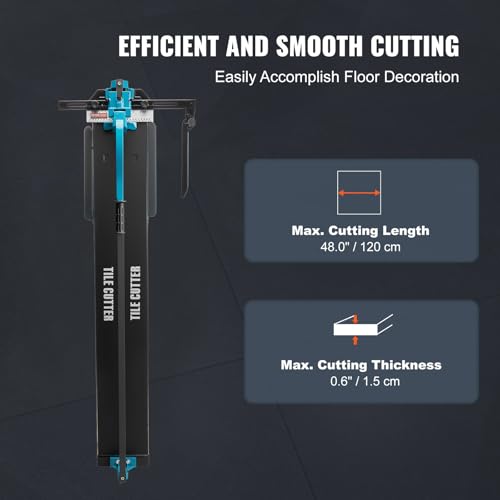
VEVOR is upfront about the limits. The listing says it’s meant for wall tiles and polished tiles, and says it won’t cut marble, granite, uneven-surface tiles or microcrystalline stone with a 0.5 to 3 mm crystal surface layer. It has 4.1 stars across 690 ratings.
Pros: Lowest-cost 48-inch cutter here; infrared line guide; clear statement of what it can’t cut; large number of ratings.
Cons: Not for stone or textured tile; a long budget rail needs careful support at the ends to avoid snapping off the line.
Skip it if: you’re cutting a lot of large-format porcelain. The SHIJING 48-inch has a stiffer base and support feet.
7. SHIJING 48-Inch Tile Cutter with Laser Guide – Best for 48-Inch Porcelain

Large-format porcelain is where cheap rails fail. A 48-inch tile needs a base that won’t flex and support under both ends while you snap it. The SHIJING uses a double-layer aluminum plate base, solid aluminum adjustable feet and adjustable side supports for wide tiles.
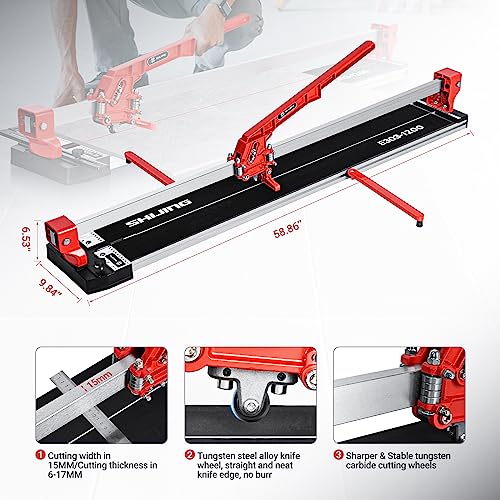
A laser guide projects the cut line, and the scoring wheel is tungsten carbide. At a listed 41.4 pounds it’s the heaviest cutter here, which is a hassle to carry but helps keep it planted while you press down on a long tile. It has 4.3 stars across 117 ratings.
Against the VEVOR 48-inch, you pay about twice as much for the stiffer double-layer base and the aluminum support feet. If you’re cutting more than a few 48-inch tiles, that’s money well spent.
Pros: Double-layer aluminum base resists flex on long cuts; adjustable aluminum feet and side supports; laser line guide.
Cons: Heaviest cutter here at 41.4 pounds; listing doesn’t state max tile thickness for this size.
Skip it if: your biggest tile is 24 inches. A 24-inch cutter is lighter, cheaper and easier to handle.
8. SHIJING 24-Inch Tile Cutter with Laser Guide – Best for Thin Tile
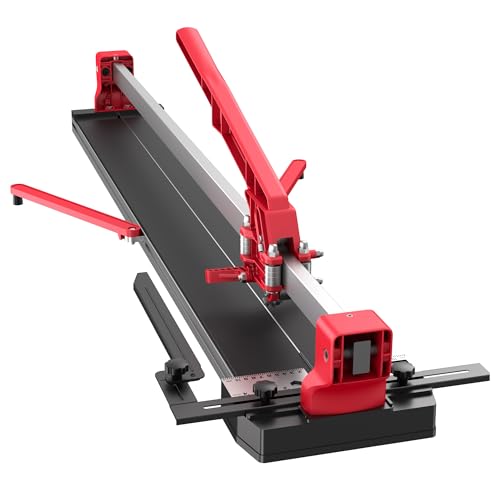
This is the smaller version of the SHIJING above, with one useful extra: a split breaking plate (SHIJING calls it a split-handle platen). The movable halves let the breaking foot close up tighter, so it can snap thinner tiles and narrower pieces that a fixed plate would crush or miss. SHIJING lists a tile thickness range of 0.23 to 0.67 inches and specifically mentions subway and mosaic tiles.

It shares the double-layer aluminum base, solid aluminum adjustable feet, adjustable side supports and laser guide of the 48-inch model. The listing weight is 21.5 pounds. It holds 4.2 stars across 107 ratings.
It costs the same as the QEP 10630. Pick the SHIJING for the laser and split plate. Pick the QEP for the bigger 7/8-inch wheel and the established brand.
Pros: Split breaking plate for thin tile and narrow pieces; laser guide; aluminum support feet; 24-inch cut.
Cons: Heavier than the QEP 10630; less brand support for replacement parts.
Skip it if: you mainly cut thick floor porcelain. The QEP’s larger wheel is the better match.
9. TILER 14-Inch Manual Tile Cutter – Best Budget

For one backsplash or a small bathroom wall, the TILER 14-inch costs about the same as a box of decent tile. It cuts up to 14 inches (350 mm) in ceramic and porcelain up to 0.47 inches thick. The tungsten carbide wheel is replaceable, and the sliding bar is die-cast with a ball bearing.
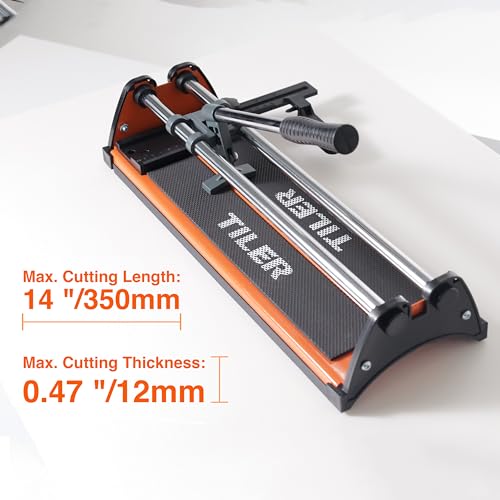
It has 4.2 stars across 191 ratings. Don’t expect it to hold its accuracy through years of trade use. It’s a project tool. Replace the wheel as soon as scores start to look ragged, since a dull wheel is the most common reason budget cutters break tiles off the line.
Pros: Lowest price here; replaceable carbide wheel; handles tile up to 0.47 inches thick; compact for countertop use.
Cons: 14-inch limit; lighter build than the Sigma 2G; no angle stops listed.
Skip it if: you tile for a living. The Sigma 2G covers the same size with a far better build.
10. QEP 9-Inch Compound Tile Nipper – Must-Have Extra

Every snap cutter needs a partner for the cuts it can’t make. The QEP 9-inch compound nipper bites small chunks off tile to shape curves, trim around pipes and clean up notches. It works on tile from 1/8 to 1/4 inch thick, and QEP says the compound linkage gives three times the cutting power of standard nippers.
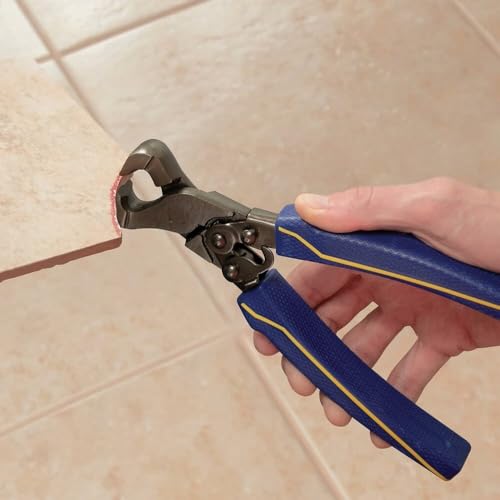
The tips are 5/8-inch tungsten carbide on a rustproof steel body, with a co-molded non-slip grip. Rinse it after each use so thinset doesn’t build up in the jaws. It holds 4.4 stars across 204 ratings.
Pros: Compound linkage for more biting force; tungsten carbide tips; rustproof body; low price.
Cons: Only rated to 1/4-inch tile, so it won’t handle thick floor porcelain; slow for anything bigger than small notches.
Skip it if: you need to notch thick porcelain. Use a grinder with a diamond blade instead.
Scoring Wheels: Size, Coating and When to Replace
The scoring wheel does most of the work on a manual cutter. A larger wheel, like the 7/8-inch wheels on the QEP cutters, spreads the pressure over a longer contact patch and tends to score hard porcelain more evenly. Smaller wheels concentrate the pressure, which helps on thin wall tile.
Titanium coating on a tungsten carbide wheel adds wear resistance. It doesn’t make a wheel sharper, but it holds its edge longer on abrasive porcelain.
Replace the wheel when the score line looks broken or dotted instead of a single continuous scratch, or when tiles start snapping off the line. Wheels are cheap compared with the tile you’ll waste with a dull one. Check the wheel diameter and bore of your cutter before ordering a replacement, since they aren’t universal.
How to Get a Clean Snap Every Time
Score once, with steady pressure, in one continuous pass. Going over the line twice is the most common mistake: the second pass rarely follows the first exactly and leaves a ragged break.
Keep the tile tight against the fence and centered on the breaking ridge, then press down on the handle smoothly rather than slamming it. Support long tiles at both ends so they don’t sag. Wipe dust off the rail and the bearing slide between jobs, and keep the wheel clean.
For a narrow sliver under about an inch, a snap cutter often can’t get enough leverage to break it. Score it on the cutter, then snap or nibble it off with nippers.
Buying Guide
Base Stability
A wide base with rubber pads or adjustable feet keeps the cutter from shifting when you press down. On cutters over 24 inches, look for side supports or fold-out arms.
Breaking Plate
The breaking foot presses the tile on both sides of the score. A split or adjustable plate, like the one on the SHIJING 24-inch, handles thin tile and narrow pieces better than a fixed foot.
Measuring Square and Angle Stops
A square that locks at common angles saves time on diagonal layouts. The Sigma cutters’ pivoting squares are the strongest feature in this guide for angled cuts.
Laser Guides
Lasers help you line up a pencil mark quickly, which is useful for one-off cuts. For repeated cuts, a locked measuring fence is more reliable.
Safety
Score-and-snap cutting doesn’t make silica dust the way a dry saw does, but snapped edges are sharp and small chips fly. Wear safety glasses and gloves when handling cut pieces, and use knee pads if the cutter is on the floor.
Frequently Asked Questions
Can a manual tile cutter cut porcelain?
Yes. All of the cutters here are sold for ceramic and porcelain. Hard, dense porcelain needs a sharp wheel and a firm, single score. Thick or textured porcelain is harder; check the cutter’s maximum thickness first.
Why did my tile break off the cut line?
Usually it’s a dull wheel, a double score, too little pressure on the score, or a long tile sagging off the end of the base. Replace the wheel first, then support both ends.
Manual tile cutter or wet saw?
Use a manual cutter for straight cuts in ceramic and most porcelain. It’s faster, quieter and makes no mess. Use a wet saw for natural stone, thick pavers, L-cuts, notches and very thin slivers. See our tile saw guide.
Can I cut 2 cm outdoor porcelain pavers with a manual cutter?
Most of the cutters here aren’t rated for 20 mm tile. The Sigma 2B3 is listed at 19 mm maximum. For 2 cm pavers, a wet saw is the safer choice.
How do I cut a thin sliver off a tile?
Score it on the cutter, then use tile nippers to snap or nibble off the narrow piece. Most snap cutters can’t break a strip under about an inch wide.
Can I cut natural stone with a manual cutter?
Generally no. VEVOR states its 48-inch cutter isn’t for marble or granite. Stone doesn’t break predictably along a score line, so use a wet saw.
Bottom Line
Match the cutter length to your largest tile, then decide how much you’ll use it.
- Best overall: QEP 10630 – 24 inches, a 7/8-inch titanium-coated wheel and side arm extensions.
- Best pro pull-handle cutter: Sigma 2B3 – 26 inches, up to 19 mm tile, with spare parts available.
- Best heavy-duty push cutter: QEP 10800 – dual rails and a 28-inch rip for frequent use.
- Best for walls and backsplashes: Sigma 2G – light, precise and the best-rated cutter here.
- Best value mid-size: VEVOR 32-Inch Laser – 32 inches and a laser guide for less than the QEP.
- Best budget large format: VEVOR 48-Inch – the cheapest 48-inch rail, for polished tile only.
- Best for 48-inch porcelain: SHIJING 48-Inch Laser – a stiff double-layer base and support feet.
- Best for thin tile: SHIJING 24-Inch Laser – a split breaking plate for subway and mosaic tile.
- Best budget: TILER 14-Inch – enough for one backsplash.
- Must-have extra: QEP 9-Inch Compound Nipper – for the curves and notches a snap cutter can’t make.
Once the tile’s down, our guide to using a grout bag covers the next step, and a laser level will keep your first row straight before you make the first cut.