Every drywall job eventually reveals the same truth: a regular drill is not a drywall tool. Use one and you’ll spend the next six months repairing screw pops — those small bumps that appear under paint when screws back out of the gypsum because they were driven too deep, tore the paper face, and lost their holding power. It happens on almost every sheet when you’re relying on a drill’s torque clutch to judge depth on soft, inconsistently-dense gypsum board.
A dedicated drywall screw gun solves this at the mechanical level. Instead of stopping when it feels resistance, the screw gun’s adjustable nose cone stops the moment it touches the wall surface. The clutch disengages automatically — every screw set to the identical depth, regardless of how hard you push or how the density varies across the panel. That’s a physical guarantee no drill can offer.
Beyond accuracy, screw guns run at 4,000–5,300 RPM — two to three times faster than a typical drill. On a 500-screw room that difference adds up to hours. And on metal studs, that RPM gap is non-negotiable: a drill running at 1,500 RPM will bind and strip fine-thread screws in light-gauge steel; a screw gun drives through cleanly every time.
This guide covers 8 of the best drywall screw guns available on Amazon right now — corded workhorses, brushless cordless tools, a production auto-feed system, and a budget-friendly option — with everything you need to choose the right one for your project size, stud type, and battery platform.

Quick Comparison: Best Drywall Screw Guns (2026)
| Product | Type | RPM | Motor | Collated | Key Mode | Best For |
|---|---|---|---|---|---|---|
| DeWalt DCF630B 20V XR | Cordless 20V | 4,400 | Brushless | Compatible | 4-mode select | Best Overall Cordless |
| DeWalt DW268 6.3A Corded | Corded | 4,400 | 6.3A Brushed | Compatible | Variable speed | Best Corded |
| Senco DS230-D2 | Corded | 2,500 | Auto-feed | Native | Auto-feed collated | Best Auto-Feed |
| Milwaukee 2866-20 M18 FUEL | Cordless M18 | 4,000 | Brushless | Compatible | Auto-start | Best Pro Cordless |
| Bosch GTB18V-45N 18V | Cordless 18V | 4,500 | Brushless | Compatible | Xtend Drive | Best Cordless Value |
| Makita XSF03Z 18V LXT | Cordless 18V | 4,400 | Brushless | Compatible | Variable speed | Best for Metal Studs |
| Hoteche 4.5A Corded | Corded | 4,500 | 4.5A Brushed | Compatible | Variable speed | Best Mid-Range Corded |
| Metabo 620063840 18V | Cordless 18V | 4,500 | Brushless | Compatible | Variable speed | Best Premium Cordless |
Drywall Screw Gun vs. Drill – The Real Mechanical Difference

Most buying guides describe this briefly and move on. It’s worth understanding properly, because it explains every advantage a screw gun has over even an expensive drill.
How a Drill Stops (Torque Clutch)
A drill’s clutch is set to a torque number — say, position 10 out of 20. The motor drives the screw until the resistance it feels in the gypsum reaches that preset level, then the clutch slips and stops. The problem: gypsum board is not a consistent material. Paper facing, core density, and stud backing vary across every sheet. The same torque setting that produces a perfect dimple in the middle of a panel will overdrive a screw near a dense knot or underdrive one in a soft section. Depth varies screw-to-screw, and every overdriven screw that tears the paper face has reduced holding power — which eventually backs out as a screw pop.
How a Screw Gun Stops (Nose-Cone Depth Clutch)
A screw gun doesn’t stop when it detects torque. It stops when the nose cone physically contacts the drywall surface. The motor drives the screw at full speed; the moment the cone touches the wall, the clutch disengages mechanically. The depth is controlled by the distance between the cone tip and the screw head — not by feel, not by operator pressure, not by material density. Every screw identical. That’s what makes a screw gun fundamentally different from a drill for this work.
Why RPM Matters for Metal Studs
Standard drills run 1,500–2,000 RPM. Dedicated screw guns run 4,000–5,300 RPM. For wood studs, a high-quality drill can manage drywall work adequately. For metal studs, it can’t. Fine-thread self-tapping screws need 4,000+ RPM to cut through light-gauge steel cleanly and without binding. A drill at 1,800 RPM on a metal stud will cam out, strip the screw head, or stall — all of which leave screws at wrong depths and damage panels. Any job involving metal stud framing requires a real screw gun.
Why Impact Drivers Are Even Worse for Drywall
An impact driver’s rotational impulses are too aggressive for gypsum. The hammering action drives screws past the correct depth before the operator can react — especially on the trigger-pull. The result is overdriven screws, torn paper, and screw pops guaranteed to appear under paint. Impact drivers are excellent tools; drywall installation is not one of their applications.
The Dimpler Bit Alternative (Honest Advice for Small Jobs)
If you’re hanging fewer than 15 sheets on wood studs for a single small room, a drywall dimpler bit is a practical $10 accessory that converts your existing drill into a workable drywall driver. The bit has an adjustable depth-stop collar that contacts the drywall surface exactly like a screw gun nose cone, providing the same depth-limiting benefit without buying a new tool. It won’t help on metal studs (RPM issue), won’t match a screw gun’s speed, and adds length that makes ceiling work awkward. But for a small patch or single-room job, it’s a legitimate option worth knowing about.
What to Look for in a Drywall Screw Gun
RPM by Application – The Most Misread Spec

RPM is the single most important spec for a drywall screw gun, and the one most buyers skim past. Here’s what you actually need:
| Application | Minimum RPM | Notes |
|---|---|---|
| Drywall into wood studs | 3,500 RPM | Standard residential walls and ceilings |
| Drywall into metal studs | 4,000+ RPM | Self-tapping fine-thread screws require high speed to cut steel cleanly |
| Subfloor & deck screws | 2,500–3,500 RPM | Lower RPM, higher torque required for denser materials |
| Collated auto-feed systems | 2,500 RPM | Auto-feed guns trade RPM for continuous feeding — fine for wood studs |
Any cordless tool running at below a full charge can drop RPM. For metal stud work, always use a fresh, fully charged battery and choose a brushless motor model — brushless maintains RPM under load more consistently than brushed.
Operating Modes — What They Actually Mean
Higher-end screw guns offer multiple operating modes, and these matter more than most guides acknowledge. The DeWalt DCF630B, for example, offers four distinct modes:
Push-Start Mode: The motor is off until you apply pressure to a screw. Release pressure and it stops. This is the safest mode — no accidental spins — and it saves battery by running the motor only when needed. Best for precision work, ceiling patches, and beginners.
Trigger Mode (Standard): Motor runs when trigger is squeezed; stops when released. The conventional drill-driver experience. Good for general wall work where you want direct control over when the motor runs.
Lock-On Mode: Motor runs continuously regardless of trigger position. You load a screw, push to drive, pull back, load the next — the motor never stops between screws. This is the fastest operating mode and is how professional drywallers hang full sheets at production speed. At the rhythm of one screw per 2–3 seconds, the difference on a 500-screw room is roughly 25 minutes of time saved versus trigger mode.
Auto-Drive Mode: Motor engages only when the bit contacts a screw and senses load, then disengages when the depth is reached and pressure is removed. The most automated experience — closest to auto-feed feel without a collated magazine. Good for tired hands at the end of a long day since it minimizes unnecessary motor time.
Corded vs. Cordless
Corded screw guns deliver unlimited runtime and consistent RPM from first screw to last — no voltage sag as a battery depletes. For commercial metal stud framing, production drywall hanging over multiple shifts, or any application where consistent high RPM is critical, corded is the professional default. The DeWalt DW268 and Hoteche are the relevant corded choices in this guide.
Cordless tools win on job site flexibility — no cord to manage while supporting a drywall sheet with one hand, and freedom to work in spaces without convenient outlets. For residential use, modern brushless cordless tools (DCF630B, Milwaukee 2866-20, Bosch GTB18V-45N, Makita XSF03Z, Metabo) maintain consistent performance through a 4.0Ah or 5.0Ah battery charge. Battery platform strategy matters: if you already own DeWalt 20V MAX tools, the DCF630B is the obvious pick. Milwaukee M18 users go for the 2866-20. For Makita 18V LXT users, the XSF03Z uses batteries already on your charger.
Collated Attachment Systems
A collated attachment feeds screws from a plastic strip magazine automatically — you never manually place individual screws. The result is roughly double the installation speed on large projects: no picking up a screw, placing it on the bit, steadying it, and driving — just push and drive, strip advances, push and drive. On a full-house hang of 40+ sheets, a collated system is a productivity transformation.
Two types exist: native auto-feed guns (like the Senco DS230-D2) where the collated magazine is built into the tool’s design, and bolt-on collated attachments that fit onto a standard screw gun’s nose. DeWalt makes the DCF6202 collated attachment that fits the DCF630B. Milwaukee makes a collated attachment for the 2866-20. These add-on attachments cost $50–$100 extra but transform any compatible screw gun into a production tool.
Brushless vs. Brushed Motor
For cordless tools, choose brushless. It extends runtime per charge by 25–50%, generates significantly less heat during sustained all-day ceiling work, and the motor lasts longer before requiring any service. Every cordless pick in this guide is brushless for this reason. For corded tools, brushed motors are standard and perfectly reliable — the DeWalt DW268’s brushed motor has been running on job sites for decades without issues.
Weight and Ceiling Work
Tool weight matters most when you’re working on ceilings with one hand while the other supports the panel. Aim for under 3 lbs bare tool weight for ceiling-heavy projects. A cordless tool with a heavy 5.0Ah battery attached can push total weight toward 4–5 lbs — manageable in short sessions, fatiguing over hours. Consider using a lighter 2.0Ah battery specifically for ceiling runs and swapping to 5.0Ah for wall work.
Nose-Cone Depth Adjustment
Look for a nose cone with fine, smooth depth adjustment — ideally an infinite twist dial rather than a three-click detent system. You’ll set it once per surface type (½-inch drywall to wood studs, ⅝-inch to metal studs) and leave it, but getting to that setting quickly at the start of a job saves frustrating test screws. A removable nose cone is a bonus feature that lets you use the tool as a standard driver for decking, subfloor, or non-drywall applications without the cone in the way.
The 8 Best Drywall Screw Guns (2026)
1. DeWalt DCF630B 20V MAX XR — Best Overall Cordless

The DeWalt DCF630B is the most technically capable cordless drywall screw gun available on Amazon, and the standout feature is its four dedicated operating modes — Trigger High Speed, Trigger Low Speed, Push-Start, and Lock-On — selectable via a mode switch on the tool body. This level of operational flexibility doesn’t exist on any other consumer-accessible screw gun. Lock-On mode in particular is the reason professional drywallers choose this tool: the motor runs continuously while you drive screws in rhythm, eliminating the trigger press between each fastener and producing production-level speed on residential wall and ceiling work.
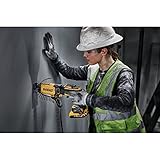
The POWERSTATE Brushless Motor delivers a consistent 4,400 RPM across the battery discharge cycle — sufficient for both wood stud and metal stud applications. The adjustable nose cone provides precise depth control and accepts DeWalt’s DCF6202 collated screw attachment (sold separately), which transforms it into a production auto-feed tool for large jobs without needing a second dedicated auto-feed gun. The TOOL CONNECT chip pocket is a job-site asset tracking feature built into the housing — useful for contractors managing multiple tools across crews. An LED work light illuminates dimly-lit corners and low-ceiling spaces.

Weighing just 2.2 lbs bare, the DCF630B is one of the lightest screw guns in its class, which makes it genuinely practical for sustained ceiling work. The compact nose profile fits into tight framing corners more easily than bulkier alternatives. The tool ships as a bare tool — a DeWalt 20V MAX battery and charger are required. If you’re already running DeWalt 20V tools on site, this integrates seamlessly; the 4.0Ah or 5.0Ah packs are the right batteries for all-day use.
Pros
- Four operating modes including Lock-On for production-speed driving
- Brushless motor maintains 4,400 RPM through battery discharge — metal stud capable
- Compatible with DeWalt DCF6202 collated attachment — upgradeable to auto-feed
- Lightest tool in this guide at 2.2 lbs bare — excellent for ceiling work
- Full DeWalt 20V MAX platform compatibility (200+ tools)
Cons
- Bare tool only — battery and charger sold separately
- Collated attachment adds significant extra cost
Specs
- Type: Cordless (20V MAX)
- Motor: POWERSTATE Brushless
- RPM: 4,400
- Modes: Trigger High/Low, Push-Start, Lock-On
- Collated: DCF6202 attachment compatible
- Weight: 2.2 lbs (bare)
Best for: Professional and serious DIY drywallers on the DeWalt 20V platform who want the most versatile cordless screw gun available — with Lock-On mode for production walls and Push-Start for precision ceiling patches.
2. DeWalt DW268 6.3A Corded — Best Corded

The DeWalt DW268 is the professional corded standard — a tool with a decades-long track record on commercial job sites and the choice of dedicated drywall crews who hang full houses and office builds without ever touching a battery. Its 6.3-amp motor produces 4,400 RPM continuously, without any voltage sag across a shift, and it drives fine-thread screws into light-gauge metal studs as effortlessly as coarse-thread screws into wood. The helical-cut, heat-treated steel gears are quieter and significantly more durable than straight-cut gear alternatives — this tool is built for thousands of hours of daily use, not just occasional home projects.
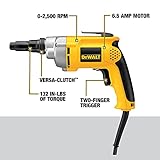
The adjustable nose cone provides smooth, infinite depth adjustment and is fully removable — pull it off and the DW268 becomes a standard driver for subfloor screws, decking, or any other fastener application. Variable speed via the trigger gives you low-speed control for starting screws in awkward positions without spinning off the bit, and full-speed driving once engaged. DeWalt includes a belt hook for hanging the tool between screws — on a job where you’re driving 600+ screws a day, not having to set the tool down between each row genuinely adds up.

The DW268 accepts DeWalt’s collated screw attachment for auto-feed capability on large production runs. At its price point it represents exceptional value — this is one of the most recommended corded drywall screw guns by professional drywall contractors, and it consistently outperforms tools at two or three times the price on the metrics that matter for commercial work: RPM consistency, gear durability, and nose-cone precision. The power cord is the only limitation for very large open job sites, but in standard residential and commercial interior work, the cord is never a problem.
Pros
- 6.3A motor delivers consistent 4,400 RPM — no battery management required
- Helical-cut steel gears for long-term durability under daily professional use
- Removable nose cone for multi-application use (drywall, decking, subfloor)
- Belt hook included for efficient workflow between screws
- Excellent price-to-performance for professional corded work
Cons
- Corded — cord management required on busy multi-trade job sites
- Heavier than cordless models — ceiling work more tiring over long sessions
Specs
- Type: Corded
- Motor: 6.3A
- RPM: 4,400
- Speed: Variable (trigger)
- Nose cone: Adjustable, removable
- Gears: Helical-cut heat-treated steel
Best for: Professional drywall contractors and framers doing high-volume corded work on wood or metal studs where consistent RPM all day and maximum gear durability are the priority.
3. Senco DS230-D2 — Best Auto-Feed
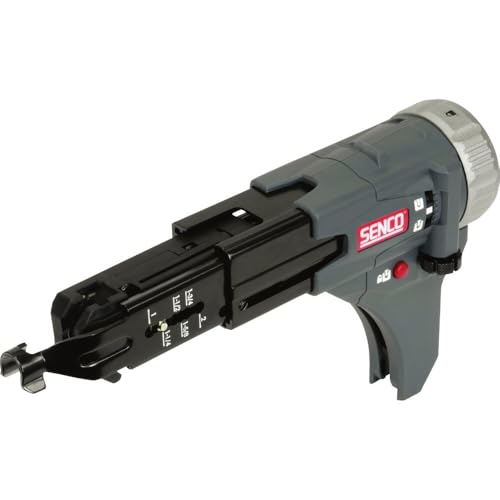
The Senco DS230-D2 is a purpose-built collated auto-feed drywall screw gun — not a standard screw gun with an add-on attachment, but a tool where the magazine feeding system is integral to the design from the ground up. The difference matters in practice: native auto-feed systems feed more reliably, jam less frequently, and handle the screw strip more smoothly than bolt-on attachments. The DS230 accepts 1,000-screw collated strips and drives screws at 2,500 RPM — lower than standalone screw guns because the auto-feed mechanism takes time to advance and present each screw, but fast enough that total throughput significantly exceeds manual single-screw loading at any RPM.

The workflow the Senco enables is fundamentally different from any other tool in this guide. One hand supports the drywall panel; the other drives screws continuously along the stud line without ever touching an individual fastener. On a ceiling installation, this single-handed driving capability — combined with the auto depth control — makes the Senco the only tool that makes solo ceiling hanging genuinely practical for long sessions. The depth adjustment is tool-free, with a clear dial setting that corresponds to standard drywall thicknesses. Screw collation uses standard plastic-collated drywall screw strips widely available on Amazon.

The primary limitation is that the DS230’s 2,500 RPM makes it unsuitable as a primary tool for metal stud applications — fine-thread self-tapping screws need 4,000+ RPM to cut through light-gauge steel reliably. For wood-stud residential work where production speed is the priority, it’s unmatched. Many professional drywall crews carry both a Senco-style auto-feed gun for the bulk of the hanging work on wood studs and a high-RPM cordless for metal stud corners and non-collated applications.
Pros
- Native auto-feed system — most reliable collated performance in this guide
- 1,000-screw magazine capacity — minimal reloading on full-sheet runs
- Single-handed driving enables solo ceiling work
- Accepts standard collated drywall screw strips from any manufacturer
- Dramatically faster throughput on large wood-stud projects
Cons
- 2,500 RPM not suitable for metal studs
- Corded — cord management on site
- Larger, heavier format than standard screw guns
Specs
- Type: Corded auto-feed
- RPM: 2,500
- Feed system: Native collated (1,000-screw strips)
- Depth control: Tool-free dial adjustment
- Application: Wood studs (drywall, subfloor, sheathing)
Best for: Professional crews and serious DIYers hanging large quantities of drywall on wood-stud framing where auto-feed production speed is worth the investment.
4. Milwaukee 2866-20 M18 FUEL — Best Pro Cordless
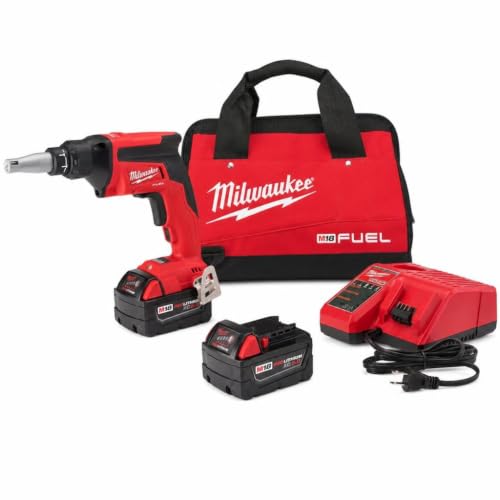
The Milwaukee 2866-20 is the tool of choice for professional drywall contractors already committed to the M18 platform — and for good reason. Its POWERSTATE Brushless Motor delivers 4,000 RPM at the high setting and includes a low-speed setting (approximately 2,000 RPM) for controlled driving in delicate applications like cement board or when backing out screws without the nose cone. The auto-start feature — Milwaukee’s implementation of push-start mode — means the motor only engages when the bit contacts a screw under pressure, saving battery and preventing accidental spins when repositioning between fasteners.

The nose cone offers three-position depth adjustment with clear detent positions corresponding to standard drywall thicknesses, plus a fourth position with the cone removed for non-drywall driving. The nose cone also features a reversible setting that allows you to back out screws without removing the cone — a genuinely practical feature on a tool that regularly needs to remove incorrectly placed fasteners. Milwaukee includes a belt clip and an LED work light. Bare tool weight is 3.3 lbs, which is comfortable for wall work; pair it with Milwaukee’s 2.0Ah REDLITHIUM compact battery for ceiling sessions to keep total weight under 4 lbs.

Milwaukee’s M18 platform covers over 250 tools, and the REDLITHIUM battery system is widely regarded as having the strongest cold-weather performance of the major cordless platforms — a practical advantage on unheated job sites in winter. The 2866-20 is a bare tool; Milwaukee M18 batteries and charger are sold separately. A Milwaukee collated screw attachment is available separately for auto-feed upgradeability. At its price point the 2866-20 is competitive with the DeWalt DCF630B — platform loyalty is the primary differentiator between them.
Pros
- Auto-start mode saves battery and prevents accidental driving
- Reversible nose cone for screw removal without cone removal
- Two-speed operation (high and low) for versatile applications
- Full M18 platform compatibility — excellent cold-weather battery performance
- Belt clip and LED included as standard
Cons
- Bare tool only — M18 battery and charger required separately
- Heavier than DCF630B (3.3 lbs bare)
- Three-position detent less fine than infinite-adjust nose cones
Specs
- Type: Cordless (M18)
- Motor: POWERSTATE Brushless
- RPM: 0–4,000 (high) / 0–2,000 (low)
- Mode: Auto-start, two-speed
- Nose cone: 3-position + reversible
- Weight: 3.3 lbs (bare)
Best for: Professional contractors on the Milwaukee M18 platform who want the most capable cordless screw gun with reversible nose cone functionality and reliable all-day cold-weather battery performance.
5. Bosch GTB18V-45N 18V — Best Cordless Value
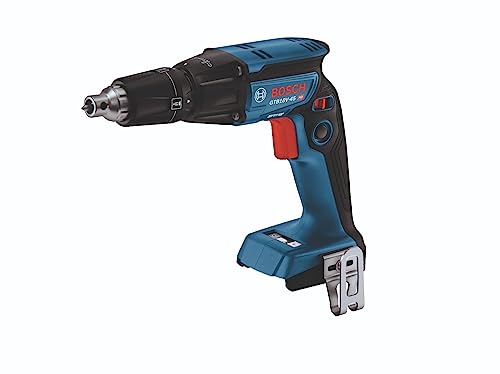
The Bosch GTB18V-45N is the best value cordless drywall screw gun for users not already invested in a major platform, and a strong competitor to the DeWalt and Milwaukee even if you are. Its brushless motor runs at 4,500 RPM — the highest top speed of any cordless tool in this guide, providing the most headroom for metal stud work as battery charge depletes. Bosch’s unique Xtend Drive feature is the signature innovation: the motor only engages when it senses contact pressure from the bit on a screw, conserving battery between fasteners and producing a push-start driving feel that reduces the chance of cam-out on screw loading.

The depth adjustment system uses Bosch’s tool-free rotating collar — smooth, precise, and infinitely adjustable within the range, rather than a three-click detent. This makes fine-tuning depth for different drywall thicknesses or stud materials fast and accurate. The nose cone is removable for non-drywall applications. At 3.1 lbs bare, the GTB18V-45N is a comfortable ceiling tool paired with a 2.0Ah Bosch 18V battery. The 1/4-inch hex collet accepts all standard Phillips drywall bits, and the tool includes a built-in bit holder for keeping a spare immediately accessible.

The GTB18V-45N is a bare tool sold without a battery or charger. It uses Bosch’s 18V battery system (ProCORE or standard CORE18V), which is a smaller ecosystem than DeWalt 20V or Milwaukee M18 but perfectly capable for users who also own Bosch 18V drills, saws, or impact drivers. For buyers comparing it specifically to the DCF630B and 2866-20: the Bosch wins on peak RPM and depth adjustment precision; the DeWalt wins on operating mode variety; the Milwaukee wins on reversible nose cone and cold-weather battery performance. All three are excellent tools.
Pros
- Highest RPM among cordless models (4,500) — most metal-stud headroom
- Xtend Drive pressure-sensing engagement conserves battery
- Infinite depth adjustment collar — most precise depth setting
- Removable nose cone for multi-application use
- Built-in bit holder for quick spare bit access
Cons
- Bare tool only — Bosch 18V battery required separately
- Smaller battery ecosystem than DeWalt or Milwaukee
Specs
- Type: Cordless (18V)
- Motor: Brushless
- RPM: 0–4,500
- Mode: Xtend Drive (pressure-sensing)
- Nose cone: Infinite adjust, removable
- Weight: 3.1 lbs (bare)
Best for: Drywallers and framers who want the highest RPM cordless screw gun for reliable metal stud work, with the most precise depth adjustment system available in this guide.
6. Makita XSF03Z 18V LXT — Best for Metal Studs

The Makita XSF03Z earns its “best for metal studs” designation through a combination of consistent high RPM, reliable brushless motor performance, and Makita’s Extreme Protection Technology (XPT) — a sealed internal construction that keeps metal shavings and construction dust out of the motor and gear train. When you’re driving fine-thread screws through light-gauge steel studs all day, the self-tapping screw tips generate tiny steel particles that can infiltrate motor windings and accelerate wear in unprotected tools. The XPT seal makes the XSF03Z significantly more durable in sustained metal stud applications than standard cordless screw guns.

The brushless motor delivers 4,400 RPM with a variable speed dial that lets you reduce speed for wood stud applications or when driving into delicate materials. The nose cone adjustment is smooth and precise, and the tool accepts all Makita 18V LXT batteries — the largest single battery platform in the industry with 300+ compatible tools. At 2.8 lbs bare, it’s lighter than the Milwaukee 2866-20 and well-balanced for ceiling work with a compact 2.0Ah battery pack. The XSF03Z is a bare tool like the other cordless picks in this guide — Makita 18V LXT batteries and charger are sold separately.

Makita’s build quality on the XSF03Z reflects its commercial positioning — the housing is robust, the gear train is all-metal, and the variable speed dial is tactile and precise rather than a flimsy slider. The tool is compatible with Makita’s collated screw attachment for auto-feed upgradeability on large wood-stud jobs. For contractors doing mixed wood and metal stud framing who are on the Makita 18V LXT platform, the XSF03Z handles both applications confidently — the XPT protection for metal work and the variable speed control for wood and finishing applications.
Pros
- XPT sealed construction resists metal particle and dust infiltration — superior durability for metal stud work
- 4,400 RPM brushless motor with variable speed control
- Compatible with Makita 18V LXT (300+ tools, largest cordless platform)
- Lightweight at 2.8 lbs bare — good ceiling ergonomics
- All-metal gear train — professional build quality
Cons
- Bare tool — Makita 18V LXT battery required separately
- Variable speed dial may require re-calibration habit vs. fixed-speed tools
Specs
- Type: Cordless (18V LXT)
- Motor: Brushless (XPT sealed)
- RPM: 0–4,400
- Speed: Variable dial
- Protection: XPT (metal particle and dust seal)
- Weight: 2.8 lbs (bare)
Best for: Makita 18V LXT platform users and contractors doing sustained metal stud framing who need a sealed, durable brushless screw gun that resists steel particle infiltration in daily commercial use.
7. Hoteche 4.5A Drywall Screw Gun — Best Mid-Range Corded
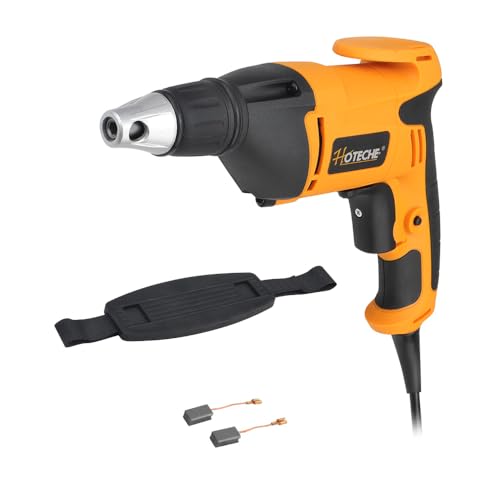
The Hoteche 4.5A is the practical mid-range corded option for DIYers, remodelers, and occasional professional users who need a reliable corded screw gun without the professional price tag of the DeWalt DW268. Its 4.5-amp motor produces 4,500 RPM — the highest RPM of any corded tool in this guide, and sufficient for both wood stud and metal stud drywall applications. Variable speed via the trigger gives you low-speed control for starting screws and precision work, stepping up to full speed for production driving. The 1/4-inch hex chuck accepts all standard Phillips drywall bits.

The forward and reverse switch is conveniently placed for one-handed operation — useful for backing out misplaced screws without releasing your grip. The adjustable nose cone depth control is accessible and straightforward, with a twist collar that covers the typical depth range for ½-inch and ⅝-inch drywall on both wood and metal studs. The ergonomic handle grip is comfortable for extended sessions, and the tool balance is good for both wall and ceiling work. Hoteche includes a carrying case and the tool is backed by standard warranty coverage.

Where the Hoteche falls short of the DeWalt DW268 is in internal component quality — the gear train uses standard steel rather than helical-cut heat-treated gears, which means it won’t sustain a professional contractor’s daily workload for years the way the DeWalt will. For the DIYer hanging a few rooms, a remodeler doing occasional drywall work, or any buyer who needs corded screw gun performance without a professional price, the Hoteche delivers honest value. It drives screws cleanly, depths consistently, and costs significantly less than the premium corded alternatives.
Pros
- Highest RPM of any corded tool in this guide (4,500) — metal stud capable
- Corded reliability — unlimited runtime with no battery cost
- Forward and reverse for one-handed screw removal
- Variable speed trigger for low-speed starting control
- Strong value vs. professional corded alternatives
Cons
- Standard gears vs. helical-cut on DeWalt — reduced long-term durability under daily pro use
- Less refined depth adjustment than premium models
Specs
- Type: Corded
- Motor: 4.5A
- RPM: 0–4,500
- Speed: Variable (trigger)
- Chuck: 1/4-inch hex
- Switch: Forward/Reverse
Best for: DIYers, remodelers, and occasional-use professionals who need a corded screw gun with 4,500 RPM capability — including metal stud applications — at a mid-range price.
8. Metabo 620063840 18V — Best Premium Cordless
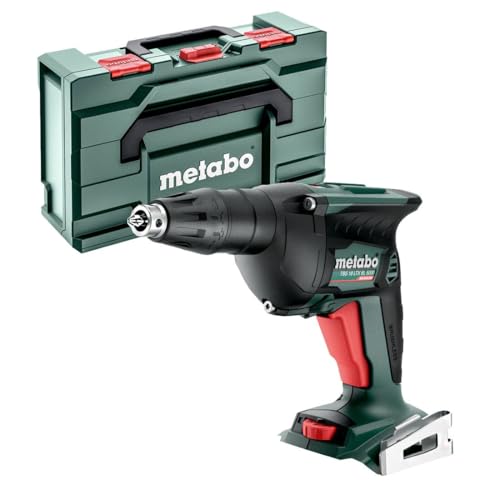
Metabo is the most underrated name in professional power tools — a German manufacturer whose tools are standard equipment on European commercial job sites but less visible in North American retail despite being well-established on Amazon. The 620063840 18V drywall screw gun exemplifies why professionals who know the brand choose it: the build quality, gear precision, and motor refinement are at the top of the cordless field. The brushless motor produces 4,500 RPM — tied for highest among cordless tools in this guide — and the electronic speed control maintains RPM under load more precisely than most competitors, including at the end of a battery charge cycle.

The depth adjustment system on the Metabo uses an exceptionally smooth infinite-adjust collar with a wide range that covers everything from thin drywall to thicker cement board and subfloor applications. The nose cone design incorporates a quick-change mechanism for fast bit swaps without removing the entire cone assembly — a small workflow detail that professionals who swap between Phillips, square drive, and star bits during a day notice and appreciate. The tool accepts Metabo’s 18V LiHD battery platform, and Metabo’s battery technology is notable for maintaining consistent output voltage well into the discharge cycle rather than dropping off rapidly as some competing platforms do.

The primary consideration with the Metabo is platform size: the Metabo 18V ecosystem is smaller than DeWalt 20V, Milwaukee M18, or Makita 18V LXT, which means fewer compatible tool options if you’re building out a full cordless toolkit. For users who simply need the best-built, highest-precision cordless drywall screw gun available on Amazon and aren’t locked into an existing platform, the Metabo 620063840 is the answer. It is a bare tool — Metabo 18V batteries and charger sold separately.
Pros
- Best-in-class build quality and gear precision — German engineering standard
- 4,500 RPM with best-in-class voltage maintenance through battery discharge
- Quick-change bit system without full nose cone removal
- Infinite-adjust depth collar with widest range in this guide
- Excellent for cement board, subfloor and heavy drywall applications
Cons
- Bare tool — Metabo 18V battery required separately
- Smaller ecosystem than DeWalt/Milwaukee/Makita platforms
- Higher price point among cordless options
Specs
- Type: Cordless (18V)
- Motor: Brushless
- RPM: 0–4,500
- Depth: Infinite-adjust, wide range
- Bit change: Quick-change without cone removal
- Platform: Metabo 18V LiHD
Best for: Users who want the highest-built cordless drywall screw gun available and are not locked into an existing battery platform — particularly those doing cement board, thick drywall, or heavy subfloor applications.
Use-Case Guide — Best Pick by Application
Residential Walls on Wood Studs
Any tool in this guide handles standard residential wall hanging on wood studs. For cordless convenience in this scenario, the DeWalt DCF630B with Lock-On mode is the fastest option for a full room hang. If you’re not on the DeWalt platform, the Bosch GTB18V-45N is the best value cordless choice. For corded reliability without battery management, the DeWalt DW268 is the professional standard.
Metal Stud Commercial Framing
Requires 4,000+ RPM — non-negotiable. The DeWalt DW268 corded is the most reliable choice for sustained all-day metal stud work with no RPM sag. Among cordless options, the Makita XSF03Z with its XPT sealed motor handles metal stud environments best in terms of long-term durability. Always use fine-thread (S-type) self-tapping screws — coarse thread will not properly engage light-gauge steel.
Drywall Ceilings
Weight is the critical factor — aim for under 3 lbs bare tool plus your lightest battery pack. The DeWalt DCF630B at 2.2 lbs bare is the lightest tool in this guide and the top ceiling pick. Use Push-Start mode for ceilings — the motor only runs when you apply pressure to a screw, which reduces fatigue from unnecessary spinning between fasteners. Screw spacing on ceilings should be every 12″ on-center (tighter than walls) because gravity applies continuous load on each fastener.
High-Volume Production Hanging (Full-House or Commercial)
For any job exceeding 30 sheets, an auto-feed collated system doubles installation speed and is worth the investment. The Senco DS230-D2 is the purpose-built choice. Alternatively, the DeWalt DCF630B with the DCF6202 collated attachment gives you auto-feed capability plus the option to remove the magazine for non-collated applications on the same job site.
Subfloor, Decking and Cement Board
Use a tool with a removable nose cone — the DeWalt DW268 and Bosch GTB18V-45N both allow nose cone removal for direct driver use. The Metabo 620063840 has the widest depth range for cement board applications. These applications require lower RPM and higher torque than standard drywall — use variable speed control to slow down for denser materials.
Small DIY Repairs (1–15 Sheets, Wood Studs Only)
If you’re patching one room and already own a drill, buy a drywall dimpler bit ($8–$15 on Amazon) before you buy a dedicated screw gun. The dimpler’s depth-stop collar gives you accurate, consistent depth on small jobs without the cost of a new tool. If you’re hanging more than 15 sheets or doing ceiling work, step up to the Hoteche 4.5A for a budget-friendly corded entry point.
Screw Pops: Why They Happen and How to Prevent Them
Screw pops are among the most frustrating post-installation problems in drywall work — bumps that appear under paint weeks or months after a job is complete. Understanding the cause makes the prevention obvious.
Why they happen: When a screw is overdriven, the head tears through the drywall paper face. The paper is what transfers the holding load from the screw into the gypsum panel — once it’s torn, the screw has much less holding power at that point. Over time, natural wood framing shrinkage and seasonal thermal movement causes slight panel movement. A screw with reduced holding power backs out slightly, creating the bump you see through paint.
How the right tool prevents them: A screw gun’s mechanical nose-cone clutch stops the screw at the exact depth where the head creates a clean dimple in the paper surface without tearing it. That dimple — filled with joint compound at taping — is the correct installation. The screw maintains full holding power, and the small indent is invisible under finish.
Why impact drivers are the worst choice: An impact driver’s hammering impulse drives screws past correct depth in a single rotational burst. The screw is in motion when the cone touches the surface — it carries past it. Overdriven screws with torn paper are nearly guaranteed. Never use an impact driver for hanging drywall.
Fixing existing screw pops: Don’t try to remove the popped screw — backing it out enlarges the hole. Instead, drive a new screw 2 inches away in fresh gypsum. Then sink the popped screw deeper (past the torn paper, into intact material below). Apply joint compound over both, feather it smooth, and sand when dry.
Drywall Screw Types — Coarse vs. Fine Thread, Length Chart
The screw goes with the stud material. This is the single most common error on mixed wood-and-metal-stud jobs.
Coarse-thread screws (W-type): For wood studs only. The wide thread spacing grips wood fibers and provides 15–20% higher withdrawal resistance in wood than fine-thread alternatives. Self-drilling is not required — the screw point starts easily in pine or SPF framing.
Fine-thread screws (S-type / self-tapping): For metal studs only. The sharp self-tapping tip is designed to cut through light-gauge steel cleanly. Coarse-thread screws used in metal studs strip the hole rather than gripping — the thread pitch is too wide to engage thin steel effectively.
| Application | Thread Type | Recommended Length |
|---|---|---|
| ½” drywall to wood studs (walls) | Coarse (W-type) | 1-1/4″ |
| ½” drywall to wood studs (ceilings) | Coarse (W-type) | 1-5/8″ |
| ⅝” drywall to wood studs | Coarse (W-type) | 1-5/8″ to 2″ |
| ½” drywall to metal studs | Fine / S-type | 1″ |
| ⅝” drywall to metal studs | Fine / S-type | 1-1/4″ |
| Double-layer drywall (add ¼” per extra layer) | Match stud material | Add ¼” to base length |
Screws must penetrate wood framing by a minimum of ⅝ inch and steel framing by a minimum of ⅜ inch per IRC requirements. Black phosphate coating is standard for interior drywall — it resists corrosion from the moisture in joint compound during the taping process.
→ Browse collated coarse-thread drywall screws on Amazon
→ Browse collated fine-thread metal stud screws on Amazon
Screw Spacing Reference Guide (IRC Code)
Correct screw spacing is as important as screw depth. Too few fasteners and panels sag, crack at seams, or produce screw pops from panel flex. These are the standard spacings per IRC requirements:
| Location | Field Spacing | Edge Distance Min. | Notes |
|---|---|---|---|
| Walls (16″ OC framing) | Every 8″ on each stud | 3/8″ from edge | Standard residential walls |
| Ceilings (16″ OC framing) | Every 7″ on each joist | 3/8″ from edge | Tighter spacing — gravity load |
| Ceilings (24″ OC framing) | Every 6″ on each joist | 3/8″ from edge | Wider span requires more fasteners |
| Stud penetration — wood | — | — | Min. ⅝” penetration (IRC) |
| Stud penetration — metal | — | — | Min. ⅜” penetration (IRC) |
Pro tip: Before hanging, snap chalk lines along stud center lines across the panel surface. At production speed in Lock-On mode, it’s easy to miss a stud by ½ inch — chalk lines keep every row of screws hitting framing reliably without stopping to check.
Pro Technique: How to Hang Drywall Fast With a Screw Gun
Step 1 — Calibrate Depth Before Hanging
Always test your nose cone depth on a scrap piece of the same drywall before starting a new surface type. Drive a test screw and check it with your finger — the head should create a small dimple that you can feel but that doesn’t crack or tear the paper surface. Adjust the nose cone collar until test screws are consistent, then start hanging.
Step 2 — Use Lock-On Mode for Wall Runs
Engage Lock-On mode so the motor runs continuously. Load a screw onto the magnetized bit, position it on the chalk line, push to drive, pull back, and load the next. At a comfortable pace this delivers one screw every 2–3 seconds. Compare that to trigger mode (starting the motor each time) at 5–6 seconds per screw — the difference across 500 screws is over 20 minutes per room.
Step 3 — Use Push-Start Mode for Ceilings
On ceiling work, switch to Push-Start. You’re working one-handed, often with your head at an awkward angle. Push-Start means the motor only runs when you apply pressure to a screw — no accidental spinning while repositioning. It also extends battery runtime by eliminating motor time between fasteners, which matters more on ceiling work where you’ll need to pause frequently to reposition.
Step 4 — Hold the Gun Perpendicular
Angle the gun even slightly off 90 degrees and the screw will seat deeper on one side than the other — the nose cone contacts the panel unevenly, the clutch disengages too early on one edge, and you get a partially overdriven screw. Keep the gun straight. On ceilings, use your forearm or a tool-specific drywall lift to support the panel and keep your driving arm free to work perpendicular.
Step 5 — Maintain Your Bit
Replace your #2 Phillips drywall bit every 400–500 screws driven at high RPM. A worn tip cams out of the screw head at speed — the spinning bit damages the screw head, makes the screw impossible to remove cleanly, and can score the paper face around the fastener. Drywall bits are inexpensive in bulk packs on Amazon and the fresh-bit difference in driving quality is immediately noticeable.
Step 6 — Drive From Edges to Center on Each Sheet
Start screws at the top edge of each sheet, work down one stud line, then move to the next stud. Never drive from the center of a panel outward — this can cause the sheet to bow or buckle against the framing, creating surface waves that show through finish. Edge-to-center driving keeps the panel flat against the studs as it’s fastened.
Frequently Asked Questions
What is a drywall screw gun used for?
A drywall screw gun is a specialized power tool designed to drive drywall screws to a consistent, precise depth in gypsum board panels. Unlike a drill, it uses a mechanical nose-cone clutch that stops the screw the moment the cone touches the wall surface — guaranteeing identical depth on every fastener regardless of operator pressure or material density variation. It’s also used for subfloor installation, cement board fastening, and decking when the nose cone is removed. Its high RPM (4,000–5,300) makes it the correct tool for driving fine-thread screws into metal stud framing.
Can I use a regular drill instead of a drywall screw gun?
For small jobs (under 15 sheets on wood studs), yes — with a drywall dimpler bit, which adds an adjustable depth-stop collar to your existing drill. For metal studs, no — a standard drill lacks the 4,000+ RPM needed to drive self-tapping screws through steel cleanly. For any job exceeding 15–20 sheets, a dedicated screw gun saves significant time and produces more consistent results than a drill with any accessory.
What RPM do I need for metal studs?
A minimum of 4,000 RPM. Self-tapping fine-thread screws need high rotational speed to cut through light-gauge steel without binding. Standard drills running at 1,500–2,000 RPM will cam out, strip screw heads, or stall when driving into metal studs. Every cordless screw gun in this guide (DCF630B, 2866-20, GTB18V-45N, XSF03Z, Metabo 620063840) meets or exceeds 4,000 RPM. Both corded tools (DW268, Hoteche) also meet the threshold. The Senco DS230 auto-feed gun at 2,500 RPM is the only tool in this guide not recommended for metal stud applications.
What’s the difference between Push-Start and Lock-On mode?
Push-Start mode: the motor only activates when you apply pressure through the bit to a screw. Release pressure and the motor stops. This is the safest mode — no accidental spins when repositioning — and it conserves battery. Lock-On mode: the motor runs continuously regardless of trigger input. You load a screw, push to drive, pull back, load the next. No trigger pressing between screws. This is the fastest driving mode used by professionals for production wall hanging — at one screw per 2–3 seconds, it significantly outpaces Push-Start or Trigger mode for large runs.
How do I prevent screw pops in drywall?
Screw pops are caused by screws driven too deep, tearing the paper face and losing holding power. Use a dedicated screw gun (not a drill or impact driver), calibrate the nose cone depth so every screw creates a small clean dimple without paper tearing, use the correct screw thread type for your stud material (coarse for wood, fine for metal), and drive to the correct screw spacing per IRC code. Correctly driven screws at proper depth and spacing will not pop under normal conditions.
What drywall screws should I use for metal studs vs. wood studs?
For wood studs: coarse-thread W-type screws (1-1/4″ for walls, 1-5/8″ for ceilings). For metal studs: fine-thread S-type self-tapping screws (1″ for ½” drywall, 1-1/4″ for ⅝” drywall). Using coarse thread in metal studs is a common mistake — the thread pitch is too wide to grip light-gauge steel and the screw will strip out rather than seating properly.
Is a cordless or corded drywall screw gun better?
For residential jobs and job sites where cord management is inconvenient, cordless is more practical. All brushless cordless tools in this guide deliver sufficient RPM for wood and metal stud applications with a fully charged battery. For sustained commercial production work — hanging entire floors of drywall across multi-hour shifts — corded tools provide consistent RPM all day without battery rotation and are the professional default. Many professional drywall crews use both: a corded tool for high-volume wall runs and a cordless for ceiling work and anywhere a cord is awkward.
How deep should drywall screws go into studs?
Per IRC requirements: a minimum of ⅝ inch penetration into wood framing and ⅜ inch into steel framing. At the drywall surface, the screw head should sit slightly below the panel face — creating a small dimple — without tearing the paper facing. This depth is what the nose-cone clutch on a properly calibrated screw gun produces automatically on every fastener.
Final Verdict
The right drywall screw gun depends primarily on your stud material, project volume, and existing battery platform. Here are the definitive picks by buyer type:
- Best overall cordless (DeWalt 20V platform): DeWalt DCF630B — four operating modes including Lock-On, lightest tool in this guide, brushless 4,400 RPM, upgradeable to auto-feed.
- Best corded for professional production work: DeWalt DW268 — 6.3A, helical-cut steel gears, decades of proven performance on wood and metal stud commercial framing.
- Best for high-volume auto-feed hanging: Senco DS230-D2 — native collated system doubles speed on large wood-stud jobs.
- Best pro cordless (Milwaukee M18 platform): Milwaukee 2866-20 — reversible nose cone, auto-start mode, best cold-weather battery performance.
- Best cordless value (no existing platform): Bosch GTB18V-45N — highest RPM among cordless tools (4,500), Xtend Drive, infinite depth adjustment.
- Best for metal stud framing (Makita 18V platform): Makita XSF03Z — XPT sealed motor resists metal particle infiltration in sustained steel stud work.
- Best mid-range corded: Hoteche 4.5A — 4,500 RPM corded performance at a budget-friendly price for DIYers and occasional pros.
- Best premium cordless build quality: Metabo 620063840 — German engineering standard, best voltage consistency through discharge, widest depth range for cement board and multi-layer applications.
Whatever you choose, calibrate the nose cone on a scrap piece before you start, match your screw thread type to your stud material, and give Lock-On mode a try on your first full wall run — once you’ve driven 200 screws in rhythm without touching the trigger, you won’t go back.