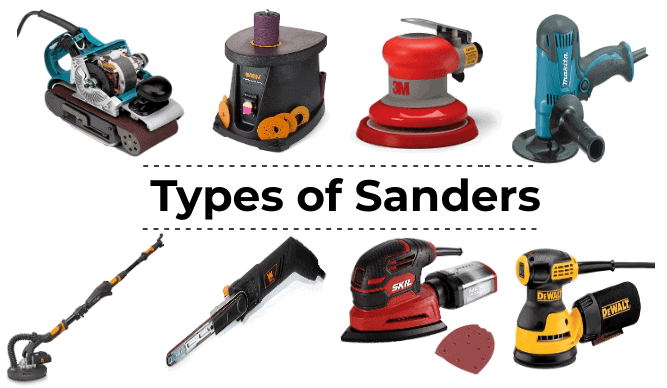
There is one sanding job that every random orbital sander fails at: the inside corner. That last millimetre where two sanded surfaces meet at 90° – a cabinet face frame, a window sash rebate, a chair rail return – sits permanently out of reach of any round pad. A detail sander exists specifically for that millimetre. Its triangular pad, pointed at the tip, reaches into corners that no other sander can access while simultaneously sanding the adjacent flat surface in the same stroke. If you have ever sanded up to an inside corner, stopped, and then spent ten minutes doing the corner by hand with a folded sheet of sandpaper, you already understand exactly what a detail sander is worth.
This guide covers eight of the best detail sanders available in 2026 – from a $20 budget corded model to an $80 professional cordless – with the sections that no competing guide includes: a direct comparison against random orbital sanders and oscillating multi-tools so you know exactly which tool your project actually needs, a sandpaper compatibility breakdown that exposes the proprietary pad trap several brands use, a use-case section covering furniture restoration, spindles, window frames, trim, and 3D print finishing, and a proper technique guide for using a detail sander in corners and on curved surfaces.
Quick answer: The Black+Decker BDEMS600 is the best detail sander for most woodworkers — excellent value, finger attachment included, standard H&L triangular pads, and a feature set that covers everything from furniture restoration to trim work. For professional cordless use on Milwaukee batteries, the Milwaukee M12 FUEL is the benchmark. Keep reading for the full comparison and the guide to using each model correctly.

What Is a Detail Sander? (And Why It Has a Different Name)
A detail sander, mouse sander, and corner sander are the same tool — the same triangular oscillating pad mechanism sold under different marketing names by different brands. “Mouse sander” became popular because the tool’s triangular body, when viewed from above, vaguely resembles a computer mouse. “Corner sander” is the purely functional name for the primary use case. “Detail sander” is the current industry-standard term. If you are searching for any of these three names, you are looking for the same product category covered in this guide.
All detail sanders work through the same fundamental mechanism: the triangular sanding pad oscillates — vibrates in a tiny, rapid back-and-forth arc — at between 10,000 and 27,000 OPM (oscillations per minute). This motion sands the surface beneath the pad while generating less heat than spinning disc sanders and producing no swirl marks. The pointed tip of the triangular pad is the defining feature: it fits into 90-degree inside corners and reaches into recessed spaces where every other sander shape cannot go.
What to Look for in a Detail Sander: the Five Specs That Matter

1. OPM (Oscillations Per Minute)
OPM is the primary performance specification — how fast the pad oscillates. Higher OPM means faster material removal and better results on harder materials. Standard range is 10,000–14,000 OPM for budget corded models, 14,000–20,000 OPM for quality corded models, and up to 27,000 OPM for professional cordless tools. Variable speed adds practical value for delicate work: running at 10,000 OPM on bare wood prevents burn marks; running at 20,000+ OPM on paint or sealer removal speeds the job. For furniture restoration and fine woodworking, a variable-speed model is worth the modest price premium.
2. Pad Tip Angle — The Detail That Determines Corner Access
Not all triangular pads are equal. The key variable is the angle at the pointed tip — the sharper (more acute) the tip, the tighter the corner it can access. Standard detail sanders have a tip angle of approximately 60–70 degrees. Better models feature a sharper, more acute tip that reaches into tighter inside corners and narrower rebates. Before buying, check the pad geometry: a sharper tip is a genuine functional advantage for furniture and trim work where inside corners are common. The models in this guide with the best corner access performance are highlighted in their individual reviews.
3. Sandpaper Compatibility — Avoiding the Proprietary Trap
This is the buying mistake no competitor guide warns you about. Several brands — SKIL’s Octo system in particular — use proprietary pad shapes that only accept brand-specific replacement sheets. This means you pay premium per-sheet prices and cannot use the universally available standard triangular hook-and-loop sheets that every other detail sander accepts. Before purchasing any detail sander, confirm it uses standard triangular H&L (hook-and-loop) sandpaper. Standard triangular H&L sheets cost $0.40–$0.70 per sheet in bulk packs on Amazon. Proprietary sheets typically run $1.00–$1.50 per sheet and are unavailable at local hardware stores. Over a year of regular use, this difference is significant. All models in this guide that use proprietary pad systems are specifically noted so you can factor this into the real purchase cost.
4. Finger Attachment — The Underexplained Feature
Many detail sanders include or offer a “finger” attachment — a narrow, elongated pad that replaces the standard triangular pad. Competitors mention the finger exists. None of them explain what it actually enables. A detail sander finger attachment is specifically designed for: sanding inside spindle grooves and turned profiles on chair and stair balusters, reaching into recessed carvings on antique furniture, accessing narrow slots and channels in joinery, and working on profiles where the triangular pad is simply too wide. The technique for spindles is specific: wrap the finger in the groove channel and use short rocking strokes rather than linear dragging — this follows the profile correctly without digging in at the edges. If furniture restoration, chair refinishing, or stair railing work is part of your project, the finger attachment should be a factor in your purchasing decision.
5. Corded vs. Cordless
Corded detail sanders are lighter (no battery weight), less expensive, and provide consistent unlimited power — the correct choice for workshop and stationary finish work. Cordless models offer mobility that matters for site work, staircase work where outlets may not be nearby, or multi-room renovation projects where moving a power cord through a house is impractical. The tradeoff is battery weight, battery cost (if you do not already own the platform), and finite runtime. For existing Milwaukee M12 or Bosch 18V users, the battery investment is already made — and the cordless convenience is genuine.
Quick Comparison — All 8 Detail Sanders at a Glance
| Model | Power | OPM | Variable Speed | Finger Attach. | Sandpaper | Best For | Price | Buy |
|---|---|---|---|---|---|---|---|---|
| ★ Black+Decker BDEMS600 | Corded 1.2A | 12,000 OPM | ❌ | ✅ Included | Standard H&L | Best Overall Value | ~$30 | View → |
| SKIL SR232301 4-in-1 | Corded 1.2A | 12,000 OPM | ❌ | ✅ + 3 pads | ⚠️ Proprietary Octo | Multi-attachment versatility | ~$35 | View → |
| Bosch GSS18V-10 18V | Cordless 18V | Up to 27,000 OPM | ✅ | ✅ Available | Standard H&L | Professional cordless | ~$75 | View → |
| Milwaukee M12 FUEL Detail | Cordless M12 | Up to 24,000 OPM | ✅ | ✅ Included | Standard H&L | Best professional cordless | ~$80 | View → |
| WORX 20V 5-in-1 WX820L | Cordless 20V | Variable | ✅ | ✅ + 4 pads | Standard H&L | Best versatile cordless | ~$55 | View → |
| CRAFTSMAN CMEW210 | Corded 1.0A | 14,000 OPM | ❌ | ✅ 2 pads | Standard H&L | Best mid-range corded | ~$35 | View → |
| WEN 6301 Electric | Corded 1.0A | 13,500 OPM | ❌ | ❌ | Standard H&L | Best budget corded | ~$20 | View → |
| ANSAI Pen Reciprocating Sander | USB rechargeable | Multi-speed | ✅ | ✅ 8 heads | Proprietary mini sheets | Best for crafts & 3D printing | ~$25 | View → |
The 8 Best Detail Sanders — Full Reviews
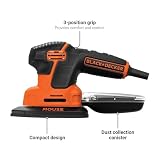
1. Black+Decker BDEMS600 — Best Overall Detail Sander ★

The Black+Decker BDEMS600 is the best all-around detail sander for most woodworkers, DIYers, and furniture restorers — the model that comes up most consistently across independent hands-on reviews, and the one that delivers on every specification a buyer should care about at an accessible price. It includes the finger attachment that several other models make you purchase separately, uses standard hook-and-loop triangular sandpaper widely available on Amazon and in hardware stores, and handles the full range of detail sanding tasks from furniture prep to trim painting without the overheating issues that affect some budget alternatives.
| Key Specifications | |
|---|---|
| Power | Corded 1.2A |
| OPM | 12,000 OPM |
| Variable Speed | No — single speed |
| Sandpaper System | Standard H&L triangular — universal |
| Finger Attachment | Yes — included in the box |
| Dust Port | Yes — vacuum compatible |
| Weight | ~1.9 lbs — lightweight for extended sessions |

What we like:
- Finger attachment included in the box — not an add-on purchase. This is significant because several competitors price the detail finger as an optional accessory that costs $8–$15. For spindle sanding, carving grooves, and turned profile work on furniture, the finger is essential. Getting it in the box at the BDEMS600’s price point is genuine value.
- Standard H&L triangular sandpaper — not a proprietary system. Pick up a 50-pack of standard triangular detail sander sheets on Amazon for under $15 across any grit. No locked ecosystem, no scarcity at hardware stores. This is the most important consumable advantage in the category.
- 1.2A motor with reasonable duty cycle — the BDEMS600 handles extended furniture restoration sessions without the rapid heat buildup that affects the smaller 1.0A motors in some budget models. For 20–30 minute continuous sessions, it performs reliably.
- Dust port accepts standard shop-vac fittings — effective dust collection that keeps your work surface visible, which matters for precision sanding on finished pieces.
What to know:
- Single speed — no variable OPM control. For most furniture and trim applications, 12,000 OPM is appropriate. If you regularly work on very delicate or heat-sensitive finishes (thin lacquer, shellac) and want low-speed control, the SKIL 4-in-1 or Milwaukee M12 are the alternatives to consider.
Best for: Furniture restoration, inside cabinet corners, trim painting preparation, window frames, door casing touch-up, and spindle work with the included finger. The right first detail sander for most buyers.
→ Check Current Price on Amazon
2. SKIL SR232301 4-in-1 Detail Sander — Best Multi-Attachment Option
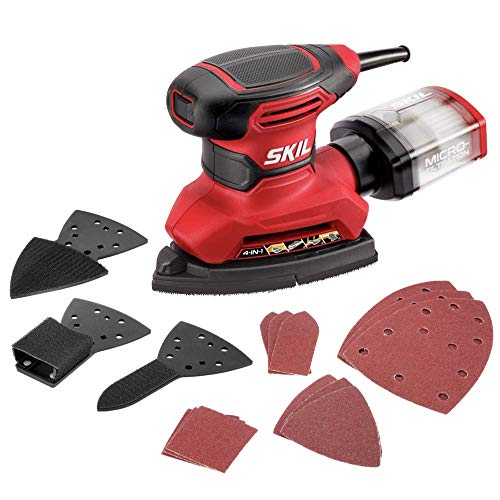
The SKIL SR232301 is the 4-in-1 multi-attachment detail sander — and the four attachment system is genuinely different pads that enable meaningfully different tasks, not just marketing. The triangular pad handles standard inside corners and flat surface detail work. The finger attachment handles spindles and carved profiles. A round pad handles convex curved surfaces like chair rungs. A flat rectangular pad handles flat-surface work where you want the detail sander’s gentle oscillation rather than an orbital’s more aggressive action. If your projects span curved furniture, carved detail work, and standard trim in the same session, the SKIL 4-in-1 reduces the number of tool changes.

| Key Specifications | |
|---|---|
| Power | Corded 1.2A |
| OPM | 12,000 OPM |
| Variable Speed | No |
| Attachments Included | 4: triangular, finger, round, rectangular |
| Sandpaper System | ⚠️ Octo system — partly proprietary; triangular uses standard H&L |
| Dust Port | Yes |
| Weight | ~1.8 lbs |

What we like:
- Four distinct attachment shapes address four genuinely different sanding scenarios — the triangular for corners, the finger for spindles and carved profiles, the round for convex curved surfaces, and the rectangular for flat detail work. If your woodworking regularly involves all of these, the SKIL 4-in-1 reduces trips back to the tool cabinet.
- The round pad specifically — for chair rungs, turned furniture legs, and curved rail profiles — is a capability no standard triangular detail sander offers. Sanding a convex curve with a flat pad requires awkward technique; the SKIL round pad conforms to the curve.
- Competitive pricing for four attachments — the total cost is similar to buying a basic detail sander and the attachments separately from another brand.
The proprietary sandpaper issue — read before purchasing:
- The triangular pad uses standard hook-and-loop triangular sheets — available everywhere. The other three attachment shapes (round, rectangular, and the Octo format) use SKIL’s proprietary Octo sandpaper system. These sheets cost more per unit than standard sheets and are not available in local hardware stores in most areas. Factor the ongoing sandpaper cost into the real price of this tool if you will use all four attachments regularly.
Best for: Woodworkers who regularly sand curved surfaces alongside standard corner work — chair and furniture restorers with varied surface profiles. The correct tool if you need the round attachment specifically. If you only use the triangular and finger, the Black+Decker BDEMS600 delivers the same at lower cost with no proprietary sandpaper commitment.
→ Check Current Price on Amazon
3. Bosch GSS18V-10 18V Cordless Detail Sander — Best Professional Cordless

The Bosch GSS18V-10 is the professional tier of cordless detail sanding — and the OPM specification is where it separates from budget cordless alternatives. At up to 27,000 OPM with variable speed control down to 10,000 OPM, the Bosch has a wider and higher speed range than any corded model in this roundup. The 27,000 OPM ceiling is the highest of any detail sander tested here — relevant for professional finishers who need maximum material removal rate on painted surfaces before the higher grits. For Bosch 18V Starlock platform users, the tool-only pricing makes this the economical choice for adding detail sanding capability to an existing collection.

| Key Specifications | |
|---|---|
| Power | Cordless 18V — Bosch CORE18V battery |
| OPM Range | 10,000–27,000 OPM (variable) |
| Variable Speed | Yes — dial control |
| Sandpaper System | Standard hook-and-loop triangular |
| Finger Attachment | Available separately |
| Dust Port | Yes — EasyCatch dust box included |
| Platform | Bosch 18V CORE — 200+ compatible tools |

What we like:
- 27,000 OPM is the highest in this roundup — at maximum speed, the Bosch removes material faster than any other model here. Combined with 10,000 OPM minimum, the full variable speed range covers everything from delicate finish work on bare wood to aggressive old paint removal on architectural trim.
- Dial variable speed control — a physical dial rather than trigger pressure control gives consistent, repeatable speed settings. Set 14,000 OPM for bare wood detail work, bump to 22,000 OPM for gel-stain prep, full 27,000 for paint removal. Precise and repeatable.
- EasyCatch dust box includes a micro-filter — effective on-tool dust collection without a shop-vac connection, which matters for site work in finished rooms where a shop vac is impractical.
- Standard hook-and-loop triangular sandpaper — no proprietary system. Full universal consumable access.
What to know:
- Battery not included at tool-only pricing. For buyers without existing Bosch 18V tools, the Milwaukee M12 FUEL kit (which includes battery) represents better value at a similar price point for cordless buyers starting fresh.
Best for: Existing Bosch 18V platform users, professional finishers and furniture restorers who need the widest OPM range and highest ceiling speed for varied work, site contractors who need cordless detail sanding without a power outlet.
→ Check Current Price on Amazon
4. Milwaukee M12 FUEL Detail Sander — Best Professional Cordless on M12
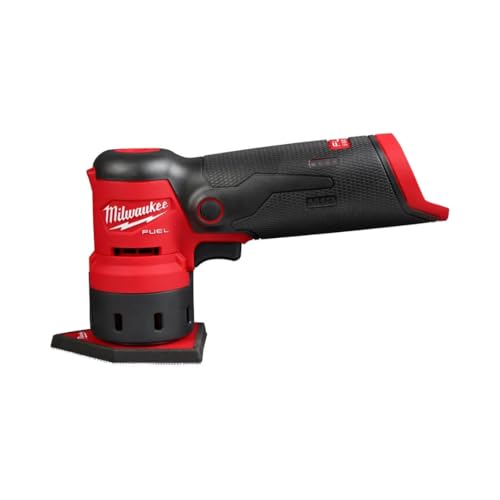
The Milwaukee M12 FUEL Detail Sander is the professional benchmark for M12 platform users — and for tradespeople and finishers already running M12 batteries, it is the straightforward detail sander recommendation. Milwaukee’s POWERSTATE brushless motor delivers 24,000 OPM maximum with variable speed that holds its set speed under load — unlike cheaper variable-speed motors that slow down under pressure and produce inconsistent results. For a finish carpenter or furniture restorer who runs their detail sander hard for hours in a day, the FUEL brushless motor’s sustained performance is the relevant professional advantage.
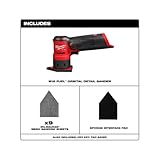
| Key Specifications | |
|---|---|
| Power | Cordless Milwaukee M12 battery |
| OPM Range | Variable — up to 24,000 OPM |
| Motor | POWERSTATE brushless — sustained under load |
| Variable Speed | Yes — REDLINK electronics |
| Sandpaper System | Standard H&L triangular |
| Finger Attachment | Yes — included |
| Platform | Milwaukee M12 — 100+ compatible tools |
| Dust Port | Yes — vacuum compatible |

What we like:
- POWERSTATE brushless motor maintains speed under load. This is the technical advantage that separates the Milwaukee FUEL from brushed variable-speed alternatives. When you press a detail sander into a corner with firm pressure — which is the correct technique for the inside corner pass — a brushed motor slows under that load. The POWERSTATE motor compensates electronically to maintain the set OPM regardless of pad pressure, producing more consistent sanding results on surfaces that require pressure control.
- REDLINK PLUS intelligence protects the motor and battery from overload and overheating — the professional duty-cycle protection that allows the Milwaukee to run harder and longer than budget corded models with their duty-cycle rest requirements.
- Finger attachment included — not an optional extra. For M12 platform users, this tool arrives ready for the full range of detail sanding tasks.
- M12 compact platform — one of the lightest cordless detail sanders with battery installed. The M12’s battery is significantly smaller and lighter than 18V or 20V alternatives, which matters for extended overhead or one-handed detail work.
What to know:
- Premium price — the most expensive tool in this roundup. Justified for M12 professionals who run this tool daily; not justified for occasional DIY use. For non-Milwaukee users, the WORX 5-in-1 or BDEMS600 are the better value alternatives.
Best for: Finish carpenters, professional furniture restorers, and anyone already invested in Milwaukee M12 — the brushless FUEL motor’s sustained performance under load is the professional advantage that separates this from every corded and budget cordless alternative.
→ Check Current Price on Amazon
5. WORX 20V 5-in-1 WX820L — Best Versatile Cordless Detail Sander
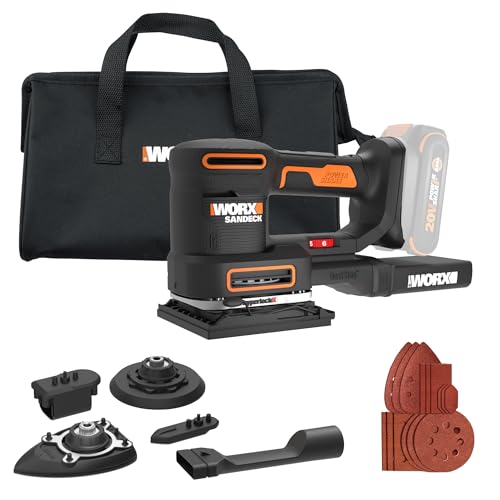
The WORX WX820L 5-in-1 is the versatility argument for the cordless detail sander category — five attachment modes on one tool platform, with WORX’s 20V PowerShare battery that is also compatible with WORX string trimmers, blowers, circular saws, and outdoor tools. If you want orbital sanding capability alongside detail sanding capability on one battery, the WX820L is the only tool in this roundup that provides both. The five modes include the standard triangular detail pad, the detail finger, a round sanding pad, a rectangular flat pad, and a scraper attachment — covering sanding, carving, and light scraping on the same tool body.

| Key Specifications | |
|---|---|
| Power | Cordless 20V WORX PowerShare |
| Modes | 5: triangular, finger, round, rectangular, scraper |
| Variable Speed | Yes |
| Sandpaper System | Standard H&L triangular + other shapes |
| Battery Platform | WORX 20V PowerShare — 75+ compatible tools |
| Dust Port | Yes |

What we like:
- Five attachments in one battery tool — the WORX delivers more attachment modes than any other single tool in this roundup. For a DIYer or hobbyist who wants one cordless sanding/scraping tool rather than a collection, the WX820L’s range is genuine.
- WORX 20V PowerShare is the same battery that powers WORX garden and power tools — for existing WORX users, this tool-only purchase slots into an existing battery collection.
- Scraper attachment is the fifth mode — useful for paint and adhesive removal in tight spots where the triangular sanding pad transitions from abrasive to scraping. No other model in this roundup includes a scraper mode.
What to know:
- Variable speed and multiple modes add value but also add complexity — for a buyer who wants a simple, reliable detail sander for furniture corners and trim, the Black+Decker BDEMS600 at lower cost is the less complicated choice. The WORX rewards buyers who will actually use multiple attachment modes across varied projects.
Best for: WORX platform users, DIYers who want a single cordless tool covering triangular sanding, finger detail work, curved surface sanding, and light scraping; projects combining prep and finishing in different surface types.
→ Check Current Price on Amazon
6. CRAFTSMAN CMEW210 — Best Mid-Range Corded Detail Sander

The CRAFTSMAN CMEW210 is the mid-range corded pick — a step up from the WEN 6301 budget model in build quality and attachment count, at a price below the cordless professional options. It ships with two attachments (triangular pad and finger), runs at 14,000 OPM (slightly faster than the Black+Decker BDEMS600’s 12,000), and includes a micro-filter dust collection system. For DIYers who want a corded detail sander with the CRAFTSMAN V20 ecosystem’s brand reliability without the cordless premium, it is a sensible middle-ground choice.

| Key Specifications | |
|---|---|
| Power | Corded 1.0A |
| OPM | 14,000 OPM |
| Variable Speed | No — single speed |
| Attachments | 2: triangular + finger |
| Sandpaper System | Standard H&L triangular |
| Dust Collection | Micro-filter system — vacuum compatible |
| Weight | ~1.5 lbs |

What we like:
- 14,000 OPM is slightly higher than the Black+Decker at the same price tier — marginally faster material removal for users who prioritise throughput on prep work.
- Finger attachment included — the same advantage as the BDEMS600 at a competitive price point.
- Micro-filter dust box provides on-tool dust collection for use without a shop-vac connection.
What to know:
- 1.0A motor is slightly less powerful than the BDEMS600’s 1.2A — for extended sessions on hard painted surfaces, the BDEMS600 runs cooler over time. For occasional use and lighter sanding tasks, the difference is negligible.
Best for: CRAFTSMAN brand loyalists, mid-range corded users who want 14,000 OPM with finger attachment at a budget-adjacent price, and DIYers looking for a reliable upgrade over the WEN entry-level model.
→ Check Current Price on Amazon
7. WEN 6301 Electric Detail Sander — Best Budget Corded
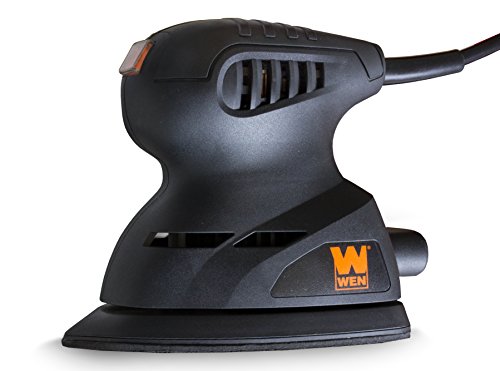
The WEN 6301 is the entry-level corded detail sander — approximately $20, functional, and appropriate for the buyer whose projects require a detail sander occasionally rather than regularly. At 13,500 OPM with a 1.0A motor and standard hook-and-loop triangular pad system, it handles the core use case (inside corner sanding for trim and furniture prep) correctly for casual use. It does not include a finger attachment, which limits its spindle and carving capability. For a first-time buyer who wants to try detail sanding without a significant investment, or for someone who needs a detail sander for one specific project, the WEN 6301 delivers the essential function at minimum cost.

| Key Specifications | |
|---|---|
| Power | Corded 1.0A |
| OPM | 13,500 OPM |
| Variable Speed | No |
| Finger Attachment | No — triangular pad only |
| Sandpaper System | Standard H&L triangular |
| Dust Port | Yes — bag included |
| Weight | ~2 lbs |

What we like:
- Standard hook-and-loop triangular sandpaper — no proprietary system at the lowest price point in this roundup.
- At ~$20, it is the most accessible entry point into the detail sander category — appropriate for a single project, a first-time test of the tool type, or a backup tool for a workshop with a primary sander.
What to know:
- No finger attachment — if spindle or carving work is any part of your project, the Black+Decker BDEMS600 is $10 more with the finger attachment included. The WEN is the right choice when you are confident you only need the standard triangular pad.
- Duty cycle consideration: the 1.0A motor runs warmer under sustained load than the BDEMS600’s 1.2A. For longer continuous sessions (30+ minutes), follow the 5–10 minute rest rule to prevent motor heat buildup.
Best for: Buyers who need a detail sander for one specific project, first-time buyers testing the category, and workshop owners who want a low-cost backup tool. If the budget can stretch $10 further, the BDEMS600’s finger attachment and better duty cycle are worth it.
→ Check Current Price on Amazon
8. ANSAI Pen Reciprocating Sander — Best for Crafts, Models & 3D Print Finishing

The ANSAI Pen Sander occupies a completely different niche from every other tool in this roundup — it is not a triangular pad detail sander but a USB-rechargeable pen-format reciprocating sander designed specifically for fine craft work, model making, miniature finishing, and 3D print post-processing. Where a standard detail sander handles furniture and architectural woodwork, the ANSAI handles resin models, PLA and PETG 3D prints, scale miniatures, wooden craft kits, and small carved pieces where any full-size sander — including a detail sander — is too large and aggressive. Eight interchangeable sanding heads at multiple profiles, USB-C charging, and multi-speed control from a single hand-held pen format tool. This is the correct tool for a specific and underserved use case.

| Key Specifications | |
|---|---|
| Power | USB-C rechargeable — no outlet required |
| Speed | Multi-speed — variable control |
| Attachments | 8 interchangeable sanding heads |
| Format | Pen/pencil grip — single-hand precision |
| Best Materials | Resin, PLA, PETG, balsa, light wood, MDF crafts |
| Sandpaper System | Proprietary mini sheets (included) |
| Weight | Very light — pen-format hand tool |

What we like:
- Purpose-built for 3D print finishing and model making — a gap completely unaddressed by every other tool in this roundup. FDM 3D prints (PLA, PETG, ABS) require careful layer-line removal that a standard detail sander performs too aggressively. The ANSAI’s multi-speed low-end settings and fine sanding heads handle this work correctly without removing material too quickly or generating heat that warps thin printed walls.
- USB-C charging — no outlet, no battery platform, no cord. For crafters and makers who work at a desk rather than a workbench, this portability and power source flexibility is the correct format.
- Eight head profiles cover flat surfaces, curved profiles, pointed recesses, and edge work across a variety of small-scale project types.
What to know:
- This tool is not a substitute for a standard detail sander on furniture and woodworking — it is purpose-built for fine craft work at small scale. If your projects are primarily furniture, trim, and architectural woodwork, this is not the tool you need. If you combine woodworking with model making or 3D printing, it is a useful addition alongside a standard detail sander.
- Proprietary mini sandpaper heads — replacement availability should be checked before purchasing. Verify replacement head availability at your expected use frequency.
Best for: 3D print post-processing (PLA, PETG, resin), miniature and model makers, balsa wood craft kits, small wooden carved pieces, and any scale work where a full-size detail sander is too aggressive and too large.
→ Check Current Price on Amazon
Detail Sander vs. Random Orbital Sander — Which Do You Actually Need?

This is the most common question in the category — and no competitor provides a clear decision framework. Here it is.
A random orbital sander uses a round pad that spins and oscillates simultaneously, producing fast, swirl-free material removal on flat and near-flat surfaces. It is the correct tool for large flat panels, table tops, wide floor boards, cabinet door faces, and any open flat surface where covering area quickly matters. A 5″ random orbital sander covers roughly 20 square inches per pass. It cannot access inside corners, narrow rebates, carved profiles, or any confined space where the round pad cannot reach the surface.
A detail sander uses a triangular pad that oscillates without spinning. It covers far less area per pass (the triangular tip is the active point), removes material more slowly on flat surfaces, and is specifically designed to reach inside corners and tight spaces that orbital sanders cannot. Its defining capability — the pointed tip that accesses 90-degree inside corners — is something no orbital sander in any format can replicate.
The correct answer for most woodworkers: own both. They are complementary tools, not competing ones. Use the random orbital on open flat surfaces; switch to the detail sander for corners, profiles, and detail work. The overlap is minimal and the capability each provides is genuinely different.
If you can only buy one: Choose the random orbital sander. It covers more use cases for more woodworking projects. The detail sander becomes the second purchase — for when you have started doing the inside corner work by hand and decided there is a better way.
| Task | Detail Sander | Random Orbital |
|---|---|---|
| Inside corners (90°) | ✅ Best tool for this | ❌ Cannot reach |
| Spindles and turned profiles | ✅ With finger attachment | ❌ Wrong shape |
| Carved furniture details | ✅ Tip accesses recesses | ❌ Too large |
| Flat panel sanding | ⚠️ Very slow — wrong tool | ✅ Best tool for this |
| Table top prep | ❌ Impractical for large area | ✅ Correct choice |
| Window sash and glazing | ✅ Reaches corners and rebates | ⚠️ Misses corners |
| Cabinet face frame corners | ✅ The defining use case | ❌ Cannot reach |
| Stair railing profiles | ✅ With appropriate pad | ❌ Wrong shape |
Detail Sander vs. Oscillating Multi-Tool – The Real Comparison

This comparison is completely absent from every competing detail sander article — yet it is one of the most common decisions buyers face, because both tools use triangular sanding pads and reach inside corners.
Where the oscillating multi-tool wins: cutting, scraping, grout removal, flush cuts on protruding nails, removing old caulk, and any task that requires an accessory other than a sanding pad. The oscillating tool is a multi-function platform — it sands, cuts, scrapes, and grinds on the same body with accessory changes. For a buyer who wants maximum versatility from one cordless tool, the oscillating multi-tool is the better investment.
Where the dedicated detail sander wins: sustained fine sanding sessions on furniture, trim, and finished wood. The dedicated detail sander is lighter, less expensive, generates less vibration (important for hand comfort on long sessions), and is optimised for sanding rather than divided across multiple functions. Oscillating multi-tool sanding pads also wear faster and cost more per pad than standard detail sander sheets — the ongoing consumable cost favours the dedicated detail sander for users who primarily sand.
The key overlap and difference: both tools accept triangular pads and both reach inside corners. The detail sander handles this task better — its oscillation mechanism is specifically designed for sanding, producing a smoother result than an oscillating multi-tool running a sanding pad. But the oscillating multi-tool can also cut the piece, scrape the old finish, and remove embedded fasteners before the sanding begins — capabilities the detail sander cannot replicate.
The verdict: If your projects are primarily sanding and finishing, a dedicated detail sander is the better value. If your projects combine prep work (cutting, scraping, old-finish removal) with finishing (sanding), an oscillating multi-tool provides more capability for the same or similar investment — and can be used with a sanding pad when detail sanding is needed. Many experienced woodworkers own both, using the multi-tool for prep and the dedicated sander for finishing.
Use-Case Guide — Best Detail Sander by Application
Furniture Restoration and Antiques
Detail sanders are among the most valuable tools for furniture restoration — the combination of a pointed triangular pad for carved corner details and a finger attachment for turned spindles and profile grooves covers the two areas of antique furniture that no other powered tool reaches. For stripping old finish from a carved Victorian chair, start with 80-grit to remove the finish layer, move to 120-grit for the bare wood surface, and finish with 180–220-grit for the pre-stain pass. Work at moderate pressure — antique wood is often thinner or more fragile than new timber, and aggressive pressure risks digging into the surface. The Black+Decker BDEMS600 with its included finger attachment is the recommended starting point for furniture restoration use.
Stair Spindles and Balusters
Spindle sanding is one of the most tedious hand-sanding jobs in residential woodworking — and a detail sander with a finger attachment changes it fundamentally. The technique that works: load the finger with a grit appropriate for the phase (120-grit for initial prep, 220-grit for pre-finish), wrap the finger in the recessed groove of the spindle at the narrowest point, and use short rocking strokes that follow the curved profile. Do not drag the finger linearly along the spindle — this digs in at the profile transitions. Rock with the curve. Note the vacuum seal limitation: the finger attachment on a spindle does not form a vacuum seal over the dust port, so effective dust extraction is significantly reduced. Pre-vacuum the work area and wear a dust mask — fine wood dust from spindle sanding accumulates quickly in the air without effective extraction.
Window Sash and Glazing Compound Removal
This is the painter’s most underutilised application for a detail sander — a use case completely absent from competing guides. When repainting wooden window frames, glazing compound (the putty around glass panes) frequently fails, hardens, or has been poorly applied. A detail sander with a fresh 80-grit sheet navigates the narrow rebate channels between the glass and the sash frame, removing old compound residue and preparing the surface for fresh glazing. The pointed tip accesses the corners of the rebate where a scraper struggles to reach cleanly. Follow with 120-grit for the bare wood prep, then prime and re-glaze. This application alone — if you have older single-pane windows to restore — justifies the cost of a detail sander over doing the same work with scrapers and folded sandpaper.
Cabinet Inside Corners and Face Frames
This is the defining use case that places a detail sander in every serious cabinet maker’s tool set. After assembling a cabinet face frame and sanding the flat surfaces with a random orbital, the inside corners where stiles meet rails remain unsanded — the orbital’s round pad cannot reach the last few millimetres. A detail sander’s pointed tip enters the corner at a slight angle: the tip addresses the corner directly while the adjacent face of the triangular pad simultaneously sands the flat surface next to it. One pass in each corner, top and bottom, and the face frame is fully sanded without any hand sanding. On a kitchen’s worth of cabinet faces, this saves an hour.
Trim, Moulding, and Door Casing Prep
Pre-paint prep on installed trim is detail sander territory — the goal is to sand off old brush marks, drips, and imperfections on the surface of installed moulding before repainting, while also feathering into the inside corners where the trim meets the wall or adjacent surface. Start with 120-grit for surface prep, 180-grit for light feathering, 220-grit before the final coat. Move along the profile at a consistent pace — do not pause the sander in one spot, which creates a depression in the surface. The technique for narrow profiles (like pencil-bead moulding): keep the pad flat against the widest face and let the pointed tip handle the smaller adjacent face in the same stroke.
Model Making, Miniatures, and 3D Print Finishing
For 3D print post-processing, a standard detail sander is typically too aggressive — the OPM and pad size are calibrated for woodworking, not for thin resin models or PLA printed walls. The ANSAI Pen Sander in this roundup is specifically designed for this application: multi-speed control at the low end for delicate resin and PLA surfaces, fine sanding heads that profile to small-scale surface geometry, and a pen grip that allows the same dexterity as hand sanding with the mechanical assistance of powered oscillation. The grit progression for FDM 3D prints: 120-grit to remove layer lines, 180-grit for surface smoothing, 320-grit for pre-paint finish, 400–600-grit wet for near-injection-moulded results before primer. Speed control matters here: resin and thin PLA overheat and distort at high sanding speeds — keep the ANSAI at its lowest speed setting until you understand how your specific print material responds.
Sandpaper Guide – Avoiding the Compatibility Trap
Sandpaper compatibility is the practical buying decision that no competing guide addresses — and it has a direct long-term cost impact that changes the real price of some tools in this roundup.

Standard Hook-and-Loop Triangular Sheets
The universal format that most detail sanders use — a triangular sheet with a velcro-style hook-and-loop backing that attaches to the pad without clips or adhesive. These sheets are available in bulk packs on Amazon for $0.40–$0.70 per sheet across all standard grits. They are also available in every hardware store. The Black+Decker BDEMS600, WEN 6301, CRAFTSMAN CMEW210, Bosch GSS18V-10, Milwaukee M12 FUEL, and WORX WX820L all use standard triangular H&L sheets. Buy in bulk packs of 50+ for the best per-sheet cost.
Proprietary Pad Systems
The SKIL SR232301 uses the Octo system for its non-triangular pads (round, rectangular, and some specialty shapes) — these require brand-specific replacement sheets at $1.00–$1.50 per sheet. The ANSAI Pen Sander uses proprietary mini heads. When purchasing a multi-attachment model, check whether the attachments you actually plan to use require proprietary sandpaper. If you primarily use the triangular pad on your SKIL 4-in-1, you can use standard sheets on that pad and avoid the proprietary cost on the others.
Grits to Keep in Stock
- 80-grit: Paint and old finish removal, aggressive prep on rough surfaces
- 120-grit: General surface prep, bare wood initial sanding
- 180-grit: Pre-finish prep, between sealer coats
- 220-grit: Between paint or varnish coats, smooth pre-final-coat prep
- 320-grit: Final finish on bare wood, very smooth pre-paint surface on repainted trim
For most furniture restoration projects, stocking 80, 120, and 220-grit covers the full progression from old finish removal to pre-topcoat prep. For fine woodworking finishing, add 180 and 320.
Technique Guide — How to Use a Detail Sander Properly
Correct Pressure
Let the pad do the work — do not press the sander firmly into the surface. Excess pressure does not increase material removal speed; it generates heat, causes premature pad wear, and can burn the wood surface at the corners and tips where pressure concentrates. Hold the sander with a light, guiding grip rather than pressing actively. The oscillating motion of the pad against the surface is doing the work — your hand’s job is to guide direction and pace, not to apply downward force.
How to Use the Pointed Tip in a 90-Degree Corner
Approach the corner at a slight angle — roughly 15–20 degrees from perpendicular to the corner line. At this angle, the pointed tip enters the corner directly while the adjacent face of the triangular pad contacts the flat surface next to the corner. One stroke addresses both surfaces simultaneously. For very tight corners (under 5mm depth), the tip alone is the contact point — reduce the approach angle further and use short strokes rather than long passes.
Using the Finger Attachment on Spindles
Load the finger with the correct grit sheet, positioned so the abrasive side faces outward from the tip. Wrap the finger into the recessed groove or profile channel of the spindle at the point where the curve is sharpest. Use short rocking strokes that follow the radius of the curve — not linear strokes along the axis of the spindle. Linear strokes on a curved profile dig in at the transition points. Rocking strokes follow the geometry correctly and produce an even surface across the full width of the profile.
The Always-Moving Rule
Never hold a detail sander stationary on the workpiece with the motor running. The rapid oscillation concentrated on one point generates heat at a rate the wood surface cannot dissipate — this produces burn marks, especially in softwoods, and creates a depression in the surface that shows through any finish. Keep the sander moving at a consistent, unhurried pace. If you need to stop — to reposition, to check your work, to change grit — lift the pad from the surface before the sander stops or while it is still running, never let it rest on the wood while stationary.
Dust Collection on Spindles
When using a detail sander or finger attachment on a spindle, the irregular surface geometry means the dust port does not form an effective vacuum seal with the pad. Fine wood dust escapes freely into the air rather than being captured by the extraction system. Before beginning spindle sanding: pre-vacuum the surrounding area, close doors if working indoors, and put on a P2 or N95 dust mask. Fine wood dust from repeated sanding sessions is a respiratory hazard — the vacuum seal limitation on curved surfaces means less capture, not less dust generation.
Duty Cycle Rest Rule
This is the technical note no competitor includes — and it matters for the motors in the budget corded category. Detail sanders with 1.0A motors (WEN 6301, CRAFTSMAN CMEW210) run warmer under sustained load than the 1.2A BDEMS600 and are not designed for continuous all-day use. For sessions longer than 20–30 minutes of continuous running, allow a 5–10 minute rest to let the motor cool. Signs the motor needs a rest: the housing feels hot to the touch, the OPM sounds like it is slowing, or you detect a slight electrical smell. The cordless models — Milwaukee M12 FUEL, Bosch GSS18V-10 — use brushless motors with better thermal management and do not have the same duty-cycle limitation for typical woodworking sessions.
Frequently Asked Questions — Detail Sanders
What is a detail sander used for?
A detail sander is specifically designed to sand inside corners, tight spaces, carved profiles, spindles, window rebates, and any surface geometry where a round or rectangular sanding pad cannot reach. It is not the right tool for large flat surfaces — use a random orbital for those. The detail sander’s defining capability is the pointed triangular pad tip that accesses 90-degree inside corners that every other sander cannot reach.
What’s the difference between a detail sander and a mouse sander?
They are the same tool — different brand names for the same triangular oscillating pad mechanism. “Mouse sander” became common because the tool’s triangular body, viewed from above, resembles a computer mouse. “Detail sander” and “corner sander” are the current standard terms. If you are searching for any of these three names, you are looking at the same category.
Can a detail sander replace a random orbital sander?
No — they are complementary tools, not substitutes. A detail sander covers inside corners, spindles, and tight spaces that orbital sanders cannot access. A random orbital sander covers large flat surfaces, panels, and open wood far more efficiently than a detail sander. Most serious woodworkers own both. If you can only buy one, buy the random orbital — it covers more project types. The detail sander becomes the second purchase for when inside-corner work by hand becomes tedious enough to justify it.
Can I use a detail sander on spindles and chair legs?
Yes — with the finger attachment, which is purpose-designed for this application. The correct technique is rocking strokes that follow the radius of the spindle’s profile, not linear dragging along the axis. Without the finger attachment, the standard triangular pad does not conform to a convex curve effectively. Note that vacuum dust extraction is significantly reduced on spindle work — wear a dust mask.
What sandpaper fits a detail sander? Can I cut my own?
Most quality detail sanders use standard hook-and-loop triangular sheets — available in bulk packs of 50+ on Amazon for $0.40–$0.70 per sheet in any grit. Yes, you can cut your own from full-sheet hook-and-loop sandpaper rolls or quarter-sheet H&L pads — trace the pad shape onto the sheet and cut with scissors. This is the most cost-effective option for high-volume use. Be aware that several brands (SKIL Octo, ANSAI) use proprietary pad formats for some attachments — check before purchasing.
Is a cordless detail sander as good as a corded one?
At the professional tier — yes. The Milwaukee M12 FUEL and Bosch GSS18V-10 match or exceed the performance of quality corded models at their respective OPM specs. The tradeoff is battery weight, battery cost for new platform buyers, and finite runtime. For workshop use near outlets, a quality corded model (BDEMS600) provides excellent performance at lower cost. For site work, stair railings, and room-to-room renovation where mobility matters, cordless is genuinely better in practice.
Why does my detail sander get hot?
There are three common causes: pressing too hard (forcing the motor to work against resistance rather than letting the pad oscillate freely), running a 1.0A motor beyond its duty cycle without rest periods, and running a worn sandpaper sheet (a clogged or worn sheet offers more friction with less cutting, generating heat without removing material). Check your sanding pressure first — most detail sander overheating comes from excess force rather than motor limitation. If the tool is genuinely overheating at light pressure, allow a 10-minute rest and check that the ventilation slots are clear of sawdust.
What is the best detail sander for furniture restoration?
The Black+Decker BDEMS600 for most furniture work — finger attachment included, standard sandpaper, 1.2A motor with good duty cycle, and a price that makes it the correct entry into the category. For professional restorers running the tool daily on hard painted surfaces and carved antique profiles, the Milwaukee M12 FUEL’s POWERSTATE brushless motor is the step up — better sustained performance under load and no duty-cycle concerns for extended professional sessions.
Final Verdict — Best Detail Sander for Every Buyer
Use the table below for a direct comparison and quick purchase access for all eight models.
| Best For | Our Pick | Key Reason | Buy on Amazon |
|---|---|---|---|
| Best Overall | Black+Decker BDEMS600 | Finger attachment included, standard H&L sandpaper, 1.2A duty cycle, best all-round value | Buy Now → |
| Best Multi-Attachment | SKIL SR232301 4-in-1 | 4 pad shapes including round for convex curves; note proprietary Octo sheets for 3 of 4 pads | Buy Now → |
| Best Professional Cordless (Bosch) | Bosch GSS18V-10 18V | 27,000 OPM maximum, dial variable speed, EasyCatch dust box, Bosch 18V platform | Buy Now → |
| Best Professional Cordless (Milwaukee) | Milwaukee M12 FUEL | POWERSTATE brushless motor holds speed under load, finger included, M12 platform | Buy Now → |
| Best Versatile Cordless | WORX 20V 5-in-1 WX820L | 5 modes including scraper, variable speed, WORX PowerShare platform | Buy Now → |
| Best Mid-Range Corded | CRAFTSMAN CMEW210 | 14,000 OPM, finger attachment, micro-filter, CRAFTSMAN quality | Buy Now → |
| Best Budget Corded | WEN 6301 Electric | ~$20 entry price, standard H&L sandpaper, correct for occasional and single-project use | Buy Now → |
| Best for Crafts and 3D Printing | ANSAI Pen Reciprocating Sander | USB-C rechargeable, 8 heads, multi-speed for delicate resin and PLA post-processing | Buy Now → |
For most woodworkers, furniture restorers, and DIYers: start with the Black+Decker BDEMS600. It handles the full range of detail sanding tasks, includes the finger attachment for spindle work, and uses standard sandpaper without any proprietary system. If you are a Milwaukee M12 professional, the M12 FUEL is the obvious step up — the brushless motor is the professional-grade feature that separates it from all corded alternatives. If you work on models, miniatures, or 3D prints, the ANSAI Pen Sander is the correct tool for a scale of work that no full-size detail sander addresses properly.