If you’ve ever pressure washed a concrete driveway with just a standard wand and nozzle, you already know the frustration: faint parallel streaks — sometimes called “zebra lines” — left behind in a repeating pattern no matter how carefully you overlap each pass. These stripes aren’t a technique problem. They’re a physics problem, and a surface cleaner is the only real fix.
What Is a Pressure Washer Surface Cleaner and Why You Actually Need One
A surface cleaner attachment is a disc-shaped tool that replaces your standard spray wand. Inside the shroud, a rotating bar carries two or more spray nozzles that spin continuously, delivering overlapping, even pressure across the entire cleaning deck simultaneously. The result is a flat, uniform clean — no lines, no missed strips, no uneven patches.
Beyond eliminating stripe marks, a good pressure washer surface cleaner for driveway use offers three significant practical advantages over standard wand cleaning. First, it’s dramatically faster — most users report cleaning their concrete driveways 3–4 times quicker with a surface cleaner compared to a single wand. A 600 sq ft driveway that might take 40 minutes with a nozzle can be done in under 15 minutes with a quality surface cleaner. Second, the enclosed shroud design contains the spray, which means you stay dry during the cleaning pass and water doesn’t blast onto cars, walls, or landscaping. Third, the spinning nozzle pattern distributes pressure evenly, reducing the risk of accidental etching from lingering too long in one spot.
If you recently picked up one of the machines from our best pressure washer for concrete driveway guide and haven’t added a surface cleaner to your kit yet, this is the accessory that completes the setup. Before you use it, it’s also worth check on the best concrete degreasers — pre-treating oil stains before the surface cleaner pass makes a significant difference on heavily contaminated driveways.
Table of Contents
Quick Comparison Table: Best Surface Cleaner Attachments
| Product | Best For | Deck Size | Max PSI | Housing |
|---|---|---|---|---|
| Simpson Universal 15″ | Best Overall | 15″ | 3,700 PSI | Steel |
| Briggs & Stratton 14″ | Runner-Up / Gas Machines | 14″ | 3,200 PSI | Plastic |
| Karcher 15″ Universal | Best Value | 15″ | 3,200 PSI | Plastic |
| Greenworks 15″ | Best for Electric Washers | 15″ | 3,100 PSI | Plastic |
| Simpson Universal 20″ Industrial | Best Semi-Pro / Large Driveways | 20″ | 4,000 PSI | Steel |
| Twinkle Star 15″ | Best Budget Pick | 15″ | 3,000 PSI | Plastic |
How to Choose the Right Surface Cleaner Attachment
Surface cleaners look similar at first glance — most are round, plastic or steel, and connect via a standard 1/4″ quick-connect fitting. But the differences between a well-matched unit and a poorly matched one show up immediately in cleaning quality. Here’s what actually matters:
Size: The 4-Inches-Per-GPM Rule
Deck size is the most important spec to get right, and it’s determined by your pressure washer’s GPM (gallons per minute) — not its PSI. The standard guideline is 4 inches of cleaning deck per GPM. A 2.5 GPM machine pairs well with a 10–12″ surface cleaner. A 3.5–4 GPM machine can drive a 15–20″ deck effectively. Going too large causes the rotary nozzle bar to spin too slowly, which creates uneven cleaning and — ironically — the same kind of streaking you bought the surface cleaner to avoid. Bigger is not better unless your machine has the GPM to back it up.
PSI Rating: Match or Exceed Your Machine
Every surface cleaner has a maximum PSI rating. This rating must meet or exceed your pressure washer’s output. Using a surface cleaner rated at 2,500 PSI with a 3,200 PSI machine risks blowing the internal seals and destroying the unit prematurely. Always buy rated above your machine’s output — the models on this list were selected with that margin built in for their respective use cases.
Housing Material: Steel vs. Plastic
Powder-coated steel housings — like those on the Simpson models — are significantly more durable and resistant to cracking, warping, and UV degradation over time. If you clean your driveway multiple times per year or clean for others, steel is worth the price premium. Plastic housings are perfectly adequate for homeowners doing one or two cleaning sessions per year, and the lighter weight makes them easier to maneuver.
Brass vs. Plastic Nozzle Heads
This detail gets skipped by most buying guides, but it matters enormously for longevity. Brass nozzle orifices resist corrosion, scale buildup, and erosion far better than plastic nozzles — particularly in areas with hard water. Over time, worn plastic nozzles develop irregular spray patterns that cause uneven cleaning. If you plan to use your surface cleaner regularly, look for brass nozzle inserts. The Simpson units and higher-end Karcher accessories typically include them.
Wheels vs. Floating Design
Wheels make pushing the surface cleaner effortless on smooth, flat concrete — the typical residential driveway. However, if your driveway has a textured aggregate finish, uneven paving stones, or raised expansion joints, wheeled models can catch and skip. In those cases, a floating (wheel-free) design that rides on the water cushion between the shroud and the surface adapts more fluidly.
Grease Fitting (Zerk Fitting)
Semi-professional models include a grease fitting on the spindle housing — a small port that lets you inject bearing grease to lubricate the rotary arm mechanism. Consumer models skip this to reduce cost. If you’re cleaning driveways frequently — multiple times per season or for multiple properties — a Zerk fitting dramatically extends the service life of the spinning mechanism. It’s the difference between a component lasting two seasons and lasting ten.
Top 6 Surface Cleaner Attachments In-Depth Reviews

1. Simpson Universal 15″ Surface Cleaner — Best Overall

Deck Size: 15″ | Max PSI: 3,700 | Max GPM: 3.0 | Housing: Powder-coated steel | Connection: 1/4″ quick-connect | Nozzles: Brass | Price Range: $$
The Simpson Universal 15″ is the best all-around surface cleaner for most homeowners and the logical companion to any mid-to-high-output gas pressure washer. Its powder-coated steel housing is the headline advantage — while most surface cleaners at this price use injection-molded plastic, Simpson’s steel build shrugs off impacts, resists UV cracking, and maintains its structural integrity season after season. The unit is rated to 3,700 PSI and 3.0 GPM, which pairs perfectly with machines like the Simpson MSH3125 MegaShot reviewed in our driveway pressure washer guide.
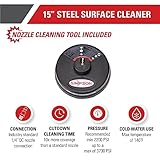
The brass spray nozzles are another distinguishing feature — they resist corrosion and wear far longer than the plastic nozzles found on budget competitors. This matters more than it sounds if you have hard water or use detergent regularly. The 15″ cleaning deck hits the sweet spot between coverage speed and practical GPM requirements — you get excellent cleaning efficiency without needing to push 3.5+ GPM to maintain good spin speed. Two integrated guide wheels make it easy to push across flat concrete at a steady pace, and the quick-connect fitting is compatible with virtually all residential pressure washers.

Pros:
- Powder-coated steel housing — durability far above plastic competitors
- Brass nozzle inserts resist corrosion and wear for long-term performance
- 3,700 PSI rating handles any residential or semi-pro gas washer
- Universal 1/4″ quick-connect fits virtually all pressure washers
- Excellent Simpson brand reputation and customer support
Cons:
- Heavier than plastic alternatives — slightly more effort to maneuver
- May be overkill for homeowners using a low-output electric washer
Best For: Homeowners and semi-pros with gas pressure washers in the 2,500–3,700 PSI range who want a surface cleaner built to last years of regular use.
2. Briggs & Stratton 14″ Surface Cleaner — Runner-Up for Gas Machines
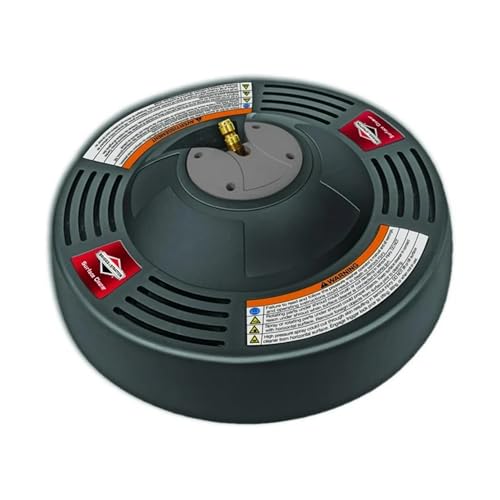
Deck Size: 14″ | Max PSI: 3,200 | Max GPM: 2.5 | Housing: Reinforced plastic | Connection: 1/4″ quick-connect | Nozzles: Stainless steel | Price Range: $$
Briggs & Stratton is best known for its engines — the kind found in millions of gas pressure washers — so it’s no surprise their surface cleaner attachment is engineered specifically to match the output of those machines. Rated at 3,200 PSI and 2.5 GPM, it pairs precisely with the output of common residential gas washers like the Westinghouse WPX2700 and similarly speced machines in the 2,500–3,200 PSI range. The 14″ deck suits machines producing around 2.5–3.0 GPM by the 4-per-GPM sizing rule, making this a well-matched combination.

The reinforced plastic housing is more robust than standard consumer-grade plastic, and stainless steel spray nozzles offer better corrosion resistance than plain plastic alternatives — a meaningful durability upgrade at this price point. The unit includes two guide wheels and is notably lighter than steel-housing competitors, which makes long cleaning sessions less fatiguing. Setup is genuinely straightforward: connect to your wand’s quick-connect, test the spin, and go.

Pros:
- Engineered to match common residential gas washer output specs
- Stainless steel nozzles provide good corrosion resistance
- Lighter than steel-housing alternatives — easier for longer sessions
- Well-priced for the performance on offer
- Simple, no-fuss setup and connection
Cons:
- Plastic housing less durable than Simpson’s steel unit for frequent use
- 3,200 PSI ceiling means it won’t suit the most powerful residential gas washers
Best For: Homeowners with standard residential gas pressure washers producing 2,500–3,200 PSI who want a reliable, well-matched surface cleaner without paying for steel construction they won’t need.
3. Karcher 15″ Universal Surface Cleaner — Best Value

Deck Size: 15″ | Max PSI: 3,200 | Max GPM: 2.6 | Housing: Lightweight plastic | Connection: 1/4″ quick-connect (universal) | Price Range: $–$$
Karcher’s 15″ universal surface cleaner delivers the German brand’s characteristic engineering quality at a price that undercuts the Simpson steel model considerably. At 3,200 PSI rated, it’s a solid match for mid-range gas washers and the upper tier of electric machines, while the 15″ cleaning deck covers ground efficiently for standard residential driveways. Karcher’s engineering approach prioritizes balanced spin dynamics, which means even at the entry-level price point this cleaner produces noticeably even results compared to unbranded alternatives.

The plastic housing is lightweight — a genuine advantage when you’re pushing the cleaner back and forth across a long driveway for 15–20 minutes. The unit connects universally via standard 1/4″ quick-connect and works across Karcher’s own machines as well as virtually all third-party residential pressure washers. For homeowners who clean their driveways once or twice a year and don’t need the longevity of a steel housing, this represents arguably the best per-dollar value in the category.

Pros:
- Excellent price-to-performance ratio — the best value option on the list
- Karcher engineering quality in balanced nozzle spin for even coverage
- Lightweight plastic housing is easy to maneuver
- Universal fitting — works on Karcher and third-party machines
- 15″ deck is ideal for most residential driveways
Cons:
- Plastic housing will not outlast steel alternatives under frequent use
- No brass nozzles — plastic nozzle tips will wear faster in hard water areas
Best For: Budget-conscious homeowners using mid-range gas or high-output electric machines who want a quality brand name and reliable results without the premium price tag.
4. Greenworks 15″ Surface Cleaner — Best for Electric Pressure Washers

Deck Size: 15″ | Max PSI: 3,100 | Min GPM: 1.1 | Housing: Plastic | Connection: 1/4″ quick-connect | Price Range: $
Most surface cleaners are engineered with gas-powered machines in mind — the specs, sizing, and minimum GPM requirements quietly assume you have 2.5+ GPM flowing through the system. The Greenworks 15″ breaks that mold. It’s specifically designed and tested to perform with electric pressure washers that produce as little as 1.1 GPM, making it genuinely suitable for popular electric models like the Ryobi RY142500 Brushless, the Westinghouse ePX3100, and comparable machines in the 1,800–2,400 PSI range.

The internal nozzle and rotary arm geometry are calibrated to maintain adequate spin speed at lower flow rates — a design detail that makes a real practical difference. Many electric washer owners have bought a “universal” surface cleaner only to find it barely rotates at their machine’s GPM. The Greenworks spins properly and delivers streak-free results even at 1.2–1.5 GPM. The lightweight plastic body keeps the unit manageable, and the 3,100 PSI rating gives headroom above most electric pressure washers‘ output. For more on pairing accessories with your electric machine, see our gas vs. electric pressure washer guide.

Pros:
- Specifically designed and tested for electric pressure washers
- Works at GPM as low as 1.1 — genuine low-flow compatibility
- Excellent value for electric washer owners
- Lightweight and easy to push
- 3,100 PSI rating provides generous headroom above most electric machines
Cons:
- Plastic construction — not built for commercial or semi-pro frequency of use
- Not the best choice if you upgrade to a gas machine later
Best For: Owners of electric pressure washers in the 1,800–2,500 PSI range who want a surface cleaner that will actually spin and perform correctly at their machine’s GPM output.
5. Simpson Universal 20″ Industrial — Best for Semi-Pro & Large Driveways

Deck Size: 20″ | Max PSI: 4,000 | Max GPM: 5.0 | Housing: Heavy-gauge steel | Connection: 1/4″ quick-connect | Nozzles: Brass | Grease Fitting: Yes (Zerk) | Price Range: $$$
The Simpson 20″ Industrial is in a different class from the other units on this list — and it’s priced accordingly. Built for semi-professional use, this heavy-gauge steel unit covers 20 inches of concrete per pass, which translates to completing a large driveway in roughly half the time of a 15″ unit. Rated to 4,000 PSI and 5.0 GPM, it requires a powerful gas pressure washer to drive it properly — pair it with a machine producing at least 3.5 GPM for full cleaning effectiveness.

The standout professional feature is the included Zerk grease fitting on the spindle housing. This single detail separates tools built for occasional homeowner use from tools built to work reliably for seasons on end. Inject bearing grease every few months of active use and the rotary mechanism will outlast any plastic competitor by years. Combined with brass nozzle inserts and a heavy-gauge steel housing, this is a surface cleaner you buy once. Four sturdy guide wheels handle the additional weight and size without issue on smooth concrete. For anyone cleaning driveways of 1,000 sq ft or larger — or anyone offering driveway cleaning as a service — this is the clear choice.

Pros:
- 20″ deck — covers large driveways in dramatically less time
- Zerk grease fitting for spindle maintenance — built to last for years
- Heavy-gauge steel housing — commercial-grade durability
- Brass nozzle inserts for long-term spray pattern integrity
- 4,000 PSI / 5.0 GPM rating handles the most powerful residential gas washers
Cons:
- Requires 3.5+ GPM to spin correctly — not suitable for most electric washers
- Heavier and more expensive than any other option on this list
- Overkill for standard two-car residential driveways
Best For: Homeowners with large properties (circular drives, long runs, multiple concrete areas) and anyone running a residential pressure washing side business who needs maximum coverage speed and professional durability.
6. Twinkle Star 15″ Surface Cleaner — Best Budget Pick
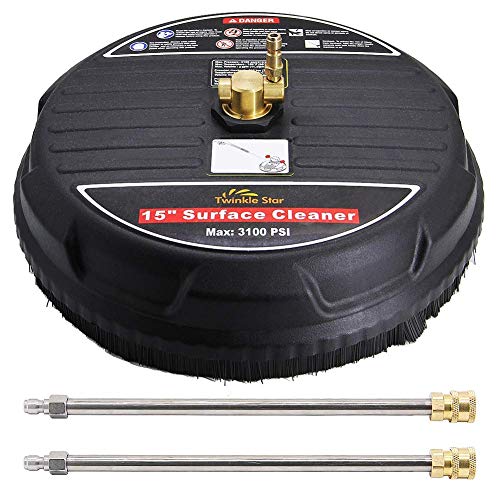
Deck Size: 15″ | Max PSI: 3,000 | Housing: Plastic | Connection: 1/4″ quick-connect | Price Range: $
The Twinkle Star 15″ has quietly accumulated thousands of verified Amazon reviews for a straightforward reason: it does the job at a price point that makes adding a surface cleaner to your kit essentially a no-brainer. Rated to 3,000 PSI, it covers the majority of mid-range gas machines and higher-output electrics, and its 15″ cleaning deck is the right size for most standard residential driveways. If you’ve never used a surface cleaner before and want to try one without committing significant budget, this is the entry point to start.
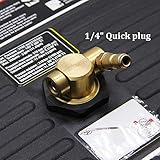
The plastic construction is standard consumer grade — don’t expect it to match the Simpson steel units for longevity, but for once-or-twice-a-year driveway cleaning it’s more than adequate. The unit includes two removable nozzle jets, guide wheels, and a standard 1/4″ quick-connect fitting. Setup takes under a minute. For homeowners who’ve been putting off buying a surface cleaner because they weren’t sure it was worth the expense, the Twinkle Star removes all financial hesitation. Once you try it, you won’t go back to wand-only cleaning.

Pros:
- Lowest price on the list — makes surface cleaning accessible to any budget
- Thousands of positive Amazon reviews across verified buyers
- 15″ deck is well-sized for standard residential driveways
- Simple setup — quick-connect and go
- Adequate for annual or seasonal residential use
Cons:
- Basic plastic construction — not built for frequent or semi-pro use
- No brass nozzles or grease fitting
- 3,000 PSI ceiling excludes use with the most powerful residential gas washers
Best For: First-time surface cleaner buyers, budget-conscious homeowners, and anyone who wants to see what a surface cleaner does before investing in a premium unit.
Gas vs. Electric Pressure Washer Compatibility
One of the most common frustrations with surface cleaner attachments is buying one that doesn’t spin properly — and in most cases, the culprit is a GPM mismatch rather than a defective product. Here’s how gas and electric machines differ in practice:
Gas pressure washers producing 3,000+ PSI and 2.5+ GPM can drive any surface cleaner on this list with full effectiveness. The higher GPM maintains strong spin speed even in a 15–20″ deck, and the untethered operation means complete freedom of movement around any driveway. The Simpson 15″ and 20″ Industrial units are the natural companions for gas machines in this range.
Electric pressure washers in the typical 1,800–2,400 PSI and 1.1–2.0 GPM range require more careful matching. The core issue is GPM: a standard 15″ surface cleaner designed around 2.5 GPM simply won’t spin fast enough on a machine delivering 1.2 GPM. The result is slow rotation, uneven coverage, and stripe marks — the exact problem you’re trying to solve. The Greenworks 15″ in our list is specifically calibrated for low-GPM electric machines and is the recommended choice for electric washer owners. The Karcher and Twinkle Star also perform reasonably well on higher-output electrics producing 1.5+ GPM.
Step-by-Step: How to Use a Surface Cleaner on a Concrete Driveway
- Pre-treat heavy stains first. Apply a concrete degreaser to any visible oil or grease spots and let it soak for 5–10 minutes before washing. See our guide on the best concrete degreasers for recommended products. Pressure washing over untreated oil stains simply spreads them rather than removing them.
- Connect the surface cleaner. Attach the surface cleaner to your pressure wand’s 1/4″ quick-connect fitting. Make sure it clicks firmly into place. If your machine uses a different fitting size, use the included adapter.
- Test the spin before you lower it. Start the pressure washer and hold the surface cleaner about 6 inches above the driveway surface for 5 seconds. Listen and watch for the rotary arm spinning smoothly. An irregular or slow spin before you even touch the concrete indicates a GPM mismatch or a blocked nozzle jet.
- Begin at the far end and work toward the street. Start nearest the garage and work in the direction of natural drainage. This keeps wastewater and loosened grime flowing away from areas you’ve already cleaned.
- Work in slow, overlapping passes — like mowing a lawn. Move at a steady walking pace, overlapping each pass by about 2 inches. Rushing leads to missed strips; overlapping ensures full coverage.
- Never stop moving. Pausing the surface cleaner on one spot concentrates the spinning nozzle jets and can leave circular etch marks in the concrete. Keep moving at all times while the machine is running.
- Finish with a fan nozzle rinse. Disconnect the surface cleaner, attach your green (25°) fan nozzle, and do a full rinse pass across the driveway to clear all loosened debris and detergent residue. Direct the wastewater toward the street or drain.
Pro Tips for Better Results
- Overlap by 2 inches on every pass. Even with a good surface cleaner, the very edge of the cleaning deck gets slightly less pressure than the center. A 2-inch overlap between passes eliminates any faint missed strips along the seam.
- Run a second pass at 90 degrees for heavily contaminated concrete. On driveways with deep-set grime or mold, a second cleaning pass perpendicular to the first catches residue that survived the first pass. This two-direction method is the standard technique for professional driveway cleaning services.
- Clean the nozzle ports after every use. Your surface cleaner should include a small pin tool or wire for clearing the nozzle orifices. Hard water deposits and dirt particles can partially block a nozzle port, causing one side of the rotary bar to spray harder than the other — which produces the very streaking you’re trying to avoid. Run the pin through each nozzle port before storing the unit.
- Store with nozzle ports cleared and housing dry. Any trapped moisture in the housing encourages corrosion and can cause the rotary arm to stick between uses. Shake out standing water, clear the nozzles, and store the unit in a covered location.
- For sealed or stamped concrete, lower your machine’s pressure first. Drop below 2,000 PSI and test in an inconspicuous corner before cleaning the full surface. Surface cleaners amplify the effect of sustained pressure — what seems manageable with a wand can strip a sealer coating quickly.
Frequently Asked Questions
Conclusion: Which Surface Cleaner Should You Buy?
For most homeowners with a mid-range gas pressure washer, the Simpson Universal 15“ is the pick to make once and never revisit. The steel housing, brass nozzles, and 3,700 PSI rating make it the most durable residential option available at its price point, and it pairs perfectly with machines like the Simpson MegaShot or Westinghouse WPX2700.
If you’re on a budget or don’t want to over-invest for occasional use, the Karcher 15“ and Twinkle Star 15″ both deliver genuine surface-cleaner performance at accessible price points. For electric washer owners specifically, the Greenworks 15″ is the essential choice — engineered to actually spin at the lower GPM output most electric machines produce.
And if you have a large property or are starting to clean driveways professionally, the Simpson 20″ Industrial with its Zerk grease fitting is an investment that pays back in time saved and years of reliable service.
Whichever you choose, adding a surface cleaner to your pressure washing kit is one of the highest-impact equipment upgrades you can make. Once you see a concrete surface cleaned evenly and streak-free in a quarter of the time, there’s no going back to wand-only cleaning.