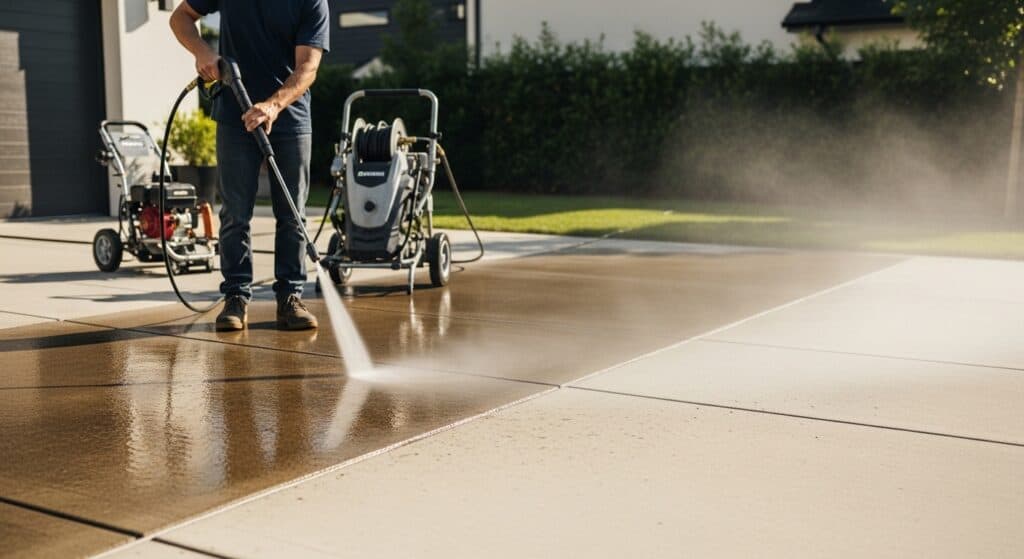
Picture this: your concrete driveway has turned into a patchwork of dark oil stains, green mildew streaks, and years of embedded grime. You’ve tried scrubbing, you’ve tried a garden hose at full blast — and yet it still looks like it belongs to a junkyard. The problem isn’t your effort. It’s your tool.
Concrete is porous, which means dirt, grease, and mold don’t just sit on the surface — they sink in. A standard garden hose tops out around 40–60 PSI, which is nowhere near enough to dislodge what’s locked into those pores. To genuinely clean a concrete driveway, you need a pressure washer capable of at least 2,500 PSI, paired with a decent GPM flow rate to rinse away the debris fast.
But not every pressure washer is built for concrete. The wrong machine will either leave streaks, waste your time, or worse — etch and damage your surface permanently. What separates a great concrete pressure washer from a mediocre one comes down to three things: PSI (pressure), GPM (water flow), and surface cleaner compatibility.
After researching and comparing dozens of models, our top pick is the Simpson MSH3125 MegaShot — a gas-powered beast that hits 3,200 PSI with 2.5 GPM, making short work of even the most stubborn oil stains. For homeowners who prefer electric, the Ryobi RY142500 Brushless is the sweet spot of performance and convenience.
Read on for our full top 7 picks, a buying guide, and everything you need to pressure wash your driveway like a pro.
Table of Contents
- Introduction
- Quick Comparison Table
- What PSI & GPM Do You Need for Concrete?
- Top 7 Pressure Washers — In-Depth Reviews
- Gas vs. Electric Pressure Washer for Concrete
- Do You Need a Surface Cleaner Attachment?
- Nozzle Guide for Concrete
- How to Pressure Wash a Concrete Driveway
- Things to Avoid When Pressure Washing Concrete
- Buying Guide: What to Look For
- FAQ
- Conclusion

Quick Comparison Table: Best Pressure Washers for Concrete Driveways
| # | Product | Type | PSI | GPM | Best For |
|---|---|---|---|---|---|
| 1 | Simpson MSH3125 MegaShot | Gas | 3,200 | 2.5 | Heavy-duty driveways |
| 2 | Ryobi RY142500 Brushless | Electric | 2,500 | 1.2 | Most homeowners |
| 3 | Sun Joe SPX3000 | Electric | 2,030 | 1.76 | Budget pick |
| 4 | Karcher K5 Power Control | Electric | 2,000 | 1.4 | Mid-range reliability |
| 5 | Westinghouse WPX2700 | Gas | 2,700 | 2.3 | Large driveways |
| 6 | Westinghouse ePX3100 | Electric | 2,300 | 1.76 | Compact electric upgrade |
| 7 | DeWalt DWPW2400 | Electric | 2,400 | 1.1 | Brand-loyal pros |
What PSI & GPM Do You Need for Concrete?
Before you buy, it pays to understand the two numbers that matter most: PSI and GPM. PSI (pounds per square inch) measures the force of the water stream — higher PSI means more penetrating power for blasting out embedded dirt and stains. GPM (gallons per minute) measures water flow — higher GPM means faster rinsing and less total time cleaning.
For a standard residential concrete driveway, 2,500–3,000 PSI is the sweet spot. This range is powerful enough to remove oil stains, tire marks, mildew, and years of grime without risking surface damage on solid, well-cured concrete. If your driveway is sealed, stamped, or decorative, dial it back — stay between 1,500–2,000 PSI to avoid etching the surface or stripping the sealer.
GPM matters more than most people realize. A machine pumping 2.0+ GPM will rinse a large driveway dramatically faster than one pushing only 1.0 GPM — even at the same PSI. That’s because GPM controls how quickly loosened debris gets washed away. The combination of the two is captured in a useful formula:
PSI × GPM = Cleaning Units (CU)
For example: 3,200 PSI × 2.5 GPM = 8,000 CUs — significantly more effective than 2,000 PSI × 1.2 GPM = 2,400 CUs. Cleaning Units give you a truer picture of total cleaning performance.
Top 7 Pressure Washers for Concrete Driveways – In-Depth Reviews
1. Simpson MSH3125 MegaShot — Best Overall for Tough Driveways
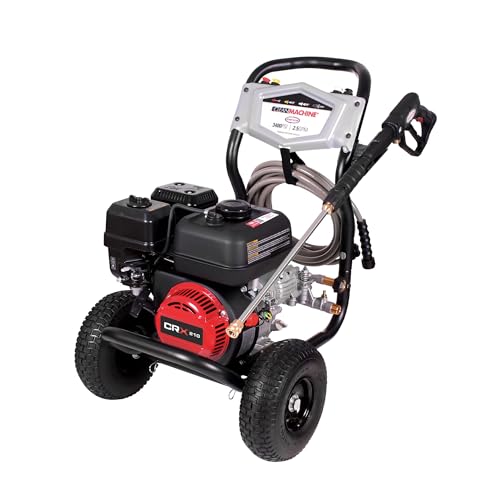
Type: Gas | PSI: 3,200 | GPM: 2.5 | Engine: Honda GC190 | Hose Length: 25 ft | Weight: 64 lbs | Price Range: $$$
The Simpson MSH3125 MegaShot is our top pick for a reason — it pairs a genuinely powerful 3,200 PSI output with a Honda GC190 engine that’s been proven in commercial applications for decades. The result is 8,000 Cleaning Units, which is enough force to strip away oil stains, embedded tire marks, and mold from even long-neglected driveways. The 2.5 GPM flow rate means you’re rinsing away grime fast, cutting your total cleaning time significantly compared to lower-flow electrics.

The 25-foot high-pressure hose gives you real flexibility to move around a standard two-car driveway without constantly repositioning. It accepts a wide range of surface cleaner attachments via its 1/4-inch quick-connect fittings, which is essential for streak-free results on large concrete areas. Build quality is robust — the welded steel frame and professional-grade pump are built to last for years of seasonal use.

Pros:
- Honda GC190 engine — legendary reliability and easy starting
- 8,000 Cleaning Units — best raw power in our roundup
- Compatible with surface cleaner attachments for streak-free coverage
- Solid 25 ft hose with 1/4″ quick-connect fittings
- No cord — complete freedom of movement around any driveway
Cons:
- Requires oil and fuel maintenance (not plug-and-play like electrics)
- Loud — not ideal for early morning or quiet neighborhoods
- Heavier at 64 lbs compared to electric options
Best For: Homeowners with heavily stained driveways, large concrete areas (1,000+ sq ft), or anyone who wants the most powerful residential washer available without going commercial.
2. Ryobi RY142500 Brushless 2500 PSI — Best Electric for Most Homeowners

Type: Electric | PSI: 2,500 | GPM: 1.2 | Motor: Brushless | Hose Length: 25 ft | Weight: 31 lbs | Price Range: $$
If you want strong concrete-cleaning performance without the noise, fumes, or fuel tank of a gas machine, the Ryobi RY142500 Brushless is the electric to beat. At 2,500 PSI, it clears the minimum threshold we recommend for driveway cleaning with room to spare — enough force to tackle oil spots, mildew, and general surface grime on standard residential concrete.

The brushless motor is the headline feature. Brushless motors run cooler, last significantly longer, and are far more energy-efficient than traditional brushed alternatives — you’ll get years more service life from this machine. Ryobi’s OnePlus-style build quality means the unit feels durable without being cumbersome at just 31 lbs. The 25 ft hose is standard for the class, and it accepts common surface cleaner attachments with ease.

Pros:
- Brushless motor for extended lifespan and efficiency
- 2,500 PSI — meets the recommended threshold for concrete driveways
- Lightweight at 31 lbs — easy to maneuver and store
- Low maintenance — no oil changes, no fuel, just plug in and go
- Quiet enough for residential use any time of day
Cons:
- 1.2 GPM is lower than gas models — slower rinsing on large driveways
- Cord limits range; may need an extension for longer driveways
- Not ideal for extremely heavy oil contamination
Best For: Most homeowners with standard single or double driveways who want a capable, low-maintenance electric machine that will last.
3. Sun Joe SPX3000 — Best Budget Pick

Type: Electric | PSI: 2,030 | GPM: 1.76 | Motor: 14.5A brushed | Hose Length: 20 ft | Weight: 31.5 lbs | Price Range: $
The Sun Joe SPX3000 is one of the best-selling pressure washers in the United States for a simple reason — it delivers solid driveway-cleaning performance at a price point that’s hard to argue with. At 2,030 PSI and 1.76 GPM, it generates around 3,573 Cleaning Units, which is respectable for an entry-level electric. While it falls just short of the 2,500 PSI ideal for heavy staining, it handles routine driveway maintenance, mildew removal, and general surface dirt very capably.

One standout feature is the dual onboard detergent tanks, which let you pre-load two different cleaning solutions and switch between them — handy for pre-treating oil stains before rinsing. The five quick-connect nozzle set covers everything from precision blasting to wide fan rinsing. Build quality is adequate for occasional use, though the brushed motor won’t outlast the Ryobi’s brushless alternative under heavy use.
Pros:
- Outstanding value — serious performance at a budget price
- Dual detergent tanks are genuinely useful for driveway pre-treatment
- 1.76 GPM provides faster rinsing than many budget electrics
- Lightweight and easy to store
- Five included nozzles cover all cleaning scenarios
Cons:
- 2,030 PSI is marginal for heavy oil staining on concrete
- Brushed motor has shorter lifespan than brushless alternatives
- 20 ft hose is shorter than competitors at this price
Best For: Budget-conscious homeowners with lightly-to-moderately stained driveways who need a reliable machine for seasonal cleaning without a big upfront investment.
4. Karcher K5 Power Control — Best Mid-Range Electric

Type: Electric | PSI: 2,000 | GPM: 1.4 | Motor: Water-cooled induction | Hose Length: 25 ft | Weight: 29 lbs | Price Range: $$
Karcher is a German brand with a longstanding reputation for engineering quality, and the K5 Power Control is their most popular residential model for a reason. At 2,000 PSI, it sits at the lower boundary of what we recommend for concrete driveways, but its water-cooled induction motor — a technology borrowed from professional-grade machines — runs significantly cooler and lasts considerably longer than air-cooled motors found in similarly priced competitors.

What sets the K5 apart is Karcher’s Plug ‘n’ Clean detergent system and the Vario Power spray wand, which lets you adjust water pressure by simply twisting the nozzle rather than swapping tips. This makes it extremely user-friendly for tackling concrete sections that need different pressure levels — lighter on stamped areas, heavier on plain concrete. Build quality is excellent, and Karcher’s customer service is reliably good.

Pros:
- Water-cooled induction motor — exceptional longevity for an electric
- Vario Power wand adjusts pressure without nozzle swapping
- Premium German engineering and build quality
- Excellent brand support and warranty coverage
- Compact and easy to store on its integrated hose reel
Cons:
- 2,000 PSI is the minimum for concrete — won’t tackle heavy oil stains well
- 1.4 GPM is lower than comparable units at this price
- Premium brand carries a slight price premium
Best For: Homeowners who prioritize long-term reliability and build quality over raw power, with moderately stained driveways and a preference for German engineering.
5. Westinghouse WPX2700 Gas — Best for Large Driveways
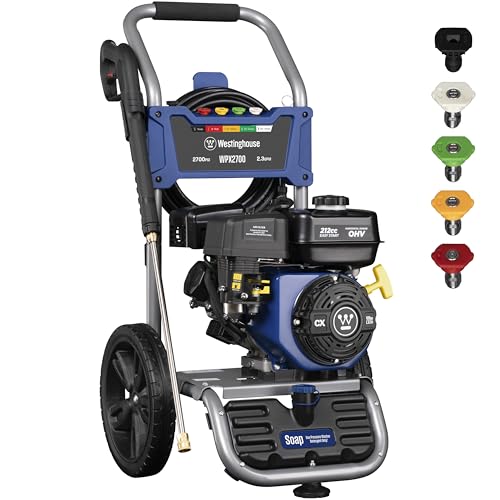
Type: Gas | PSI: 2,700 | GPM: 2.3 | Engine: 212cc OHV | Hose Length: 30 ft | Weight: 62 lbs | Price Range: $$$
If you have a long, wide driveway — think three-car garage, circular drive, or an extended run to the street — the Westinghouse WPX2700 gas pressure washer is engineered to handle it without fatigue. Its 212cc OHV engine drives 2,700 PSI and 2.3 GPM for 6,210 Cleaning Units, which is plenty of force for concrete cleaning. The 30-foot hose — longer than the competition at this price point — means fewer trips back to reposition the unit on sprawling surfaces.

Westinghouse has packed in a thoughtful feature set: an hour meter to track maintenance intervals, a low-oil auto-shutdown to protect the pump, and large 10-inch flat-free tires that roll smoothly over uneven driveways. The unit comes with five color-coded nozzles and a foam cannon, giving you everything needed to tackle both the blasting and the pre-treatment of stubborn stains.

Pros:
- 30 ft hose — best reach in this roundup for large properties
- Low-oil auto-shutdown protects the pump long-term
- Hour meter simplifies maintenance scheduling
- Large flat-free tires for easy mobility on any terrain
- Includes foam cannon for pre-treatment application
Cons:
- Gas maintenance required — oil changes, fuel storage
- Loud operation
- Slightly less raw power than the Simpson at similar weight
Best For: Homeowners with large driveways, long access roads, or anyone who needs gas-powered performance with smart maintenance features built in.
6. Westinghouse ePX3100 Electric — Best Compact Electric Upgrade

Type: Electric | PSI: 2,300 | GPM: 1.76 | Motor: Brushless | Hose Length: 25 ft | Weight: 19 lbs | Price Range: $$
The Westinghouse ePX3100 hits a rare combination for an electric pressure washer — 2,300 PSI, 1.76 GPM, and just 19 lbs of total weight. That 1.76 GPM flow rate is genuinely impressive for an electric at this size, putting it in gas-competitor territory for rinsing speed. The brushless motor keeps the unit compact and long-lived, while a built-in GFCI power cord adds a meaningful safety layer for wet outdoor use.

At only 19 lbs, this is the easiest machine on our list to carry up and down the driveway, load into a car trunk for offsite use, or tuck away in a small storage space. Despite its compact footprint, it generates 4,048 Cleaning Units — more than enough for routine concrete maintenance and moderate stain removal. The five included nozzles and detergent tank round out a well-packaged kit.
Pros:
- Lightest machine in the roundup at just 19 lbs
- 1.76 GPM rivals larger electrics for rinsing speed
- Brushless motor for long-term reliability
- GFCI safety cord for peace of mind during wet use
- Easy to store — ideal for smaller garages
Cons:
- 2,300 PSI slightly below ideal for heavy oil staining
- Cord restricts movement on very long driveways
- Lighter build may feel less robust than heavier gas alternatives
Best For: Homeowners who want a capable, compact electric that punches above its weight class in GPM, especially those with limited storage space or who value portability.
7. DeWalt DWPW2400 — Best for Pros & Brand Loyalists

Type: Electric | PSI: 2,400 | GPM: 1.1 | Motor: Universal brushless | Hose Length: 25 ft | Weight: 34 lbs | Price Range: $$–$$$
DeWalt’s DWPW2400 brings the brand’s signature tool-grade durability to the pressure washer market. At 2,400 PSI with a brushless motor, it delivers concrete-capable pressure in a machine built to a contractor standard — reinforced frame, heavy-duty pump, and connections designed to stand up to frequent use. If you’re already invested in the DeWalt ecosystem or simply want a machine that feels closer to a professional tool than a consumer product, this is your pick.

The 1.1 GPM flow rate is the trade-off — lower than most competitors at this PSI, which means rinsing takes longer on large concrete areas. That said, the high PSI more than compensates when tackling stubborn stains, and the machine’s rugged build means it’ll be cleaning driveways long after lighter competitors have given up. It includes four quick-connect nozzles and integrates well with DeWalt’s broader accessory range.

Pros:
- Contractor-grade build quality — built to last
- 2,400 PSI — solid concrete cleaning performance
- Brushless motor for extended lifespan
- DeWalt accessory compatibility for existing brand users
- Sturdy frame handles jobsite-level use and storage
Cons:
- 1.1 GPM is the lowest in our roundup — slower rinsing on larger areas
- Priced at a premium relative to similar-spec electrics
- Lower GPM limits Cleaning Units vs. comparably priced rivals
Best For: Contractors, semi-pro users, and homeowners who already use DeWalt tools and want the same build quality in a pressure washer — and are willing to trade some GPM for longevity.
Gas vs. Electric Pressure Washer for Concrete
The gas-vs-electric debate is one of the most common questions homeowners face before buying, and the answer genuinely depends on your specific situation. Here’s the direct comparison:
| Feature | Gas | Electric |
|---|---|---|
| PSI Range | 2,500–4,000 | 1,800–3,000 |
| GPM | 2.5–4.0 | 1.2–2.0 |
| Portability | High (no cord) | Limited by cord |
| Maintenance | Higher (oil, filters, fuel) | Low (plug-and-play) |
| Noise | Louder (~85 dB) | Quieter (~70 dB) |
| Startup | Pull cord | Instant on/off |
| Best For | Large/heavily stained driveways | Average residential driveways |
| Price Range | $200–$600 | $150–$500 |
Choose gas if your driveway has oil stains, heavy grease deposits, or covers more than 1,000 square feet. The higher Cleaning Units will make a real difference in both cleaning effectiveness and speed. Gas also gives you complete freedom of movement with no cord to manage.
Choose electric if you have a standard residential driveway with routine dirt and mildew buildup. Electric machines are quieter, require zero maintenance between uses, start instantly, and are kinder to the environment. For most homeowners, a quality electric at 2,300–2,500 PSI is all you’ll ever need.
Do You Need a Surface Cleaner Attachment?
If you’re serious about cleaning a concrete driveway efficiently and without streaks, a surface cleaner attachment isn’t just nice to have — it’s transformative. A surface cleaner is a disc-shaped attachment that connects to your pressure washer wand. Inside, two or more rotating nozzles spin rapidly under a plastic shroud, delivering even, overlapping pressure across a wide path.
The practical difference is enormous. Without a surface cleaner, you’re moving a single high-pressure stream back and forth — and no matter how careful you are, you’ll leave faint parallel lines in the concrete that become visible once it dries. A surface cleaner eliminates that entirely. It also works dramatically faster: a 1,000 sq ft driveway that might take 45 minutes with a wand and nozzle can be cleaned in roughly 15 minutes with a quality surface cleaner.
When choosing a surface cleaner, a general sizing rule applies: allow about 4 inches of cleaner diameter per GPM of your machine. A 2.5 GPM gas washer pairs well with a 10–12 inch surface cleaner. A 1.5–2.0 GPM electric does best with an 8–10 inch model.
Nozzle Guide for Concrete Driveways
Every pressure washer comes with a color-coded nozzle set. Each color indicates the spray angle — and choosing the wrong one can waste time or damage your driveway. Here’s what each nozzle does on concrete:
- Red (0°): A pencil-point stream of extreme concentrated pressure. Useful for blasting weeds from cracks, but can easily etch or scar concrete if held close. Use with extreme caution and keep moving.
- Yellow (15°): The best nozzle for concrete driveways. Powerful enough to strip staining and grime, but wide enough to cover ground quickly without leaving streaking lines. This is your workhorse nozzle.
- Green (25°): A good all-purpose rinse nozzle. Use this for lighter cleaning or the final rinse after the yellow nozzle has done the heavy lifting.
- White (40°): Too diffused for deep concrete cleaning. Best reserved for rinsing cars, windows, or delicate surfaces.
- Black (65°): Low-pressure soaking nozzle for applying detergent. Use before the cleaning pass.
- Turbo/Rotary Nozzle: A rotating stream that combines the power of a 0° nozzle with the coverage pattern of a 25° nozzle. Excellent for concrete — great at removing mold, mildew, and embedded grime faster than any fixed nozzle.
How to Pressure Wash a Concrete Driveway (Step-by-Step)
- Clear the area. Remove cars, bikes, pots, and any loose debris. Sweep away leaves, dirt, and gravel so you’re not pushing debris into the concrete.
- Pre-treat stains. Apply a concrete degreaser or all-purpose cleaner to any oil or grease spots. Let it soak for 5–10 minutes before washing — this breaks down the oil and makes it far easier to remove.
- Connect your equipment. Attach the surface cleaner if you have one, or select your yellow (15°) nozzle for the cleaning pass. Connect the pressure washer to your garden hose, turn on the water, and start the machine.
- Work in sections. Start at the highest point of the driveway (usually closest to the garage) and work toward the street, so runoff flows away from cleaned areas. Use overlapping passes for full coverage.
- Don’t linger. Keep the wand or surface cleaner moving at a steady, consistent pace. Holding in one spot too long can etch the concrete or leave visible marks.
- Final rinse. Switch to the green (25°) nozzle and do a final rinse across the entire surface, directing wastewater toward the street or drainage area.
- Post-treat for mildew. If mildew was present, a diluted bleach solution (1 part bleach to 10 parts water) applied after pressure washing and left to dry will prevent regrowth for the coming season.
- Allow full drying. Don’t park vehicles on the driveway until it’s completely dry — typically 30 minutes to a few hours depending on sun and temperature.
Things to Avoid When Pressure Washing Concrete
- Using the 0° nozzle too close to the surface. The red nozzle can permanently etch, pit, or score concrete, especially older slabs. Keep it at least 12 inches away if you must use it at all.
- Holding the wand stationary. Any pause over one spot concentrates pressure and risks visible damage or uneven cleaning lines. Keep moving at all times.
- Skipping pre-treatment on oil stains. Pressure washing alone rarely fully removes embedded oil. Pre-treating with degreaser first is essential for a clean result.
- Exceeding 2,000 PSI on sealed or stamped concrete. High pressure can strip sealers and damage decorative finishes. Always use a gentler setting on coated or decorative surfaces.
- Pressure washing toward people, pets, or vehicles. The stream from even an electric pressure washer can cause serious injury. Clear the area before you start.
- Using too short a hose and yanking the machine. Dragging a pressure washer by its hose can damage the connections and void the warranty. Always use an adequately long hose and move the machine deliberately.
Buying Guide: What to Look For in a Concrete Pressure Washer
If you’ve read this far, you already know the core specs. Here’s a quick summary of what to prioritize before adding to cart:
- PSI: Minimum 2,500 for driveways with typical staining. 3,000+ for heavily contaminated or large concrete areas. Don’t go below 2,000 if you have oil stains.
- GPM: Aim for 2.0+ for efficient rinsing. Low GPM means more time rinsing and higher water bills on large jobs.
- Hose length: 25 ft minimum for a standard driveway. 30 ft if your driveway is long or you don’t want to reposition frequently.
- Surface cleaner compatibility: Look for 1/4″ quick-connect fittings. This is essentially universal on residential machines, but verify before buying a surface cleaner separately.
- Motor type: Brushless electric motors (Ryobi, Westinghouse ePX3100, DeWalt) last significantly longer and run more efficiently than brushed motors. Worth the modest price premium for regular use.
- Warranty: 1–3 years is standard for this category. Longer is better — Simpson and Karcher tend to offer the strongest coverage on our list.
- Portability: Large pneumatic or flat-free wheels make a real difference on uneven driveways and gravel paths. Check wheel size if mobility matters to you.
Frequently Asked Questions
Conclusion: Which Pressure Washer Should You Buy?
After testing and researching across all seven models, our recommendations come down to two standout picks depending on your preference:
For maximum power, the Simpson MSH3125 MegaShot is unbeatable at its price point. Its Honda GC190 engine, 3,200 PSI, and 2.5 GPM deliver 8,000 Cleaning Units — more than enough to restore even the most neglected concrete driveway to a near-new appearance. If your driveway has oil stains, heavy mildew, or covers a large area, this is the machine to buy.
For most homeowners who want the best electric option, the Ryobi RY142500 Brushless hits the ideal balance of 2,500 PSI performance, brushless durability, and low-maintenance convenience. It’ll handle virtually every standard residential driveway cleaning job without the noise, fumes, or fuel management of a gas machine.
Remember: aim for at least 2,500 PSI and 2.0+ GPM, invest in a surface cleaner for streak-free results, and pre-treat oil stains before washing. Do all three, and your driveway will look like it was just poured.
If your current unit starts strong and fades partway through a driveway, see our guide on why pressure washers lose pressure mid-job to diagnose it before buying a replacement.