Why Choosing the Right Home Garage Air Compressor Is Harder Than It Looks. You pull up an Amazon listing for an air compressor and immediately face a wall of numbers: 2.6 SCFM @ 90 PSI, 165 PSI max, 6-gallon pancake, 2 HP motor, 78.5 dBA. Do those specs mean it can run your impact wrench? Will it trip your garage breaker on startup? Is it quiet enough to use on a Saturday morning without your neighbors noticing? Most product listings — and most “best of” articles — don’t answer these questions clearly.
An air compressor is the single most versatile tool investment you can make for a home garage. One machine powers impact wrenches, framing nailers, brad nailers, tire inflators, blow guns, HVLP spray guns, die grinders, and orbital sanders. But the best air compressor for a professional shop and the best air compressor for a home garage are two very different machines. Shop guides are written for contractors with 240V dedicated circuits and 800 sq ft of floor space. You’re working with a standard wall outlet, a two-car garage, and neighbors who sleep in on weekends.
After researching and comparing dozens of models specifically for residential use, our top overall pick is the California Air Tools 8010 — a whisper-quiet 60 dB unit that handles 80% of home garage tasks on any standard 15-amp outlet. For homeowners who run impact wrenches or occasional spray painting, the Makita MAC2400 Big Bore is the oil-lubricated workhorse that will outlast any pancake compressor in its price range.
Read on for our full reviews, the CFM formula you actually need, and everything you should know before buying.
Table of Contents
- Introduction
- Before You Buy: The 3 Home Garage Constraints Nobody Talks About
- Quick Comparison Table
- The One Spec That Actually Matters: CFM Explained
- Oil-Free vs. Oil-Lubricated: The Real Trade-Off
- Top 8 Air Compressors — In-Depth Reviews
- The Horsepower Lie: Why HP Ratings Are Misleading
- Duty Cycle — The Spec That Protects Your Investment
- Moisture in Your Tank: The Silent Tank Killer
- Extension Cord Warning
- Essential Accessories to Buy With Your Compressor
- Buying Guide Checklist
- FAQ
- Conclusion
Before You Buy: The 3 Home Garage Constraints Nobody Talks About
Most buying guides skip straight to product reviews. That’s a mistake. Before any spec comparison makes sense, you need to understand the three constraints that make home garage compressor shopping fundamentally different from buying for a commercial shop.
Constraint 1: Your Electrical Circuit
The single most common frustration with a new air compressor in a home garage is tripping the breaker the first time you turn it on. Here’s why it happens: most home garages share a standard 15-amp, 120V circuit with the lights, a radio, and whatever else is plugged into the wall. A standard 2HP compressor draws 15–20 amps at startup — the “inrush current” spike that occurs in the first second of motor startup. Even if the running draw is 12 amps, that startup spike trips the breaker instantly on a shared circuit.
The solution is to look for models with low amp draw motors (under 10–12 amps running) and soft-start designs. California Air Tools machines are specifically engineered around this constraint — their 8.5-amp draw is the reason they top so many home garage lists. A dedicated 20-amp garage circuit solves most problems. A 240V outlet opens up all options, including larger belt-drive models.
Constraint 2: Noise Level
In a standard two-car garage with the door closed, a 90 dB compressor is genuinely loud enough to cause hearing fatigue during extended sessions — and loud enough to travel through walls into your home and your neighbor’s yard. The decibel scale is logarithmic, which means 80 dB is not “a little louder” than 70 dB — it’s twice as loud.
Here’s a practical reference: 60 dB is a normal conversation. 70 dB is a busy restaurant. 80 dB is a garbage disposal. 90 dB is a lawnmower — continuous exposure causes hearing damage. For an attached garage or any neighborhood with noise ordinances, aim for 75 dB or below. The California Air Tools 8010 runs at 60 dB — quieter than your refrigerator.
Constraint 3: Available Floor Space
Tank shape determines where a compressor can realistically live in your garage — and whether you’ll actually put it away between uses or leave it permanently in your parking space. Here’s the practical breakdown:
- Pancake (6 gal): Wide, low, and very stable. Easy to carry with the top handle. Takes up about 2 sq ft of floor space. Best for garages where you store the compressor between uses.
- Hot dog / Twin-stack (4–8 gal): Longer and narrower than pancake. Slightly more portable. Good CFM in a compact package.
- Vertical tank (8–20 gal): Tall and narrow — designed to live in a corner. The most space-efficient option for larger-capacity compressors. Best choice when floor space is tight but you need more than 6 gallons.
- Horizontal stationary (20–30+ gal): Requires a dedicated corner. Not moved frequently. Best for serious home workshops where the compressor has a permanent home.
Quick Comparison Table: Best Air Compressors for Home Garages
| # | Product | Tank | Max PSI | CFM @90 PSI | Noise | Best For | Link |
|---|---|---|---|---|---|---|---|
| 1 | California Air Tools 8010 | 8 gal | 120 PSI | 3.10 CFM | 60 dB | Best Overall / Quietest | Amazon |
| 2 | DEWALT DWFP55126 | 6 gal | 165 PSI | 2.6 SCFM | 78 dB | Best Budget Pancake | Amazon |
| 3 | Makita MAC2400 Big Bore | 4.2 gal | 130 PSI | 4.8 CFM | 79 dB | Best for Air Tools | Amazon |
| 4 | Bostitch BTFP02012 | 6 gal | 150 PSI | 2.6 SCFM | 78 dB | Best for Beginners | Amazon |
| 5 | California Air Tools 10020C | 10 gal | 120 PSI | 5.3 CFM | 70 dB | Best for Heavy DIY | Amazon |
| 6 | CRAFTSMAN CMEC6150K | 6 gal | 150 PSI | 2.6 SCFM | 79 dB | Best Value Kit | Amazon |
| 7 | Industrial Air ILA1883054 | 30 gal | 155 PSI | 5.7 CFM | 82 dB | Best Stationary | Amazon |
| 8 | Porter-Cable C2002 | 6 gal | 150 PSI | 2.6 SCFM | 82 dB | Best Basic Starter | Amazon |
The One Spec That Actually Matters: CFM Explained
Of all the numbers on an air compressor listing, CFM (Cubic Feet per Minute) at 90 PSI is the only one that directly tells you whether a compressor can actually run your tools. PSI measures pressure — the force of the air. CFM measures volume — how much air is delivered per minute. PSI is almost always sufficient on modern home compressors. CFM is what runs out first.
Think of it this way: PSI is how hard the water comes out of a faucet; CFM is how fast the bucket fills. A tool that needs 5 CFM to run will stutter and stall on a compressor producing 2.6 CFM — no matter how high the PSI reads on the tank gauge. This is the most common reason homeowners are disappointed with their compressor purchase: they matched PSI without checking CFM.
The sizing formula: Add up the CFM requirement of the single most demanding tool you plan to use. Multiply by 1.5. That’s your minimum compressor CFM at 90 PSI. The 1.5x buffer accounts for line losses, tank cycling, and keeping the motor from running at maximum load continuously.
Most Demanding Tool CFM × 1.5 = Minimum Compressor CFM
Use the reference table below to plan your purchase:
| Tool | CFM Required @ 90 PSI | Use Type |
|---|---|---|
| Tire inflator | 0.5–1.0 CFM | Burst use |
| Brad nailer / finish nailer | 0.3–1.0 CFM | Burst use |
| Framing nailer | 2.0–2.5 CFM | Burst use |
| Blow gun / air duster | 1.0–3.0 CFM | Burst/continuous |
| Air ratchet (3/8″) | 3.0–4.5 CFM | Continuous |
| Impact wrench (1/2″) | 4.0–5.0 CFM | Continuous |
| Die grinder | 5.0–8.0 CFM | Continuous |
| HVLP spray gun | 6.0–12.0 CFM | Continuous — high demand |
| Orbital sander / DA sander | 8.0–14.0 CFM | Continuous — very high demand |
| Sandblaster | 10.0–25.0 CFM | Continuous — industrial demand |
Oil-Free vs. Oil-Lubricated: The Real Trade-Off
Almost every article on this topic reduces the comparison to one line: “Oil-free means less maintenance; oil-lubricated means more durability.” That’s true as far as it goes — but it leaves out the noise difference, the duty cycle difference, and the application differences that actually drive the buying decision. Here’s the full picture:
| Factor | Oil-Free | Oil-Lubricated |
|---|---|---|
| Maintenance | None (no oil changes) | Check/change oil every 3 months or per hours run |
| Noise Level | Generally louder | Quieter by 5–10 dB typically |
| Pump Lifespan | 500–2,000 pump hours typical | 2,000–5,000+ hours with proper oil changes |
| Duty Cycle | 50–75% typical | 75–100% on most models |
| Weight | Lighter | Heavier (cast iron pump adds weight) |
| Cold Weather | Starts more easily in cold | Oil thickens in cold; may need synthetic oil |
| Best For | Occasional use: nailers, inflation, light tools | Frequent/heavy use: impact wrenches, spraying, continuous operation |
The honest bottom line: for homeowners using a compressor 1–3 times per month for nailers and tire inflation, oil-free is the right choice — simpler, lighter, and perfectly adequate. For anyone running impact wrenches or spray guns multiple times per week, an oil-lubricated pump pays for itself in longevity within two years. The Makita MAC2400 is the standout oil-lubricated pick on this list for exactly that reason.
Top 8 Air Compressors for Home Garages — In-Depth Reviews
1. California Air Tools 8010 — Best Overall / Quietest Home Garage Compressor
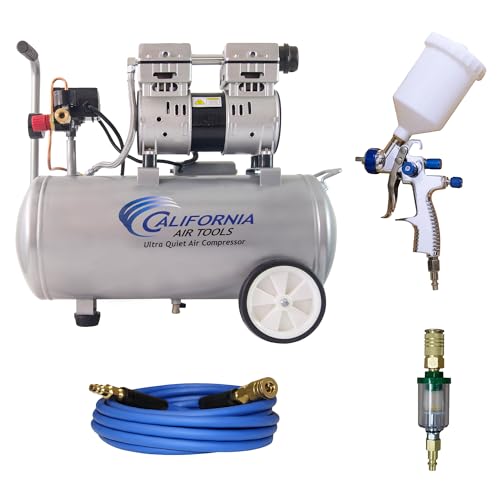
Tank: 8 gal | Max PSI: 120 | CFM @ 90 PSI: 3.10 | Noise: 60 dB | Amp Draw: 8.5A | Oil Type: Oil-free | Weight: 48 lbs | Price Range: $$$
The California Air Tools 8010 is the gold standard for home garage air compressors, and its defining spec is its noise level: 60 dB — quieter than a normal conversation. That number sounds impressive on paper, but the real-world experience is genuinely remarkable. You can run this compressor with the garage door open, carry on a conversation while it cycles, and use it in the evening without waking anyone in the house. In a closed two-car garage, it’s essentially background noise.

The 8.5-amp draw is the other headline feature for home garage use. While most compressors spike to 15–20 amps on startup and routinely trip shared 15-amp circuits, the 8010’s carefully engineered motor starts smoothly and runs well within the safety margin of any standard household outlet. You can have lights, a radio, and a phone charger on the same circuit without worry. The 8-gallon tank gives you enough air volume to run a nailer continuously, inflate all four car tires back to back, or run an impact wrench for short sessions before the motor cycles back on. The 3.10 CFM output handles everything from blow guns to air ratchets, though it’s not the right machine for spray guns or sanders.

What tools it can realistically power: Tire inflation, brad nailers, finish nailers, framing nailers (intermittent), blow guns, air ratchets (light use), staple guns. Not recommended for continuous impact wrench use, spray painting, or sanders.
Pros:
- 60 dB operation — genuinely quieter than most household appliances
- 8.5-amp draw — safe on any shared 15-amp home circuit, even in cold weather
- Oil-free pump — zero maintenance between sessions
- Wheeled design makes it easy to move around a garage or driveway
- 3,000+ hour pump life rating — exceptional for an oil-free design
Cons:
- 120 PSI max is lower than pancake competitors (150–165 PSI) — adequate for most tools but less pressure reserve
- 3.10 CFM is not enough for spray guns or continuous sander use
- Higher price than comparable 6-gallon pancake units
Best For: Homeowners who prioritize quiet operation above all else — especially those with attached garages, noise-sensitive neighborhoods, or evening/weekend work schedules. The definitive pick for 80% of home garage use cases.
2. DEWALT DWFP55126 Pancake — Best Budget Pancake Compressor
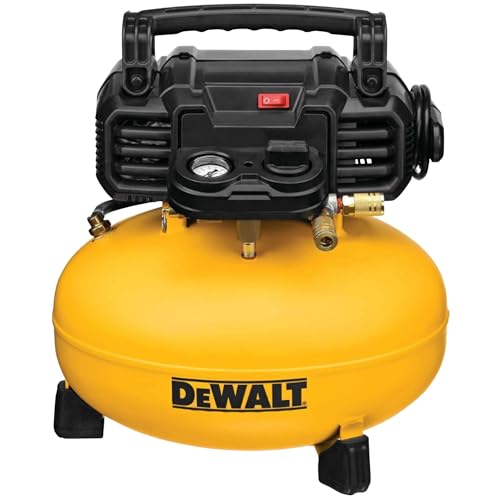
Tank: 6 gal | Max PSI: 165 | CFM @ 90 PSI: 2.6 SCFM | Noise: 78.5 dB | Amp Draw: ~15A | Oil Type: Oil-free | Weight: 30 lbs | Price Range: $$
The DEWALT DWFP55126 is one of the best-selling air compressors in the United States, and it earns that position through a combination of proven reliability, a 165 PSI maximum pressure (significantly higher than most competitors in this class), and a motor specifically engineered to start in cold temperatures or when running off a 50-foot extension cord without complaint. That cold-weather start capability is not a small thing — many compressors struggle to turn over below 40°F, which matters every winter morning in a garage.
At 2.6 SCFM @ 90 PSI, the DWFP55126 delivers the same volume as Bostitch, Porter-Cable, and Craftsman pancake units at this price tier. The higher max PSI gives it more pressure stored in the tank per cycle, which translates to slightly longer tool runtime between refill cycles. The dual outlet ports let you run two air tools or hoses simultaneously — handy when working with a partner. At 30 lbs, it’s light enough to carry one-handed to a job site and compact enough to store under a workbench.

What tools it can realistically power: Tire inflation, brad nailers, finish nailers, framing nailers (intermittent), blow guns, staple guns, light impact work (short bursts only). Not designed for spray guns, sanders, or continuous impact wrench use.
Pros:
- 165 PSI max — highest tank pressure in the 6-gallon pancake class
- Cold-weather motor start is a genuine differentiator for unheated garages
- Dual air outlets for running two tools simultaneously
- 30 lbs — highly portable for a job-site or driveway use
- DEWALT brand reputation and widely available service support
Cons:
- 78.5 dB — louder than CAT models; not suitable for very noise-sensitive situations
- Amp draw can spike near 15A on startup — a dedicated outlet is recommended
- 2.6 SCFM limits use with high-demand tools
Best For: Budget-conscious homeowners who want a reliable, no-fuss pancake compressor from a trusted brand for nailers, inflation, and general garage tasks — especially those dealing with cold winter garage temperatures.
3. Makita MAC2400 Big Bore — Best for Running Air Tools
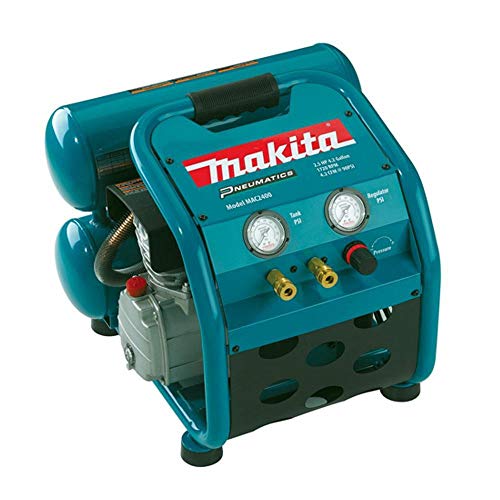
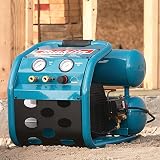
Tank: 4.2 gal (twin-stack) | Max PSI: 130 | CFM @ 90 PSI: 4.8 CFM | Noise: 79 dB | Amp Draw: 14A | Oil Type: Oil-lubricated | Weight: 52 lbs | Price Range: $$$
The Makita MAC2400 is the outlier on this list in the best possible way. While every other portable compressor here uses an oil-free pump, the MAC2400 uses Makita’s “Big Bore” cast-iron cylinder with an oil-lubricated pump — the same technology found in commercial-grade machines. The practical result is 4.8 CFM at 90 PSI, the highest output of any portable 120V compressor in its size and weight class. That CFM number is what makes this machine genuinely capable of running a 1/2″ impact wrench, a die grinder, or an air ratchet for extended periods without the motor chasing the tool.
The oil-lubricated cast-iron pump runs noticeably cooler under load than oil-free alternatives, which directly extends pump life — Makita rates this unit for thousands of hours of reliable operation versus the 500–2,000 hours typical of oil-free designs. The twin-stack design keeps the machine stable and portable. The roll cage frame protects the pump on job sites and in cramped garages. The low-amp motor (14A running) starts reliably in cold conditions. The oil sight glass lets you check oil level without disassembly. For homeowners who regularly work with air tools, this is the machine that pays for itself over a 5–10 year horizon.
What tools it can realistically power: Everything the pancake units handle, plus: impact wrenches (sustained use), air ratchets, die grinders (moderate use), light HVLP spraying (with proper moisture management), framing nailers at high volume. Not ideal for full automotive painting or DA sanders.
Pros:
- 4.8 CFM @ 90 PSI — highest output in the portable 120V class
- Oil-lubricated cast-iron pump — dramatically longer service life than oil-free designs
- Roll cage frame — built to take punishment in a working garage
- Oil sight glass — maintenance is easy and can’t be skipped accidentally
- Runs cooler and quieter per CFM than oil-free alternatives
Cons:
- Requires oil maintenance — oil sight glass checks and periodic changes
- 52 lbs — heaviest portable unit on this list
- 4.2-gallon twin-stack tank is smaller than competitors (the high CFM compensates)
Best For: Homeowners who regularly run impact wrenches, die grinders, or air ratchets and need sustained CFM output without stepping up to a stationary 20-gallon unit. The best portable compressor for serious automotive DIY work.
4. Bostitch BTFP02012 — Best for Beginners

Tank: 6 gal | Max PSI: 150 | CFM @ 90 PSI: 2.6 SCFM | Noise: 78.5 dB | Amp Draw: ~12A | Oil Type: Oil-free | Weight: 29 lbs | Price Range: $$
The Bostitch BTFP02012 has accumulated hundreds of thousands of Amazon reviews for a straightforward reason: it works reliably out of the box for the tasks most homeowners actually need — inflating tires, running nailers, blowing dust, and the occasional short air ratchet session. At 29 lbs, it’s one of the lightest 6-gallon compressors on the market, making it easy to carry to the driveway, up a ladder, or into the attic for HVAC work. The high-efficiency motor requires 12-amp service at startup, which is comfortably within the range of most shared 15-amp circuits.
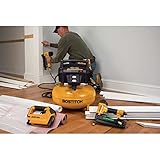
The quick-recovery design means the tank refills faster than many competitors in its class, so you spend less time waiting and more time working. The oil-free pump requires zero maintenance — no oil checks, no oil changes, nothing to forget. The dual couplers let you run two tools or hoses simultaneously. Where the Bostitch distinguishes itself from the nearly identical Craftsman and Porter-Cable versions is its consistent build quality and straightforward user experience — gauges are easy to read, the regulator is simple to adjust, and nothing feels cheap about the fittings or valve hardware.

What tools it can realistically power: Tire inflation, brad nailers, finish nailers, framing nailers (intermittent), blow guns, staple guns, caulk guns, short air ratchet sessions. Not for sustained impact wrench use, spray painting, or sanders.
Pros:
- 29 lbs — lightest 6-gallon unit on this list; genuinely portable
- Fast recovery time — less waiting between tool uses
- Oil-free — zero maintenance required
- Dual outlet ports for running two hoses simultaneously
- Proven reliability across hundreds of thousands of user reviews
Cons:
- 78.5 dB — same noise level as DEWALT and Craftsman in this class
- 2.6 SCFM limits high-demand tool use
- No accessories included — hose and fittings purchased separately
Best For: First-time compressor buyers and homeowners who want a proven, no-fuss pancake unit that handles all everyday garage tasks without complication or maintenance.
5. California Air Tools 10020C — Best for Heavy DIY Use
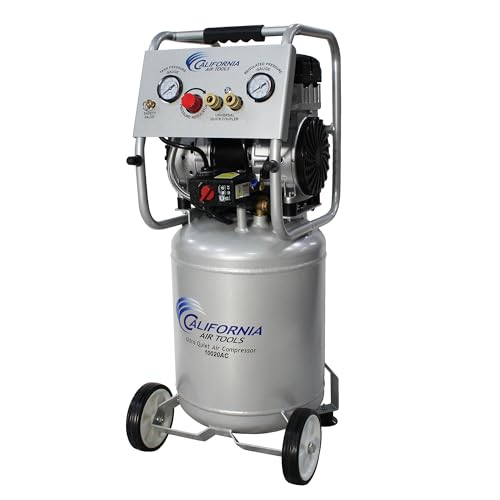
Tank: 10 gal | Max PSI: 120 | CFM @ 90 PSI: 5.3 CFM | Noise: 70 dB | Amp Draw: ~14A | Oil Type: Oil-free | Weight: 64 lbs | Price Range: $$$
The California Air Tools 10020C is what you buy when you’ve outgrown the 6-gallon pancake but aren’t ready for a stationary 30-gallon unit. It delivers a remarkable 5.3 CFM at 90 PSI — enough to run a 1/2″ impact wrench continuously, power a die grinder for extended sessions, and approach the territory of light spray work — while still operating at just 70 dB. That combination of power and quiet is genuinely unusual; most compressors at this CFM output run at 82–88 dB. Running at 70 dB, this machine is still twice as loud as the 8010, but roughly half as loud as a standard pancake compressor.
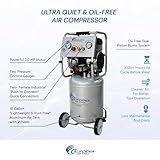
The 10-gallon steel tank gives you meaningful air reserve — enough to run an impact wrench through a full wheel change on a car before the motor needs to cycle. The oil-free pump requires zero maintenance. The wheeled design handles the 64-lb weight easily on a flat garage floor. At around 14 amps running, it still operates safely on a dedicated 15-amp outlet, though a 20-amp circuit is recommended for heavy sessions. This is the model California Air Tools recommends when users upgrade from the 8010 — it’s fundamentally the same ultra-quiet motor architecture scaled up for higher-demand work.

What tools it can realistically power: Everything the 8010 handles, plus: impact wrenches (sustained use), die grinders (moderate), air ratchets (continuous), light HVLP spray work (with moisture trap). Still not ideal for DA sanders or full automotive painting sessions.
Pros:
- 5.3 CFM @ 90 PSI — bridges the gap between home and shop-grade performance
- 70 dB — remarkably quiet for its CFM output class
- 10-gallon tank provides meaningful air reserve for sustained tool use
- Oil-free pump — no maintenance between sessions
- Still runs on a standard 110V/15-amp circuit (dedicated recommended)
Cons:
- 64 lbs — heavy; requires the wheels to move around the garage
- Higher price than 6-gallon units
- 120 PSI max — no pressure headroom beyond tool requirements
Best For: Serious DIY homeowners who regularly run impact wrenches, die grinders, and air ratchets and want California Air Tools’ legendary quiet operation at a scale that can actually keep up with continuous tool demand.
6. CRAFTSMAN CMEC6150K — Best Value Kit with Accessories Included
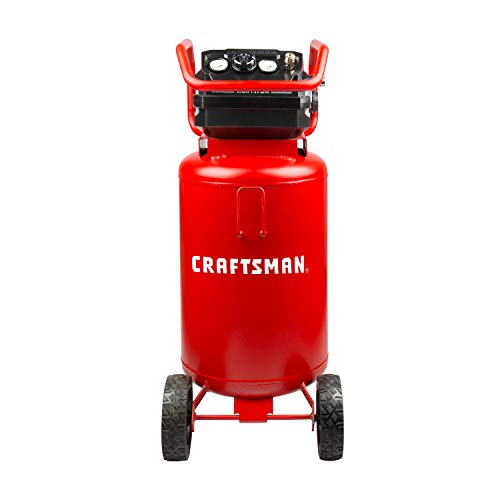
Tank: 6 gal | Max PSI: 150 | CFM @ 90 PSI: 2.6 SCFM | Noise: 79 dB | Amp Draw: ~15A | Oil Type: Oil-free | Weight: 34 lbs | Price Range: $$
The CRAFTSMAN CMEC6150K occupies the same core spec territory as the Bostitch and DEWALT pancake units — 6-gallon tank, 2.6 SCFM @ 90 PSI, 150 PSI max — but wins on value because it comes bundled with a 25-foot air hose, blow gun, and quick-connect fittings, accessories that would add $25–$40 to the cost of any of the bare-unit alternatives. For someone setting up their first home garage compressor, that bundled kit eliminates one frustrating “why didn’t they include this?” moment after delivery.
The compressor itself is well-built and shares design elements with the Bostitch, Porter-Cable, and DEWALT units (all owned by Stanley Black & Decker). The low-profile head design offers 25% thinner clearance than standard designs — useful when working in engine bays where the compressor is positioned under the hood area. The oil-free pump is maintenance-free. Dual air outlets handle two simultaneous connections. The Craftsman name carries a strong reputation for longevity and the brand’s retail presence means replacement parts and warranty service are easy to access.

What tools it can realistically power: Tire inflation, all types of nailers (intermittent), blow guns, staple guns, caulk guns, short air ratchet and impact wrench sessions. Same limitations as other 2.6 CFM units for sustained high-demand tool use.
Pros:
- Bundled kit includes 25-ft hose, blow gun, and fittings — genuine value add
- 25% thinner head profile — easier to use in tight garage spaces
- Dual air outlets standard
- Oil-free and maintenance-free
- Strong Craftsman brand support and retail accessibility
Cons:
- 79 dB — same noise tier as other pancake units in this class
- 15-amp startup draw may trip shared circuits — dedicated outlet recommended
- 2.6 SCFM is not enough for spray guns or continuous sander use
Best For: First-time buyers who want a complete ready-to-use kit out of the box without sourcing separate hoses and fittings, and who value Craftsman’s long-term brand support.
7. Industrial Air ILA1883054 — Best Stationary Compressor for Serious Garages
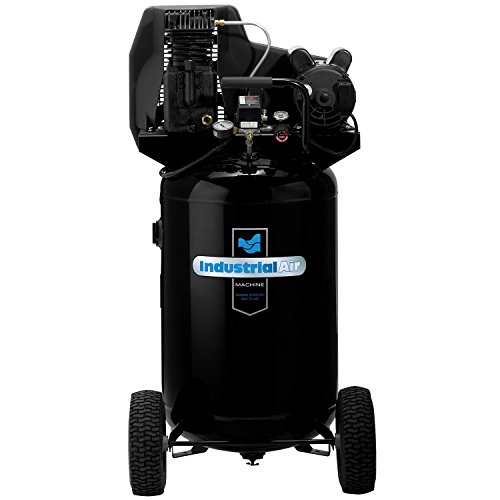
Tank: 30 gal (vertical) | Max PSI: 155 | CFM @ 90 PSI: 5.7 CFM | Noise: 82 dB | Voltage: 120V (15-amp dedicated recommended) | Oil Type: Oil-lubricated (belt-drive) | Weight: ~175 lbs | Price Range: $$$$
The Industrial Air ILA1883054 is a different category of machine from everything else on this list — and it’s the right choice for homeowners who have a dedicated workshop space, regularly run high-demand tools, or want a compressor that functions as the permanent heart of a well-equipped garage. The 30-gallon vertical tank holds enough air to run an impact wrench through a full brake job, power a die grinder for extended cutting sessions, or support light HVLP spray work without the motor cycling every 60 seconds. The narrow vertical footprint occupies roughly the same floor area as a standard kitchen trash can — it fits in a corner without taking over the space.

The belt-driven, oil-lubricated cast-iron pump is the core engineering advantage. Belt-drive compressors run cooler and quieter than direct-drive alternatives at the same output level, and the cast-iron construction throughout the pump assembly means a service life measured in thousands of hours rather than hundreds. At 5.7 CFM @ 90 PSI, it delivers commercial-grade volume on a standard 120V supply. The 155 PSI maximum gives you pressure headroom above every common pneumatic tool’s operating range. Factory-installed gauges and regulators mean setup is genuinely plug-and-play for a machine of this size.

What tools it can realistically power: All tools listed above, plus: sustained impact wrench use (full automotive work), die grinders (extended sessions), moderate HVLP spraying (smaller projects), DA sanders (moderate sessions with recovery time between passes). Not a full spray-painting replacement for whole-car automotive refinishing — for that, a 60+ gallon unit is required.
Pros:
- 30-gallon tank — substantially more air reserve than any portable unit
- Belt-driven oil-lubricated pump — built for thousands of hours of operation
- 5.7 CFM @ 90 PSI — handles all standard pneumatic tools without constant cycling
- Vertical design minimizes floor footprint for the tank size
- 155 PSI maximum — generous pressure headroom above tool requirements
Cons:
- ~175 lbs — this machine does not move once it’s positioned
- 82 dB — louder than CAT units; not for noise-sensitive environments
- Requires oil maintenance — periodic oil checks and changes
- Dedicated circuit strongly recommended
Best For: Homeowners with a dedicated garage workshop who want a stationary, permanently-installed compressor capable of handling all pneumatic tool work without compromise — the machine you buy once and never replace.
8. Porter-Cable C2002 — Best Basic Starter with the Best Warranty

Tank: 6 gal | Max PSI: 150 | CFM @ 90 PSI: 2.6 SCFM | Noise: 82 dB | Amp Draw: ~15A | Oil Type: Oil-free | Weight: 30 lbs | Price Range: $
The Porter-Cable C2002 holds one significant advantage over every other 6-gallon pancake compressor on this list: a 3-year limited warranty — the longest in the class by a significant margin. Most comparable units offer 1-year coverage; Porter-Cable’s 3-year commitment reflects the brand’s confidence in the product’s durability and provides genuine peace of mind for homeowners who use the compressor regularly over several years. For buyers who weight warranty coverage heavily in a purchase decision, this alone justifies the choice.

In every other respect, the C2002 delivers the same core performance as its Bostitch, Craftsman, and DEWALT siblings — 2.6 SCFM @ 90 PSI, 150 PSI max, 30 lbs, oil-free maintenance-free operation, and two outlet ports. It handles all standard home garage tasks from tire inflation to nailers without issue. The 82 dB noise level is slightly higher than the Bostitch and DEWALT, which is worth noting for noise-sensitive situations. The straightforward design, minimal controls, and proven reliability make it a solid entry-level choice that covers the bases without unnecessary complexity.

What tools it can realistically power: Tire inflation, brad nailers, finish nailers, framing nailers (intermittent), blow guns, staple guns, short air tool sessions. Same CFM limitations as the pancake class for sustained tool use.
Pros:
- 3-year limited warranty — longest coverage in the 6-gallon pancake class
- Simple, proven design with minimal failure points
- 30 lbs — lightweight and genuinely portable
- Oil-free and maintenance-free
- Most affordable entry point on this list
Cons:
- 82 dB — slightly louder than Bostitch and DEWALT at the same price tier
- No accessories included
- 2.6 SCFM limits use with high-demand tools
Best For: First-time buyers on a tight budget who prioritize warranty coverage, proven simplicity, and the lowest possible entry cost — or anyone who simply needs a compressor for tire inflation and occasional nailer work.
The Horsepower Lie: Why HP Ratings on Amazon Are Misleading
Here’s something no one in the air compressor industry wants you to know: the horsepower numbers on Amazon listings — and on the box at the hardware store — are almost universally “peak HP”, not running HP. Peak HP is the maximum power the motor draws at the instant of startup. It has almost nothing to do with the sustained performance you actually need to run your tools.
A compressor advertised as “2 HP” typically delivers 1.0–1.5 HP continuously. The peak number is achieved for a fraction of a second during motor startup, then drops immediately as the motor reaches operating speed. Manufacturers use peak HP because it’s a larger, more impressive-sounding number — and because there’s no FTC enforcement of consistent HP labeling standards in the consumer tool market.
The practical implication: a “2 HP” pancake compressor and a “1.5 HP” California Air Tools model may deliver identical real-world CFM output. The CAT motor is engineered for sustained output efficiency; the “2 HP” motor is optimized for a peak number on a spec sheet.
Duty Cycle — The Spec That Protects Your Investment
Duty cycle is the percentage of time within each cycle that a compressor motor can safely run. A 50% duty cycle means the motor can run for 30 seconds, must rest for 30 seconds, then run again. A 100% duty cycle means the motor can run continuously without rest periods.
For nailers and tire inflation — burst-use tools that fire for a second and stop — duty cycle barely matters. The compressor refills the tank between shots and never approaches its limit. But for spray guns and orbital sanders that require 6–14 CFM of sustained, continuous airflow, a 50% duty cycle compressor is being asked to run non-stop while your tool is active. The result is overheating, accelerated pump wear, and premature failure — often within the first year of regular use.
Most oil-free pancake and portable compressors have 50–75% duty cycles. This is fine for their intended use cases. Oil-lubricated compressors — like the Makita MAC2400 and Industrial Air ILA1883054 — typically achieve 75–100% duty cycles due to better thermal management in the pump design.
Moisture in Your Tank: The Silent Tank Killer
Every air compressor produces water. It’s basic physics: when air is compressed, its moisture content condenses into liquid droplets that collect inside the tank. This is not a defect — it happens to every compressor, every session, everywhere on the planet. What matters is what you do about it.
Left undrained, tank moisture causes internal rust that gradually thins the tank wall. Over years, a rusted tank can develop pinhole leaks — and in worst-case scenarios, weaken enough to fail under pressure. Moisture also travels through your air lines: for spray painting, it causes water spots, fisheye defects, and adhesion failures in paint. For air tools, it contaminates internal oil and degrades performance.
The fix is simple and takes 30 seconds: After every use, open the drain valve at the bottom of the tank. Let it run for 5–10 seconds until only air exits. Close the valve. Done. In humid climates or during summer heat (when air carries more moisture), drain mid-session on long projects too.
For spray painting specifically, add an inline water separator / moisture trap between your tank outlet and your hose. This $15–$25 accessory catches droplets that make it past the tank before they reach your spray gun. It’s one of the most impactful and most overlooked upgrades a home garage spray painter can make.
Extension Cord Warning: Don’t Destroy Your Motor Before You Start
Running an air compressor on the wrong extension cord is one of the most common causes of breaker trips, motor strain, overheating, and premature motor failure in home garages — and it’s almost never covered in buying guides or product manuals.
The problem is voltage drop. An undersized or overly long extension cord creates resistance in the circuit, which causes the voltage at the motor terminals to drop below the rated level. When an electric motor receives lower-than-rated voltage, it draws more current to compensate — which means the startup amp spike gets even higher, and the running temperature increases. Over time, this degrades motor winding insulation and shortens motor life significantly.
The rules:
- Never use an extension cord thinner than 14 AWG for any home compressor. 12 AWG is better.
- Maximum cord length: 25 feet for 14 AWG; 50 feet for 12 AWG
- For runs over 50 feet: use 10 AWG
- Best practice: position the compressor close to the outlet and use a longer air hose instead of a longer extension cord. A 50-foot rubber air hose costs $30–$50 and has zero effect on motor performance.
Essential Accessories to Buy With Your Compressor
Most compressors ship with the machine and nothing else. These are the accessories that complete the setup and prevent the most common first-day frustrations:
- Air hose (3/8″ × 25 ft minimum): Rubber hose stays flexible in cold temperatures; coil hoses tangle and restrict flow. For a garage, 25–50 ft gives you reach around a full-size vehicle without moving the compressor. Buy rubber, not coil.
- Inline water separator / moisture trap: Installs between the tank outlet and your hose. Mandatory for spray painting; strongly recommended for any finish work. Catches moisture before it reaches your gun or tools.
- Quick-connect fittings kit (1/4″ NPT): Universal quick-connect fittings standardize all your air tool connections. Without these, every hose-to-tool connection requires a wrench. With them, swapping tools takes two seconds.
- Blow gun with safety tip: The most-used attachment in any home garage. For cleaning filters, drying parts, blowing debris off work surfaces, and inflating sports equipment. OSHA-style safety tips are required by some local regulations.
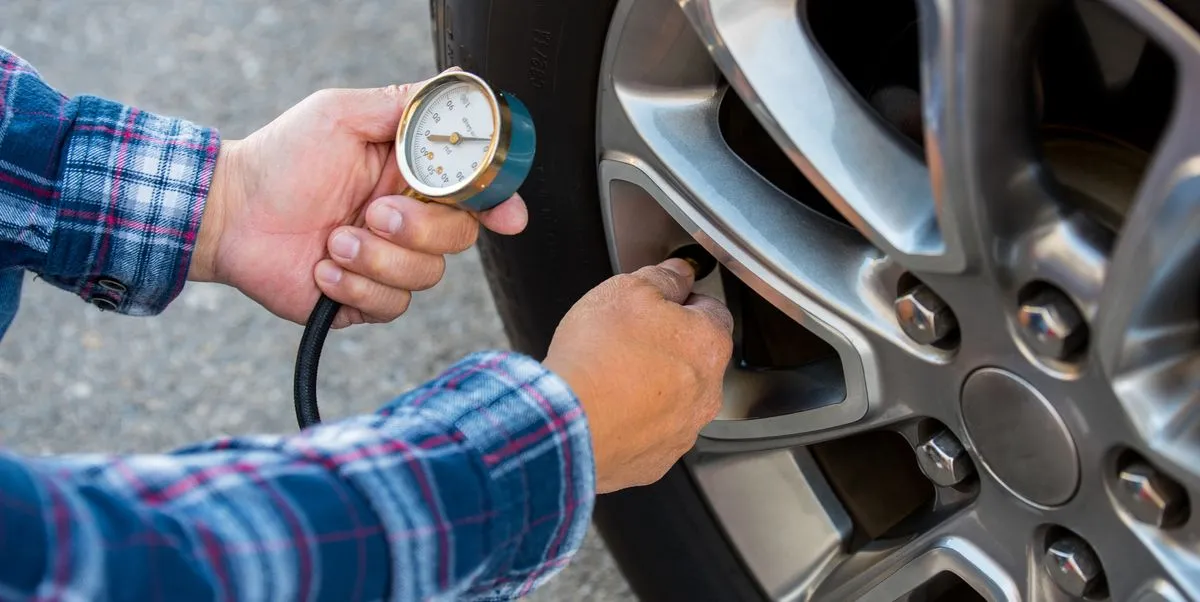
- Tire chuck with built-in gauge: Makes hands-free tire inflation possible. Far more convenient than holding a standard chuck while watching a separate gauge.
- Tank drain valve extension: On some compressors, the drain valve is positioned in a hard-to-reach location. A $10 brass drain valve extension makes draining practical — and if it’s easy, you’ll actually do it.
Buying Guide Checklist: What to Confirm Before You Buy
Run through these specs for any compressor you’re considering:
- CFM @ 90 PSI: Match to your most demanding tool and multiply by 1.5. This is the most important spec. Budget pancakes: 2.6 CFM. Mid-range portables: 3–5 CFM. Stationary: 5–8 CFM.
- Tank size: Nailers and inflation → 6 gal. Impact wrenches → 10–20 gal. Spray guns and sanders → 20–30+ gal.
- Noise (dB): Under 75 dB for attached garages. Under 65 dB if noise is a hard constraint. Avoid any unit over 82 dB for extended home garage use without hearing protection.
- Amp draw (running): Under 12 amps for shared 15-amp circuits. Under 15 amps for dedicated 15-amp circuits. Larger units should have their own 20-amp dedicated outlet.
- Oil type: Oil-free for occasional use and simplicity. Oil-lubricated for frequent heavy use, continuous tools, and maximum longevity.
- Duty cycle: 50% is fine for burst-use tools (nailers, ratchets). 75–100% required for spray guns and continuous sander use.
- Max PSI: 120–130 PSI handles all standard tools. 150–165 PSI gives pressure headroom and slightly longer tool runtime between cycles.
- Warranty: 1 year minimum. 3 years (Porter-Cable) and California Air Tools’ extended pump warranties are the best coverage in the home garage class.
- Weight and tank style: Pancake/hot dog for portability. Vertical for corner placement and larger capacity. Horizontal stationary for permanent workshop installation.
Frequently Asked Questions
Conclusion: Which Air Compressor Should You Buy?
For the majority of homeowners — those who inflate tires, run nailers, blow off dust, and use an air ratchet now and then — the California Air Tools 8010 is the clearest recommendation on this list. Its 60 dB operation, 8.5-amp draw, and oil-free simplicity make it the most livable compressor for a home garage environment. You can use it any time of day, on any standard outlet, and you’ll never need to touch it for maintenance.
If you regularly run a 1/2″ impact wrench, die grinder, or want the highest portable CFM available on a 120V supply, step up to the Makita MAC2400 Big Bore. Its oil-lubricated cast-iron pump delivers 4.8 CFM and a service life that will outlast multiple oil-free alternatives. It requires periodic oil maintenance — but for serious automotive DIY work, the performance and longevity trade-off is clearly worth it.
For a complete workshop with a permanent compressor installation and the need to power multiple tools over extended sessions, the Industrial Air ILA1883054 30-gallon belt-drive unit is the one you buy once and never replace. It bridges the home garage and light commercial gap without requiring a 240V circuit.
Whatever you choose, remember the three rules that separate a good purchase from a frustrating one: match CFM to your tools (× 1.5), check the amp draw against your circuit, and drain the tank after every use.
Check current prices on Amazon:
| Product | Best For | Amazon Link |
|---|---|---|
| California Air Tools 8010 | Best Overall / Quietest | 🛒 View on Amazon |
| DEWALT DWFP55126 | Best Budget Pancake | 🛒 View on Amazon |
| Makita MAC2400 Big Bore | Best for Air Tools | 🛒 View on Amazon |
| Bostitch BTFP02012 | Best for Beginners | 🛒 View on Amazon |
| California Air Tools 10020C | Best for Heavy DIY | 🛒 View on Amazon |
| CRAFTSMAN CMEC6150K | Best Value Kit | 🛒 View on Amazon |
| Industrial Air ILA1883054 | Best Stationary | 🛒 View on Amazon |
| Porter-Cable C2002 | Best Basic Starter | 🛒 View on Amazon |