Table of Contents
- Introduction
- What Polishing Actually Does — And Why That Changes Everything
- DA vs. Rotary vs. Forced-Rotation: Which Type for a Beginner?
- The Throw Size Nobody Explains
- Quick Comparison Table
- Top 9 Car Polishers Reviewed
- The Dark Paint Warning
- The Pad System: What You Actually Need
- Speed Settings: The Actual Guide Beginners Need
- Single-Stage vs. Two-Stage Paint: Check This First
- After Polishing: The 2-Hour Protection Window
- Corded vs. Cordless: The Honest Answer
- What to Buy Beyond the Polisher
- Buying Guide Checklist
- FAQ
- Conclusion
The Fear That Stops Most Car Owners – And How to Beat It
There’s one thing that keeps most car owners from ever trying machine polishing: the knowledge that one wrong move can burn through clear coat and turn a dull-but-intact paint job into a $1,000 body shop bill. That fear is legitimate. A rotary polisher in the wrong hands can strip clear coat in seconds. But a dual-action (DA) polisher in a beginner’s hands? That’s how paint gets genuinely transformed — swirl marks erased, light scratches leveled, oxidation cleared, and mirror-like gloss restored — without any of the catastrophic risk.
Machine polishing is the single most impactful thing you can do for your car’s paint. No wax, no spray detailer, and no car wash can touch what a best car polisher for beginners can achieve in a single afternoon. The difference between a car that looks two years old and one that looks ten years old is almost always in the paint correction — and paint correction means machine polishing. The key is choosing the right machine for your skill level: a tool engineered to be forgiving, not one that punishes any mistake with permanent damage.
Our top overall pick for beginners is the Griot’s Garage G15 Long Throw — a 15mm throw DA polisher that hits the ideal balance of correction speed and safety for first-time users. If maximum safety is your priority above all else, the legendary PORTER-CABLE 7424XP remains the most forgiving beginner machine ever made. Read on for the full breakdown, the technique knowledge nobody else gives beginners, and everything you need to polish your first panel correctly.

What Polishing Actually Does – And Why That Changes Everything
Most beginners assume polishing fills scratches — like spreading a coating over the surface to cover imperfections. This is a common and understandable assumption, and it’s completely wrong. Understanding what actually happens changes how carefully you approach the machine.
Polishing removes the clear coat surrounding a scratch, leveling the paint surface down to the depth of the scratch. The scratch doesn’t disappear — the clear coat around it comes down to meet it, creating a uniformly flat surface that reflects light evenly. That even light reflection is what creates gloss. The scratch is gone from view not because it was filled, but because the surface surrounding it was brought to its level.
The consequence of this is significant: every polishing session removes a thin layer of clear coat. Average factory clear coat is 50–70 microns thick — roughly the width of a human hair. Each polishing session removes 1–5 microns depending on compound aggressiveness, pad choice, machine speed, and technique. Across a vehicle’s lifetime, that allows for approximately 10–50 polishing sessions before the clear coat becomes dangerously thin. This is not an infinite resource.
DA vs. Rotary vs. Forced-Rotation: Which Type for a Beginner?
The most important decision you’ll make when buying a car polisher isn’t brand or price — it’s machine type. Getting this wrong is how beginners damage paint. Here are the three types you’ll encounter:
Random Orbital DA (Dual Action) — The Only Choice for Beginners
A DA polisher moves the pad in two ways simultaneously: the pad rotates around its own center point AND the spindle carrying the pad oscillates in a random orbital pattern. This random dual motion constantly changes the pad’s contact angle with the paint surface. The result is that heat never builds up in one concentrated spot — it’s distributed across a wide, ever-changing area. The most important safety feature: if you press a DA polisher down too hard and stop moving it, the pad literally stops rotating under load. It stalls rather than burning. This built-in safety mechanism is why DA polishers are recommended for every beginner, without exception. Speed is measured in OPM (Oscillations Per Minute) — not RPM, a distinction that matters when comparing specs between machines.
Rotary (Single-Direction) Polisher — Never for Beginners
A rotary polisher spins the pad in a single direction around a fixed center point — like a drill. It generates heat rapidly and consistently. Professional body shops use rotary polishers for aggressive paint correction after wet sanding because of this power. For a beginner, holding a rotary in one spot for 3–5 extra seconds can burn through clear coat permanently — a mistake no amount of polishing afterward can reverse. The Makita 9237CX2 and SPTA 7″ Rotary reviewed later in this article are included to explain what they are and who they’re genuinely for — not to recommend them to beginners.
Forced-Rotation DA (Gear-Driven) — Step Up, Not Starting Point
A forced-rotation DA is a hybrid: the pad oscillates like a random orbital but is mechanically forced to keep rotating under load — it won’t stall when pressed. More aggressive cutting than a random orbital DA, but safer than a rotary. Brands like Flex and Rupes make premium forced-rotation units ($250–$500+). These are excellent once you’ve learned technique on a random orbital. They are not the starting point.
| Type | Safe for Beginners? | Correction Power | Price Range | Best For |
|---|---|---|---|---|
| Random Orbital DA | ✅ Yes | Moderate | $80–$250 | All beginners; swirls, light scratches, oxidation |
| Forced-Rotation DA | ⚠️ With experience | High | $250–$600 | Intermediate users; moderate-to-heavy correction |
| Rotary | ❌ No | Very High | $100–$400 | Professional detailers; body shops; deep scratch removal |
The Throw Size Nobody Explains — And Why It Matters More Than Brand
“Throw” (also called orbit size or stroke) is the distance in millimeters that the pad travels in its orbital path around the spindle. It’s the most important spec on a DA polisher that beginners consistently overlook — and it has more practical impact on your results than brand name or motor wattage.
Small throw (8–10mm): The pad traces a small circular path. Less surface coverage per rotation. More control around tight spaces — bumper curves, around door handles, mirror housings. The PORTER-CABLE 7424XP uses an 8mm throw. It is the safest beginner machine ever made, but also the slowest at defect removal. Removing a panel’s worth of swirl marks with an 8mm machine takes significantly longer than a 15mm machine.
Medium throw (12–15mm): The sweet spot for most beginners. Covers more paint surface per rotation, removes defects noticeably faster, still manageable and forgiving. The Griot’s Garage G15 uses a 15mm throw — meaningfully faster than the Porter-Cable but equally safe. A 15mm machine does the same job approximately 30–40% faster than an 8mm machine at comparable settings.
Large throw (18–21mm): Used by experienced detailers for fast correction on large flat panels — hoods, roofs, trunk lids. The Chemical Guys TORQ 10FX uses a 21mm throw. More physical pad movement to manage; the machine “walks” slightly across the surface. Not dangerous on a DA, but more technique required to maintain even panel coverage.
Quick Comparison Table: Best Car Polishers for Beginners
| # | Product | Type | Throw | OPM Range | Power | Best For | Link |
|---|---|---|---|---|---|---|---|
| 1 | PORTER-CABLE 7424XP | Random Orbital DA | 8mm | 2,500–6,800 | 4.5A | Safest beginner pick | Amazon |
| 2 | Griot’s Garage G15 | Random Orbital DA | 15mm | 3,200–7,400 | 6.0A | Best overall beginner | Amazon |
| 3 | Chemical Guys TORQ 10FX | Random Orbital DA | 21mm | 1,200–4,200 | 7.4A | Best for large flat panels | Amazon |
| 4 | Meguiar’s MT300 | Random Orbital DA | 15mm | 3,000–7,500 | 7.4A | Best mid-range upgrade | Amazon |
| 5 | BLACK+DECKER WP900 | Traditional Orbital | N/A | 2,500–6,800 | 10A | Best budget / waxing only | Amazon |
| 6 | Adam’s Swirl Killer 9mm | Random Orbital DA | 9mm | 1,000–6,000 | 6.0A | Best beginner kit with pads | Amazon |
| 7 | Milwaukee M18 Cordless | Random Orbital DA | 8mm | 1,000–5,800 | 18V | Best cordless pick | Amazon |
| 8 | Makita 9237CX2 | Rotary | N/A | 600–3,000 RPM | 10A | Best professional rotary | Amazon |
| 9 | SPTA 7″ Rotary Polisher | Rotary | N/A | 1,000–6,500 RPM | 1,400W | Best budget rotary (experienced only) | Amazon |
Top 9 Car Polishers Reviewed — In-Depth

1. PORTER-CABLE 7424XP — Safest Beginner Car Polisher Ever Made

Type: Random Orbital DA | Throw: 8mm | Speed: 2,500–6,800 OPM (6 settings) | Motor: 4.5A | Pad Size: 5″–6″ | Weight: 5.5 lbs | Cord: 10 ft | Thread: 5/16″ UNF | Price Range: $$
Since the 1980s, the PORTER-CABLE 7424XP has been the machine that professional detailers hand to beginners — and for four decades, that recommendation has held. There’s a reason it remains the entry point for the detailing world despite dozens of newer competitors: its 8mm throw is the smallest available in a serious DA polisher, which means it’s the slowest at material removal and the most forgiving machine if technique is imperfect. For a first-time user learning how much pressure to apply, how fast to move across a panel, and how to read pad behavior, that forgiveness is genuinely valuable.

At 4.5 amps, it’s the lowest-powered machine on this list — a limitation that’s also a feature for beginners. Less power means less aggressive cutting per pass, which means more room for technique errors before the paint sees negative consequences. The 5.5 lb weight is comfortable for extended sessions without fatigue. The power lock slide switch holds the machine on without holding a trigger — freeing your grip to focus on pressure and movement. The two-position auxiliary handle provides wrist-twist positioning for different panel angles. One important note: the Porter-Cable does not ship with a backing plate — you’ll need to purchase a 5″ backing plate separately, or buy one of the Chemical Guys bundles that include the PC7424XP with backing plate and pads already included.

What defects it removes: Light to moderate swirl marks, minor water spots, light surface oxidation, haze from improper washing technique. Not designed for deep scratches, heavy oxidation, or paint transfer. For anything beyond light correction, a 15mm machine with more aggressive compound will be faster and more effective.
Best paint colors: Excellent on all colors. The slow, gentle 8mm action makes it particularly safe on dark paint (black, dark navy) where more aggressive machines risk haze and marring from beginner technique errors.
Pros:
- 8mm throw — the most forgiving DA polisher available; pad stalls before it burns paint
- Decades of proven reliability and a massive aftermarket of compatible pads and backing plates
- 5.5 lbs — comfortable for all-day detailing without arm fatigue
- Power lock slide switch — no trigger hold required during use
- 5/16″ UNF thread is industry standard — widest backing plate and accessory compatibility
Cons:
- 8mm throw is notably slower at defect removal than 15mm alternatives — polishing a full car takes significantly longer
- 4.5A motor is the weakest on this list — struggles with heavier compound on dense foam pads
- Does not include backing plate — separate purchase required before first use
Best For: True beginners who prioritize absolute safety over speed — particularly those working on dark-colored paint, sports cars with complex panel shapes, or anyone who wants maximum margin for error while learning technique.
2. Griot’s Garage G15 Long Throw — Best Overall Beginner Car Polisher
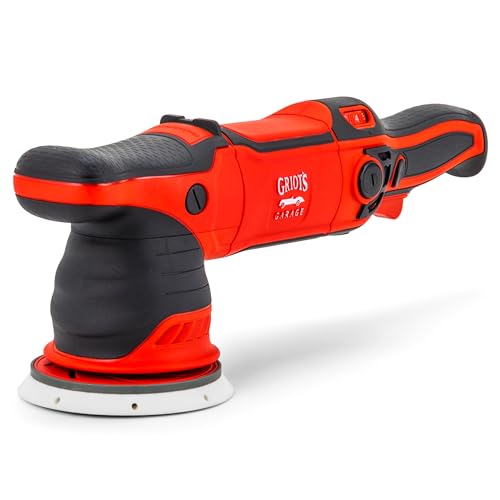
Type: Random Orbital DA | Throw: 15mm | Speed: 3,200–7,400 OPM (6 settings) | Motor: 6.0A | Pad Size: 5″–6″ | Weight: 5.8 lbs | Cord: 12 ft | What’s Included: Backing plate + 5″ foam pad + pads | Price Range: $$$
The Griot’s Garage G15 has earned its place as the top recommendation for beginner detailers who want to learn on a machine that won’t limit them as their skills grow. The 15mm throw is the key differentiator from the Porter-Cable: it covers significantly more paint surface per orbital rotation, removing defects 30–40% faster on equivalent compounds and pads. The practical consequence is that polishing a full car in an afternoon is genuinely achievable — where the PC7424XP might leave you with one side done before fatigue sets in, the G15 finishes the job and leaves time for the sealant step.

Despite the larger throw, the G15 is equally safe for beginners. The random orbital mechanism still stalls under excess load — the safety that prevents clear coat burn is inherent to the DA design, not dependent on throw size. The 6.0A motor has more power than the Porter-Cable, which means it maintains pad speed through heavier compounds without bogging down. Griot’s Garage includes a backing plate and foam pad in the box — unlike the Porter-Cable, you’re ready to polish on delivery. The double-shot rubber grips reduce vibration during long sessions, and the machine’s balance makes one-handed operation on vertical panels comfortable. The 12-foot cord gives more working radius around a vehicle than most competitors.

What defects it removes: Light to moderate swirl marks, water spots, light oxidation, bird dropping etching (light), surface haze, minor single-panel scratches that haven’t penetrated to base coat. With an appropriate cutting compound and microfiber pad, it handles moderate oxidation on daily drivers effectively.
Best paint colors: Excellent on all colors. The 15mm throw makes it faster on large panels (silver, white, light colors) and still manageable on dark paint with proper low-speed technique (speed 3–4 on correction passes).
Pros:
- 15mm throw — the beginner sweet spot: 30–40% faster defect removal than 8mm machines while remaining equally safe
- 6.0A motor maintains pad speed under heavier compounds without bogging
- Backing plate and foam pad included — ready to use out of the box
- 12-foot cord — more working radius around a full vehicle
- Double-shot rubber grips reduce vibration for extended sessions
Cons:
- Higher price than the Porter-Cable — the quality justifies it, but the budget isn’t negligible
- 15mm throw on tight curved panels (compact bumpers, mirrors) requires slightly more attention than 8mm
- Griot’s pads are proprietary-sized; third-party 5″ pads work but check backing plate compatibility
Best For: The beginner who wants to learn on the best machine available and not outgrow it — the G15 handles everything from first-timer swirl removal to experienced single-stage paint correction without being replaced.
3. Chemical Guys TORQ 10FX — Best for Large Flat Panels
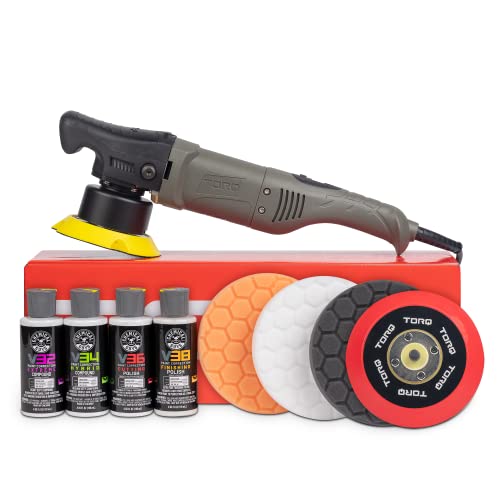
Type: Random Orbital DA | Throw: 21mm | Speed: 1,200–4,200 OPM (6 settings) | Motor: 7.4A | Pad Size: 5″–6″ | Weight: 6.2 lbs | Cord: 10 ft | Price Range: $$
The Chemical Guys TORQ 10FX takes the DA polisher concept to the largest throw available in the home detailer class — 21mm — which means maximum paint coverage per orbital rotation. On flat, open panels like a truck hood, full-size sedan roof, or minivan door, the 10FX clears swirl marks and light oxidation in dramatically fewer passes than 8mm or 15mm alternatives. For beginners polishing large vehicles (SUVs, trucks, full-size sedans), the time saving is substantial. On a 6-foot hood, the difference between an 8mm and a 21mm machine at similar settings is approximately half the working time.

The trade-off is physical management. A 21mm throw creates more pad movement — the machine “walks” slightly as the orbital path is larger, which requires a slightly firmer grip and more deliberate panel-coverage technique than a 15mm or 8mm machine. This isn’t dangerous on a DA — the random orbital safety mechanism is still present — but it does require more attention to maintain even panel coverage and avoid missing strips. On tight curved panels (bumper edges, around mirrors, A-pillars), the 10FX is less maneuverable than smaller-throw alternatives. The 7.4A motor is one of the strongest on this list, maintaining consistent pad speed through heavier compounds without the bogging that limits lower-amperage machines.

What defects it removes: Light to moderate swirl marks, water spots, moderate surface oxidation, light scratches, bird drop etching. The 21mm throw with appropriate microfiber pads handles heavier oxidation on daily drivers effectively — faster than any other DA on this list on open panel work.
Best paint colors: All colors. Particularly efficient on light colors (white, silver, champagne) where the large throw’s speed advantage can be fully used without dark-paint haze concerns from aggressive technique.
Pros:
- 21mm throw — fastest defect removal of any DA on this list; ideal for large vehicles
- 7.4A motor — strongest available on a home-class DA; handles all compound types
- Maximum time efficiency for SUVs, trucks, minivans, and full-size sedans
- Still a random orbital DA — retains all beginner safety characteristics
- Competitive price for the motor output and throw size
Cons:
- 21mm throw requires slightly more management to maintain even panel coverage
- Less maneuverable on tight curved panels than 8mm or 15mm alternatives
- Does not include backing plate — separate purchase required
Best For: Beginners with large vehicles (full-size trucks, SUVs, minivans) who want maximum efficiency on open panel work, and intermediate users who’ve outgrown 15mm performance and want to step up before a forced-rotation machine.
4. Meguiar’s MT300 — Best Mid-Range Upgrade
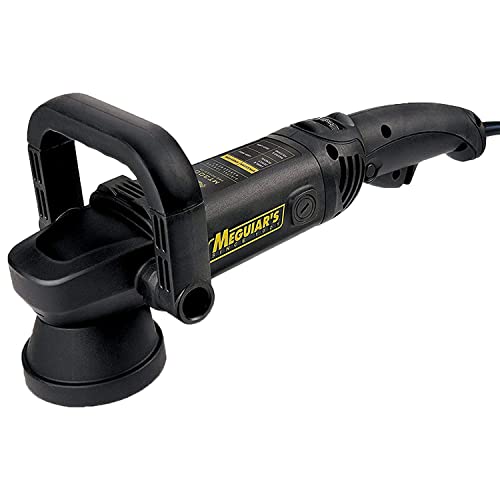
Type: Random Orbital DA | Throw: 15mm | Speed: 3,000–7,500 OPM (variable dial) | Motor: 7.4A | Pad Size: 5″–6″ | Weight: 6.0 lbs | Cord: 12 ft | Price Range: $$$
The Meguiar’s MT300 is what happens when the world’s most trusted polishing compound brand builds its own machine — and it shows in every design decision. At 15mm throw with a 7.4A motor, the MT300 occupies the same throw-size sweet spot as the Griot’s G15 but delivers significantly more power to the pad. The practical result: on heavier compounds and denser cutting foam pads, the MT300 maintains pad speed and cutting consistency where lower-amperage machines slow perceptibly. This matters most when working on moderately oxidized paint that requires sustained compound pressure over multiple passes.

The variable speed dial covers a wider OPM range than most competitors — 3,000 to 7,500 — with genuinely granular control between settings. This is particularly noticeable in the 3,000–5,000 OPM range where most beginner correction work happens. Meguiar’s also includes a longer 12-foot cord, a comfortable ergonomic body designed for extended use, and a backing plate and pad in the box. The build quality feels premium — rubberized grip areas, solid electronic speed control, and balanced weight distribution that makes vertical panel work (doors, fenders, quarter panels) less fatiguing than machines that put all the weight at the motor end.

What defects it removes: Everything the G15 handles, plus more efficient on moderate oxidation, heavier swirl patterns, and multi-panel correction sessions where sustained high-speed performance matters. The 7.4A motor makes a noticeable difference on heavily contaminated paint.
Best paint colors: Excellent on all colors. The wider speed range and precise control make it particularly versatile on dark paint where speed precision at 3,000–4,000 OPM is critical for avoiding haze.
Pros:
- 7.4A motor — 23% more power than the G15; maintains cutting speed through heavier compounds
- 15mm throw — the proven beginner sweet spot with added motor output
- Widest OPM range in this roundup — maximum speed control precision
- Meguiar’s brand familiarity — products, pads, and compounds are all ecosystem-compatible
- 12-foot cord + backing plate + pad included
Cons:
- Higher price than G15 and Porter-Cable — the power and build quality justify it, but it’s the priciest DA beginner option
- 6.0 lbs — not the lightest; noticeable on overhead panels (roof, upper windshield trim)
Best For: Beginners who want to buy once and never upgrade — or anyone starting with moderately oxidized paint that requires more sustained cutting power than the Porter-Cable or G15 can efficiently deliver.
5. BLACK+DECKER WP900 — Best Budget Pick (Waxing & Finishing Only)
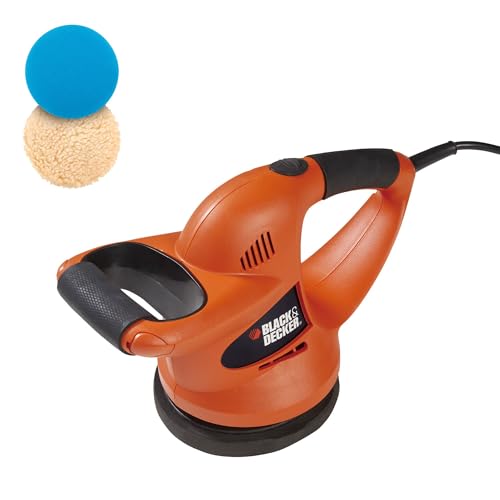
Type: Traditional Orbital (NOT dual-action DA) | Motion: Single-axis orbital only | Speed: 2,500–6,800 OPM | Motor: 10A | Pad Size: 9″ | Weight: 5.3 lbs | Price Range: $
The BLACK+DECKER WP900 earns its place on this list as the best budget entry point for one specific use case: applying wax, sealant, and liquid polish to already-clean paint. At 5.3 lbs it’s the lightest machine in this roundup, and the wide 9″ pad covers large panels efficiently for wax distribution. For someone who just wants to apply a carnauba wax or synthetic sealant faster and more evenly than by hand — without removing scratches or correcting paint — the WP900 does the job at a fraction of the cost of a DA polisher.

What the WP900 is not: a paint correction machine. Traditional orbital polishers like this one move the pad in a single circular orbital path without the dual-axis random movement that makes DA polishers safe for compound work. Used with a heavy cutting compound, a traditional orbital creates consistent heat patterns in the paint — the same pattern repeated — which can cause localized burning similar to a rotary polisher. Stick to finishing polish, liquid wax, and paint sealant with a soft foam pad, and the WP900 is a genuinely useful, honest tool. Step outside that use case and you risk paint damage.

What it can do: Apply liquid carnauba wax, synthetic sealant, finishing polish (light), and glaze to clean, already-corrected paint. Excellent for quarterly wax maintenance on paint that doesn’t need active correction.
What it cannot do: Remove swirl marks, scratches, water spots, or oxidation. Do not use with cutting compound.
Pros:
- Lowest price on this list by a significant margin
- 5.3 lbs — lightest machine in the roundup; no arm fatigue
- 9″ pad covers large panels quickly for wax application
- Zero risk when used correctly (finishing polish and wax only)
- BLACK+DECKER brand reliability and wide retail availability
Cons:
- Traditional orbital — NOT a DA polisher; cannot safely remove paint defects
- Using with compound risks paint damage identical to a rotary polisher
- No paint correction capability — zero value for swirl or scratch removal
Best For: Budget buyers who want to apply wax and sealant faster than by hand on paint that’s already clean and doesn’t need correction — or as a finishing tool after DA polishing with a separate machine.
6. Adam’s Polishes Swirl Killer 9mm DA — Best Beginner Kit with Everything Included
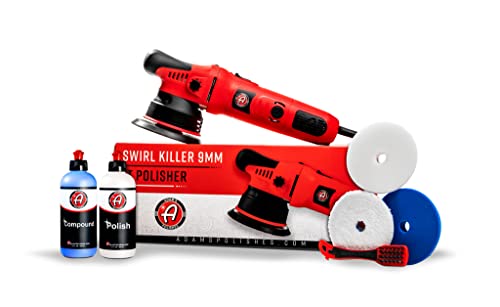
Type: Random Orbital DA | Throw: 9mm | Speed: 1,000–6,000 OPM (6 settings) | Motor: 6.0A | Pad Size: 5″–6″ | Weight: 5.9 lbs | Cord: 10 ft | Price Range: $$–$$$
Adam’s Polishes built its reputation on chemistry — polishing compounds, ceramic coatings, and detailing sprays that perform at a professional level. The Swirl Killer 9mm DA polisher is the natural extension of that ecosystem, designed to be picked up, plugged in, and used effectively the first time — particularly when bought as part of one of Adam’s complete detailing kits that bundle the machine with their polishing compounds, pads, and finishing products. For a beginner who doesn’t want to research compatible compounds and pad combinations separately, the Adam’s kit approach eliminates that complexity entirely.

The 9mm throw puts this machine between the Porter-Cable’s 8mm and the G15’s 15mm — slightly faster than the PC at defect removal, but with the same conservative orbital path that maximizes control on complex panel shapes and curved surfaces. The 6.0A motor is stronger than the Porter-Cable’s 4.5A, maintaining better pad speed through heavier compound on a 5″ cutting foam pad. The low starting speed of 1,000 OPM is the lowest on this list — useful for pad priming and product spreading without compound splatter. The trigger-lock switch, balanced grip, and comfortable weight make extended panel sessions manageable.

What defects it removes: Light to moderate swirl marks, minor water spots, light oxidation, surface haze. With Adam’s dedicated cutting compound, it handles moderate paint correction efficiently. The 9mm throw is particularly well-suited to curved panels and complex body shapes.
Best paint colors: Excellent on dark paint — the 9mm throw’s conservative action is ideal for black and dark navy where higher-throw machines require more careful speed management.
Pros:
- 6.0A motor — stronger than Porter-Cable; better sustained cutting speed
- 1,000 OPM minimum — lowest starting speed for pad priming without splatter
- Best bought as a complete kit — eliminates pad and compound compatibility research
- 9mm throw is excellent on curved panels and complex body shapes
- Adam’s brand ecosystem means chemistry and machine are designed together
Cons:
- 9mm throw is faster than PC7424XP but slower than G15 at flat-panel defect removal
- The machine alone is priced similarly to the G15 — the kit version provides the real value
- Less third-party pad compatibility documentation than Porter-Cable
Best For: Beginners who want to buy the machine, pads, and compounds together in one kit from one brand — eliminating compatibility research while getting a capable, well-balanced DA polisher with a focus on dark paint and complex body shapes.
7. Milwaukee M18 Cordless DA Polisher — Best Cordless Pick

Type: Random Orbital DA | Throw: 8mm | Speed: 1,000–5,800 OPM (variable) | Power: 18V M18 battery (sold separately or in kit) | Pad Size: 5″–6″ | Weight: 5.1 lbs (bare) | Price Range: $$$ (tool only) / $$$$ (with battery)
The Milwaukee M18 Cordless DA Polisher solves the single most physically frustrating part of polishing a car: cord management. Working around a full vehicle — pulling a 10-foot cord through the engine bay, past door handles, and across the roof — is a constant interruption to smooth technique. Cordless eliminates it entirely. The M18 battery platform delivers genuine working time for light correction sessions on a 5Ah battery, and the machine itself at 5.1 lbs (bare) is the lightest on this list in working configuration.

The honest limitation is torque under correction load. Cordless polishers — including this one — experience a measurable drop in pad speed when compound pressure is applied on dense foam cutting pads. For light swirl removal and finishing work, the M18 delivers consistent results indistinguishable from a corded machine. For heavier correction (moderate oxidation, water spots requiring sustained passes), the pad speed reduction is noticeable and requires slower working speed to compensate. This isn’t a dealbreaker — it’s a characteristic to understand. For wax application, light polish, and swirl removal on well-maintained paint, the M18 is excellent. For aggressive multi-stage correction sessions on neglected paint, a corded machine delivers more consistent sustained power.
What defects it removes: Light swirl marks, minor water spots, surface haze, wax and sealant application. Light-to-moderate correction work on well-maintained paint. Less suited for sustained heavy correction that requires consistent pad speed over multiple long passes.
Best for: Spot corrections, maintenance polishing between detail sessions, and anyone in the Milwaukee M18 ecosystem who values cord-free operation above maximum sustained correction power.
Pros:
- Completely cord-free — no cord management around the vehicle
- 5.1 lbs bare — lightest DA polisher in this roundup during use
- Milwaukee M18 battery compatibility — uses existing batteries from the ecosystem
- 8mm throw — safe and conservative for beginners learning technique
- Excellent for spot corrections, maintenance work, and wax/sealant application
Cons:
- Torque drops under heavy compound load — less consistent pad speed than corded machines during aggressive correction
- Battery and charger are an additional cost if not already in the M18 ecosystem
- Battery adds weight and changes balance compared to the bare tool spec
Best For: Milwaukee M18 tool ecosystem users, detailers who do regular maintenance polishing on well-kept paint, and anyone who prioritizes cord-free operation for spot corrections and wax application over maximum sustained correction power.
8. Makita 9237CX2 7″ Variable Speed Polisher — Best Professional Rotary (NOT for Beginners)
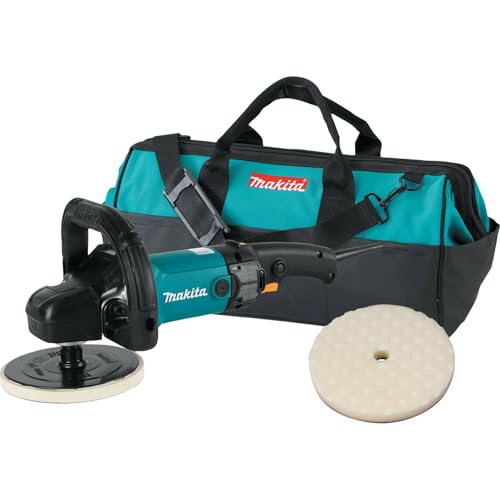
Type: Rotary (single-direction spin) | Speed: 600–3,000 RPM (variable) | Motor: 10A | Pad Size: 7″ | Weight: 6.6 lbs | Cord: 10 ft | Price Range: $$$
The Makita 9237CX2 is one of the most respected rotary polishers in the professional detailing world, and its reputation is entirely earned — by experienced operators. The 10-amp motor drives a 7″ pad at up to 3,000 RPM in a single-direction rotation that generates aggressive, sustained heat at the pad contact point. For professional detailers working on wet-sanded paint correction, removing deep scratches, or cutting through heavy oxidation on aged paint, the rotary’s direct friction approach achieves in two passes what a DA polisher might take six passes to accomplish.

For a beginner, that same aggressive heat generation is the precise risk that causes clear coat burns. Holding a rotary polisher in one spot for even 3–4 extra seconds while adjusting your grip can create a burn-through — a circular discoloration or haze pattern that penetrates below the clear coat and requires wet sanding or repainting to resolve. The variable speed dial runs 600–3,000 RPM with genuine control at low settings, which is how experienced users manage the risk. The machine also includes an ergonomic side handle and backing plate for 7″ pads. Build quality is Makita-grade — this machine will last decades of professional use.

What it’s designed for: Heavy paint correction following wet sanding, removing deep scratches (not surface-level), severe oxidation removal on aged paint, first-stage correction before finishing with a DA polisher. Body shop and professional detailing work.
Pros:
- 10A motor — the most powerful machine on this list; handles the most demanding correction work
- 600–3,000 RPM variable range — precise control from very low to maximum speed
- 7″ pad covers more area per pass than 5″–6″ DA polishers
- Professional-grade build quality — decades of reliable service life
- The benchmark rotary polisher recommended by professional detailers worldwide
Cons:
- Rotary design — generates concentrated heat that can burn clear coat in seconds of improper use
- Absolutely not beginner-safe — requires demonstrated technique before attempting paint correction
- Burns, buffer trails, and haze from improper technique require body shop correction
Best For: Experienced detailers and professionals with demonstrated rotary technique, or as a second machine for users who’ve mastered DA polishing and are ready for aggressive multi-stage correction work.
9. SPTA 7″ Rotary Polisher — Best Budget Rotary (Experienced Users Only)

Type: Rotary (single-direction spin) | Speed: 1,000–6,500 RPM (variable) | Motor: 1,400W | Pad Size: 7″ | Weight: 5.9 lbs | Cord: 8 ft | Price Range: $
The SPTA 7″ is the budget entry point into the rotary polisher category, and its value proposition is straightforward: it delivers 1,400W of rotary polishing power at a fraction of the Makita’s price. The variable speed range from 1,000–6,500 RPM covers everything from wax application at low speeds to aggressive compound work at maximum — and the 6,500 RPM ceiling makes it one of the higher-top-speed rotaries available at any price point. The 5.9 lb weight is lighter than the Makita despite the higher wattage rating, which reduces arm fatigue during extended correction sessions.

The honest assessment for experienced users: the SPTA 7″ performs well above its price point for routine rotary tasks. For professionals who need a workshop polisher that they won’t panic about leaving on a job site, or for hobbyists who’ve completed their first 10+ hours of DA polishing and want to explore rotary technique on a budget, it delivers. The 8-foot cord is shorter than professional alternatives — an inconvenience for working around a full vehicle. Build quality is adequate, not premium — the electronic speed control is functional but lacks the precise feel of the Makita’s dial.

What it’s designed for: Heavy oxidation removal, deep scratch correction after wet sanding, first-stage compound work before DA finishing. Same applications as the Makita — at a lower price point and with less build refinement.
Pros:
- Lowest price rotary on this list — significant cost saving vs. Makita for budget-conscious professionals
- 1,400W motor — strong output for the price category
- 1,000–6,500 RPM variable range covers all rotary applications
- 5.9 lbs — lighter than Makita; less arm fatigue on extended correction sessions
- Includes backing plate and pads in most kit configurations
Cons:
- Rotary design — same clear coat burn risk as any rotary; not beginner-safe
- Build quality does not match Makita’s professional-grade construction
- 8-foot cord is shorter than professional standards for full-vehicle work
- Electronic speed control less precise than premium alternatives
Best For: Experienced rotary users looking for a budget workshop or job-site machine, and hobbyists who’ve mastered DA polishing and want to explore rotary technique without the Makita price point.
The Dark Paint Warning: Your First Session Should NOT Be on a Black Car
This is the piece of advice no competitor gives beginners — and it’s the one most likely to prevent a frustrating first experience from becoming a discouraging one.
Dark paint — black, dark navy, dark green, dark burgundy — shows swirl marks, haze, and buffer trails approximately 10 times more clearly than silver, white, or light-coloured paint. The physics: dark surfaces absorb light rather than diffusing it. Every imperfection in surface levelness becomes visible because light reflects off the uneven surface in multiple directions rather than uniformly. A technique error that’s completely invisible on a white car — a slightly loaded pad, one pass at too high a speed, a missed strip between overlapping passes — shows as a visible haze band on black paint.
A beginner’s first polishing session will have technique errors. That’s not criticism — it’s the learning process. On silver or white paint, those errors are invisible and the result looks excellent. On black paint, those same errors create a haze pattern that requires another polishing pass to correct — before you’ve finished the first one.
The Pad System: What Comes in the Box vs. What You Actually Need
Most beginner polishers ship with one foam pad. That pad is doing a specific job in the paint correction process — and using the wrong pad for a given stage either under-corrects (wastes your time) or over-corrects (removes more clear coat than necessary). Understanding the pad system changes your results from the first session.
| Pad Type | Typical Color | Use Case | Stage |
|---|---|---|---|
| Heavy Cut / Microfiber | Grey / Blue | Aggressive compound — deep scratches, severe oxidation | Stage 1 (rarely needed by beginners) |
| Medium Cut Foam | Orange | Light to moderate correction — swirls, water spots, light oxidation | Main correction (most common beginner pad) |
| Polishing Foam | Yellow / White Foam | Refining after cut pad — removes micro-marring from correction stage | Stage 2 refinement |
| Finishing Foam | White / Black (soft) | Applying wax, sealant, and finishing polish — zero abrasion | Final stage — always last |
| Wool / Heavy Cut | Yellow Wool | Aggressive compound — post wet-sanding, severe defect removal | Professional use — skip as a beginner |
The dead pad problem — and how beginners miss it: A foam pad becomes ineffective when it’s loaded with dried compound residue. The abrasive particles become coated, the foam pores clog, and the pad spreads product rather than working it in. Signs: the pad turns grey-brown, compound smears across the paint without working in, the surface feels greasy rather than clean after a pass. The fix: use a pad conditioning brush between panels to clear the pores and restore cutting effectiveness. Carry 3–4 pads per session so you can rotate them. Replace pads every 3–5 heavy correction sessions.
Speed Settings: The Actual Guide Beginners Need
Every beginner article says “start low and work up.” Here’s what that actually means with real numbers for each stage of the process:
| Stage | Speed Setting (1–6) | Purpose |
|---|---|---|
| Pad priming / product spreading | 1–2 | Distribute compound before working in; prevents product splatter across the panel |
| Light swirl removal / maintenance polish | 3–4 | Main correction speed for light defects; safe on all panel types including dark paint |
| Moderate correction / compound work | 4–5 | Water spots, moderate oxidation, light scratches on flat open panels |
| Wax / sealant application | 2–3 | Low speed distributes protection product evenly without heat; prevents streaking |
| Final gloss finishing polish | 5–6 | High speed for maximum gloss enhancement — flat panels only (hood, roof, trunk) |
Single-Stage vs. Two-Stage Paint: Check This Before You Polish
This is the paint knowledge gap that no beginner article addresses — and it’s the one most likely to cause a genuinely irreversible mistake on a classic or older vehicle.
Two-stage paint — base coat plus separate clear coat — has been standard on virtually all production vehicles since the late 1980s. When you polish two-stage paint, you’re removing clear coat only. The color sits in the base coat underneath and is completely protected from the polishing process. This is why polishing a red car with an orange pad produces white-grey residue (clear coat) rather than red pigment.
Single-stage paint — color pigment combined directly into the top coat with no separate clear layer — was common on vehicles produced before approximately 1990, and still appears on some commercial vehicles, motorcycles, and repainted panels where single-stage systems were used. When you polish single-stage paint, you are removing the color itself. The top layer of pigment is the paint.
How to tell before you start: Apply a pea-sized amount of light polishing compound to an orange medium-cut pad. Make four or five working passes in a small test area — typically the bottom edge of a door or a hidden body panel. Remove the pad and examine the residue on the foam. If it’s white-grey or clear, you have two-stage paint. If the residue shows the vehicle’s color — red, blue, black pigment — it’s single-stage.
After Polishing: The 2-Hour Protection Window
This is the step most beginner guides mention briefly in a conclusion paragraph — and it deserves dedicated attention because skipping it wastes everything you just did.
Polishing removes the existing wax, sealant, or any protective coating on the paint surface along with the top layer of clear coat. The freshly polished clear coat underneath is completely unprotected. UV radiation, airborne industrial fallout, water mineral deposits, bird droppings, and tree sap attack exposed clear coat immediately — and on freshly polished paint, they have no barrier to slow them down.
Apply a wax, paint sealant, or ceramic coating spray the same session you polish — ideally within 1–2 hours of completing the final polish pass and wiping off compound residue. Do not leave polished paint unprotected overnight. Do not drive the car to the store and come back to seal it tomorrow. Polish and protect in the same session.
For beginners: a spray paint sealant or liquid carnauba wax is the easiest immediate protection. Apply with a clean white finishing foam pad at Speed 2–3, let haze to a dull film, wipe off with a clean microfiber towel. The entire protection step for a standard sedan takes 15–20 minutes.
Corded vs. Cordless: The Honest Beginner Answer
Cordless polishers have improved dramatically and the convenience is real — no cord to manage around door handles, across the roof, or while moving between panels on a driveway. For wax application and light swirl removal on well-maintained paint, modern cordless machines like the Milwaukee M18 deliver results indistinguishable from corded alternatives.
The limitation that matters for beginners: torque under correction load. When you apply a DA polisher to paint with compound on a dense cutting pad, the pad encounters resistance. Corded machines maintain their rated OPM through that resistance. Cordless machines experience a measurable speed drop as battery current draw increases under load — the pad slows when the correction work is most demanding. For a beginner learning what correct pad behavior feels like, this variable pad speed makes it harder to develop consistent technique.
The recommendation: Learn technique on a corded machine. The consistent pad speed under all load conditions gives you reliable feedback — you’ll feel the difference between a properly loaded pad doing work and a dead pad spreading product. Once you’ve developed feel for technique and pad behavior, cordless is an excellent addition for maintenance sessions and spot corrections.
What to Buy Beyond the Polisher: The Complete Beginner Kit
The polisher is only the delivery mechanism. These are the accessories that complete a functional first-session setup:
- Polishing compound (Meguiar’s Ultimate Compound) — the most forgiving beginner compound; diminishing abrasive technology means it self-adjusts as you work and leaves less marring than traditional compounds
- Finishing polish (Meguiar’s Ultimate Polish) — refines the surface after compound stage; removes micro-marring and brings up maximum gloss before protection
- Paint sealant or spray wax (Meguiar’s Hybrid Ceramic Wax) — easiest immediate protection after polishing; spray on, wipe off in minutes
- Foam pad set (5.5″ kit with orange cut, yellow polishing, and white finishing pads) — minimum three pads to cover all stages of a complete correction
- Pad conditioning brush — cleans compound from pad pores between panels; extends pad life and prevents the “dead pad” loading failure
- Detailing masking tape — tape off rubber seals, plastic trim, and emblems before polishing; compound stains porous trim and is difficult to remove
- Microfiber towels — minimum 6 clean microfibers per session for compound removal, polish removal, and final wipe-down
- Backing plate (if not included) — 5″ backing plate for Porter-Cable 5/16″ thread; confirm thread compatibility before purchasing
Buying Guide Checklist: What to Confirm Before You Buy
- Machine type: Random orbital DA only for beginners. No rotary, no forced-rotation until you have demonstrated technique experience.
- Throw size: 15mm for best speed-safety balance; 8–9mm for maximum safety on dark paint or complex curved panels; 21mm for large flat vehicles only
- OPM range: Look for a minimum range of 3,000–7,000 OPM with at least 5 distinct speed steps — not just a variable dial with two usable positions
- Motor strength: Minimum 4.5A for basic correction work; 6.0A+ for sustained compound performance; 7.4A for the most demanding correction sessions
- Pad size: 5″ or 6″ pads for the widest aftermarket selection; 5″ for more control on curved panels
- Weight: Under 6.5 lbs for comfortable all-day use; heavier machines cause fatigue that leads to uneven pressure and technique inconsistency
- Cord length: 10 feet minimum; 12 feet for working around a full vehicle without repositioning the power source
- Trigger lock: Essential — you should not need to hold a trigger continuously during polishing; this causes grip fatigue and inconsistent pressure
- What’s included: Confirm whether a backing plate and pad are included before buying — the Porter-Cable notably omits the backing plate
- Thread size: 5/16″ UNF is the industry standard; confirm compatibility with any separately purchased backing plates and pads
Frequently Asked Questions
Conclusion: Two Rules, Two Picks, and Everything in Between
The type of machine you choose matters infinitely more than the brand or the price. Random orbital DA polisher — yes. Rotary polisher — not until you’ve spent real time learning on a DA. That single decision keeps your clear coat intact through every session as you develop technique.
For the best overall beginner machine: the Griot’s Garage G15 Long Throw at 15mm is the recommendation that combines correction speed, beginner safety, and build quality in a machine you won’t outgrow. For maximum safety margin — particularly on dark paint or complex curved vehicles — the PORTER-CABLE 7424XP at 8mm is the most forgiving beginner polisher ever made and the one professionals have trusted for decades.
Remember the two rules that protect every beginner: always use the least aggressive pad-and-compound combination that achieves the result, and always protect freshly polished paint the same session. Get those two right and the machine choice is almost secondary.
Check current prices on Amazon:
| Product | Best For | Link |
|---|---|---|
| PORTER-CABLE 7424XP | Safest Beginner Pick | 🛒 View on Amazon |
| Griot’s Garage G15 Long Throw | Best Overall Beginner | 🛒 View on Amazon |
| Chemical Guys TORQ 10FX | Best for Large Flat Panels | 🛒 View on Amazon |
| Meguiar’s MT300 | Best Mid-Range Upgrade | 🛒 View on Amazon |
| BLACK+DECKER WP900 | Best Budget (Waxing Only) | 🛒 View on Amazon |
| Adam’s Swirl Killer 9mm | Best Complete Beginner Kit | 🛒 View on Amazon |
| Milwaukee M18 Cordless | Best Cordless Pick | 🛒 View on Amazon |
| Makita 9237CX2 | Best Professional Rotary | 🛒 View on Amazon |
| SPTA 7″ Rotary Polisher | Best Budget Rotary | 🛒 View on Amazon |