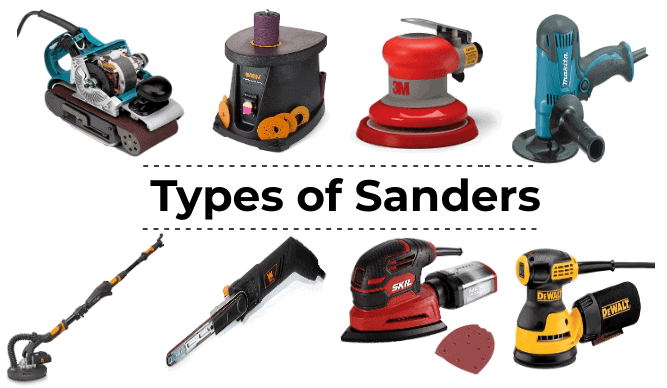
There’s one sanding problem no belt sander, sheet sander, or hand-sanding session can solve cleanly: changing grain direction. The moment you hit a section of wood where the grain shifts — a parquet floor, a piece of figured maple, a curved cabinet panel — a fixed-motion sander leaves visible cross-grain scratches that survive all the way to the finish coat.
A random orbital sander solves this by combining two simultaneous motions: the pad spins in circles and orbits in a random ellipse at the same time. That combination means no two sanding strokes ever follow the same path, which is exactly what eliminates swirl marks and produces the kind of glassy smooth surface that takes stain and finish beautifully.
But the random orbital sander market is flooded with options ranging from $35 to well over $300, and the specs manufacturers advertise — amps, OPM, RPM — rarely tell you what you actually need to know before buying. After deep research across dozens of models available on Amazon right now, I’ve selected 9 of the best across every price tier and use case: corded, cordless, finishing-focused, power-removal-focused, and everything in between.
Quick Comparison: Best Random Orbital Sanders (2026)
| Product | Type | Amps / Volts | OPM | Orbit | Pad | Best For |
|---|---|---|---|---|---|---|
| Makita BO5041K | Corded | 3.0A | 4,000–12,000 | 3.2mm | 5″ | Best Overall |
| DeWalt DCW210B 20V XR | Cordless | 20V | 8,000–12,000 | 3.0mm | 5″ | Best Cordless |
| Bosch ROS20VSC | Corded | 2.5A | 7,500–12,000 | 2.5mm | 5″ | Best for Finish Work |
| Bosch GET75-6N | Corded | 7.5A | 7,500–12,500 | 5.0mm | 6″ | Best Dual-Mode |
| Makita XOB01Z 18V LXT | Cordless | 18V | 7,000–11,000 | 3.5mm | 5″ | Best Cordless Value |
| DeWalt DWE6421K | Corded | 3.0A | 8,000–12,000 | 3.0mm | 5″ | Best Mid-Range Corded |
| SKIL SR211601 | Corded | 2.8A | 7,000–13,000 | 2.7mm | 5″ | Best for DIYers |
| Black+Decker BDCROS20C | Cordless | 20V | 12,000 | 3.0mm | 5″ | Best Cordless Budget |
| CRAFTSMAN CMEW231 | Corded | 2.4A | 8,000–12,000 | 3.0mm | 5″ | Best Budget Corded |

What to Look for in a Random Orbital Sander — What Competitors Don’t Explain
Most buying guides for random orbital sanders focus on amps and OPM, then move straight to product reviews. That skips the specs that actually determine how a sander performs on your specific project. Here’s what genuinely matters.
Orbit Diameter (mm) — The Most Ignored Spec
Orbit diameter is the single most important spec most buyers never look at — and it determines how aggressive the sander is more than amps or OPM. The orbit is measured in millimeters and describes how far the pad travels on each elliptical pass. Here’s how it breaks down:
| Orbit Diameter | Cut Rate | Finish Quality | Best Use |
|---|---|---|---|
| 2.5mm | Slow | Ultra-fine | Final finishing on furniture, hardwood, auto paint |
| 3.0–3.2mm | Moderate | Excellent | All-purpose woodworking, cabinetry, floors |
| 5.0mm | Fast / aggressive | Good | Paint/varnish removal, rough stock, deck prep |
If you want swirl-free furniture finishing, a smaller orbit (2.5mm) keeps the scratch pattern tighter and finer. If you want to strip a painted deck quickly, a 5mm orbit removes material much faster. Most general-purpose sanders fall in the 3.0–3.2mm range, which is the right call for the majority of woodworking projects.
5-Inch vs. 6-Inch Pad — Which Should You Choose?
The 5-inch pad is the right default choice for most users. Discs are more widely available on Amazon, cheaper per pack, and the smaller pad reaches closer to edges and into corners on furniture and trim work. A 5-inch sander is also lighter, making it easier to control for overhead or vertical sanding.
The 6-inch pad makes sense when you’re covering large flat surfaces — deck boards, floor panels, tabletops, large exterior siding sections. The larger pad removes material roughly 40% faster on open surfaces. The trade-off is weight, reduced edge reach, and slightly fewer disc options at the hardware store.
OPM and Variable Speed
OPM (orbits per minute) is your speed control. High OPM (10,000–13,000) removes material faster but generates more heat and is more likely to burn soft woods like pine. Lower OPM (4,000–7,000) is where finish sanding, scuff sanding between coats, and automotive paint correction live. A tool with a wide OPM range and a smooth variable-speed dial gives you far more versatility than a single-speed or three-preset-speed model.
Corded vs. Cordless — and Battery Platform Strategy

Corded sanders deliver consistent power throughout a job without worrying about battery management, and they’re typically less expensive. Cordless models give you freedom of movement, which matters on job sites and when working around large pieces. If you’re going cordless, the battery platform is critical: the DeWalt DCW210B runs on 20V MAX batteries shared with DeWalt’s drill, saw, and impact driver lineup. The Makita XOB01Z uses the 18V LXT platform. Buying into the same platform your other cordless tools use eliminates the need for separate chargers and battery purchases.
Brushless vs. Brushed Motor — When It Actually Matters
For cordless sanders, a brushless motor is a meaningful upgrade — it runs cooler, extends battery runtime per charge by 25–50%, and lasts significantly longer than brushed motors before requiring maintenance. For corded sanders, the practical difference is less dramatic since you’re not running on battery power — a high-quality brushed motor like the one in the Makita BO5041K delivers excellent performance for years with normal use. Don’t pay a premium for brushless specifically in a corded tool unless you’re buying at the professional end of the market.
Dust Collection – Three Systems Compared
Random orbital sanders use one of three dust collection approaches, and each has real trade-offs:
Onboard canister: A rigid plastic box attached directly to the sander. Convenient, always with you, but has limited capacity — you’ll empty it every few minutes on aggressive material removal. Look for a model with micron filtration (like the Bosch ROS20VSC’s ½-micron micro-filter) to capture fine dust rather than just coarse chips.
Cloth bag: Larger capacity than a canister, better for extended sessions. Less filtration than a good canister system — the bag captures coarse particles but fine dust escapes back into the air. Adequate for outdoor or garage work; not ideal for workshops or finished interior spaces.
Shop-vac port: The best option for dust control, period. Connect a shop vac or dust extractor to the sander’s port and essentially all dust is captured at the source. Mandatory for drywall sanding (fine drywall dust is a serious respiratory hazard and will clog any onboard collector instantly). All professional woodworkers working with MDF or doing interior finishing should use this method.
Hook-and-Loop vs. PSA Disc Attachment
Hook-and-loop (H&L) is the standard on every modern consumer and prosumer random orbital sander. It works like Velcro — discs attach and release in seconds. The trade-off is that H&L discs cost slightly more per disc than PSA (pressure-sensitive adhesive) alternatives.
PSA discs use a peel-and-stick adhesive backing. They’re cheaper per disc and provide very secure attachment while in use. The downside: removing them mid-grit change is slower and the backing can leave adhesive residue on the pad over time. PSA is common in body shops and production environments where grit changes are infrequent. For home woodworking where you’re moving through grit sequences, H&L is the right choice.
Dual-Mode Sanders — Is the Premium Worth It?
Dual-mode sanders like the Bosch GET75-6N offer two distinct sanding modes: standard random orbital (random spin + orbit) and turbo mode (fixed orbit only, no random element). Turbo mode is significantly more aggressive — it removes material like a belt sander in terms of speed, but in a palm-sander format. This is a genuine professional tool for stripping paint, flattening rough lumber, or removing heavy varnish fast before finishing. If your work includes both aggressive removal and fine finishing on the same projects, a dual-mode tool eliminates the need for a separate belt sander for rough work.
The 9 Best Random Orbital Sanders (2026)
1. Makita BO5041K — Best Overall

The Makita BO5041K has been the go-to recommendation among woodworkers and tool reviewers for years, and it earns the top spot here because it gets the fundamentals exactly right. Its 3-amp motor covers the full OPM range from 4,000 to 12,000, giving you genuine low-speed control for finish work and enough top-end speed for efficient material removal on hardwood and softwood alike. The 3.2mm orbit diameter is the sweet spot for all-purpose woodworking — aggressive enough to remove material efficiently, smooth enough to produce finishing-quality surfaces.
What genuinely sets the BO5041K apart from competitors at this price level is the pivoting front handle. It rotates to multiple positions so you can grip the sander two-handed in the most ergonomic position for the work at hand, or lock it out of the way entirely when working in tight corners near edges. Combined with Makita’s sealed ball-bearing construction and one of the lowest vibration ratings in its class (3.5 m/s²), this is a tool designed for extended use without hand fatigue. The dust bag has a large capacity and the built-in vacuum adapter makes it easy to connect a shop vac when working with MDF or in a finished space.

The kit version (BO5041K) includes a hard carrying case, which is genuinely useful for protecting the tool and keeping the dust bag, sanding disc, and vacuum adapter organized in the shop. The build quality feels solid throughout — this is a tool that holds up to daily professional use, not just occasional weekend projects. The one minor limitation is that the maximum speed (12,000 OPM) is slightly lower than some competitors that reach 13,000 OPM, but the difference in real-world finishing quality is negligible.
Pros
- Pivoting front handle — best two-handed ergonomics in its class
- 3.2mm orbit is the ideal all-purpose diameter for most woodworking tasks
- Wide OPM range (4,000–12,000) for both finish and material-removal work
- Low vibration (3.5 m/s²) — comfortable for long sessions
- Sealed ball bearings for long-term durability
- Kit includes hard carrying case
Cons
- Slightly lower max OPM (12,000) than some competitors
- No brushless motor (not critical for corded use)
Specs
- Type: Corded
- Motor: 3.0A
- OPM: 4,000–12,000
- Orbit diameter: 3.2mm
- Pad size: 5 inches
- Vibration: 3.5 m/s²
- Weight: 3.5 lbs
Best for: Woodworkers, furniture makers, and serious DIYers who want the most versatile all-purpose corded random orbital sander on the market.
2. DeWalt DCW210B 20V MAX XR — Best Cordless

The DeWalt DCW210B is the best cordless random orbital sander for anyone already invested in the DeWalt 20V MAX battery platform — and the most capable cordless orbital sander available at its price point regardless of platform. Its brushless motor is the key differentiator: it runs significantly cooler and longer per charge than brushed cordless alternatives, delivering 8,000 to 12,000 OPM with consistent power delivery even as the battery depletes. The 3.0mm orbit diameter is well-suited to general woodworking and finish sanding without sacrificing too much cutting speed.

The paper clamp system allows you to use standard 1/4-sheet hook-and-loop discs or secure them with the paper clamp for extra grip on aggressive passes. The onboard dust collection features a sealed dust bag and a convenient one-handed bag release for fast emptying. The variable speed dial is accessible with the thumb of your gripping hand, making OPM adjustments mid-use genuinely practical rather than requiring you to stop. It weighs 2.8 lbs bare — noticeably lighter than most corded alternatives — which makes it particularly easy for overhead cabinet work or long vertical sanding sessions.

A critical note: the DCW210B is sold as a bare tool. You need a DeWalt 20V MAX battery and charger to use it. If you already own DeWalt 20V tools, this is an outstanding pick. If you’re starting from scratch, look for the DCW210D1 kit version which includes a 2.0Ah battery and charger. For extended sanding sessions, a 5.0Ah battery is recommended — the 2.0Ah pack will run around 20–25 minutes at moderate speed before needing a charge.
Pros
- Brushless motor maximizes runtime and longevity
- Lightweight (2.8 lbs bare) — easy for extended or overhead use
- Compatible with entire DeWalt 20V MAX platform (200+ tools)
- Variable speed accessible without stopping sanding
- Clean, intuitive bag-release dust system
Cons
- Bare tool only — battery and charger sold separately
- Short runtime with 2.0Ah battery on aggressive stock removal
Specs
- Type: Cordless (20V MAX)
- Motor: Brushless
- OPM: 8,000–12,000
- Orbit diameter: 3.0mm
- Pad size: 5 inches
- Weight: 2.8 lbs (bare)
Best for: DeWalt 20V MAX platform users who want a high-performance brushless cordless sander for job sites, renovations, and workshop work without a cord in the way.
3. Bosch ROS20VSC — Best for Finish Work
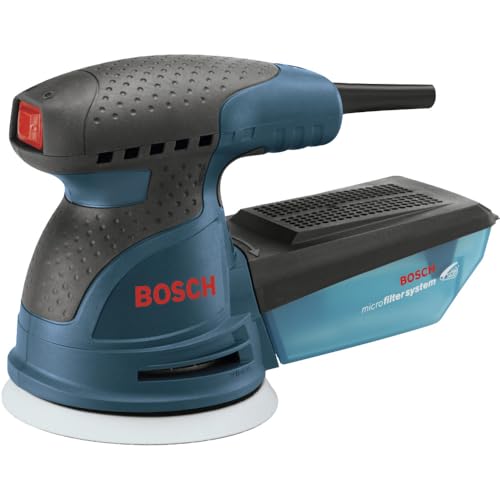
The Bosch ROS20VSC is the specialist in this lineup — a sander built from the ground up specifically to produce the finest possible surface finish with the least possible swirl mark risk. Its 2.5mm orbit diameter is the smallest in this guide, which means it removes material more slowly than the Makita or DeWalt models, but it leaves a scratch pattern so fine and tight that surfaces often require little or no additional hand-sanding before finishing. This makes it exceptional for fine furniture, hardwood cabinetry, and musical instrument repair where finish quality is everything.

The standout technical feature is Bosch’s pad dampening system — a mechanism that absorbs vibration before it transfers to the work surface, dramatically reducing the micro-chatter that causes swirl marks in other tools. On surfaces like maple or cherry where swirl marks are most visible under raking light, the Bosch consistently outperforms tools with larger orbits. The micro-filter dust canister captures particles down to ½ micron in diameter — finer than virtually any other onboard collection system at this price — making it the best choice for indoor woodworking without a separate dust extractor.

The ROS20VSC kit includes a sanding pad, sanding disc, dampening ring, dust canister, vacuum adapter, and a soft carrying bag. Speed ranges from 7,500 to 12,000 OPM via a variable dial — the lower speed end is particularly useful for scuff sanding between finish coats without cutting through the finish layer. One trade-off: the 2.5mm orbit and 2.5-amp motor make it slower at aggressive material removal than the Makita or DeWalt models. If you need to strip paint or remove significant stock, this isn’t the right tool. If you need the best possible final surface for staining or finishing, nothing at this price beats it.
Pros
- 2.5mm orbit produces the finest finish quality in this guide
- Pad dampening system actively reduces swirl marks
- ½-micron micro-filter — best onboard dust capture available
- Excellent ergonomics — compact palm design with comfortable grip
- Complete kit with carrying bag included
Cons
- Slower material removal than 3mm+ orbit competitors
- Not ideal for paint stripping or rough stock removal
Specs
- Type: Corded
- Motor: 2.5A
- OPM: 7,500–12,000
- Orbit diameter: 2.5mm
- Pad size: 5 inches
- Weight: 3.3 lbs
Best for: Fine furniture makers, cabinet finishers, and anyone whose priority is the smoothest possible surface for staining, painting, or clear-coating hardwood.
4. Bosch GET75-6N — Best Dual-Mode
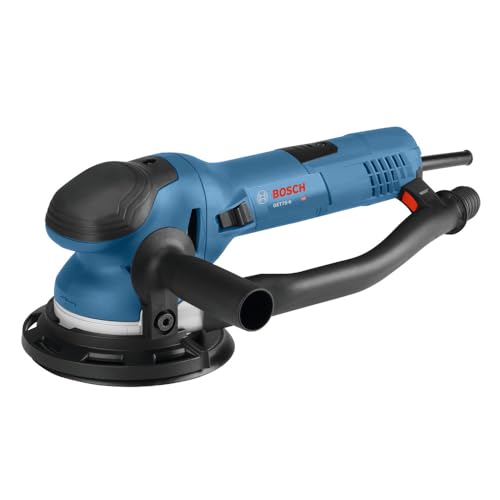
The Bosch GET75-6N is a category of its own — a professional-grade dual-mode sander that operates as both a standard random orbital sander and a dedicated turbo (gear-driven) orbital sander with a switch. In random orbital mode, it behaves like any other quality sander — the pad spins and orbits randomly for swirl-free finishing. In turbo mode, the gear drive forces the pad into a fixed orbital pattern without the random spin, which produces dramatically more aggressive material removal — comparable to a belt sander in cutting speed, but in a palm-tool format. This makes the GET75-6N genuinely two tools in one.

The 7.5-amp motor and 6-inch pad combined with the 5.0mm orbit in turbo mode creates a material removal machine for paint stripping, heavy varnish removal, rough lumber flattening, and deck restoration. Yet switching back to random orbital mode at low speed (7,500 OPM) gives you the fine finishing capability needed before applying stain or topcoat. The variable speed covers 7,500 to 12,500 OPM. Dust collection uses Bosch’s sealed vacuum port, which connects directly to a shop vac — strongly recommended given the volume of dust this tool generates in turbo mode. The 6-inch pad means faster coverage on large surfaces than any 5-inch alternative.

This is a professional-tier tool priced accordingly. It’s not the right choice for someone who just wants to sand a bookshelf — for that, the Makita BO5041K or Bosch ROS20VSC are better value. But for contractors, deck builders, flooring professionals, and serious woodworkers who handle both rough prep and fine finishing on the same projects, the GET75-6N eliminates the need for a separate belt sander for aggressive work. The build quality is exceptional — the all-metal gear housing feels indestructible.
Pros
- Dual-mode: random orbital for finishing + turbo mode for aggressive removal
- 7.5A motor is the most powerful corded sander in this guide
- 6-inch pad covers large surfaces significantly faster than 5-inch
- 5.0mm orbit in turbo mode — belt-sander-equivalent material removal
- Professional-grade all-metal gear housing
Cons
- Premium price point — significant investment over standard orbital sanders
- Heavier than 5-inch models — less comfortable for extended overhead work
- Shop vac strongly recommended (high dust volume in turbo mode)
Specs
- Type: Corded
- Motor: 7.5A
- OPM: 7,500–12,500
- Orbit diameter: 5.0mm (turbo) / random orbital mode
- Pad size: 6 inches
- Mode switch: Random orbital + Turbo
Best for: Professionals and serious DIYers who need one tool that handles both heavy paint/varnish removal and fine finishing work on large projects like decks, floors, and large furniture pieces.
5. Makita XOB01Z 18V LXT — Best Cordless Value

For woodworkers already invested in Makita’s 18V LXT battery platform, the XOB01Z is the natural cordless sander choice — and even for those not on the platform, it represents an outstanding balance of performance and value in the cordless category. The brushless motor delivers variable speed from 7,000 to 11,000 OPM and runs on any 18V LXT battery, with a 5.0Ah pack providing a full workshop session of sanding time. The 3.5mm orbit diameter sits between the fine-finish focus of the Bosch ROS20VSC and the aggressive removal capacity of the GET75-6N, making it a genuinely versatile all-purpose choice.
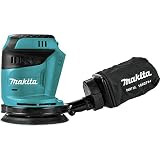
Makita’s vibration management in the XOB01Z is the best in the cordless category in this guide. The tool is engineered with an internal counterbalance that reduces vibration reaching your hand — a Makita design priority that consistently shows up in their measured vibration specs. This matters particularly for woodworkers who sand for extended periods, since cumulative vibration exposure causes hand fatigue and reduced control precision. The dust collection features a sealed bag and vacuum adapter, and the hook-and-loop backing pad accepts all standard 5-inch hook-and-loop discs. The compact, rounded body is easy to grip in either a full-palm or fingertip hold.

Like the DeWalt DCW210B, the XOB01Z is a bare tool — Makita 18V LXT batteries and charger are required and sold separately. If you’re starting fresh on the Makita platform, the Makita 18V LXT starter kit (battery + charger) is available separately on Amazon. One consideration: the XOB01Z’s top OPM (11,000) is slightly lower than the DeWalt’s 12,000 — in practice this has no meaningful impact on surface quality, but for maximum-speed material removal, the DeWalt has a slight edge.
Pros
- Brushless motor for maximum cordless runtime
- Best vibration control among cordless models in this guide
- Compatible with entire Makita 18V LXT platform (300+ tools)
- 3.5mm orbit — excellent all-purpose finishing balance
- Compact, comfortable body for extended use
Cons
- Bare tool — batteries sold separately
- Maximum OPM (11,000) slightly lower than DeWalt equivalent
Specs
- Type: Cordless (18V LXT)
- Motor: Brushless
- OPM: 7,000–11,000
- Orbit diameter: 3.5mm
- Pad size: 5 inches
- Weight: 2.6 lbs (bare)
Best for: Makita 18V LXT platform users and woodworkers prioritizing low vibration and long cordless runtime for extended sanding sessions.
6. DeWalt DWE6421K — Best Mid-Range Corded
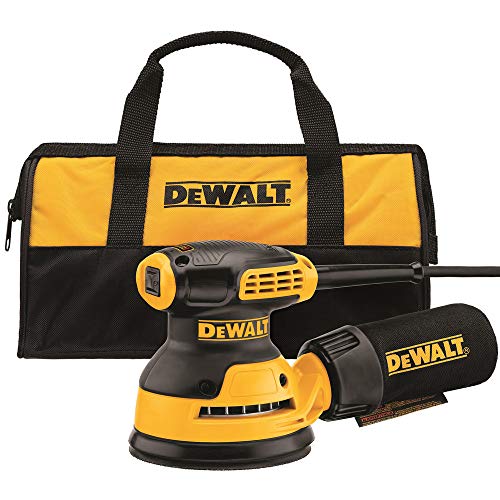
The DeWalt DWE6421K is the corded sibling to the DCW210B and delivers comparable sanding performance in a plug-in format with a complete kit at a competitive price. The 3-amp motor produces 8,000 to 12,000 OPM with a smooth variable-speed dial, and the 3.0mm orbit is well-suited to the majority of woodworking and home improvement sanding tasks. Where DeWalt has historically led Makita in the corded comparison is raw cutting speed — the DWE6421K removes material slightly faster than the Makita BO5041K at the same grit, making it the better choice for larger material-removal projects.
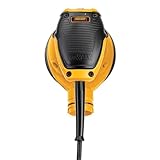
The K kit designation means this model ships with a hard carrying case, a dust bag, and a sanding disc — everything you need to start working immediately. The dust collection system uses a sealed dust bag with a quick-release latch for fast emptying. DeWalt’s hook-and-loop pad accepts all standard 5-inch H&L discs from any manufacturer. The build quality is solid throughout, with a rubberized grip that handles sweat and sawdust well during long sessions. The ergonomic palm grip is comfortable for single-hand operation, and the power switch is positioned for easy thumb access.

One notable advantage over the Makita BO5041K is the DeWalt’s dust bag capacity — it holds noticeably more before needing to be emptied, which matters on long continuous sanding sessions. The trade-off is slightly higher measured vibration than the Makita equivalent, which becomes noticeable during sessions over an hour. For most DIYers and occasional woodworkers, this is an irrelevant difference. For professionals sanding every day, the Makita’s lower vibration profile is the better long-term choice.
Pros
- Excellent material removal speed for a 3A corded sander
- Complete kit with hard case, dust bag, and disc included
- Large-capacity dust bag — fewer interruptions for emptying
- Accepts all standard 5-inch H&L discs
- Strong value for a DeWalt kit at this price point
Cons
- Slightly higher vibration than Makita BO5041K at equivalent speeds
- No pivoting front handle — single-grip palm design only
Specs
- Type: Corded
- Motor: 3.0A
- OPM: 8,000–12,000
- Orbit diameter: 3.0mm
- Pad size: 5 inches
- Weight: 3.4 lbs
Best for: DIYers and woodworkers who want a complete corded DeWalt kit with fast material removal and good dust collection at a mid-range price.
7. SKIL SR211601 — Best for DIYers
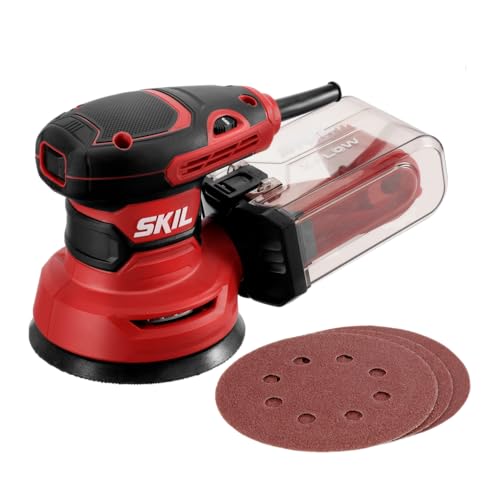
The SKIL SR211601 is the best random orbital sander for homeowners and weekend DIYers who need reliable performance without paying professional prices. At under $40 on Amazon, it delivers features that compete well above its price class — specifically the X-Flow cyclonic dust collection system, which creates a centrifugal airflow pattern inside the onboard dust container to keep the filter from clogging and maintain consistent suction throughout the session. The transparent dust box lets you see when it’s time to empty without stopping to check, which is a genuinely practical feature that most tools at this price don’t include.

The 2.8-amp motor drives a 2.7mm orbit at 7,000 to 13,000 OPM — notably, the highest max OPM of any corded tool in this guide at 13,000, though the motor lacks the torque of higher-amp models to sustain that speed under heavy load. For light-to-medium sanding tasks — smoothing furniture, preparing trim for paint, scuff sanding between finish coats, and general woodworking — the SKIL performs excellently. The variable speed dial is smooth and the tool balance is comfortable in a single-hand palm grip. SKIL includes a sanding disc and dust box with the tool.

The realistic limitations of the SR211601 are in extended heavy use. The vibration level is more noticeable than on the professional-tier tools, and the 2.8-amp motor will bog down if you apply heavy pressure on hardwood. For the DIYer who sands a few times a month for a few hours at a time, neither limitation matters in practice. For daily professional use or projects that require extended stock removal on dense hardwoods, step up to the Makita BO5041K. But for occasional home use, it’s one of the best values available on Amazon.
Pros
- Outstanding value — professional features at a budget price
- X-Flow cyclonic dust system reduces filter clogging
- Transparent dust container shows fill level at a glance
- Highest max OPM (13,000) of any corded tool in this guide
- Variable speed for finishing and material removal flexibility
Cons
- Motor bogs under heavy pressure on dense hardwoods
- More vibration than professional-tier tools
- Not suitable for sustained daily professional use
Specs
- Type: Corded
- Motor: 2.8A
- OPM: 7,000–13,000
- Orbit diameter: 2.7mm
- Pad size: 5 inches
- Weight: 3.4 lbs
Best for: Homeowners, beginning woodworkers, and occasional DIYers who want a capable, feature-rich sander for light-to-medium tasks at a budget-friendly price.
8. Black+Decker BDCROS20C 20V — Best Cordless Budget
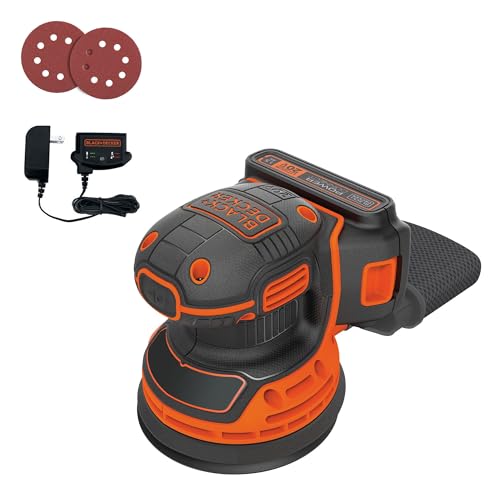
The Black+Decker BDCROS20C is the right cordless pick for homeowners who want the convenience of a battery-powered sander without the premium price of the DeWalt or Makita cordless models. Crucially, it’s available as a complete kit — the 20V 1.5Ah lithium-ion battery and charger are included in the box, so you can start sanding immediately without a separate battery purchase. This makes it significantly more accessible for buyers who don’t already own a 20V platform and just want a functional cordless sander for occasional home use.

The 5-inch hook-and-loop pad runs at a fixed 12,000 OPM — there’s no variable speed dial, which is the key trade-off at this price point. Single-speed operation means you can’t slow down for delicate finish work or scuff sanding, which limits its application primarily to general wood smoothing and paint prep rather than fine finishing work. For those specific use cases — sanding deck railings, smoothing furniture before painting, light surface prep — 12,000 OPM is perfectly adequate and the cordless convenience is a genuine advantage. The included dust bag captures coarse particles acceptably, and the molded rubber grip is comfortable for its size and weight.

The 1.5Ah battery provides around 15–20 minutes of continuous sanding at full speed — adequate for small projects but not for large surfaces. Upgrading to a compatible 20V 2.0Ah or 4.0Ah battery extends runtime significantly, and Black+Decker 20V batteries are widely available and affordable on Amazon. This is not a professional tool and isn’t designed to be — it’s a practical, affordable entry point for homeowners who want cordless convenience for light sanding work around the house.
Pros
- Complete kit — battery and charger included, start sanding immediately
- Most affordable cordless option in this guide
- Lightweight and easy to handle for home users
- Compatible with Black+Decker 20V battery ecosystem
Cons
- Single-speed (no variable control) — limits fine finishing applications
- Short runtime with included 1.5Ah battery
- Not suitable for professional or heavy-use applications
Specs
- Type: Cordless (20V MAX)
- Motor: Brushed
- OPM: 12,000 (fixed)
- Orbit diameter: 3.0mm
- Pad size: 5 inches
- Includes: 1.5Ah battery + charger
Best for: Homeowners who want cordless convenience for occasional light sanding and prefer a complete ready-to-use kit at an affordable price.
9. CRAFTSMAN CMEW231 — Best Budget Corded
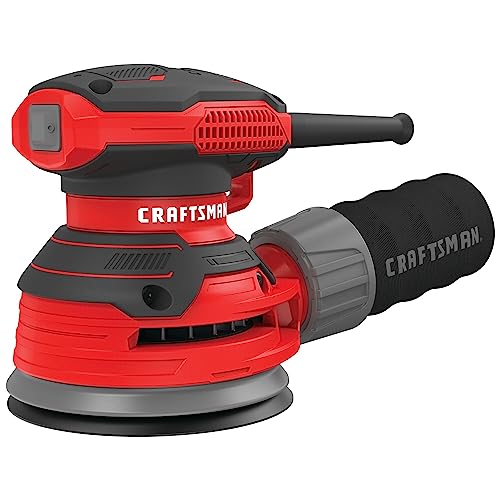
The CRAFTSMAN CMEW231 delivers the best corded random orbital sanding performance under $50 on Amazon. Its 2.4-amp motor and variable speed range of 8,000 to 12,000 OPM cover the needs of most home woodworking and surface prep tasks efficiently. Unlike the Black+Decker cordless model, the CMEW231 has a proper variable speed dial — a meaningful advantage at this price point that allows you to dial back speed for finish sanding and scuff sanding between coats, rather than being locked into a single aggressive speed.

CRAFTSMAN includes a dust bag with the tool, and the 5-inch hook-and-loop backing pad accepts all standard H&L discs. The grip design is comfortable and the switch is accessible without shifting your hand. Build quality is honest for the price — it’s solidly constructed with no rattles or flex in the housing, though the internal components won’t match the lifespan of the Makita or DeWalt professional tools. For the homeowner who sands a few times a year, the CMEW231 is an excellent investment: variable speed, reliable dust collection, and real corded power without interruptions for battery charging.

The realistic limitation is durability over extended professional use — the 2.4-amp motor will sustain performance for years of occasional home use but isn’t built for daily contractor workloads. Vibration is moderate — higher than the Makita or Bosch professional models, but entirely manageable for the 30–60 minute sessions that characterize home DIY projects. If you’re on a tight budget and need a dependable corded variable-speed sander for general home use, the CRAFTSMAN CMEW231 is the most practical choice available on Amazon at this price.
Pros
- Best value corded option — solid performance under $50
- Variable speed (unlike many budget single-speed alternatives)
- Reliable corded power — no battery management needed
- Accepts all standard 5-inch hook-and-loop discs
- CRAFTSMAN brand reliability and warranty support
Cons
- Not designed for daily professional or contractor use
- Higher vibration than professional-tier models
- Dust bag capacity is modest — frequent emptying on large projects
Specs
- Type: Corded
- Motor: 2.4A
- OPM: 8,000–12,000
- Orbit diameter: 3.0mm
- Pad size: 5 inches
- Weight: 3.1 lbs
Best for: Budget-conscious homeowners and beginning woodworkers who need a reliable, variable-speed corded sander for general surface prep and occasional woodworking projects.
Use Case Guide — Best Random Orbital Sander for Every Application
Furniture Refinishing
Fine furniture demands a small orbit and excellent finishing capability. The Bosch ROS20VSC (2.5mm orbit, ½-micron dust filter) is the top choice for hardwood tables, chairs, and cabinets where finish quality is the priority. The Makita BO5041K is the better all-rounder if the same tool also needs to handle some rough work alongside fine finishing.
Deck and Outdoor Wood
Speed and coverage matter on large flat outdoor surfaces. The Bosch GET75-6N in turbo mode covers deck boards fast with its 6-inch pad and 5mm orbit. For a more affordable corded option, the DeWalt DWE6421K provides strong material removal speed at a much lower price point.
Paint and Varnish Removal
The Bosch GET75-6N in turbo mode is the clear choice — no other tool in this guide comes close for paint stripping speed. For lighter paint removal on wood trim, the Makita BO5041K at high OPM with 60-grit discs handles it well.
Auto Detailing and Car Paint Correction
Random orbital sanders used with polishing pads are an effective and affordable alternative to dedicated dual-action polishers for car paint correction. The key is very low speed (4,000–6,000 OPM) and a soft foam polishing pad. The Makita BO5041K and DeWalt DCW210B are the best choices for this application because their wide variable-speed ranges reach the low OPM needed for safe paint correction. Always use a foam polishing pad (not sandpaper) and work through 1500-grit wet → 2000-grit wet → polishing compound → finishing polish.
Drywall Finishing
Any random orbital sander with a shop-vac port connection works for drywall — but a shop vac connection is mandatory, not optional. Drywall dust is ultra-fine, clogs onboard filters instantly, and is a serious respiratory hazard without proper capture. The DeWalt DCW210B and DeWalt DWE6421K both accept vacuum adapters.
Metal Deburring and Rust Removal
A corded high-amp sander with aluminium oxide discs handles metal work well. The Bosch GET75-6N provides the power needed for removing rust or scale from metal surfaces. Keep speeds moderate and use discs rated for metal use.
Grit Sequence Guide — The Right Order for Every Project
One of the most common mistakes beginners make with a random orbital sander is jumping too far between grits — going from 80-grit straight to 220-grit, for example. The fine paper cannot erase the scratches left by 80-grit no matter how long you sand. Each grit step only removes the scratches from the previous grit, which is why the sequence matters as much as the grits themselves.
Wood Prep for Stain (the most critical application)
Start at 80-grit to remove mill marks, previous finish, or major surface defects. Move to 120-grit to remove the 80-grit scratches. Finish with 180-grit, then 220-grit. After the 220-grit pass, wipe the surface with a tack cloth and check under raking light before applying stain. Never skip the 180-grit step — stain will reveal 80 or 120-grit scratches as dark lines running across the grain.
Paint Removal from Wood
For heavy paint or varnish: 40-grit or 60-grit first (this is where the Bosch GET75-6N turbo mode shines), then 80-grit, then 120-grit, then 150-grit before applying new finish. For light paint on softwood, you can often start at 80-grit.
Between Finish Coats (Scuff Sanding)
220-grit followed by 320-grit for scuff sanding between polyurethane, lacquer, or oil coats. The goal is just to knock down dust nibs and improve adhesion — not to remove significant material. Keep sander speed low (6,000–8,000 OPM) and use very light pressure.
Automotive Paint Correction
1500-grit wet sanding → 2000-grit wet sanding → cutting compound with foam pad → polishing compound with finishing pad → detail spray. Keep OPM at 4,000–6,000 for all stages and work in small sections (12×12 inches at a time) to monitor heat buildup.
Best Sanding Discs for Random Orbital Sanders (Amazon Picks)
The sander is only half the equation — the disc determines the cut quality, speed, and finish. Here are three disc lines worth knowing about for different applications:
Diablo 5-Inch Hook-and-Loop Multi-Packs are the best value option for general wood sanding on Amazon. Available in mixed-grit packs (80/120/180/220), they provide consistent cut quality and good disc life on both hardwood and softwood at a reasonable per-disc cost. Browse Diablo sanding discs on Amazon.
3M Cubitron II Discs use precision-shaped abrasive grains that cut faster, run cooler, and last significantly longer than standard aluminum oxide discs. They cost more per disc but outperform cheaper alternatives on hardwood, MDF, and paint removal to a degree that justifies the price for frequent users. Browse 3M Cubitron II discs on Amazon.
Mirka Abranet Mesh Discs are the professional’s choice when paired with a shop vac. The entire disc is a mesh rather than a solid abrasive sheet, meaning dust is captured through the whole disc surface rather than just through the pre-drilled holes. This produces dramatically better dust collection and keeps the abrasive surface clear for longer, extending disc life significantly. Browse Mirka Abranet discs on Amazon.
How to Avoid Swirl Marks — Pro Technique
Random orbital sanders are specifically designed to minimize swirl marks — but the wrong technique can still produce visible circular scratches in your finished surface. Here’s what causes them and how to prevent them.
Mistake 1: Too much downward pressure. This is the single most common cause of swirl marks. Pressing down hard on the sander slows the pad’s orbital motion, reduces the randomness of the pattern, and concentrates the scratch marks. Let the weight of the tool do the work. Move slowly, use light contact, and let the abrasive cut at its natural rate.
Mistake 2: Stopping the sander on the workpiece. Always lift the sander off the surface before releasing the trigger. When the pad slows to a stop while still in contact with the wood, it leaves a circular mark — the pad’s final rotation burned into the surface without the random motion to hide it.
Mistake 3: Skipping grit steps. The scratch pattern from 80-grit is deeper than 180-grit paper can remove. Work through each step: 80 → 120 → 180 → 220. Never jump more than one grit number in the sequence.
Mistake 4: Worn backing pad. A worn hook-and-loop backing pad doesn’t grip the disc evenly, which creates an uneven orbital motion and inconsistent scratch patterns. If you notice swirl marks appearing on a sander that previously produced clean surfaces, check the pad — replace it if the hooks are worn flat.
Pro technique — overlapping passes: Many professional finishers use the N-S-E-W pattern: sand north-south passes overlapping by 1/4 pad width, then sand east-west passes with the same overlap. This cross-hatch pattern ensures no area is missed and the randomness of the orbital motion is maximized across the whole surface.
Checking your surface: Before applying any finish, hold a work light or a flashlight at a very low angle (raking light) across the surface. Swirl marks that are invisible under normal lighting become clearly visible under raking light. This check takes 10 seconds and prevents discovering the problem after the finish coat has dried.
Sander Maintenance — How to Make It Last
Empty the dust canister or bag after every session. A clogged dust system doesn’t just reduce suction — it makes the motor work harder to pull air through the blocked filter, which generates excess heat and accelerates bearing wear. 60 seconds of emptying after each use adds years to your sander’s life.
Clean the micro-filter with compressed air. Fine dust embeds itself in the filter material and resists shaking out. Use a quick blast of compressed air (or a mini turbo fan cleaner) to clear the filter fibers monthly if you sand regularly. Signs of a clogged filter: reduced suction, the dust bag fills unusually slowly, or the motor sounds strained.
Inspect and replace the backing pad. The hook-and-loop pad is a wear item. Once the hooks are worn flat, sanding discs won’t grip reliably — they’ll spin off during use or orbit unevenly, causing swirl marks. Most 5-inch random orbital backing pads are inexpensive and widely available on Amazon as replacement parts. Check the pad every 3–6 months with regular use.
Store the sander pad-side up or on a shelf. Setting the sander face-down on a hard surface compresses the foam backing pad over time, which causes uneven disc contact. Store it pad-up or hang it on a hook.
Frequently Asked Questions
What’s the difference between a random orbital sander and a regular orbital sander?
A standard orbital (or “sheet”) sander moves the pad in fixed circles — the same path, every time. This predictable pattern means the pad always scratches in the same direction, leaving visible swirl marks on the surface. A random orbital sander adds a spinning motion on top of the orbital motion so no two passes follow the same path. This combination virtually eliminates swirl marks, which is why random orbital has replaced standard orbital sanders for almost all surface finishing work.
Can I use a random orbital sander for car paint polishing?
Yes — with the right setup. Replace the sandpaper disc with a foam polishing pad, set speed to 4,000–6,000 OPM, and use an appropriate polishing compound. The Makita BO5041K and DeWalt DCW210B are the best choices for this because their variable speed ranges reach the low end needed for safe paint correction. This approach won’t match a professional DA polisher for heavy paint correction, but it works well for light oxidation removal and final polish on automotive clear coat.
What orbit diameter is best for finishing wood?
A 2.5mm orbit produces the finest finish with the least risk of swirl marks — the Bosch ROS20VSC uses exactly this orbit and is the best finishing sander in this guide. For all-purpose work where you also need decent material removal speed, a 3.0–3.2mm orbit (Makita BO5041K, DeWalt models) is the better practical choice. Avoid 5mm orbit tools for finish sanding — they’re built for stock removal, not fine surface prep.
Do I need to connect a shop vac to my random orbital sander?
Not always — but it depends on what you’re sanding. For general wood sanding in a garage or workshop with good ventilation, the onboard dust bag or canister is adequate. For drywall finishing, MDF, or any work in a living space, always use the shop-vac port connection. MDF dust is ultra-fine and a serious respiratory hazard; drywall dust clogs onboard filters in seconds and floats in the air for hours. Connect a shop vac and it’s a non-issue.
How long do sanding discs last?
On typical hardwood (oak, maple), a quality hook-and-loop disc lasts roughly 15–20 minutes of continuous sanding before cutting efficiency drops noticeably. On softwood or MDF, they load up faster — especially at lower OPM speeds. Signs a disc needs replacing: it feels like it’s sliding rather than cutting, the surface temperature is rising faster than usual, or you’re applying more pressure to achieve the same result. Don’t oversand with a worn disc — you’ll generate heat that can raise grain or burn the surface.
What’s the best random orbital sander for beginners?
The SKIL SR211601 is the top pick for beginners: variable speed, excellent dust collection with the X-Flow system, transparent dust box, and a price that won’t hurt if you decide sanding isn’t your thing after all. For beginners who want to invest in a tool that’ll last for years and grow with their skills, the Makita BO5041K is worth the additional investment upfront.
Can I sand drywall with a random orbital sander?
Yes, but you must connect a shop vac. Drywall dust is calcium sulfate — a very fine white powder that becomes airborne instantly and stays suspended for hours. It will clog an onboard filter in under a minute and coats everything in the room. With a shop vac connected, drywall sanding is fast and clean. Use 100–120 grit for joint compound, and work in overlapping passes across the full joint width.
Final Verdict
The right random orbital sander depends on who you are and what you’re building. Here are the clear winners by buyer type:
- Best overall for most woodworkers: Makita BO5041K — the pivoting handle, low vibration, wide OPM range, and 3.2mm orbit make it the most versatile corded sander in this guide. It does everything well.
- Best for the finest possible finish: Bosch ROS20VSC — the 2.5mm orbit and pad dampening system produce surfaces that need almost no additional prep before finishing.
- Best for professionals and large projects: Bosch GET75-6N — the only tool in this guide that handles both aggressive paint stripping and fine finishing without a tool swap.
- Best cordless: DeWalt DCW210B for DeWalt platform users; Makita XOB01Z for Makita platform users.
- Best for beginners and home use: SKIL SR211601 (corded) or Black+Decker BDCROS20C (cordless kit with battery included).
- Best on a tight budget: CRAFTSMAN CMEW231 — variable speed, reliable dust collection, and real corded performance for under $50.
Whatever your budget, the key specs to prioritize are orbit diameter (mm) for your use case, variable speed for flexibility, and a dust collection system that matches where you work. Any of the tools on this list will serve you well for years with proper technique and maintenance.