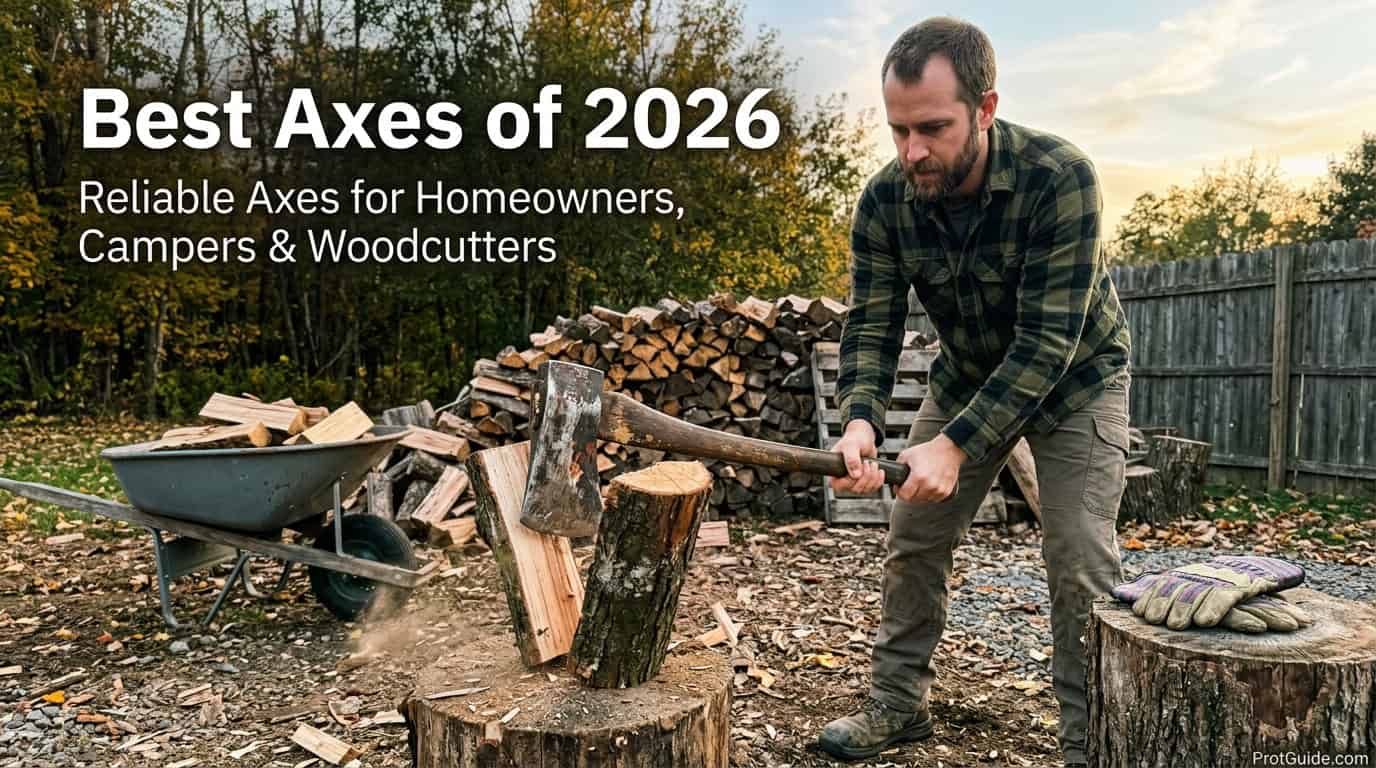
The right axe makes every swing more effective. The wrong one makes splitting a frustrating battle between you and a stubborn log that ends with a stuck blade, a tired back, and a pile of wood that looks exactly the same as when you started. The difference between those two outcomes is almost never effort – it is tool selection. A splitting axe with convex blade geometry will split the same round in one strike that a felling axe gets embedded in. A 36-inch maul makes short work of oak rounds that a 23-inch splitting axe barely dents. A 19-inch camping axe processes fireside kindling in minutes while a full-size splitting axe is overkill and a pocket knife is useless.
This guide covers all three major axe categories – splitting, camping, and chopping – with 14 specific picks across every budget. Before the product reviews, there are buying guide sections that explain the specifications that actually matter: head geometry, weight-to-log matching, handle material by scenario, and the complete Fiskars range comparison that no other guide provides in one place. These sections are worth reading before the product reviews because they will tell you which category of axe you actually need — and they will explain why one of the most expensive axes on this list, the Gransfors Bruk, and one of the least expensive, the Cold Steel Trail Boss, can both be the correct answer depending on what you’re doing.
The 5 Types of Axes – Which One Do You Actually Need?

Understanding axe types before you buy prevents the most common purchasing mistake: choosing a beautiful felling axe for splitting firewood and wondering why it gets stuck on every swing, or buying a splitting maul for camping and leaving it in the truck because it is too heavy to carry.
| Type | Head Profile | Handle Length | Primary Task | Do NOT Use For |
|---|---|---|---|---|
| Splitting Axe | Heavy wedge, convex bevel | 23–36 inches | Splitting rounds along the grain into firewood | Felling trees, limbing — the thick wedge gets stuck across the grain |
| Felling / Chopping Axe | Sharp, thin bit, long cutting edge | 24–36 inches | Cutting across wood grain: felling, limbing, bucking | Splitting firewood — the thin bit embeds in the grain instead of splitting it apart |
| Camping / Forest Axe | Medium — handles both splitting and chopping | 19–26 inches | Versatile campsite wood processing: kindling, small logs, limbing | High-volume splitting of large rounds — under-powered for serious firewood production |
| Splitting Maul | Very heavy wedge, flat poll (back) for driving wedges | 32–36 inches | Large rounds, dense hardwood, knotty grain that defeats standard splitting axes | Felling, limbing, camping carry — too heavy and the geometry is wrong for cross-grain work |
| Hatchet | Light, versatile | 10–19 inches | Kindling, small branches, bushcraft, one-handed light work | Logs over 6 inches in diameter — insufficient mass and handle length for serious splitting |
The 6 Specifications That Actually Matter When Choosing an Axe

1. Head weight and the weight-to-log-size match. This is the most important specification. Too light for the log: the axe bounces off or embeds without splitting. Too heavy for the task: you exhaust yourself swinging unnecessary mass. The matching table is in the next section.
2. Axe head geometry — convex vs. flat vs. wedge. The cross-section profile of the blade determines what happens on contact with wood. A thin, flat-ground blade (felling axe) creates a sharp edge that takes deep bites across the grain. Put it to splitting work and the flat sides create friction that holds the head in the log. A convex-ground blade (Fiskars X-series, quality splitting axes) has a rounded cross-section that pushes wood fibres outward as the head enters — converting vertical force into horizontal splitting force and allowing the head to exit cleanly. A wedge-shaped head (mauls) uses mass and taper to force wood apart behind the leading edge. Never use a felling axe for splitting. Always choose convex or wedge geometry for splitting tasks.
3. Handle length. Longer handles create more arc, more speed, and more impact force at the head — but reduce control and require more physical strength to swing accurately. The 36-inch Fiskars X27 is genuinely more effective than the 23.5-inch X17 for large rounds, but it requires more technique to use well and is unsuitable for shorter users or tight spaces. The general guide: handle length should roughly match a comfortable two-handed swing arc for your height. For most users, 24 to 30 inches is the practical sweet spot for everyday splitting; 36 inches is the power tier for high-volume work with large rounds.
4. Handle material. Hickory is the traditional choice for strength and shock absorption — superior at dampening the impact vibration from off-center strikes, and replaceable when damaged. Fiberglass (composite) is lighter, weather-resistant, requires no maintenance, and survives misstrikes without splitting. Steel one-piece construction (Estwing) is virtually indestructible but transmits the most vibration back into the hands. The scenario guide: beginners and outdoor/vehicle storage → fiberglass. Traditional preference and experienced use → hickory. Industrial durability → steel.
5. Steel type. Most quality axes use 1055, 1075, or 1080 high-carbon steel. Gransfors Bruk and Husqvarna use Swedish forge steel — hand-forged with tighter tolerances. Higher carbon content and harder heat treatment (measured in HRC — Estwing specifies 50–55 HRC, one of the hardest on the market) produce better edge retention but require slightly more effort to resharpen when they eventually dull. For most buyers, the steel specification follows the brand rather than requiring individual assessment: stick to the quality brands on this list and the steel will be adequate.
6. Blade sheath. An axe without a sheath is a safety hazard and a blade-dulling hazard in storage. Every quality axe on this list includes some form of blade protection. Gransfors Bruk includes their thick leather sheaths. Fiskars includes molded plastic blade guards. Estwing includes a sheath. Never store or transport an unprotected axe head.
Weight-to-Log-Size Matching Guide

This is the table that determines which axe actually belongs in your hand for your specific firewood situation.
| Log Diameter | Recommended Head Weight | Handle Length | Best Tool on This List | Notes |
|---|---|---|---|---|
| Under 4″ (kindling) | 1–2 lbs | 14–19″ | Fiskars X7 (14″) or X14 (14″) | Full-size splitting axes are overkill and harder to control on small pieces; a hatchet is faster and safer for kindling |
| 4–8″ (standard rounds) | 2–3.5 lbs | 23–28″ | Fiskars X17 (23.5″) or Husqvarna 26″ | The most common household splitting size; most mid-range splitting axes handle this category easily |
| 8–12″ (medium logs) | 3.5–5 lbs | 28–36″ | Fiskars X25 (28″) or X27 (36″) | Step up from the X17 here — the additional mass and handle length make a measurable difference on rounds over 8 inches |
| 12–16″ (large rounds) | 4–6 lbs | 36″ | Fiskars X27 (36″) or Gransfors Bruk Splitting Maul | The X27 handles the majority of this range; very dense hardwood (oak, hickory) may need the maul |
| Over 16″ or knotty grain | 6–8+ lbs | 36″ | Fiskars IsoCore Maul or Estwing 8 lb Maul | Standard splitting axes are under-powered; a maul or wedge-and-sledgehammer is the correct tool |
The wood species factor that the log-size table doesn’t capture: The species of the wood matters as much as the diameter. Softwoods — pine, spruce, fir, poplar, cedar — split readily at any diameter with a standard splitting axe. Ash splits cleanly despite being a hardwood. Maple, birch, and beech are moderate. Oak, hickory, and locust are difficult and benefit from a heavier axe or maul. Elm — particularly green elm — is notoriously stringy and uncooperative regardless of diameter, and a maul with a wedge is usually the most effective approach.
One additional note: green (freshly cut) wood splits more easily than seasoned (dried) wood for most species. The moisture content keeps the fibres hydrated and separable. Seasoned wood has contracted fibres that interlock more firmly — harder to split but far better for burning. If you are splitting fresh-cut rounds, a lighter axe may handle logs that would require a maul once the wood dries.
Quick Comparison — All 14 Picks
| Axe | Type | Length | Head Weight | Handle | Best For | Price | Link |
|---|---|---|---|---|---|---|---|
| Fiskars X27 | Splitting | 36″ | 4.2 lbs | FiberComp | Best overall splitting | $55–75 | → |
| Gransfors Bruk Splitting Maul | Splitting Maul | 31.5″ | ~5.5 lbs head | Hickory | Best premium splitting | $185–210 | → |
| Fiskars X17 | Splitting | 23.5″ | 2.1 lbs | FiberComp | Best budget / small logs | $35–45 | → |
| Fiskars IsoCore Maul | Splitting Maul | 36″ | 8 lbs | FiberComp IsoCore | Best heavy-duty maul | $65–85 | → |
| Husqvarna 26″ | Camping / Forest | 26″ | ~1.5 lbs | Hickory | Best overall camping axe | $40–55 | → |
| Estwing E45A Camper’s | Camping | 26″ | One-piece steel | All-steel SRG | Best durable camp axe | $45–65 | → |
| Fiskars X7 Hatchet | Hatchet | 14″ | ~1.3 lbs | FiberComp | Best ultralight camping | $25–35 | → |
| Gransfors Bruk Small Forest | Camping | 19.5″ | ~1.1 lbs | Hickory | Best premium camping axe | $145–175 | → |
| Cold Steel Trail Boss | Felling / Chopping | 27″ | ~1.8 lbs | Hickory | Best value chopping axe | $40–55 | → |
| Fiskars 28″ Chopping Axe | Chopping | 28″ | ~1.7 lbs | FiberComp | Best for beginners | $45–60 | → |
| Gransfors Bruk Outdoor Axe | Multipurpose | 23″ | ~1.1 lbs | Hickory | Best premium multipurpose | $155–185 | → |
| Fiskars X25 | Splitting | 28″ | 3.5 lbs | FiberComp | Best mid-size splitting | $50–65 | → |
| Estwing 8 lb Maul | Splitting Maul | 36″ | 8 lbs | Fiberglass | Best heavy-duty value maul | $75–100 | → |
| Fiskars X14 Hatchet | Hatchet | 14″ | ~1.3 lbs | FiberComp | Best kindling hatchet | $30–45 | → |
Best Axes for Splitting Wood
Splitting axes are built for one task: driving a wedge-shaped head along the grain of a round of wood to separate it into firewood. The critical feature that distinguishes them from felling and chopping axes is the convex blade geometry — the rounded cross-section that pushes wood fibres apart sideways on contact rather than slicing through them. Get the geometry right and the wood splits cleanly. Get it wrong and the blade buries itself and stays there.
1. Fiskars X27 Super Splitting Axe, 36″ — Best Overall for Splitting Wood
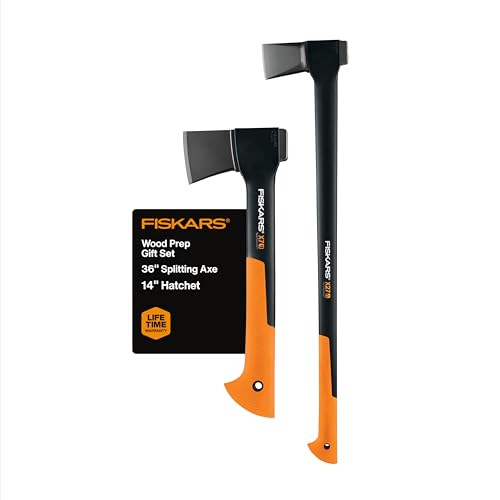
If you need one splitting axe recommendation for most men and women splitting firewood at home or on a homestead, this is it. The Fiskars X27 is the most consistently recommended splitting axe across GearJunkie, BobVila, OutdoorGearLab, and every major outdoor tool review site — not because Fiskars has the best marketing, but because the X27 genuinely delivers more one-strike splits per session than any other axe at its price point. It holds over 22,000 Amazon reviews at 4.8 stars, which is an exceptionally strong signal for a tool that buyers actually use hard. One tester at BobVila has owned the same model for over 15 years of regular use.

The technology behind the performance is Fiskars’ FiberComp handle and convex blade geometry combination. The FiberComp handle is stronger than steel per unit weight, completely weather-resistant, and uses an insert-molded head attachment that eliminates the most common failure point in traditional axes — the head working loose from the handle over time. The convex blade geometry (what Fiskars calls their “advanced bevel”) converts vertical strike force into outward splitting pressure, which is why the blade exits the wood cleanly after each swing rather than embedding. The low-friction coating on the blade face reduces drag further. Combined with the 36-inch handle that generates substantial swing arc speed, the result is an axe that multiplies human effort efficiently. The 36-inch length means this axe is best for taller users (5’9″ and above) or anyone willing to develop the technique; shorter users will find the X25 at 28 inches more manageable without sacrificing the core Fiskars geometry.

The X27 is appropriate for logs from approximately 8 inches to 14 inches in diameter. Below 8 inches, the X17 or X25 is more controllable. Above 14 inches of dense hardwood like oak or elm, the 8-pound Fiskars IsoCore Maul is the better tool. The X27 comes with a molded plastic blade guard for storage and transport, and carries Fiskars’ lifetime warranty — an unusually strong guarantee for a tool at this price point.
Specs: Type: Splitting axe | Handle: 36″ FiberComp | Head weight: ~4.2 lbs | Total weight: ~6.3 lbs | Steel: Forged carbon steel | Geometry: Convex | Warranty: Lifetime
✅ Best for: Home firewood production, logs 8–14″ diameter, users 5’9″ and taller, the single best-value splitting axe on this list.
⚠️ Not ideal for: Users under 5’8″ — the 36″ handle is difficult to control at shorter stature; the X25 is the better choice. Logs under 8″ — the X17 is more efficient at this scale.
Pros: The most field-tested splitting axe at this price; convex geometry produces clean exits without embedding; FiberComp handle survives misstrikes and outdoor storage; insert-molded head never loosens; 22,000+ reviews at 4.8 stars; lifetime warranty.
Cons: 36″ is genuinely too long for shorter users — don’t buy it and size down; overkill for small logs where the X17 is faster.
2. Gransfors Bruk Splitting Maul, 31.5″ — Best Premium Splitting Axe
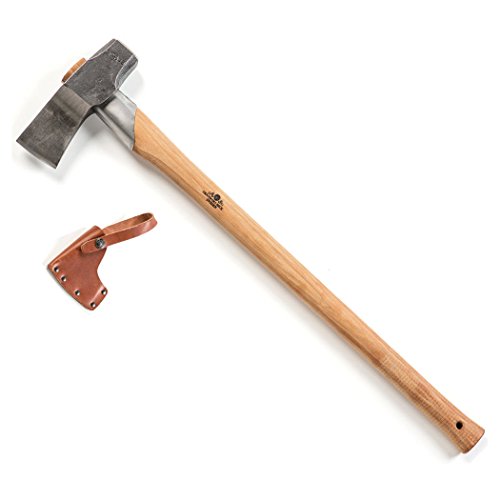
Gransfors Bruk is a Swedish forge that has been making hand-forged axes since 1902. Their Splitting Maul is what GearJunkie calls “the best of the best” for splitting wood — not as hyperbole, but as a precise assessment of what happens when a century of Swedish axe-making refinement is applied to a single purpose. Every Gransfors Bruk head is hand-forged by a named blacksmith whose initials are stamped on the head alongside the company mark. The result is a consistency and quality of steel that mass-produced axes cannot replicate, regardless of price.

The Gransfors Bruk Splitting Maul’s head design is specifically engineered to solve the two failure modes of splitting axes: embedding and bouncing. The narrow leading edge penetrates difficult wood where a blunt maul would bounce. The concave section behind the bit prevents the head from getting stuck — as the leading edge drives in, the concave geometry actively forces the wood outward rather than gripping it. The large, heavy mass of the head then completes the split as it carries through. At 31.5 inches with a quality American hickory handle, the Splitting Maul balances mass and swing arc at a length that works for a wider range of user heights than a 36-inch handle. The hickory handle absorbs the shock of hard strikes better than any composite material — a meaningful detail when you are swinging a heavy maul repeatedly.

This is the investment pick. At $185 to $210 on Amazon, it costs three to four times the Fiskars X27 for splitting performance that is genuinely superior on the most demanding wood — large-diameter oak, dense hickory, knotty rounds that defeat lighter axes. Whether that performance premium is worth the cost depends on your use frequency. For someone who splits a full cord or more per season across many years, the Gransfors Bruk’s longevity (hickory handles are replaceable; the head will outlast any owner who cares for it) and quality make it a legitimate long-term investment. For someone who splits occasionally, the Fiskars X27 at a quarter of the price is the more sensible choice.
Specs: Type: Splitting maul | Handle: 31.5″ American hickory | Head: Hand-forged Swedish steel | Geometry: Narrow bit with concave shoulders | Includes: Thick leather sheath | Warranty: Covers manufacturing defects
✅ Best for: Serious firewood producers; large rounds over 12″ and dense hardwoods; buyers who want the best axe they will ever own; multi-decade use.
⚠️ Not ideal for: Casual or occasional splitting where the Fiskars X27 delivers 80% of the performance at 25% of the cost; the hickory handle requires occasional conditioning and storage care.
Pros: Hand-forged Swedish steel head with specific blacksmith’s stamp; concave geometry solves the embedding problem on difficult wood; hickory handle provides superior shock absorption; quality leather sheath included; the one axe you buy and never replace.
Cons: Premium price — the cost is justified for frequent serious use but is genuinely excessive for occasional splitting; hickory requires more care than composite handles.
3. Fiskars X17 Splitting Axe, 23.5″ — Best Budget Splitting Axe
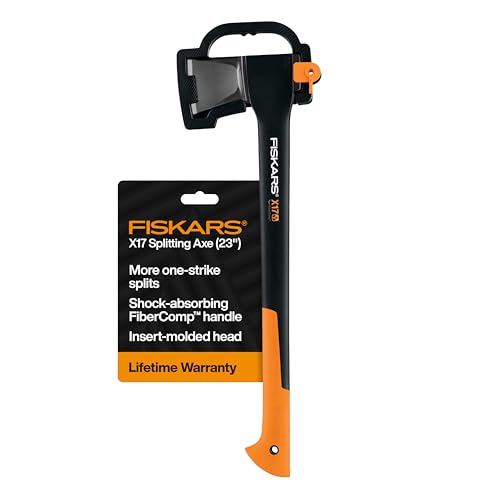
The Fiskars X17 is the entry point to the Fiskars splitting axe system — the same FiberComp handle, the same convex blade geometry, the same lifetime warranty as the X27, in a 23.5-inch format that is more manageable for shorter users, smaller logs, and tighter spaces. It is also the cheapest genuine splitting axe on this list at under $40 on Amazon, making it the obvious recommendation for anyone who wants to test whether a quality splitting axe changes their wood-processing experience without committing to a premium investment.

The 23.5-inch handle and 2.1-pound head are optimised for logs in the 4 to 8-inch diameter range — the most common dimension for kindling and everyday firewood production. The shorter handle generates less swing arc than the X25 or X27, which means less raw force, but also more control and faster stroke cycles on smaller rounds. For a backyard woodpile of softwood rounds or small hardwood splits, the X17 is genuinely the most efficient tool — the X27 is overkill at this scale and requires unnecessary effort to swing accurately on small pieces. The X17 also works well in confined spaces (wood sheds, garages, tight splits) where the full arc of a 36-inch handle is impractical.

The honest limitation: the X17 is under-powered for logs over 10 inches in diameter or dense hardwood species. On oak or hickory rounds above 8 inches, you will work harder and split less efficiently than with the X25 or X27. If you know your wood is large-diameter hardwood, step up to the X25 at a modest additional cost. If your wood is softwood or mixed small rounds, the X17 is the right call — not just the budget option, but genuinely the better tool for this specific task.
Specs: Type: Splitting axe | Handle: 23.5″ FiberComp | Head weight: 2.1 lbs | Total weight: 3.8 lbs | Steel: Forged carbon steel | Geometry: Convex | Warranty: Lifetime
✅ Best for: Logs under 8″ diameter; shorter users or confined spaces; budget-conscious buyers; first splitting axe purchase; softwood firewood production.
⚠️ Not ideal for: Logs over 10″ or dense hardwood — insufficient mass; not the right choice if you are regularly splitting large rounds.
Pros: Best price on this list for a genuine splitting axe; same Fiskars geometry and warranty as X27; most manageable handle length for varied users; efficient for everyday small to medium log splitting.
Cons: Under-powered for large-diameter hardwood — the application boundary is clear; 23.5″ generates less force than longer alternatives for the same effort.
4. Fiskars Pro 36-Inch IsoCore Splitting Maul, 8 lb — Best Heavy-Duty Maul
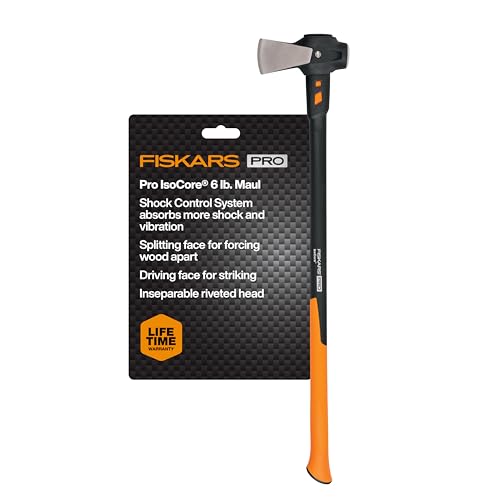
There is a category of wood that standard splitting axes cannot handle: the large-diameter, dense-grained rounds of oak, hickory, and locust; the knotty, twisted elm that fights every axe geometry; the rounds that the X27 hits twice or three times without fully splitting. For this wood, a maul is the correct answer — and the Fiskars IsoCore is the maul that combines the accessibility of the Fiskars system with 8 pounds of head weight that few rounds can resist.

The IsoCore technology is the feature that distinguishes this from a standard heavy maul. A conventional 8-pound steel head sends significant shock back through the handle into the hands and wrists with every swing — a fatigue factor that compounds across a long splitting session. Fiskars’ IsoCore system uses a shock-control insert in the handle that BobVila’s testing found reduces vibration by 4x compared to solid steel handles. Over a two-hour splitting session with hundreds of swings, this difference is meaningful for anyone’s wrists and hands. The result is a heavy-duty maul you can use for longer before fatigue degrades your technique and efficiency. The 36-inch FiberComp handle provides the full swing arc that 8 pounds of head mass needs to reach maximum splitting velocity.

The IsoCore Maul is not a beginner’s tool. At 8 pounds of head weight and 36 inches of handle, this requires physical conditioning and technique to use effectively and safely. The power it provides is proportional to the demands it places on the user. For anyone who regularly processes large hardwood rounds, it is the tool that solves the problem. For anyone splitting normal-sized softwood, it is significant overkill — use the X27 and save the energy.
Specs: Type: Splitting maul | Handle: 36″ FiberComp with IsoCore | Head weight: 8 lbs | Total weight: ~10 lbs | Steel: Forged carbon steel | Geometry: Heavy wedge | Warranty: Lifetime
✅ Best for: Large rounds over 14″ diameter; dense hardwood (oak, hickory, locust, elm); high-volume splitting sessions; when the X27 isn’t enough.
⚠️ Not ideal for: Standard-sized softwood — the weight is excessive; beginners who lack the technique to control 10 lbs of swinging mass safely.
Pros: IsoCore system reduces vibration by 4x — less fatigue on long sessions; 8 lb head handles rounds other axes cannot; Fiskars FiberComp handle survives hard use; lifetime warranty.
Cons: Heavy — requires physical conditioning and technique to use safely; 10 lbs total weight is genuinely tiring; overkill for anything under 12-inch diameter.
Best Axes for Camping
A camping axe has different requirements from a splitting axe, and buying a full-size splitting axe for camp use is one of the most common and most avoidable axe purchasing mistakes. At a campsite, you need a tool that processes fireside wood across multiple tasks — splitting kindling, processing 6 to 10-inch rounds for fire fuel, limbing small branches — while being light enough to carry and short enough to control in the varied environments a campsite presents. A good camping axe handles all of these tasks at acceptable levels. A splitting axe optimised for one task at home handles one of them brilliantly and the others poorly.
5. Husqvarna 26″ Wooden Splitting Axe — Best Overall Camping Axe

The Husqvarna 26-inch Wooden Splitting Axe is the best all-around camp and forest axe at an accessible price point. At 26 inches and approximately 2.2 pounds total weight, it sits at the sweet spot between campsite versatility and portability — long enough for two-handed use when processing 8 to 10-inch rounds for fire fuel, short enough for one-handed work on kindling and small branches, and light enough that carrying it for several miles does not become the memorable part of the trip. Swedish steel head, straight-grain hickory handle, and classic Husqvarna build quality make this a tool that looks and feels like a serious piece of equipment rather than a disposable camp purchase.
The 26-inch length represents a deliberate compromise in the camping axe category. Longer handles generate more power but make one-handed work difficult and pack carriage awkward. Shorter handles (19-inch hatchet range) sacrifice the two-handed power needed for genuine log processing. At 26 inches, the Husqvarna handles both modes adequately — which is exactly what campsite use requires. The Swedish steel head is sharp out of the box and holds an edge well through a camping season; the hickory handle absorbs the shock of occasional off-strikes without the brittleness that makes steel one-piece handles uncomfortable over extended camp days. A leather blade mask is included for safe transport.

This is the camp axe that stays in the truck bed or the base camp kit indefinitely — used regularly, maintained minimally (condition the handle annually, touch up the blade with a whetstone when it dulls), and outlasting multiple trips over multiple years. At under $55 on Amazon, it is also one of the best-value axes on this list in absolute terms. If you are buying a single camping axe and have no other specification requirements, this is the recommendation.
Specs: Type: Camping / forest axe | Handle: 26″ straight-grain hickory | Head: Swedish steel | Total weight: ~2.2 lbs | Includes: Leather blade mask | Best handle range: 26″ serves from one-handed to two-handed use
✅ Best for: Campsite firewood processing; truck or base camp kit; versatile chopping and splitting at moderate scale; users who want one quality camp axe that handles all campsite tasks.
⚠️ Not ideal for: Ultralight backpacking where every ounce matters — the X7 hatchet at half the weight is the backpacking pick; high-volume splitting of large rounds where a dedicated splitting axe is required.
Pros: The best price-to-quality ratio in the camping axe category; Swedish steel head holds a sharp edge; 26″ length covers the full range of campsite tasks; hickory handle shock absorption; leather blade mask included.
Cons: Hickory handle requires conditioning in dry climates; 26″ is too long for pack carry — this is a camp kit or truck kit axe, not a hiking pack tool.
6. Estwing Camper’s Axe, 26″ E45A — Best Durable Camp Axe

Estwing is an American tool manufacturer that has been making one-piece steel axes and hammers in Rockford, Illinois since 1923. The E45A Camper’s Axe is the product of that hundred-year commitment to a single construction philosophy: forge the head and handle from a single piece of steel so there is no attachment point to fail, wrap the handle in a leather or synthetic shock-reduction grip to address the vibration that all-steel construction transmits, and back the result with a lifetime warranty. The E45A is the axe you buy when you never want to think about handle loosening, handle replacement, or whether the axe will hold together on the next trip.

The one-piece steel construction is genuinely indestructible in practical use. You can overstrike on the handle (hitting the wood with the handle rather than the head), store it in conditions that would crack or loosen a wooden-handled axe, and drop it on rocks at a campsite without worrying about damage. The Shock Reduction Grip — Estwing’s leather-wrapped or vinyl-grip handle — absorbs a meaningful portion of the vibration that pure steel would otherwise transmit, making extended use considerably more comfortable than early all-steel axes offered. The 26-inch length provides the same versatile campsite range as the Husqvarna: two-handed power for small log processing, one-handed control for kindling and branch work.
The Estwing trades some of the shock absorption of a quality hickory handle (Husqvarna) and some of the weight savings of a composite handle (Fiskars) for the absolute mechanical reliability of monolithic construction. This trade-off is correct for specific use cases: vehicle camping where weight isn’t a concern and the axe gets thrown in the truck; users who have broken handles before and want the issue eliminated permanently; anyone who stores outdoor tools in conditions that degrade wood or composite handles. BobVila recommends it specifically for beginners for this reason — a beginner who misstrikes will not break this handle.
Specs: Type: Camping axe | Construction: One-piece forged steel | Handle length: 26″ | Grip: Shock Reduction Grip (SRG) | Made in: USA | Warranty: Lifetime
✅ Best for: Vehicle camping and truck kits; anyone who has broken handles before; beginners who want an indestructible learning tool; harsh storage conditions; the most mechanically reliable camp axe available.
⚠️ Not ideal for: Backpacking — all-steel construction is heavier than hickory or composite alternatives; extended splitting sessions where steel’s lower shock absorption becomes fatiguing.
Pros: One-piece steel construction eliminates all handle failure modes; Shock Reduction Grip addresses the vibration problem; Made in USA; lifetime warranty; the most durable camp axe on this list.
Cons: Heavier than hickory or composite-handled alternatives of the same length; steel transmits more vibration than natural hickory despite the SRG — noticeable on long use sessions.
7. Fiskars X7 Hatchet, 14″ — Best Ultralight Camping and Backpacking Hatchet
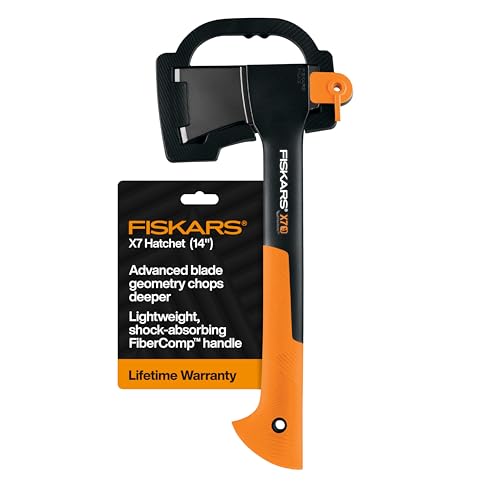
The Fiskars X7 is the pick when weight and size are the primary constraints. At 14 inches and approximately 1.4 pounds, it is the lightest tool on this list and the one most suited to backpack carry — it fits in a pack side pocket, adds negligible weight, and handles the kindling and small branch work that covers most backcountry campfire needs. The same FiberComp handle technology and convex blade geometry that make the larger Fiskars splitting axes effective are present in the X7, scaled to the hatchet form factor. The result is a small axe that performs substantially better for its size than most alternatives at this price.

The X7 is specifically designed for kindling and small-diameter work: splitting kindling from split softwood pieces, processing small branches for fire fuel, light limbing. It handles rounds up to approximately 5 to 6 inches in diameter adequately; above that, the insufficient mass and short handle make the work harder than a slightly longer tool would require. For backpacking campsites where you are processing whatever dry wood you can find at the site — fallen branches, small rounds — the X7 covers the practical range. For car camping with larger log rounds, the Husqvarna 26″ or Estwing are more capable tools.

One of the best-reviewed hatchets on Amazon with tens of thousands of reviews. The molded plastic blade guard stores securely on the head and protects both the edge and anything the axe contacts in a pack. Lifetime Fiskars warranty. Under $30 at most Amazon pricing, making it also the best-value pick on this list.
Specs: Type: Hatchet | Handle: 14″ FiberComp | Total weight: 1.4 lbs | Steel: Forged carbon steel | Geometry: Convex | Includes: Molded blade guard | Warranty: Lifetime
✅ Best for: Backpacking; ultralight camp kits; kindling splitting; small branch processing; pack carry where weight matters; budget-conscious buyers.
⚠️ Not ideal for: Logs over 6″ diameter — insufficient mass; car camping where a full camp axe is practical to carry and more capable.
Pros: Lightest and most packable axe on this list; Fiskars convex geometry and lifetime warranty; best price on this list; handles all backpacking campfire wood processing adequately.
Cons: Limited by mass and handle length — genuinely insufficient for larger rounds; 14″ handle reduces power significantly compared to 19″+ alternatives.
8. Gransfors Bruk Small Forest Axe, 19.5″ — Best Premium Camping Axe
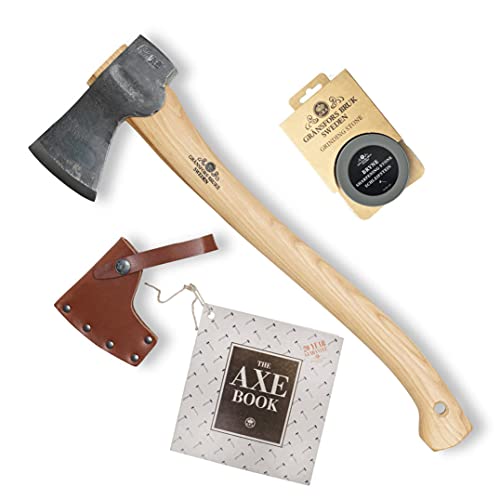
The Gransfors Bruk Small Forest Axe is the axe that experienced outdoorspeople describe as the one they will own for the rest of their lives. At 19.5 inches and 2.2 pounds total, it is compact enough to carry comfortably and precise enough for fine work — splitting kindling accurately, processing wood at camp with the control that a skilled user develops over time. The hand-forged Swedish steel head has a sharpness and edge geometry that mass-produced axes do not replicate, and the curved hickory handle provides both comfortable grip geometry and excellent shock absorption. This is the tool for buyers who understand the difference between a quality axe and a generic one and are willing to pay for it.

GearJunkie notes that the Small Forest requires more skill to use effectively than beginner-friendly alternatives like the Fiskars X7. The sharp, tapered blade takes precise bites that reward accurate strikes and can miss or glance on imprecise ones. A new axe user may find the Fiskars system more immediately effective for exactly this reason — the Fiskars convex geometry is more forgiving of imprecision. The Gransfors Bruk rewards developed technique with performance that the Fiskars cannot match. It will split large and dense firewood with surprising ease when struck correctly, and it will carve, limb, and process wood at a campsite with a precision that feels completely different from a production axe.

Like the Gransfors Bruk Splitting Maul, the Small Forest Axe includes a thick leather sheath and carries a named blacksmith’s stamp. It is the investment-tier camping axe — correct for experienced outdoorspeople who will use it regularly for decades, less correct for occasional campers who would not feel or appreciate the quality difference in weekend use.
Specs: Type: Camping / forest axe | Handle: 19.5″ curved American hickory | Head: Hand-forged Swedish steel, ~1.1 lbs | Total weight: ~2.2 lbs | Includes: Thick leather sheath | Country: Sweden
✅ Best for: Experienced outdoorspeople who will use it regularly; buyers who want an axe they will own for decades; precision campsite wood processing; the investment camping axe.
⚠️ Not ideal for: Beginners — the precision it rewards takes time to develop; occasional campers who will not perceive or justify the quality premium.
Pros: Hand-forged Swedish steel with individual blacksmith’s mark; curved hickory handle provides excellent grip geometry; sharpness and edge retention beyond production axes; quality leather sheath; the camping axe equivalent of a lifetime tool.
Cons: Premium price ($145–175) requires regular serious use to justify; rewards technique that beginners have not developed; hickory requires care.
Best Axes for Chopping Wood
Chopping wood means cutting across the grain — felling standing trees, limbing branches from a downed tree, and bucking (cross-cutting) a trunk into rounds. This is the opposite task from splitting, which runs along the grain. The axes designed for it have a thinner, sharper bit profile that takes deep bites across the grain without the thick wedge that would make them embedding in the wood. Using a splitting axe for chopping is inefficient; using a felling axe for splitting is frustrating. The picks below are optimised for cross-grain work.
9. Cold Steel Trail Boss Axe, 27″ — Best Value Chopping Axe

BobVila’s “Best Bang for the Buck” in the axe category, and the pick that proves a quality chopping axe does not require a premium price. The Cold Steel Trail Boss uses a 1055 carbon steel European felling-style head — the broad, thin-edged profile designed for taking deep cross-grain bites — on a straight American hickory handle at 27 inches. The result is a versatile felling and chopping axe that handles limbing, bucking, and clearing at a price that makes it the clear value choice in the chopping category.

The 27-inch length is close to the Husqvarna 26-inch camping axe in format, but the Trail Boss is a dedicated chopping tool rather than a camping multipurpose: the thinner felling-style bit takes more aggressive bites across the grain, making it more efficient for felling and limbing than the camping axe’s more moderate profile. The hickory handle provides the shock absorption that a chopping axe needs — felling work generates significant vibration from hard cross-grain strikes, and hickory manages this better than steel or composite handles. The straight grain on the Trail Boss handle is the quality indicator to look for: a straight-grained hickory handle is stronger and less likely to fail than cross-grained alternatives.

The Trail Boss is not a splitting tool. The thin bit that makes it excellent for felling will embed in a round when used for splitting — the geometry is specifically wrong for that task. Use the Fiskars splitting axes for firewood and the Trail Boss for the tasks it is designed for: clearing, felling, and processing felled wood into sections. At under $50, it is the best-value dedicated chopping axe on Amazon in this category.
Specs: Type: Felling / chopping axe | Handle: 27″ American hickory | Steel: 1055 carbon steel | Head: European felling profile | Weight: ~2.75 lbs total
✅ Best for: Felling, limbing, and bucking; clearing and trail work; buyers who want quality chopping performance at an accessible price.
⚠️ Not ideal for: Splitting firewood — the thin bit embeds in the grain; heavy continuous use where 1075 or 1080 steel would offer better edge retention.
Pros: Best value chopping axe on this list; 1055 carbon steel European felling head; hickory handle shock absorption; 27″ is versatile across felling and limbing tasks; under $50.
Cons: 1055 carbon steel is softer than higher-carbon alternatives — may dull faster on abrasive conditions; do not use for splitting.
10. Fiskars 28″ Chopping Axe — Best for Beginners
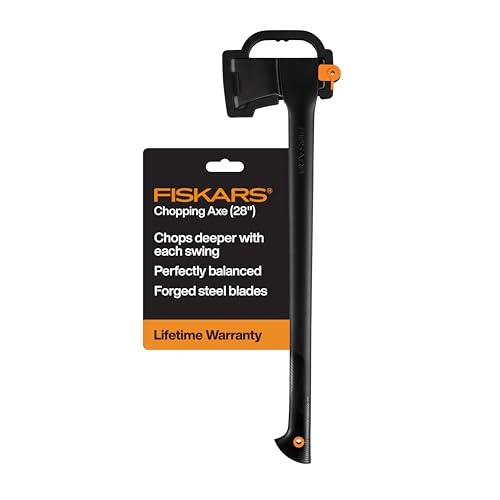
The Fiskars 28-inch Chopping Axe is BobVila’s recommended axe for beginners, and the reason is the handle: FiberComp composite that survives the misstrikes that are a normal part of learning axe technique without splitting, cracking, or requiring replacement. A beginner learning to chop will hit the handle rather than the head on a meaningful percentage of early swings. On a hickory-handled axe, repeated misstrikes weaken the handle at the neck. On the Fiskars FiberComp, the same strikes leave the handle undamaged. This is not a compromise in other respects — the forged steel head performs well, the 28-inch length is appropriately manageable for most users, and the Fiskars convex geometry provides the same clean-exit characteristic that makes all Fiskars axes more effective than their price suggests.

The 28-inch length makes this the most versatile handle length in the Fiskars chopping range — long enough for two-handed chopping power, short enough for controlled one-handed work when limbing or working in tight spaces. For a buyer who does a range of outdoor clearing, woodlot maintenance, and occasional felling, the 28-inch Chopping Axe covers the full scope without requiring specialisation. The FiberComp handle also makes this the right choice for outdoor and vehicle storage in varying climates — composite does not swell, crack, or loosen in humidity and temperature cycles the way wood does.

The Fiskars lifetime warranty applies. At $45 to $60, this sits in the same price range as the Cold Steel Trail Boss with the advantage of the indestructible handle. Choose between the two based on handle preference: hickory for traditional feel and better shock absorption; FiberComp for durability, beginner-tolerance, and weather resistance.
Specs: Type: Chopping axe | Handle: 28″ FiberComp | Steel: Forged carbon steel | Weight: ~4.0 lbs total | Warranty: Lifetime
✅ Best for: Beginners learning axe technique; outdoor/vehicle storage; clearing, felling, and limbing; buyers who want the Fiskars durability in a chopping format.
⚠️ Not ideal for: Traditional hickory preference — FiberComp cannot be reshaped or replaced; splitting firewood (chopping geometry embeds in split grain).
Pros: FiberComp handle survives learning misstrikes without damage; forged steel head performs well; 28″ versatile length; weather-resistant storage; lifetime warranty.
Cons: Cannot be re-handled if the composite is ever damaged; traditional users prefer hickory feel; chopping-specific geometry — not for splitting.
11. Gransfors Bruk Outdoor Axe, 23″ — Best Premium Multipurpose Axe
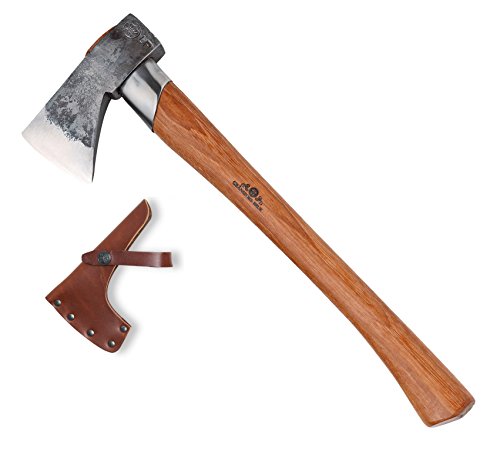
The Gransfors Bruk Outdoor Axe is the one-axe solution for buyers who want a single hand-forged Swedish tool that handles both splitting and chopping without specialisation. At 23 inches and approximately 2.2 pounds, it sits between hatchet and full-size camp axe in a format that GearJunkie recommends specifically for overlanding, camping, and professional logging use. The head is a medium-profile design — not as thin as a dedicated felling axe, not as thick as a splitting wedge — that handles both cross-grain chopping and splitting of rounds up to 10 inches with genuine competence.

Like all Gransfors Bruk products, the Outdoor Axe is hand-forged from Swedish steel by a named blacksmith, with the blacksmith’s initials stamped on the head. The quality of this steel — its edge retention, its toughness under hard use, and the consistency of the heat treatment — is what justifies the $155 to $185 price premium over production alternatives. The 23-inch length makes it versatile for one-handed and two-handed use, and the curved hickory handle geometry provides both comfort and control across varied tasks. A quality leather sheath is included.

This is the pick for buyers who refuse to compromise on tool quality, who use an axe regularly across varied tasks, and who want to own one tool indefinitely rather than a succession of cheaper alternatives. The cost calculus is the same as all Gransfors Bruk products: if you use it regularly for years, the per-use cost is competitive with anything on this list. If you use it occasionally, the Husqvarna 26-inch delivers comparable versatility at a third of the price.
Specs: Type: Multipurpose forest axe | Handle: 23″ curved hickory | Head: Hand-forged Swedish steel, ~1.1 lbs | Total weight: ~2.2 lbs | Includes: Leather sheath | Country: Sweden
✅ Best for: Regular outdoor and forestry use; buyers who want one quality axe for all tasks; overlanding and truck kit; investment-tier purchase for long-term use.
⚠️ Not ideal for: Occasional users who will not perceive or justify the quality premium; high-volume splitting where a dedicated heavier splitting axe is more efficient.
Pros: Hand-forged Swedish steel; the best multipurpose axe for both chopping and splitting in a single tool; named blacksmith quality assurance; curved hickory handle; leather sheath included.
Cons: Premium price requires frequent regular use to justify; 23″ is a compromise for both splitting and chopping — specialist tools outperform it at each extreme.
Additional Picks
12. Fiskars X25 Splitting Axe, 28″ — Best Mid-Size Splitting Axe
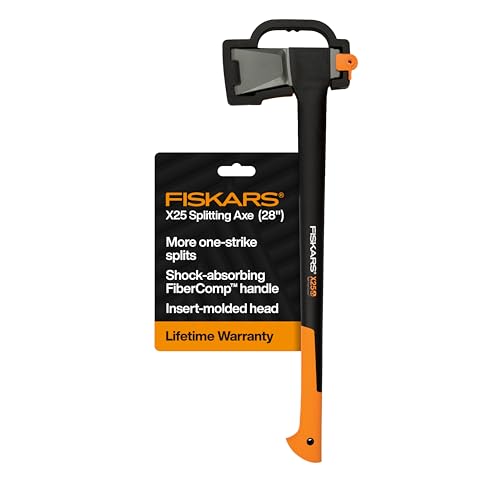
The Fiskars X25 occupies the most practically useful position in the Fiskars splitting range for most buyers: 28 inches of handle (more manageable than the X27’s 36 inches for users under 5’10”) and 3.5 pounds of head weight (more powerful than the X17’s 2.1 pounds for medium-large logs). It handles the 8 to 12-inch log range that represents the majority of everyday firewood splitting efficiently, with the same FiberComp handle, convex geometry, and lifetime warranty that define the Fiskars system. If you are average height and split mixed-size softwood and hardwood rounds, this is the Fiskars to start with.


✅ Best for: Average-height users splitting medium logs (8–12″); the most versatile Fiskars splitting axe for most buyers; users who find the X27 too long.
13. Estwing 8 lb Wood Splitting Maul, 36″ Fiberglass — Best Heavy-Duty Value Maul

The Estwing 8-pound Splitting Maul with fiberglass handle is the heavy-duty maul for buyers who want maximum hardness and durability without the Fiskars premium. The forged head is hardened to 50–55 HRC — one of the hardest steel specifications in consumer splitting tools, which translates to excellent edge retention and resistance to dulling. The fiberglass handle provides weather resistance and adequate shock absorption for maul use. At $75 to $100, it sits between the Fiskars IsoCore Maul and the Gransfors Bruk premium in price, and it delivers genuinely industrial-grade construction at that price point. The Estwing 8-pound Maul is an Amazon bestseller in the splitting maul category for good reason: it does exactly what a maul needs to do, built to last.


✅ Best for: High-volume splitting of large hardwood rounds; buyers who want maximum steel hardness; homesteaders who process large quantities of firewood regularly.
14. Fiskars X14 Universal Hatchet, 14″ — Best Kindling Hatchet
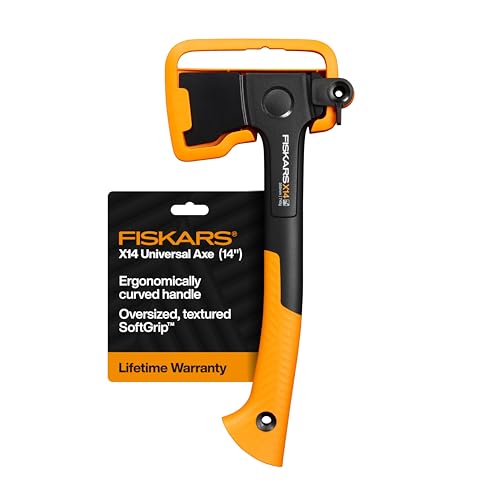
The Fiskars X14 is the dedicated kindling hatchet — optimised for limbing and splitting small pieces of dried wood into kindling. The 14-inch format matches the X7 in size but with a head profile specifically designed for limbing and kindling work rather than the pure splitting geometry of the X7. It is the natural companion to the X25 or X27 for buyers who want both a serious splitting axe for rounds and a compact kindling tool for the camp or fireside: the X27 handles the big rounds, the X14 handles the small stuff without the overkill of swinging a 6-pound axe at kindling sticks. FiberComp handle, lifetime warranty, the same Fiskars build quality throughout.
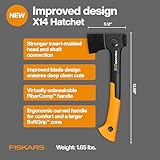

✅ Best for: Kindling splitting; campsite light work alongside a larger splitting axe; buyers who want the complete Fiskars system from kindling to large-round splitting.
Which Fiskars Axe Is Right for You? — The Complete Range Comparison
Fiskars makes five splitting axes, two chopping axes, two hatchets, and a splitting maul — all available on Amazon. The overlapping range confuses buyers who read multiple articles recommending different models. Here is the complete guide to which Fiskars belongs in which situation.
| Model | Length | Total Weight | Best For | Who It Suits |
|---|---|---|---|---|
| X7 Hatchet | 14″ | 1.4 lbs | Backpacking, kindling, ultralight camp | Backpackers; anyone for whom weight is the primary constraint |
| X14 Hatchet | 14″ | ~1.8 lbs | Kindling, limbing, campsite light work | Car campers wanting a dedicated kindling tool; complement to a splitting axe |
| X17 Splitting Axe | 23.5″ | 3.8 lbs | Small to medium logs (4–8″ diameter), shorter users, budget entry point | Users under 5’8″; confined spaces; softwood firewood; best value in the range |
| X25 Splitting Axe | 28″ | 5.0 lbs | Medium logs (8–12″ diameter) — the most versatile Fiskars | Average-height users (5’6″–5’10”); everyday mixed firewood splitting; the one to buy if you are unsure |
| X27 Splitting Axe | 36″ | 6.3 lbs | Large logs (10–16″ diameter), high-volume splitting | Taller users (5’10″+); experienced splitters; the power axe for large rounds |
| 28″ Chopping Axe | 28″ | 4.0 lbs | Cross-grain chopping: felling, limbing, bucking | Beginners learning technique; outdoor storage; felling and clearing work |
| IsoCore Splitting Maul 8 lb | 36″ | ~10 lbs | Very large rounds (14″+), dense hardwood, when splitting axes fail | High-volume hardwood splitters; anyone who regularly processes oak, hickory, large knotty rounds |
The shortcut answer for the most common buyer: If you are average height and split a mixed woodpile of small to medium rounds at home, buy the X25. If you are tall and regularly split large hardwood rounds, buy the X27. If you primarily need a camping hatchet, buy the X7. If the X27 isn’t enough, buy the IsoCore Maul.
Axe Technique — Why Your Form Matters as Much as Your Tool
The most expensive axe in the world will frustrate you if you are aiming at the wrong spot. These are the technique principles that make any axe from this list perform better immediately.
Aim at the edge, not the center. The wood fibres near the outer edge of a round have less resistance and fewer interlocking grain patterns than the center. Splitting from the outside in is consistently more efficient than attacking the middle of a solid round. Start splits at the outer edge and work toward the center on successive strikes.
Use pre-existing cracks. Checks — the natural cracks that appear in drying wood — are the grain’s natural split lines. Every check is an invitation. A strike aimed at a check requires a fraction of the force of a strike on undamaged wood. Rotate the round to find the best check before swinging.
Let the weight do the work. The most common beginner error is swinging too hard, which reduces accuracy, increases fatigue, and often embeds the axe without splitting the round. The weight of the head and the speed of the swing arc together produce splitting force. A committed, well-aimed swing at moderate effort is more effective than a maximum-effort swing that misses the optimal impact point. Trust the axe.
Control the choke-up. Gripping the handle further up toward the head (choking up) reduces the power of the swing but increases control significantly. This is useful for precise strikes, for working in confined spaces, and for accurate kindling splitting where the target is small. For full-power splitting of large rounds, grip at the base of the handle to maximise arc.
The embedded axe. When an axe buries in a round without splitting it, the problem is usually geometry (too thin a bit), wood type (very dense or knotty grain), or strike accuracy (hitting away from a check or the optimal edge position). Levering the round over while still attached to the axe and striking the ground or a splitting block with the round’s weight on the head usually dislodges both together. Do not lever the axe handle sideways — this puts lateral stress on the handle attachment that can damage composite handles over time.
Sharpening and Maintenance — Keeping Your Axe at Peak Performance
How to test for sharpness. The fingernail test: draw your thumbnail lightly across the blade edge at a perpendicular angle. A sharp axe catches the nail with immediate grip. A dull axe slides across. This test takes two seconds and is accurate. Alternatively, the paper test: hold a sheet of printer paper vertically and draw the blade edge across it; sharp blades cut cleanly, dull blades tear.
Sharpening tools and sequence. For a significantly dulled or chipped edge: a 10-inch mill bastard file restores the bevel. File from the shoulder toward the bit, maintaining the original bevel angle — approximately 25 to 30 degrees for splitting axes, 15 to 20 degrees for felling axes. File in one direction only (heel to toe). After filing, move to a whetstone (400 grit for the remaining file marks, 600 grit to refine), then finish with a leather strop loaded with honing compound for a final edge. The strop step is optional but noticeably improves cutting performance.
Handle care for hickory. Apply a light coat of raw linseed oil to the hickory handle once per season and whenever the wood feels dry or begins to show grey discoloration. Dry hickory is more likely to crack at the neck (the narrow section where the wood meets the head). Never force-dry a wet hickory handle near a heat source — rapid drying causes cracking. Store hickory-handled axes indoors or under cover where temperature swings are moderate.
When to replace the edge vs. the whole axe. A splitting axe that has been filed repeatedly loses profile over time — the blade geometry becomes progressively less efficient as material is removed. When the convex or wedge geometry of the bit has been reduced to a thin profile through many sharpenings, the axe’s splitting performance degrades regardless of sharpness. At this point on a composite-handled axe, the tool has reached practical end of life. On a hickory-handled traditional axe, the head can be re-hung on a new handle and the remaining bit still provides decades of use.
FAQ: Best Axes
What is the best axe for splitting firewood?
The Fiskars X27 (36″) is the best overall splitting axe for most buyers — consistent top recommendation across all major review sites, 22,000+ Amazon reviews at 4.8 stars, and genuine performance from its convex blade geometry and FiberComp handle. For large rounds and serious hardwood, the Gransfors Bruk Splitting Maul is the premium choice. For budget entry, the Fiskars X17 handles small to medium logs at under $40.
What is the difference between a splitting axe and a splitting maul?
A splitting axe has a lighter head (2–5 lbs) and a moderate wedge profile — suitable for most standard-diameter rounds. A splitting maul has a very heavy head (6–10 lbs), a more aggressive wedge profile, and often a flat poll for driving splitting wedges. The maul is used when a splitting axe is insufficient: logs over 14 inches in diameter, dense hardwood species, or knotty grain that resists the lighter axe. The maul takes more physical effort to swing and is overkill for everyday splitting of normal-sized rounds.
What is the best camping axe?
The Husqvarna 26″ Wooden Splitting Axe is the best overall camping axe — Swedish steel, hickory handle, 26 inches at the sweet spot between packable and capable. For backpacking where weight is critical, the Fiskars X7 Hatchet at 1.4 lbs is the pick. For the premium camping axe you will own for decades, the Gransfors Bruk Small Forest Axe is the choice.
Are Fiskars axes worth buying?
Yes — Fiskars axes consistently outperform their price point. The FiberComp handle, convex blade geometry, and lifetime warranty combine to make them the most practically capable axes in the $30 to $80 price range. The Gransfors Bruk and other hand-forged Swedish brands are better axes in absolute terms, but the quality premium requires regular serious use to justify. For most buyers, Fiskars provides the best combination of performance, durability, and value on Amazon.
What is the best axe for beginners?
The Fiskars 28-inch Chopping Axe for chopping, or the Fiskars X17 or X25 for splitting. FiberComp handles survive the misstrikes that are part of learning technique without damage — a meaningful advantage over hickory during the skill development period. Start with the X25 if you primarily need to split firewood; the 28-inch Chopping Axe if you need to fell and limb.
What is the difference between a chopping axe and a splitting axe?
The key difference is blade geometry and the direction of the wood grain relative to the cut. A chopping or felling axe has a thin, sharp bit designed to cut across the grain of wood — useful for felling standing trees, limbing branches, and bucking trunks. A splitting axe has a thick, convex wedge profile designed to force wood apart along the grain — it drives between fibres rather than cutting through them. Using a felling axe for splitting will embed the thin bit in the grain. Using a splitting axe for felling will be slow and inefficient.
How heavy should a splitting axe be?
Match head weight to log diameter: 2–3 lbs for logs under 8 inches, 3.5–5 lbs for logs 8–12 inches, 4–6 lbs for logs over 12 inches, and 6–8+ lbs maul for logs over 14 inches or dense hardwood. Heavier is not universally better — a heavier axe requires more effort to swing accurately and is less efficient on small rounds than a lighter tool with good geometry.
Is a hickory or fiberglass axe handle better?
Hickory is better for shock absorption, traditional feel, and replaceability — correct for experienced users who store axes indoors and appreciate natural materials. Fiberglass/composite is better for beginners (survives misstrikes), outdoor/vehicle storage (no swelling or cracking in weather), and low-maintenance use. Steel one-piece (Estwing) is best for absolute durability where comfort is secondary. Neither hickory nor fiberglass is universally superior — both are excellent in their appropriate context.
How do I sharpen an axe at home?
For a significantly dull edge: use a 10-inch mill bastard file to restore the bevel, filing from shoulder to bit at the original bevel angle (approximately 25–30 degrees for splitting axes). Then use a whetstone (400 then 600 grit) to smooth file marks. Optional: finish with a leather strop and honing compound for maximum sharpness. Test with the fingernail test — the edge should catch your thumbnail immediately. For maintenance between sessions, a few strokes on a whetstone followed by stropping is usually sufficient.
What is the best axe under $50?
For splitting: Fiskars X17 (23.5″, ~$40) or Husqvarna 26″ (~$45). For chopping: Cold Steel Trail Boss (~$45). For camping/backpacking: Fiskars X7 (~$30). All three are available on Amazon at these prices and deliver genuine quality at their respective tasks.
What is the best axe for hardwood like oak?
For oak and hickory rounds under 12 inches, the Fiskars X27 handles most cases. For oak rounds over 12 inches or with significant knots and irregular grain, the Fiskars IsoCore Splitting Maul (8 lb) or the Estwing 8 lb Maul is the correct tool — the additional mass is what carries through the resistance that dense hardwood presents. A splitting axe alone is often insufficient for large-diameter oak. A wedge and sledgehammer is the escalation option for rounds that defeat even a heavy maul.