A lathe is fundamentally different from every other tool purchase in a workshop — it doesn’t just determine what you can make, it determines what category of maker you’re becoming. A pen turner, a bowl turner, a furniture legmaker, and a machinist all need a lathe. They need completely different machines. The most expensive mistake in this category isn’t overspending — it’s spending $400 on a machine you outgrow in 90 days, or buying the wrong type entirely and discovering the error only after unpacking it.
This roundup covers nine products across three fundamentally different lathe types: one metal lathe (INTSUPERMAI 8×32) that serves machinists and engineers, several mini wood lathes suited to pen turning and small spindle work, midi wood lathes for the general hobbyist turning bowls and furniture pieces, and one full-size floor lathe for serious bowl turners and production work. These are not interchangeable categories.
Two decisions drive everything before any product comparison matters: metal vs. wood (completely different machines) and size class (determined by the largest workpiece diameter you plan to turn — and the answer is almost always one class larger than your first instinct). Our top picks: JET JWL-1221VS for the best overall midi wood lathe for beginners through intermediates; JET JWL 16″×40″ EVS for serious bowl turners needing full-size swing; Rikon 70-105 for the best mini lathe for pen and spindle work; and the INTSUPERMAI 8×32 as the only metalworking option in this comparison.
Table of Contents
- Introduction
- Metal Lathe vs. Wood Lathe — The Critical Distinction
- Lathe Size Classes — Which Category Matches Your Projects
- RPM Safety Formula — The Guide Every Article Buries
- Electronic Variable Speed vs. Belt-Change
- Morse Taper — The 10-Year Accessory Decision
- HP Guide — Match Motor Power to What You’re Turning
- Cast Iron and Weight — The Quality Proxy Buyers Can Use
- Quick Comparison Table
- All 9 Lathes — In-Depth Reviews
- What Can You Make — Project Guide by Lathe Size
- Essential Accessories
- Buying Guide Checklist
- FAQ
- Conclusion
Metal Lathe vs. Wood Lathe – The Critical Distinction

The INTSUPERMAI 8×32 is a metal lathe. Every other product in this roundup is a wood lathe. These are not variations of the same machine — they are fundamentally different tools that cannot substitute for each other. Understanding this distinction prevents the most expensive wrong purchase in this category.
| Factor | Wood Lathe | Metal Lathe (Engine Lathe) |
|---|---|---|
| Tool holding | Hand-held — operator guides tool against spinning work | Rigid tool post on mechanical cross-slide — no hand tool work |
| Materials | Wood, soft plastics, some composites | Steel, aluminum, brass, hard plastics |
| Dimensional precision | Artistic — operator-controlled | Mechanical — thousandths of an inch |
| Threading capability | None | Yes — lead screw cuts precise threads in metal |
| Typical RPM range | 200–4,000+ RPM | 50–2,500 RPM (slower for metal cutting) |
| Applications | Bowls, pens, spindles, furniture legs, hollow forms | Machined parts, threaded fasteners, precision cylinders, repairs |
Lathe Size Classes – Which Category Matches Your Projects
Wood lathes fall into three size classes based on swing (the maximum workpiece diameter that clears the lathe bed) and distance between centers (the maximum workpiece length for spindle turning). The right size class is determined by the largest project you plan to turn — and the right strategy is almost always to buy one class above your current plans.
| Size Class | Swing | Between Centers | Motor HP | Projects |
|---|---|---|---|---|
| Mini | 8″–10″ | 12″–18″ | 1/3–1/2 HP | Pens, knobs, bottle stoppers, small spindles, 6″ bowls max |
| Mini-Midi (14″) | 14″ | 18″–20″ | 1/2–3/4 HP | Bowls to 12″, most hobby turning, spindles and furniture pieces |
| Midi | 12″–13″ | 18″–21″ | 3/4–1 HP | Bowls to 12″, furniture spindles, rolling pins, handles, hobby production |
| Full-Size | 16″–20″+ | 37″–40″+ | 1.5–2+ HP | Large bowls, baseball bats, table legs, hollow forms, production work |
RPM Safety Formula – The Most Important Spec Every Article Buries

Most lathe articles bury the RPM safety formula or skip it entirely. It is the single most important safety and quality information for any lathe buyer, regardless of size class or budget.
6,000 ÷ workpiece diameter (inches) = Minimum safe RPM | 9,000 ÷ diameter = Maximum RPM
A large, unbalanced wood blank spinning too fast at the start of a turning session can eject from the lathe. This is not a hypothetical risk — it is the most common cause of lathe-related injuries in woodturning. Always start large blanks at the lowest safe RPM and increase only as the blank becomes balanced through initial roughing cuts.
| Workpiece Diameter | Min Safe RPM | Max RPM | Typical Use |
|---|---|---|---|
| 2″ (pens, small spindles) | 3,000 | 4,000+ | Maximum speed — pen turning and small detail work |
| 4″ (knobs, small bowls) | 1,500 | 2,250 | Normal working range for small bowls |
| 6″ (standard small bowl) | 1,000 | 1,500 | Typical bowl roughing and refining range |
| 8″ (medium bowl) | 750 | 1,125 | Requires 3/4 HP+ to maintain speed under cut |
| 10″ (large bowl) | 600 | 900 | Requires 1 HP to maintain momentum |
| 12″ (large bowl) | 500 | 750 | Why minimum RPM matters more than maximum |
| 14″+ (very large bowl) | Under 500 | 650 | Requires full-size lathe with low-speed capability |
Electronic Variable Speed vs. Belt-Change – The Workflow Difference
Most listings say “variable speed” without explaining whether this means electronic speed control or belt-change speed control. These are fundamentally different systems with different workflow implications.
Electronic Variable Speed (EVS): A variable frequency drive adjusts motor speed infinitely between the stated minimum and maximum RPM — while the lathe is running. Turn a dial; speed changes immediately without stopping the machine. Essential for bowl turning where you need to slow down for initial roughing of a large blank, speed up for refining cuts, and drop back down for finishing. The JET JWL-1221VS and JET JWL 16×40 EVS use true electronic variable speed across their full range.
Belt-Change Variable Speed: Multiple pulley positions allow different speed ranges — but changing between ranges requires stopping the lathe and manually repositioning the drive belt. Within a single belt position, speed may vary somewhat; between ranges, you must stop completely. This interrupts workflow repeatedly during bowl roughing where speed needs to change frequently as the blank becomes more balanced. Some budget lathes also use EVS within a single belt position but require belt changes for the lowest and highest speed ranges.
Morse Taper – The 10-Year Accessory Decision
The Morse taper (MT) is the tapered spindle interface in the headstock and tailstock that accepts centers, chucks, drill bits, and attachments. The size you buy today determines what accessories you can use for the life of the machine — and it has a decade-long downstream consequence that almost no buyer article explains.
MT1 (Morse Taper #1): Smaller interface — basic accessories available (spur centers, live centers, standard Jacobs chucks) but aftermarket specialty items are limited. Most of the budget entry-level mini lathes use MT1 in the tailstock. The limitation becomes apparent when you want a steady rest, hollow form mandrel, or specialty chuck — many simply aren’t available in MT1.
MT2 (Morse Taper #2): The standard for quality mini lathes and all midi and full-size machines. Full aftermarket availability — every lathe chuck manufacturer (Nova, Oneway, PSI, Teknatool), every tooling supplier, every accessory brand targets MT2 compatibility. The Rikon 70-105, JET JWL-1221VS, WEN 34035, and Grizzly T25920 all use MT2.
HP Guide — Match Motor Power to What You’re Actually Turning
| HP Range | What You Can Turn Comfortably | Where It Struggles |
|---|---|---|
| 1/3–1/2 HP | Pens, small spindles, dry softwood bowls to 6″ | Hardwoods over 6″, green wood, aggressive cuts |
| 3/4 HP | Bowls to 10″, domestic hardwoods (oak, maple, cherry, walnut) | Dense exotics, 12″+ bowls, sustained heavy cuts in dry hardwood |
| 1 HP | Bowls to 12″–14″, hardwoods and figured woods, hobby production | Very large green blanks, heavy commercial production volumes |
| 1.5–2 HP | Large bowls, green wood, furniture production, all domestic hardwoods at scale | Limited only by machine swing capacity, not motor |
Wood species note: Pen turners working with domestic woods need 1/2 HP. Bowl turners working with dense exotics (ebony, cocobolo, rosewood) or large green wood blanks need 1 HP minimum to maintain speed under the cutting load without stalling. Green (wet) wood is actually easier to cut but requires lower speeds and more attention to blank ejection risk from moisture-softened grain that can let the drive center slip.
Cast Iron and Weight — The Quality Proxy Every Buyer Can Use
When comparing two lathes with similar stated specifications, the heavier one almost always uses more cast iron in the headstock, bed, and tailstock — and it will vibrate less under load. Cast iron construction can reduce vibration by up to 78% compared to aluminum alternatives. Vibration matters for two reasons: it produces chatter marks (visible ridges) on the finished surface requiring additional sanding, and at high speed with large unbalanced blanks, it creates a safety concern as the lathe shifts on the bench.
The weight proxy rule: A 50 lb benchtop lathe vibrates noticeably under a 10″ bowl blank. A 100 lb benchtop lathe of similar size handles the same blank smoothly. Extra weight in a lathe is always good weight — it’s mass absorbing vibration that would otherwise travel into your workpiece and your hands. When in doubt between two similarly priced lathes, choose the heavier one.
Quick Comparison Table — All 9 Lathes
| # | Product | Type | Swing | Centers | Motor | Speed | EVS? | Best For | Link |
|---|---|---|---|---|---|---|---|---|---|
| 1 | INTSUPERMAI 8″×32″ Metal | Metal Lathe | 8″ | 32″ | Variable | 50–2,500 RPM | — | Machinists, metalwork, threading | Amazon |
| 2 | JET JWL 16″×40″ EVS | Full-Size Wood | 16″ | 40″ | 1.5 HP | 40–3,800 RPM | Yes | Large bowls, furniture, production | Amazon |
| 3 | JET JWL-1221VS | Midi Wood | 12″ | 21″ | 1 HP | 60–3,600 RPM | Yes | Best overall — pens to 12″ bowls | Amazon |
| 4 | VEVOR 1 HP Benchtop | Midi Wood | ~13″ | ~20″ | 1 HP | 700–2,600 RPM | Yes | Budget midi — note 700 RPM min | Amazon |
| 5 | WEN 34035 14″×20″ | Mini-Midi Wood | 14″ | 20″ | 6-Amp | 580–3,200 RPM | Yes | Best value 14″ swing on Amazon | Amazon |
| 6 | Rikon 70-105 10″×18″ | Mini Wood | 10″ | 18″ | 1/2 HP | 250–3,750 RPM | No (5-speed) | Best mini — pens, spindles, MT2 | Amazon |
| 7 | Laguna Revo 10|14 | Mini-Midi Wood | 10″ | 14″ | — | Variable | Yes | Premium compact — Laguna brand quality | Amazon |
| 8 | WM101A-Plus Mini Wood Lathe | Mini Wood | 8″–10″ | — | Low | Variable | Yes | Entry-level / absolute beginner | Amazon |
| 9 | Grizzly T25920 12″×18″ | Midi Wood | 12″ | 18″ | 3/4 HP | 300–3,700 RPM | Yes (belt) | Budget midi with DRO — good value | Amazon |
All 9 Lathes — In-Depth Reviews
1. INTSUPERMAI 8″×32″ Precision Benchtop Metal Lathe — Best for Machining and Metalwork
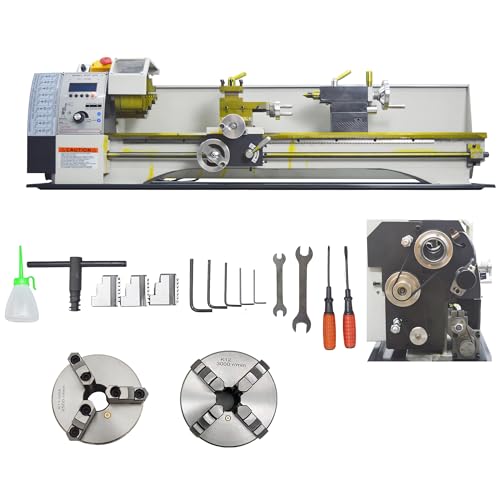
Type: Metal Engine Lathe | Swing: 8″ over bed | Bed Length: 32″ | Speed Range: ~50–2,500 RPM | Features: Cross-slide, compound rest, lead screw, threading capability | Material: Metals, hard plastics | Price Range: $$–$$$
The INTSUPERMAI 8×32 is the machinist’s bench tool that belongs in a different category entirely from the wood lathes in this roundup — and understanding what it does well immediately clarifies who should buy it. With a 32-inch bed and 8-inch swing, it handles a substantial range of metalworking tasks: turning down bar stock to specified diameters, boring holes to precise dimensions in aluminum and mild steel, cutting internal and external threads with the lead screw, facing operations for flat parallel surfaces, and precision cylindrical turning for mechanical repair and custom parts fabrication.

The cross-slide and compound rest assembly is the defining feature of a metal lathe — the cutting tool is held rigidly in a tool post mounted on a mechanically controlled carriage that moves parallel to or perpendicular to the spindle axis. This mechanical rigidity is what enables dimensional accuracy to thousandths of an inch. Speed ranges from approximately 50 to 2,500 RPM across multiple belt positions — metal turning requires much lower speeds than wood turning because cutting speeds in metal are measured in surface feet per minute (SFPM) and harder materials cut at lower RPM to prevent tool overheating and workpiece damage.

Who this is for: Machinists and engineers who need to machine custom metal parts, repair equipment, cut threads, or perform precision turning operations in a home shop or small professional shop. Model engineers, gunsmiths, and anyone who works with mechanical systems regularly will recognize the immediate utility of a benchtop metal lathe.
Pros:
- 32″ bed provides substantial working capacity for a benchtop metal lathe
- Cross-slide and compound rest enable precision dimensional control to thousandths of an inch
- Lead screw threading capability — cuts standard and metric threads in steel and aluminum
- Variable speed range covers the full spectrum of metalworking cutting speeds
- Fills the precision metalwork gap no wood lathe in this roundup can address
Cons:
- Not a wood lathe — cannot be used for bowl turning, pen turning, or any woodturning
- Requires metalworking knowledge and safety practices different from woodturning
- Benchtop metal lathe rigidity is lower than floor-standing industrial equivalents
Best For: Home machinists, engineers, model makers, and repair technicians who need to turn metal parts to precise dimensions, cut threads, and perform machining operations that require mechanical tool control beyond hand-held woodturning techniques.
2. JET JWL 16″×40″ EVS Variable Speed Woodworking Lathe — Best Full-Size for Serious Bowl Turners
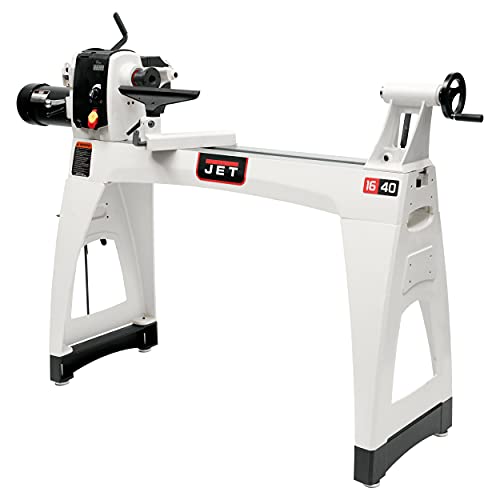
Type: Full-Size Wood Lathe | Swing: 16″ over bed | Between Centers: 40″ | Motor: 1.5 HP | Speed: 40–3,800 RPM (EVS) | Speed Control: Electronic Variable Speed | Morse Taper: MT2 | Voltage: 115V, 1Ph | Warranty: 5 years | Price Range: $$$$
The JET JWL 16×40 EVS is the machine that serious bowl turners eventually arrive at — after a mini lathe and a midi lathe and the discovery that 12″ isn’t quite enough swing for the large bowl blanks they want to turn. The 16″ swing provides practical clearance for 14″–15″ bowl blanks; the 40″ between centers handles full baseball bat blanks, large architectural spindles, and extended furniture turning. The 1.5 HP motor maintains consistent speed through aggressive roughing cuts in dense hardwoods and large green wood blanks where a 1 HP midi lathe would bog down or stall.

The electronic variable speed range of 40–3,800 RPM is the most important specification on this machine: 40 RPM at the bottom end means you can safely start a 16″ rough-turned blank with significant imbalance — far below the 250 RPM minimum of the Rikon mini lathe and the 60 RPM of the JWL-1221VS. Properly using this range requires discipline: always start at the lowest practical speed for a new blank, verify balance, and increase gradually. The EVS dial changes speed without stopping the lathe, which is essential for the transition from roughing (low speed) to refining (medium speed) to finishing (higher speed) in a single turning session. JET’s 5-year warranty is the strongest in this roundup and reflects genuine manufacturer confidence in the drivetrain.

Who will outgrow this machine: Almost nobody at the hobbyist level. The JET 16×40 EVS is the machine most turners keep indefinitely once they reach this size class. The only upgrade path is a Powermatic 3520B or Oneway 2436 — machines at 4–5× the price for professional production work.
Pros:
- 16″ swing provides practical clearance for 14″–15″ finished bowl diameter
- 40 RPM minimum — safely starts very large, unbalanced blanks at speeds below any midi lathe
- 1.5 HP motor maintains speed through aggressive cuts in large hardwood blanks
- 40″ between centers handles baseball bats, large architectural spindles, extended furniture turning
- 5-year JET warranty — strongest coverage in the roundup
Cons:
- Significant floor space requirement — not a benchtop machine; needs dedicated workshop floor position
- Highest price in the wood lathe section — substantial investment
- Heavier and less portable than benchtop alternatives — commitment to a permanent workshop position
Best For: Serious bowl turners who regularly need to turn pieces over 12″ in diameter, furniture makers working with long spindle stock, and anyone ready to make the investment in a machine they won’t need to upgrade for a decade.
3. JET JWL-1221VS 12″×21″ Variable Speed Woodworking Lathe — Best Overall for Beginners to Intermediates

Type: Midi Wood Lathe | Swing: 12″ over bed | Between Centers: 21″ | Motor: 1 HP | Speed: 60–3,600 RPM (EVS) | Speed Control: Electronic Variable Speed | Morse Taper: MT2 headstock and tailstock | Reverse: Yes | Weight: ~121 lbs | Warranty: 5 years | Price Range: $$$
The JET JWL-1221VS is the Editor’s Choice recommendation across virtually every independent wood lathe review — and it earns that position consistently because it gets every important specification right simultaneously: 1 HP motor that handles hardwoods and bowls to 12″ without stalling, 60 RPM minimum for safe large blank startup, 3,600 RPM maximum for pen finishing work, true electronic variable speed that changes while running, 21″ between centers for rolling pins and furniture legs, MT2 tapers in both headstock and tailstock, forward and reverse rotation, and a 121 lb cast iron frame that dampens vibration to the point where bowl turning at 1,000 RPM feels solid and controlled rather than anxious.

The 60 RPM minimum is worth emphasizing specifically: this is far lower than the VEVOR’s 700 RPM minimum, and it means you can safely start an unbalanced 12″ bowl blank that would be dangerous to mount on a faster-minimum lathe. The reverse function is practically useful for sanding — running the lathe in reverse with abrasive removes tool marks that sand in one direction can leave in the grain. The 5-year JET warranty matches the full-size JWL 16×40 EVS and represents genuine confidence in the platform’s durability. This is the machine most turners who start on a mini lathe wish they had bought first.

RPM safety check: 60 RPM minimum means you can safely start 12″ blanks (minimum safe = 500 RPM — but starting at 60 and building up is the correct technique). The 3,600 RPM maximum handles 2″ pen blanks comfortably at minimum safe RPM of 3,000.
Pros:
- 60 RPM minimum — safe startup for large, unbalanced bowl blanks up to 12″
- True EVS across the full 60–3,600 RPM range — no belt changes required
- 1 HP motor — handles domestic hardwoods and 12″ bowls without stalling
- MT2 both ends — full aftermarket accessory compatibility for the life of the machine
- Forward and reverse — useful for sanding and accessory operations
- 5-year JET warranty — the strongest coverage in the midi category
Cons:
- 12″ swing limits practical bowl diameter to approximately 10″–11″ due to banjo interference
- Premium pricing compared to Grizzly and VEVOR alternatives at this size class
Best For: Any woodturner from beginner to intermediate who wants one midi lathe they won’t need to replace — the correct first serious lathe purchase for anyone committed to the craft beyond a brief trial period.
4. VEVOR Wood Lathe 6-Amp 1 HP Benchtop — Best Budget Midi with Important Caveats
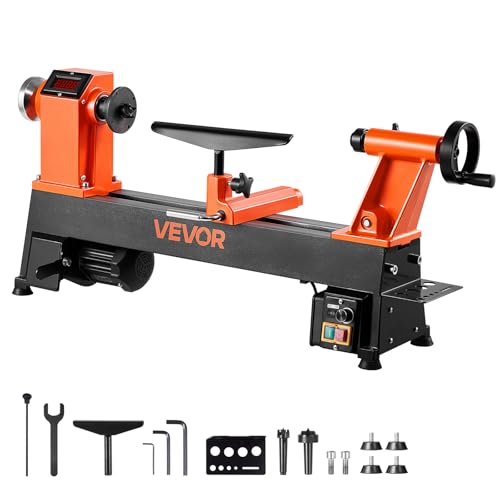
Type: Midi Wood Lathe | Swing: ~13″ over bed | Motor: 6-Amp / 1 HP | Speed: 700–2,600 RPM | Speed Control: Electronic Variable Speed | Weight: Lower than JET equivalent | Price Range: $$
The VEVOR 1 HP benchtop offers genuine 1 HP motor power at a price point that undercuts the JET JWL-1221VS significantly — making it the go-to recommendation for buyers who need midi HP but have a constrained budget. The 1 HP motor handles domestic hardwoods (walnut, oak, maple) in the 8″–10″ bowl range with adequate torque, and the electronic variable speed system eliminates belt-change interruptions. The larger stated swing vs. the JET is a marketing advantage that doesn’t fully translate in practice — vibration characteristics on the VEVOR under large blanks are less refined than the heavier cast iron JET construction, and the 700 RPM minimum is a genuine bowl-turning limitation.

For the buyer whose primary projects are pen turning, small spindle work, and occasional 6″–8″ bowls in softer domestic hardwoods, the VEVOR’s limitations don’t manifest in daily use. For the buyer who specifically wants to turn 10″–12″ bowl blanks from rough green or unbalanced dry lumber — the 700 RPM minimum is the wrong specification for safe startup procedure, and the JET JWL-1221VS is the correct machine regardless of budget preference. The VEVOR is a reasonable choice; it’s just the right choice for a specific use profile rather than a universal recommendation.

RPM safety check: 700 RPM minimum is adequate for blanks up to approximately 8.5″ (6,000 ÷ 8.5 = 706 RPM). For 10″+ blanks, the safe minimum of 600 RPM is below what this lathe can reach — start at the lowest available speed and proceed with extra caution on any large blank.
Pros:
- 1 HP motor at budget pricing — genuine mid-range power for under-budget buyers
- Electronic variable speed — no belt changes required within the 700–2,600 RPM range
- Larger swing than JET JWL-1221VS (by marketing spec)
- Good value for buyers primarily turning pens, small spindles, and 6″–8″ bowls
Cons:
- 700 RPM minimum — cannot safely start large (10″+) unbalanced blanks at recommended minimum RPM
- Lower cast iron weight than JET alternatives — more vibration under large, unbalanced blanks
- Less refined construction finish than premium brands at similar swing specs
Best For: Budget-conscious woodturners whose primary work is pen turning, small spindle work, and occasional 6″–8″ bowls in softer domestic woods — and who want 1 HP motor power at the lowest possible price point.
5. WEN 34035 6-Amp 14″×20″ Variable Speed Benchtop Wood Lathe — Best Underrated Value Pick

Type: Mini-Midi Wood Lathe | Swing: 14″ over bed | Between Centers: 20″ | Motor: 6-Amp | Speed: 580–3,200 RPM (EVS) | Speed Control: Electronic Variable Speed | Morse Taper: MT2 | Price Range: $$
The WEN 34035 is the hidden gem in this roundup — a 14″ swing variable speed benchtop lathe at a price that competes with 10″–12″ swing alternatives. The 14″ swing positions it firmly between standard mini and standard midi, with practical bowl capacity for pieces up to approximately 12″–13″ in diameter. The 580 RPM minimum is meaningfully lower than the VEVOR’s 700 RPM — it safely starts unbalanced blanks up to approximately 10″ (580 RPM ÷ 6,000 = 10.3″ workpiece diameter at minimum safe speed), giving it better large-blank safety characteristics than the VEVOR despite similar pricing.

The 6-amp motor is not rated in horsepower on the product page — at 720W equivalent, it sits approximately between 3/4 HP and 1 HP in practical output. Independent testing by woodturning community members confirms it handles 12″ walnut bowl blanks with deliberate, controlled cuts, though sustained aggressive roughing of large green wood blanks pushes it harder than a dedicated 1 HP machine. The MT2 taper in both headstock and tailstock is the correct accessory compatibility standard — all standard chucks, centers, and specialty attachments will fit without adapter complications. For buyers who want 14″ swing capacity at mid-range pricing without stepping up to the full-size JET, the WEN 34035 deserves serious consideration.

Pros:
- 14″ swing at mid-range pricing — the largest benchtop swing per dollar in this roundup
- 580 RPM minimum — better large-blank safety characteristics than the VEVOR
- MT2 tapers — full aftermarket accessory compatibility
- EVS eliminates belt changes — smooth speed adjustment while running
- 20″ between centers handles most hobby spindle work
Cons:
- Motor HP not explicitly stated — approximately 3/4–1 HP equivalent; less sustained power than explicit 1 HP machines under heavy continuous load
- WEN brand has less dealer and service support than JET or Grizzly
- Not the right choice for sustained heavy roughing of large green wood blanks
Best For: Hobbyists wanting 14″ swing capability at mid-range pricing — the correct pick when maximum swing-per-dollar is the primary decision factor and bowls up to 12″ are the target project size.
6. Rikon Power Tools 70-105 10″×18″ 1/2 HP Mini Lathe — Best Mini Lathe for Pens and Spindles
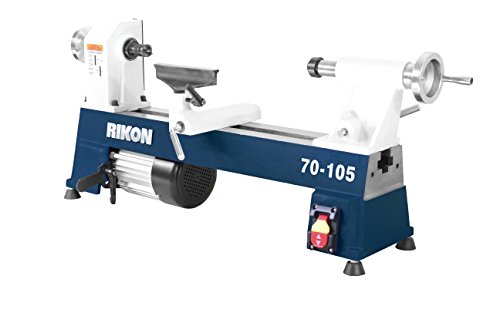
Type: Mini Wood Lathe | Swing: 10″ over bed | Between Centers: 18″ | Motor: 1/2 HP | Speed: 250–3,750 RPM (5-speed manual) | Speed Control: Belt-change (5 positions) | Morse Taper: MT2 both ends | Indexing: Yes (24-position) | Price Range: $$
The Rikon 70-105 is the best-regarded mini lathe in the woodturning community for one reason more than any other: it uses MT2 tapers in both the headstock and tailstock where most competing mini lathes at this price use MT1. This single specification makes the Rikon the correct starting mini lathe for any woodturner who plans to grow their accessory collection — you won’t need to replace chucks, centers, or live centers when you eventually upgrade to a midi machine, because MT2 is the standard across all quality lathes.
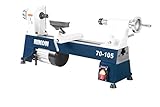
The 1/2 HP motor and 10″ swing are appropriate for the Rikon’s intended use case: pen turning is its standout application. The smooth operation and stable tailstock allow turning down to diameters under 1/4″ without chatter — critical for pen barrel work where precision matters and vibration shows immediately in surface finish. The 24-position indexing mechanism opens up decorative work (fluting, reeding, equally spaced features) that requires accurate angular positioning — an unusual feature at this price tier. The 5-speed belt-change system (250–3,750 RPM across five positions) is the limitation vs. EVS alternatives — changing speed requires stopping and moving the belt, but for pen turning where one speed setting often serves an entire session, this interruption rarely matters in practice.
RPM safety check: 250 RPM minimum is excellent for a mini lathe — it safely starts bowl blanks up to 24″ (well beyond the 10″ swing capacity), meaning the minimum speed is never the limiting factor. The 3,750 RPM maximum handles 2″ pen blanks comfortably within the safe range.
Pros:
- MT2 both ends — the critical accessory compatibility specification that sets this apart from MT1 competing mini lathes
- 250 RPM minimum — safely starts blanks well beyond the lathe’s own capacity; never the limiting factor
- 24-position indexing — enables decorative fluting and reeding work unusual at this price tier
- Smooth stable operation — pen turning to under 1/4″ diameter without chatter
- Strong Rikon brand reputation in the mini lathe category
Cons:
- Belt-change speed control — must stop lathe to change speed range; interrupts workflow vs. EVS
- 1/2 HP and 10″ swing limit to mini-scale projects — not a bowl turning machine
- Many buyers outgrow this within 6–12 months of discovering bowl turning
Best For: Pen turners, small spindle workers, and beginners who are confident their primary interest is small precision work — and want MT2 compatibility to protect their accessory investment when they eventually expand to a larger machine.
7. Laguna Revo 10|14 Benchtop Lathe — Best Premium Compact Lathe
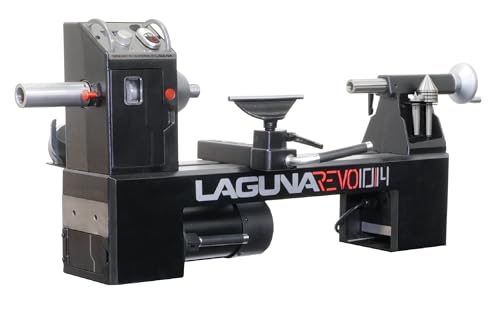
Type: Mini-Midi Wood Lathe | Swing: 10″ over bed | Between Centers: 14″ | Speed Control: Variable | Brand Heritage: Laguna Tools — professional woodworking brand | Price Range: $$$
Laguna Tools carries one of the most respected names in professional woodworking machinery — their full-size Revo series (Revo 18|36, Revo 24|36) are benchmarks in the serious turning market. The Revo 10|14 brings Laguna’s design philosophy to a compact benchtop format: premium build quality, thoughtful ergonomics, and the brand support infrastructure that makes Laguna tools worth the premium for buyers who view tool quality as a long-term investment rather than a cost-minimization exercise. The 10″ swing and 14″ between centers position it in the mini-to-compact-midi range — smaller between centers than most competitors at this price, which limits spindle work length but keeps the footprint genuinely compact.

Laguna’s engineering pedigree shows in the details: the anodized aluminum construction elements, precision-machined spindle, and refined control placement reflect a tool designed by people who use lathes professionally rather than speced by a marketing team targeting a price point. For buyers who are serious about the craft and want a compact lathe with premium heritage — perhaps as a precision complement to a larger floor lathe — the Revo 10|14 is the correct choice. For buyers who want maximum practical turning capacity per dollar in the compact category, the Rikon 70-105 or WEN 34035 offer more between-centers distance at lower cost.

Pros:
- Laguna Tools brand heritage — professional woodworking manufacturer with genuine dealer and service support
- Premium build quality and finish above competing mini/compact lathes
- Compact footprint — genuinely space-efficient benchtop machine
- Laguna’s reputation in turning circles means strong community knowledge and support
Cons:
- 14″ between centers is the shortest in the roundup — limits spindle and furniture turning length
- Premium price premium for brand heritage vs. purely utilitarian competitors
- 10″ swing limits bowl work to approximately 8″–9″ practical diameter
Best For: Woodturners who prioritize build quality, brand reputation, and Laguna’s professional heritage over maximum specifications per dollar — and want a compact premium lathe either as a primary small machine or as a precision complement to a larger floor lathe.
8. WM101A-Plus Mini Wood Lathe Machine — Best True Entry-Level Beginner Lathe
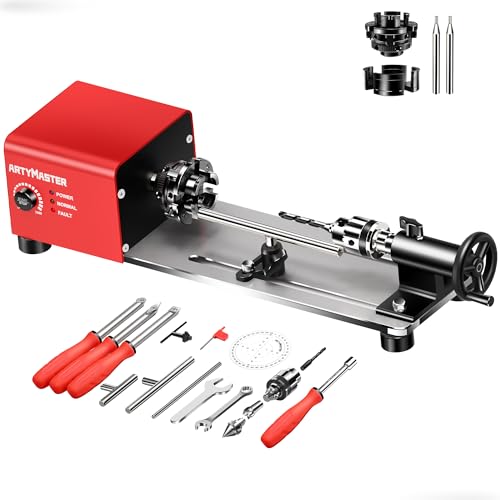
Type: Mini Wood Lathe | Swing: 8″–10″ | Motor: Entry-level | Speed Control: Variable | Best Use: Pens, small spindles, beginner projects | Price Range: $
The WM101A-Plus is the absolute entry point of the lathe category — a compact, lightweight mini lathe priced for buyers who want to try woodturning before committing significant money to the craft. Variable speed control in a package at this price tier is genuinely unusual — most competitors at this price level offer only fixed or stepped speeds, making the WM101A-Plus a better starting point for learners who need speed flexibility for different project diameters. For pen turning, small knobs, bottle stoppers, and introductory spindle work, this machine provides the basic rotating capability needed to learn fundamental tool technique.
The honest assessment for buyers considering this machine: it is a trial tool, not a foundation tool. The build quality, motor torque, and vibration characteristics of an entry-level mini lathe at this price point mean you will feel the machine’s limitations within the first several months of regular turning. The path from here leads either to discovering you don’t enjoy woodturning (in which case the low investment is appropriate), or to discovering you love it and upgrading to the Rikon 70-105 or JET JWL-1221VS within a year. The WM101A-Plus is the correct purchase for genuine first-time entry — not for buyers who have already decided they’re committing to the craft.

Pros:
- Lowest price entry to woodturning — minimal financial commitment for a first trial
- Variable speed at this price tier — better than fixed-speed entry-level alternatives
- Compact and lightweight — fits any bench space
- Adequate for pens, small spindles, and beginner projects within its size capacity
Cons:
- Entry-level build quality — vibration and precision below Rikon and JET equivalents
- Limited motor torque — will stall on hardwoods or aggressive cuts
- Most buyers outgrow this within 3–6 months of regular turning; plan for upgrade costs
- Verify Morse taper specification on current listing — MT1 limitations apply if present
Best For: True beginners making their very first purchase who want to try woodturning at minimal financial risk before committing to a proper mini or midi lathe.
9. Grizzly Industrial T25920 12″×18″ Variable Speed Benchtop Wood Lathe — Best Budget Midi with Digital Readout

Type: Midi Wood Lathe | Swing: 12″ over bed | Between Centers: 18″ | Motor: 3/4 HP | Speed: 300–3,700 RPM (EVS with belt changes) | Digital RPM Display: Yes (tachometer) | Morse Taper: MT2 | Optional Bed Extension: Yes | Price Range: $$
The Grizzly T25920 is the budget midi pick for buyers who want a digital RPM tachometer display and the ability to add a bed extension for longer spindle work — both features that competing midi lathes at this price don’t include. The digital speed readout takes the guesswork out of setting consistent speeds across turning sessions: when you find the right RPM for finishing a particular bowl size, you can return to that exact speed in the next session with certainty. The optional 22-inch bed extension brings total between-centers distance to 40 inches — enough for a full furniture leg or baseball bat without buying a full-size floor lathe.

The 300 RPM minimum is a meaningful improvement over the VEVOR’s 700 RPM and adequate for starting 12″ bowl blanks safely (minimum safe RPM for 12″ = 500 RPM; 300 RPM provides additional safety margin for very rough or significantly unbalanced blanks at startup). The speed control is EVS within belt positions but requires a belt change to access the lowest and highest speed ranges — a minor workflow interruption compared to true single-range EVS machines like the JET JWL-1221VS. Grizzly’s direct-to-buyer model (primarily online sales) means strong dealer support is less available than JET or Rikon, but Grizzly’s customer service reputation and parts availability are consistently positive in the woodworking community.

Pros:
- Digital RPM tachometer — allows precise, reproducible speed settings across sessions
- Optional bed extension to 40″ between centers — furniture turning capacity without full-size lathe
- 300 RPM minimum — adequate safety margin for starting 12″ bowl blanks
- MT2 tapers — full aftermarket accessory compatibility
- Budget midi pricing with above-average feature set
Cons:
- Belt changes required to access full speed range — not true full-range EVS like the JET JWL-1221VS
- 3/4 HP is adequate for most hobby work but below 1 HP for sustained heavy bowl roughing in dense hardwoods
- No reverse function — limits certain sanding and accessory techniques
Best For: Budget-conscious hobbyists who want midi-class capacity, the practicality of a digital RPM readout, and the option to extend bed length for occasional spindle work — at a price that undercuts the JET JWL-1221VS while offering meaningful features the VEVOR doesn’t include.
What Can You Make — Project Guide by Lathe Size
| Project | Minimum Lathe | HP Needed | Notes |
|---|---|---|---|
| Pens and pencils | Any mini (8″ swing) | 1/3 HP | High RPM (3,000+) for finishing |
| Bottle stoppers, finials | 10″ mini | 1/2 HP | Small but need stability for fine detail |
| Small bowls (6″) | 10″ mini | 1/2 HP | Safe at 1,000+ RPM minimum |
| Medium bowls (8″–10″) | 12″ midi | 3/4 HP | Requires 500–750 RPM minimum for startup |
| Large bowls (12″) | 12″ midi (1 HP) | 1 HP | Requires 500 RPM minimum and adequate HP |
| Very large bowls (14″+) | 16″ full-size | 1.5 HP | Requires below 500 RPM minimum |
| Rolling pins | 12″ midi (21″ DBC) | 3/4 HP | Between-centers length is the constraint |
| Furniture legs (28″) | Midi with bed extension or full-size | 1 HP | Grizzly T25920 with extension or JET 16×40 |
| Baseball bats | Full-size only (40″+ DBC) | 1.5 HP | JET JWL 16×40 EVS only in this roundup |
| Machined metal parts | Metal lathe only | N/A | INTSUPERMAI 8×32 only in this roundup |
Essential Lathe Accessories to Buy Alongside Your Machine
- 4-jaw scroll chuck (MT2): The most transformative accessory addition — holds irregular bowl blanks and spindle stock far more securely than a faceplate alone. Nova G3, Oneway Talon, and PSI Woodcraft are community standards. Ensure MT2 compatibility with your specific lathe model before purchasing.
- Bowl gouge set: The primary cutting tool for bowl turning. A 1/2″ and 3/8″ bowl gouge in HSS (high-speed steel) covers 80% of all bowl work. Sorby, Hamlet, and Thompson are respected brands.
- Spindle gouge set: For detail work, beads, coves, and spindle turning — finer and more pointed than a bowl gouge.
- Full face shield: Woodturning produces chips at unexpected angles and velocities. A full face shield (not just safety glasses) is the correct eye protection for lathe work — non-negotiable for any turning session.
- Lathe stand or cabinet: For benchtop models — a dedicated lathe stand at proper working height (typically 40″–44″ to spindle centerline for most adults) significantly improves tool control and reduces fatigue.
- Tool rest (additional sizes): Most lathes include one standard tool rest — a short rest for bowl work and a long rest for spindle work complete the setup.
- Dust collection connection: Woodturning generates fine dust continuously. A connection to a shop vac or dust collector at the lathe position is strongly recommended for any regular use.
Buying Guide Checklist — Confirm Before Purchasing
- Metal vs. wood first: Machining metal parts, threading, precision dimensional work → metal lathe (INTSUPERMAI). Turning wood bowls, pens, spindles → wood lathe. These are not interchangeable.
- Size class matched to largest planned project: Buy one size above what you think you need. The mini-to-midi upgrade cycle is the most common and most avoidable lathe expense in woodturning. A midi lathe costs $150–$300 more and saves a $500–$700 replacement within 12 months.
- Minimum RPM for your target bowl size: Divide 6,000 by your target maximum bowl diameter. If your lathe can’t reach that RPM or lower, the machine is not safe for that project size. The VEVOR’s 700 RPM minimum limits safe starting for 10″+ blanks; the Rikon’s 250 RPM minimum is never the limiting factor.
- EVS vs. belt-change: EVS for bowl turning and any work requiring frequent speed changes. Belt-change acceptable for pen turning and spindle work with consistent speeds. Verify which system your target lathe uses — “variable speed” can mean either.
- Morse taper: MT2 minimum for any lathe you plan to accessorize beyond basic centers. MT1 limits your accessory options for the life of the machine. Never buy MT1 for serious turning.
- Motor HP matched to wood species and project size: 1/2 HP for pens and small softwood bowls. 3/4 HP for general hobby hardwood work. 1 HP for bowls to 12″ in hardwoods. 1.5 HP for large bowls and sustained production.
- Weight as quality proxy: Between two similarly-priced lathes, choose the heavier one. More weight = more cast iron = less vibration = better finish quality and safer operation.
- Warranty: JET’s 5-year warranty is the benchmark in this roundup. Budget brands offer 1–2 years. The warranty tells you what the manufacturer believes about their product’s durability.
- Face shield before the first turning session: A full face shield is not optional equipment. Buy one before you start the lathe for the first time.
Frequently Asked Questions
Conclusion — The Right Lathe for Every Workshop
The lathe decision is one of the most consequential tool purchases in any workshop because it defines your craft trajectory — the projects you can attempt, the materials you can turn, and the skill ceiling you’re working toward. The hierarchy is clear: metal vs. wood first, size class second, minimum RPM for your project type third, then EVS, Morse taper, HP, and weight.
For most woodturners starting their journey and wanting one machine to grow with: the JET JWL-1221VS is the consensus correct answer — 60 RPM minimum, 1 HP, true EVS, MT2, 5-year warranty, and enough swing to keep most hobbyists satisfied indefinitely. For serious bowl turners who need 14″+ bowl capacity: the JET JWL 16″×40″ EVS is the machine that ends the upgrade cycle. For pen turners committed to small precision work: the Rikon 70-105 is the best mini lathe available at mid-range pricing. And for machinists: the INTSUPERMAI 8×32 is the only machine in this roundup built for your work.
Check current prices on Amazon:
| Product | Best For | Link |
|---|---|---|
| INTSUPERMAI 8″×32″ Metal Lathe | Best for machinists and metalwork | 🛒 Amazon |
| JET JWL 16″×40″ EVS | Best full-size for large bowls | 🛒 Amazon |
| JET JWL-1221VS | Best overall — beginners to intermediates | 🛒 Amazon |
| VEVOR 1 HP Benchtop | Best budget midi (note 700 RPM min) | 🛒 Amazon |
| WEN 34035 14″×20″ | Best value 14″ swing | 🛒 Amazon |
| Rikon 70-105 10″×18″ | Best mini for pens and spindles | 🛒 Amazon |
| Laguna Revo 10|14 | Best premium compact | 🛒 Amazon |
| WM101A-Plus Mini Wood Lathe | Best entry-level beginner | 🛒 Amazon |
| Grizzly T25920 12″×18″ | Best budget midi with digital readout | 🛒 Amazon |
A lathe and a drill press cover two different but equally essential shop operations – see our guide to the best benchtop and magnetic drill presses to round out your precision tool setup.