
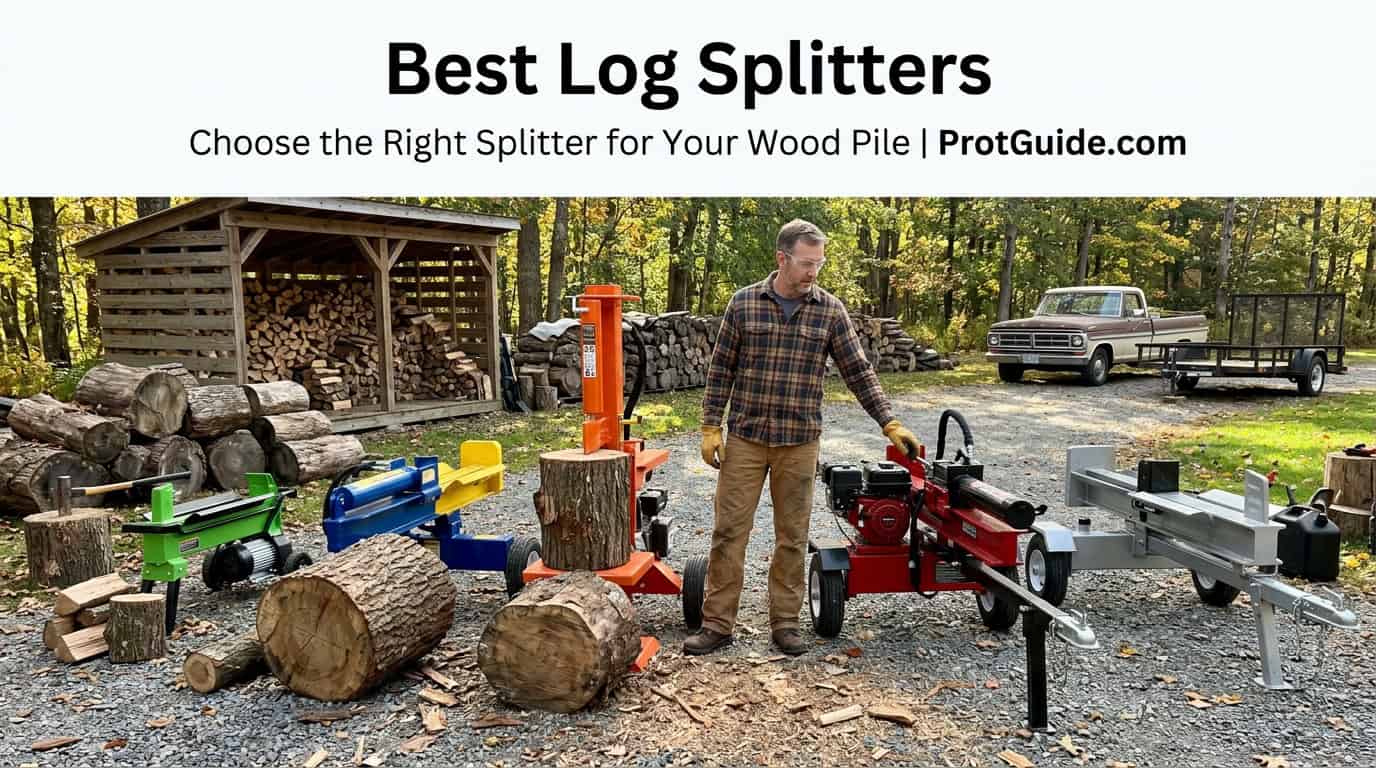
If you’ve started shopping for a log splitter, you’ve probably already run into the same wall every buyer hits: every article ranks splitters by vague labels like “great for homeowners” or “heavy-duty,” but almost none of them tell you the one number that actually matters — how many tons of force your wood needs. Below, we cut through the tonnage guesswork with an actual reference table, break down electric vs. gas vs. kinetic in terms of real total cost of ownership, and review 10 log splitters currently available on Amazon across every use case, from apartment-friendly electric units to towable gas beasts for a full cord a day.
We also cover the two decisions most roundups skip entirely: whether you need vertical loading for heavy rounds, and how much a few seconds of cycle time actually costs you over a full season of splitting. By the end, you should be able to match a specific splitter to your specific wood pile, rather than just picking whichever model has the most stars.
Table of Contents
- Quick Picks: Best Log Splitters at a Glance
- How Many Tons of Log Splitter Do You Actually Need?
- Wood Species Tonnage Reference Table
- Green vs. Seasoned Wood: Which Splits Easier?
- Electric vs. Gas vs. Kinetic: Full Cost & Performance Comparison
- Horizontal vs. Vertical vs. Dual-Position Splitters
- Cycle Time: Why 30 Seconds Matters More Than You Think
- Log Length and Beam Capacity Guide
- Our Picks: 10 Best Log Splitters, Reviewed
- Full Comparison Table
- Log Splitter Safety: Non-Negotiable Rules
- Maintenance Schedule
- Pre-Purchase Checklist
- Frequently Asked Questions
- Conclusion: Which Log Splitter Should You Buy?
How to Use This Guide
Rather than ranking splitters purely by tonnage or price, we’ve organized this guide around real buying scenarios: How much wood do you process in a season? What species make up most of your pile? Do you have power access where you split, or does the machine need to travel out to the wood? Each pick below answers one of those scenarios directly, and the full comparison table further down lets you weigh tonnage, power source, and portability side by side before you commit to a purchase.

Quick Picks: Best Log Splitters at a Glance
| Category | Splitter | Tonnage | Power |
|---|---|---|---|
| Best Overall | 20-Ton Gas Log Splitter, 209CC 7HP | 20 tons | Gas |
| Best for Heavy Hardwood | 28 Ton Log Splitter – Full Boar 212cc | 28 tons | Gas |
| Best Electric Overall | 7 Ton Electric Wood Splitter, 15Amp | 7 tons | Electric (110V) |
| Best High-Capacity Electric | SuperHandy 14 Ton Electric Log Splitter | 14 tons | Electric (110V) |
| Best Portable Gas | Portable Log Splitter 20 Ton | 20 tons | Gas |
| Most Portable / Lightest | 7 Ton Lightweight Portable Electric Splitter | 7 tons | Electric (110V) |
| Best Value Electric | VEVOR Electric Log Splitter 6.5 Ton | 6.5 tons | Electric (110V) |
| Best for Small Yards | YARDMAX YS0650 6.5 Ton Electric | 6.5 tons | Electric (110V) |
| Best Budget Pick | BILT HARD Log Splitter 6.5 Ton | 6.5 tons | Electric (110V) |
| Best Manual / No Power Needed | Sun Joe Cordless Manual Hydraulic Splitter | 10 tons (manual) | Manual hydraulic |
How Many Tons of Log Splitter Do You Actually Need?
This is the question every buyer starts with, and it’s the question most articles answer worst. The tonnage rating on a log splitter is the maximum force its hydraulic ram can generate to drive the wedge through a log. Three variables determine how much of that force you actually need:
- Wood species. Density and grain structure vary enormously between species. A splitter that breezes through pine will bog down or stall on elm or sweetgum, which are notorious for interlocked, twisting grain that resists splitting regardless of tonnage.
- Log diameter. Splitting force requirement doesn’t scale linearly with diameter — it scales roughly with the cross-sectional area the wedge has to separate, so a log twice as wide can need well over twice the force.
- Moisture content (green vs. seasoned). For most species, green (freshly cut, high moisture) wood splits more easily than fully dried wood, because the wood fibers haven’t hardened yet. A handful of dense hardwoods buck this trend and split more easily once seasoned.
As a practical rule: if you’re mostly splitting softwoods (pine, fir, spruce, cedar) under about 16 inches in diameter, a 6–7 ton electric splitter will handle the job comfortably. Once you’re regularly working oak, hickory, elm, or logs over 18–20 inches across, you want to be in the 20-ton-plus range, and a gas-powered unit will give you the sustained duty cycle that heavy hardwood splitting demands.
Wood Species Tonnage Reference Table
Use this table as a starting point, not gospel — knots, forks, and unusually twisted grain can push any log’s requirement higher than its species would suggest.
| Wood Species | Relative Density | 12″ Diameter, Straight Grain | 18–20″ Diameter, Straight Grain |
|---|---|---|---|
| Pine, Spruce, Fir, Cedar (softwoods) | Low | 4–6 tons | 7–10 tons |
| Poplar, Birch, Cottonwood | Low–Medium | 5–7 tons | 10–14 tons |
| Maple, Ash, Cherry | Medium | 7–10 tons | 14–20 tons |
| Red Oak, White Oak | Medium–High | 10–12 tons | 20–25 tons |
| Hickory, Locust | High | 12–15 tons | 22–28 tons |
| Elm, Sweetgum, Sycamore (interlocked grain) | Variable, grain-resistant | 15+ tons and still difficult | 25 tons+, expect stalling even then |
Note: elm and sweetgum are the exception to “more tonnage always wins” — their interlocked fiber structure can resist even a 25–30 ton splitter on some rounds. If elm is a significant part of your wood supply, a kinetic splitter’s repeated fast strikes can sometimes succeed where raw hydraulic tonnage stalls.
Green vs. Seasoned Wood: Which Splits Easier?
For the majority of common firewood species — oak, maple, ash, pine, birch — green wood splits noticeably easier than fully seasoned wood, because the moisture keeps the fibers more pliable and less resistant to the wedge. This is why most experienced firewood processors split immediately after felling rather than letting rounds dry first. The exceptions are a few very dense, high-tannin hardwoods like elm and, to a lesser degree, sycamore, which some users find split more predictably once partially dried, since drying reduces some of the fiber’s rubbery resistance. If you have a choice, split within a few weeks of cutting for anything other than elm.
There’s a second, practical reason to split soon after cutting: once rounds season fully, they also tend to develop surface checking (radial cracks) that can throw a log off-center as it splits, increasing the chance of an uneven or partial split that requires a second pass. Splitting green wood produces cleaner, more predictable halves, and the wood will still season properly once it’s split and stacked — split pieces dry faster than whole rounds because more surface area is exposed to air.
One more variable worth flagging: frozen wood. In cold climates, partially frozen green rounds can actually split more easily than the same wood at room temperature, since ice crystals within the fibers add a brittleness that helps the wedge separate the grain. This is why plenty of experienced processors deliberately split in late fall or winter rather than waiting for spring.

Electric vs. Gas vs. Kinetic: Full Cost & Performance Comparison
Most roundups treat this as a simple “do you have an outlet nearby” question. It’s really a total-cost-of-ownership decision with real tradeoffs in speed, noise, maintenance, and where you can use the machine.
| Electric Hydraulic | Gas Hydraulic | Kinetic / Flywheel | |
|---|---|---|---|
| Typical tonnage range | 4–14 tons | 20–37+ tons | Rated in cycle speed, not always tons |
| Upfront cost | $ | $$–$$$ | $$$ |
| Ongoing cost | Electricity only, negligible | Gas, oil changes, air filters, spark plugs | Electricity or gas, minimal hydraulic wear parts |
| Cycle time | 12–20 sec typical | 10–16 sec typical | 2–5 sec per stroke |
| Noise | Low, garage/neighborhood-friendly | Loud, small-engine exhaust | Loud if gas-driven, moderate if electric |
| Where you can use it | Needs outlet, works indoors/garage | Outdoors only, ventilation required | Depends on drive motor |
| Best for | Occasional use, softwood, <1 cord/week, noise-sensitive areas | Regular heavy hardwood, full cords, off-grid sites | High-volume processors who value raw speed over max diameter |
| Maintenance burden | Very low | Moderate — small engine upkeep | Low to moderate |
The practical takeaway: if you’re processing less than roughly a cord a month of mostly softwood or medium hardwood, an electric splitter in the 6.5–14 ton range will save you money and hassle over its lifetime versus a gas unit, because you avoid fuel costs, small-engine maintenance, and winterization. If you’re processing a cord or more per week, especially of oak or hickory, the extra tonnage and faster sustained cycle time of a gas splitter pays for itself in hours saved.
Horizontal vs. Vertical vs. Dual-Position Splitters
This decision gets treated as a footnote in most guides, but it’s a real ergonomic and safety consideration, especially for anyone dealing with heavy rounds.
- Horizontal-only splitters require you to lift each round onto the beam. This is fine for logs you can comfortably lift (roughly under 50–60 lbs) but becomes a back-injury risk with large, heavy rounds.
- Vertical-position splitters let you roll heavy rounds into place on the ground rather than lifting them, which is the safer option once you’re dealing with large-diameter hardwood rounds you can’t easily lift.
- Dual-position (horizontal/vertical convertible) units give you both: horizontal for speed on manageable rounds, vertical for anything too heavy or awkward to lift. Most mid-range and larger gas splitters (20 tons and up) on this list offer dual-position operation; most compact electric splitters are horizontal-only, which is one more reason to match tonnage and log size to the wood you’re actually processing.
Cycle Time: Why 30 Seconds Matters More Than You Think
Cycle time is how long it takes the ram to extend, split the log, and retract back to the starting position. It sounds like a minor spec, but the math adds up fast: splitting a full cord of wood typically requires 150–250 individual splits depending on round size. A splitter with a 20-second cycle versus one with a 12-second cycle means roughly 20–35 extra minutes of standing-around time per cord, and that gap widens further if you’re processing multiple cords per season. Kinetic splitters, which use a flywheel rather than a hydraulic pump to drive the wedge, cut cycle time to 2–5 seconds per stroke, which is why high-volume processors often prefer them despite a higher upfront cost — but most kinetic units require more physical handling per log than a hydraulic auto-return splitter.
Log Length and Beam Capacity Guide
Check this spec before you buy, because it’s easy to overlook and directly limits what you can process without extra cutting. Beam length determines the longest log the splitter can accept:
| Beam / Max Log Length | Typical Splitter Class | Good Match For |
|---|---|---|
| 16–20 inches | Compact electric (6.5–7 ton) | Standard fireplace and wood stove lengths |
| 20–24 inches | Mid-size electric/gas (7–20 ton) | Wood stoves, outdoor fire pits, most residential use |
| 25–30+ inches | Large gas (20–37+ ton) | Outdoor furnaces, commercial firewood processing, large stoves |
If your logs regularly exceed a splitter’s max length, you’ll need to buck them shorter with a chainsaw before splitting, which adds real time to your workflow — factor this in before choosing a compact unit to save money.
Our Picks: 10 Best Log Splitters, Reviewed
Best Overall: 20-Ton Gas Log Splitter, 209CC 7HP

- 🔨 20-Ton Splitting Force with Precision Steel Wedge: Equipped with a high-performance hydraulic system and a hardened alloy steel wedge, this gas powered log splitters powers through dry, wet, and knotted logs with ease. Handles logs up to 20" long and 16" in diameter with clean, consistent splits every time.
- ⚡ 8-Second Cycle Time + Extended Fuel Capacity: Designed for high-volume productivity, this gas firewood splitting machine completes each cycle in just 8 seconds. With a 0.74-gallon fuel tank, it runs continuously for 2–3 hours—ideal for winter prep, firewood service, or commercial jobs.
- 🌿 Advanced 4-Stroke Engine—More Power, Less Emissions: Our portable gas wood splitter upgraded 4-stroke engine burns fuel more efficiently than traditional 2-stroke designs—delivering 30% better fuel economy and reducing harmful emissions by up to 60%. Built for serious work with a cleaner footprint.
- 🔨 Gas-Powered Freedom—No Cords, No Limits: Runs independently of power outlets or cords, making gas firewood splitter perfect for remote locations, camping trips, off-grid living, or emergency blackout situations. A reliable solution for farms, rural homes, and outdoor wood processing.
- Compact, Lightweight, and Built to Move: Weighing just 132 lbs and featuring a compact frame with ergonomic handles and 10" pneumatic tires, this portable log splitter goes anywhere. Navigate rough terrain, muddy woods, or backyard paths with ease—even by yourself.
This 20-ton gas splitter sits in the sweet spot for most homeowners who process more than the occasional armload of softwood. The 209cc 7HP engine has enough sustained power to work through oak and ash rounds up to 20 inches in diameter without bogging down, and 20 tons covers nearly everything short of the densest elm and hickory. A 20″ x 16″ work area gives enough room to reposition awkward rounds without repositioning the whole machine.
Pros: Strong all-around tonnage for mixed hardwood and softwood; gas engine handles sustained full-cord sessions without overheating like some electric units under continuous load; solid value at this tonnage tier.
Cons: Gas engine means fuel, oil changes, and outdoor-only use; heavier and less convenient to store than electric alternatives.
Best for: Homeowners processing 1–3+ cords per season with a realistic mix of hardwood species.
Check current price on Amazon →
Best for Heavy Hardwood: 28 Ton Log Splitter – Full Boar Engine 212cc

- Reliable 212cc FULL BOAR OHV engine delivers 28-ton force and cycles in just 10.9 seconds for a fast and easy splitting
- An auto return control valve with adjustable detent saves time and effort
- Heavy Duty H beam structural design
- Hydraulic oil filter is mounted inside the reservoir, eliminating damage from falling logs and operator entanglement.
When oak, hickory, and locust make up the bulk of your woodpile, 28 tons of splitting force gives you real headroom over the 20-ton class, particularly on large-diameter rounds that would stall a smaller machine partway through the stroke. The 212cc engine is built for the sustained torque this tonnage tier demands rather than short bursts.
Pros: Highest tonnage on this list; genuinely handles the toughest common firewood species without repeated stalling; beam capacity suited to large rounds.
Cons: Overkill and needlessly heavy/expensive if your wood is mostly softwood; larger footprint for storage and transport.
Best for: Anyone whose wood supply is dominated by oak, hickory, or locust, or who processes wood commercially or for multiple households.
Check current price on Amazon →
Best Electric Overall: 7 Ton Electric Wood Splitter, 15Amp Hydraulic

- 🪵【7 TON HYDRAULIC POWER】 This 7 ton electric log splitter delivers strong hydraulic force, making it ideal for log splitters for firewood and hardwoods like oak and maple. A reliable firewood splitter for efficient home heating and daily use.
- ⚡【15AMP ELECTRIC MOTOR】 Features a 1500W / 15Amp copper motor for steady torque and fast cycles. No gas, no fumes — an eco-friendly electric wood splitter for home or garage use.
- 🧱【HEAVY-DUTY STEEL BUILD】 Built with a reinforced steel frame and durable wedge, this wood splitter handles logs up to 21.2" long and 12" in diameter. Ideal among wood splitters for firewood for tough, consistent splitting performance.
- 🚗【PORTABLE & COMPACT】 As a compact electric log splitter, this machine is equipped with sturdy transport wheels for easy mobility. Its space-saving design makes it convenient to move and store in garages, yards, or workshops.
- 🛡️【Safe and Reliable】 This electric log splitter for firewood features two-hand safety control and overload protection. The stable hydraulic system ensures smooth operation, delivering consistent and reliable splitting results.
This 15-amp, 7-ton unit is the most well-rounded electric splitter on this list: enough force for the softwood-to-medium-hardwood range most homeowners actually process, quiet and exhaust-free enough for garage or driveway use, and portable enough to wheel to wherever the woodpile is.
Pros: Runs on standard 110V household power; no fuel, no emissions, minimal maintenance; portable with wheels included.
Cons: 7 tons will struggle on large-diameter oak or elm rounds; extension cord length can limit where you work.
Best for: Suburban and residential users splitting mostly softwood and medium hardwood in moderate volumes.
Check current price on Amazon →
Best High-Capacity Electric: SuperHandy 14 Ton Portable Electric Log Splitter

- SPECS - Built with a heavy-duty 2.5eHP 15amp 1800W Electric Motor, powering our 14-ton rated system, utilizes the highly ultra-reliable and trusted 2-Stage 10.5GPM Bucher Hydraulic Gear Pump, with Rapid Auto Return that easily splits logs up to 20" inches in length and up to 14" inches in diameter; All weighing 126lbs
- PORTABLE DESIGN - Our lightweight horizontal full beam and steel wedge log splitter design is built to be portable with fast and easy set up for anywhere nature takes you; Complete with 8” inch Sturdy transport wheels, allowing for smooth maneuvering for easy transportation from site to site
- EFFICIENT - Precision gear pump and brushless induction motor with copper windings allow for this Log Splitter to produce constant splitting force, providing a smooth linear power curve to help avoid clunky performance during operation; Effortlessly complete large splitting jobs with only a 16-second cycle time reset in-between log splits
- ECO-FRIENDLY - (Green and Safe), unlike gasoline-powered devices, electric-powered units produce no smog/fumes/emissions and are both gas and exhaust free; Can be used on the ground or on a workbench, outside and inside, while being quieter ONLY producing 65dB noise during operation
- SAFETY and PROPER USE - Always operate the Log Splitter with eye and hand protection, utilize the controls and shut off/on switch as needed;This log splitter is electric powered and does not require fuel to operate; (NOTE: HYDRAULIC FLUID NOT INCLUDED, AW32 Recommended)
The SuperHandy pushes electric-splitter tonnage further than most, using a Bucher gear pump and a rapid auto-return hydraulic ram to close some of the cycle-time gap with gas units. At 14 tons, it moves comfortably up into medium hardwood territory while remaining cord-and-outlet powered.
Pros: Highest tonnage available in electric form on this list; rapid auto-return shortens cycle time versus typical electric units; full horizontal steel-beam wedge construction built for forestry-adjacent use.
Cons: Draws 15 amps continuously, so it needs a dedicated circuit for sustained sessions; heavier than compact 6.5–7 ton electric units.
Best for: Users who want gas-class tonnage without gas, fuel, or exhaust — particularly for garage-adjacent or noise-restricted properties.
Check current price on Amazon →
Best Portable Gas: Portable Log Splitter 20 Ton

- Powerful Splitting: Powered by a 209CC 7HP engine and a 20-ton hydraulic ram, this gas log splitter easily splits hardwood and knotty logs. Handles logs up to 20.5" long and 16" wide—ample capacity for most household and farm needs
- High-Speed Efficiency: With an 8-second cycle time, this wood splitter processes up to 450 logs per hour. The 90° alloy steel wedge with multi-point welding delivers clean, consistent splits through oversized and knotty hardwoods with minimal effort
- Auto-Return Valve: Equipped with an auto-return detent valve, this log splitter gas powered automatically retracts the ram after each split. Push the handle, load the next log—no waiting, no extra steps. Reduces fatigue during long sessions
- Smooth Hydraulic Power: Equipped with a dual-stage aluminum gear pump that automatically balances speed and power—fast approach for quick cycling, high-pressure mode for splitting tough hardwoods. Get more done with less engine strain
- Easy Mobility: Built with a lightweight steel frame and 10-inch pneumatic tires, this full boar log splitter is tough yet easy to move around your yard, farm, or job site. Low-maintenance design ensures long-lasting reliability
This 20-ton unit is built around mobility — a compact frame and wheel setup make it realistic to tow behind an ATV or hitch to a truck and take out to where the trees actually fell, rather than hauling rounds back to a fixed splitting station.
Pros: Full 20-ton gas power in a genuinely towable, job-site-friendly package; good match for property owners clearing their own land.
Cons: Still gas-powered, so outdoor use and routine engine maintenance apply; less refined work-table area than larger stationary units.
Best for: Rural property owners and land-clearing projects where the splitter needs to travel to the wood, not the other way around.
Check current price on Amazon →
Most Portable / Lightest: 7 Ton Lightweight Portable Electric Firewood Log Splitter

- Split Logs Effortlessly: Log splitter has a single-handed operation and allows you to split logs in your backyard with high-powered hydraulics that help the machine slice through logs with ease
- Easy to Use and Transport: Electric design allows you to use the log splitter in your garage or outdoors while the rubber wheels help you take this lightweight firewood splitter with you on the go
- Power Log Splitters: Features a splitting force of 7 tons and 3700 PSI hydraulic pressure, this hydraulic log splitter has a motor power of 2 horsepower and 14 seconds cycle time with 4 quarts oil capacity
- Guaranteed Stability and Durability: Built-in side rails keep logs stable while splitting, and the front handle allows for easy maneuvering: Steel construction makes this splitter last for years
- Electric Splitter Dimensions: Outdoor log splitter machine has 20.5 inches maximum log length and a maximum of 10 inches log diameter; Measures 39.5 inches long, 13.5 inches wide, and 20 inches tall
Built specifically around low weight and rubber wheels, this 7-ton electric splitter is the easiest unit on this list to move around a garage, driveway, or small property by hand, without needing a truck or ATV to reposition it.
Pros: Genuinely light for its tonnage class; rubber wheels make single-person repositioning easy; electric power keeps it quiet and low-maintenance.
Cons: 7-ton ceiling means the same hardwood limitations as other compact electric units.
Best for: Smaller properties or anyone who needs to move the splitter frequently and can’t manage a heavier machine solo.
Check current price on Amazon →
Best Value Electric: VEVOR Electric Log Splitter 6.5 Ton

- Powerful Motor: This electric log splitter features a robust 15-amp motor that delivers up to 6 tons of splitting force at speeds up to 3,400 RPM. Effortlessly handles logs up to 9.8 inches in diameter and 20 inches in length.
- Efficient Performance: Equipped with a high-efficiency hydraulic ram, this electric wood splitter resets quickly and splits smoothly with every push. Designed for high-volume tasks, this wood splitters for firewood helps you power through large batches of wood with ease.
- Built-In Safety Control: Two-hand operation ensures user safety and prevents accidental starts. The firewood splitter includes a power switch for easy operation. For optimal performance, use an extension cord no longer than 50 ft and with a cross-section no less than 3.3 mm².
- Portable & User-Friendly: With 6-inch durable transport wheels and a compact frame, this log splitting machine is easy to move and store. Its lightweight horizontal beam and steel wedge provide smooth control on sand, mud, and rough terrain—ideal for both home and outdoor use.
- Green Power & Quiet Operation: The log splitters for firewood runs clean with zero emissions—no carbon monoxide or harmful fumes. This electric log splitter offers quieter, greener performance while cutting down on energy use.

VEVOR’s 6.5-ton electric splitter covers the core use case — occasional splitting of stove-length softwood and medium hardwood — at a price point that undercuts most of the competition in this tonnage class, without cutting corners on the basics.
Pros: Strong price-to-tonnage ratio; simple, low-maintenance electric hydraulic design; good entry point for first-time buyers.
Cons: 6.5 tons is the lower end of the useful range; not built for regular hardwood duty.
Best for: Budget-conscious buyers who mostly need to keep up with a wood stove or fire pit through softwood and lighter hardwood.
Check current price on Amazon →
Best for Small Yards: YARDMAX YS0650 6.5 Ton Electric Log Splitter

- Powerful, 6.5 Ton RAM Force to get the job done fast
- Log capacity - 20.5" in length and 10" in diameter
- Log capacity - 20.5" in length and 10" in diameter
YARDMAX builds specifically toward compact residential use, and the YS0650 reflects that: a small footprint, quiet 110V operation, and enough tonnage for typical stove-length rounds, all sized to store easily in a garage corner or shed.
Pros: Compact footprint ideal for smaller properties; quiet enough for close-neighbor suburban lots; easy storage.
Cons: Same 6.5-ton hardwood ceiling as other compact electric units; smaller work table than larger machines.
Best for: Suburban homeowners with limited storage space and light, occasional splitting needs.
Check current price on Amazon →
Best Budget Pick: BILT HARD Log Splitter 6.5 Ton

- POWERFUL MOTOR - Powerful 15Amps motor provides 6.5-Ton of log cracking pressure, speed up to 3,400RPM. Split logs up to 9.8" diameter and 20.5" length, and the efficient hydraulic ram log splitter could quickly reset to cut another log that allows your cutting effortlessly and saves your time. In addition, durable steel construction ensures long-lasting stable performance.
- SAFE&ECO-FRIENDLY DESIGN - Two-hand controls ensure operator safety, utilize the controls and shut off/on the switch as needed. BILT HARD log splitter utilizes electric power, the fume-free design eliminates carbon monoxide and other toxic emissions while being quieter. Extension cord: It is recommended not to exceed 15m and the cross-section should not be less than 3.3mm². A 40-amp circuit breaker is recommended.
- PORTABLE AND STABLE - Complete with 5.7” inch Sturdy transport wheels that allow you to roll the unit fast and easy. With our lightweight horizontal full beam and steel wedge log splitter design for smooth maneuvering, you can conquer any terrains, such as sand, muddy and uneven roads.
- EFFICIENT - Precision gears and copper motor windings allow for this log splitter to produce constant splitting force. It completes large splitting jobs with an 18-second cycle time reset in-between log splits.
- WARRANTY - We guarantee this product to be free from defects in materials and workmanship 90 days from the date of purchase. Our support team is on standby for YOU.
BILT HARD’s 6.5-ton, 15-amp electric splitter is a straightforward, no-frills option for buyers who want a functional splitter without paying for tonnage or features they won’t use.
Pros: Competitive entry price; simple 110V plug-and-go operation; adequate for typical stove-length softwood.
Cons: Basic build quality compared to mid-tier options; 6.5-ton ceiling limits hardwood capability.
Best for: First-time buyers or occasional users who want the lowest reasonable entry cost into powered splitting.
Check current price on Amazon →
Best Manual / No Power Required: Sun Joe Cordless Manual Hydraulic Steel Beam Log Splitter

- Powerful Log Splitter: Log splitting machine splits firewood up to 18 inches long and 8 inches wide with 10-ton hydraulic driving force for tough timber tasks
- Manual Hydraulic Power: Features a 2-speed pump for up to 10 tons of hydraulic force without the need for gas or electric sources
- Durable Steel Construction: Built with a solid steel frame for long-lasting durability, perfect for outdoor wood-splitting jobs year after year
- Compact & Portable Design: Equipped with rear wheels for easy portability and compact storage, ideal for home, camping, or on-the-go use
- Safe & Efficient Operation: Log cradle prevents split wood from falling, while the ram return spring allows quick resets for continuous splitting
This is the outlier on the list in the best way: a manual hydraulic splitter that needs no electricity and no gas, using foot-pump or lever-driven hydraulic pressure (rated up to 10 tons) to split logs. It’s slower per log than any powered unit, but it’s silent, has zero fuel or electricity cost, and works anywhere — including off-grid, at a remote cabin, or as a no-maintenance backup.
Pros: No power source needed at all; zero ongoing fuel or electricity cost; virtually nothing to maintain or winterize; genuinely portable to remote sites.
Cons: Physically slower and more labor-intensive per split than any powered option; best suited to occasional or light-volume use.
Best for: Off-grid properties, cabins without power access, or anyone who splits infrequently enough that a powered unit isn’t worth the cost.
Check current price on Amazon →
Full Comparison Table
| Splitter | Tonnage | Power Source | Best For |
|---|---|---|---|
| 20-Ton Gas Log Splitter, 209CC 7HP | 20 tons | Gas | Best overall |
| 28 Ton Log Splitter – Full Boar 212cc | 28 tons | Gas | Heavy hardwood, large diameter |
| 7 Ton Electric Wood Splitter, 15Amp | 7 tons | Electric | All-around electric pick |
| SuperHandy 14 Ton Electric | 14 tons | Electric | Max tonnage without gas |
| Portable Log Splitter 20 Ton | 20 tons | Gas | Towable, land-clearing use |
| 7 Ton Lightweight Portable Electric | 7 tons | Electric | Easiest to move solo |
| VEVOR Electric 6.5 Ton | 6.5 tons | Electric | Best value |
| YARDMAX YS0650 6.5 Ton | 6.5 tons | Electric | Small yards, compact storage |
| BILT HARD 6.5 Ton | 6.5 tons | Electric | Lowest-cost entry point |
| Sun Joe Cordless Manual Hydraulic | 10 tons (manual) | None – manual | Off-grid, no power available |
Log Splitter Safety: Non-Negotiable Rules
Log splitters are involved in a meaningful number of serious hand and finger injuries every year, including crushing injuries and amputations. This isn’t a category where safety content is optional padding — treat the following as required reading before first use, regardless of which splitter you buy.
Before You Start
- Read the manual for your specific model — hand placement and operating procedure vary between horizontal, vertical, and two-lever vs. single-lever designs.
- Set up on level, stable ground. A splitter that rocks or shifts during a stroke is a hazard.
- Keep a clear exclusion zone around the machine. Bystanders, especially children and pets, should stay well back from the beam and ram path at all times — not just during the active stroke.
- Inspect logs for embedded metal (nails, fencing wire) before loading, particularly on reclaimed or storm-damage wood.
During Operation
- Never place your hands near the log while the ram is advancing. Many modern splitters require two-hand control operation specifically to keep both hands away from the pinch point — don’t defeat or bypass this feature.
- Position knotted or forked logs carefully; irregular logs can shift or kick sideways under pressure. When in doubt, orient the log so any twist or bulge is supported against the beam, not free to rotate.
- Never try to catch, push, or free-hand a log that’s shifting mid-stroke. Stop the cycle, retract the ram, and reposition instead.
- Wear sturdy gloves, safety glasses, and steel-toe or heavy work boots. Loose clothing and jewelry should be removed before operating.
- Never override, block, or reach past a safety guard or two-hand control mechanism.
After Operation
- Fully retract the ram and shut off power (unplug electric units, shut off fuel on gas units) before clearing jams or debris.
- Let a gas engine cool before refueling or performing maintenance.
Maintenance Schedule
| Task | Electric Splitters | Gas Splitters |
|---|---|---|
| Check hydraulic fluid level | Every 25 hours of use / seasonally | Every 25 hours of use / seasonally |
| Change hydraulic fluid | Annually or per manufacturer spec | Annually or per manufacturer spec |
| Inspect/replace air filter | N/A | Every 25 hours; replace if visibly dirty |
| Oil change (engine) | N/A | After first 5 hours, then every 25–50 hours |
| Spark plug check | N/A | Seasonally |
| Sharpen/inspect wedge | Seasonally or as needed | Seasonally or as needed |
| Check power cord/plug condition | Before each use | N/A |
| Fuel stabilizer for off-season storage | N/A | Before storing 30+ days |
Pre-Purchase Checklist
- Identify your dominant wood species and typical log diameter, and match tonnage using the reference table above — don’t just buy the highest number in your budget.
- Confirm the beam/max log length fits your typical rounds without extra bucking.
- Decide electric vs. gas based on realistic volume: under roughly a cord a month favors electric; regular full-cord sessions favor gas.
- Check whether you need vertical operation for large rounds you can’t safely lift.
- Confirm storage space and portability needs (wheels, weight, towability) match where and how often you’ll use it.
- Budget for ongoing costs — hydraulic fluid for all types, plus fuel/oil/filters for gas units.
Frequently Asked Questions
How many tons of log splitter do I need?
For softwood and log diameters under about 16 inches, 6–7 tons is typically sufficient. For hardwoods like oak and ash, or diameters up to 20 inches, plan on 20 tons or more. Very dense or twisted-grain species like hickory, locust, and elm can require 25–30+ tons.
Is an electric or gas log splitter better?
Electric is better for lower-volume, mostly softwood-to-medium-hardwood use, thanks to lower cost, no fuel, and near-zero maintenance. Gas is better for regular high-volume splitting or dense hardwood, where higher available tonnage and sustained duty cycles matter more than convenience.
What is log splitter cycle time?
Cycle time is the total time for the ram to extend through a full split and retract back to start. Faster cycle times save significant cumulative time across the 150–250 splits a typical cord of wood requires.
Can I use a log splitter in my garage?
Electric log splitters are generally suitable for garage or indoor-adjacent use since they produce no exhaust. Gas splitters should only be operated outdoors or in well-ventilated spaces due to engine exhaust.
How much firewood is in a cord?
A full cord is a stack measuring 4 feet by 4 feet by 8 feet (128 cubic feet of stacked wood, including air gaps between pieces).
Do I need a vertical log splitter?
If you regularly handle large-diameter rounds you can’t comfortably lift, a vertical or dual-position splitter lets you roll the round into place instead of lifting it onto a horizontal beam, which reduces back-injury risk.
What’s the difference between kinetic and hydraulic log splitters?
Hydraulic splitters use a pump-driven ram that pushes steadily through the log, typically taking 10–20 seconds per cycle. Kinetic splitters use flywheel-stored energy to deliver a fast, repeated striking action, often completing a split in 2–5 seconds, which suits high-volume processing.
Is a manual log splitter worth it?
Manual hydraulic splitters make sense for low-volume or off-grid use where you don’t have power access, or simply don’t split often enough to justify a powered machine’s cost and maintenance.
How long do log splitters last?
With regular hydraulic fluid changes and, for gas units, standard small-engine maintenance, a well-built log splitter can reasonably last 10+ years of seasonal use.
Do I need 240V for an electric log splitter?
Most residential electric log splitters, including every electric model on this list, run on standard 110V household current. Some larger commercial electric units use 240V for higher sustained output, but that’s uncommon for home use.
Conclusion: Which Log Splitter Should You Buy?
| If you… | Get this |
|---|---|
| Want one splitter that handles almost everything | 20-Ton Gas Log Splitter, 209CC 7HP |
| Process mostly oak, hickory, or large-diameter hardwood | 28 Ton Log Splitter – Full Boar 212cc |
| Want a reliable, quiet, all-purpose electric splitter | 7 Ton Electric Wood Splitter, 15Amp |
| Want maximum tonnage without gas | SuperHandy 14 Ton Electric |
| Need to tow the splitter out to the wood | Portable Log Splitter 20 Ton |
| Need the lightest machine to move solo | 7 Ton Lightweight Portable Electric |
| Want the best price-to-tonnage ratio | VEVOR Electric 6.5 Ton |
| Have limited storage space | YARDMAX YS0650 6.5 Ton |
| Want the lowest-cost entry point | BILT HARD 6.5 Ton |
| Split occasionally with no power access | Sun Joe Cordless Manual Hydraulic |
Whichever splitter you choose, match tonnage to your actual wood, not the biggest number in your budget — and treat the safety guidance above as mandatory, not optional, before your first split.
Clearing a property often means the stump is still in the ground after the tree comes down – see our guide to the best stump grinders to finish the job properly.


