Which creeper seat actually rolls on your floor? Complete type guide, caster compatibility, seat height by task, weight capacity table, and top Amazon picks.
You are about to buy a creeper seat, and if you are like most buyers, you are looking at the price tag or the thickness of the foam padding. But before you look at a single product, you need to answer the two questions that actually dictate whether a rolling seat improves your workflow or ends up thrown in the corner of the garage: Which type of creeper product matches your actual tasks and your floor? And what seated height and weight capacity does your body actually require?
Buy a seat with 2-inch plain-bore casters for an epoxy floor, and it will drag like a cement block. Buy a 9-inch-high seat for side-panel suspension work, and you will end up with a worse back than before. This guide skips the basic star-rating summaries and breaks down the exact engineering specifications—seated height, caster quality, floor matching, and dynamic weight load margins—that separate a true back-saving asset from a frustrating piece of garage scrap metal.

Creeper Seat vs. Flat Creeper vs. Convertible vs. Rolling Stool — Which Type Do You Actually Need?
Every bad creeper purchase starts with buying the wrong tool format for the job. Do not buy a low-profile creeper seat for workbench tasks, and do not buy a convertible for pure under-vehicle use if your car has lowered clearance. The decision tree below routes your exact use case to the correct tool profile.
| Your Primary Task | Right Tool Type | Optimal Seated Height | Why Other Types Fall Short |
|---|---|---|---|
| Under-vehicle work: oil changes, exhaust, brake lines, transmission pans | Low-profile fixed creeper seat or flat creeper | 8–12 inches | A tall rolling stool puts your shoulders against the undercarriage; a convertible’s flat profile is 1–2 inches higher than a dedicated flat board, risking clearance issues. |
| Beside-vehicle work: brakes, hubs, wheel bearings, CV axles, suspension | Fixed or adjustable-height creeper seat at mid height | 14–18 inches | A low creeper seat at 9 inches puts hands below hub height, requiring bent-wrist awkward tool angles; a flat creeper is entirely wrong. |
| Mixed session: both under-vehicle and beside-vehicle in same repair | Adjustable-height creeper seat with at least 10 in of height range | 8–18 inches (adjustable range) | A fixed-height seat forces the user to the wrong position for one of the two tasks — the fatigue cost adds up over a full session. |
| Workbench-adjacent tasks and underhood work at standing-ish height | Rolling shop stool (taller format) | 18–26 inches | A creeper seat at 10–14 inches is too low for comfortable workbench height; you will hunch over the bench surface. |
| Limited budget and need both under-vehicle and beside-vehicle access | Convertible creeper/seat combination | Dual mode (seat at ~12 in; flat at ~3.5–4 in profile) | Dedicated products outperform in each mode; convertible is the practical compromise. Confirm flat-mode profile height clears your vehicle. |
Caster Quality and Floor Compatibility — The Spec Nobody Covers That Determines Roll Quality
In our analysis of real-world buyer feedback across the top-selling creeper seats, caster complaints—stiff rolling, scratching floors, wheel seizure, and wobble—account for the majority of negative reviews. Caster size matters: 2-inch casters struggle over expansion joints, while 3-inch casters roll smoothly. Bearing type matters: ball-bearings roll freely, while plain-bore (solid plastic) casters require immense push force. Match your floor below.
| Floor Surface | 2-inch Casters | 3-inch Casters | Ball-Bearing Casters | Plain-Bore Casters | Best Choice |
|---|---|---|---|---|---|
| Bare concrete (rough) | Acceptable but may catch on surface texture | Good — rolls over rough surface texture | Rolls freely under full load | Acceptable; will stiffen in cold temperatures | 3-inch ball-bearing |
| Sealed / painted concrete | Good on smooth surface | Excellent | Rolls freely; minimal noise | Acceptable on smooth sealed surface | 3-inch or 2-inch ball-bearing |
| Epoxy-coated floor (high-gloss) | May mark surface if hard nylon or steel | Best distribution of load weight across coating | Best option — low rolling resistance protects coating | Will drag and potentially mark high-gloss epoxy | 3-inch ball-bearing with polyurethane/soft-rubber |
| Interlocking rubber floor mat | Sinks into mat texture — requires significant push force | Significantly better — rides over mat surface rather than sinking | Still requires more effort than on hard floor | Very difficult on rubber mat — not recommended | 3-inch ball-bearing; expect some rolling resistance |
| Outdoor / driveway concrete | Catches on expansion joints and surface chips | Navigates minor surface irregularities | Rolls better than plain-bore on uneven surface | Gets stuck easily on outdoor surface texture | Use a flat creeper; rolling seats are not for outdoors |
Seat Height Guide — Matching Seated Height to Your Tasks

Creeper seats are not one-size-fits-all. The goal is to place your eyes roughly level with your work point. Missing this target by even three inches causes immediate postural strain.
| Task | Ideal Seated Height | Why This Height | Too Low Causes | Too High Causes |
|---|---|---|---|---|
| Oil drain, oil filter, transmission fluid | 8–11 inches | Places eyes at drain pan level under standard sedan/SUV clearance | Neck strain from tilting head up to see drain plug | Shoulders and head contacting undercarriage |
| Exhaust, brake lines, fuel lines under vehicle | 9–13 inches | Provides clear sightline to undercarriage mid-section | Working too far below the line of sight | Head clearance issues on low-ride vehicles |
| Brake caliper, rotor, and pad work at wheel | 13–17 inches | Places hands at hub-center height for natural elbow angle | Shoulder fatigue from raising arms above natural angle | Requires leaning down, loading lower back |
| Suspension, CV axle, and wheel bearing | 14–18 inches | Places hands at mid-hub to upper-hub height | Significant shoulder elevation required | Lower suspension components require excessive body lean |
| Workbench-adjacent assembly work | 18–26 inches | Matches typical workbench surface elevation | Hunching over workbench surface — lumbar strain | Seat too tall for bench; feet dangle uncomfortably |
For buyers who are broadly built, seat width is the primary comfort determinant. A seat narrower than your hip width places the full body weight on the outer thigh rather than your sit-bones, producing hip pain and numbness within 20 minutes. Minimum practical seat width is 11 inches for slim builds, 13–14 inches for most adults, and 15–17 inches for broader hips or users over 230 lbs. Furthermore, padding density is critical: foam that compresses fully to the hard base under your body weight is worse than no padding at all. Look for molded, high-density foam.
Weight Capacity Reality Check — What “Heavy Duty” Actually Means
Manufacturer capacities are static load ratings (measured at rest). Sitting down or leaning applies dynamic load, frequently 1.3–1.5× your body weight.
| User Body Weight | Minimum Rated Capacity (1.25× rule) | Recommended Capacity (1.5× rule) | Frame Material Preference |
|---|---|---|---|
| Under 150 lb | 188 lb minimum | 225 lb or higher | Steel or polypropylene both acceptable |
| 150–200 lb | 250 lb minimum | 300 lb or higher | Steel frame preferred for longevity |
| 200–250 lb | 313 lb minimum | 375 lb or higher (look for 400 lb units) | Steel frame required; poly prone to micro-cracking |
| 250–300 lb | 375 lb minimum | 450 lb or higher (heavy-duty tier) | Steel frame only; verify all-steel seat platform |
| Over 300 lb | 375+ lb required | 500 lb rated or professional-tier only | Steel frame and platform throughout |
Height Adjustment Mechanisms — Pneumatic vs. Pin-and-Hole vs. Lever
For adjustable seats, the mechanism is as important as the height range.
| Mechanism Type | How It Works | Reliability Over Time | Failure Mode |
|---|---|---|---|
| Pin-and-hole | Pin drops through frame hole | Excellent — no mechanical parts to wear out | Pin loss; hole edge wear over years of heavy use |
| Pneumatic (gas cylinder) | Under-seat lever activates continuous gas lift | Good initially; cylinders last 2–5 years daily use | Cylinder drift: seat sinks during use; requires replacement |
| Lever-clamp | Friction clamp secures telescoping column | Moderate; clamp surface wears with use | Slip under heavy lateral force; clamp fatigue |
Tool Tray Utility Assessment — What Makes a Tray Useful
A genuinely useful tool tray must meet three criteria simultaneously: 1) It must be accessible from the seated position without standing up. 2) It must be large enough to hold a ratchet, 6-8 sockets, and a pry tool without stacking. 3) It must sit low enough that it does not become a pinch point when rolling under bumpers. Additionally, a magnetic tray surface is the single feature that transforms a flat shelf into an active, functional parts holder.
Convertible Creeper Seats — The Honest Trade-Off Analysis
Convertible “Z” creepers offer incredible value, but you must acknowledge the physical trade-offs before buying.
| Factor | Dedicated Creeper Seat | Dedicated Flat Creeper | Convertible (Both) |
|---|---|---|---|
| Flat mode clearance | N/A | 2.5–3 inches (lowest possible) | 3.5–4.5 inches (seat frame adds height) — not for low cars |
| Seat mode comfort | Best — wider, deeper dedicated platform | N/A | Compromise — smaller seat surface to accommodate folding |
| Weight / Price | Lighter / Lower | Lighter / Lower | Heavier / Higher (or lower quality components to meet budget) |
| Right for you if… | You primarily do seated wheel-well work | You primarily do flat under-vehicle work | You genuinely need both modes and have high vehicle clearance |
Quick Comparison Table — All Products at a Glance Master Comparison
| Product Name | Type | Key Spec | Best For | Link |
|---|---|---|---|---|
| VEVOR Rolling Creeper Shop Seat | Fixed-Height | 15.7″ H / 300 lb | Brakes, Hubs, Detail | Amazon → |
| Rolling Garage Shop Seat for Men | Fixed-Height | 14.5″ H / Storage Drawer | Workbench / Tool Storage | Amazon → |
| AeroCreeper Adjustable Mechanics Seat | Adjustable | 5.5″–20″ H / 350 lb | Professional / Multi-Task | Amazon → |
| Pro-LifT C-9100 Black 40″ Z Creeper | Convertible | 40″ Length / 450 lb | Heavy Users / SUVs | Amazon → |
| VEVOR Foldable Z Garage Creeper | Convertible | 300 lb / 3″ Casters | Budget Home DIY | Amazon → |
| M-AUTO Foldable Z Creeper 2-in-1 | Convertible | Compact Footprint | Small Garages | Amazon → |
| DNA MOTORING 40″ 2-IN-1 | Convertible | 40″ Extended Length | Tall Mechanics | Amazon → |
| DNA MOTORING 36″ 2-IN-1 | Convertible | 36″ Short Frame | Tight Workbays | Amazon → |
| Automotive Mechanic Combo | Convertible | Entry Level Build | Occasional Repair | Amazon → |
| Shop Stool with Wheels | Rolling Stool | 18″–26″ Height Range | Workbench / Underhood | Amazon → |
| Traxion 1-200 King Crawler | Flat Creeper | 5″ All-Terrain Casters | Rough Floors / Driveways | Amazon → |
| Powerbuilt Big Wheel Creeper | Flat Creeper | 4″ Pneumatic-style Tires | Off-Road / Gravel | Amazon → |
| AFF Viking Mechanic’s Creeper | Flat Creeper | Welded Steel / 350 lb | Professional Shop Bays | Amazon → |
| 42″ Mechanic Creeper (6 Swivel) | Flat Creeper | 42″ Contoured Board | Maximum Under-car Comfort | Amazon → |
1. VEVOR Rolling Creeper Garage/Shop Seat — Best Overall Fixed-Height
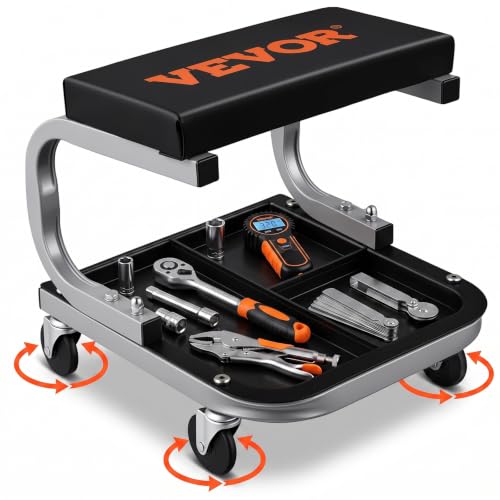
Targeting the DIY mechanic who handles standard maintenance—oil changes, brakes, and suspension—the VEVOR Rolling Seat offers a rigidly confirmed seated height of 15.7 inches. This elevation hits the sweet spot for wheel-well work, allowing your hands to naturally meet hub-center without hunching.

Built with tubular steel, it bypasses the common failure points of cheaper plastic-bodied seats. The 300 lb capacity easily handles average dynamic loading, while the segmented tool tray is recessed beautifully so it does not snag on bumpers when rolling underneath the chassis.

Contextually, the 2-inch casters are soft-rubber ball-bearing units. They will protect epoxy and sealed concrete, but users on rubber interlocking mats or heavily cracked driveways should be aware that 2-inch casters will require noticeable push force.
-
Type / SpecsFixed Seat | Height: 15.7 in | Cap: 300 lb | Casters: 2.0 in Ball-Bearing Soft Rubber | Frame: Steel
-
✓ Best forGeneral beside-vehicle work, brake jobs, detailing on sealed or epoxy floors.
-
⚠ Not ideal forCracked driveway concrete or users working strictly under low-clearance vehicles.
-
Pros / ConsPros: Rigid frame; excellent recessed tray; floor-safe casters. Cons: Casters are slightly small for expansion joints; foam density is standard, not premium.
2. Rolling Creeper Garage Shop Seat for Men — Best for Built-In Storage
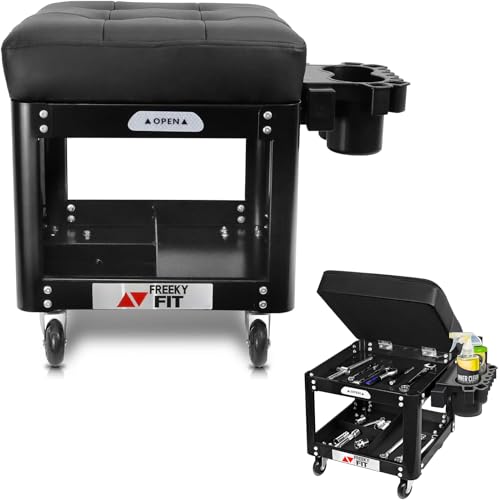
For mechanics who hate standing up to fetch tools, this fixed-height unit acts as a rolling toolbox. The seated height rests slightly lower at 14.5 inches, granting slightly better clearance for reaching under body panels while staying seated.

The defining feature is the under-seat slide-out drawer, paired with dual-sided utility trays. It carries an impressive capacity to hold ratchets, socket rails, and aerosol cans securely while moving. The heavy-duty plate steel construction pushes its static load rating up to 300 lbs securely.

The 3-inch dual-bearing casters solve the floor compatibility gap—they roll beautifully over garage threshold cracks and debris. However, the added drawer weight means this seat is heavy; it is meant to stay on the floor, not be hung on a wall peg.
-
Type / SpecsStorage Seat | Height: 14.5 in | Cap: 300 lb | Casters: 3.0 in Dual-Bearing | Width: 14.5 in
-
✓ Best forTool-heavy tear downs, keeping parts organized directly under you.
-
⚠ Not ideal forMechanics who need to carry their seat around the garage constantly.
-
Pros / ConsPros: Massive tool storage; smooth 3-inch casters; wide comfort cushion. Cons: Heavy unit weight; drawers can slide out if tipped sharply.
3. AeroCreeper – Adjustable Height Mechanics Creeper — Best Premium Ergonomic Option
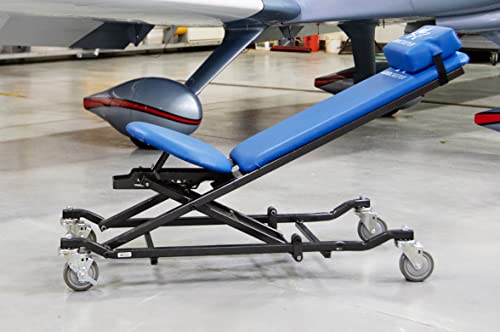
The AeroCreeper represents the ultimate solution for back pain and multi-tasking. Rather than a standard pneumatic cylinder that fails over time, it uses a highly engineered mechanical lift structure that transitions from an ultra-low 5.5 inches all the way up to a 20-inch seated height.
This 14.5-inch range is transformative. You can lie nearly flat at 5.5 inches to drain oil, then raise it to 16 inches for brake pad replacement in the same session without ever leaving the seat. The 350 lb capacity rating is fully supported by aircraft-grade structural alloys.
Equipped with 3-inch industrial casters, it navigates expansion joints effortlessly. The contoured 15-inch wide cushion perfectly supports broader hip measurements, eliminating outer thigh nerve pinching.
-
Type / SpecsAdjustable | Height: 5.5–20.0 in | Cap: 350 lb | Casters: 3.0 in | Width: 15.0 in
-
✓ Best forMixed-session mechanics, pre-existing back injuries, shared garages.
-
⚠ Not ideal forBudget buyers—this is a significant, premium shop investment.
-
Pros / ConsPros: Massive height range; reliable mechanical lock; ultra-comfortable contour. Cons: High price point; larger floor footprint.
4. Pro-LifT C-9100 Black 40″ Foldable Z Creeper — Best Heavy-Duty Convertible
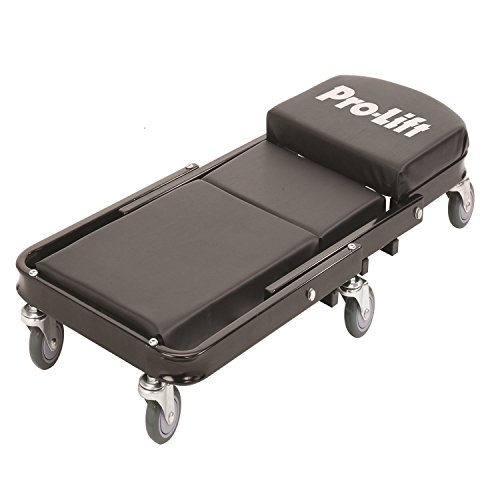
Pro-LifT’s C-9100 is the benchmark for the convertible category. In seat mode, it provides an 18-inch height; when folded flat via the pin-pull system, it acts as a 40-inch long traditional creeper with a 4.5-inch ground clearance profile.

The standout specification here is the massive 450 lb weight capacity, secured by heavy-wall square steel tubing. Applying the 1.25× dynamic load rule, this unit safely accommodates mechanics weighing up to 360 lbs without weld fatigue.

Remember the Gap 8 trade-off: the 4.5-inch flat profile is higher than dedicated boards. Ensure your vehicle has adequate clearance. The 3-inch polyurethane casters are superb, preventing floor scratching while handling heavy loads effortlessly.
-
Type / SpecsConvertible | Seat Height: 18.0 in | Flat Profile: 4.5 in | Cap: 450 lb | Casters: 3.0 in Poly
-
✓ Best forHeavy-set mechanics, SUV/Truck owners, small garages needing 2-in-1 function.
-
⚠ Not ideal forLowered sports cars with less than 5 inches of undercarriage clearance.
-
Pros / ConsPros: True heavy-duty rating; smooth conversion pins; excellent 3-inch casters. Cons: High flat-mode ground profile.
5. VEVOR Foldable Z Garage Creeper — Best Budget Combo
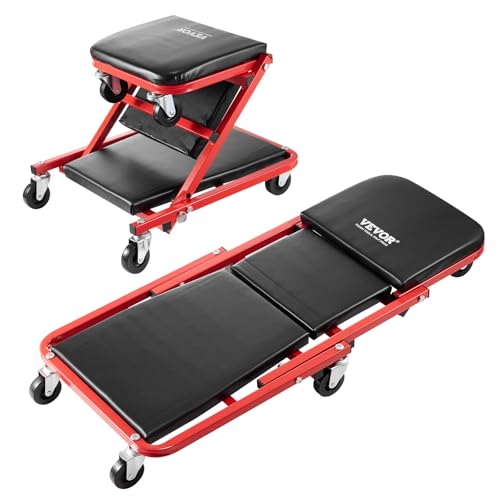
VEVOR provides the 2-in-1 utility at an accessible entry price. With a seated height of 18.5 inches and a flat mode profile of 4.2 inches, it matches the geometry of premium models but scales the materials for casual home use.

The 300 lb static rating is adequate for mechanics under 240 lbs. The 3-inch rubberized casters are an excellent inclusion at this price point, ensuring it doesn’t snag on minor concrete imperfections.

The primary compromise is the vinyl cushion covering, which is thinner and more susceptible to tearing if a sharp screwdriver or scraper is left in your back pocket during use.
-
Type / SpecsConvertible | Seat: 18.5 in | Flat: 4.2 in | Cap: 300 lb | Casters: 3.0 in Rubberized
-
✓ Best forWeekend DIYers doing seasonal maintenance on standard vehicles.
-
⚠ Not ideal forDaily commercial use or operators exceeding 240 lbs (accounting for dynamic load).
-
Pros / ConsPros: High value-to-cost ratio; decent caster size; lightweight to hang. Cons: Thin vinyl upholstery; padding bottoms out quickly.
6. M-AUTO Foldable Z Creeper 2-in-1 — Best Compact Convertible

Targeting the tight single-car garage, the M-AUTO model uses a slightly shorter frame geometry. It folds into a stable mid-height seat and drops down into a 4.0-inch profile flat board.
The hinged mid-stabilizer locks firmly, supporting its 300 lb rating. The 2.5-inch swivel casters are a middle-ground compromise, rolling better than 2-inch units but occasionally catching on heavier debris compared to 3-inch models.

Because the frame is compact, mechanics over 6 feet tall may find their head extending past the top padded cushion in flat mode. It is highly maneuverable between jack stands, however.
-
Type / SpecsConvertible | Flat: 4.0 in | Cap: 300 lb | Casters: 2.5 in Swivel | Frame: Steel
-
✓ Best forTight workspaces, compact storage, and mechanics under 6’0″.
-
⚠ Not ideal forTall users who need full spine and head support in flat mode.
-
Pros / ConsPros: Highly maneuverable; easy to fold; space-saving. Cons: Short overall length; 2.5-inch casters are mediocre on rough concrete.
7. DNA MOTORING TOOLS-00186 40″ 2-IN-1 — Best for Tall Users
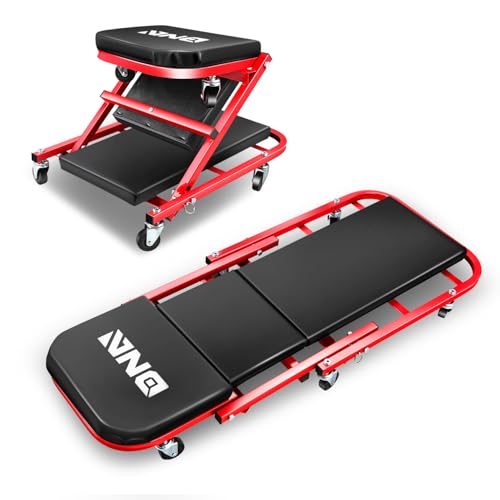
DNA Motoring solves the tall-mechanic issue with an extended 40-inch frame length. In flat mode, this ensures complete head-to-pelvis padding support, eliminating neck fatigue.

It utilizes standard 3.0-inch casters to support a 300 lb frame limit. The conversion joints are robust, locking it into an upright seat that is incredibly stable laterally due to the extended leg base.

The trade-off is the swing radius: rolling this 40-inch board out from under a car requires more floor clearance behind the vehicle.
-
Type / SpecsConvertible | Length: 40 in | Cap: 300 lb | Casters: 3.0 in
-
✓ Best forMechanics over 6 feet tall needing full body support.
-
⚠ Not ideal forCramped bays where pivoting a long board is difficult.
-
Pros / ConsPros: Excellent head support; stable seated base; good caster size. Cons: Wide turning radius.
8. DNA MOTORING TOOLS-00184 36″ 2-IN-1 — Short Frame Alternative

The exact same build quality as the 00186, but compressed into a 36-inch length. This is optimized for weaving between lift posts, jack stands, and tight garage layouts.

It drops the casters down to 2.5 inches to lower the profile slightly, yielding a more compact flat mode. The 300 lb capacity remains unchanged.

If you don’t need the extra head support length, the 36-inch is objectively easier to handle and store.
-
Type / SpecsConvertible | Length: 36 in | Cap: 300 lb | Casters: 2.5 in
-
✓ Best forAgile movement under tightly lifted vehicles.
-
⚠ Not ideal forTall operators; rough floors (due to 2.5-inch casters).
-
Pros / ConsPros: Easy to store; highly nimble; sturdy hinges. Cons: Reduced caster performance on debris.
9. Creepers Automotive Mechanic Creeper Seat & Under — Basic Backup Tool
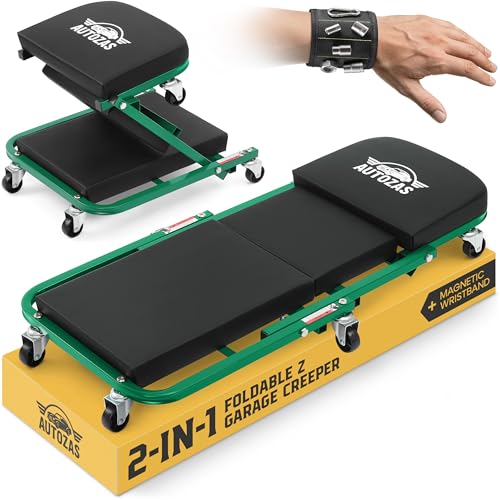
This entry-level generic combo board serves best as a secondary tool or a backup for occasional roadside emergency trunk storage.

It performs the standard Z-conversion reliably with a 300 lb rating, but utilizes economy plain-bore 2.5-inch casters. These will stiffen in cold weather and drag on dirty floors, requiring frequent cleaning.

Expect basic utility, but do not mistake this for a daily driver in an active shop.
-
Type / SpecsConvertible | Cap: 300 lb | Casters: 2.5 in Plain-Bore Economy
-
✓ Best forTrunk storage, occasional use, extreme budget constraints.
-
⚠ Not ideal forEpoxy floors (will drag/scratch), cold weather garages.
-
Pros / ConsPros: Very cheap; does the job. Cons: Poor caster quality; basic padding.
10. Shop Stool with Wheels for Garage — Best for Workbenches
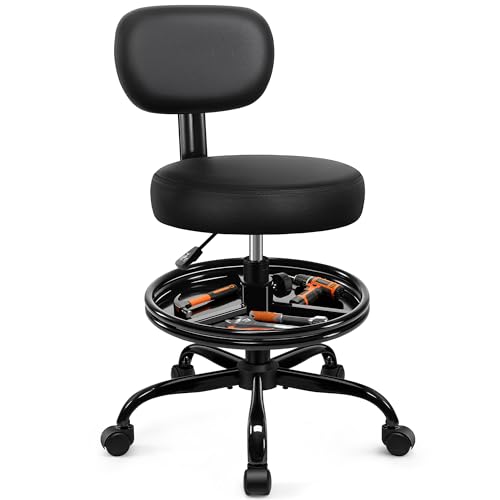
Do not use a low creeper seat for workbench tasks; you need a rolling shop stool. This unit provides a pneumatic adjustment range from 18 to 26 inches, keeping your spine neutral at bench height.

It is constructed with heavy chrome-plated steel supporting up to 330 lbs. Crucially, it features a lower footrest ring—this prevents your legs from dangling, which cuts off thigh circulation and strains the lower back over time.

The tool tray is located at the base rim. The 2.5-inch dual swivel casters are acceptable for smooth shop floors. Warning: the pneumatic cylinder will likely require replacement every 3-5 years due to inevitable seal wear.
-
Type / SpecsTall Stool | Height: 18–26 in | Cap: 330 lb | Casters: 2.5 in Dual Swivel
-
✓ Best forEngine bay teardowns, workbench assembly, upper-panel detailing.
-
⚠ Not ideal forAny form of low under-vehicle or brake hub work.
-
Pros / ConsPros: Essential footrest ring; fast pneumatic lift; good capacity. Cons: Gas cylinder lifespan limit; small casters.
11. Traxion 1-200 King Crawler — Best for Damaged Floors

The Traxion King Crawler flat board solves the #1 complaint in mechanics tools: wheels stopping dead on debris. It utilizes massive 5-inch terrain wheels that roll effortlessly over zip ties, air hoses, and cracked concrete.

The frame drops down below the axle line, creating a deep V-shape that cradles the user. This keeps your center of gravity low and maintains an incredibly low under-car clearance despite the giant wheels. It easily manages a 400 lb dynamic load.

If your driveway is rough or your garage floor is pitted, skip the small-wheel seats entirely and buy this. The rolling freedom is unmatched.
-
Type / SpecsFlat Board | Profile: Drop-Deck | Cap: 400 lb | Casters: 5.0 in Terrain
-
✓ Best forCracked concrete, old asphalt, heavily cluttered garage floors.
-
⚠ Not ideal forExtremely cramped storage spaces (it is wide).
-
Pros / ConsPros: Unstoppable wheels; high capacity; dropped clearance deck. Cons: Wide footprint; cannot convert to a seat.
12. Powerbuilt Big Wheel Creeper — Best Off-Road Platform
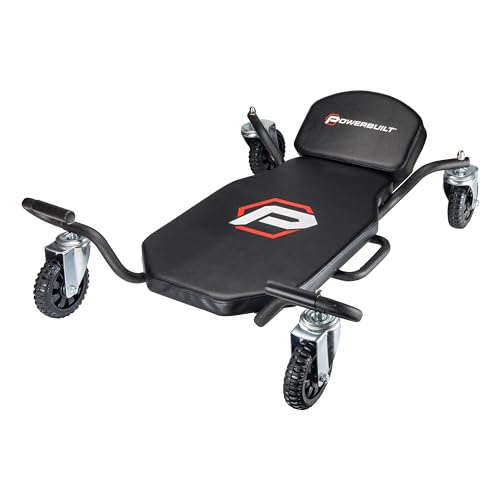
Designed for overlanding and field repairs, the Powerbuilt uses 4-inch deep-tread wheels. It acts as an off-road flat creeper, capable of rolling across hard-packed dirt, campground gravel, and rough trail terrain.

The composite body is highly durable and supports 400 lbs. It is strictly a high-clearance tool for lifted trucks and 4x4s.

Do not buy this for a standard sedan in a clean garage; the tread design will pick up grease and track it everywhere.
-
Type / SpecsOff-Road Board | Cap: 400 lb | Casters: 4.0 in Treaded Wheels
-
✓ Best forLifted trucks, trail repairs, gravel driveways.
-
⚠ Not ideal forClean indoor epoxy floors; standard ride-height cars.
-
Pros / ConsPros: Rolls on dirt; indestructible body; easy clean. Cons: Too tall for standard cars.
13. AFF Viking Mechanic’s Creeper — Best Professional Board
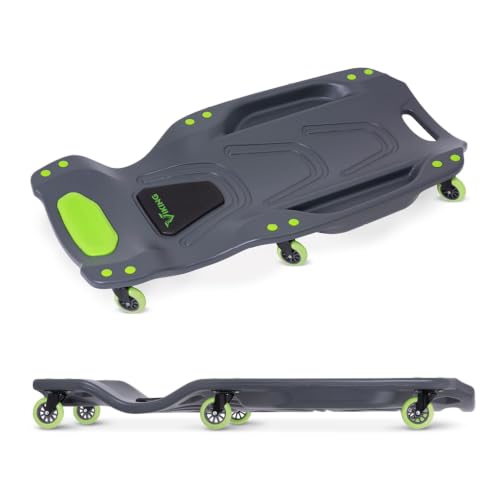
American Forge & Foundry provides a pure, uncompromised industrial flat board. No folding joints, no gimmicks—just a welded steel frame supporting a chemical-resistant high-density pad.

It supports 350 lbs dynamically. The ultra-low profile allows it to slide under almost any chassis. The 3.0-inch professional swivel casters are heavy, oil-resistant, and incredibly smooth.

This is the tool you buy once for a lifetime of under-car work.
-
Type / SpecsFlat Board | Profile: Ultra-Low | Cap: 350 lb | Casters: 3.0 in Oil-Resistant Swivel
-
✓ Best forProfessional shops, low sports cars, daily under-chassis work.
-
⚠ Not ideal forMechanics requiring seated beside-vehicle access.
-
Pros / ConsPros: Industrial durability; lowest possible clearance; pro casters. Cons: Expensive for a single-mode tool.
14. 42″ Mechanic Creeper with 6 Swivel Casters — Best Body Contouring
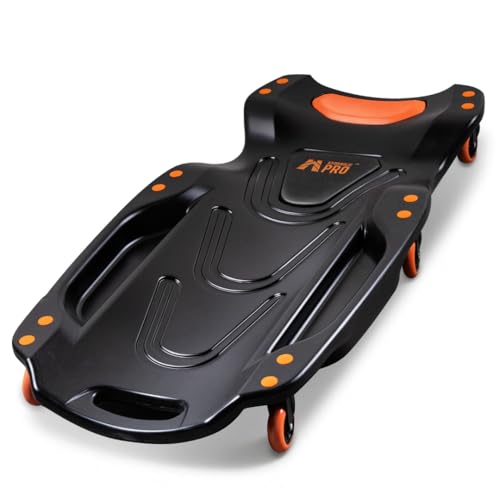
This 42-inch polymer board replaces a steel frame with a molded tub that curves around your shoulders. This contouring drops your back deep down, maximizing chest-to-undercarriage working room.

It supports 350 lbs across six independent 3-inch swivel casters, distributing the weight excellently on thin epoxy floors.

The plastic wipes clean of oil instantly, making it highly practical for fluid drain tasks.
-
Type / SpecsContoured Board | Length: 42 in | Cap: 350 lb | Casters: Six 3.0 in Swivels
-
✓ Best forFluid drains, tight clearances, mechanics wanting shoulder recesses.
-
⚠ Not ideal forSitting upright or folding for storage.
-
Pros / ConsPros: Ergonomic shoulder pockets; wipes clean; 6-caster stability. Cons: Hard plastic is less plush than thick vinyl padding.
Correct Posture: Position the seat for under-vehicle work with feet pointed out and hips square. Do not twist sideways to reach heavy torque wrenches—this shears lumbar discs. For side work, keep elbows near your ribs.
Maintenance: Clean caster bearings monthly using compressed air. If they bind, use light machine oil, not heavy grease. Store your padded seats off cold concrete in the winter; freezing temperatures permanently compress and destroy open-cell foam resilience.
Safety: Never use a rolling seat on an inclined driveway slope. Always verify the floor is free of massive oil slicks before rolling under a 4,000 lb vehicle. Maximum lean angle is moderate—do not lean past the wheelbase when breaking seized bolts.
For Back Pain: A fixed flat seat provides no lumbar support. If you have chronic lower back pain, invest in an adjustable model that allows you to bring your eyes perfectly level with the task, preventing all spinal hunching.
- Primary task identified: under-vehicle (low creeper or flat) vs. beside-vehicle (mid-height seat).
- Ground clearance measured: measure vehicle clearance to ensure a convertible (3.5–4.5 in profile) will actually fit.
- Floor surface mapped: Bare concrete (any) vs. Epoxy (polyurethane casters required to prevent scratching).
- Capacity mathematically calculated: Body weight × 1.25 = absolute minimum rated capacity you can buy safely.
- Seat width verified: Ensure the cushion width is at least 13 inches for standard builds, wider for broad frames.
Pair your seat with a Magnetic Parts Dish to stop 10mm sockets from rolling away on the floor. Use a Mechanic’s Work Light attached magnetically to the chassis above you. If you have bare, pitted concrete, lay down a Garage Floor Mat to instantly create a smooth rolling surface for your casters.
- What is a creeper seat used for?
A creeper seat is designed to provide low-height, rolling access for beside-vehicle mechanic tasks like brake jobs, detailing, and suspension work, preventing knee and back strain from crouching.
- What is the difference between a creeper seat and a flat creeper?
A flat creeper allows you to lie completely horizontal to slide directly under the center of a vehicle. A creeper seat keeps you upright and seated for tasks on the perimeter of the vehicle.
- What height should a creeper seat be?
It depends on the task: 8–12 inches for low under-bumper access, 14–18 inches for comfortable wheel-well and brake pad work, and 18–26 inches for workbench tasks.
- Can you use a creeper seat on an epoxy floor?
Yes, provided you use polyurethane or soft-rubber casters. Hard nylon or solid steel wheels will scratch and drag across a high-gloss epoxy coating.
- How much weight can a creeper seat hold?
Most range from 250 to 450 lbs. Always select a rated capacity that is at least 1.25 times your actual body weight to account for the dynamic force of sitting down heavily.
- What is a convertible creeper seat?
It is a “Z” frame tool that folds into an upright mechanic seat and unfolds into a flat lay-down creeper board. The trade-off is a slightly higher ground clearance when lying flat compared to a dedicated board.
- Are adjustable height creeper seats worth it?
Yes, for users who move between tasks of different heights in a single session. They prevent spinal hunching by allowing you to dial in your exact eye level to the work point.
- What creeper seat is best for back pain?
Seats with adjustable height mechanisms are best, allowing neutral spine posture. Look for high-density foam, wide hip bases (over 14 inches), and models equipped with padded backrests.
- How do I stop casters from scratching my floor?
Switch out stock hard-plastic wheels for universal 7/16-inch stem polyurethane replacement casters, and regularly clear debris like metal shavings from the wheel bearings.
- How do I maintain a creeper seat?
Blow out caster bearings with compressed air monthly, lubricate with light oil, inspect frame welds quarterly, and never store foam cushions directly on freezing concrete floors.
Ready to upgrade your garage workflow? Here are the best options mapped to your specific task:
- Best Overall Fixed Seat: VEVOR Rolling Creeper Shop Seat →
- Best for Built-in Storage: Rolling Shop Seat for Men →
- Best Premium Adjustable Ergonomics: AeroCreeper Mechanics Seat →
- Best Heavy-Duty Convertible: Pro-LifT C-9100 Black 40″ →
- Best Budget Z-Creeper: VEVOR Foldable Z Garage Creeper →
- Best Compact Folding Combo: M-AUTO Foldable Z Creeper →
- Best for Tall Mechanics: DNA MOTORING 40″ 2-IN-1 →
- Best for Tight Garage Spaces: DNA MOTORING 36″ 2-IN-1 →
- Best Entry-Level Combo: Automotive Mechanic Combo →
- Best for Taller Workbenches: Shop Stool with Wheels →
- Best for Rough / Damaged Floors: Traxion 1-200 King Crawler →
- Best True Off-Road Platform: Powerbuilt Big Wheel Creeper →
- Best Professional Flat Board: AFF Viking Mechanic’s Creeper →
- Best Body Contouring Board: 42″ Mechanic Creeper (6 Swivel) →