

Swinging a framing hammer all day on a deck, wall frame, or house build isn’t just exhausting — it’s slow. A framing nailer drives a 3.5″ 16d nail in under a second with consistent depth, every time, without the arm fatigue or split studs that come with hammer work. But walking into the framing nailer category for the first time is genuinely confusing: pneumatic or cordless, 21° or 30° magazine, stick or coil, bump fire or sequential. Get the wrong combination and you end up with a tool that doesn’t meet your local building code, won’t work with the compressor you own, or is so heavy it wears you out faster than the hammer would have. (Need a trim, brad or pin nailer instead? See our best nail guns guide for every nail type.)
This guide cuts through all of it. I’ve reviewed 8 of the best framing nailers on Amazon across every use case — from daily professional framing and metal connector work to weekend deck builds, remodeling in tight corners, and high-volume sheathing. Before the product reviews, I’ve included a buying guide that covers the specs every competitor article skips: building code compliance, compressor requirements, drive system differences, and a complete breakdown of what nails to buy for your specific tool.
Quick Comparison: Best Framing Nailers (2026)
| Product | Type | Angle | Nail Length | Weight | Best For |
|---|---|---|---|---|---|
| Metabo HPT NR90AES1 | Pneumatic | 21° | 2″–3.5″ | 7.5 lbs | Best Overall |
| BOSTITCH F21PL | Pneumatic | 21° | 1.5″–3.5″ | 8.1 lbs | Best Pro / Metal Connector |
| NuMax SFR2190 | Pneumatic | 21° | 2″–3.5″ | 8.6 lbs | Best Budget |
| Freeman PFR2190 | Pneumatic | 21° | 2″–3.5″ | 8.5 lbs | Best Budget Runner-Up |
| Milwaukee 2744-20 | Cordless | 21° | 2″–3.5″ | 10.05 lbs | Best Cordless Overall |
| DEWALT DCN21PLB | Cordless | 21° | 2″–3.25″ | 8.5 lbs | Best Cordless DeWalt |
| Metabo HPT NR1890DCA | Cordless | 30° | 2″–3.5″ | 8.2 lbs | Best Cordless for Tight Spaces |
| Metabo HPT NV83A5 | Pneumatic Coil | 15° | 2″–3.25″ | 8.8 lbs | Best Coil Nailer |
Framing Nailer Buying Guide – The Specs Most Articles Skip

Most framing nailer buying guides cover brands and prices, then jump straight into product reviews without explaining the decisions that actually determine which tool is right for your situation. These next sections cover the six factors that matter most — including several that can affect whether your framing work passes a building inspection.
Magazine Angle – 15°, 21°, 28°, 30° Explained
The magazine angle is the first number you’ll encounter in any framing nailer description, and it’s the most misunderstood. The angle refers to how the nails sit in the magazine relative to the tool’s nose. Here’s what each actually means in practice.
15° coil nailers use wire-connected nails that coil into a large drum magazine, typically holding 200–300 nails. Full round-head nails only. The large capacity makes these the preferred tool for production-volume work — sheathing, roof decking, subfloors — where reloading interrupts rhythm. The Metabo HPT NV83A5 is the benchmark product in this category.
21° plastic collated is the professional standard for structural framing in the United States. It uses full round-head nails, which is critical for building code compliance. Most US jurisdictions that specify framing nail requirements call for full round-head nails — 21° is the answer. Magazine capacity is typically 50–70 nails in two strips. Every pneumatic nailer in this review except the coil model uses 21° collation.
28° wire weld is less common and appears mostly on older Paslode and some Bostitch models. Uses clipped or offset-head nails. Worth knowing about but not the focus of this guide.
30° paper collated is the most compact stick magazine format. The steeper angle allows the tool to have a narrower profile, which is genuinely useful in tight framing corners, stud bays, and overhead work. Uses clipped-head or offset round-head nails — two strips in the magazine means less-frequent reloading than many 21° designs. The trade-off is nail head compliance (see the building code section below).
Decision rule: For structural framing on any permitted, inspected construction project, use 21°. For remodeling, deck building, and non-inspected DIY work, 21° or 30° are both effective. For high-volume sheathing and decking where you’re driving hundreds of nails per session, 15° coil is the professional choice.

Building Code Compliance — The Most Overlooked Factor in This Category
This is the section that almost no framing nailer buying guide includes, and it’s the one that can make the difference between a framing job that passes inspection and one that fails.
The International Residential Code (IRC) and many state and local building codes specify nail schedules for structural framing connections — including minimum nail diameter, length, and head type for shear walls, hurricane straps, hold-downs, and load-bearing connections. Many of these specifications call for full round-head nails.
Clipped-head nails, used in 28° and 30° nailers, have a trimmed head that allows tighter coil or strip collation in the magazine. In a shear wall nailing schedule requiring full round-head nails, a clipped-head nail has a reduced bearing area that may not meet the code-specified withdrawal resistance. In California, Florida, and other states with strict seismic and wind resistance codes, full round-head nails are required for most structural framing connections.
The practical consequence: if you’re framing walls, shear panels, or any structural element that will be inspected, a 21° full round-head nailer is always the safe, code-compliant choice. A 30° clipped-head nailer may or may not be acceptable depending on your jurisdiction — and finding out after the framing inspection fails is expensive. When in doubt, use 21°.
PSI and Compressor Requirements
Pneumatic framing nailers need a compressor that can deliver adequate pressure and volume. Most models on this list require 70–120 PSI operating pressure, with optimal performance around 90–100 PSI. But pressure alone isn’t the whole picture — you also need sufficient air volume, measured in CFM (cubic feet per minute).
A framing nailer typically consumes 2–4 CFM at 90 PSI for sustained nailing. A standard pancake compressor — the small, portable units common in home shops — typically delivers only 0.5–1.5 CFM. That’s insufficient for continuous framing nailer operation. You’ll get a nail or two before the pressure drops and subsequent nails drive shallow.
For framing nailer use, you need at minimum a 6-gallon compressor delivering at least 2 CFM at 90 PSI. For sustained production work with a single nailer, a 15–20 gallon unit is more comfortable. For a two-nailer crew on a house frame, 30+ gallon with a 5+ CFM output is the professional standard. The good news is that if this compressor requirement is a problem, the cordless options on this list — the Milwaukee 2744-20, DeWalt DCN21PLB, and Metabo HPT NR1890DCA — need no compressor at all.
Cordless Drive Systems — Nitrogen Spring vs. Flywheel vs. Air Spring
Cordless framing nailers use one of three mechanisms to drive nails, and the differences affect firing response, maintenance, and daily usability significantly.
Flywheel/brushless motor (used in the DEWALT DCN21PLB): the battery spins a flywheel up to speed; when you pull the trigger, the flywheel engages a driver to strike the nail. Modern designs have reduced the ramp-up time dramatically, but there’s still a slight dwell between trigger pulls compared to pneumatic tools. The DeWalt DCN21PLB also has a dual-speed motor and a stall release lever for when the motor locks up in dense material — a useful safety feature.
Nitrogen spring mechanism (used in the Milwaukee 2744-20): a sealed nitrogen chamber stores energy. The POWERSTATE brushless motor releases this stored energy to drive the nail. The result is zero ramp-up time — a nail fires the instant you pull the trigger, identical to a pneumatic tool. No gas cartridges needed, no flywheel spin-up. Milwaukee’s implementation is widely regarded as the smoothest-feeling cordless framing nailer on the market.
Air spring drive system (used in the Metabo HPT NR1890DCA): charges a small internal air spring that drives the nail pneumatic-style. No gas cartridges (unlike older Paslode gas-actuated models), no motor ramp-up. Delivers 120 joules of driving energy with zero ramp-up time. The air spring design results in consistent nail depth across varying wood densities — it behaves more like a pneumatic tool than any flywheel design.
Bump Fire vs. Sequential Fire
Every framing nailer on this list has two firing modes. Understanding the real-world difference matters for both speed and safety.
Sequential fire (also called single fire): the contact tip must touch the wood surface before the trigger fires a nail, and you must release and re-pull the trigger for each subsequent nail. One trigger pull, one nail, always. This is the safest mode for toe-nailing, angled connections, and any work where the nose placement requires precision. Use this mode when you’re working overhead, in awkward positions, or driving nails in places where the contact tip might accidentally touch something you don’t intend to nail.
Bump fire (also called contact actuation): hold the trigger down and bump the contact tip against the wood to fire — one nail per contact. Dramatically faster for production framing work where you’re nailing plate after plate, stud after stud, in a flat, controlled position. The risk: if your hand slips or the tool bounces unexpectedly, the contact tip can touch an unintended surface and fire. Use bump fire only for production flat-surface framing, never for overhead work or toe-nailing.
All eight nailers on this list feature tool-free selectable actuation — a switch or lever that lets you change modes without swapping physical triggers. This is a meaningful convenience feature that budget tools in the broader market often omit.

What Nails to Buy for Your Framing Nailer
Collation type must exactly match your nailer’s magazine angle. 21° plastic collated nails for 21° nailers. 30° paper collated nails for 30° nailers. 15° wire coil nails for coil nailers. Mixing types causes jams and misfires.
For nail length, match the application. For sheathing attachment, 2″ to 2.5″ nails work well. For toe-nailing studs to plates, 3″ nails give proper penetration. For standard structural framing — stud to top and bottom plate, header connections, rim joists — 3″ to 3.5″ 16d nails are the professional standard. For engineered lumber (LVL beams, laminated headers), use 3″ to 3.5″ ring-shank nails where the extra withdrawal resistance is appropriate.
For nail material, use bright (uncoated) nails only for interior framing in dry conditions. For exterior framing, decking, and any pressure-treated lumber, you must use hot-dipped galvanized nails. Uncoated nails in contact with pressure-treated wood will corrode due to the copper compounds in modern PT treatments, and can fail structurally within a few years. This is a code requirement, not a preference.
Framing Nailer vs. Other Nailer Types — Do You Need More Than One?
A framing nailer is purpose-built for structural work: driving 2″ to 3.5″ nails through dimensional lumber and engineered wood products. It is not the same tool as a finish nailer or a brad nailer, and these tools are not interchangeable. A finish nailer (15 or 16 gauge) drives smaller nails for trim, door casings, and molding — it cannot substitute for framing work. A brad nailer (18 gauge) is for thin trim, bead board, and lightweight molding — far too small for anything structural. If you’re building decks, framing walls, or doing structural carpentry, a framing nailer is the specific tool you need. See our Best Cordless Brad Nailer guide if you also need a tool for finish work.
The 8 Best Framing Nailers — Full Reviews
1. Metabo HPT NR90AES1 — Best Overall Framing Nailer

The Metabo HPT NR90AES1 has held the top spot in professional framing nailer rankings for years, and in 2026 it still earns it. Builder and Developer Magazine has rated Metabo HPT the Pro Preferred nailer brand for over a decade running — that kind of sustained professional preference comes from real-world durability and performance on job sites where tools take daily punishment. The NR90AES1 specifically is the lightest full-size professional pneumatic framing nailer available at just 7.5 lbs. On a day where you drive 500 nails, that weight difference matters considerably.
The 21° plastic collated magazine accepts full round-head nails from 2″ to 3.5″, holds up to 64–70 nails in two strips, and uses Metabo HPT’s two-step loading system that prevents nail strips from accidentally splitting during loading. The selective actuation switch is a simple flip — no tool swap, no fumbling — letting you move between bump fire for production plate nailing and sequential fire for toe-nailing and precision connections in seconds. Tool-free depth adjustment is just below the driver assembly: turn the dial to match your material and move on. The adjustable exhaust port lets you direct debris away from your face in any work orientation, which any framer who’s been hit with a face full of sawdust on a hot day will appreciate.

The NR90AES1’s one honest limitation is the absence of a rafter hook and no dry-fire lockout — both features that competitors at a similar price point include. The rafter hook omission is a minor annoyance on roof work where hanging the tool between shots is convenient. These are trade-offs Metabo HPT made to keep weight down and cost competitive. The 5-year warranty — the best in the pneumatic category — covers any buyer who plans to use this tool seriously. Operating range is 70–120 PSI at approximately 4 CFM at 90 PSI. Runs comfortably at 85 PSI for standard framing in pine, needs 90–100 PSI for dense engineered lumber.

| Spec | Detail |
|---|---|
| Magazine Angle | 21° |
| Collation | Plastic strip |
| Nail Length | 2″–3.5″ (full round-head) |
| Magazine Capacity | 64–70 nails |
| Operating Pressure | 70–120 PSI |
| Weight | 7.5 lbs |
| Drive Modes | Bump / Sequential (selectable switch) |
| Depth Adjust | Tool-free |
| Warranty | 5 years |
What we like:
- Lightest full-size professional pneumatic framing nailer at 7.5 lbs — noticeably less fatigue on full-day framing work
- Selective actuation switch (no tool or trigger swap required to change modes)
- 21° full round-head nails — code-compliant for all jurisdictions
- 5-year warranty — best in the pneumatic framing nailer category
- Pro Preferred brand for 12+ years running by Builder and Developer Magazine
- Adjustable exhaust port prevents debris blowback
What we don’t like:
- No rafter hook included — notable omission for roof work
- No dry-fire lockout — requires manual monitoring of magazine level
Bottom line: The best framing nailer for the majority of professional framers, contractors, and serious DIYers. The lightest tool in its class, the longest warranty, and the most trusted brand name in professional pneumatic nailers. If you’re buying one framing nailer for the long haul, start here.
Check Price on Amazon — Metabo HPT NR90AES1
2. BOSTITCH F21PL — Best Pro Pneumatic / Best for Metal Connector Work
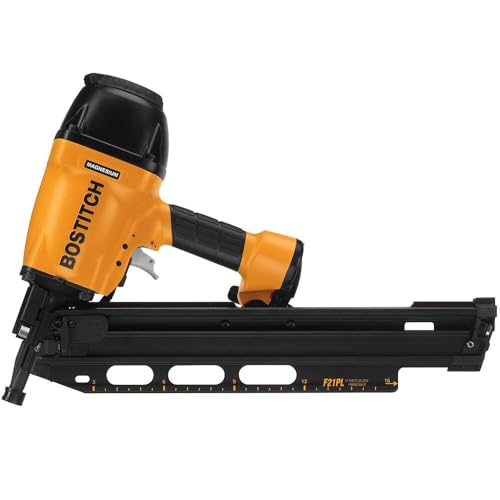
The BOSTITCH F21PL solves a specific job site problem that most framing nailers ignore entirely: the constant tool swap between driving framing nails and driving metal connector nails for joist hangers, hurricane ties, and seismic straps. The F21PL comes with two quick-change nosepieces — one for standard 21° plastic collated framing nails (2″ to 3.5″), and a second for 1.5″ to 2.5″ metal connector nails. Switching takes seconds. On a deck build or structural addition where you’re alternating between framing lumber and installing Simpson Strong-Tie hardware, eliminating the separate palm nailer from your kit is a genuine efficiency gain.
The magnesium housing keeps weight to 8.1 lbs despite the dual-magazine capability. BOSTITCH’s Smart Point technology narrows the nosepiece significantly compared to competitors — the smaller nose profile improves nail placement accuracy in tight framing bays and makes the tool easier to maneuver in cramped structural situations. Driving power is rated at 1,050 in-lbs, which is the highest published driving power figure among the pneumatic models on this list, making it the right choice for dense engineered lumber and LVL beam connections. The 16-inch stud layout indicator printed on the magazine side is a small but practically useful feature that helps maintain consistent stud spacing without breaking stride to measure.

Operating pressure is 80–120 PSI — slightly higher minimum than the Metabo HPT, meaning your compressor needs to be maintaining at least 80 PSI at the tool for consistent nail depth. The 7-year warranty on this tool is the longest of any nailer on this list. The adjustable rafter hook is included. Magazine holds 60 nails. One honest note: the F21PL’s nosepiece is slightly wider than the Metabo HPT’s in standard framing mode, which can make nailing in the narrowest stud bays marginally more challenging. But for the dual framing and metal connector capability, no other tool on this list comes close.

| Spec | Detail |
|---|---|
| Magazine Angle | 21° |
| Collation | Plastic strip |
| Nail Length (framing) | 2″–3.5″ |
| Nail Length (connector) | 1.5″–2.5″ |
| Magazine Capacity | 60 nails |
| Operating Pressure | 80–120 PSI |
| Driving Power | 1,050 in-lbs |
| Weight | 8.1 lbs |
| Drive Modes | Bump / Sequential (selectable) |
| Special Feature | Dual quick-change nosepieces (framing + metal connector) |
| Warranty | 7 years |
What we like:
- Two nailers in one — framing and metal connector nails with quick-change nosepieces
- 1,050 in-lbs driving power — the strongest on this list for dense engineered lumber
- 7-year warranty — the longest warranty on this list
- 16″ stud layout indicator on the magazine for faster consistent spacing
- Adjustable rafter hook included
- Lightweight magnesium housing despite the dual-function capability
What we don’t like:
- Higher minimum PSI (80 PSI) — requires a more capable compressor than the Metabo HPT
- Slightly wider nosepiece in framing mode vs. the Metabo HPT
- No dry-fire lockout
Bottom line: The right framing nailer for anyone who regularly installs metal connectors — deck builders, structural framing crews, addition framers, and anyone doing hurricane strapping or seismic retrofits. The dual nosepiece system eliminates an entire separate tool from your job site kit.
Check Price on Amazon — BOSTITCH F21PL
3. NuMax SFR2190 — Best Budget Framing Nailer

The NuMax SFR2190 is the framing nailer that shows up on every “best budget” list for good reason: it delivers the core features you need — 21° full round-head collation, dual-mode trigger, tool-free depth adjustment, anti-dry fire mechanism, and a 360° adjustable exhaust port — at a price that makes it accessible to homeowners and occasional-use contractors who can’t justify a Metabo HPT or BOSTITCH for a shed build or fence project. The die-cast magnesium body keeps weight manageable at 8.6 lbs, and the ergonomic rubber-grip handle absorbs vibration during extended use.
The anti-dry fire mechanism is worth highlighting specifically at this price point: it prevents the driver blade from firing on an empty magazine, which is the single most common cause of driver blade damage on budget nailers. The removable no-mar tip protects finished or semi-finished framing surfaces from the contact tip scratching or marring. A dust cap and internal air filter protect the internal components from debris ingestion — features that extend tool life significantly on dusty job sites. Operating pressure range is 70–120 PSI, consistent with the professional models.
The honest trade-offs: the NuMax’s fit and finish quality is below the Metabo HPT and BOSTITCH. Depth of drive can be slightly inconsistent in very dense hardwood or thick LVL — the occasional nail sits a hair proud or a hair deep on the first few shots when you change material. Magazine capacity is approximately 55 nails. The 1-year warranty is the shortest on this list — if you plan to use this tool daily for professional production framing, the warranty gap vs. the Metabo HPT (5 years) or Freeman PFR2190 (7 years) is a meaningful long-term cost consideration. For homeowners building decks, sheds, fences, and additions one project per season, neither limitation matters much.
| Spec | Detail |
|---|---|
| Magazine Angle | 21° |
| Collation | Plastic strip |
| Nail Length | 2″–3.5″ (full round-head) |
| Magazine Capacity | ~55 nails |
| Operating Pressure | 70–120 PSI |
| Weight | 8.6 lbs |
| Drive Modes | Bump / Sequential (dual-mode trigger) |
| Special Features | Anti-dry fire, no-mar tip, 360° exhaust |
| Warranty | 1 year |
What we like:
- Best price point of any functional framing nailer on this list
- Anti-dry fire mechanism protects the driver blade — critical for budget tool longevity
- 21° full round-head collation — code-compliant
- 360° adjustable exhaust port
- Tool-free depth adjustment
- Removable no-mar tip
What we don’t like:
- 1-year warranty — the shortest on this list
- Occasional depth inconsistency in very dense engineered lumber
- Not suited for daily professional production framing over years
Bottom line: The right framing nailer for homeowners, occasional DIYers, and light-use contractors who need a functional, code-compliant 21° nailer for seasonal projects without spending $150–$200 on a professional tool. If you’ll use it regularly, step up to the Freeman PFR2190 for the better warranty.
Check Price on Amazon — NuMax SFR2190
4. Freeman PFR2190 — Best Budget Runner-Up
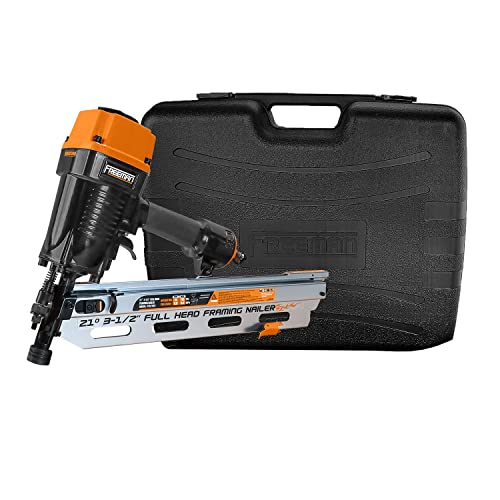
The Freeman PFR2190 and the NuMax SFR2190 are functionally the same tool — both designed and distributed by Prime Global Products Inc., with identical internals, specs, and feature sets. The one meaningful difference is the warranty: 7 years on the Freeman vs. 1 year on the NuMax. That warranty gap makes the Freeman the smarter long-term value for any buyer who plans to use the tool regularly, even if the Freeman costs slightly more upfront. Seven years of warranty coverage on a budget-tier nailer is exceptional — it matches the BOSTITCH F21PL’s warranty despite costing significantly less.
Like the NuMax, the Freeman PFR2190 uses 21° plastic collated full round-head framing nails from 2″ to 3.5″, operates between 70–115 PSI, weighs 8.5 lbs with a die-cast magnesium body, and includes a dual-mode trigger (bump and sequential), tool-free depth adjustment, 360° adjustable exhaust, and a rubber comfort grip handle. Magazine capacity is approximately 55 nails in two strips. An adjustable rafter hook is included — the NuMax omits this — and the Freeman ships with a padded carrying case, which adds value at this price point for storage and transport between job sites.

Freeman is a US-based company (Georgia) founded in 2008, and their warranty and after-sales service is handled domestically — a practical consideration for a tool you’re expecting to cover for 7 years. Amazon customer feedback consistently sits at 90%+ positive across thousands of reviews. The PFR2190 has earned Bob Vila’s Runner-Up designation in their tested framing nailer review, which is independent validation that the budget price doesn’t mean inadequate performance for DIY and moderate professional use. The same honest limitation applies as with the NuMax: this tool is not engineered for daily production framing at professional volume over years the way the Metabo HPT or BOSTITCH are. For seasonal and moderate-use buyers, the Freeman’s 7-year coverage makes it the better long-term budget value.

| Spec | Detail |
|---|---|
| Magazine Angle | 21° |
| Collation | Plastic strip |
| Nail Length | 2″–3.5″ (full round-head) |
| Magazine Capacity | ~55 nails |
| Operating Pressure | 70–115 PSI |
| Weight | 8.5 lbs |
| Drive Modes | Bump / Sequential |
| Includes | Padded carrying case, rafter hook |
| Warranty | 7 years (professional) |
What we like:
- 7-year professional warranty at a budget price — the best warranty-to-price ratio on this list
- Padded carrying case included — rare at this price tier
- Adjustable rafter hook included (NuMax omits this)
- 21° full round-head collation — fully code-compliant
- US-based warranty and service handling
- Bob Vila Runner-Up designation from a tested review
What we don’t like:
- Identical internal design to the NuMax — same depth consistency limitations in very dense material
- Not designed for daily high-volume professional production framing
- Slightly higher price than the NuMax for the same tool hardware
Bottom line: The better budget buy if you plan to use the tool more than occasionally. The 7-year warranty separates the Freeman from every other tool in the budget tier and makes it the right choice for homeowners and semi-pro users who want long-term coverage on a wallet-friendly tool.
Check Price on Amazon — Freeman PFR2190
5. Milwaukee 2744-20 M18 FUEL — Best Cordless Framing Nailer
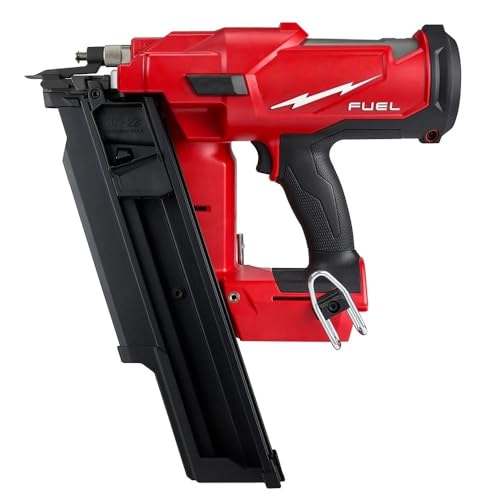
The Milwaukee M18 FUEL 2744-20 is the cordless framing nailer that genuinely replaced compressors and hoses for professional framers and finish carpenters on the M18 platform. Its defining technology is the nitrogen spring mechanism: a sealed, maintenance-free chamber of compressed nitrogen that stores driving energy and releases it the instant you pull the trigger. Zero ramp-up time. Zero gas cartridges. Zero compressor setup. A nail fires immediately on trigger pull at 3 nails per second — matching the firing response of a pneumatic nailer — every time, regardless of battery charge level within the tool’s operating range.
The POWERSTATE brushless motor and REDLINK PLUS intelligence work together to maintain consistent driving depth across material changes: if the system detects the nail isn’t seating fully in dense engineered lumber, it automatically increases the driving force on subsequent nails. This self-adjusting capability means you set the depth once and trust the tool to maintain it across varying material density — pine stud to LVL header — without manually re-adjusting the depth dial. Dry fire lockout prevents the tool from firing when the magazine is running low, and the on/off power button conserves battery when the tool is set down between uses.

This is the M18 FUEL family — meaning it runs on Milwaukee’s entire REDLITHIUM battery ecosystem. If you already own M18 batteries from a drill, circular saw, or any other Milwaukee cordless tool, those batteries run this nailer. The 5-year Milwaukee warranty covers the tool. The pivoting rafter hook and belt hook are both included. Magazine accepts 21° plastic strip full round-head nails from 2″ to 3.5″, keeping the tool fully code-compliant for structural framing. Weight is 10.05 lbs with a 5.0Ah battery — heavier than any pneumatic on this list, which is the unavoidable trade-off for cordless freedom. For a full day of framing, most users report the weight acceptable for horizontal work but noticeable on overhead nailing.

| Spec | Detail |
|---|---|
| Platform | M18 FUEL (18V brushless) |
| Drive System | Nitrogen spring + POWERSTATE brushless motor |
| Magazine Angle | 21° |
| Nail Length | 2″–3.5″ (full round-head, plastic strip) |
| Firing Speed | 3 nails per second, zero ramp-up time |
| Weight (with battery) | 10.05 lbs |
| Drive Modes | Bump / Sequential (selectable) |
| Features | Dry fire lockout, pivoting rafter hook, belt hook, REDLINK PLUS |
| Warranty | 5 years |
What we like:
- Nitrogen spring mechanism: zero ramp-up time, fires 3 nails per second instantly
- REDLINK PLUS auto-adjusts drive force to maintain consistent depth in varying materials
- No gas cartridges — M18 battery only, no consumable running costs
- 21° full round-head collation — fully code-compliant
- Dry fire lockout protects the tool when magazine runs low
- Compatible with all M18 REDLITHIUM batteries — leverages existing platform
- 5-year warranty
What we don’t like:
- 10.05 lbs with battery — heaviest nailer on this list, noticeable on overhead framing
- Sold as bare tool — budget for a battery if you don’t already own M18
- Higher price than pneumatic alternatives with equivalent performance
Bottom line: The best cordless framing nailer on the market for M18 platform users. The nitrogen spring system’s zero-ramp-up firing, self-adjusting drive depth, and no-consumable operation make it the most compelling argument for going cordless in the framing nailer category. If you’re already on M18, this is the obvious choice.
Check Price on Amazon — Milwaukee 2744-20
6. DEWALT DCN21PLB — Best Cordless DeWalt Framing Nailer
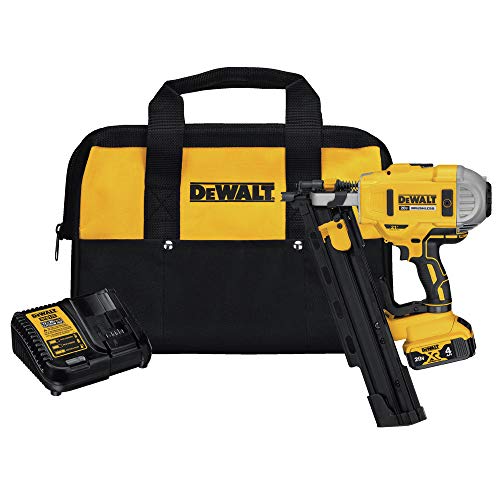
The DEWALT DCN21PLB is the 20V MAX cordless framing nailer for DeWalt platform users, and its defining features reflect what DeWalt does best: a compact, well-balanced tool with practical job site features engineered around the reality of daily contractor use. The dual-speed brushless motor is a design choice specific to DeWalt’s cordless nailer lineup — a lower speed setting for standard 2x lumber and dimensional pine, and a higher speed for dense engineered lumber and LVL. This two-speed approach lets you optimize motor output and battery consumption for the material you’re actually working with rather than always running at maximum power.
The stall release lever is a feature unique to the DeWalt’s flywheel-based drive system. When the motor locks up in extremely dense material — which can happen with any flywheel cordless nailer hitting a very hard knot or thick LVL — the stall release lever resets the motor without needing to cycle the tool off and on. It’s a safety and convenience feature that prevents the frustrating mid-job motor lockup that early cordless framing nailers were prone to. The easy-access nosepiece for jam clearing is also well-designed — framing nailer jams happen, and the DeWalt makes clearing one a 30-second job rather than a tool-disassembly ordeal.

The top-loading magazine holds 49 nails and accepts 21° plastic collated full round-head nails from 2″ to 3.25″ — note that the maximum nail length is 3.25″, slightly shorter than the 3.5″ accepted by the Milwaukee, Metabo HPT, and pneumatic models. For standard structural framing this is rarely a limitation, but for applications specifically requiring 3.5″ nails, verify your nail schedule before purchasing. The tool weighs 8.5 lbs — lighter than the Milwaukee 2744-20 by 1.5 lbs — and has an adjustable rafter hook. Approximately 899 nails per charge on a 4.0Ah battery. Three-year warranty. Sold as bare tool (DCN21PLB); the kit version (DCN21PLM1) includes a 4.0Ah battery and charger.

| Spec | Detail |
|---|---|
| Platform | DeWalt 20V MAX (compatible with FlexVolt 60V) |
| Drive System | Dual-speed brushless flywheel |
| Magazine Angle | 21° |
| Nail Length | 2″–3.25″ (full round-head, plastic strip) |
| Magazine Capacity | 49 nails |
| Nails Per Charge | ~899 (4.0Ah battery) |
| Weight | 8.5 lbs |
| Drive Modes | Bump / Sequential (tool-free selector) |
| Features | Dual-speed motor, stall release lever, dry fire lockout, rafter hook |
| Warranty | 3 years |
What we like:
- Dual-speed motor optimizes power and battery life for material type
- Stall release lever prevents motor lockup issues in dense material
- Lightest of the three cordless nailers on this list at 8.5 lbs
- Dry fire lockout and easy-access nosepiece for fast jam clearing
- Compatible with all DeWalt 20V MAX and FlexVolt 60V batteries
- 21° full round-head collation — fully code-compliant
What we don’t like:
- Maximum nail length 3.25″ — cannot fire 3.5″ nails
- Flywheel drive means slight ramp-up compared to Milwaukee’s nitrogen spring
- 3-year warranty — shorter than Milwaukee (5 years) and the pneumatic Metabo HPT (5 years)
Bottom line: The right cordless framing nailer for DeWalt 20V MAX users. The dual-speed motor, stall release lever, and lighter weight make it a practical job site tool. Verify your nail length requirements against the 3.25″ maximum before purchasing.
Check Price on Amazon — DEWALT DCN21PLB
7. Metabo HPT NR1890DCA — Best Cordless Framing Nailer for Tight Spaces

The Metabo HPT NR1890DCA is the latest generation of what is arguably the most technically sophisticated cordless framing nailer drive system available. The Air Spring Drive System charges a sealed internal air chamber on each shot cycle — no gas cartridges, no external air supply, no flywheel spin-up. The result is pneumatic-like nail driving at up to 3 nails per second with zero ramp-up time, and 120 joules of output energy that drives through LVL and hard engineered lumber as cleanly as any compressor-powered nailer. The NR1890DCA is the newest generation of this system, now weighing a full pound less than its predecessor at 8.2 lbs (without battery) — the lightest cordless framing nailer in its class.
The 30° paper collated magazine is the key differentiator against the Milwaukee and DeWalt cordless options. The narrower magazine profile makes the NR1890DCA significantly easier to maneuver in tight stud bays, corner assemblies, and overhead framing situations where the wider body of a 21° nailer can’t reach cleanly. The redesigned control panel on the DCA generation is more accessible and better lit, with enhanced LED indicator lighting that makes battery and firing mode status readable in all lighting conditions. The upgraded aluminum magazine improves durability and makes nail loading faster. The aggressive nose design provides positive grip during toe-nailing — a common weak point on cordless nailers where you need to hold the nose firmly against the workpiece at an angle.

The MultiVolt battery compatibility is a significant range advantage. The included 4.0Ah battery works in any Metabo HPT 18V tool at its rated capacity. If you upgrade to a MultiVolt 36V battery, it doubles effective runtime to up to 8.0Ah per charge — far beyond what any single-platform 18V battery can deliver. 500 nails per charge on the included 4.0Ah compact battery is the manufacturer’s specification; real-world experience in hardwood-heavy framing runs slightly lower, but for standard pine and engineered lumber framing it’s accurate. Important note on nail compliance: the NR1890DCA uses 30° paper collated nails, which are clipped or offset round-head. Verify your local building code acceptance of offset round-head nails for structural framing before using this tool on permitted work. The lifetime tool body warranty is the best coverage on this list.

| Spec | Detail |
|---|---|
| Platform | Metabo HPT MultiVolt 18V/36V |
| Drive System | Air Spring Drive (no gas cartridge) |
| Magazine Angle | 30° |
| Collation | Paper tape (clipped/offset round-head) |
| Nail Length | 2″–3.5″ |
| Driving Energy | 120 joules |
| Firing Speed | 3 nails per second, zero ramp-up |
| Nails Per Charge | 500 (4.0Ah battery) / up to 8.0Ah with MultiVolt |
| Weight | 8.2 lbs (without battery) |
| Features | LED light, redesigned control panel, brushless motor |
| Warranty | Lifetime tool body warranty |
What we like:
- Air Spring Drive: pneumatic performance, no gas cartridges, zero ramp-up time
- 120 joules driving energy — drives 3.5″ nails into LVL and engineered lumber cleanly
- Lightest cordless framing nailer in its class at 8.2 lbs without battery
- 30° compact profile — the best choice for tight framing bays and corner work
- Lifetime tool body warranty — the best warranty on this list
- MultiVolt battery runs up to 8.0Ah effective runtime
What we don’t like:
- 30° clipped/offset head nails — verify local building code acceptance for structural framing
- 500 nails per charge is lower than the Milwaukee on the same battery capacity
- Smaller battery ecosystem than Milwaukee M18 or DeWalt 20V MAX
Bottom line: The most technically advanced cordless framing nailer drive system currently available — no gas cartridges, no ramp-up, pneumatic-level consistency, and the longest warranty on this list. The right choice for remodelers, punch-out crews, and framers who work in tight spaces where the 30° compact profile outperforms a 21° nailer. Confirm local building code acceptance of offset round-head nails for any permitted structural work.
Check Price on Amazon — Metabo HPT NR1890DCA
8. Metabo HPT NV83A5 — Best Coil Framing Nailer
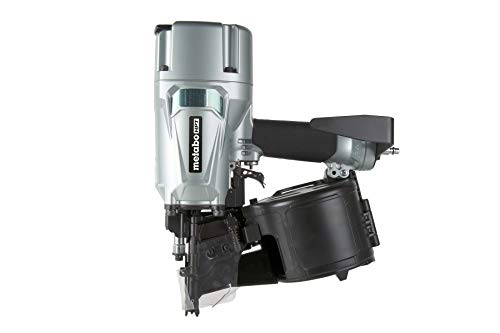
The Metabo HPT NV83A5 is the benchmark coil framing nailer for production work — sheathing, roof decking, subflooring, and any application where driving hundreds of nails per hour makes stick magazine reloading a genuine productivity constraint. The coil magazine holds 200–300 wire-collated nails depending on nail length, compared to 50–70 nails in any stick magazine nailer. On a roof sheathing job or a full subfloor installation, the difference between reloading every 15 minutes vs. every 1–2 hours is a meaningful impact on daily output. Metabo HPT’s Pro Preferred brand designation covers the entire lineup, and the NV83A5 specifically has been independently validated in production framing environments by Tool Box Buzz and ProToolReviews as one of the consistently highest-performing coil nailers available.
The cylinder valve drive system is Metabo HPT’s production nailer mechanism: it provides rapid response on trigger pull and exceptional driving power through dense material, with less maintenance overhead than piston-style systems because the cylinder valve has fewer wear components. The side-load, pop-out magazine design makes reloading fast — tilt out the magazine, drop in a new coil, close, and you’re firing again in seconds. The hardened claw tip on the nose resists wear during toe-nailing and provides positive grip on the workpiece at angle, which is critical for coil nailers where the wider body can feel less precise for angled work.

The NV83A5 uses 15° wire coil nails from 2″ to 3.25″ — note the maximum nail length is 3.25″, not 3.5″ as with the stick nailers. For standard framing nailing this covers every structural application. Full round-head nails, fully code-compliant. Selectable actuation switch for bump or sequential fire. Rafter hook is included and can be positioned on either the left or right side depending on user preference. Weight is 8.8 lbs (9.1 lbs with the rafter hook installed), and the cylinder valve design keeps the balance compact despite the larger coil magazine. Operating pressure is 70–120 PSI. One practical note: coil nails are slightly less convenient to source in small quantities at retail compared to stick collated nails, and the wire collation generates more debris cleanup on job sites than plastic or paper collation. For production volume where neither matters, the capacity advantage is decisive.

| Spec | Detail |
|---|---|
| Magazine Type | Coil |
| Magazine Angle | 15° ± 1° |
| Collation | Wire coil |
| Nail Length | 2″–3.25″ (full round-head) |
| Magazine Capacity | 200–300 nails |
| Operating Pressure | 70–120 PSI |
| Weight | 8.8 lbs (9.1 lbs with rafter hook) |
| Drive Modes | Bump / Sequential (selectable switch) |
| Drive System | Cylinder valve |
| Features | Hardened claw tip, side-load pop-out magazine, rafter hook |
What we like:
- 200–300 nail capacity — 4–6x the capacity of any stick nailer on this list
- Cylinder valve drive system for rapid response and maximum production speed
- Full round-head nails — code-compliant for all jurisdictions
- Side-load pop-out magazine for the fastest reloading in the category
- Hardened claw tip for toe-nailing grip and nose wear resistance
- Pro Preferred brand for 12 consecutive years
What we don’t like:
- Maximum nail length 3.25″ — cannot fire 3.5″ nails
- Coil nails are less convenient to source at retail in small quantities
- Wire collation creates more job site debris than plastic or paper
- Larger, wider profile than stick nailers — less maneuverable in tight spaces
Bottom line: The right nailer for production framers, sheathing crews, roofers, and anyone driving 300+ nails per session. The magazine capacity advantage over stick nailers is decisive at this volume. Not the tool for occasional DIY use or tight-space remodeling where the compact stick nailers outperform it.
Check Price on Amazon — Metabo HPT NV83A5
Framing Nailer Safety — 6 Rules That Protect You on the Job
Framing nailers drive large nails at high velocity through structural lumber. When used correctly, they’re efficient and safe. The injuries that do occur — and they do occur — are almost always the result of specific, avoidable mistakes.
Always disconnect air before clearing a jam. A pressurized nailer with a stuck nail in the nosepiece can fire the nail if the jam is being cleared and the contact tip or trigger is accidentally actuated. Disconnect the air hose, or for cordless nailers engage the power lock-off button, before opening the nosepiece to clear any jam.
Never defeat the contact safety tip. The spring-loaded contact tip on the nose of every framing nailer must be depressed before the trigger can fire. Some users tape or wedge the contact tip in the depressed position to eliminate the requirement to press the nose against the wood before each shot. This converts the tool from a contact-actuated nailer into something close to a trigger-only firearm. Never do this.
Use sequential mode for toe-nailing and angled work. When you’re driving nails at an angle into a stud edge or the end of a board, the exact nose placement is critical — the contact tip can slip. Bump fire mode with a slipping contact tip on angled work is a leading cause of misdirected nail shots. Switch to sequential mode for any nailing position that isn’t a flat, flat-on surface.
Keep your free hand behind the nail path. When positioning a board for nailing, your free hand should be holding the board away from and behind the nail path, not in front of the nosepiece. Double-fire events and nail deflections through knots are uncommon but real — keep your hands out of the path.
Check air pressure before starting. Too high (over 120 PSI on most nailers) over-drives nails and can fracture wood fibers around the nail, reducing holding strength. Too low (under 70 PSI) results in proud nails that require hand-setting, which defeats the purpose. Set your compressor regulator to 90–100 PSI and verify it maintains that level under load before beginning a framing session.
Eye protection is mandatory. Framing nailers eject plastic or wire nail collation as the nail is driven. These fragments travel at speed and at unpredictable angles. Safety glasses — not safety squinting — are required every time the nailer is in use.
Frequently Asked Questions About Framing Nailers
What is the best framing nailer for a beginner?
The Metabo HPT NR90AES1 is the best starting point for anyone who wants a tool that will serve them well as their skills grow. At $150–$170, it’s priced accessibly relative to its professional-grade build and 5-year warranty. For a homeowner with a tight budget who’s building one deck or shed, the NuMax SFR2190 is a functional, code-compliant option at a lower price. The Freeman PFR2190 is the better budget choice if you want meaningful warranty coverage.
Do I need a compressor for a framing nailer?
For pneumatic framing nailers, yes — and not just any compressor. You need a minimum 6-gallon compressor delivering at least 2–4 CFM at 90 PSI for sustained framing nailer operation. Pancake compressors (typically under 1.5 CFM) are insufficient for continuous nailer use. Cordless framing nailers — the Milwaukee 2744-20, DeWalt DCN21PLB, and Metabo HPT NR1890DCA — require no compressor.
What is better: 21° or 30° framing nailer?
For structural framing on any permitted, inspected construction, 21° is the safer choice because it uses full round-head nails that are code-compliant in all US jurisdictions. For remodeling, decking, and uninspected DIY work, 30° is equally effective and offers better access to tight corners. If you’re only buying one framing nailer and don’t know in advance what your local inspector requires, choose 21°.
How many nails does a framing nailer hold?
Stick nailers (21° and 30°) typically hold 47–70 nails depending on the model. Coil nailers hold 200–300 nails. For occasional DIY use, stick capacity is fine. For production framing where you’re driving hundreds of nails per session, the coil nailer’s capacity is a meaningful productivity advantage.
Can I use a framing nailer for deck building?
Yes — a 21° framing nailer with hot-dipped galvanized ring-shank nails is the standard tool for pressure-treated deck framing. Use galvanized nails specifically — uncoated (bright) nails will corrode rapidly in contact with the copper compounds in modern pressure-treated lumber and can fail structurally. For decking boards, a dedicated decking nailer or palm nailer may provide better access between boards.
What PSI does a framing nailer need?
Most pneumatic framing nailers operate at 70–120 PSI with optimal performance at 90–100 PSI. The BOSTITCH F21PL has a higher minimum at 80 PSI. Your compressor must be able to maintain consistent pressure at the tool, not just at the tank — pressure drops through long hoses and at sustained firing rates.
What is the difference between a framing nailer and a finish nailer?
A framing nailer drives 2″ to 3.5″ structural nails (10d–16d) through dimensional and engineered lumber for structural connections. A finish nailer drives smaller 15- or 16-gauge nails through trim, molding, and finish carpentry. They are completely different tools for completely different applications. A finish nailer cannot do structural framing work, and a framing nailer will split thin trim boards. See our Best Brad Nailer guide if you need a finish tool.
Final Verdict — Which Framing Nailer Should You Buy?
The right framing nailer depends on how you work and what you’re building.
For the majority of framers, contractors, and serious DIYers, the Metabo HPT NR90AES1 is the answer: lightest in its class, 5-year warranty, and the Pro Preferred track record that professionals trust. If you regularly work with metal connectors, the BOSTITCH F21PL‘s dual-nosepiece system and 7-year warranty make it worth the premium. For budget buyers who want the best long-term value, the Freeman PFR2190 and its 7-year warranty beats the NuMax SFR2190 on coverage for a modest price difference. For M18 platform users going cordless, the Milwaukee 2744-20 sets the standard. For tight-space remodeling without a compressor and with the most advanced drive system available, the Metabo HPT NR1890DCA is the choice. And for production sheathing and decking volume where magazine capacity matters most, the Metabo HPT NV83A5 coil nailer stands alone.
| Pick | Product | Why |
|---|---|---|
| Best Overall | Metabo HPT NR90AES1 | Lightest 21° pneumatic, 5-year warranty, Pro Preferred for 12+ years |
| Best Pro / Metal Connector | BOSTITCH F21PL | Dual nosepieces for framing and connector nails, 7-year warranty |
| Best Budget | NuMax SFR2190 | Lowest price, anti-dry fire, 21° code-compliant |
| Best Budget Runner-Up | Freeman PFR2190 | 7-year warranty at budget price, case included |
| Best Cordless Overall | Milwaukee 2744-20 | Nitrogen spring, zero ramp-up, 3 nails/sec, M18 platform |
| Best Cordless DeWalt | DEWALT DCN21PLB | Dual-speed motor, stall release, lightest cordless on this list |
| Best Cordless Tight Spaces | Metabo HPT NR1890DCA | Air spring drive, 120J power, 30° compact profile, lifetime warranty |
| Best Coil Nailer | Metabo HPT NV83A5 | 200–300 nail capacity, cylinder valve drive, Pro Preferred production nailer |


