A wire pulled out of a terminal under vibration. A battery cable lug that never seated properly and has been building heat inside the junction every time you start the engine. An RJ45 connector with one pin that didn’t quite reach the crimp die, giving you an Ethernet cable that drops packets on pin 7. Every one of these failures has the same root cause: the wrong crimping tool, used on the wrong connector, without a full-cycle ratchet to confirm completion. A proper crimping tool — matched to the connector type, the wire gauge, and the application — makes the difference between a connection that lasts decades and one that fails in six months.
We’ve researched and reviewed the 10 best crimping tools on Amazon in 2026, covering five distinct application categories: insulated wire terminal crimping for general electrical and automotive work, ferrule/bootlace terminal crimping for commercial panels and industrial installations, heavy-duty battery cable lug crimping for automotive and marine power systems, RJ45 and modular network cable crimping for data and voice applications, and heat shrink connector crimping for weatherproof marine and outdoor wiring. Whatever your application, the right tool is in this guide.
For the wire stripping side of this workflow, see our companion guide to the best wire strippers. Also worth bookmarking: our roundups of the best DeWalt power tools, best moisture meters for professionals, and best tool gifts for dad — crimping tools consistently rank among the most practical workshop gifts available.

Types of Crimping Tools and Connector Types: What You Need to Know
Ratchet vs Non-Ratchet Crimpers
The most important distinction in this category. A ratchet crimping tool locks the die in compression and will not open until the crimp is fully complete — the ratchet mechanism physically prevents early release. A non-ratchet crimper relies entirely on user technique to judge when the crimp is done. For any safety-critical connection — automotive, marine, electrical panel, or data — always use a ratchet crimper. An incomplete crimp looks identical to a complete one from the outside, but fails under vibration and load. Every tool reviewed in this roundup uses a full-cycle ratchet mechanism.
Insulated Terminal Crimpers
The most common type — three colour-coded cavities for red (22–18 AWG), blue (16–14 AWG), and yellow (12–10 AWG) insulated ring, spade, butt, and blade terminals. Covers residential electrical work, automotive accessories, marine wiring, and general DIY. The Klein Tools 3005CR is the professional standard.
Ferrule Crimpers (Bootlace / End Sleeve Terminals)
A ferrule is a small metal sleeve — insulated or uninsulated — crimped onto the end of stranded wire before it’s inserted into a terminal block or screw terminal. Without a ferrule, individual strands can splay, fray, or break over time as the screw is tightened and loosened. Ferrule crimping is the standard in European commercial and industrial electrical installations, and increasingly required in North American solar inverter panels, EV charging installations, industrial control systems, and commercial building automation. Ferrule crimpers use hex or square die profiles and cover AWG ranges from 23–7 (fine control signal wire to heavy power conductors). The Klein 34060 and 34056 cover AWG 10–22; the SOMELINE covers AWG 23–7.
Battery Cable Lug Crimpers
For AWG 8 to 4/0 heavy copper lug terminals on battery cables, welding leads, inverter cables, and shore power connections. These require 5–15 tons of mechanical force — far beyond what an insulated terminal crimper can provide. Using the wrong tool produces a mechanically weak, high-resistance lug that heats under load and eventually fails. Dedicated lug crimpers use heavy compound-action handles or hydraulic mechanisms with interchangeable dies.
RJ45 / Modular Network Crimpers
Crimp 8P8C (RJ45) connectors for Cat5e/Cat6 Ethernet and 6-position connectors for RJ11/RJ12 telephone. Pass-through RJ45 connectors (recommended) allow all 8 conductors to extend past the connector face for verification before crimping, then the tool trims them flush simultaneously with the crimp. Full-cycle ratchet ensures all 8 pins are simultaneously seated.
Heat Shrink Connector Crimpers
Crimp insulated connectors with an integrated heat shrink sleeve — butt connectors, ring terminals, spade terminals — specifically for marine, outdoor automotive, and moisture-exposed wiring. The connector barrel geometry differs from standard insulated terminals; a dedicated heat shrink crimper is required for reliable connections.
Connector Type Quick Reference
| Connector Type | Tool Needed | AWG Range | Typical Application |
|---|---|---|---|
| Insulated ring/spade/butt | Insulated terminal crimper | 10–22 AWG | Residential, automotive, marine |
| Ferrule / bootlace end sleeve | Ferrule crimper (hex or square) | 7–23 AWG | Control panels, solar inverters, terminal blocks |
| Battery cable lug | Battery lug crimper | 8–4/0 AWG | Automotive, marine, off-grid, welding |
| RJ45 (8P8C) / RJ11 (6P) | Modular/network crimper | 28–22 AWG | Ethernet Cat5e/6, telephone, data |
| Heat shrink connector | Heat shrink crimper | 10–22 AWG | Marine, outdoor automotive, moisture-exposed |
Best Crimping Tools 2026: Quick Comparison
| Product | Type | AWG / Range | Ratchet | Kit Included | Best For |
|---|---|---|---|---|---|
| Klein 3005CR ★ | Insulated terminal | 10–22 AWG | Full-cycle | Tool only | Best Overall |
| Klein 34060 Set | Ferrule – square | 10–22 AWG | Full-cycle | 1200 terminals + case | Best Ferrule Kit |
| Klein 34056 | Ferrule – hex | 10–22 AWG | Full-cycle adjustable | Tool only | Best Ferrule Hex Tool |
| Solsop Battery Kit | Battery cable lug | AWG 10–1/0 | Ratchet | 60 lugs + heat shrink + cutter | Best Battery Lug Kit |
| iCrimp HX-50BI | Battery cable lug | AWG 8–1/0 | Ratchet | Tool only | Best Heavy-Duty Lug |
| Klein VDV226-110 | RJ45 / modular | 28–22 AWG data cable | Full-cycle | Tool only | Best RJ45 Pro |
| Brileine RJ45 Kit | RJ45 / modular | Cat5/5e/Cat6 + RJ11 | Yes | Tester + 50 connectors + boots | Best RJ45 Budget Kit |
| haisstronica HS-8327 | Heat shrink connector | AWG 22–10 | Full-cycle | 200 marine heat shrink connectors | Best Heat Shrink Crimper |
| SOMELINE Ferrule Kit | Ferrule – quadrilateral | AWG 23–7 | Ratchet | 23 sizes of ferrule terminals | Best Budget Ferrule Kit |
| Wire Stripper + Crimper Combo | Combo strip + crimp | Strip: 24–10 / Crimp: 22–10 | Full-cycle | Tool set | Best Everyday Combo |
★ = Editor’s top pick. All products sourced from Amazon.com. Prices and availability verified at time of publishing — always confirm current pricing before purchasing.
1. Klein Tools 3005CR Ratcheting Insulated Terminal Crimper — Best Overall
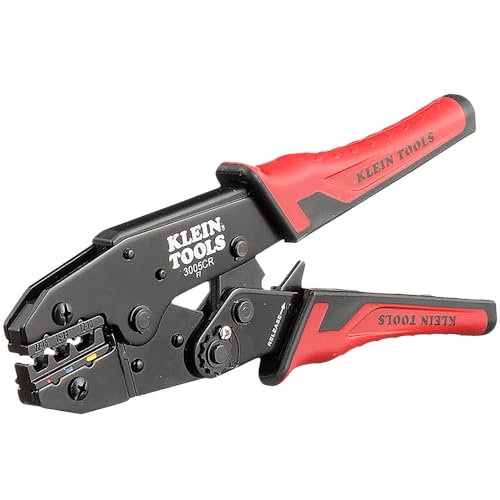
The Klein Tools 3005CR is the best overall crimping tool on Amazon for 2026 — and it earns that position through the same combination that has kept Klein Tools at the top of the professional electrical market for over 160 years: precision manufacturing, thoughtful design, and a build quality that holds up under daily professional use. For crimping insulated wire terminals across the AWG 10–22 range — the range that covers virtually every residential electrical, automotive accessory, and general wiring application — the 3005CR is the benchmark tool that working electricians reach for first.

The tool features three crimping cavities in a single body, colour-coded by wire size: one cavity for 22–18 AWG (small signal and light automotive wire), one for 16–14 AWG (standard automotive and lighting), and one for 12–10 AWG (heavier circuit and marine applications). Each cavity is matched to the barrel geometry of standard colour-coded insulated terminals — red (22–18 AWG), blue (16–14 AWG), and yellow (12–10 AWG) — so matching wire to connector to cavity is immediate and error-free. The full-cycle ratchet mechanism is the critical quality feature: it locks the handles in compression and will not release until the die has fully closed and the crimp is complete. This prevents the incomplete crimps that pass visual inspection but fail under mechanical stress or vibration.

The compound-action handle design provides low effort crimping with high terminal pull-off force — the geometry of the handle linkage multiplies your grip force into consistent die pressure without requiring exceptional hand strength. Dual-layer moulded grips provide comfort during extended use and resist the oils and solvents common in automotive and electrical environments. This is the insulated terminal crimper that appears in the tool bags of professional electricians, automotive technicians, and marine electricians across North America, and it’s consistently among the top-selling crimping tools on Amazon for a reason. Pair it with the best heat guns for complete wire termination workflows that include heat shrink finishing.
Pros: Klein 160-year professional pedigree; full-cycle ratchet prevents incomplete crimps; three colour-coded cavities cover 10–22 AWG insulated terminals; compound-action handles for low-effort high-force crimping; dual-layer moulded grips; high terminal pull-off force; the standard insulated terminal crimper in professional electrical trades.
Cons: Insulated terminals only — not for ferrules, battery lugs, or RJ45; tool only, no terminals included; one profile does not handle heat shrink connectors (different geometry).
Who it’s for: Electricians, automotive technicians, marine wiring professionals, and serious DIYers who crimp standard insulated ring, spade, butt, and blade terminals. The default first purchase for anyone setting up a professional crimping capability.
→ Check Current Price on Amazon
2. Klein Tools 34060 Ratcheting Square Ferrule Crimper Set — Best Ferrule Crimper Kit
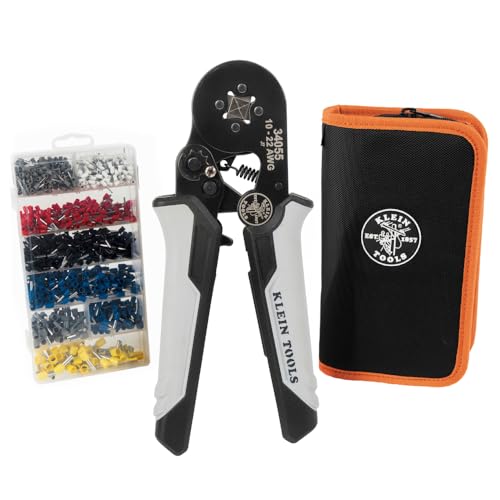
The Klein Tools 34060 is the complete ferrule crimper kit — the Klein 34055 square ferrule crimper tool plus 1,200 wire ferrule terminals across 10 sizes (AWG 10 through 22) in a soft carry case. If you’re starting ferrule crimping from scratch and need both the tool and the consumables, this is the most practical single purchase available. Before diving into the specs, a brief explanation of what ferrule crimping is — because this is the application that every competitor crimping tool article completely ignores.

A wire ferrule (also called a bootlace ferrule, pin terminal, or end sleeve) is a small metal tube — usually tinned copper with a coloured plastic collar — that is crimped onto the end of a stranded wire before the wire is inserted into a terminal block, screw terminal, or push-in connector. Without a ferrule, individual strands of a stranded wire splay when the terminal screw is tightened, some strands miss the contact point, and repeated tightening and loosening breaks individual strands over time. A correctly crimped ferrule bundles all conductors into a solid pin that maintains complete contact, survives thousands of insertion cycles, and meets IEC 60228 and DIN 46228 standards required in commercial and industrial installations. Ferrule crimping is standard practice in European electrical panels and is increasingly required in North American solar inverter wiring, EV charging installations, industrial control panels, building automation systems, and any wiring that uses DIN-rail mounted terminal blocks.

The Klein 34060 uses a square crimp profile — four-sided compression that evenly distributes force around the ferrule barrel and matches the terminal block ferrule standards used in Klein’s own product range. The full-cycle ratchet ensures every ferrule receives a complete, uniform crimp before the tool releases. The 1,200-terminal assortment includes the 10 most common ferrule sizes from AWG 22 through AWG 10, covering the range needed for most commercial and residential panel work. The soft carry case keeps the complete kit organised on a job site. Klein backs the entire set with their standard professional warranty.
Pros: Complete kit — crimper tool plus 1,200 terminals in 10 sizes; square crimp profile for consistent 360° compression; full-cycle ratchet for uniform complete crimps; soft carry case; AWG 10–22 range covers standard residential and commercial panel work; Klein professional quality and warranty.
Cons: Doesn’t cover AWG 23 fine signal wire (see SOMELINE for that range); square profile — confirm your ferrule brand specifies square (not hex) for best results; premium price vs budget ferrule kits.
Who it’s for: Commercial electricians, solar/battery system installers, industrial control panel builders, smart home integrators, and anyone who needs to start ferrule crimping with both tool and consumables in one purchase.
→ Check Current Price on Amazon
3. Klein Tools 34056 Ratcheting Ferrule Hex Crimper — Best Standalone Ferrule Hex Crimper

The Klein Tools 34056 is the tool-only version for buyers who already have ferrule terminals or want to source specific ferrule brands and sizes independently. Where the Klein 34060 (reviewed above) uses a square crimp profile and comes with matching square-profile terminals, the 34056 uses a hex crimp profile — six-sided compression that matches the IEC/DIN standard ferrule specification used by the majority of European ferrule brands and an increasing number of North American panel component suppliers.

The hex versus square distinction matters when you’re sourcing ferrules independently. Most ferrule terminal assortments sold on Amazon specify either “hex crimp” or “square crimp” in their listing — match your crimper profile to your terminal specification and you get a compliant, consistent crimp. Mix profiles and you’ll get an asymmetric crimp that may still hold mechanically but won’t meet installation standards. The 34056’s six-die jaw arrangement creates a 360-degree hex crimp that completely surrounds the ferrule barrel — no flat spot or under-compressed side that a two-jaw design can produce. The built-in adjustable ratchet allows fine-tuning of crimp force when switching between different ferrule materials or wall thicknesses, which is a valuable feature when working across multiple ferrule brands on the same job.

The AWG 10–22 range and full-cycle ratchet are identical to the 34060. Compound-action handles keep crimping effort low even through a full day of panel wiring work. Dual-layer moulded grips are comfortable under sustained use. If you already own ferrule terminals from a previous purchase, or if you specifically need hex-profile crimps for IEC-standard ferrules, the Klein 34056 is the professional tool-only choice. If you need both the tool and terminals together, the 34060 set is better value.
Pros: Hex crimp profile for IEC/DIN standard ferrule compatibility; 360° six-die jaw for complete even compression; full-cycle adjustable ratchet; AWG 10–22 range; compound-action handles; Klein professional quality; tool-only purchase for buyers sourcing their own terminals.
Cons: Tool only — no terminals included; hex profile only — verify your ferrule brand specifies hex; AWG 10–22 doesn’t cover fine signal wire AWG 23+; doesn’t cover insulated terminal or battery lug crimping.
Who it’s for: Electricians and panel builders who need a hex-profile ferrule crimper and already have their ferrule terminal supply sorted. Also the right choice for anyone working with European-standard IEC ferrule brands.
→ Check Current Price on Amazon
4. Solsop Battery Cable Crimper Tool Kit (AWG 10–1/0) — Best Battery Cable Lug Crimper Kit
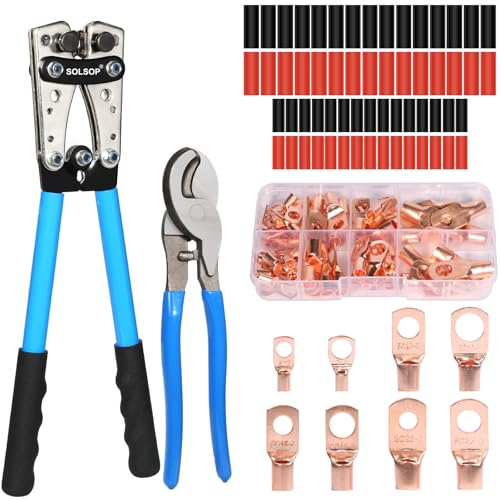
The Solsop Battery Cable Crimper Tool Kit is the complete package for anyone building or repairing battery cable systems: a hexagonal lug crimper covering AWG 10 through 1/0, six interchangeable dies, 60 copper wire lugs, heat shrink tubing, a cable cutter, and an 18-month warranty — everything needed to crimp professional-quality battery cable terminations without sourcing components from multiple listings. The AWG 10 to 1/0 range covers the full spectrum of automotive, marine, RV, and off-grid solar battery cable sizes commonly used in North America.

Battery cable lug crimping is a category that standard insulated terminal crimpers simply cannot serve. A 2 AWG battery cable carrying 200+ amps requires a lug crimp that creates a low-resistance, high-current-capacity mechanical connection between the cable’s copper conductors and the lug barrel — that requires a minimum of several tons of compression force. Standard crimpers produce 200–400 lbs of force; a proper lug crimper produces 5–12 tons. The difference is the difference between a connection that runs cool under load and one that builds heat, corrodes internally, and eventually fails. The Solsop kit uses industrial-grade carbon steel construction with a compound-action handle geometry that multiplies your grip force into the sustained pressure needed for a complete hex crimp at every die size. The twist-to-switch die mechanism changes dies without loose pieces that can fall inside an engine bay or bilge — a practical design advantage for real-world installation work.

The 60 included copper wire lugs cover the six die sizes in the kit, providing a useful starting inventory for a wiring project. The included heat shrink tubing seals each completed lug termination against moisture, vibration, and corrosion. The included cable cutter handles the copper cable cleanly before crimping — a clean, square-cut cable end is essential for proper lug seating. Solsop’s 18-month warranty backs the complete kit. For automotive audio builders, marine electricians, RV battery bank wiring, off-grid solar installations, or anyone building a battery cable harness from scratch, this kit provides a complete and competent crimping capability at a fair price.
Pros: Complete kit — crimper, 6 dies, 60 copper lugs, heat shrink, cable cutter; AWG 10–1/0 range covers all common battery cable sizes; twist-to-switch die change with no loose pieces; industrial-grade carbon steel; hex crimp profile; 18-month warranty; everything needed in one purchase.
Cons: Does not cover AWG 2/0–4/0 (see iCrimp for heavier gauge); newer brand vs iCrimp’s established Amazon track record; included lugs may not match all lug specifications (verify barrel dimensions for specialty applications).
Who it’s for: Automotive audio builders, marine electricians, RV and off-grid solar battery wiring, anyone building a complete battery cable harness who needs both tool and consumables in one kit.
→ Check Current Price on Amazon
5. iCrimp HX-50BI Battery Cable Lug Crimping Tool — Best Heavy-Duty Lug Crimper
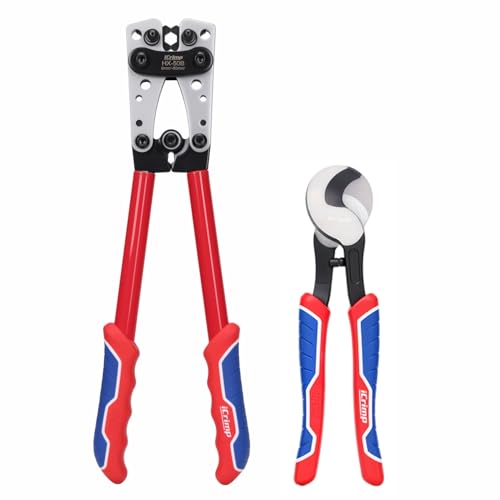
The iCrimp HX-50BI is the professional-grade heavy-duty battery lug crimper — the choice for frequent professional use on AWG 8 through 1/0 copper lug terminals where tool durability and consistent crimp quality over thousands of cycles matter as much as the initial crimp result. Where the Solsop kit is the comprehensive value package, the iCrimp HX-50BI is the dedicated professional tool built for longevity under sustained heavy use.

The die material is the key specification: SCM-40 hardened steel — a chromium-molybdenum alloy (JIS SCM440, equivalent to AISI 4140) used in high-strength mechanical components including automotive crankshafts, landing gear components, and high-load structural fasteners. The polished and tempered die surfaces resist corrosion and maintain their dimensional accuracy over many more crimping cycles than standard carbon steel alternatives. Each crimp produces a hexagonal profile that creates large surface contact between the cable conductors and the lug barrel — exactly the geometry that minimises resistance and maximises current-carrying capacity. The integrated wire shear cutter handles copper cable in the AWG 8–1/0 range cleanly, eliminating the separate cable cutter that the Solsop kit includes as an accessory.

The ergonomic compound-action handle with anti-slip rubber coating reduces hand fatigue during extended use — relevant for marine electricians or automotive shops that crimp multiple lugs per day. iCrimp (also sold as IWISS on some Amazon listings) is one of the most established brands in the battery lug crimper category on Amazon, with a review base that reflects years of professional and enthusiast use across automotive, marine, and off-grid solar applications. The HX-50BI covers AWG 8, 6, 4, 2, 1, and 1/0 — if you regularly work with the heavier cable sizes in this range, its SCM-40 die steel will maintain quality significantly longer than softer steel alternatives. If you need AWG 10 included and want a complete starter kit, the Solsop above is the better value choice.
Pros: SCM-40 chromium-molybdenum hardened steel dies — professional longevity; polished and tempered die surfaces resist corrosion; integrated wire shear cutter; AWG 8–1/0 coverage; anti-slip rubber handle; hexagonal crimp for maximum conductor-to-lug contact; established iCrimp brand with strong Amazon review base.
Cons: Tool only — no lugs, heat shrink, or cable cutter supplied separately; starts at AWG 8 (not AWG 10); higher price than value alternatives; no kit value for first-time buyers.
Who it’s for: Professional automotive shops, marine electricians, and off-grid system installers who crimp battery lugs frequently and need a tool built for professional longevity rather than an occasional-use kit.
→ Check Current Price on Amazon
6. Klein Tools VDV226-110 Ratcheting Data Cable Crimper — Best RJ45 Network Crimper
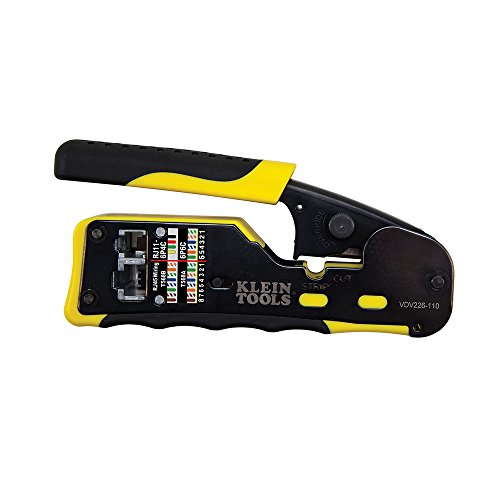
The Klein Tools VDV226-110 is the professional standard for RJ45 Ethernet and modular telephone cable crimping — a three-in-one tool that strips, cuts, and crimps paired-conductor data cable for Cat5e and Cat6 installations using Klein’s Pass-Thru RJ45 connectors, plus standard RJ11 and RJ12 modular connectors for telephone applications. This is the tool that IT professionals, network installers, security camera technicians, and structured cabling contractors reach for when running cable drops, and it’s the most complete single-tool solution for any professional who terminates network cable regularly.

The Pass-Thru connector technology is the headline feature. Standard RJ45 connectors require all 8 conductors to be precisely trimmed to length before insertion — one conductor even slightly short means it won’t reach the crimp pin, producing a pin 7 (or whichever) failure that the crimped connector looks fine but the cable tester catches. Pass-Thru connectors allow the 8 conductors to extend past the connector face, confirming all 8 are present and in order before crimping. The VDV226-110 then trims the excess conductors flush with the connector face simultaneously during the crimp stroke. This single design feature eliminates the most common source of RJ45 termination failures and is particularly valuable when installing dozens of drops in a commercial environment. The wiring diagram printed directly on the tool body shows both T568A and T568B wiring sequences — the on-the-job reference that eliminates card hunting when you need to verify a wiring standard mid-run.

The full-cycle ratchet mechanism prevents the partial pin seating that produces intermittent connectivity issues. The blade-guard on the cutting and stripping knives reduces injury risk. The compact, non-slip comfort grip stores easily in a tool belt or laptop bag. The VDV226-110 crimps 4, 6, and 8-position modular connectors — RJ11 standard (4-position and 6-position for telephone), RJ12 (6-position), and RJ45 Klein Pass-Thru (8-position for Ethernet). One honest limitation: the VDV226-110 is optimised for Klein’s own Pass-Thru connectors — for standard (non-pass-through) connectors, see the Klein VDV226-011 or the Brileine kit below. For a full home networking setup, pair this with a good professional toolkit and a dedicated cable tester.
Pros: Klein Pass-Thru RJ45 technology eliminates the most common crimping failure mode; strips, cuts, and crimps in one tool; T568A/T568B wiring diagram on body; full-cycle ratchet; crimps RJ45, RJ12, RJ11 (4, 6, 8 position); compact non-slip grip; Klein professional build quality and warranty.
Cons: Optimised for Klein Pass-Thru connectors — verify connector compatibility for non-Klein brands; tool only, no connectors or cable tester included; premium price; not compatible with Cat7/Cat8 shielded connectors in standard configuration.
Who it’s for: IT professionals, structured cabling contractors, security camera installers, network technicians, and advanced home users who regularly terminate Cat5e/Cat6 cable and need a professional-grade crimping solution.
→ Check Current Price on Amazon
7. Brileine RJ45 Pass-Through Crimp Tool Kit — Best Budget RJ45 Crimper Kit

The Brileine RJ45 Crimp Tool Kit is the complete network cable crimper package for home users, small office setups, and DIYers who need to run and terminate a few dozen Ethernet drops without the professional price commitment of the Klein VDV226-110. The kit includes everything needed to start crimping immediately: the pass-through RJ45 crimper, a LAN cable tester, 50 Cat6 pass-through connectors, 50 strain relief boots, and a mini cable stripper — an unusually comprehensive package for its price point.

The pass-through design brings the most important quality feature of the Klein VDV226-110 to the budget tier. All 8 conductors push through the front of the connector, allowing visual verification that every conductor is present and in correct sequence before crimping. The tool then trims and crimps simultaneously. For RJ11/RJ12 telephone connectors, the same tool handles 6-position and 4-position connectors. The included LAN cable tester is the single most valuable included accessory in this kit — it tests all 8 conductors simultaneously for continuity and correct wiring sequence, immediately identifying any failed crimp before you close up a wall or run cable to a switch. Not having to purchase a cable tester separately saves a meaningful amount on the total kit cost.

The 50 included Cat6 pass-through connectors and 50 strain relief boots eliminate the first-purchase friction for a homeowner who needs to run several cable drops for home networking, security cameras, or smart home devices. The mini cable stripper removes the outer jacket cleanly without nicking the internal pairs — a cable stripper that damages the pairs produces a crimped cable that fails the tester. Compared to the Klein VDV226-110, the Brileine kit trades some build quality and connector brand flexibility for a significantly lower price and the inclusion of a cable tester, connectors, boots, and stripper. For home use, that’s an excellent trade. For professional daily commercial use, invest in the Klein. For running a complete home network or small office LAN, the Brileine is the smarter purchase.
Pros: Complete kit — crimper, cable tester, 50 connectors, 50 boots, mini stripper; pass-through design for reliable termination; crimps RJ45 Cat5/5e/Cat6 + RJ11/RJ12; cable tester eliminates a separate purchase; excellent value for home and small office use.
Cons: Lower build quality vs Klein; cable tester is basic continuity checker, not professional certifier; included connectors are Cat6 — verify compatibility for Cat7/Cat8; less precise jaw tolerances than professional alternatives.
Who it’s for: Homeowners running Ethernet drops, small office network installers, security camera DIYers, and anyone who needs a complete RJ45 crimping kit without the professional price tag.
→ Check Current Price on Amazon
8. haisstronica HS-8327 Heat Shrink Connector Crimper — Best Heat Shrink Crimper
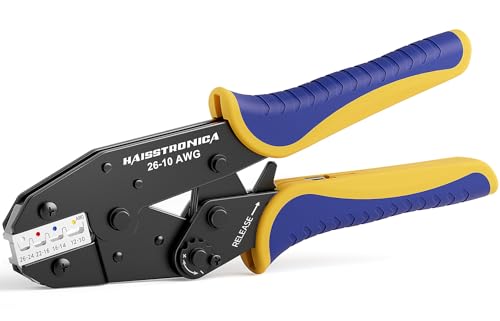
The haisstronica HS-8327 is the dedicated heat shrink connector crimper for marine, outdoor automotive, and any application where moisture, vibration, and corrosion put standard insulated terminals at risk. The tool is specifically engineered for heat shrink butt connectors, ring terminals, and spade terminals with integrated heat shrink sleeves — connectors where the outer heat shrink tubing provides a weatherproof seal after crimping that bare insulated terminals cannot achieve. The kit includes 200 marine-grade heat shrink connectors with tinned copper conductors, providing a complete working inventory for a substantial wiring project.

The reason a dedicated heat shrink crimper is required — rather than simply using a standard insulated terminal crimper — is connector geometry. Heat shrink connector barrels have a larger outer diameter than standard insulated terminals at the same wire gauge, because the barrel includes the integrated heat shrink sleeve. Using an insulated terminal crimper on a heat shrink connector applies force to the wrong location, produces an incomplete crimp on the conductor, and may split the heat shrink sleeve. The HS-8327’s dies are sized and shaped for the larger heat shrink connector barrel profile, producing the correct crimp depth and profile at AWG 22–10 across all three colour-coded cavities. The full-cycle ratchet mechanism is essential here: the outer heat shrink sleeve conceals the barrel after crimping, making visual inspection of the crimp difficult — the ratchet guarantees completion before the connection is sealed.

Marine-grade tinned copper in the included 200 connectors means the internal conductors resist salt water corrosion — standard copper connectors oxidise in marine environments, increasing resistance and eventually failing. For boat wiring, trailer lighting harnesses, outdoor automotive accessories, RV electrical systems, and any connection exposed to moisture, heat shrink tinned connectors with a proper ratchet crimper are the professional standard. haisstronica has a strong Amazon review base specifically for their heat shrink crimping tools, with consistent feedback on the smooth ratchet action and reliable crimp quality across all three connector sizes. The quick-release lever on the inside of the handle provides escape if repositioning is needed mid-crimp.
Pros: Purpose-designed for heat shrink connector barrel geometry; full-cycle ratchet prevents incomplete concealed crimps; 200 marine-grade tinned copper connectors included (AWG 22–10); three colour-coded cavities; quick-release lever; ergonomic non-slip handle; excellent for marine, automotive, and outdoor wiring.
Cons: Heat shrink connectors only — not for standard insulated or ferrule terminals; the included connectors are butt/ring/spade style only; requires a heat gun (sold separately) to activate the heat shrink sleeve after crimping.
Who it’s for: Marine electricians, boat owners, RV and trailer wiring builders, outdoor automotive enthusiasts, and anyone working with moisture-exposed electrical connections where standard insulated terminals are inadequate.
→ Check Current Price on Amazon
9. SOMELINE AWG 23–7 Quadrilateral Ferrule Crimper — Best Budget Wide-Range Ferrule Kit

The SOMELINE Ferrule Crimping Tool fills the gap that the Klein ferrule crimpers leave open at the fine end: AWG 23 signal wire. If you work with control panel signal wiring — 4–20mA analog loops, thermocouple extension wire, PLC input connections, building automation sensor leads — you need a ferrule crimper that reaches AWG 23 or finer. The Klein 34056 and 34060 both start at AWG 22 (10mm²) and don’t go finer. The SOMELINE covers AWG 23–7 (0.25–10mm²), encompassing both the finest signal wire and the heaviest power conductor in a single tool, and it includes 23 sizes of ferrule terminals to get you crimping immediately.

The quadrilateral crimp profile — four-sided compression, functionally equivalent to square — produces an even, complete ferrule crimp that meets DIN rail terminal block standards. The self-adjustable ratchet mechanism provides the full-cycle assurance that incomplete crimps are mechanically prevented. The compound-action handle reduces hand effort for fine-gauge work where over-force risks deforming a thin-walled ferrule. The 23-size terminal assortment is notably comprehensive — covering the complete AWG 23–7 range in increments fine enough to match any wire gauge you’re likely to encounter in automation, instrumentation, or power distribution work. This breadth of included terminal sizes is genuinely useful: ferrule assortments from dedicated suppliers are sold by size rather than in mixed packs, so having 23 sizes in one kit saves multiple sourcing steps.

At its price point, the SOMELINE is the value leader for wide-range ferrule crimping capability. It won’t match Klein’s build quality over thousands of daily professional crimps, but for an automation technician, PLC programmer, building management system installer, or electronics hobbyist who needs fine-gauge ferrule crimping alongside heavier power conductor termination, the SOMELINE covers the complete range that no single Klein ferrule crimper does. If you need AWG 23 and AWG 10 in the same tool, this is currently the most practical single-tool solution at this price level.
Pros: AWG 23–7 range — covers fine signal wire that Klein ferrule crimpers don’t reach; 23 sizes of ferrule terminals included; quadrilateral 4-sided crimp profile; full-cycle ratchet; compound-action handle; self-adjustable mechanism; strong value vs Klein for wide-range coverage.
Cons: Budget build quality — not for sustained daily professional use; quadrilateral profile — verify ferrule brand compatibility; mechanism tolerances slightly less precise than Klein at fine gauges; carry case/storage less refined than Klein 34060 kit.
Who it’s for: Automation technicians, PLC programmers, building management system installers, electronics hobbyists, and anyone who needs ferrule crimping across the full AWG 23–7 range including fine signal wire gauges.
→ Check Current Price on Amazon
10. Wire Stripper and Crimping Tool AWG 24–10 Combo — Best Everyday Strip-and-Crimp Set
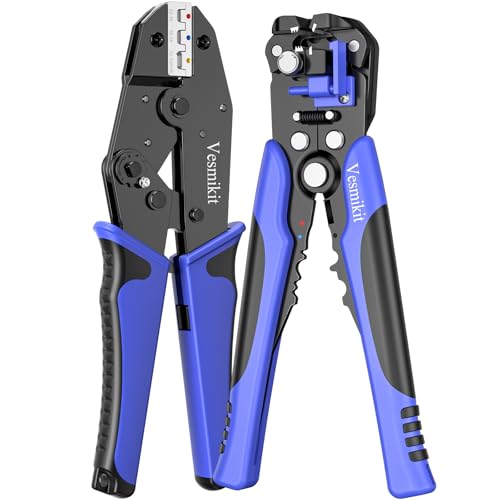
The Wire Stripper and Crimping Tool AWG 24–10 is the everyday do-everything combo kit for the homeowner, automotive DIYer, and light-duty professional who wants to strip and crimp wire without maintaining two separate dedicated tools. The kit pairs an automatic self-adjusting wire stripper (AWG 24–10) with a ratchet crimper for heat shrink and insulated terminals (AWG 22–10), covering the complete strip-to-crimp workflow in matched tools that are specified to work together across the same AWG range.
The automatic wire stripper uses a self-adjusting jaw mechanism — insert the wire, squeeze, and the blades automatically calibrate to the wire diameter and cut the insulation cleanly without conductor damage across the AWG 24–10 range. No dial selection, no gauge notch hunting, no stripped settings to remember between sessions. The ratchet crimper uses full-cycle ratchet action on AWG 22–10 heat shrink connectors and insulated terminals — the same connector types that cover automotive accessories, trailer wiring, speaker installation, appliance repair, and general DIY wiring. Both tools share the same ergonomic non-slip handle design, reducing the grip-adjustment time when switching between stripping and crimping on the same job.

This tool set is the natural bridge between the wire strippers guide and this crimping tools article — it literally combines both categories in one purchase. For buyers who have read both guides and want one set that covers both operations for light-to-medium wiring work, the combo is the practical choice. Honest positioning: for professional daily electrical use, a dedicated Klein 11063W wire stripper paired with a dedicated Klein 3005CR crimper (both reviewed in their respective guides) outperforms this combo in stripping precision and crimp consistency. For a homeowner tackling automotive accessories, home appliance repair, speaker wiring, or trailer lighting, the combo delivers excellent results at a fraction of the total two-tool cost. It’s also a strong first-tool purchase for anyone new to wire work who wants to start stripping and crimping without separate tool investments.
Pros: Auto-adjusting wire stripper (AWG 24–10) + full-cycle ratchet crimper (AWG 22–10) in matched set; self-adjusting stripper eliminates gauge selection; full-cycle ratchet on the crimper; covers heat shrink and insulated terminals; ergonomic handles; excellent value combo for light-to-medium use.
Cons: Not a substitute for dedicated professional tools at daily professional use volume; crimper covers heat shrink/insulated only — not for ferrules, battery lugs, or RJ45; build quality is light-duty vs Klein standalone tools.
Who it’s for: Homeowners, automotive DIYers, trailer wiring builders, speaker installers, and anyone who wants a complete strip-and-crimp capability in one affordable kit for light-to-medium wiring projects.
→ Check Current Price on Amazon
How to Choose the Best Crimping Tool: Complete Buyer’s Guide
Always Match the Tool to the Connector Type
This is the cardinal rule of crimping tool selection. A ferrule crimper cannot crimp insulated terminals — the die geometry is wrong. An insulated terminal crimper cannot crimp heat shrink connector barrels — the barrel diameter is larger. An RJ45 crimper cannot handle battery lugs — the force and die profile are completely mismatched. And no standard crimper of any type can crimp fiber optic connectors. Always identify the connector type first, then select the tool. The connector type quick-reference table at the top of this article maps this relationship clearly.
Always Choose Ratchet for Safety-Critical Connections
A non-ratchet crimper relies entirely on user technique to judge when a crimp is complete. An incomplete crimp on a battery terminal running high current builds heat. An incomplete crimp on a marine connector in a bilge corrodes internally before the failure becomes visible. An incomplete crimp on an RJ45 produces a dropped connection that’s nearly impossible to diagnose without a tester. For any application where connection quality has safety or reliability consequences — which is most electrical work — a full-cycle ratchet is mandatory. Every product reviewed in this roundup uses a ratchet mechanism.
Hex vs Square vs Quadrilateral Crimp Profiles (Ferrule Crimpers)
For ferrule crimping specifically, the die profile must match the ferrule terminal specification. Hex (6-sided): the IEC/DIN international standard, used by most European ferrule brands and increasingly by North American control component suppliers. Square (4-sided): some North American brands and Klein’s own ferrule terminal range. Quadrilateral: functionally equivalent to square, used on several value-tier crimpers. When buying ferrule terminals to use with a specific crimper, confirm the terminal packaging specifies the matching profile. Mismatched profiles produce an asymmetric crimp that may hold mechanically but doesn’t meet installation standards.
AWG Range — Cover Your Full Working Gauge
Buy a crimper that covers your complete AWG range. An insulated terminal crimper rated for AWG 10–22 cannot crimp AWG 24 wire connectors — the connector won’t fit the cavity. A ferrule crimper rated for AWG 10–22 cannot handle AWG 23 signal wire — the die is too large. Verify both ends of the range before purchasing, especially if you work with fine-gauge signal wire alongside standard power wire.
Kit vs Tool-Only
Kits (Klein 34060, Solsop Battery Kit, Brileine RJ45, haisstronica HS-8327, SOMELINE): include consumables (terminals, connectors, lugs) and sometimes accessories (case, tester, cutter). Best for first-time buyers in a category who need to source everything at once. Tool-only (Klein 3005CR, Klein 34056, iCrimp HX-50BI, Klein VDV226-110): better for buyers who already have terminal inventories or want specific brands. Often better long-term value if you purchase consumables in bulk separately.
Die Quality — One-Piece vs Stacked-Plate
One-piece machined or forged dies (Klein, iCrimp HX-50BI) resist bending under repeated high-force crimps and maintain crimp geometry over thousands of cycles. Stacked-plate dies (some budget tools) can bend over time, producing progressively inconsistent crimps. For daily professional use, one-piece dies are worth the price premium. For occasional home use, stacked-plate performance is adequate.
What Is a Good Crimp?
A correctly completed crimp should meet all four criteria: (1) the ratchet has fully released — the mechanism has confirmed complete die closure; (2) the conductor is visible in the inspection window where present, confirming full insertion; (3) no insulation is caught in the crimp zone — only the conductor barrel is compressed; (4) a pull test at 50+ lbs does not move the wire relative to the connector. For RJ45 crimps, a cable tester should confirm all 8 pins pass continuity before the cable is installed.
For complementary workshop tools, see our guides on the best electric paint sprayers, best scarifiers for small lawns, electric pressure washer reviews, and the best tool gifts for dad.
How to Make a Proper Crimp: Step-by-Step
The most reliable crimps come from consistent technique, not just a good tool. Follow this sequence every time.
Step 1: Select the correct die cavity. Confirm the wire AWG matches the connector rating AND the crimper cavity. For insulated terminals: red cavity for 22–18 AWG (red terminals), blue for 16–14 AWG (blue terminals), yellow for 12–10 AWG (yellow terminals). For ferrules: match the die size to the ferrule size marked on the terminal collar. Mismatched cavities produce undersized or oversized crimps — both fail.
Step 2: Strip the wire to the correct length. Check the connector’s strip length specification — typically 3/8″–1/2″ (9–12mm) for insulated terminals, 6–8mm for ferrules. Too short leaves conductors outside the crimp zone; too long leaves exposed copper beyond the connector, creating a short circuit risk. Use a quality wire stripper — the companion wire strippers guide covers the best options for clean insulation removal.
Step 3: Twist stranded wire conductors clockwise before insertion. A single clockwise twist consolidates the individual strands into a compact bundle that inserts cleanly into the connector barrel without strands splaying outside the crimp zone. Strands outside the barrel are cut or excluded by the die, weakening the mechanical connection.
Step 4: Insert wire fully into the connector. For insulated terminals: the wire insulation should butt firmly against the connector entry funnel — conductor fully inside the barrel, no copper exposed past the connector. For ferrules: push the stranded end to the open front of the ferrule until strands are visible. For RJ45 pass-through: push all 8 conductors completely through until they protrude from the face.
Step 5: Position the connector in the correct cavity. The connector barrel goes in the die — not the insulation sleeve. The coloured insulation sleeve should be visible and free from the die on the tool handle side. Placing the insulation in the die produces a compressed insulation sleeve and an uncrimped barrel.
Step 6: Squeeze to full ratchet release. Apply steady pressure until the ratchet mechanism releases and the handles spring open. Do not force the release lever to escape early — a half-crimped connection is electrically and mechanically unreliable.
Step 7: Inspect the crimp. No cracking or splitting in the connector barrel. Conductor visible in inspection window where provided. Insulation not caught in the crimp zone. Connector oriented correctly (ring terminal facing the correct direction, spade terminal properly aligned).
Step 8: Pull test. Grip the wire and connector separately and apply approximately 50 lbs of pull force. The wire should not move relative to the connector under this load. Any movement indicates an incomplete crimp — cut and re-crimp.
Most common mistakes: Wrong die size (most frequent — match the colour code); incomplete ratchet cycle (second most frequent — don’t force early release); insulation in the crimp zone (position the connector fully into the die before squeezing); forgotten clockwise twist on stranded wire (strands splay and miss the barrel); wrong strip length (too short = mechanical failure, too long = short circuit risk).
Frequently Asked Questions
What is a ferrule crimping tool?
A ferrule crimping tool is a precision ratchet crimper specifically designed to crimp bootlace ferrules (also called pin terminals or end sleeves) onto the ends of stranded wire before insertion into terminal blocks, screw terminals, or push-in connectors. Ferrule crimpers use hex or square die profiles matched to the ferrule barrel geometry, and cover fine wire gauges (AWG 23 for signal wire down to AWG 7 for heavy power conductors). They are standard equipment in European commercial electrical installations and increasingly required in North American solar, EV, industrial control, and building automation panel work.
What is the difference between a ratchet and non-ratchet crimper?
A ratchet crimper locks the handles in compression and physically will not open until the die has fully closed and the crimp is mechanically complete — it prevents the user from releasing early. A non-ratchet crimper has no such lock and relies entirely on the user’s technique and judgment to determine completion. For any safety-critical application — automotive, marine, electrical panel, or data network — a ratchet crimper is mandatory. An incomplete crimp looks identical to a complete crimp from outside the connector.
Can you crimp without a crimping tool?
You can deform a connector with pliers, a vice, or a hammer — but the result is an unreliable connection that fails under vibration and load. The crimp profile, force distribution, and completion control of a proper crimping tool cannot be replicated with improvised methods. Pliers produce asymmetric deformation that crushes one side of the barrel while leaving the opposite side under-compressed. For any connection in a vehicle, vessel, electrical panel, or data network, always use a proper crimping tool.
What is the difference between hex and square crimp profiles?
The profiles refer to the cross-sectional shape of the die impression left on the crimped ferrule. Hex (6-sided) is the IEC international standard and matches most European and ISO-specification ferrule terminal brands. Square (4-sided) matches some North American ferrule brands and Klein’s own terminal range. Both produce reliable connections when the profile matches the ferrule specification. Always verify which profile your ferrule terminal brand specifies before selecting a crimper.
What AWG crimper do I need?
It depends entirely on the connector type and application. For standard insulated ring/spade/butt terminals (residential, automotive, marine): a 10–22 AWG insulated terminal crimper (Klein 3005CR). For ferrule terminals in commercial panels: AWG 10–22 for standard power wiring (Klein 34056/34060), AWG 23–7 for fine signal wire (SOMELINE). For battery cable lugs: AWG 10–1/0 (Solsop) or AWG 8–1/0 (iCrimp). For heat shrink connectors: AWG 22–10 (haisstronica HS-8327). For RJ45 Ethernet: AWG range is irrelevant — connector type (8P8C pass-through) determines compatibility.
Do I need a separate crimper for heat shrink connectors?
Yes. Heat shrink connector barrels have a larger outer diameter than standard insulated terminal barrels at the same wire gauge, because the barrel incorporates the heat shrink sleeve. Using a standard insulated terminal crimper on a heat shrink connector applies force at the wrong position on the barrel, producing an incomplete mechanical crimp and potentially splitting the heat shrink sleeve. Use a dedicated heat shrink crimper (haisstronica HS-8327) or a clearly rated combo tool (Wire Stripper + Crimper Combo) that specifies heat shrink connector compatibility.
What is the best crimper for RJ45 Ethernet cable?
For professional daily use: the Klein Tools VDV226-110 with Pass-Thru connector technology. For home users and small office setups: the Brileine RJ45 kit — includes cable tester, 50 Cat6 connectors, boots, and stripper in one package. Both use pass-through connector design for reliable termination.
How do I know if my crimp is good?
Four checks: (1) the ratchet mechanism released fully — confirming complete die closure; (2) the conductor is visible in the inspection window where one is present; (3) no insulation is visible inside the crimp zone; (4) a pull test at 50+ lbs produces no relative movement between wire and connector. For RJ45 crimps, verify all 8 pins with a cable tester before installing the cable. For battery lug crimps in high-current applications, verify with a contact resistance meter if a tester is available.
Our Final Verdict
For standard insulated terminal crimping — the AWG 10–22 application that covers residential electrical, automotive, and marine wiring — the Klein Tools 3005CR is the best crimping tool on Amazon in 2026 and the default first purchase for any electrician or serious wiring professional. For ferrule crimping in commercial panels and industrial installations, the Klein 34060 complete kit gives you both tool and 1,200 terminals in one purchase — the most practical entry into ferrule work. For battery cable lug terminations in automotive, marine, and off-grid solar work, the Solsop AWG 10–1/0 kit provides everything needed including lugs and heat shrink, while the iCrimp HX-50BI is the professional-longevity tool for frequent heavy-duty work. For RJ45 network crimping, the Klein VDV226-110 sets the professional standard while the Brileine kit covers home and small office use with excellent included accessories.
Match the tool to the connector, use the ratchet every time, and follow the technique steps in this guide. A properly crimped connection outlasts soldering in vibration environments, meets installation standards in commercial work, and never requires revisiting. The right crimp, made once, is permanent.