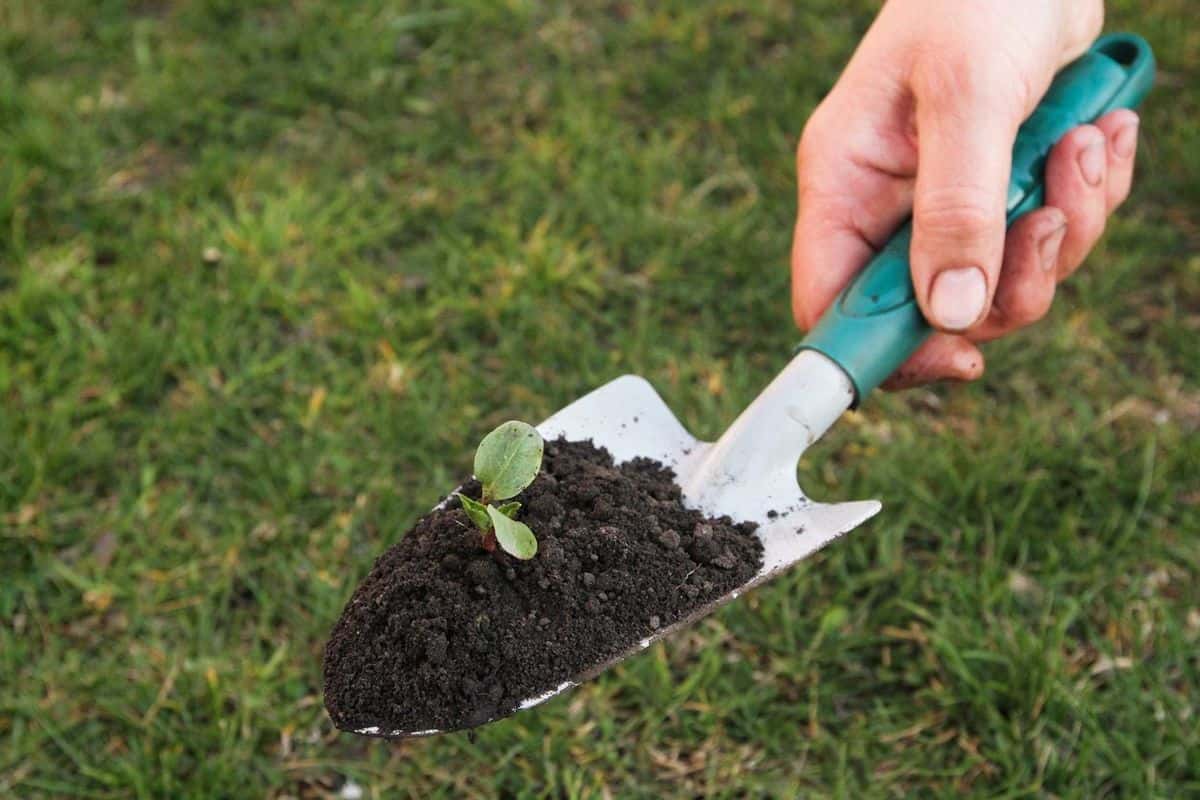
Here is the weeding failure that every gardener recognises: you spend an hour pulling weeds by hand on a Saturday afternoon, feel satisfied with the clean result, and return two weeks later to find them back — often in exactly the same spots, sometimes larger than before. This is not bad luck. It is biology. When a weed is pulled by hand or cut at soil level with a hoe, the stem breaks while the root system stays intact underground. For tap-rooted weeds like dandelions, even one third of the taproot left behind will regenerate a full plant within two to three weeks. You have not removed the weed. You have pruned it.
A proper weed puller tool solves this by extracting the entire root system in a single motion — from a fully upright standing position, without chemicals, and without leaving root fragments that regrow. But “weed puller tool” now covers everything from pocket hand weeders to 39-inch stand-up claw pullers, and matching the right tool to your specific weeds, soil type, and mobility needs is the difference between effective permanent removal and frustrating partial improvement. This guide reviews eight of the best weed puller tools on Amazon in 2026, with a weed-type matching guide that no competitor article provides, a specific section for seniors and gardeners with limited mobility, and the soil moisture guidance that determines whether any weed puller works correctly.
Quick navigation: Types of Weed Pullers | Weed Type Guide | Comparison Table | Full Reviews | Buyer’s Guide | For Seniors | FAQs
Why Most Weeding Fails — and What a Proper Weed Puller Does Differently
Understanding why hand-pulling and basic hoeing fail explains why weed puller tools work — and which type to choose for your garden.
When a weed is pulled by hand, the stem is gripped and pulled upward. The weakest point in the plant is not the root — it is the junction between stem and root at soil level. The stem breaks there. The root stays. For a dandelion with a taproot that can extend 12 inches into the soil, hand-pulling removes the visual problem while leaving the biological cause entirely untouched. The plant regrows within two weeks, usually stronger than before because the remaining root is already established.
What stand-up claw weed pullers do differently is fundamentally mechanical: the claw mechanism grips the soil column around the root, not the stem of the plant. When the handle is tilted sideways, the serrated claws extract the entire root ball as a unit — root and surrounding soil together — rather than snapping the stem at surface level. The root comes with the soil. The weed does not grow back from a clean extraction.
The Four Main Types of Weed Puller Tools
| Type | Best For | Requires Bending? | Best Weed Types |
|---|---|---|---|
| Stand-up claw weeder (Fiskars, GrootPow, Grampa’s) |
Lawn weeding, large areas, full-root extraction | ❌ No — fully upright | Dandelions, thistles, plantain, wild onions |
| Long-handle cultivator/weeder (CobraHead) |
Spreading weeds, mixed garden beds | ⚠️ Slight bend only | Crabgrass, clover, surface-rooted weeds |
| Handheld weeder / knife (Root Slayer, Hori Hori) |
Garden beds, between plants, precision work | ✅ Yes — kneeling | All types in tight spaces; bindweed; fibrous roots |
| Crack / crevice weeder (GREBSTK, Spear & Jackson) |
Patio joints, driveways, path edges | ⚠️ Light bend or standing | Patio weeds, pavement crevice weeds, path edges |
Which Weed Puller Works for Which Weed? A Type-by-Type Guide

This is the most important section in this guide — and the section that no competing review article provides properly. The tool that works brilliantly on dandelions is the wrong tool for crabgrass. Using a stand-up claw weeder on bindweed accomplishes almost nothing. Matching tool to weed type is what determines whether your weeding session is effective or frustrating.
Dandelions and Taprooted Weeds
Dandelions, thistles, and dock all have a single deep taproot that can extend 12 inches or more into the soil. They are the ideal target for a stand-up claw weeder — the 4-claw mechanism grips the soil column around the taproot and the tilting motion extracts it cleanly. The Fiskars 4-Claw and GrootPow both excel on dandelions. The critical variable is soil moisture: in slightly moist soil the taproot extracts cleanly; in dry, compacted soil the taproot snaps and the lower section remains, regenerating the plant. Weed dandelions the day after rain or light irrigation for best results.
Crabgrass and Spreading Fibrous-Rooted Weeds
Crabgrass, creeping Charlie, and similar spreading weeds have a fibrous root system — no single taproot to extract. Stand-up claw weeders are largely ineffective on these because there is no root column to grip and extract cleanly. The correct tool is a long-handle cultivator (CobraHead) or stirrup hoe that severs the root crown at soil level and disrupts the root mat. For crabgrass specifically, removal before it sets seed in late summer is far more effective than any mechanical removal after seeding has occurred.
Clover
Clover has shallow fibrous roots and is best managed with a long-handle or handheld weeder that lifts and removes the root mat before the plant sets seed. A stand-up claw can work on individual clover plants in a lawn, but it is slow for the spreading root system. The most effective approach is removal before flowering combined with lawn overseeding to close the gaps clover colonises.
Bindweed and Morning Glory
Bindweed has one of the deepest and most extensive rhizome systems of any garden weed — a single plant can extend 15–20 feet of root underground. No weed puller tool removes bindweed permanently. Repeated crown removal at soil level (using a CobraHead or hoe) combined with mulching to deny light is the correct management approach. Do not waste time with deep extraction attempts on bindweed — the rhizomes extend far beyond any tool’s reach.
Plantain (Broadleaf and Narrow-leaf)
Plantain has a flat rosette with a fibrous root system that spreads horizontally. A long-handle cultivator or Hori Hori knife is more effective than a stand-up claw, which can struggle to get underneath the horizontal root structure. A CobraHead blade slides under the rosette and lifts the whole root mass cleanly.
Wild Onions and Wild Garlic
Bulb-based weeds must be extracted with the bulb completely intact — if the bulb breaks, any fragment left in the soil regenerates. A stand-up claw weeder or Hori Hori knife in moist soil is the correct approach. Moist soil is even more critical here than for taprooted weeds: in dry soil the bulb will reliably snap, leaving viable fragments behind. Never try to remove wild onions in dry conditions.
Patio, Path, and Driveway Weeds
Weeds growing in paving joints, driveway cracks, and path edges cannot be reached by stand-up claw weeders. The GREBSTK Crack Weeder and Spear & Jackson Telescopic Patio Knife are the correct tools here — long-handled blades that reach into narrow crevices and scrape or lever out weeds growing in the joint filler material.
Quick Comparison — All 8 Weed Puller Tools at a Glance
Product names link directly to Amazon. “Requires bending” indicates whether any step in the weeding process requires bending below waist height.
| Model | Type | Handle Length | Eject Button | Requires Bending? | Best Weed Types | Best For | Price | Buy |
|---|---|---|---|---|---|---|---|---|
| ★ Fiskars 4-Claw Stand-Up Weeder | Stand-up claw | 39″ | ✅ Yes | ❌ No | Dandelions, thistles, plantain | Best Overall | ~$50 | View → |
| Grampa’s Weeder Original | Stand-up articulating | 45″ | ❌ No | ❌ No | Dandelions, taprooted weeds | Best Heritage / Tall Users | ~$40 | View → |
| GrootPow Stand-Up Weeder | Stand-up claw | ~40″ | ✅ Yes | ❌ No | Deep taproots, wild onions | Best for Deep Roots | ~$45 | View → |
| CobraHead Long-Handle Weeder | Long-handle cultivator | Standard long | ❌ N/A | ⚠️ Slight bend | Crabgrass, clover, fibrous roots | Best Multi-Use | ~$85 | View → |
| Radius Garden Root Slayer | Handheld | Short handle | ❌ N/A | ✅ Yes — kneeling | All types in beds, fibrous roots | Best Handheld | ~$25 | View → |
| GREBSTK Crack Weeder | Crack / crevice | Short to medium | ❌ N/A | ⚠️ Light | Patio, driveway crevice weeds | Best Budget / Patio | ~$15 | View → |
| Hori Hori Japanese Soil Knife | Handheld knife | 7″–8″ blade | ❌ N/A | ✅ Yes — kneeling | Bindweed, invasive roots, rocky soil | Best Garden Knife | ~$30 | View → |
| Spear & Jackson Patio Knife | Telescopic patio | Telescopic | ❌ N/A | ❌ No | Patio joints, path edges | Best Telescopic Patio | ~$25 | View → |
Stand-up weeders work best in slightly moist soil. Always test on a small area first to verify root extraction before treating the full lawn or garden.
The 8 Best Weed Puller Tools — Full Reviews

1. Fiskars 4-Claw Stand-Up Weed Puller — Best Overall ★

The Fiskars 4-Claw Stand-Up Weed Puller is the benchmark in this category — Family Handyman’s “Best Garden Tool of 2025,” top-tested by Bob Vila, and the most consistently recommended stand-up weeder across every major review source for the past several years. It earns that position through the combination of four serrated steel claws, a foot pedal for hands-free soil insertion, and an eject button that distinguishes it from every competitor: you can complete the entire weed removal cycle — position, step, tilt, eject — without bending over once. This is not a minor convenience. For gardeners with any back, knee, or hip discomfort, the eject button is the feature that makes the Fiskars the only weed puller that genuinely requires zero bending at any stage.

| Key Specifications | |
|---|---|
| Type | Stand-up 4-claw weeder |
| Handle Length | 39 inches — aluminum construction |
| Claw Design | 4 serrated stainless steel claws |
| Eject Button | ✅ Yes — drops weed without bending |
| Mechanism | Foot pedal + tilt extraction |
| Best Weed Types | Dandelions, thistles, plantain, taprooted weeds |
| Requires Bending | No — fully upright operation |
| Price | ~$50 |

How it works — the correct technique: Position the claw head over the weed. Step firmly on the foot pedal — this drives all four claws into the soil around the root rather than through it. Tilt the handle sideways (not straight up — this is the critical technique point). The tilting motion levers the serrated claws upward and outward, extracting the root and surrounding soil column as a unit. Press the eject button. The weed drops without you touching it or bending over.
The most important technique note: Family Handyman’s field tester made this explicit from their hands-on evaluation: “Rather than pulling the weeder straight out of the ground, we had to tip it to the side, which allowed the serrated blades to pull the weed out, roots and all.” This is the single most common user error with stand-up weeders — pulling straight upward rather than tilting sideways. Most one-star reviews of the Fiskars come from users who pulled straight up and got incomplete root extraction. Tilt sideways, and root extraction is near-complete.
What we like:
- Eject button is the standout feature. Family Handyman’s tester called it “a clever feature many competitors lack.” Position a bag or bucket under the claw, press eject, the weed drops in. No bending, no touching, no secondary step. Grampa’s Weeder — the closest competitor — still requires reaching to the claw head to manually remove the weed while standing.
- 4 serrated claws grip the root column effectively in moist soil. The serrations bite into the soil rather than sliding against it, providing the grip needed to extract a 12-inch dandelion taproot cleanly rather than breaking it mid-shaft.
- Fiskars brand provides genuine long-term quality assurance. The Finnish brand established in 1649 makes tools used at Home Depot, in professional landscaping, and in home gardens globally. Replacement parts are available and widely stocked.
- Consistently top-tested: Family Handyman (Best Garden Tool 2025), Bob Vila best overall, multiple independent review endorsements from physical field testing rather than spec comparisons.
What to know:
- Works best on tap-rooted weeds in slightly moist soil — see the soil moisture guide in the buyer’s guide section. In dry, compacted clay soil, root extraction success decreases noticeably.
- The 39″ handle is comfortable for gardeners of average height. Taller gardeners (over 6′) may find the 45″ Grampa’s Weeder more comfortable for extended sessions.
Best for: Most homeowners — the best combination of features, technique reliability, and brand quality for general lawn and garden weeding of tap-rooted weeds. The top choice for seniors and gardeners with limited mobility due to the zero-bend eject button design.
→ Check Current Price on Amazon
2. Grampa’s Weeder The Original — Best Heritage Design

Invented in 1913 and essentially unchanged since, Grampa’s Weeder is the original stand-up weed puller — a design so effective it preceded the Fiskars by over 80 years and remains one of the highest-rated weed removal tools on Amazon. The articulating claw mechanism, bamboo handle, and lighter overall weight (2.3 lbs vs the Fiskars’ heavier aluminum build) give it a character that functional replica tools cannot replicate. Bob Vila named it “Best Bang for the Buck” in their tested weeder roundup. Family Handyman described it as “strong and smooth with a slender design that allows you to work around other plants” — the last point identifying the Grampa’s slim claw profile as a genuine advantage in densely planted garden beds where the Fiskars’ wider stance is awkward.

| Key Specifications | |
|---|---|
| Type | Stand-up articulating claw weeder |
| Handle Length | 45 inches — bamboo |
| Claw Design | Single articulating jaw (not 4-claw) |
| Eject Button | ❌ No — manual removal while standing |
| Weight | 2.3 lbs — lightest stand-up in this roundup |
| Best Weed Types | Dandelions, taprooted weeds |
| Requires Bending | No — standing, but reach to claw head to remove weed |
| Price | ~$40 |

How the articulating claw differs from Fiskars: The Fiskars uses four individual serrated claws that surround the root column from four directions. Grampa’s uses a single articulating jaw — a V-shaped fork that closes around the root when the handle is tilted. Both mechanisms extract tap-rooted weeds effectively, but the single jaw’s slimmer profile allows it to operate between closely-spaced garden plants where the Fiskars’ wider four-claw stance would damage adjacent plants or struggle to position correctly.
Fiskars vs. Grampa’s — the most searched comparison in this category:
- Choose Fiskars if: You want an eject button (no secondary weed-removal step), you are of average or below-average height, you want the most tested and widely validated option, or you prioritise maximum serration for grip in slightly harder soil.
- Choose Grampa’s if: You are taller (the 45″ handle is 6″ longer, which is significant for gardeners over 6′), you want the lightest possible stand-up weeder (2.3 lbs — important for users with limited arm strength), you work in densely planted beds where the slim claw profile matters, or you prefer the warmth and natural feel of a bamboo handle over aluminum.
What we like:
- 2.3 lbs is the lightest stand-up weeder in this roundup — a meaningful difference over an extended weeding session, and the most important weight advantage for senior gardeners or users with arm fatigue issues.
- 45″ bamboo handle is genuinely comfortable for tall gardeners who find 39″ stand-up weeders requiring a slight bend that adds up over 30 minutes of weeding.
- Century-old design validated by continued market success — the articulating claw mechanism works, has worked for 110+ years, and generates consistently high Amazon ratings from verified gardeners.
What to know:
- No eject button means a secondary step: after extraction, the weed sits in the claw jaw and must be removed by reaching to the claw head while standing upright. This is not bending — the claw head at 45″ is reachable without significant bend — but it is one more step vs. the Fiskars eject button.
Best for: Taller gardeners, senior gardeners who prioritise light weight over eject-button convenience, gardeners who work in densely planted beds where the slim profile matters, and budget-conscious buyers who want a century-proven design at a lower price than the Fiskars.
→ Check Current Price on Amazon
3. GrootPow Stand-Up Weed Puller — Best for Deep-Rooted Weeds

Bob Vila tested the GrootPow for a full year in a warm climate where weeds are a year-round challenge — one of the most rigorous real-world evaluations of any stand-up weeder available in current reviews. Their findings: the GrootPow excels specifically on weeds with long, deep taproots and bulb-based root systems that require firm, deep claw insertion. The cast-iron shaft is the distinguishing specification: where the Fiskars uses an aluminum shaft that may flex under very firm foot-pedal pressure on hard or compacted soil, the GrootPow’s cast-iron construction allows you to step on the pedal with full body weight without flex or wobble — getting the claws to the full depth needed for a clean deep-root extraction.

| Key Specifications | |
|---|---|
| Type | Stand-up 4-claw weeder |
| Handle Length | ~40 inches |
| Shaft Material | Cast-iron shaft — rigid under full body weight |
| Claw Material | Stainless steel — rust resistant |
| Coating | Powder-coated steel — corrosion resistant |
| Grip | Cushioned — reduces hand fatigue |
| Eject Button | ✅ Yes |
| Best Weed Types | Deep taproots, wild onions, dandelions, plantain |
| Requires Bending | No |
| Bob Vila Field Test | 1-year tested (Mar 2026) |

What we like:
- Cast-iron shaft is the performance differentiator for compacted or clay soil. Bob Vila’s field test specifically noted the GrootPow’s rigidity as an advantage for deep-rooted weeds: “The four-claw steel jaws sink into the soil with a firm step on the foot pedal, gripping the root deep below the surface.” In soft loamy soil the aluminum Fiskars is entirely adequate; in compacted or clay soil where you need to apply significant foot pressure, the cast-iron shaft transfers that force to the claws without flexing.
- Year-long professional field testing on a broad range of weed types including wild onions, plantain, henbit, and chickweed provides real-world validation beyond the standard “it works on dandelions” claim.
- Cushioned grip reduces hand fatigue on extended weeding sessions — the most ergonomic grip among the three stand-up weeders in this roundup.
- Powder-coated steel construction resists rust better than bare metal alternatives — relevant for tools stored outdoors or used in consistently wet conditions.
What to know:
- Bob Vila noted the GrootPow “is a bit heavy overall, weighing a touch over 4 pounds” — significantly heavier than Grampa’s 2.3 lbs. The reviewer’s practical solution: “tossing it into a wheelbarrow and parking it near the area where I’m working.” The cast-iron shaft’s added weight is the trade-off for its rigidity. For senior users or gardeners with limited arm strength, the lighter Grampa’s or Fiskars is the more manageable choice.
Best for: Gardeners with compacted or clay soil where deep claw insertion requires rigid shaft construction; those dealing specifically with deep-rooted perennial weeds like dandelions, wild onions, and plantain; buyers who want the most durability-focused construction in the stand-up weeder category.
→ Check Current Price on Amazon
4. CobraHead Long-Handle Weeder and Cultivator — Best Multi-Use Weeder

The CobraHead is not a weed puller in the same sense as the Fiskars or Grampa’s — it is a cultivator, weeder, furrowing tool, and row-maker in a single single-tine design, and understanding this distinction is essential before purchasing. Where stand-up claw weeders are designed specifically for taproot extraction, the CobraHead’s sharp curved blade digs under and lifts weeds — which is the correct approach for crabgrass, clover, and the spreading fibrous-rooted weeds that stand-up claw weeders struggle to address. Family Handyman’s head-to-head comparison against Grampa’s Weeder concluded: “If I had to choose between the two, I would pick Grampa’s Weeder for its no-bend design and effortlessness, but that’s only because I already have the handheld CobraHead Mini for precision weeding.” This positions the CobraHead correctly: as the multi-function companion for fibrous-rooted weeds and cultivation, not a direct replacement for a stand-up taproot extractor.
| Key Specifications | |
|---|---|
| Type | Long-handle cultivator/weeder |
| Tine Design | Single cobra-shaped curved blade |
| Weight | 2.5 lbs |
| Origin | American made |
| Functions | Weeder, cultivator, furrowing, row-making, grass chopper |
| Best Weed Types | Crabgrass, clover, fibrous spreading weeds; surface-rooted weeds |
| Requires Bending | Slight forward lean — not kneeling |
| Price | ~$85 |

What we like:
- The only tool in this roundup effective on crabgrass and spreading fibrous-rooted weeds. Stand-up claw weeders have no mechanism for crabgrass because crabgrass has no single taproot to extract. The CobraHead’s blade slides under the root crown and severs it at soil level — the correct mechanical approach for fibrous root systems.
- Multi-function capability: weeder, cultivator, furrow-maker, row creator. For gardeners who do vegetable gardening, the CobraHead replaces several single-purpose tools with one. The same tool that removes crabgrass from a garden bed creates planting furrows for seed sowing in the same session.
- American-made construction at 2.5 lbs — light enough for extended sessions without the arm fatigue that heavier cultivating tools cause.
What to know:
- The CobraHead does not eliminate the need to pick up the lifted weed from the ground — unlike the stand-up claw weeder’s eject mechanism, the CobraHead severs and lifts weeds but leaves them in place for manual collection. For gardeners with mobility limitations, this secondary step requires a bend that stand-up weeders avoid.
- At ~$85, the CobraHead is the most expensive tool in this roundup. The premium is justified for gardeners with mixed weed populations (both taproot and fibrous) who want one tool to handle both, plus cultivating capability. For pure taproot weed removal in a lawn, the Fiskars at ~$50 does more for less.
Best for: Vegetable gardeners who need cultivation capability alongside weeding; gardeners with crabgrass, clover, and fibrous-rooted weeds that stand-up claw weeders cannot address; buyers who want one tool serving multiple garden tasks rather than a dedicated weed extractor.
→ Check Current Price on Amazon
5. Radius Garden Root Slayer Hand Weeder — Best Handheld Weed Puller
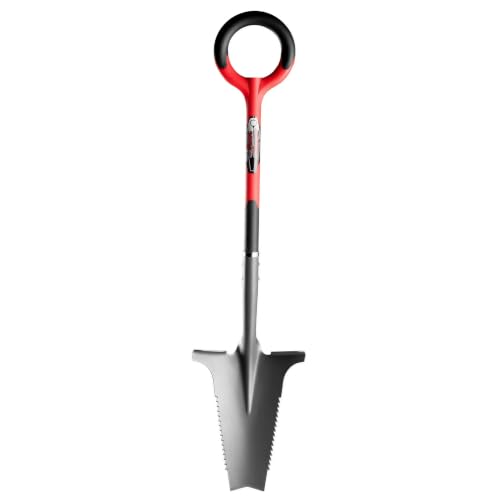
For weeding in garden beds, between established plants, in raised beds, and in any tight space where a stand-up weeder is too large or too forceful, a handheld weeder provides the precision that large-format tools cannot. The Radius Garden Root Slayer is Bob Vila’s consistently recommended hand weeder — the serrated V-shaped blade, full-tang construction, and ergonomic foam grip combine the precision of a hand tool with the durability of a professional implement. It requires kneeling, which makes it the wrong tool for gardeners with knee or hip limitations, but for those who can kneel comfortably the Root Slayer provides weeding capability in spaces where no stand-up tool reaches.
| Key Specifications | |
|---|---|
| Type | Handheld V-blade weeder |
| Blade Design | Serrated V-shape — cuts on entry and lifts on return |
| Construction | High-carbon steel, powder coat, full tang |
| Grip | Ergonomic foam — reduces hand fatigue |
| Best Weed Types | All types in close quarters; fibrous and taproot |
| Requires Bending / Kneeling | Yes — handheld close-work tool |
| Price | ~$25 |

What we like:
- Serrated V-blade cuts through roots on entry and lifts on the return stroke — two cutting directions from one blade position make the Root Slayer effective on both taproot weeds (dig beside the root, undercut, lift) and fibrous-rooted weeds (slice through the root mat on entry). No handheld tool replicates this dual-cutting action as cleanly.
- Full tang construction — the steel blade extends through the full length of the handle rather than attaching at the base only. Full tang tools resist the handle-snap failure that ends cheaper weeders under lateral leverage when working around established roots.
- Foam grip significantly reduces hand fatigue during extended kneeling weed sessions in garden beds. The ergonomic grip shape prevents the cramping that straight cylindrical handles cause during repeated twist-and-lift motions.
- Bob Vila’s top handheld weeder recommendation — validated by physical field testing.
What to know:
- Kneeling is required — this is a close-work precision tool, not a standing solution. It is completely inappropriate for gardeners with knee, hip, or back conditions that prevent comfortable kneeling. For those users, the Fiskars or GrootPow stand-up weeder is the correct substitute.
Best for: Garden bed weeding between established plants, raised bed maintenance, container garden weeding, and any tight-space work where stand-up tools cannot reach. The correct pairing with a Fiskars or GrootPow for a complete weeding kit: stand-up for lawn taproot extraction, Root Slayer for bed close-work.
→ Check Current Price on Amazon
6. GREBSTK Crack Weeder Crevice Weeding Tool — Best Budget Crevice Weeder
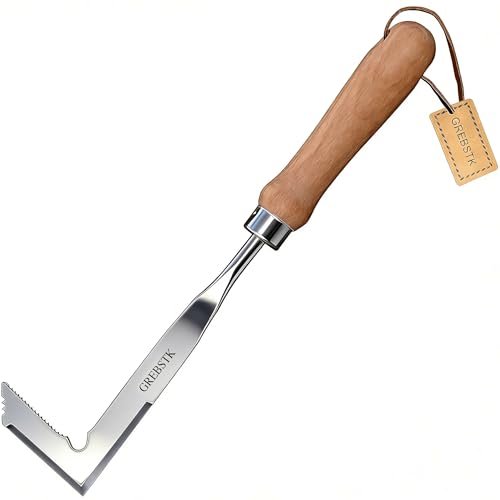
The GREBSTK addresses the weed problem that no stand-up claw weeder or cultivator can reach: weeds growing in the narrow joints of paving slabs, driveway cracks, path edges, wall crevices, and between brickwork. These weeds are among the most persistent in any garden because the narrow crack environment protects their root systems from most tools — conventional weeders are simply too wide to enter the joint. The GREBSTK’s thin metal blade is specifically dimensioned for crevice entry, with a hook end that levers weeds out of the joint rather than just scraping the surface. At approximately $15, it is the most affordable tool in this roundup and one of the most useful for homeowners with any paved outdoor areas.

| Key Specifications | |
|---|---|
| Type | Crevice / crack weeding tool |
| Blade Design | Thin metal blade — fits paving joints and cracks |
| Best Surfaces | Patio slabs, driveway, paths, brickwork, wall crevices |
| Requires Bending | Light — depends on surface level |
| Price | ~$15 — lowest in this roundup |

What we like:
- Solves the paving weed problem that no other tool in this roundup addresses. Stand-up claw weeders, cultivators, and hand weeders are all designed for soil-based weeds. The GREBSTK is the correct tool for the distinct challenge of weeds established in paving joints — different material, different root environment, different tool requirement.
- Thin blade profile fits into standard paving joint widths — the dimension that determines whether a crack tool works or does not.
- At ~$15, the GREBSTK is accessible as a supplementary purchase alongside a stand-up weeder for homeowners with both lawn and paved areas to maintain.
What to know:
- This is a complementary tool, not a standalone weed management solution. For lawn and garden bed weeds, you need a stand-up or handheld weeder — the GREBSTK is specifically for paved surfaces and crevice environments.
- For tall users or those who need a longer reach tool for large patio areas, the Spear & Jackson Telescopic Patio Knife (also in this roundup) provides a longer handle for the same crevice-weeding function.
Best for: Homeowners with paved patios, block paving driveways, or path edges where joint weeds are a persistent problem — the budget-friendly dedicated solution for crack and crevice weeding.
→ Check Current Price on Amazon
7. Hori Hori Japanese Soil Knife — Best Garden Knife for Heavy-Duty Weed Work
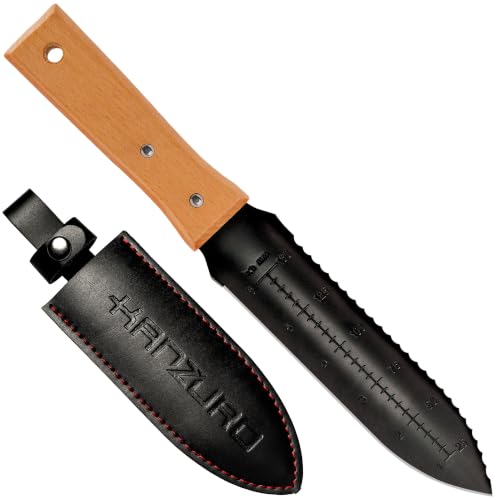
The Hori Hori is Japan’s traditional all-purpose gardening knife — a pointed, double-edged blade with one serrated side and one smooth cutting edge, designed to dig, cut roots, split plants, and extract deep-rooted weeds with precision that no claw tool matches in rocky, root-dense, or very compacted soil. It is not a standing solution and it is not the fastest tool for large-area lawn weeding. What it does that no other tool in this roundup can do is cut through established root systems with controlled precision — which makes it the correct choice for bindweed, invasive grasses, and the woody weed seedlings (young tree saplings, wild rose canes) that require actual root cutting rather than extraction.

| Key Specifications | |
|---|---|
| Type | Handheld Japanese soil knife |
| Blade Length | 7″–8″ stainless steel |
| Edge Types | One serrated, one smooth cutting edge |
| Extras | Depth markings on blade; leather sheath |
| Weight | ~8–12 oz |
| Best Weed Types | Bindweed, invasive grasses, woody seedlings, rocky soil weeds |
| Also Used For | Transplanting, bulb planting, dividing perennials |
| Requires Kneeling | Yes — close-work precision tool |
| Price | ~$30 |

What we like:
- The serrated blade cuts through established root systems that a claw weeder cannot grip. For bindweed rhizomes running through a garden bed, invasive grass roots matted through soil, and young woody weed seedlings with developing root systems, the Hori Hori cuts rather than extracts — the correct mechanical approach when roots are too deep, too extensive, or too intertwined for extraction to work.
- Depth markings on the blade allow precise planting depth — a genuinely useful feature when planting bulbs or transplanting seedlings after clearing weeds from a bed in the same session.
- Genuinely multi-use: transplanting, bulb planting, dividing perennials, soil testing by feel, and root cutting in one tool. For gardeners who want to reduce tool count, the Hori Hori provides more functions per dollar than almost any single garden tool available.
- Leather sheath for safe storage — a thoughtful inclusion for a tool with two sharp cutting edges.
What to know:
- Kneeling is required — this is a precision close-work knife, not a standing tool. Not appropriate for users who cannot kneel comfortably.
- Best used as a complement to a stand-up weeder rather than a replacement: the Hori Hori for deep-root and rocky-soil precision work, and a Fiskars or GrootPow for the general taproot weeds that make up the majority of lawn weeding.
Best for: Gardeners dealing with bindweed, invasive roots, and woody weed seedlings in garden beds; rocky or very compacted soil where claw weeders hit resistance; experienced gardeners who want a multi-use professional-grade garden knife that works for weeding alongside transplanting and planting tasks.
→ Check Current Price on Amazon
8. Spear & Jackson Razorsharp Telescopic Patio Knife — Best Telescopic Patio Weeder
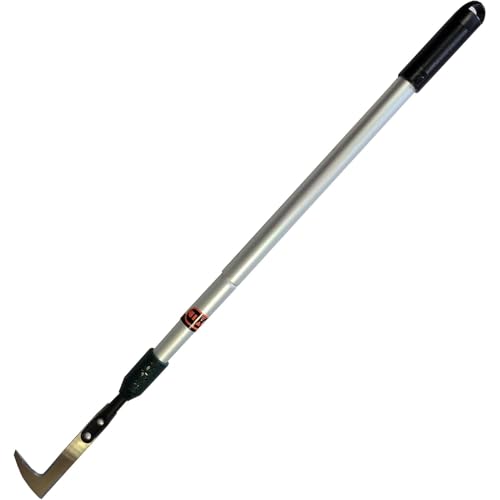
Spear & Jackson is one of Britain’s oldest garden tool manufacturers — established 1760 — and their Razorsharp Telescopic Patio Knife addresses the same paving crevice weeding need as the GREBSTK but with a telescopic handle that extends to reach larger patio areas and taller walls without requiring significant bending. Where the GREBSTK is better suited for floor-level crack weeding with a shorter handle, the Spear & Jackson’s telescopic design allows working at a more upright position across large patio surfaces — reducing the cumulative lower-back strain of extended patio maintenance sessions.

| Key Specifications | |
|---|---|
| Type | Telescopic patio / crevice knife |
| Handle | Telescopic — extends for standing posture |
| Blade Edge | Razorsharp — enhanced cutting edge |
| Best Surfaces | Patio slabs, block paving, wall joints, path edges, steps |
| Requires Bending | ❌ Minimal — telescopic reach reduces bending |
| Brand Heritage | Spear & Jackson — est. 1760, Sheffield |
| Price | ~$25 |

What we like:
- Telescopic handle is the key upgrade over fixed-handle patio knives. For large patio areas — the kind that takes 30–45 minutes to weed properly — the ability to work at a more upright posture rather than bent over a short-handled scraper makes a significant practical difference in comfort and completeness of coverage.
- Razorsharp enhanced blade edge enters tight paving joints more cleanly than standard blade-edge alternatives — reducing the force required per joint and therefore arm fatigue over extended patio sessions.
- Spear & Jackson’s 260+ years of Sheffield manufacturing heritage provides quality confidence — the same brand used by professional landscapers and groundskeeping teams for paved area maintenance.
Spear & Jackson vs. GREBSTK — which to choose:
- Choose GREBSTK if you have a small patio or prefer a lighter, simpler crack-weeding tool at minimum cost (~$15).
- Choose Spear & Jackson if you have a large patio area, if bending is uncomfortable for you, if you want to work in a more upright posture, or if you prefer established heritage brand quality for a tool you will use repeatedly through multiple seasons.
What to know:
- Like the GREBSTK, this is a complementary tool for paved surfaces specifically — it does not replace a stand-up weeder for lawn or soil-based weed management.
Best for: Homeowners with larger patio areas who want a standing-posture telescopic patio knife for efficient weed removal from paving joints; gardeners with any back sensitivity who need a longer handle to reduce bending during patio maintenance; buyers who value established brand quality for repeated seasonal use.
→ Check Current Price on Amazon
How to Choose the Best Weed Puller Tool for Your Garden
Choose by Weed Type — The Most Important Factor
The single most important buying decision is matching the tool to the weed type. A tool that is perfect for dandelions may be wrong for crabgrass, and a tool that handles bindweed effectively is different from one designed for wild onions. Use the weed type guide at the top of this article to identify your primary weed types before selecting a tool. The short version: taproot weeds (dandelions, thistles) → stand-up claw weeder; spreading fibrous weeds (crabgrass, clover) → CobraHead or cultivating hoe; paving crevice weeds → GREBSTK or Spear & Jackson; precision bed and rocky soil weeds → Hori Hori.
Choose by Mobility — Standing vs. Bending vs. Kneeling
Stand-up claw weeders (Fiskars, Grampa’s, GrootPow) operate completely upright — no bending at any stage if the Fiskars eject button is used. These are the correct tools for gardeners with back, knee, or hip conditions. Long-handle cultivators (CobraHead) require a slight forward lean but not kneeling. Handheld weeders (Root Slayer, Hori Hori) require kneeling — the wrong choice for mobility-limited users but the right choice for able-bodied gardeners working in tight bed spaces. See the dedicated seniors section below for detailed guidance on this choice.
Handle Length and User Height
Most stand-up weeders are 38″–45″ tall. Optimal handle height is when the grip reaches your wrist while standing upright with arms relaxed. The Fiskars at 39″ suits average-height users (5’4″–5’10”). Grampa’s Weeder at 45″ suits taller gardeners. For multi-height households, an adjustable-handle model is worth seeking out. Do not use a stand-up weeder that requires you to lean forward to operate — this defeats its entire purpose.
Soil Type and Condition
Clay or compacted soil requires a heavier, more rigid shaft — the GrootPow’s cast-iron shaft allows firm stepping pressure without flex. Sandy or loamy soil allows any stand-up weeder to work effectively, including the lighter aluminum Fiskars. Rocky soil makes stand-up claw weeders impractical (claws hit rocks); use the Hori Hori for precision work around rocks. Refer to the soil moisture rule below — it applies more strongly in clay soil than any other type.
The Soil Moisture Rule — The Single Most Important Weeding Technique
Regardless of which tool you buy, soil moisture is the variable that most determines whether root extraction is successful or frustrating. In slightly moist soil — the day after rain or light irrigation — the soil surrounding the root column releases the root cleanly when the claw mechanism extracts it. In dry, compacted soil, the root snaps at the point of maximum resistance and the lower section remains underground. For dandelions in dry soil, this means the plant regrows from the remaining root within two weeks and you have invested effort for no permanent result.
The practical rule: weed the day after rain. If rain is not available, water the area lightly 30–60 minutes before weeding — just enough to soften the top 4–6 inches of soil where root extraction occurs. This one change makes more difference to weeding effectiveness than any tool upgrade.
Fiskars vs. Grampa’s Weeder — Direct Comparison
This is the most searched comparison query in the stand-up weeder category, and the answer depends on your specific situation:
- Fiskars wins for: eject button (zero secondary step), 4 serrated claws (better grip in harder soil), most tested and validated option, average-height gardeners
- Grampa’s wins for: lighter weight (2.3 lbs — important for arm strength limitations), taller gardeners (45″ handle), slim claw profile for densely planted beds, bamboo handle warmth and feel, slightly lower price
- Neither wins universally. Both are excellent. The choice comes down to whether the eject button (Fiskars) or the lighter weight and taller handle (Grampa’s) is more important for your specific situation.
Do Stand-Up Weed Pullers Really Work?
Yes — effectively, for tap-rooted weeds in slightly moist soil. No — for spreading fibrous-rooted weeds where a cultivator is the correct tool. The key variables are weed type and soil moisture. In the right conditions (taprooted weeds, moist soil, correct tilting technique), stand-up weed pullers extract 80–95% of the root system cleanly and permanently. In the wrong conditions (fibrous roots, dry soil, pulling straight up), they perform poorly — which explains the one-star reviews from users who are either using the wrong tool type for their weeds or using the correct tool with the wrong technique or soil moisture.
Best Weed Puller Tools for Seniors and Gardeners with Limited Mobility
A significant portion of stand-up weed puller buyers are seniors and gardeners with knee, back, or hip conditions that make kneeling and bending impossible or painful. This is, in fact, the primary reason the stand-up weeder category exists — the “no bending required” selling point is specifically aimed at this audience. Yet no competing review article directly addresses the senior or limited-mobility gardener with specific tool recommendations. Here is the guidance they deserve.
What matters most for limited-mobility gardeners:
- Eject button — the Fiskars eject button is the feature that makes zero-bend operation genuinely complete. Without it, even a stand-up weeder requires reaching down to the claw head to remove the weed. With the Fiskars eject button, no bending occurs at any stage of the weeding process.
- Tool weight — Grampa’s Weeder at 2.3 lbs is the lightest stand-up option in this roundup. For gardeners with reduced grip strength or arm fatigue issues, the weight difference between 2.3 lbs (Grampa’s) and 4+ lbs (GrootPow) is noticeable across a 30-minute weeding session.
- Handle length vs. user height — a handle that is too short for your height forces a forward lean that creates exactly the back strain a stand-up weeder is supposed to prevent.
- Cushioned grip — the GrootPow’s cushioned grip reduces hand fatigue for users with arthritis or grip weakness, even though the GrootPow is heavier overall.
What to avoid: Heavy long-handled cultivators that require significant muscle force to operate; handheld kneeling tools (Root Slayer, Hori Hori) that require floor-level work; any tool without an eject button if you cannot bend comfortably.
Specific recommendations for limited-mobility gardeners:
- Best overall for seniors: Fiskars 4-Claw Stand-Up Weeder — eject button eliminates all bending, proven ergonomics, widely available. The slight weight disadvantage vs. Grampa’s is outweighed by the eject button’s elimination of the secondary weed-removal step.
- Best for seniors with limited arm strength: Grampa’s Weeder — at 2.3 lbs it is significantly lighter than the Fiskars or GrootPow. The absence of an eject button is a trade-off, but the claw head at 45″ is reachable while standing upright without significant bending.
- Best for patio maintenance without bending: Spear & Jackson Telescopic Patio Knife — the telescopic handle allows paving crevice maintenance from a standing position, eliminating the forward bend that fixed-handle patio knives require.
Frequently Asked Questions — Weed Puller Tools
What is the best weed puller tool?
The Fiskars 4-Claw Stand-Up Weed Puller is the best weed puller tool for most users — consistently rated #1 across Family Handyman (Best Garden Tool 2025), Bob Vila, and multiple independent review sources. The 4-claw serrated extraction mechanism, eject button, and 39″ aluminum handle provide the best combination of complete root extraction, zero bending, and long-term durability available in a stand-up weeder.
Do stand-up weed pullers really work?
Yes, effectively for tap-rooted weeds (dandelions, thistles, plantain) in slightly moist soil. Less effectively for spreading fibrous-rooted weeds (crabgrass, clover) where a cultivator is the more appropriate tool. The key variable is soil moisture — weed the day after rain or light irrigation for complete root extraction. In dry, compacted soil any stand-up weeder performs significantly worse because roots snap rather than extract cleanly.
Does a weed puller get the whole root?
When used correctly in slightly moist soil, quality stand-up weed pullers extract 80–95% of the root system. The critical technique is to tilt the handle sideways after inserting the claws — not pull straight upward. Straight-up pulling is the most common failure mode and generates most negative user reviews. Tilting sideways uses the claw serrations correctly and extracts the root column as a unit rather than breaking the upper shaft.
What is the best weed puller for dandelions?
The Fiskars 4-Claw Stand-Up Weeder or the GrootPow Stand-Up Weeder — both use the 4-claw mechanism that grips the taproot column of a dandelion at full depth. Ensure the soil is slightly moist before use. Tilt the handle sideways rather than pulling straight up. In consistently dry conditions, water the area lightly 30–60 minutes before weeding to soften the soil around the taproot.
What is the best weed puller for seniors or bad backs?
The Fiskars 4-Claw with eject button is the best choice for most seniors — it completes the full weed removal cycle from standing position with no bending at any stage. The eject button drops the weed into a bag or bin without the reach-to-the-claw step that Grampa’s Weeder requires. For seniors who prioritise the lightest possible tool over the eject button, Grampa’s Weeder at 2.3 lbs is the alternative recommendation.
What is the difference between Fiskars and Grampa’s Weeder?
Fiskars uses 4 serrated steel claws with an eject button on a 39″ aluminum handle, weighing approximately 3 lbs. Grampa’s Weeder uses a single articulating jaw (slimmer profile) on a 45″ bamboo handle, weighing 2.3 lbs, without an eject button. Fiskars is better for most users — the eject button, 4-claw extraction, and proven build quality are advantages. Grampa’s is better for taller gardeners who benefit from the extra 6″ handle length, users who need the lightest possible tool, and those working in densely planted beds where the slim jaw profile matters.
What time of year is best for using a weed puller?
Year-round, but most effective in spring when taproots are actively growing and soil is naturally moist from seasonal rain. Winter can also be surprisingly effective — Family Handyman’s tested review noted that winter soil is often softer and moister than summer soil, making root extraction cleaner. Avoid the peak dry summer period when soil moisture drops and root extraction success decreases. The specific condition that matters more than season is soil moisture — weed after rain regardless of month.
Can I use a weed puller on all types of weeds?
No — 4-claw stand-up weeders are designed for tap-rooted weeds and are the wrong tool for spreading fibrous-rooted weeds. For crabgrass, creeping Charlie, and clover, use a long-handle cultivator like the CobraHead or a stirrup hoe. For bindweed, repeated surface removal with a hoe is more appropriate than deep extraction. For paving joint weeds, use the GREBSTK or Spear & Jackson. See the weed type guide in this article for the specific tool recommendation for each common weed type.
Can you use a weed puller in winter?
Yes — and it can be more effective than summer in climates with moist winters. Family Handyman specifically noted that winter soil tends to be softer and moister than dry summer soil, which improves root extraction quality. The primary limitation is frozen ground: if the soil is actually frozen solid, claw insertion is impossible. For soil that is simply cold but unfrozen, winter weeding with a stand-up puller works well and has the added advantage that annual weeds are at their smallest and easiest to extract before spring growth begins.
Final Verdict — Best Weed Puller Tool for Every Garden
The right weed puller depends on what you are weeding, where you are weeding it, and how much you can bend. Use the weed type guide and the buyer’s guide above to confirm your primary requirement, then use the table below.
| Best For | Our Pick | Key Reason | Buy on Amazon |
|---|---|---|---|
| Best Overall | Fiskars 4-Claw Stand-Up Weeder | FH Best Garden Tool 2025, eject button, 4-claw serrated extraction, zero bending | Buy Now → |
| Best Heritage / Tall Gardeners | Grampa’s Weeder Original | 45″ bamboo handle, lightest at 2.3 lbs, 110-year proven design, Bob Vila bang for buck | Buy Now → |
| Best for Deep Roots / Compacted Soil | GrootPow Stand-Up Weeder | Cast-iron shaft, 1-year Bob Vila field test, cushioned grip, deep-root extraction | Buy Now → |
| Best Multi-Use / Crabgrass & Fibrous Weeds | CobraHead Long-Handle Weeder | Only tool here effective on crabgrass; cultivator + weeder + furrow-maker in one | Buy Now → |
| Best Handheld for Garden Beds | Radius Garden Root Slayer | Bob Vila best hand weeder, V-blade serrated, full tang, ergonomic foam grip | Buy Now → |
| Best Budget Crevice Weeder | GREBSTK Crack Weeder | Purpose-built for paving joints and cracks, lowest price in roundup | Buy Now → |
| Best Garden Knife / Heavy-Duty Roots | Hori Hori Japanese Soil Knife | Dual-edge serrated + smooth blade, cuts roots rather than extracting, leather sheath | Buy Now → |
| Best Telescopic Patio Weeder | Spear & Jackson Razorsharp Telescopic | Telescopic standing reach, razorsharp blade, 260-year Sheffield heritage brand | Buy Now → |
The Fiskars is the correct first purchase for most homeowners — it covers the majority of lawn and garden taproot weeds from a fully upright standing position with complete root extraction when used with correct technique. If you also have crabgrass or fibrous spreading weeds, add the CobraHead. If you have a paved patio, add the GREBSTK or Spear & Jackson. If you weed in garden beds between established plants, add the Root Slayer or Hori Hori. No single tool covers every weeding scenario, but the Fiskars covers the most common one.