A reciprocating saw is one of the most useful tools you can own for demolition, remodeling, plumbing, pruning, and rough cutting. Whether you are tearing out wall framing, cutting cast iron pipe, trimming tree branches, or removing nail-embedded lumber, the right reciprocating saw makes the job faster and far less exhausting. In this guide, we cover the five best cordless reciprocating saws plus the best corded option, a full blade guide, safety tips, and a buying guide so you can pick the right tool for your exact situation.

Top 5 Reciprocating Saws — Quick Comparison
| Pick | Best For | SPM | Stroke | Weight (bare) | Motor |
|---|---|---|---|---|---|
| DEWALT DCS380B 20V MAX | Best Overall / Best Value Cordless | 0–3,000 | 1 in | 5.5 lbs | Brushed |
| Milwaukee 2720-20 M18 FUEL | Best for Heavy Demo | 0–3,000 | 1-1/8 in | 7.3 lbs | Brushless |
| Makita XRJ05Z 18V LXT | Best Compact / Overhead | 0–3,000 | 1-1/8 in | 6.4 lbs | Brushless |
| Bosch CRS180B 18V | Best for Tight Spaces | 0–2,700 | 1-1/8 in | 5.3 lbs | Brushless |
| BLACK+DECKER BDCR20B | Best Budget Cordless | 0–2,500 | 7/8 in | 4.9 lbs | Brushed |
| DEWALT DWE305 | Best Corded | 0–2,900 | 1-1/8 in | 7.0 lbs | Corded 12A |
Who Should Buy Which Saw
- Homeowner, occasional use: BLACK+DECKER BDCR20B — light, affordable, handles everyday tasks.
- DIYer doing regular remodeling, pruning, and plumbing: DEWALT DCS380B — the best value for versatile use.
- Trade worker (electrician, plumber, HVAC): Makita XRJ05Z — compact and light for overhead and confined work.
- Contractor doing heavy demolition daily: Milwaukee M18 FUEL 2720-20 — best vibration control and longest stroke in the class.
- Workshop or fixed location use, no battery concern: DEWALT DWE305 corded — unlimited runtime, full power, no battery cost.
Best Overall: DEWALT 20V MAX Reciprocating Saw (DCS380B)

- Compact and lightweight design
- Variable speed trigger with 0-2900 SPM
- Pivoting shoe
- Combination set provides a selection of blades for common applications
- Compatible with all reciprocating saw brands
The DEWALT DCS380B is the best all-around reciprocating saw for most buyers. It runs at 0–3,000 SPM with a 1-inch stroke, weighs just 5.5 pounds bare, and fits into the DEWALT 20V MAX battery ecosystem that covers over 60 compatible tools. If you already own DEWALT batteries, the bare tool is an outstanding value.
The 4-position blade clamp is the standout feature — it rotates the blade to cut flush against surfaces or work in tight wall cavities where a fixed blade cannot reach. That flexibility makes this saw far more versatile than most tools at its price point.
Variable speed from 0 to 3,000 SPM gives you control for slow precise cuts on pruning work and full-speed demolition on lumber and pipe. The adjustable shoe extends blade reach as teeth wear, helping you get more life out of each blade before swapping.
Users consistently rate it highly for everyday DIY and light professional use. Some note more vibration than the Milwaukee under heavy sustained loads, but for most buyers the difference is not meaningful enough to justify the higher premium.
- 0–3,000 SPM variable speed, 1-inch stroke.
- 4-position blade clamp for flush and angle cuts.
- Fits DEWALT 20V MAX battery platform.
- 5.5 lbs bare — easy to control overhead.
- Best overall value in the cordless category.
Also read: Top Picks: Best Work Boots for Men
Best for Heavy Demo: Milwaukee M18 FUEL Reciprocating Saw (2720-20)

- [KIT INCLUDES] WORX 20V Power Share Jaw Saw and Extra Power Share 20V 4.0Ah Battery
- [ADDED SAFETY] The JawSaw features a fully protective guard. When not in use the blade retracts into the base. And because of that guard, this is the only chainsaw made for cutting directly on the ground. Leave the log right there on the pavement and get to work
- [CUTS UP TO 4”] Saw through material up to 4 inches in diameter. And with its innovative single-action cutting mechanism you’ve never had so much cutting power that was so easy to use
- [LIGHT ENOUGH TO USE OVERHEAD] The Worx JawSaw weighs 7.9 lbs. with the battery attached. Not only is that light for a chainsaw; the even weight distribution, and safety jaw guard, bolster the tool and make it easy to maneuver around overhead branches
- [2 SAWS IN 1] Pivoting, push-button head turns your jigsaw into a reciprocating saw and back again in just a few seconds

If you use a reciprocating saw professionally and need to cut through nail-embedded lumber, cast iron pipe, or thick demolition material for hours at a time, the Milwaukee M18 FUEL 2720-20 is the right tool. Independent testing confirmed it as the top cordless reciprocating saw in its category for vibration damping, stroke length, and blade change speed.
The POWERSTATE brushless motor delivers consistent speed from the first cut to the last without the motor lag that brushed models show under heavy load. The 1-1/8-inch stroke — the longest in the cordless category — removes more material per pass, which compounds into noticeably faster cuts across a full demo day.
Milwaukee’s ANTI-VIBRATION system is the most practical reason to pay the premium. Extended demo work transfers significant energy into your hands and arms, and Milwaukee’s active damping is measurably better than competitors at reducing that fatigue. The QUIK-LOK blade clamp changes blades in under five seconds, one-handed, without tools — a real advantage when switching between wood, metal, and demo blades frequently.
For homeowners and light users, the DEWALT above is a better fit. For contractors running a saw four or more hours per day, the Milwaukee pays for itself quickly in reduced fatigue and faster work.
- POWERSTATE brushless motor — 0–3,000 SPM, 1-1/8 in stroke.
- ANTI-VIBRATION technology reduces arm and hand fatigue on long jobs.
- QUIK-LOK blade clamp — one-handed, tool-free swap in under 5 seconds.
- Orbital action mode for faster aggressive cuts in wood.
- Compatible with all M18 batteries.
Best Compact and Overhead: Makita 18V LXT Reciprocating Saw (XRJ05Z)

- Oscillating tool has 2 finger tool-free system for quick accessory changes; Reciprocating saw has tool-free blade release for quick changes.
- Oscillating tool has variable speed dial from 8K to 18K OPM for control across applications; Reciprocating saw has variable speed trigger for cutting variety of materials.
- Oscillating tool has LED work light for visibility in dark conditions.
- Reciprocating saw delivers up to 3,000 SPM with 1 inch stroke length to help finish jobs quickly.
- Reciprocating saw has compact 14.5 inch length to access tight spaces.
The Makita XRJ05Z is the lightest full-power reciprocating saw in this comparison at 6.4 pounds bare, and that weight advantage matters most when you are working overhead. Cutting ceiling joists, pruning high branches, or removing pipe from above becomes noticeably less fatiguing with a lighter saw.
It runs at 0–3,000 SPM with a 1-1/8-inch stroke, matching the Milwaukee on specs. The compact front-end geometry gets into tight spaces that longer saws cannot physically reach, making it especially practical for plumbers, electricians, and HVAC installers who work inside walls and overhead regularly.
It is not the right tool for a full commercial demo day where Milwaukee’s sustained runtime advantage and superior vibration control become critical. But for residential trade work, overhead tasks, and medium-duty cutting, it delivers excellent performance with better control than heavier models.
If you already own Makita 18V LXT batteries — used across 275+ tools in the platform — the bare tool is the most cost-effective option on this list for your ecosystem.
- 6.4 lbs bare — lightest full-stroke saw in this comparison.
- 0–3,000 SPM, 1-1/8 in stroke.
- Anti-vibration technology for extended overhead use.
- Compact body for tight spaces and under-floor work.
- Compatible with all Makita 18V LXT batteries.
Best for Tight Spaces: Bosch 18V Reciprocating Saw (CRS180B)

- XRJ04Z - Makita-built variable speed motor delivers 0-2,800 strokes per minute and a 1-1/4 inches stroke length for faster cutting and variable speed trigger for added convenience
- XRJ04Z - "Tool-less" blade change system allows for faster blade installation and removal for increased productivity and compact and ergonomic design at only 19-1/8 inches long
- XRJ04Z - Weighs only 8.3 pounds with battery for reduced operator fatigue and rubberized soft grip handle provides increased comfort on the job
- XRJ04Z - Refined crank mechanism design minimizes blade deflection and reduces vibration and large two-finger trigger for operator convenience
- BL1840BDC2 - 18V LXT Lithium-Ion 4.0Ah battery reaches a full charge in 40 minutes or less and provides up to 35% more run time per charge compared to BL1830
The Bosch CRS180B is the right choice when your main challenge is physically getting the saw into a confined space. At 13.9 inches overall length, it is the most compact body in this comparison, giving you access to wall cavities, under cabinets, inside utility closets, and anywhere a longer saw cannot fit.
It runs at 0–2,700 SPM with a 1-1/8-inch stroke — slightly slower at max speed than the DEWALT and Milwaukee, but fully capable for residential applications and confined-space work where max speed is less important than physical access. The SDS-style blade change is fast and one-handed. Bosch’s Vibration Control system reduces fatigue noticeably during longer cutting sessions.
If you are not already in the Bosch 18V battery ecosystem, factor that cost into your decision. For those already on the platform, this is an excellent addition. For serious DIYers and trade workers who regularly deal with confined-space jobs, the compact body is a genuine advantage no other saw here offers.
- 13.9 in compact body — best for confined-space cutting.
- SDS-style blade change — fast, one-handed.
- 0–2,700 SPM variable speed, 1-1/8 in stroke.
- Vibration Control system for reduced fatigue.
- Compatible with Bosch 18V battery system.
Best Budget: BLACK+DECKER 20V MAX Reciprocating Saw (BDCR20B)

- Tool Free Blade Change; Battery and charger sold separately
- Pivoting Shoe
- Maximum initial battery voltage (measured without a workload) is 20 volts; Nominal voltage is 18.
- Complete all-in-one charging solution
- Versatility and convenience
The BLACK+DECKER BDCR20B is the right tool for homeowners who need occasional reciprocating saw capability — cutting PVC pipe, trimming tree limbs, handling light remodeling — without spending $120 or more on a contractor-grade model. For that type of use, it performs adequately at a much lower price.
It runs at 0–2,500 SPM with a 7/8-inch stroke, noticeably slower through nail-embedded lumber and cast iron pipe than the tools above. For occasional and light use that difference rarely matters. For sustained demo work, the vibration and slower cut speed become real limitations quickly.
It shares battery compatibility with BLACK+DECKER and PORTER-CABLE 20V MAX tools, which is a practical plus if you already own batteries in that ecosystem. For homeowners using it a few times a year, it is a solid value and a significant step up from having no reciprocating saw at all.
- Best budget pick for light and occasional use.
- 0–2,500 SPM, 7/8 in stroke.
- Tool-free blade change.
- Compatible with BLACK+DECKER and PORTER-CABLE 20V MAX batteries.
- 4.9 lbs — lightest saw in this comparison.
Best Corded: DEWALT 12-Amp Reciprocating Saw (DWE305)
- Compact and lightweight design
- Variable speed trigger with 0-2900 SPM
- Pivoting shoe
- Combination set provides a selection of blades for common applications
- Compatible with all reciprocating saw brands
The DEWALT DWE305 is the best corded reciprocating saw for buyers who want unlimited runtime without battery costs. It runs on a 12-amp motor delivering 0–2,900 SPM with a 1-1/8-inch stroke — strong enough for sustained heavy demolition without worrying about battery charge [web:419][web:426].
The 4-position blade clamp matches the cordless DEWALT, giving you flush-cutting capability and four blade orientations for versatile use. Variable speed trigger gives full control from slow precise starts to full-speed cutting. At around $100, it is also one of the best-value reciprocating saws on the market if you are working in a fixed location with power access.
The tradeoff is the cord — on a busy demo site the cord needs managing, and reach is limited to wherever your extension cord reaches. For workshop use, garage work, or job sites with reliable power, none of that is a problem. For rooftop, crawlspace, or outdoor site work where power access is inconsistent, a cordless model is more practical [web:420][web:429].
- 12-amp motor — 0–2,900 SPM, 1-1/8 in stroke.
- 4-position blade clamp for flush cuts and versatile blade positioning.
- No battery cost — unlimited runtime at the outlet.
- 7.0 lbs — comparable weight to premium cordless models.
- Best corded value at around $100.
Also read: Milwaukee M12 Review
Reciprocating Saw Blade Guide
Choosing the right blade matters as much as choosing the right saw. A good saw with the wrong blade will cut slowly, break blades early, or produce poor results. Here is what you need to know.
Blade Types by Material
| Blade Type | Best For | TPI | Notes |
|---|---|---|---|
| Bi-metal | Wood, thin metal, PVC, drywall | 6–18 | Most versatile all-purpose blade |
| Carbide-tipped | Nail-embedded lumber, cast iron, fiber cement | 6–8 | Lasts longer in abrasive demo material |
| Diamond grit | Tile, cement board, fiberglass, masonry | N/A | No teeth — cuts by abrasion |
| Pruning / wood only | Green wood, tree branches, rough lumber | 5–6 | Large aggressive teeth for fast wood removal |
| Metal-specific | Steel pipe, copper, aluminum, sheet metal | 14–24 | Fine teeth — turn orbital action OFF |
TPI Guide — Quick Reference
- 5–8 TPI: Fast aggressive cuts in wood, demolition, green branches.
- 10–14 TPI: General-purpose wood and light metal cutting.
- 18–24 TPI: Clean cuts in thin metal, copper pipe, and sheet metal.
Blade Length
Use the shortest blade that fits your material — longer blades deflect more and produce less accurate cuts. For pipe and beam work where you need reach, longer blades are necessary, but start with the shortest that will complete the cut.
Reciprocating Saw Buying Guide

Brushless vs. Brushed Motor
Brushless motors run cooler, last longer, and maintain consistent speed under load without the power drop you feel in brushed models during heavy cutting. For professional or heavy daily use, pay the premium for brushless. For occasional homeowner use, a brushed motor is adequate and significantly cheaper.
Stroke Length
Stroke length is how far the blade travels with each motion. A 1-1/8-inch stroke removes more material per pass than a 7/8-inch stroke — the difference compounds into noticeably faster cuts over a full day of work. For demo and heavy cutting, choose at least 1-1/8 inches. Budget tools often reduce this spec to cut costs.
SPM — Strokes Per Minute
Higher SPM means faster cutting. Most quality reciprocating saws reach 2,700 to 3,000 SPM at maximum. Variable-speed triggers are essential — they let you start cuts slowly for control and ramp up to full speed once the blade is seated, which is especially important when starting a cut on metal or pipe to prevent blade skating.
Orbital Action
Orbital action moves the blade in an elliptical pattern instead of a straight push-pull, which increases cutting speed dramatically in wood and aggressive demo work. For metal cutting, always turn orbital action off — it damages blades faster and makes cuts less accurate. The best saws make orbital mode selectable.
The Adjustable Shoe
The shoe is the metal foot at the front of the saw that presses against the material being cut. An adjustable shoe lets you expose more blade as the teeth near the shank wear down, extending blade life significantly. It also lets you set a consistent depth for flush cuts against walls or floors. Always press the shoe firmly against the material when cutting — this stabilizes the blade and dramatically reduces vibration.
4-Position Blade Clamp
A 4-position blade clamp lets you rotate the blade in four directions — straight down for standard cuts, angled for flush cuts against a surface, or perpendicular for cutting in confined spaces. If you ever need to cut flush against a floor or ceiling, this feature is essential. Both DEWALT saws in this guide include it.
Corded vs. Cordless
Cordless saws are the better choice for most buyers in 2026 — brushless motor technology has closed the performance gap significantly, and the freedom of movement on a job site is a genuine advantage. Corded saws still win for all-day sustained heavy work in a fixed location because you never worry about battery charge or runtime. For mixed use and job site portability, go cordless. For workshop or garage use, corded is an excellent lower-cost option.
Battery Ecosystem
If you already own batteries from DEWALT 20V MAX, Milwaukee M18, or Makita 18V LXT, buy a bare tool in that platform. Cross-brand compatibility does not exist, and battery savings are significant. All three platforms have 60+ tools available, so staying in your ecosystem pays off long-term. If you are starting fresh, DEWALT 20V MAX offers the lowest entry cost, while Milwaukee M18 offers the highest overall performance ceiling.
Vibration Control
Vibration becomes a real issue during extended cutting sessions. Saws with active vibration damping — like the Milwaukee M18 FUEL’s ANTI-VIBRATION system — measurably reduce arm and hand fatigue over a full day. For occasional use, this is not a critical spec. For daily demo work, it is one of the most important things to check.
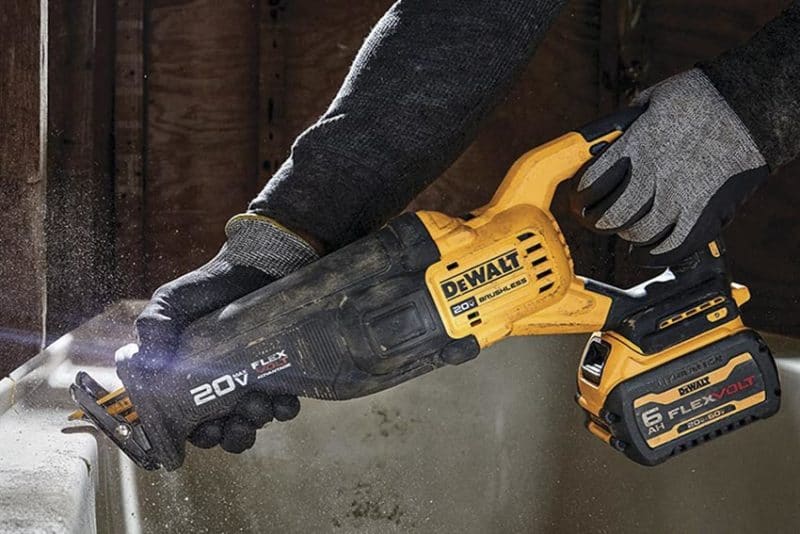
What Is a Reciprocating Saw Used For?
A reciprocating saw is primarily a demolition and rough-cutting tool. It excels at speed and access rather than precision. The most common uses are:
- Demolition work: Cutting through walls, removing old framing, tearing out floors.
- Plumbing: Cutting PVC, copper, cast iron, and galvanized steel pipe in tight spaces.
- Pruning: Removing tree branches, trimming shrubs, cutting roots.
- Remodeling: Cutting window and door openings, removing subfloor sections.
- Drywall: Making rough openings for outlets, switches, and HVAC vents.
- Metal cutting: Conduit, pipe, angle iron, and sheet metal with the right blade.
- Nail-embedded lumber: Salvage work, pallet disassembly, old structure removal.
Reciprocating Saw vs. Jigsaw vs. Circular Saw
| Saw | Best For | Precision | Speed | Access |
|---|---|---|---|---|
| Reciprocating Saw | Demolition, pipe cutting, pruning, rough cuts | Low | Very fast | Excellent in tight/awkward spaces |
| Jigsaw | Curved cuts, sheet material, finish cuts in wood | High | Medium | Good on flat surfaces |
| Circular Saw | Long straight cuts in lumber, plywood, sheathing | High | Fast | Needs flat surface and clearance |
The rule is simple: use a reciprocating saw when you need to cut fast in a difficult location and precision does not matter. Use a jigsaw for curves and fine woodwork. Use a circular saw for long straight cuts in flat sheet material and lumber [web:424][web:430].
Reciprocating Saw Safety
A reciprocating saw is one of the most powerful tools in a workshop and one of the most commonly misused. Follow these rules every time you use one [web:425][web:428].
- Always press the shoe firmly against the material before pulling the trigger. This stabilizes the blade and dramatically reduces vibration and blade deflection.
- Check for hidden pipes and wires before cutting into any wall, floor, or ceiling. Use a stud finder with wire detection mode.
- Use two hands — one on the main grip, one on the body. Reciprocating saws vibrate heavily under load and can twist out of a single-handed grip.
- Wear safety glasses at all times. The blade throws debris at high speed in multiple directions.
- Wear gloves to reduce vibration transfer and protect against sharp material and blade contact.
- Wear ear protection during extended use. Reciprocating saws generate significant noise, especially cutting metal or masonry.
- Use the correct blade for the material. Wrong blades bind, snap under load, and can cause the saw to kick violently.
- Never pull the trigger until the blade is clear of your body and all bystanders and positioned against the material.
- Keep the cord clear when using a corded model. Route it behind you so it stays out of the cut path.
- Change blades when they feel slow. A dull blade increases vibration, slows the cut, and requires more pressure — all of which increase injury risk. If the saw needs excessive pressure to cut, the blade needs replacing [web:428].
- Never set the saw down until the blade has fully stopped moving.
How We Selected the Best Reciprocating Saws
Testing and Research Process
Our recommendations are based on independent test data from professional tool testing outlets, verified buyer reviews from Amazon and contractor forums, and evaluation of key specs including stroke length, SPM range, vibration control, blade change systems, motor type, and battery compatibility. We cross-referenced head-to-head test results on wood, cast iron, PVC, and nail-embedded demo materials to confirm real-world performance against spec sheet claims.
Model Currency
We replaced discontinued models and outdated specs from previous versions of this article with current 2025–2026 production models. All six models in this guide are in active production as of June 2026 with full parts and warranty support from their manufacturers.
Also read: Best Chainsaw Chains
Frequently Asked Questions About Reciprocating Saws
What is the best reciprocating saw for the money?
The DEWALT DCS380B 20V MAX is the best reciprocating saw for most buyers. It delivers strong all-around performance, fits the large DEWALT 20V MAX battery platform, and is available as a bare tool for buyers who already own DEWALT batteries.
What is the difference between a reciprocating saw and a Sawzall?
Sawzall is Milwaukee’s brand name for its reciprocating saw, introduced in 1951. The term is widely used as a general category name. All Sawzalls are reciprocating saws, but reciprocating saws are made by many brands beyond Milwaukee.
Can a reciprocating saw cut through metal?
Yes. Use a bi-metal or carbide blade rated for metal cutting with a high TPI count (14–24 TPI for thin metal, 8–14 TPI for thick pipe). Turn orbital action off when cutting metal to protect blade life and improve accuracy.
What TPI blade should I use for wood?
Use 5–8 TPI for fast rough cuts and demolition in lumber. Use 10–14 TPI for general wood work where a cleaner cut matters. For pruning green wood and branches, a dedicated pruning blade with large aggressive teeth at 5–6 TPI is the best choice.
Are cordless reciprocating saws as powerful as corded?
Modern brushless cordless saws from Milwaukee, Makita, and DEWALT match or exceed the performance of most corded saws for typical cutting tasks. For all-day sustained heavy commercial demo in a fixed location, a corded model still has a runtime advantage. For most professional and homeowner use, cordless is the better choice today.
What is orbital action on a reciprocating saw?
Orbital action moves the blade in an elliptical pattern rather than a straight push-pull. This increases cutting speed significantly in wood and rough demolition work. Always turn it off for metal cutting — it damages blades faster and makes cuts less accurate.
Can a reciprocating saw replace a jigsaw?
Not for precision work. A reciprocating saw excels at rough cuts, demolition, and cutting in awkward positions. A jigsaw is the better tool for curved cuts, fine woodworking, and any cut where finish quality matters.
How do I reduce vibration when using a reciprocating saw?
Press the shoe firmly against the material before and during cutting. Use a saw with active vibration damping such as the Milwaukee M18 FUEL. Change dull blades — worn blades vibrate significantly more than fresh ones.
Can I use a reciprocating saw for pruning trees?
Yes. A reciprocating saw is effective for branches up to 6–8 inches in diameter. Use a pruning blade with large aggressive teeth for best results. For larger trunks, a chainsaw is faster, but for controlled cuts in tight spaces or overhead, a reciprocating saw is excellent.
How do I maintain a reciprocating saw?
Keep the blade clamp and shoe area clean and free of debris. Inspect the shoe for play or looseness and tighten if needed. For brushed motors, inspect and replace brushes when worn. Store the saw without a blade installed. Follow the manufacturer’s battery storage guidelines to maintain runtime performance long-term.
Already own a saw and dealing with a blade that won’t stay locked in? See our guide on why a reciprocating saw blade keeps coming loose before assuming you need a new tool.