A nicked conductor is more than an annoyance — it’s a failed connection waiting to happen, a potential arc fault, or in fine electronics work, a broken trace that takes an hour to find. Every one of those nicked wires traces back to the same root cause: the wrong tool, used on the wrong wire, by someone who grabbed whatever was in the drawer. A proper wire stripper — matched to your wire gauge, your wire type, and your application — makes clean stripping effortless and reliable every time.
This guide reviews 11 of the best wire strippers on Amazon in 2026, covering four distinct use cases: general residential and commercial electrical work, specialty and automatic stripping for high-volume applications, fiber optic cable stripping for telecommunications professionals, and combo stripper/crimper tools for automotive and marine wiring. Whether you’re a licensed electrician, a fiber optic installer, an electronics hobbyist, or a homeowner changing an outlet, the right tool is in this list.
For a fully equipped workshop, also see our guides on the best DeWalt rotary hammer drills, best moisture meters for professionals, and best tool gifts for dad — wire strippers consistently rank among the most practical tool gifts for anyone who works with electrical systems.
AWG, Wire Types & Stripper Types: What You Need to Know Before Buying
What Is AWG?
AWG stands for American Wire Gauge — the standard system for measuring wire diameter in the United States. The counter-intuitive rule: higher AWG number = thinner wire. AWG 8–10 is heavy circuit wire (subpanels, large appliances). AWG 12–14 is standard residential circuit wiring. AWG 16–18 is used for lighting and automotive applications. AWG 20–22 is for electronics and signal work. AWG 24–28 covers communications, data, and fine electronics. AWG 30+ is for precision instrument and sensor wiring. A wire stripper rated for AWG 10–22 cannot strip AWG 24–28 wire without damaging the conductor — always check both the solid and stranded AWG ratings separately before purchasing.
Solid Wire vs Stranded Wire
Solid wire is a single copper conductor — common in residential house wiring (NM/Romex cable, outlet and switch circuits). Stranded wire consists of multiple thin conductors twisted together — common in automotive harnesses, flexible runs, marine wiring, and electronics. A stripper optimised for solid wire can fray or nick individual strands in stranded wire. Quality tools like the Klein 11063W and KNIPEX 13 72 8 explicitly rate separate AWG ranges for solid and stranded wire — always check both specs before use.
Types of Wire Strippers
Manual/gauged strippers have precise, fixed stripping holes for each gauge — reliable, accurate, and the right choice when you work with a consistent wire gauge. Self-adjusting/automatic strippers calibrate to the wire diameter automatically — faster for high-volume work and mixed-gauge applications. Compound-action strippers (like the Klein 11063W Katapult) grip the cable and strip in one squeeze — exceptionally fast for electricians doing repetitive termination. Fiber optic strippers are a completely different category — precision-ground for 125µm glass cladding, they cannot be substituted with any standard wire stripper. Combo stripper/crimpers add terminal crimping capability for automotive and marine applications.
AWG Quick Reference
| AWG Range | Wire Diameter | Typical Application |
|---|---|---|
| 8–10 AWG | Thick | Subpanels, large appliances, EV chargers |
| 12–14 AWG | Standard | Residential circuits, outlets, switches |
| 16–18 AWG | Medium | Lighting, automotive, extension cords |
| 20–22 AWG | Fine | Electronics, signal, speaker wire |
| 24–26 AWG | Very fine | Communications, Ethernet, thermostat wire |
| 28–30 AWG | Ultra-fine | Precision instruments, PCB, sensor leads |
Best Wire Strippers 2026: Quick Comparison
| Product | Type | AWG / Range | Solid & Stranded | Crimper | Fiber Optic | Best For |
|---|---|---|---|---|---|---|
| Klein 11063W Katapult ★ | Compound-action | 8–20 solid / 10–22 stranded | Both | No | No | Best Overall |
| IDEAL 45-177 Stripmaster | Gauged / MIL-spec | 16–26 AWG | Both | No | No | Best for Teflon/MIL-spec |
| KNIPEX 12 62 180 SBA | Self-adjusting auto | 10–24 AWG | Both | No | No | Best Auto (Premium) |
| Jokari FKZ Automatic | Self-adjusting auto | 0.2–6mm² | Both | No | No | Best Auto (Budget) |
| KNIPEX 13 72 8 | Forged gauged | 10–20 solid / 12–20 stranded | Both | No | No | Best Heavy-Duty Forged |
| haisstronica AWG 24–10 | Auto + ratchet crimper | 24–10 AWG strip / 22–10 crimp | Both | Yes | No | Best Combo Stripper/Crimper |
| Klein Tools K12075 | Slim-forged gauged | 8–18 solid / 10–20 stranded | Both | No | No | Best Slim/Compact |
| WGGE WG-015 | Gauged / spring-loaded | 10–22 AWG | Both | Basic | No | Best Budget |
| 16-in-1 Wire Scissors | Multi-function | Multi-gauge | Both | Basic | No | Best Multi-Function |
| Jonard JIC-125 | Fiber optic precision | 250µm / 900µm buffer | N/A | No | Yes | Best Fiber Optic Stripper |
| Jonard MS-316 | Fiber optic mid-span | Jacket slit & ring | N/A | No | Yes | Best Fiber Mid-Span Tool |
★ = Editor’s top pick. All products sourced from Amazon.com. Prices and availability verified at time of publishing.
1. Klein Tools 11063W Katapult Wire Stripper/Cutter — Best Overall
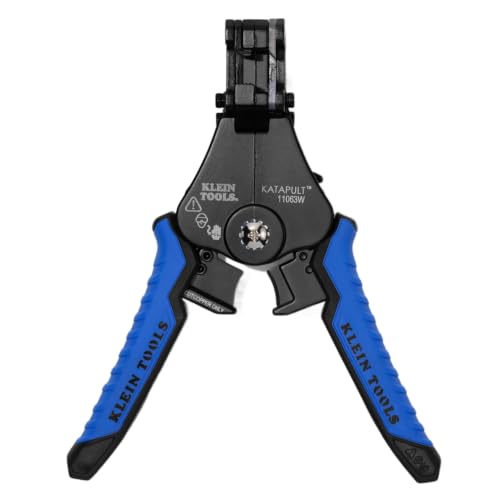
The Klein Tools 11063W Katapult is the best overall wire stripper on Amazon in 2026, and it earns that position through a mechanism innovation that fundamentally changes how fast wire stripping gets done. The Katapult’s compound-action stripping head grips the cable, cuts the insulation, and removes the jacket in a single squeeze of the handle — no repositioning, no pulling the tool away from the wire, no separate step. For an electrician working through a panel or rough-in with dozens of terminations, that single-motion efficiency adds up to serious time savings across a job.

Specs confirm why this is the professional’s choice: strips 8–20 AWG solid and 10–22 AWG stranded wire, removing up to 1 inch (25mm) of insulation per stroke. The precision-machined stripping holes remove insulation cleanly without nicking the conductor — the failure mode that causes connection problems downstream. The tension-loaded wire-grip gently holds the cable while the blade does its work, retaining cable geometry so stranded wire doesn’t splay. The cast alloy chassis with heavy-duty Ecoat finish resists corrosion under job site conditions. A built-in cutting hole handles 8–22 AWG wire cuts cleanly, eliminating the need for a separate wire cutter in most residential and light commercial work. An adjustable stopper controls strip length for consistent termination depth.

Klein Tools has been making professional hand tools since 1857 — over 160 years of manufacturing specifically for the electrical trades. The 11063W is stocked in virtually every professional electrician’s bag in the United States. It is the tool that experienced electricians recommend when someone asks what wire stripper to buy first, and it’s the benchmark against which every other general-purpose wire stripper in this roundup is measured. At its price point, the quality-to-cost ratio is exceptional. The only meaningful limitation: it is not insulated for live work, and it’s not designed for fine-gauge electronics wire below AWG 22 — for those applications, the IDEAL 45-177 or fiber optic Jonard tools are appropriate.
Pros: Compound-action single-squeeze strip mechanism saves significant time; precision-machined holes prevent conductor nicking; strips both solid (8–20 AWG) and stranded (10–22 AWG); built-in wire cutter; adjustable strip-length stopper; cast alloy chassis with Ecoat corrosion resistance; Klein 160-year professional pedigree.
Cons: Not insulated — do not use near live circuits; doesn’t handle fine-gauge wire below AWG 22; slightly heavier than basic gauged strippers at 12 oz.
Who it’s for: The default recommendation for any electrician, serious DIYer, or homeowner who works with standard AWG 10–22 wire. Buy this first.
→ Check Current Price on Amazon
2. IDEAL Industries 45-177 Custom Stripmaster Wire Stripper — Best for MIL-Spec & Teflon Wire
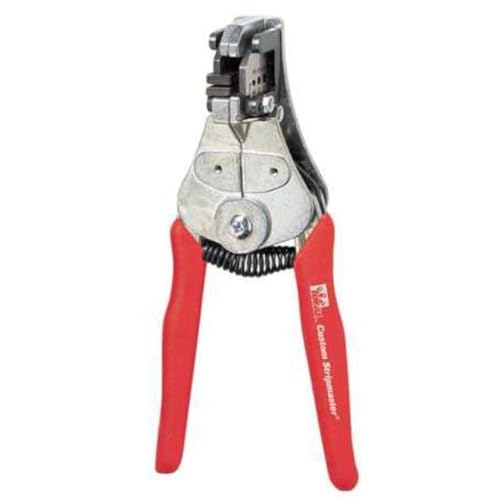
The IDEAL Industries 45-177 Custom Stripmaster exists for a specific audience that every competitor wire stripper article ignores entirely: aerospace technicians, avionics maintenance professionals, military electronics workers, and precision electronics assemblers who work with MIL-W-22759/11/12/22/23 Teflon-insulated wire. If you work with standard PVC-insulated residential or automotive wire, this is not your tool. If you work with Teflon/PTFE-insulated aerospace wire, this is the only tool that works reliably.

The reason a standard wire stripper fails on Teflon wire is straightforward: PTFE (polytetrafluoroethylene) insulation is significantly harder, more slippery, and tougher than standard PVC. A standard stripper’s jaw cannot grip it consistently, and the blade geometry that cuts cleanly through PVC will slip off or nick the conductor through PTFE. The 45-177 Custom Stripmaster uses precision die-formed stripping holes specifically ground for the insulation wall thickness of MIL-spec Teflon wire at each gauge from 16 to 26 AWG. The included grit pad on the jaw face provides the grip that smooth Teflon surfaces require. The black oxide finish resists corrosion and provides laser-etched wire gauge markings that remain legible under shop conditions. A heavy-duty spring mechanism provides consistent jaw opening force across thousands of stripping cycles.
IDEAL Industries has been manufacturing electrical tools since 1916 — they’re the brand behind the Stripmaster line that has been the aerospace and avionics industry standard for decades. The 45-177 is a tool that professional technicians buy once and use for the life of a career, rather than replacing annually the way budget tools require. For anyone working in defence electronics, aircraft maintenance, space systems, or precision instruments where wire gauge compliance is a documented requirement, the IDEAL 45-177 is the professional standard.
Pros: Specifically rated for MIL-W-22759/11/12/22/23 Teflon wire (16–26 AWG); precision die-formed stripping holes for clean cuts without conductor damage; grit pad jaw face grips slippery Teflon insulation; laser-etched gauge markings; black oxide corrosion-resistant finish; IDEAL professional pedigree since 1916.
Cons: Highly specialised — not suitable for standard PVC-insulated wire; premium price for a narrow application; 16–26 AWG range doesn’t cover thick circuit wire; heavy and substantial rather than compact.
Who it’s for: Aerospace technicians, avionics maintenance professionals, military electronics workers, and precision electronics assemblers working with MIL-spec Teflon-insulated wire.
→ Check Current Price on Amazon
3. KNIPEX 12 62 180 SBA Self-Adjusting Wire Stripper — Best Automatic Wire Stripper (Premium)
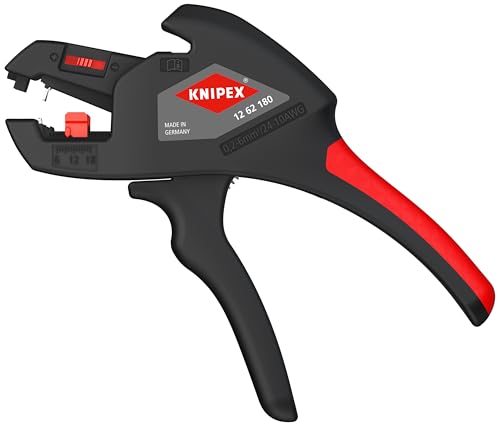
The KNIPEX 12 62 180 SBA is the European professional electrician’s standard for automatic wire stripping, and it’s increasingly the choice of quality-focused electricians in North America who have experienced the difference between it and cheaper self-adjusting alternatives. KNIPEX has been manufacturing precision pliers and cutting tools in Wuppertal, Germany since 1882, and the 12 62 180 reflects that engineering heritage in every operational detail.

The self-adjusting mechanism is the core advantage: instead of selecting a gauge notch and positioning the wire precisely (as with manual gauged strippers), you insert the wire into the jaws, squeeze, and the mechanism automatically calibrates to the exact wire diameter. The insulation is cut and removed in one motion. This works reliably across the full 10–24 AWG range on both solid and stranded wire, with PVC, PE, and most standard insulation types. The jaw geometry is precision-ground to German tooling tolerances — tighter than what budget self-adjusting tools achieve — which means the automatic calibration is more accurate and produces cleaner strips with less conductor damage risk. For high-volume panel wiring or commercial rough-in where you’re terminating dozens of the same wire gauge, the speed advantage over a manual gauged stripper is significant.

The spring-loaded return opens the jaw automatically after each strip. The ergonomic handle design reduces hand fatigue during extended use. The tool is built from KNIPEX’s standard high-alloy tool steel — the same material grade used across their professional plier range — which means the jaw blades maintain their cutting edge under daily professional use rather than dulling after a few months the way budget alternatives do. If you’re a professional electrician who wants the best self-adjusting wire stripper available and intends to use it daily for years, the KNIPEX 12 62 180 SBA justifies its premium price through longevity and consistent performance.
Pros: Self-adjusting across 10–24 AWG — no gauge selection required; German precision engineering; tighter jaw tolerances than budget auto-strippers; works on solid and stranded wire; spring-loaded auto-return; high-alloy steel for long blade life; KNIPEX professional reliability.
Cons: Significant price premium over budget alternatives; doesn’t cover fine gauge below AWG 24; self-adjusting mechanism requires clean, standard insulation types for best results.
Who it’s for: Professional electricians who want the best self-adjusting wire stripper for daily high-volume use and are willing to invest in German tooling quality.
→ Check Current Price on Amazon
4. Jokari FKZ Automatic Wire Stripper — Best Budget Self-Adjusting Stripper
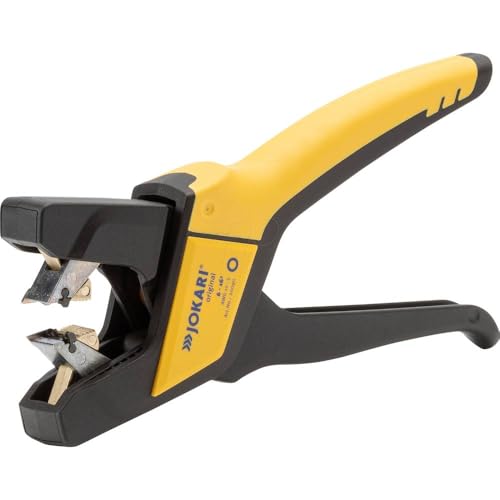
The Jokari FKZ delivers the self-adjusting wire stripping experience at a significantly lower price than the KNIPEX equivalent — and it does so with German engineering behind it. Jokari is a specialist wire stripping tool manufacturer based in Germany, far less well-known in the US market than KNIPEX, but with a strong reputation among European professional electricians and a growing following among US tradespeople who have discovered it through professional forums and tool communities.

The FKZ automatic mechanism covers 0.2–6mm² in cross-section (approximately AWG 28–10 in American sizing). A brief conversion note for US buyers: European wire sizing uses cross-sectional area in mm² rather than AWG — 0.5mm² ≈ AWG 20, 1.5mm² ≈ AWG 16, 2.5mm² ≈ AWG 14, 4mm² ≈ AWG 12, 6mm² ≈ AWG 10. This covers the full range of residential and light commercial wiring. The automatic mechanism works on the same principle as the KNIPEX — insert wire, squeeze, insulation is stripped in one motion without gauge selection — but at a noticeably lower price point. The jaw tolerances are slightly less precise than KNIPEX, which means occasional imperfect strips on very fine gauge or unusual insulation materials, but for standard PVC-insulated residential and commercial wire, the FKZ performs reliably.
The compact, lightweight body makes the FKZ easy to carry in a tool belt or pouch. The spring-loaded return is smooth. Build quality is solid for the price tier — this is not a disposable tool; with reasonable care it will last several years of regular professional use. For electricians who want the convenience of self-adjusting stripping without the KNIPEX price commitment, or for DIYers who work with wire regularly enough to benefit from automatic stripping but not frequently enough to justify premium pricing, the Jokari FKZ is the sensible choice.
Pros: Self-adjusting automatic mechanism; wide 0.2–6mm² range (AWG 28–10 equivalent); German manufacturer; significantly lower price than KNIPEX; compact and lightweight; spring-loaded return; solid build quality for price tier.
Cons: Metric mm² sizing can confuse US AWG users; jaw tolerances slightly less precise than KNIPEX; less familiar brand in the US market; not ideal for very fine gauge or specialty insulation.
Who it’s for: Electricians and regular DIYers who want self-adjusting stripping convenience without the KNIPEX price premium. The smart buy if you’re new to automatic wire strippers.
→ Check Current Price on Amazon
5. KNIPEX 13 72 8 Forged Wire Stripper — Best Heavy-Duty Forged Stripper
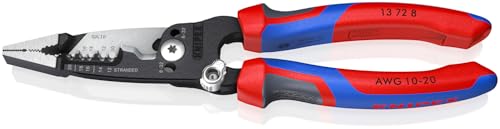
The KNIPEX 13 72 8 is KNIPEX’s answer to the American professional electrician’s market — a forged wire stripper designed specifically to the AWG sizing standard and packed with features that the European tool range doesn’t include. It strips 10–20 AWG solid and stranded wire, but its feature set goes well beyond basic stripping: locating ridges that make finding the correct stripping hole by feel in a dark junction box genuinely easy; induction-hardened blades with 50% higher cutting capacity than comparable tools; shear cutting blades that cut 6-32 and 8-32 machine screws without threading; a wire looping groove for attaching wire to terminal screws; knurled jaws for twisting multiple wires; and conduit reaming for removing burrs from cut conduit.
The forged construction — high-grade special tool steel, multi-stage oil-hardened — gives this stripper a solidity and weight that immediately distinguishes it from nylon-body alternatives. The bolted joint provides precise, smooth cutting action that stays consistent as the tool ages. The screw-shearing feature deserves particular mention: being able to cut a 6-32 or 8-32 machine screw cleanly without threading the cutter eliminates a common job-site frustration, and the front-or-back cutting option adds flexibility in tight spaces. KNIPEX designed this specifically for the US residential electrical market — it cuts NM-B, BX, and MC cable in addition to individual conductors.

The multi-component comfort grips are suitable for both right- and left-handed users — the locking mechanism operates from either side, which is an uncommon feature in this product category. At 8 inches overall length with wide gripping jaws, this is a substantial tool that replaces multiple separate functions: wire stripping, wire cutting, wire twisting, screw shearing, and conduit reaming. For a professional electrician who wants one quality tool to cover the full range of panel and rough-in tasks, the KNIPEX 13 72 8 is the premium forged alternative to the Klein 11063W.
Pros: Forged high-grade tool steel — exceptional durability; locating ridges for blind stripping hole identification; 50% higher blade cutting capacity; non-threading screw shearing (6-32, 8-32); wire looping groove; conduit reaming; cuts NM-B, BX, MC cable; ambidextrous locking; Made in Germany.
Cons: Premium price; heavier than lighter gauged strippers; 10–20 AWG range doesn’t cover fine electronics wire; not self-adjusting.
Who it’s for: Professional electricians and serious contractors who want German-forged quality in a multi-function wire stripper built specifically for the North American electrical market.
→ Check Current Price on Amazon
6. haisstronica Wire Stripper and Crimping Tool AWG 24–10 — Best Combo Stripper/Crimper
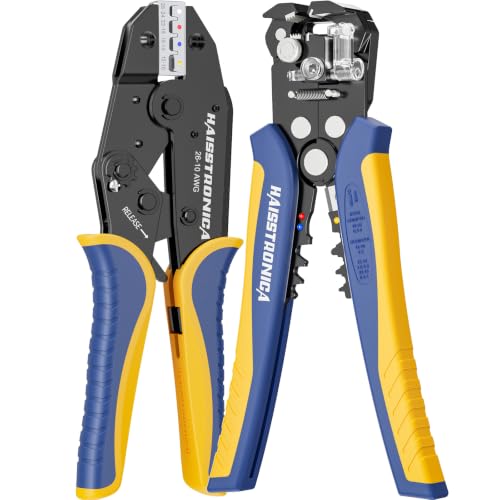
The haisstronica Wire Stripper and Crimping Tool is the best value combo stripper/crimper kit on Amazon for automotive, marine, trailer, and home appliance wiring — a 3-in-1 package that handles wire stripping (AWG 24–10), wire cutting, and ratchet crimping for heat shrink connectors (AWG 22–10) in two ergonomically matched tools. For anyone who regularly terminates wires with insulated or heat shrink connectors — butt splices, ring terminals, spade terminals — having a dedicated crimper rather than using a stripper’s basic crimp channel makes a meaningful difference to connection quality and pull-out strength.

The automatic wire stripper component uses self-adjusting jaws with heat-treated, polished, black-oxidized alloy steel blades — sharp enough for clean cuts across the full AWG 24–10 range without conductor damage on standard PVC and cross-linked polyethylene insulation types. The broad AWG 24–10 range covers essentially all automotive and marine wiring plus standard residential light circuit work. The ratchet crimper uses a full-cycle ratchet mechanism that requires the crimp to reach completion before releasing — this prevents incomplete crimps that look adequate but have high resistance and low mechanical strength. AWG 22–10 crimp range covers the full spectrum of automotive connector sizes from small weather-pack connectors to large ring terminals for battery and starter connections.

The ergonomic non-slip handles are colour-coded for easy identification and reduce hand fatigue during extended wiring sessions — important for automotive harness work where you might be crimping 30–50 connections in a single session. haisstronica has built a strong review base on Amazon specifically for their combo tool kits, and the consistent positive feedback centres on the ratchet crimper quality and the durability of the stripping blades over time. For DIY automotive wiring, trailer harness builds, marine electrical upgrades, or home appliance repair where clean crimps are as important as clean strips, this kit provides professional-quality results at an accessible price.
Pros: Self-adjusting stripper (AWG 24–10) + full-cycle ratchet crimper (AWG 22–10) in matched kit; heat-treated alloy steel stripping blades; ratchet mechanism ensures complete crimps; covers automotive, marine, and residential light wiring; non-slip ergonomic handles; strong Amazon review base.
Cons: Separate tools rather than single multi-function body; not for professional daily electrical use (use Klein or KNIPEX); ratchet crimper is for insulated/heat shrink connectors only — not bare ferrules.
Who it’s for: Automotive and marine DIYers, trailer harness builders, home appliance repairers, and anyone who needs reliable stripping and crimping capability in one affordable kit.
→ Check Current Price on Amazon
7. Klein Tools K12075 Slim-Forged Wire Stripper/Cutter — Best Slim & Compact Stripper
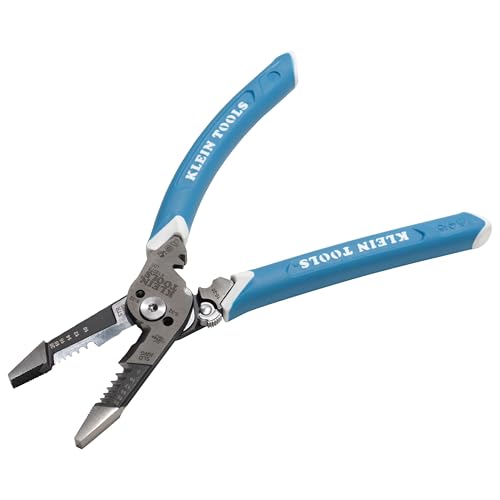
The Klein Tools K12075 is Klein’s newest addition to their professional wire stripper range — a slim-forged design engineered specifically to be lighter and more comfortable than traditional wire strippers for electricians who are stripping wire throughout an 8-hour shift. The slim-forged body is engineered to be lighter than Klein’s traditional gauged strippers while maintaining the structural rigidity of a forged tool — the best of both worlds for professionals who prize both durability and all-day comfort.

Specs: strips 8–18 AWG solid wire and 10–20 AWG stranded wire — the core residential electrical range that covers virtually all outlet, switch, lighting, and circuit work. The enhanced blade design maximises leverage for easier wire cutting without increasing handle force. A self-opening spring handle keeps the tool ready for the next strip without the manual reset that non-sprung strippers require. Cross-hatched knurled jaws provide a secure grip for twisting up to three 12 AWG wires simultaneously — a common panel task when pigtailing conductors. The integrated shear cutter cleanly cuts 6-32 and 8-32 machine screws — the same screw-shearing feature found on the KNIPEX 13 72 8, now available in the Klein range.

The K12075 sits between the Klein 11063W Katapult (compound-action, fastest single-strip operation) and the KNIPEX 13 72 8 (maximum multi-function feature set) in the professional market. It’s the choice for electricians who want the comfort advantage of a slim, lighter body for extended use but still need the full professional feature set including screw shearing and wire twisting. As with all Klein Tools, it’s manufactured to the professional standard that the brand has maintained since 1857. This is a newer model — Amazon reviews are building — but Klein’s track record means buyers can purchase with confidence.
Pros: Slim-forged design lighter than traditional wire strippers; self-opening spring handle; 8–18 AWG solid / 10–20 AWG stranded; shear cutter for 6-32 and 8-32 screws; knurled jaws for wire twisting; enhanced blade leverage; Klein professional build quality.
Cons: Newer model — Amazon review base still building; doesn’t cover below AWG 20 stranded; gauged (not self-adjusting); slightly narrower AWG range than Klein 11063W.
Who it’s for: Electricians who want a slim, lightweight Klein for extended all-day use, or Klein loyalists who want the latest forged design with screw-shearing capability.
→ Check Current Price on Amazon
8. WGGE WG-015 Wire Stripper/Cutter — Best Budget Wire Stripper

The WGGE WG-015 is the wire stripper that appears in the tool drawers of millions of homes — the sub-$10 all-in-one that handles the wire stripping, cutting, and basic crimping tasks that most homeowners encounter a few times a year. It’s one of the most-purchased wire strippers on Amazon, consistently rated positively by buyers who use it for outlet replacements, light fixture installations, speaker wire connections, and basic automotive repairs.

Specs: strips 10–22 AWG wire (both solid and stranded), cuts wire cleanly, and provides basic crimping for insulated and non-insulated connectors. The spring-loaded mechanism opens the jaws automatically after each operation — the small quality-of-life feature that makes single-handed use genuinely practical when your other hand is holding a wire in position. Serrated nose tips work as basic pliers for gripping and bending wire. The comfortable easy-grip handle reduces hand fatigue for the occasional-use scenario this tool is designed for. The Family Handyman has mentioned the WGGE WG-015 in their best wire strippers coverage, which reflects its consistent performance at the entry price point.

The honest framing: the WG-015 uses spring steel blades rather than alloy steel, which means they dull faster under heavy use. For a homeowner who strips wire a dozen times a year, this is entirely irrelevant — the blades will outlast the handle. For an electrician stripping wire daily, the blades will need replacement within months. The basic crimp channel performs adequately for occasional connector crimping but is not a substitute for a dedicated ratchet crimper on connections where pull-out strength is safety-critical. At its price point, the WGGE WG-015 is exceptional value for its intended audience. Buy it as your first wire stripper, or keep it as the backup in a home tool kit alongside more specialised tools.
Pros: Sub-$10 complete wire stripper/cutter/crimper; 10–22 AWG range covers residential needs; spring-loaded jaw return; serrated nose tip pliers; comfortable easy-grip handle; well-reviewed on Amazon; excellent value for occasional home use.
Cons: Spring steel blades dull faster than alloy steel; basic crimp channel (not ratchet); not suitable for daily professional use; 10–22 AWG range doesn’t cover fine electronics wire.
Who it’s for: Homeowners, first-time wire stripper buyers, and anyone who needs a reliable budget stripper for occasional electrical DIY. Also a strong “keep a spare” purchase alongside professional-grade tools.
→ Check Current Price on Amazon
9. 16-in-1 Wire Stripper Cable Scissors — Best Multi-Function Wire Tool
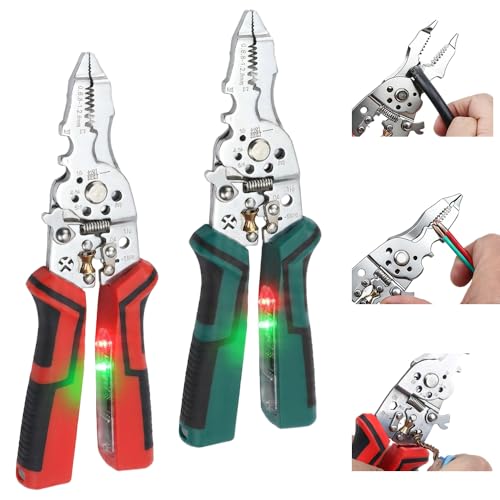
The 16-in-1 Wire Stripper Cable Scissors is the electronics hobbyist’s grab-and-go tool — the single item that covers the broad range of wire and cable tasks that Arduino builders, Raspberry Pi enthusiasts, home network DIYers, small appliance repairers, and electronics makers encounter without needing a dedicated tool for each function. Sixteen functions in one compact tool means stripping, cutting, crimping, bolt cutting, and various cable preparation tasks are all accessible without swapping tools or maintaining a full electrician’s toolkit.

The multi-gauge stripping capability covers the range of wire sizes common in electronics work — from thicker power supply wire down to the fine signal wire used in sensor connections and communication modules. The scissors-style mechanism provides fine control for close work on circuit boards and small electronics enclosures where a full-size wire stripper’s bulk makes precise positioning difficult. For home network installation — running Ethernet cable, terminating patch cables, preparing phone wire — the jacket-stripping capability handles the task without requiring a dedicated coax stripper or cable jacket tool.

The honest positioning: a 16-in-1 multi-tool does many things adequately rather than any single thing at the level of a dedicated professional tool. For a professional electrician, the Klein 11063W outperforms it on every stripping metric. For an electronics hobbyist who wants one compact, affordable tool to handle a wide variety of wire tasks on a workbench, the 16-in-1 wire scissors is exactly the right purchase. It sits naturally alongside a soldering iron, multimeter, and breadboard as part of an electronics maker’s core toolkit, and at its price point it represents outstanding value for the diversity of tasks it covers.
Pros: 16 functions in one compact tool; covers electronics, home network, and light electrical wire tasks; scissors-style mechanism for fine control; compact for workbench and hobbyist use; excellent value for the feature count; strong gift option for electronics enthusiasts.
Cons: Not a professional electrical tool — each function is adequate rather than exceptional; not suitable for heavy-gauge residential circuit wire; limited durability under daily trade use.
Who it’s for: Electronics hobbyists, Arduino and Raspberry Pi makers, home network DIYers, small appliance repairers, and anyone who wants a single compact tool for light wire work on a maker’s workbench.
→ Check Current Price on Amazon
10. Jonard JIC-125 Fiber Optic Cable Stripper — Best Fiber Optic Wire Stripper

This section opens with the single most important statement in this entire article: you cannot use a standard wire stripper on fiber optic cable. Fiber optic glass cladding is 125 microns in diameter — approximately the diameter of a human hair. A standard wire stripper blade, at any setting, will crack, shatter, or scratch the glass during stripping, creating stress points that cause fiber failure under bending load. Fiber optic stripping requires a purpose-built precision tool. The Jonard JIC-125 is that tool.

The JIC-125 is designed for the two stripping tasks that fiber optic cable termination requires: removing the 900µm or 250µm acrylate or urethane buffer coating from the 125µm glass cladding, and removing the 3mm outer jacket where applicable. The stripping holes are precision-ground to the exact tolerances required — they remove the buffer coating cleanly without applying any lateral force to the glass fiber beneath. The blades are engineered to cut the coating material (acrylate, urethane, or PVDF depending on the fiber specification) without touching the glass. This is not a tolerance that can be approximated — the difference between a correctly stripped fiber and a damaged one is measured in microns.

Jonard Tools is a specialist precision tool manufacturer for the telecommunications industry — not a mass-market brand, but the professional standard used by fiber optic installers, FTTH (Fiber to the Home) technicians, data center cabling professionals, and network infrastructure contractors across North America. The JIC-125 works with standard single-mode (OS1/OS2) and multi-mode (OM1–OM4) optical fiber, covering the fiber types found in virtually all commercial and residential FTTH installations. If you are installing, terminating, or splicing fiber optic cable — any fiber optic cable — this is the stripper you need.
Pros: Purpose-built for 125µm fiber optic glass — the only appropriate tool for this task; precision-ground holes for 250µm and 900µm buffer coating removal; Jonard Tools professional telecommunications grade; works with single-mode and multi-mode fiber; essential tool for any FTTH or fiber termination work.
Cons: Single-purpose tool — only for fiber optic cable; not useful for standard electrical wire; requires clean technique and inspection under magnification for best results; fiber stripping technique takes practice to master.
Who it’s for: Fiber optic installers, FTTH technicians, data center cabling professionals, network infrastructure contractors, and anyone terminating or splicing optical fiber cable.
→ Check Current Price on Amazon
11. Jonard Tools MS-316 Fiber Optic Cable Mid-Span Slit & Ring Tool — Best Fiber Optic Mid-Span Tool

The Jonard Tools MS-316 solves a specific fiber optic installation problem that the JIC-125 above doesn’t address: mid-span cable access. When a fiber optic cable needs to be tapped at a point along its run — not at the end, but in the middle — the outer jacket must be removed over a defined length without cutting the cable and without damaging the glass fibers inside. This requires slitting the jacket lengthwise at two points and ringing it (cutting circumferentially) to remove the section cleanly. The MS-316 is the professional tool for this specific task.
The mid-span access scenario arises regularly in FTTH (Fiber to the Home) drop cable installation, where a technician needs to branch from an existing fiber run without cutting the through-cable. It also appears in outdoor plant (OSP) work where individual fibers need to be accessed mid-cable for testing, monitoring, or splice work. The MS-316’s adjustable blade depth control is the critical feature: the blade penetrates exactly far enough to cut the jacket material without reaching the buffer tubes or glass fibers inside. Using a utility knife or any improvised tool for this task risks fiber damage that is invisible to the naked eye but catastrophic for signal transmission.

Jonard Tools designed the MS-316 specifically for the OSP and FTTH installation trade — it’s compatible with the standard single-mode and multi-mode fiber optic drop cable diameters used in North American telecommunications infrastructure. The tool is compact enough for field use in aerial and underground installation environments. For fiber optic professionals who work on mid-span access regularly, this is a purpose-built professional tool that eliminates the risk of cable damage that improvised techniques introduce. For anyone installing residential FTTH drops or building backbone fiber infrastructure, it belongs in the toolkit alongside the JIC-125.
Pros: Purpose-built for fiber optic mid-span jacket access; adjustable blade depth prevents fiber damage during slitting; compatible with standard FTTH and OSP drop cable diameters; Jonard Tools professional telecommunications grade; essential for mid-span branch and tap work.
Cons: Highly specialised — only for fiber optic mid-span cable access; requires familiarity with fiber optic cable construction to use correctly; not useful for end-of-cable termination (use JIC-125 for that).
Who it’s for: FTTH installers, OSP technicians, fiber optic contractors, and network infrastructure professionals who perform mid-span cable access for branching, testing, or splice work.
→ Check Current Price on Amazon
How to Choose the Best Wire Stripper: Complete Buyer’s Guide
Match the Stripper to the Wire Type First
This is the most important decision in this purchase — more important than brand or price. Standard PVC-insulated copper wire: use any quality wire stripper (Klein, KNIPEX, WGGE, haisstronica). MIL-spec Teflon-insulated wire: use the IDEAL 45-177 only — standard strippers slip off PTFE insulation. Fiber optic buffer coating: use the Jonard JIC-125 only — a standard wire stripper will crack the glass. Fiber optic jacket slitting (mid-span): use the Jonard MS-316 only. Multi-conductor cable jacket (NM-B/Romex): most of the gauged strippers on this list handle it; check the product specs for cable jacket capability.
Know Your AWG Range
Buy a stripper that covers your full working range. A tool rated AWG 10–22 cannot strip AWG 24–28 communications wire. If you work with both heavy circuit wire and fine electronics wire, you may need two tools — a 10–20 AWG tool for circuit work and a 16–26 AWG tool for fine gauge. Always check the solid and stranded AWG ratings separately — they differ on most tools.
Manual/Gauged vs Self-Adjusting
Manual/gauged strippers (Klein 11063W, IDEAL 45-177, KNIPEX 13 72 8, Klein K12075, WGGE WG-015) require selecting the correct stripping hole for each gauge — slower per operation but extremely reliable and appropriate for any insulation type. Self-adjusting/automatic strippers (KNIPEX 12 62 180, Jokari FKZ, haisstronica) calibrate to the wire automatically — faster for high-volume mixed-gauge work, but slightly less accurate on unusual insulation materials. For professional daily use with consistent wire types, self-adjusting wins on speed. For variable wire types or specialty insulation, gauged is more reliable.
Do You Need a Crimper?
If you connect wires to screw terminals, wire nuts, or push-in connectors (standard residential electrical), you don’t need a crimper — a standalone stripper is sufficient. If you terminate wires with insulated connectors (ring terminals, butt splices, heat shrink connectors — standard in automotive, marine, and trailer wiring), a combo stripper/crimper kit like the haisstronica saves time and produces better-quality connections than using a stripper’s basic crimp notch.
Handle Design and Fatigue
For occasional home use, any handle design is fine. For daily professional use involving hundreds of strips per shift, ergonomic handles with spring-loaded return significantly reduce cumulative hand fatigue. The KNIPEX tools and Klein K12075 prioritise extended-use comfort specifically; the WGGE WG-015 is adequate for occasional use only.
Blade Material and Tool Longevity
Spring steel blades (WGGE, budget alternatives): adequate for occasional use, dull faster. Heat-treated alloy steel (Klein, haisstronica): maintains edge well through regular use over years. High-grade forged tool steel, multi-stage oil-hardened (KNIPEX): professional grade, maintains precision edge under daily use for years. Precision-ground specialty blades (IDEAL 45-177, Jonard): engineered for specific materials — don’t substitute.
For more professional tool guides, see our roundups on best jigsaw blades, best heat guns, best electric paint sprayers, and electric pressure washer reviews.
Frequently Asked Questions
What does AWG mean and which do I need?
AWG stands for American Wire Gauge — the US standard for wire diameter. Higher AWG number means thinner wire. For standard household circuit wiring (outlets, switches, lights): AWG 12–14 is most common, use a tool rated for AWG 10–22. For automotive and marine wiring: AWG 16–22 is typical, the haisstronica combo or WGGE covers this. For fine electronics and communications work: AWG 20–28, the IDEAL 45-177 (down to 26 AWG) is appropriate. For fiber optic work: AWG doesn’t apply — fiber is measured in microns.
What is the difference between automatic and manual wire strippers?
Manual wire strippers have fixed stripping holes — you select the correct hole for your wire gauge and position the wire precisely before squeezing. Reliable and precise but slower. Automatic/self-adjusting wire strippers (like the KNIPEX 12 62 180 and Jokari FKZ) calibrate the jaw to the wire diameter automatically on contact — insert, squeeze, done. Faster for high-volume mixed-gauge work, slightly less reliable on unusual insulation materials. The Klein 11063W Katapult is a compound-action gauged tool — technically manual but with a mechanism that makes it as fast as some self-adjusting alternatives.
Can I use a regular wire stripper on fiber optic cable?
Absolutely not. Fiber optic glass cladding is 125 microns in diameter — approximately the width of a human hair. A standard wire stripper will crack or shatter the glass during stripping, creating a stress point that causes catastrophic fiber failure under bending. Fiber optic cables must be stripped with a purpose-built precision tool like the Jonard JIC-125. There is no substitute and no workaround.
What wire stripper do professional electricians use?
In the US, the Klein Tools 11063W Katapult is the most common professional choice — it’s in virtually every licensed electrician’s bag. For automatic stripping, the KNIPEX 12 62 180 SBA is the premium choice for high-volume panel and commercial work. In Europe, KNIPEX tools dominate the professional market. The KNIPEX 13 72 8 was designed specifically for the US professional market.
What wire stripper works on Teflon or MIL-spec wire?
Only the IDEAL 45-177 Custom Stripmaster in this roundup is rated for MIL-W-22759 Teflon-insulated wire. Standard wire strippers slip off PTFE insulation or nick the conductor trying. If you work in aerospace, avionics, or military electronics where Teflon-insulated wire is standard, the IDEAL 45-177 is the professional tool.
How long should wire strippers last?
Budget tools with spring steel blades (WGGE WG-015): 1–3 years of occasional home use. Mid-range alloy steel tools (Klein 11063W, haisstronica): 3–7 years of regular use with proper care. Premium German-forged tools (KNIPEX 12 62 180, KNIPEX 13 72 8): 10+ years of daily professional use — these are career-length investments for professional electricians.
What is the difference between solid and stranded wire stripping?
Solid wire is a single copper conductor — it strips cleanly with a standard blade. Stranded wire consists of multiple thin conductors twisted together — strippers not rated for stranded wire can nick or cut individual strands, weakening the conductor and increasing resistance. Always check that your stripper is rated for stranded wire if you use it. The Klein 11063W, KNIPEX 13 72 8, and Klein K12075 all provide separate solid and stranded AWG ratings.
Do I need a combo wire stripper and crimper?
Only if you terminate wires with connectors. For standard residential electrical work connecting to screw terminals, wire nuts, or push-in connectors, a standalone wire stripper is all you need. For automotive harness work, trailer wiring, marine electrical, or any application using ring terminals, spade connectors, or butt splices, a combo tool like the haisstronica kit saves time and produces better mechanical connections than a basic crimp notch.
Our Final Verdict
For general electrical work, the Klein Tools 11063W Katapult is the best wire stripper on Amazon in 2026 — the compound-action mechanism, professional build quality, and Klein’s 160-year brand reputation make it the default first purchase for any electrician or serious DIYer. For premium self-adjusting performance in high-volume professional work, the KNIPEX 12 62 180 SBA is the German-engineered alternative that serious electricians swear by. For fiber optic work, there is only one correct answer: the Jonard JIC-125 for termination stripping and the Jonard MS-316 for mid-span access — no standard wire stripper can substitute. And for the budget-conscious homeowner who needs one tool for occasional home repairs, the WGGE WG-015 delivers exceptional value at under $10.
The right wire stripper is the one matched to your wire – matched to its gauge, its insulation type, and your working volume. Every tool in this list earns its place for the right application. Choose the one that fits your work, and clean, reliable strips will follow every time. If you’re rounding out an electronics or repair bench, our guide to industrial tweezers covers the precision handling tool most stripper roundups skip.