The battery platform you pick is arguably the most expensive decision you’ll make outside of a truck, and most buyers make it based on which drill felt good in their hand at the store. That’s backwards. Once you own five or six batteries and chargers on a platform, switching brands means eating the cost of every battery, charger, and tool-only purchase you’ve made, easily $1,000 or more in stranded equipment once you’re a handful of tools deep, and roughly double that at ten or more. This guide breaks down what actually differs between DeWalt 20V MAX, Milwaukee M18, and Makita 18V LXT, the three platforms that dominate professional and serious DIY cordless tools in 2026, so you make this decision once.
The Voltage Numbers Are Marketing – Here’s What’s Actually the Same
Before comparing anything else, clear up the single most common point of confusion in this whole category: DeWalt’s “20V MAX” branding refers to peak voltage, not the tool’s actual working voltage. The nominal, real-world operating voltage of DeWalt 20V MAX batteries is 18V, identical to Milwaukee M18 and Makita 18V LXT. All three platforms use the same underlying 18V nominal cell voltage. DeWalt simply chose to market peak voltage instead of nominal voltage, which makes their number look bigger without actually meaning their tools deliver more power at the motor. If you’ve ever wondered why an “18V” Makita drill and a “20V” DeWalt drill perform similarly, this is why, they’re not actually different voltage classes. Performance differences between these platforms come from motor engineering, battery cell quality, and tool design, not from the number printed on the battery.
What Actually Differs Between the Three Platforms
DeWalt 20V MAX / FLEXVOLT

- Ergonomically Designed: Work in tight areas with a compact design that gets into tough spots
- Compact and Lightweight: Both tools are designed to fit into difficult to reach spaces. The 1/4" impact driver has a length of 5.55 in. and weighs just 2.8 lbs, while the 1/2" drill/driver measures only 7.5 in. and weighs 3.6 lbs
- Both the DEWALT impact driver and electric drill driver feature integrated LED work lights with a convenient 20-second delay, ensuring enhanced visibility in dimly lit or challenging work areas
- One-Handed Loading - Keep one hand free with a 1/4 in. hex chuck that accepts 1 in. bit tips
- Power drill cordless with 1/2" single sleeve ratcheting chuck provides tight bit gripping strength, making bit changes faster and more secure


- DCD806: Our Most Powerful 20V MAX 2-Speed Hammer Drill - Complete a wide range of applications with this hammer drill that is up to 109% more powerful.
- DCF845: Complete tough fastening applications on the jobsite with 30% more torque.
- DCD806: Professional Performance - Complete jobs with top level speed, control, and precision with a high-speed transmission and variable speed trigger featuring 2 settings (no load 0-650/0-2,000 rpm).
- DCF845: Brushless motor delivers 1825 in-lbs of torque and 3400 RPM to drive large diameter screws.
- 2-Tool Combo Kit includes (2) 20V MAX XR POWERPACK Batteries for your convenience.
DeWalt’s core strength is breadth and price competition: over 300 tools on the 20V MAX platform, the widest retail availability of any brand (Amazon, Home Depot, Lowe’s, and independent retailers all compete on price), and the most aggressive deal availability if you like shopping around. FLEXVOLT is DeWalt’s standout technical feature, a battery that automatically switches between 20V and 60V depending on which tool it’s inserted into, and two FLEXVOLT packs can combine to power select 120V stationary tools like a table saw. No other platform on this list offers as seamless a path from a compact drill to a full-size stationary shop tool on the same battery ecosystem.
The trade-off is internal fragmentation worth understanding before you buy: 20V MAX, 20V MAX XR, POWERSTACK, and FLEXVOLT are all related battery lines under the DeWalt name, and not every one behaves the same way with every tool. Most buyers only ever need standard 20V MAX batteries, but if you’re drawn to DeWalt specifically for FLEXVOLT’s stationary-tool capability, confirm which specific batteries and chargers those tools actually require before assuming everything in a “DeWalt” aisle is interchangeable. For the full breakdown of exactly which batteries fit which tools, see our DeWalt 20V battery compatibility chart.
Milwaukee M18

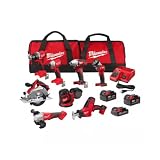
- COMPLETE KIT: Includes hammer drill, impact driver, circular saw, angle grinder, reciprocating saw, multi-tool, work light, and 3 batteries with charger in 2 tool bags
- POWER SYSTEM: Features M18 18-volt lithium-ion battery platform, providing consistent performance and extended runtime across all tools
- BATTERY PACKAGE: Comes with two high-capacity batteries and one compact battery, plus a rapid charger for minimal downtime
- STORAGE SOLUTION: Two heavy-duty contractor bags included for organized storage and easy transport of all tools and accessories
- VERSATILE APPLICATIONS: Perfect for drilling, driving, cutting, grinding, and demolition tasks in construction, remodeling, and maintenance work
Milwaukee has built its reputation on raw performance: M18 FUEL tools consistently top independent torque and cutting-speed benchmarks against comparable DeWalt and Makita tools, and the newer FORGE battery technology (refined since its 2023 release) is widely regarded as delivering the strongest cordless battery performance of any platform as of 2026. Milwaukee also offers something no competitor matches: the ONE-KEY ecosystem, Bluetooth-based tool tracking, inventory management, and (on select tools) customizable performance settings. Milwaukee additionally carries trade-exclusive tools you won’t find on any other platform, a real factor for electricians, plumbers, and HVAC technicians whose work depends on specialty tools.
The trade-off is availability and price: Milwaukee tools run at the higher end of the price spectrum, and the brand is frequently Home Depot-exclusive in the US, which limits the price-shopping flexibility DeWalt buyers enjoy.
Makita 18V LXT (and the Separate 40V XGT Platform)

- 1/2" Driver-Drill with 2-speeds (0-600 and 0-1,900 RPM) delivers up to 480 in. Lbs. Of Max Torque
- 1/2" Driver-Drill features a compact design at only 7-1/4" long and weighs only 3.3 lbs. With battery for reduced operator fatigue
- Impact Driver with variable speed (0-2,900 RPM and 0-3,500 IPM) delivers up to 1,460 in. Lbs. Of Max Torque
- Impact Driver features a compact design at only 5-3/8" long and weighs only 2.8 lbs. With battery for reduced operator fatigue
- Ergonomically designed handles with rubberized soft grips provide increased comfort
Makita’s 18V LXT platform has been on the market since 2005, making it the most mature system of the three, with 270+ tools and a reputation among finish carpenters and cabinet installers for smooth, controlled power delivery rather than raw torque, and for genuinely lightweight compact-line tools (some sub-compact drills and impact drivers weigh under 2.6 lbs while still delivering full 18V performance). Makita’s Twin 18V (36V) approach cleverly uses two 18V batteries simultaneously for higher-power tools, avoiding the need for a separate battery platform for that purpose.
Here’s the trap worth knowing before you buy: Makita also sells a completely separate 40V XGT platform, a newer, premium line with 100+ tools and no adapter bridging it to 18V LXT. A buyer who assumes “Makita” means one unified battery ecosystem can easily end up with two incompatible sets of batteries without realizing it. If you’re buying into Makita, confirm every tool and battery you’re looking at specifies 18V LXT, not 40V XGT, unless you’ve deliberately decided to invest in the premium platform instead.
Tool Selection and Price Comparison
All three platforms are comprehensive enough that raw tool count shouldn’t be the deciding factor: DeWalt leads with 300+ tools on 20V MAX/FLEXVOLT, Milwaukee follows with 280+ on M18, and Makita offers 270+ on 18V LXT. Every essential category, drills, impact drivers, circular saws, grinders, is covered by all three.
Price is where the platforms genuinely diverge. Comparing equivalent drill drivers currently on the market, DeWalt’s entry-level DCD801B runs around $149, Makita’s XFD14Z sits in the middle around $189, and Milwaukee’s 2804-20 tops the group around $196, a nearly $50 spread for tools serving the same basic function. The gap widens further up the line: in circular saws, DeWalt’s DCS570B has been available around $99 while Milwaukee’s 2732-20 runs closer to $259, a $160 difference for what’s nominally the same tool category, though the Milwaukee’s sustained performance under heavy framing work is a real, not just marketing, justification for part of that gap.
The Real Cost of Switching Later
This is the section most brand comparisons skip entirely, and it’s the actual reason this decision matters more than which drill feels nicer in your hand. Every battery, charger, and tool-only purchase you make locks you further into a platform, because none of the three brands offer official cross-platform compatibility. Third-party adapters exist that claim to let, for example, a DeWalt battery power a Makita tool, but they bypass the battery’s built-in safety systems, typically void your tool’s warranty, and are widely considered unreliable by people who’ve actually used them. They’re not a real workaround.
Once you own five or six batteries and chargers on a platform, the realistic cost of switching to a different brand, replacing every battery and charger you own, plus eating the resale loss on tool-only purchases you can no longer power, easily exceeds $1,000. At ten or more tools deep, that number roughly doubles. This is why the platform decision deserves more research upfront than any single tool purchase: you’re not just buying a drill, you’re committing to everything you’ll buy for years after it.
Which Platform Fits Which Buyer
Choose DeWalt 20V MAX if you want the widest tool selection, the most competitive pricing across multiple retailers, and you work across several trades rather than one specialty. FLEXVOLT’s stationary-tool bridge is a genuine differentiator if you also want battery-powered shop equipment.
Choose Milwaukee M18 if you’re a tradesperson (electrician, plumber, HVAC tech) who needs maximum power and access to trade-exclusive tools, and you don’t mind Home Depot exclusivity limiting your price-shopping options. If your livelihood depends on your tools holding up under sustained heavy use, the FUEL line’s benchmark performance is worth the premium.
Choose Makita 18V LXT if you’re a finish carpenter, cabinet installer, or woodworker who values smooth, controlled power delivery and genuinely lightweight tools over maximum raw torque, and you’re careful to confirm you’re buying 18V LXT tools specifically rather than accidentally crossing into the separate 40V XGT line.
Frequently Asked Questions
Can I use DeWalt batteries in Milwaukee tools?
No. Each brand uses a proprietary battery interface with no official cross-brand compatibility. Third-party adapters exist but bypass built-in safety systems, typically void your warranty, and are not a reliable long-term solution. Plan to commit to one platform.
Is 20V actually more powerful than 18V?
No. DeWalt’s “20V MAX” refers to peak voltage; the real nominal operating voltage is 18V, the same as Milwaukee M18 and Makita 18V LXT. All three platforms use the same underlying voltage class. Actual performance differences come from motor design and battery cell engineering, not the number on the label.
What’s the difference between Makita 18V LXT and 40V XGT?
They’re two completely separate, incompatible battery platforms from the same brand. 18V LXT is the mature, established line with 270+ tools; 40V XGT is a newer premium line with 100+ tools. There’s no adapter between them, so confirm which platform any Makita tool or battery belongs to before buying, don’t assume all Makita products share one battery system.
Which platform has the best warranty and service network?
All three brands offer generally strong warranty support. DeWalt and Milwaukee tend to have faster service turnaround in North America due to denser service center networks. Makita’s warranty service is excellent but can take longer if you’re not near one of their service centers.
How many tools deep before switching platforms becomes too expensive?
There’s no hard line, but the math gets serious quickly: once you own five or six batteries and chargers, switching typically means eating $1,000 or more in stranded equipment. At ten or more tools, that cost roughly doubles. Most buyers who reach that point stay on their platform simply because switching no longer makes financial sense, which is exactly why this decision deserves real research before your third or fourth tool purchase, not after.
Bottom Line
There’s no single winner here, the research is consistent that all three platforms make genuinely excellent professional-grade tools. The right choice depends on your trade, your budget, and how much you value raw power versus control versus retail flexibility. What matters most is deciding deliberately before you’re several tools deep, since the cost of changing your mind only grows from here. If you’re still narrowing down your first tool on whichever platform you choose, our guides to 12V vs. 18V drills, brushless vs. brushed motors, and other cordless power tool brands worth considering cover the decisions that come next.
Already decided on a platform? See our guide to the best battery-powered chainsaws for picks that match DeWalt, Makita, and other systems, plus standalone options.
Whichever platform you land on, the batteries themselves need proper winter storage to last, see our guide on how to store cordless tool batteries in winter.
If a table saw is next on your list, several of the picks in our best table saws guide run on the same platforms covered here.
Already on the DeWalt platform and need to know exactly which batteries fit which tools? See our DeWalt 20V battery compatibility chart for the full breakdown.
Leaning toward Milwaukee? See our Milwaukee M18 FUEL 2967-21B review for a look at one of the platform’s heavy-duty tools.