

There are two habits most people fall into with cordless tool batteries over winter, leaving them on the charger the whole season, or letting a used one sit dead in a drawer until spring, and both are genuinely risky in ways most people never find out about until a battery won’t take a charge anymore. Neither habit is obviously wrong at a glance. Here’s what actually works, and the mechanism behind why it matters.
The Right Storage Charge Level – And Why It’s Not 0% or 100%
The consistent guidance across battery manufacturers and independent testing is 40 to 60 percent charge for long-term storage, not fully charged and not fully drained. A battery held at 100% for months sits under more internal stress than one at a moderate charge, which accelerates chemical aging even while sitting unused. The empty-battery risk is less obvious but more serious: lithium-ion batteries continue to self-discharge slowly even while just sitting in storage, and a battery that starts near 0% can drift into what’s called deep discharge over a few months of winter storage. Deep discharge causes permanent, irreversible damage, the kind that shows up as a battery your charger simply refuses to recognize anymore when spring rolls around. If you’re not sure of your battery’s exact charge level, running it in a tool until roughly half its capacity indicator remains is a reasonable practical target.
Temperature Range That Actually Matters
Most sources converge on a similar range: 40-80°F for storage, with extended exposure below freezing being the real danger zone rather than an occasional cold snap. It’s worth separating two different things that both get called “cold weather damage”: temporary capacity loss and permanent damage are not the same thing. Cold temporarily slows the chemical reactions inside the battery, which is why a battery that’s been sitting in a cold garage delivers noticeably less power and shorter runtime, this reverses completely once the battery warms back up, and it’s not damage. Prolonged exposure to genuinely freezing temperatures over weeks or months is what causes lasting harm to the internal cells. An occasional cold day using a tool outside is normal; a battery living in an unheated shed all winter is the actual risk.
Never Charge a Cold Battery
This is the specific point most winter battery advice glosses over: the risk isn’t just using a cold battery, it’s charging one. Pushing current into a battery that’s still cold from sitting in an unheated space can cause internal damage in a way that simply using it in that state doesn’t carry the same risk for. If a battery has been sitting somewhere cold, let it come up to room temperature before you put it on the charger, not just before you use it in a tool. This is a genuinely easy step to skip since it feels like an unnecessary extra wait, but it’s the difference between a battery that lasts years and one that degrades noticeably faster than it should.
Practical Storage Habits
- Store batteries separate from the tool when possible, rather than leaving them seated in the tool over a long storage period.
- Keep them away from loose metal objects like screws, nails, or other tools in a drawer, a stray piece of metal bridging the terminals is a real short-circuit risk, not a theoretical one.
- Choose a dry, indoor space over an unheated shed or detached garage whenever that’s realistically an option. A closet, basement, or interior utility room beats a garage that swings well below freezing overnight.
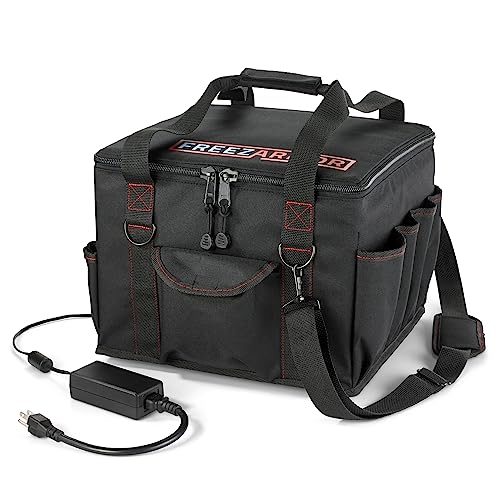
If you genuinely need to keep batteries usable in a cold environment, a purpose-built battery warmer bag solves the problem more reliably than improvising with a cooler or blankets. FreezArmor’s insulated, thermostatically controlled bag keeps lithium-ion power tool batteries in the 50-70°F range even when the outside temperature drops to -20°F, and it automatically stops heating once ambient temperature climbs back above 50°F, so there’s no risk of overheating a battery left inside on a milder day.
If You’re Storing for the Whole Season
A battery you won’t touch for months benefits from a periodic check rather than being stored and forgotten entirely. Self-discharge continues the whole time it’s sitting, so a battery stored correctly at 50% in October could realistically be meaningfully lower by the time spring arrives. Checking in every month or two, and topping off if the charge has dropped significantly, catches the slow drift toward deep discharge before it becomes a real problem rather than after.
Frequently Asked Questions
Can I leave batteries on the charger all winter?
It’s not the ideal long-term storage method. Most smart chargers stop actively charging once a battery reaches full and won’t overcharge it, but holding a battery at 100% for months still puts more stress on the cells than storing at a moderate 40-60% charge would. If you have to choose between leaving it on the charger and letting it sit fully drained, the charger is the safer of those two options, but neither is the actual best practice.
Is it safe to store batteries in an unheated garage?
It depends entirely on how cold your garage actually gets and for how long. Occasional dips near freezing for short periods are a much smaller concern than weeks of sustained sub-freezing temperatures. If your garage regularly drops well below freezing for extended stretches in winter, moving batteries somewhere warmer, or using an insulated, heated storage solution, is worth the effort.
How do I know if cold damaged my battery permanently?
Temporary cold-related capacity loss reverses once the battery warms up and behaves normally again. If a battery still shows meaningfully reduced runtime or won’t hold a charge properly after it’s been back at room temperature for a while, that points toward genuine degradation rather than a temporary cold effect. Our guide on cordless drill batteries not holding charge covers how to tell the difference and whether the pack is worth reviving.
Does this apply to all battery brands the same way?
Yes, the underlying chemistry is the same lithium-ion technology across DeWalt, Milwaukee, Makita, and every other major cordless platform, so the storage guidance in this guide applies regardless of brand. If you’re still deciding which platform to build a tool collection around, our battery platform comparison guide covers the bigger-picture decision.
Bottom Line
Store at 40-60% charge, not full and not empty, keep batteries somewhere between 40-80°F rather than an unheated space that swings below freezing, and always let a cold battery warm up before charging it, not just before using it. If you’re storing for the entire winter, check in periodically rather than leaving batteries completely untouched for months. These are small habits, but they’re the difference between a battery pack that’s still performing well in a few years and one that quietly degrades faster than it should have.


