The table saw causes more serious injuries in a home shop than any other tool, and the safety-technology landscape around it is genuinely shifting right now, not five years from now. This guide covers 8 real table saws across every type and budget, but it also covers something most buying guides skip entirely: why one brand currently has a legal monopoly on the safest available technology, and why that might not last much longer.
Which Type Do You Actually Need
The type classifications (benchtop, jobsite, contractor, hybrid, cabinet) get explained as a dry spec list almost everywhere. The question that actually sorts them out is simpler: does this saw need to travel with you, or is it staying put?

Benchtop saws are the smallest and lightest, storable when not in use, built for occasional cuts in a limited space. Jobsite saws add real cutting power in a similar footprint, with a wheeled stand built for daily carry between locations, most sources call this the practical sweet spot for both working pros and serious home DIYers. Contractor saws sit heavier and more powerful, still wheeled for moving around a shop, but not meant for the daily truck-bed abuse a jobsite saw takes. Hybrid saws pair a contractor-level motor with an enclosed, cabinet-style base for better dust collection and more stable alignment. Cabinet saws are the heaviest and most powerful (3-5 HP, 300-600+ lbs), designed to be leveled once and never moved again, the standard in production shops and serious hobbyist workshops with dedicated space.
If you’re not sure which you need: a home DIYer with a garage shop almost always wants benchtop or jobsite. A working contractor wants jobsite for the daily-carry durability. A serious woodworker with dedicated shop space is the one who should actually consider hybrid or cabinet.
SawStop and the Flesh-Detection Monopoly – What’s Actually Going On
This is worth understanding before you compare a single spec sheet. SawStop is currently the only brand that can legally sell a table saw with true flesh-detection technology (a system that stops the blade in milliseconds on contact with skin), and that’s not because no one else has tried. Bosch developed a comparable system called REAXX years ago; SawStop sued over patent infringement and won, and Bosch’s technology was banned from import via an International Trade Commission ruling in 2017. Felder, a European manufacturer, is currently being sued (filed May 2024) over their own Preventative Contact System for the same reason. This is why SawStop saws cost meaningfully more than a comparable saw without the technology, you’re not just paying for build quality, you’re paying for exclusive access to patented safety tech.
Here’s what most current buying guides don’t mention: the U.S. Consumer Product Safety Commission has an active rulemaking process that could eventually mandate flesh-detection technology on all table saws sold in the country, and there’s a countering bill in Congress aimed at delaying that rule specifically because it would hand SawStop a de facto monopoly on compliant saws. Separately, one of SawStop’s key patents, covering blade retraction using the blade’s own angular momentum, expires in 2026. Between the patent expiration and the regulatory pressure, it’s genuinely plausible that legitimate SawStop alternatives become available in the next few years. If you don’t need a new saw urgently, that’s worth factoring into your timing. If you do need one now, SawStop remains the only option if flesh-detection specifically is a requirement, not just a nice-to-have.

What Actually Makes a Table Saw Good (Beyond Horsepower)
Fence quality is the single most-cited make-or-break factor across professional reviews. A saw is only as accurate as its fence locks parallel and stays there, cheap saws fail here more than anywhere else. Rip capacity determines whether you can break down a full 4×8 sheet of plywood; anything under roughly 24 inches starts to limit you on sheet goods. Cast iron vs. aluminum tables: cast iron holds flat and resists wear better over years of use, but adds real weight, a genuine trade-off between portability and long-term stability. Riving knives and blade guards are the safety baseline every saw should have regardless of whether it also has flesh-detection, they prevent kickback by keeping the wood from pinching the blade after a cut.
Quick Comparison
| Product | Type | Rip Capacity | Power | Best For |
|---|---|---|---|---|
| DeWalt DWE7491RS | Jobsite | 32.5″ | 15A, 4800 RPM | Best Overall |
| DeWalt DWE7485 | Compact Jobsite | 24.5″ | 15A, 5800 RPM | Best for Home DIY / Small Spaces |
| Ryobi 18V ONE+ HP | Cordless Compact | 12″ | 18V Brushless | Best Cordless Budget |
| Bosch GTS15-10 | Jobsite | 32.1″ | 15A, 4 HP | Best Daily Jobsite Durability |
| SKILSAW SPT99-11 | Jobsite (Worm Drive) | 30.5″ | 15A Worm Drive | Best Torque for Hardwood |
| Milwaukee M18 FUEL 2736-20 | Cordless Jobsite | 24.5″ | 18V Brushless | Best Premium Cordless |
| Metabo HPT C10RJS | Jobsite | 35″ | 15A, 4500 RPM | Best Emerging Brand / Best Rip Capacity |
| SawStop CTS-120A60 | Compact/Jobsite | Standard | 15A | Best Safety Technology |
1. DeWalt DWE7491RS – Best Overall

This is the single most consistently recommended table saw across independent testing outlets, and the spec sheet backs up why: a 32.5-inch rip capacity that handles full sheet goods, a rack-and-pinion telescoping fence system that adjusts fast and stays accurate, and a rolling stand built for genuine daily jobsite use. The 15-amp motor rips hardwood without bogging down, and onboard storage keeps the blade guard, fence, riving knife, and accessories organized rather than lost in a truck bed.
Pros: The most widely-tested and recommended saw in this category; genuine full-sheet-goods rip capacity; fast, accurate rack-and-pinion fence; rolling stand built for real daily transport; wide parts and accessory availability given how common this saw is.
Cons: Not portable in the “carry it under one arm” sense, small benchtop saws still win there; direct-drive jobsite motors run louder than a belt-drive shop saw; no flesh-detection safety technology.
Best for: Working contractors and serious home DIYers who want the most proven, most widely-supported saw in the category, and don’t specifically need flesh-detection technology.
2. DeWalt DWE7485 – Best for Home DIY / Small Spaces

The compact sibling to the DWE7491RS above, with a smaller 8.25-inch blade and a genuinely lighter, more storable footprint (46 lbs), while still delivering 24.5 inches of rip capacity, enough to break down a 4×8 sheet. A power-loss reset feature is a real, underappreciated safety detail: if power cuts out while the saw is switched on, it won’t restart on its own once power returns, you have to deliberately re-engage the switch.
Pros: Genuinely compact and storable for apartment or small-garage shops; still handles full sheet goods at 24.5″ rip capacity; power-loss reset prevents a dangerous unexpected restart; steel roll cage base for real durability despite the smaller size.
Cons: Smaller table surface than the full-size DWE7491RS means less material support on large workpieces; no flesh-detection technology.
Best for: Home DIYers and finish carpenters working in a limited-space shop who still need real sheet-goods capacity.
3. Ryobi 18V ONE+ HP Brushless Table Saw – Best Cordless Budget

The most accessible cordless entry point in this guide, built around Ryobi’s massive 18V ONE+ battery platform (280+ compatible tools). The brushless motor delivers up to 4,500 RPM, genuinely close to corded performance, and rips up to 240 linear feet on a pair of included 4.0Ah batteries. Backed by a 3-year manufacturer warranty.
Pros: No cord to manage on a jobsite or in a garage without convenient outlet access; taps into Ryobi’s enormous existing battery ecosystem if you already own ONE+ tools; brushless motor delivers real corded-adjacent performance; 3-year warranty.
Cons: 12-inch rip capacity is meaningfully smaller than every corded saw in this guide, not suited to full sheet goods; battery life under sustained heavy cutting will be shorter than the rated figure suggests.
Best for: Cordless-platform owners doing lighter-duty ripping and crosscutting who don’t need full sheet-goods capacity and value not being tied to an outlet.
4. Bosch GTS15-10 – Best Daily Jobsite Durability
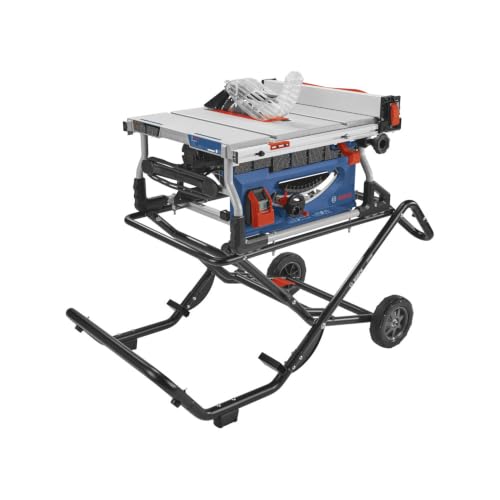
Built specifically for people who use a table saw every day, not occasionally. The gravity-rise wheeled stand deploys and folds in a single smooth motion, genuinely faster than fumbling with a multi-step stand at the start and end of every shift. Electronically regulated speed helps maintain cutting speed under load, and Bosch’s Smart Guard System pairs a three-position adjustable riving knife with anti-kickback pawls.
Pros: Single-motion gravity-rise stand is a real daily-use time-saver; electronically regulated speed resists bogging down under load; soft-start circuitry reduces the chance of tripping a breaker; a blade brake stops the blade in about three seconds after shutoff.
Cons: Open-frame roll bar design trades some rigidity for the lightweight, fast-deploying stand; no flesh-detection technology.
Best for: Contractors and tradespeople setting up and breaking down a saw daily, where the stand’s speed and reliability matter as much as the cutting itself.
5. SKILSAW SPT99-11 – Best Torque for Hardwood
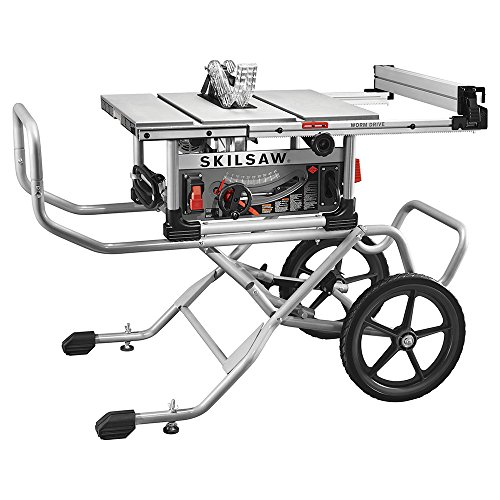
The torque specialist in this guide. SKIL’s worm-drive gearing, the same drivetrain that makes worm-drive circular saws favorites for hardwood and wet lumber, delivers meaningfully more torque than a direct-drive motor of similar amperage, so it doesn’t bog down cutting dense or wet material the way a standard jobsite saw can. A dual-field motor is designed to run cooler under sustained hard use, and SKILSAW backs new purchases with a genuinely generous 180-day full-refund satisfaction guarantee (the “SKILSAW Stay True” program) on top of standard warranty coverage.
Pros: Worm-drive torque genuinely outperforms direct-drive saws in dense or wet lumber; dual-field motor runs cooler under sustained use; 30.5″ rip capacity handles sheet goods; a 180-day satisfaction guarantee is more generous than a typical return window.
Cons: Worm-drive gearing adds some weight versus a comparable direct-drive saw; standard SKILSAW warranty terms are shorter than Ridgid’s lifetime coverage (see the warranty section below).
Best for: Anyone regularly cutting dense hardwood, wet construction lumber, or pressure-treated stock, where raw torque matters more than top-end RPM.
6. Milwaukee M18 FUEL 2736-20 with One-Key – Best Premium Cordless

The step up from the Ryobi cordless pick for buyers who need genuine corded-equivalent performance without a cord. The POWERSTATE brushless motor delivers up to 6,300 RPM, matching a 15-amp corded saw’s output, and a 24.5-inch rip capacity handles full sheet goods, something the Ryobi can’t do. REDLINK PLUS intelligence protects the tool and battery from overload, overheating, and over-discharge, and One-Key connectivity adds tool tracking and customization for anyone managing a fleet of Milwaukee tools.
Pros: Genuinely matches 15-amp corded performance in a cordless package; 24.5″ rip capacity handles full sheet goods unlike smaller cordless competitors; REDLINK PLUS overload protection genuinely protects the investment; taps into Milwaukee’s extensive M18 ecosystem.
Cons: Sold as a bare tool, the M18 REDLITHIUM High Output HD12.0 battery this saw is designed around is a serious additional cost if you don’t already own one; premium price relative to comparable corded saws.
Best for: Existing Milwaukee M18 platform owners who want a cordless table saw that genuinely doesn’t compromise on cutting capacity versus a corded saw.
7. Metabo HPT C10RJS – Best Emerging Brand / Best Rip Capacity

If you haven’t heard of Metabo HPT, it’s worth knowing: this is the rebranded former Hitachi Power Tools line (renamed in 2018, sold as HiKOKI outside North America), and it’s increasingly recommended by independent reviewers specifically for tight manufacturing tolerances and genuinely class-leading specs at a competitive price. The C10RJS posts a best-in-class 35-inch rip capacity, the largest in this entire guide, on a generous 28.75 x 22-inch table. A zero-voltage restart lock (functionally identical to DeWalt’s power-loss reset) prevents dangerous unexpected startup after a power interruption.
Pros: Largest rip capacity in this guide at 35 inches; genuinely tight build tolerances reviewers consistently praise; zero-voltage restart lock for safety after a power interruption; Metabo HPT backs many of its tools with a 5-year professional warranty (confirm exact coverage terms for this specific model before purchase).
Cons: Less brand recognition in North America than DeWalt, Bosch, or Milwaukee, despite the genuine engineering pedigree; direct-drive motor runs at the same noise level as other jobsite saws in this class.
Best for: Buyers who want the largest available rip capacity in the jobsite category and are comfortable with a less household-name brand that’s earned real credibility among reviewers.
8. SawStop CTS-120A60 Compact Table Saw – Best Safety Technology

The smallest, most portable saw in SawStop’s lineup, and as covered above, currently the only table saw on the market with genuine flesh-detection technology, patented and legally exclusive to this brand. The system detects skin contact and stops the blade in under 5 milliseconds, a fundamentally different category of protection than a riving knife and blade guard alone provide. A rack-and-pinion fence with built-in high and low shelf support handles multiple cut types, and a quick-tilt mechanism with micro-adjust fine-tunes bevel angles precisely.
Pros: The only table saw with genuine, patented flesh-detection safety technology; rack-and-pinion fence with dual-height support shelf; quick-tilt with micro-adjust for precise bevel work; durable construction built for real jobsite transport despite the compact size.
Cons: Meaningfully more expensive than a comparable non-SawStop saw, you’re paying for exclusive access to the safety technology, not just build quality; replacement cartridges after an activation event are a real ongoing cost to budget for; smallest table saw in SawStop’s own lineup, larger contractor and cabinet SawStop models exist if you need more capacity alongside the same safety system.
Best for: Anyone who considers flesh-detection technology non-negotiable, whether for solo shop safety, a training environment, or peace of mind that no other current table saw brand can legally offer.
Warranty Comparison
| Brand | Warranty | What Stands Out |
|---|---|---|
| Ridgid | Lifetime Service Agreement (with registration) | The best-known warranty differentiator in this category; genuinely sets Ridgid apart if you register on time |
| Metabo HPT | Up to 5 years on many tools | Confirm exact terms per model; among the longer standard coverages in this guide |
| Ryobi | 3 years | Solid mid-tier coverage for a budget-friendly cordless saw |
| DeWalt | 3 years limited + 1 year free service | Backed by the widest parts and service network of any brand in this guide |
| Bosch | 1 year standard (extendable via registration) | Standard coverage; extend it by registering the tool promptly after purchase |
| SKILSAW | 1 year, plus a 180-day satisfaction guarantee | The shortest standard warranty in this guide, offset somewhat by the unusually generous return window |
| SawStop | 2 years (excludes the safety system’s brake cartridge, a consumable) | Confirm what counts as a “use” event under the safety system before assuming a cartridge replacement is covered |
Warranty terms change; always confirm current coverage directly with the manufacturer before purchase, and register your saw promptly, several of these brands require registration within a specific window to get full coverage.
Frequently Asked Questions
Is a SawStop worth the extra money?
That depends entirely on how much you weigh the safety technology itself. If flesh-detection is a requirement for you, whether for personal risk tolerance, a shared or teaching shop, or peace of mind, SawStop is currently the only legal option regardless of price, since the underlying patents are exclusive to that brand. If you’re comfortable with a riving knife and blade guard as your safety baseline (the standard on every other saw in this guide), a non-SawStop saw delivers comparable cutting performance for meaningfully less money.
What rip capacity do I need for plywood?
You need at least 24 inches of rip capacity to break down a standard 4×8 sheet of plywood into two even halves, though many woodworkers prefer 30+ inches for more flexibility in how they break down sheet goods. Anything under 24 inches, like the Ryobi cordless pick in this guide, works fine for dimensional lumber and smaller stock but won’t comfortably handle full sheets.
Benchtop vs. jobsite for a beginner?
If space and budget are the primary constraints and you’re doing occasional small projects, a benchtop saw is genuinely fine to start. If you anticipate regular use, want to break down sheet goods, or might need to move the saw between a garage and a driveway or job, a jobsite saw is worth the extra size and cost from the start rather than upgrading later.
Do I need a riving knife if I’m not buying a SawStop?
Yes, unconditionally. A riving knife prevents the wood from pinching the blade after a cut and causing kickback, which is the leading cause of table saw injuries outside of direct blade contact. Every saw in this guide besides the SawStop pick still includes a riving knife and blade guard as the baseline safety standard, don’t disable or remove them for convenience.
Bottom Line
Start with whether the saw needs to travel with you or stay put, that single question sorts you into the right type before you compare a single other spec. From there, decide honestly whether flesh-detection technology is a requirement or a nice-to-have, since that answer alone currently narrows your entire market down to one brand or opens it up to several.
- Best overall: DeWalt DWE7491RS – the most proven, most widely-supported saw in the category.
- Best for home DIY: DeWalt DWE7485 – genuinely compact without giving up sheet-goods capacity.
- Best cordless budget: Ryobi 18V ONE+ HP – taps into a massive existing battery platform.
- Best daily jobsite durability: Bosch GTS15-10 – built for setup and breakdown every single day.
- Best torque for hardwood: SKILSAW SPT99-11 – worm-drive gearing that doesn’t bog down in dense or wet lumber.
- Best premium cordless: Milwaukee M18 FUEL 2736-20 – genuine corded-equivalent performance without the cord.
- Best emerging brand: Metabo HPT C10RJS – the largest rip capacity here, from a brand worth knowing.
- Best safety technology: SawStop CTS-120A60 – the only saw with real flesh-detection, for now.
Whichever saw fits your shop, don’t skip the riving knife and blade guard as your safety baseline, and buy a quality blade before your first real cut, a stock blade is rarely the right one for serious work. If you’re building out a full woodworking shop, our guides to bandsaws, benchtop thickness planers, and dust collection cover the rest of the setup.
A table saw handles ripping to width, but crosscuts and angled trim work are a miter saw’s job – see our guide to the best miter saws to round out your saw lineup.
Edge profiles, roundovers, and joinery all need a wood router – see our guide to the best wood routers to complete your shop.