Wood dust is not just a nuisance. Fine wood particles — particularly those generated by MDF, teak, walnut, western red cedar, and beech — are classified by the International Agency for Research on Cancer (IARC) as Group 1 carcinogens, meaning the evidence that they cause cancer in humans is sufficient and established. A single afternoon of unprotected MDF routing in an enclosed garage generates enough fine particulate to exceed OSHA’s permissible exposure limits several times over. The dust you can’t see is the most dangerous — particles under 10 microns stay suspended in shop air for hours after the tools stop.
The good news: proper dust management eliminates this risk almost entirely. The important nuance: “dust collection” isn’t a single tool — it’s a system. A dust extractor captures dust at the source of handheld tools. A stationary dust collector moves large chip volumes away from stationary machines via ductwork. An air filtration system cleans the fine suspended particles that both of those miss. A cyclone separator pre-separates debris before it reaches the filter, keeping suction consistent and filter life long. Most effective shop setups use at least two of these technologies together.
This guide covers 12 dust management tools available on Amazon right now, organized by category — so you can understand exactly which type solves which problem before choosing the specific model that fits your shop.
Quick Comparison: Best Dust Collection Tools (2026)
| Product | Category | Power / CFM | Filter Rating | Best For |
|---|---|---|---|---|
| DEWALT DCV585B 60V | Dust Extractor | 60V MAX cordless | HEPA-capable | Best Cordless Extractor |
| CVMA40-T 10-Gal Trolley | Dust Extractor | 150 CFM | Fine filtration | Best Portable Extractor |
| Bosch VAC090AH 9-Gal | Dust Extractor | High-suction | HEPA + auto-clean | Best for Power Tools |
| DEWALT DWV010 HEPA | Dust Extractor | 38L capacity | HEPA + auto-clean | Best HEPA Extractor |
| Delta 1HP Dust Collector | Shop Collector | 1HP / 4″ port | Standard bag | Best Single-Stage |
| WEN DC3401 12-Gal | Shop Collector | 5.7A / 660 CFM | Bag + filter | Best Mobile Collector |
| ALORAIR 580/780CFM | Air Filtration | 580–780 CFM | 2-stage filter | Best Ceiling Mount |
| DEWALT DWXAF101 | Air Filtration | High CFM | Multi-stage | Best DEWALT Air Filter |
| Portable Tabletop 580-780CFM | Air Filtration | 580–780 CFM | Multi-stage | Best Tabletop Air Filter |
| Mullet Cyclone | Cyclone Sep. | N/A (accessory) | Pre-separator | Best Value Separator |
| Festool CT CYCLONE | Cyclone Sep. | N/A (accessory) | Pre-separator | Best Pro Separator |
| DEWALT DXVCS002 6-Gal | Cyclone Sep. | N/A (accessory) | Pre-separator | Best DEWALT Separator |
The 4 Types of Dust Management Tools — What Each One Actually Does

This is the question that every buying guide in this category answers inadequately. “Dust collector” gets used as a catch-all term for four genuinely different tools that solve different parts of the dust problem. Buying the wrong category for your situation is far more expensive than buying a cheaper model in the correct category.
Type 1 — Dust Extractors
Dust extractors (also called shop vacs or wet/dry vacs in their basic form, but the term “extractor” specifically refers to higher-filtration units) provide high suction through smaller-diameter hoses, typically 1-1/4″ to 2-1/2″. This makes them ideal for capturing dust directly at the outlet of handheld power tools — random orbital sanders, angle grinders, routers, oscillating tools, and circular saws. They move less total air volume than a stationary collector but generate more suction pressure at the hose end, which is what you need to pull fine sanding dust off a sanding pad or capture the swirling plume from an angle grinder. Premium extractors add HEPA filtration and automatic filter cleaning. These are Category A in this guide.
Type 2 — Stationary Shop Dust Collectors
Stationary dust collectors use larger 4-inch (or 6-inch) diameter ductwork to move high volumes of air — typically 400–1,000+ CFM — away from stationary woodworking machines. They’re designed to handle the large chip and shaving volume a table saw, thickness planer, or jointer produces, routing it through a bag or canister filter. The high air volume is essential for stationary machines; the suction pressure of an extractor simply isn’t sufficient to prevent chips from accumulating at a planer’s discharge. These are best used with a basic blast gate system to route collection to whichever machine is active. These are Category B in this guide.
Type 3 — Ambient Air Filtration Systems
Ambient air filtration systems address a problem that neither extractors nor collectors solve: the fine dust particles (under 10 microns) that remain suspended in shop air long after the tools stop running. These particles escape point-of-use collection, float freely for hours, and are the most dangerous to inhale because they reach deep into lung tissue. Air filtration units — ceiling-mounted or tabletop — continuously cycle the entire shop air volume through multi-stage filters, progressively removing finer and finer particles from the air. They are not a replacement for point-of-use collection but an essential complement to it in any closed shop environment. These are Category C in this guide.
Type 4 — Cyclone Separators
Cyclone separators are pre-separation accessories that install between your tool hose and your vacuum or extractor. Incoming air spins in a cyclonic pattern, centrifugal force throwing the heavier particles outward and down into a collection bucket, while the cleaned air continues on to the vacuum. This pre-separation step captures 90% or more of debris before it reaches the vacuum filter — dramatically extending filter life, maintaining consistent suction levels, and reducing how often you need to empty the vacuum itself. They are not standalone tools; they require a shop vac or extractor to function. These are Category D in this guide.
Tool-to-Technology Matching Table
| Shop Tool / Situation | Right Technology | Why |
|---|---|---|
| Random orbital sander, detail sander | Dust Extractor | Fine sanding dust needs high suction at a small pad; collector airflow too low-pressure |
| Angle grinder, oscillating tool | Dust Extractor | Tool-mounted shroud captures debris with suction; collector hose too large to connect |
| Router (handheld or table-mounted) | Dust Extractor | Router base shrouds require the suction pressure of an extractor, not collector airflow |
| Table saw, cabinet saw | Stationary Collector | Needs 400+ CFM through 4″ port to clear blade cavity; extractor suction insufficient |
| Thickness planer, jointer | Stationary Collector | High chip volume requires 600+ CFM; extractor would fill and clog in minutes |
| Bandsaw, drum sander | Stationary Collector | High volume airflow needed; 4″ port connection standard |
| Fine suspended shop dust | Air Filtration System | Cleans particles under 10 microns floating in air that no point-of-use tool captures |
| High chip-volume setup | Cyclone Separator | Pre-separates bulk debris before filter, maintaining suction and extending filter life |
What to Look for — The Buying Factors Most Guides Miss
Micron Filter Ratings — The Most Important Spec Nobody Explains
Every dust collection product lists a micron rating, and almost no buying guide explains what those numbers actually mean for your lungs. Here’s the complete picture:
| Filter Rating | Particle Size Captured | What It Stops | Health Implication |
|---|---|---|---|
| 30 micron | 30μm and larger | Visible chips and large sawdust | Misses virtually all fine wood dust |
| 5 micron | 5μm and larger | Most sawdust, sanding dust | Stops most particles but misses finest fractions |
| 2 micron | 2μm and larger | Fine MDF and hardwood sanding dust | Good protection for most woodworking |
| 1 micron | 1μm and larger | Very fine dust from finish sanding | Strong protection for most shop environments |
| HEPA (0.3 micron at 99.97%) | 0.3μm and larger at 99.97% | All wood dust including the finest particles | Maximum protection; required standard for toxic woods |
The reason HEPA matters specifically: particles in the 0.5–10 micron range are what respiratory medicine calls “respirable” — small enough to pass through the body’s upper airway defenses and reach the alveoli deep in the lungs, where clearance is slow and cumulative damage occurs. A 30-micron bag filter on a basic dust collector stops the chips you can see; it lets through essentially everything that can cause lung damage over years of exposure. If you work regularly with MDF, teak, walnut, western red cedar, or any exotic hardwood, HEPA filtration at the extractor level is the correct standard.
CFM Requirements by Tool
CFM (cubic feet per minute) measures air volume throughput. Matching your system’s CFM to your tool’s requirement ensures the collector actually clears debris rather than letting it accumulate at the source.
| Tool | Minimum CFM Required | Right Tool Type |
|---|---|---|
| Random orbital sander | 100–150 CFM | Dust extractor |
| Angle grinder / oscillating tool | 80–120 CFM | Dust extractor |
| Handheld circular saw | 150–200 CFM | Dust extractor |
| Miter saw / chop saw | 250–350 CFM | Dust extractor (large) or collector |
| Router table | 350 CFM | Dust collector / large extractor |
| Bandsaw | 350–400 CFM | Dust collector |
| Table saw | 400 CFM minimum | Dust collector |
| Jointer (6″–8″) | 400–500 CFM | Dust collector |
| Thickness planer | 600 CFM+ | Dust collector (larger model) |
| Drum sander | 650 CFM+ | Dust collector |
Automatic Filter Cleaning — What It Does and Why It Matters
Several extractors and collectors include automatic filter cleaning (AFC), including the Bosch VAC090AH and DEWALT DWV010 in this guide. Here’s exactly what it does: a short burst of compressed air is periodically pulsed in reverse through the filter medium, knocking accumulated dust cake off the filter surface and back into the collection container. This keeps the filter’s pores open rather than progressively blocked, which maintains consistent suction CFM throughout the work session.
Without AFC, a filter progressively clogs as it collects fine dust — suction drops by 40–60% as the session goes on, which the operator often compensates for by pressing harder with the tool and generating even more dust. With AFC, suction stays consistent from the first cut to the last, tool performance stays predictable, and filter replacement intervals extend significantly.
Cordless Extractors — When Battery Power Makes Sense
A cordless dust extractor (like the DEWALT DCV585B) trades runtime for mobility. This makes genuine sense in specific situations: job-site finish work in rooms not yet wired for power, multi-floor projects where running an extension cord between floors is impractical, and renovation work where you’re moving between rooms frequently and an air hose or power cord creates a trip hazard. It makes less sense for extended stationary shop use where power is available and runtime becomes a constraint rather than a benefit. Evaluate your actual working conditions rather than defaulting to cordless as a premium feature.
Noise — The Overlooked Spec for Garage Shops
Dust collectors and extractors routinely produce 70–88 dB of continuous noise during operation. At 85 dB — the level most stationary dust collectors approach — OSHA recommends hearing protection for sustained exposure. For a home garage shop in a residential neighborhood, this also means your collector is clearly audible to neighbors, which is a genuine practical consideration for early morning or weekend use. Check the dB rating before buying, and factor in how your shop hours align with residential noise expectations. If you are running a collector or extractor for extended sessions, pairing it with a good pair of electronic earmuffs lets you stay protected without losing track of what else is happening in the shop.
Blast Gates — The Simple System Upgrade Nobody Mentions
A blast gate is a simple slide-valve installed in the ductwork branch going to each individual tool. With blast gates, you open only the gate for the active machine and close all others, concentrating the collector’s full CFM and suction at the tool being used rather than dividing it across all connected branches. A four-tool blast gate system costs $30–$50 in materials and takes an afternoon to install, but it meaningfully improves collection performance at every machine versus running an open, uncontrolled multi-branch system.
Category A — Best Dust Extractors
1. DEWALT FLEXVOLT 60V MAX Dust Extractor (DCV585B) — Best Cordless Extractor

The DEWALT DCV585B brings genuine cordless freedom to job-site dust extraction — and at 60V MAX FLEXVOLT, it has the battery capacity to sustain the suction needed for real work sessions rather than just occasional short captures. This is the extractor to reach for on finish work in rooms without powered outlets, renovation projects where cord management is a constant hazard, and any situation where mobility between work areas is more valuable than extended stationary runtime. The 60V FLEXVOLT platform shares batteries with DEWALT’s cordless power tool lineup, meaning existing FLEXVOLT users can power this extractor from batteries they already own.

The HEPA-capable filtration is the critical spec here — HEPA at 0.3 microns at 99.97% efficiency is the correct standard for fine wood dust, particularly on renovation sites where you’re potentially disturbing older dust deposits alongside fresh cutting debris. Auto-tool-start functionality allows the extractor to activate automatically when a connected power tool is triggered, eliminating the separate on/off step that interrupts workflow on jobs involving many short cuts in sequence.

Sold as a bare tool, this pairs with existing DEWALT FLEXVOLT 20V/60V MAX batteries — the right purchase for anyone already on this platform. For job-site work in environments with limited power access, this is one of the most practically capable cordless extractors on the market.
Pros
- Full cordless mobility for job-site environments without power access
- HEPA-capable filtration at 0.3 micron/99.97% — correct standard for fine wood dust
- Auto-tool-start activates extractor automatically with connected tool
- FLEXVOLT platform shares batteries with DEWALT’s broader cordless lineup
Cons
- Bare tool — 60V MAX FLEXVOLT battery required separately
- Battery runtime limits extended stationary shop sessions vs. corded alternatives
Specs
- Power: 60V MAX FLEXVOLT (battery not included)
- Filtration: HEPA-capable (0.3 micron, 99.97%)
- Feature: Auto-tool-start
Best for: Job-site finish work, renovation projects, and any application where cordless mobility is worth the battery runtime trade-off.
2. 10-Gallon Dust Extractor for Woodworking with Trolley, 150CFM (CVMA40-T) — Best Portable Extractor
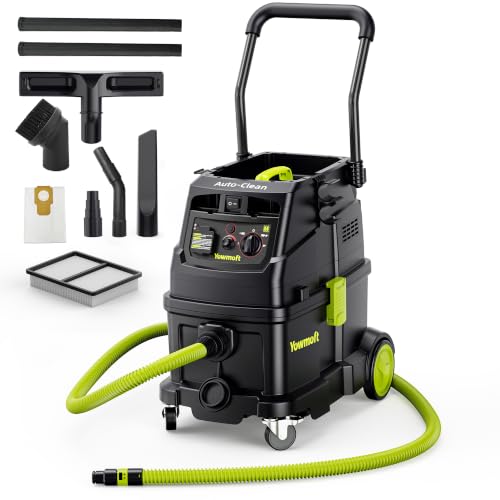
The CVMA40-T is a corded portable dust extractor built specifically around woodworking shop use rather than job-site portability — the distinction matters. Its 150 CFM airflow paired with the integrated trolley base gives you a unit that moves easily between workstations within a shop while maintaining consistent suction for sanders, routers, and handheld power tools. The 10-gallon capacity handles extended sessions without frequent emptying interruptions, which is a meaningful productivity consideration on a full day of sanding or routing work.
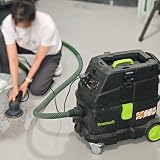
The trolley design is a practical feature that’s often underappreciated until you’ve used an extractor without one — being able to wheel the unit alongside you as you move around a project rather than carrying it or dragging it by the hose makes the workflow noticeably smoother. The fine filtration handles the dust profile typical of woodworking (hardwood and softwood sanding dust, routing chips, and finish material) without requiring the specialized HEPA rating of a remediation-grade extractor.

For woodworkers who want a dedicated shop extractor that handles everyday handheld tool use without stepping up to a full HEPA remediation unit, this sits at a practical middle ground between a basic shop vac and a premium extractor.
Pros
- 150 CFM airflow appropriate for sanders, routers, and handheld tools
- Integrated trolley base simplifies movement between workstations
- 10-gallon capacity reduces emptying interruptions on long sessions
- Purpose-built for woodworking rather than multi-purpose shop vac duty
Cons
- Not HEPA rated — standard filtration is adequate for general woodworking but not toxic wood species remediation
- Less suction pressure than premium branded extractors at higher price points
Specs
- Airflow: 150 CFM
- Capacity: 10 gallons
- Mobility: Integrated trolley
Best for: Woodworking shops that need a dedicated, mobile extractor for everyday sanding, routing, and handheld tool use.
3. Bosch VAC090AH 9-Gallon Dust Extractor with Auto Filter Cleaning — Best for Power Tools
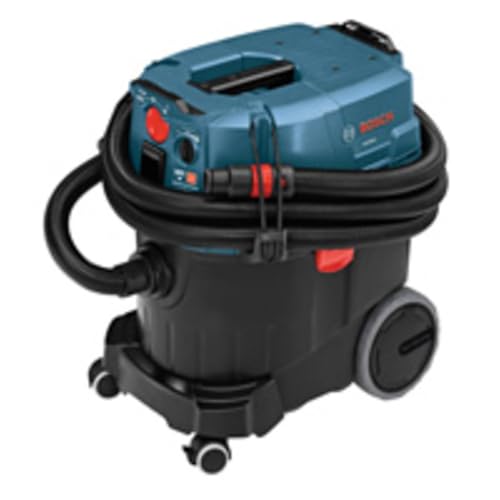
The Bosch VAC090AH is designed specifically for connection to angle grinders and other high-dust-output power tools via a paired shroud system, and its automatic filter cleaning is the feature that justifies its position in a professional kit. As explained in the buying guide above, AFC pulses a reverse burst of air through the filter medium at intervals, knocking accumulated dust cake back into the container and keeping the filter pores open. For angle grinder work — which generates extremely fine, rapidly accumulating metallic and concrete dust — this is not a luxury feature but a practical necessity: without AFC, the filter clogs progressively over a session and suction falls dramatically.

The HEPA filtration at 0.3 microns/99.97% efficiency addresses the health concern directly — angle grinder work on concrete, tile, and masonry generates silica dust alongside metal particles, both of which are serious respiratory hazards that non-HEPA filters let through in significant quantities. The 9-gallon capacity provides adequate working volume for extended grinding sessions, and the unit connects via standard hose sizing to Bosch’s tool-matched shroud accessories for the 1773AK grinder and compatible tools.

Bosch’s build quality on this unit reflects its professional positioning — the housing, hose connections, and filter seating are all tight enough to prevent bypass leakage, which is a common weak point on budget extractors that undermines HEPA ratings in practice even when the filter itself meets spec.
Pros
- Automatic filter cleaning maintains consistent suction throughout the session
- HEPA filtration essential for angle grinder work on concrete and masonry
- Designed specifically for grinder and power tool pairing via shroud accessories
- Professional build quality prevents bypass leakage around filter seating
Cons
- Premium price reflecting professional specification
- Best value when used with Bosch’s compatible shroud and tool ecosystem
Specs
- Capacity: 9 gallons
- Filtration: HEPA (0.3 micron, 99.97%)
- Feature: Automatic filter cleaning
Best for: Angle grinder, tile cutting, and high-dust-output power tool work where HEPA filtration and sustained suction throughout a session are both required.
4. DEWALT DWV010 HEPA Dust Extractor with Automatic Filter Cleaning — Best HEPA Extractor
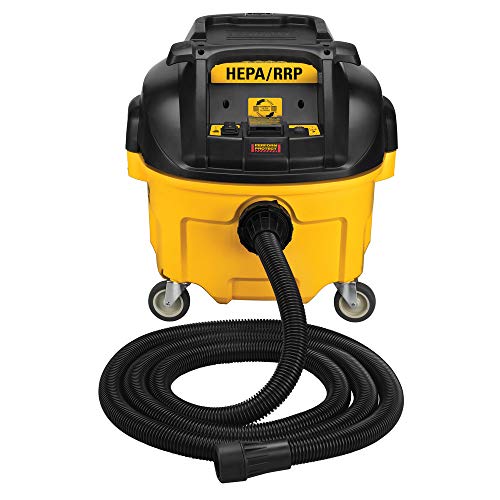
The DEWALT DWV010 is the gold standard corded dust extractor for woodworking and renovation work where HEPA-level air quality protection is the priority. The combination of HEPA filtration and automatic filter cleaning in a single unit produces consistent, certified 99.97% capture at 0.3 microns throughout the session — no progressive suction drop as dust accumulates on the filter, no manual filter tapping required between uses. The 38-liter collection tank is substantial enough for extended sessions on demanding tasks.

An important practical feature is the auto-start functionality — the extractor activates and deactivates automatically in response to a connected tool being switched on and off. This eliminates the separate on/off step entirely when using tools with a trigger switch, and ensures extraction is always running when the tool is generating dust rather than depending on the operator to remember to activate it. Consistent activation is a significant factor in actual real-world dust capture versus advertised capture; a unit that’s easy to start and stop encourages use on every cut rather than just when the dust is visibly excessive.

DEWALT’s build quality and parts availability make this a long-term investment rather than a use-and-replace unit — replacement HEPA filters are widely available and the body is designed for years of active shop use. For anyone working regularly with MDF, exotic hardwoods, or in an enclosed shop environment, this is the correct extractor specification.
Pros
- HEPA + automatic filter cleaning — the most complete extractor specification in this guide
- Auto-start ensures extraction runs every time the connected tool runs
- 38L tank for extended sessions without frequent emptying
- Replacement HEPA filters widely available; built for long-term shop use
Cons
- Premium price reflecting full professional specification
- Heavier than basic extractors given the larger tank capacity
Specs
- Filtration: HEPA (0.3 micron, 99.97%)
- Filter cleaning: Automatic
- Tank capacity: 38 liters (approximately 10 gallons)
- Feature: Auto-start
Best for: Woodworkers and renovation professionals who need maximum air quality protection with consistent suction throughout a session and no manual filter maintenance.
Category B — Best Stationary Shop Dust Collectors
5. Delta 1HP Dust Collector — Best Single-Stage

The Delta 1HP stationary dust collector is the correct tool for the job that extractors fundamentally cannot handle: clearing large chip and shaving volumes from stationary woodworking machines connected via 4-inch ductwork. Table saws, jointers, planers, and bandsaws all produce chip volumes that would fill and clog an extractor in minutes — the stationary collector’s higher air volume capacity, measured in hundreds of CFM through large-diameter ductwork, is what’s needed to keep up with these machines.

Delta’s 1HP motor moves adequate air volume for a small-to-medium shop connecting one or two stationary machines at a time via a blast gate system. The single-stage design routes collected air directly through the bag filter — simpler to set up and maintain than a two-stage cyclone system, and entirely appropriate for a shop producing standard wood chips and shavings where the filter’s capacity matches the workload. The standard 4-inch port accepts the ductwork and hose fittings common across virtually all woodworking machines and dust collection accessories.

Delta’s reputation in stationary woodworking equipment spans decades, and this collector reflects the durability expectations of a tool that will run for years in an active shop. For a small dedicated woodworking shop with a table saw and a jointer or planer, this is the appropriate capacity starting point — practical, reliable, and upgradeable via a cyclone pre-separator (Categories D in this guide) when chip volume outpaces the basic bag filter.
Pros
- Correct technology for stationary machine chip collection via 4″ ductwork
- Handles table saw, jointer, planer, and bandsaw chip volumes that overwhelm extractors
- Standard 4″ port — compatible with all standard dust collection fittings
- Delta’s long-standing reputation for stationary woodworking equipment reliability
Cons
- Single-stage bag filter — add a cyclone separator if chip volume is very high
- Standard bag filtration — consider a canister filter upgrade for fine dust applications
Specs
- Motor: 1HP
- Connection: 4″ standard port
- Type: Single-stage
Best for: Small-to-medium dedicated woodworking shops connecting a table saw and one or two additional stationary machines via a blast gate system.
6. WEN DC3401 Woodworking Dust Collector, 5.7-Amp with 12-Gallon Bag & Mobile Base — Best Mobile Collector
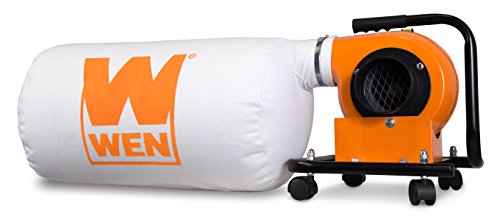
The WEN DC3401 differentiates itself from the Delta with its combination of a mobile base and an optional wall mount — a practical flexibility that matters in a small shop where floor space is at a premium. When floor space allows, the mobile base lets you wheel the collector to the active machine rather than running ductwork across the shop. When floor space is tight, the wall mount keeps the collector off the floor entirely. Few other dust collectors at this price point offer both configurations.

The 5.7-amp motor drives the collector’s 660 CFM airflow — sufficient for most small shop stationary tools including a table saw or jointer used one at a time. The 12-gallon bag capacity is larger than many entry-level collectors, which means less frequent emptying during extended sessions. Like the Delta, it uses a standard 4-inch port compatible with all standard dust collection fittings, and can be upgraded with a cyclone pre-separator from Category D to extend filter life when chip volume is high.

WEN occupies a strong value position in the power tool market — the DC3401 provides professional-functional dust collection performance at a price that makes it accessible for hobbyist shops that don’t need a commercial-grade unit. For a garage woodworker whose shop shares space with a car and needs floor space back at the end of the day, the wall mount option is worth the purchase price alone.
Pros
- Mobile base and optional wall mount in one unit — rare at this price point
- 660 CFM handles table saw, jointer, and small planer connections
- 12-gallon bag reduces emptying frequency on longer sessions
- Strong value per dollar for hobby and semi-professional shop use
Cons
- 660 CFM may fall short for a large 15-inch planer or drum sander
- Standard bag filtration — upgrade to a canister filter for fine dust sensitivity
Specs
- Motor: 5.7 amp
- Airflow: 660 CFM
- Capacity: 12-gallon bag
- Mobility: Mobile base + optional wall mount
Best for: Small hobby and semi-professional shops that need a dual-configuration collector — mobile for larger spaces, wall-mounted when floor space is limited.
Category C — Best Ambient Air Filtration Systems
7. ALORAIR 2-Stage 270° Intake Air Filtration System (580/780 CFM) — Best Ceiling Mount

The ALORAIR ceiling-mount air filtration system addresses the dust problem that no extractor or collector solves: the fine suspended particles under 10 microns that remain airborne in the shop long after the tools stop. This is not a substitute for point-of-use collection — it’s an essential complement to it. Running continuously while you work (and for 30–60 minutes after the tools stop to clear what’s still suspended), the ALORAIR cycles the entire shop air volume through progressive filter stages, cleaning progressively finer particles with each pass.

The 270-degree intake draws air from three sides simultaneously rather than a single-face intake, which covers a larger floor area in a single ceiling position and reduces the number of units needed to achieve adequate air changes per hour in a given shop volume. The 580/780 CFM dual-speed fan allows you to run at full speed when actively cutting and drop to the quieter lower speed for background filtration between sessions. Two-stage filtration captures both larger particles on the outer stage and progressively finer particles on the inner stage before the filtered air is recirculated.

For a shop of 400 square feet and 9-foot ceilings (3,600 cubic feet), achieving the recommended 6 air changes per hour requires approximately 360 CFM of filtration capacity — the ALORAIR’s 580 CFM handles this with comfortable margin, even accounting for filter loading efficiency. For larger shops, a second unit at the opposite end of the space provides full coverage.
Pros
- 270° intake covers a larger floor area in fewer ceiling positions
- 580/780 CFM dual-speed — full speed during work, quiet background speed between sessions
- Two-stage filtration for progressive particle capture
- Handles shops up to approximately 500 sq ft at a single ceiling mount
Cons
- Requires ceiling mounting — not suitable for shops without accessible ceiling structure
- Not a replacement for point-of-use collection; a complement to it
Specs
- Airflow: 580/780 CFM (dual speed)
- Intake: 270° three-side
- Filter stages: 2
- Mount: Ceiling
Best for: Enclosed woodworking shops of 200–500 sq ft that need continuous ambient air filtration as a complement to point-of-use dust collection.
8. DEWALT Air Filtration System Dust Collector for Woodworking (DWXAF101) — Best DEWALT Air Filtration

The DEWALT DWXAF101 brings DEWALT’s build quality and engineering consistency to the ambient air filtration category — a meaningful consideration for shops already running DEWALT tools and wanting ecosystem alignment, and for buyers who weight brand reliability highly when purchasing shop equipment intended to run continuously for years. DEWALT’s design in this category focuses on the filtration efficiency and motor longevity that sustained operation demands, rather than the burst-performance specs that matter more for point-of-use tools.

The multi-stage filtration design captures particles progressively from coarser to finer, maintaining the efficiency of the inner fine filter by doing the heavy coarse-particle removal work on the outer stage first. Remote control operation (included on DEWALT’s air filtration units) is a genuine practical convenience for a ceiling-mounted unit — you can adjust speed or turn the unit on and off from the floor rather than requiring a separate timer or switch near the unit itself.

For existing DEWALT shops and buyers who want name-brand reliability on a continuous-operation ambient filtration unit, the DWXAF101 delivers the expected DEWALT build standard in this less-crowded product category.
Pros
- DEWALT build quality for a continuous-operation ambient filtration application
- Multi-stage filtration for progressive particle capture
- Remote control for convenient ceiling-mount operation adjustment
- Good choice for DEWALT-aligned shops
Cons
- Premium price reflecting DEWALT positioning
- Same fundamental function as less expensive alternatives — brand alignment is the primary premium
Specs
- Filtration: Multi-stage
- Mount: Ceiling
- Control: Remote included
Best for: DEWALT-aligned shops that want name-brand build quality and remote operation in their ambient air filtration unit.
9. Portable Air Filtration System — Tabletop Dust Collector (580-780 CFM) — Best Tabletop Air Filter

Not every shop has accessible ceiling structure suitable for mounting an overhead air filtration unit — drop ceilings, exposed but widely-spaced joists, and rented shop spaces can all make ceiling mounting impractical or prohibited. This portable tabletop air filtration system delivers the same 580–780 CFM filtration capacity as ceiling-mount alternatives in a freestanding unit that can be placed on a workbench, shelf, or the floor without any mounting hardware or ceiling access.
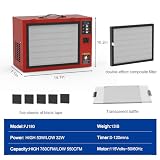
Positioning flexibility is the defining advantage — you can move the unit to the end of the shop where the most active cutting is happening, place it near a sanding station during extended finish work, or relocate it entirely to a different space (a spray booth, a finishing room, a garage for weekend projects) without permanent installation. This portability comes with the same dual-speed operation and multi-stage filtration of fixed ceiling units, applied in a more flexible package.

The limitation compared to a ceiling-mount unit: a tabletop or floor-mounted unit draws and recirculates air from floor level rather than overhead, which is somewhat less efficient at capturing the finest particles that rise and stay suspended at the upper half of the shop air column. For most shops, this is a minor consideration; the practical flexibility more than compensates for the theoretical efficiency advantage of ceiling positioning.
Pros
- No ceiling mount required — fully portable between locations and spaces
- Same 580–780 CFM filtration capacity as ceiling-mount alternatives
- Dual-speed for active and background filtration modes
- Ideal for rented spaces, drop-ceiling shops, or multi-location use
Cons
- Floor-level air intake is slightly less efficient than overhead for capturing suspended fine dust at ceiling height
- Occupies floor or bench space rather than overhead space
Specs
- Airflow: 580–780 CFM
- Mount: Freestanding / tabletop (no ceiling required)
- Speed: Dual
Best for: Shops without accessible ceiling structure, rented spaces, or woodworkers who want portable ambient filtration that moves with their work.
Category D — Best Cyclone Dust Separators
10. Mullet Cyclone Dust Collector — Best Value Cyclone Separator
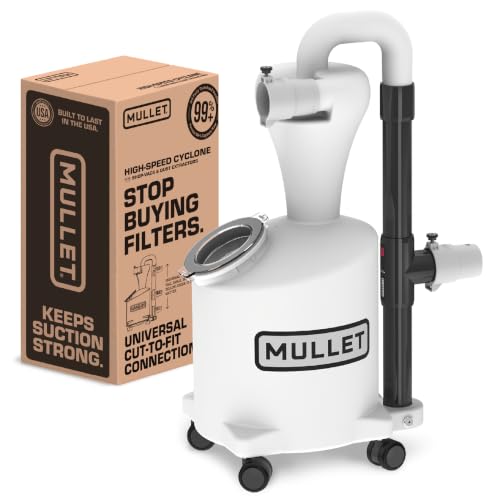
The Mullet Cyclone turns a standard shop vac into a two-stage collection system at a fraction of the cost of a dedicated two-stage collector. The cyclone body installs between the tool hose and the shop vac intake — air and debris enter the cyclone, spin in a tight vortex that drops 90%+ of debris into a collection bucket below, and the cleaned air continues to the shop vac filter. The shop vac filter sees dramatically less material, stays cleaner longer, maintains consistent suction between emptyings, and needs replacing far less frequently.

The economic argument for any cyclone separator is straightforward: shop vac filters are expensive (typically $15–$30 each) and frequent replacement is the primary ongoing cost of shop vac operation. By intercepting 90%+ of debris before the filter, a cyclone separator can extend filter replacement intervals dramatically — paying for itself within one season of regular use for an active shop. The collection bucket empties without touching the filter or the vac, which keeps maintenance clean and fast.

This is an accessory, not a standalone tool — it requires a shop vac to function. But as a shop-vac upgrade, it’s one of the highest-value-per-dollar purchases in this entire guide, transforming an existing basic shop vac into a significantly more capable and economical dust collection setup without replacing the vac itself.
Pros
- Dramatically extends shop vac filter life by pre-separating 90%+ of debris
- Maintains consistent suction between emptyings by keeping the filter cleaner
- Pays for itself quickly through reduced filter replacement costs
- Simple installation between tool hose and shop vac intake
Cons
- Requires a shop vac to function — not a standalone tool
- Adds a collection bucket to manage alongside the shop vac itself
Specs
- Type: Cyclone pre-separator
- Separation efficiency: 90%+
- Compatibility: Standard shop vac
Best for: Shop vac users who want extended filter life, consistent suction, and lower ongoing maintenance costs at the lowest possible investment.
11. Festool CT CYCLONE Dust Separator CT-VA-20 — Best Professional Separator
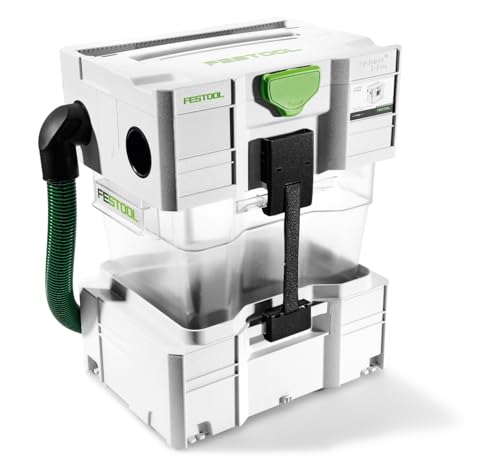
The Festool CT CYCLONE is the professional-grade separator in this guide, designed specifically for integration with Festool’s CT dust extractor lineup. Where generic cyclone separators are built to work adequately with any shop vac, the CT CYCLONE is engineered to maximize performance within Festool’s CT system — sealed connections that prevent bypass leakage, a high-quality separator body that maintains cyclone efficiency at the suction levels Festool CT extractors generate, and integrated design that maintains the portability and stacking capability of the CT system.

Festool’s ecosystem approach means the CT CYCLONE connects to CT extractor models with the same secure, dust-tight bayonet fittings used throughout the CT product line — no adapters, no air bypass at the connection points that would undermine the system’s filtration efficiency in practice. For professional finishers and cabinet makers who have invested in a Festool CT extractor, adding the CT CYCLONE extends filter life dramatically and maintains the system’s high suction across longer sessions without the filter-clogging performance drop that occurs without pre-separation.

This is specifically the right separator for Festool CT extractor owners — for everyone else, a generic cyclone separator provides the same fundamental pre-separation function at considerably less cost. The Festool premium is justified by the sealed system integration and the professional production environment the CT line is designed for.
Pros
- Engineered specifically for Festool CT extractor integration — sealed, no bypass
- Maintains CT system’s premium suction and filtration performance
- Dramatically extends CT extractor filter life in production environments
- Festool’s professional build quality for sustained daily use
Cons
- Designed for Festool CT systems — less value for non-Festool setups
- Premium price reflects Festool’s professional market positioning
Specs
- Type: Cyclone pre-separator
- Compatibility: Festool CT extractor series
- Connection: Sealed bayonet fitting (Festool-standard)
Best for: Festool CT extractor owners in professional finishing, cabinetmaking, and production environments who want to extend filter life and maintain suction consistency.
12. DEWALT 6-Gallon Dust Separator for Wet/Dry Shop Vacuums (DXVCS002) — Best DEWALT Separator

The DEWALT DXVCS002 brings DEWALT’s engineering and brand reliability to the cyclone separator category in a package specifically sized and designed for compatibility with standard wet/dry shop vacs — including DEWALT’s own shop vac lineup. The 6-gallon separator tank provides substantial pre-separation capacity, meaning you empty the separator container far less frequently than you’d empty the shop vac without it, and the vac filter stays cleaner throughout the session.

The cyclonic separation action pre-separates both wet and dry debris — an important distinction from some separators that handle only dry material. For shops that use the wet/dry capability of a shop vac (water from wet sanding, condensation cleanup, or general liquid capture alongside sawdust), the DXVCS002’s wet/dry capability means a single separator serves the full range of shop vac applications rather than needing to bypass it for wet work.

For DEWALT shop users who already run DEWALT shop vacs and want a separator that integrates cleanly with their existing equipment ecosystem — consistent fitments, DEWALT’s build standard, and wide parts availability — the DXVCS002 is the natural addition to the setup.
Pros
- 6-gallon tank capacity for extended pre-separation between emptyings
- Wet and dry separation — handles the full range of shop vac applications
- DEWALT build quality and brand alignment for existing DEWALT shop setups
- Wide compatibility with standard wet/dry shop vacuums
Cons
- Higher cost than generic cyclone separators for the same fundamental function
- Requires a shop vac — not standalone
Specs
- Type: Cyclone separator (wet/dry)
- Tank capacity: 6 gallons
- Compatibility: Standard wet/dry shop vacuums
Best for: DEWALT shop users and anyone who needs wet/dry cyclone pre-separation in a well-built, widely compatible separator unit.
Shop Size Guide — What Your Shop Actually Needs
The right combination of dust management tools depends primarily on your shop size and the types of tools you’re running. Here’s a practical framework:
Small Garage/Basement Shop (under 200 sq ft, 1–2 stationary tools)
A cyclone separator plus an existing shop vac handles point-of-use collection adequately for one tool at a time. Add a portable tabletop air filtration unit for ambient fine dust. A dedicated stationary collector isn’t yet necessary — a shop vac with a Mullet Cyclone or DEWALT DXVCS002 covers both a table saw and your handheld tools effectively at this scale.
Medium Shop (200–400 sq ft, 3–5 stationary tools)
A dedicated stationary dust collector (Delta 1HP or WEN DC3401) connected via blast gates to your stationary machines handles the bulk chip work. A separate extractor (DEWALT DWV010 HEPA or Bosch VAC090AH) handles handheld tools. A ceiling-mount air filtration system (ALORAIR or DEWALT DWXAF101) handles ambient fine dust.
Job-Site / Renovation Work Focus
A HEPA extractor — cordless (DEWALT DCV585B) or corded (DEWALT DWV010) depending on site power availability — is the primary tool. A portable tabletop air filtration unit can supplement ambient air quality in enclosed rooms. No stationary collector is appropriate for this use case.
Frequently Asked Questions

What is the difference between a dust extractor and a dust collector?
A dust extractor provides high suction through a small-diameter hose for capturing dust at handheld power tools — sanders, grinders, and routers. A dust collector moves high air volume through 4-inch ductwork connected to stationary machines like table saws and planers. They serve different tools and should not be substituted for each other — an extractor can’t clear a planer’s chip volume, and a collector’s lower suction pressure can’t effectively capture a sander’s fine dust through a small hose attachment.
Do I need a HEPA filter for wood dust?
For general woodworking with common softwoods and sheet goods, a 2–5 micron filter provides adequate protection for moderate exposure. For regular work with MDF, or any exotic hardwood species (teak, walnut, western red cedar, African woods), HEPA-rated filtration at 0.3 microns/99.97% is the correct standard — these species generate particles in the respirable range that cause cumulative lung damage and are classified as carcinogens by IARC. If you work in an enclosed space without excellent ventilation, HEPA is the safe default regardless of species.
What CFM do I need for a table saw?
A table saw requires a minimum of 400 CFM through a 4-inch connection at the blade cabinet to effectively clear chips and prevent buildup. A zero-clearance insert and a second collection point at the blade guard above the table improves collection substantially beyond what a single below-table connection achieves. Both the Delta 1HP and WEN DC3401 in this guide meet the 400 CFM threshold for table saw use.
Can I use a shop vac instead of a dust collector?
For handheld tools and light stationary machine use, yes — a quality shop vac with a cyclone separator pre-separation accessory handles most small-shop tasks effectively. For sustained high-volume chip production from a table saw, planer, or jointer, a shop vac fills rapidly, loses suction as the filter clogs, and doesn’t provide the continuous high-airflow volume these machines require. A dedicated dust collector is the right tool for sustained stationary machine use.
What does a cyclone separator do and do I need one?
A cyclone separator pre-separates 90%+ of debris before it reaches your vacuum’s filter. It extends filter life dramatically, maintains consistent suction throughout the session by keeping the filter cleaner, and reduces how often you empty the vacuum itself. If you use a shop vac for any dust collection regularly, a cyclone separator is one of the highest-value accessories you can add to your setup — it pays for itself quickly in reduced filter replacement costs and improved tool performance.
Is an air filtration system necessary if I have a dust collector?
Yes, for enclosed shop environments. A dust collector handles bulk chips and shavings at the point of use but does not capture the fine particles under 10 microns that remain suspended in shop air for hours. An air filtration system is the only tool that addresses this suspended fine dust — and it’s this particle size range that causes cumulative lung damage from sustained woodworking exposure. In a shop with good natural ventilation and open garage doors, the urgency is lower. In an enclosed basement or insulated garage shop, an air filtration system is a genuinely important health investment.
What is automatic filter cleaning on a dust extractor?
Automatic filter cleaning (AFC) pulses a brief burst of air in reverse through the filter medium, knocking accumulated dust cake off the filter surface and back into the collection container. This keeps the filter pores open and maintains consistent suction CFM throughout the work session — without AFC, a clogging filter drops suction by 40–60% over the course of extended use. AFC is particularly valuable for fine dust work (sanding, grinder use) where fine particles clog filters rapidly.
How loud are dust collectors for a garage shop?
Most stationary dust collectors run 70–82 dB during operation — similar to a standard shop vac or a running power tool. Some larger units approach 85 dB, at which level sustained exposure warrants hearing protection and the sound is clearly audible from neighboring properties. For early morning or weekend use in a residential neighborhood, the noise level of your dust collection system is a genuine practical consideration worth checking in the specs before buying.
Final Verdict
Effective workshop dust management almost always involves more than one tool type — point-of-use collection alone leaves the finest suspended particles in your shop air, and ambient filtration alone doesn’t address the chip volume from stationary machines. Here are the definitive picks by category and use case:
- Best cordless extractor: DEWALT DCV585B 60V MAX — HEPA-capable with auto-start for job-site mobility.
- Best portable shop extractor: CVMA40-T 10-Gal Trolley — 150 CFM woodworking-focused unit with integrated mobility.
- Best extractor for power tools: Bosch VAC090AH — HEPA plus auto filter cleaning for angle grinder and tool-matched use.
- Best HEPA extractor: DEWALT DWV010 — HEPA + AFC + auto-start, the most complete extractor specification in this guide.
- Best single-stage shop collector: Delta 1HP Dust Collector — reliable stationary machine chip collection via standard 4″ ductwork.
- Best mobile shop collector: WEN DC3401 — 660 CFM, 12-gallon bag, and the flexibility of mobile base or wall mount.
- Best ceiling-mount air filtration: ALORAIR 580/780CFM — 270° intake and dual-speed for active and background ambient filtration.
- Best DEWALT air filtration: DEWALT DWXAF101 — name-brand build quality with remote control operation.
- Best tabletop air filter: Portable Tabletop 580-780CFM — same filtration capacity as ceiling-mount, no ceiling access required.
- Best value cyclone separator: Mullet Cyclone — highest-value-per-dollar shop vac upgrade in this entire guide.
- Best professional separator: Festool CT CYCLONE — sealed integration with Festool CT extractors for production professionals.
- Best DEWALT separator: DEWALT DXVCS002 — wet/dry pre-separation with DEWALT build quality for existing DEWALT shop vac users.
For most woodworking shops, the minimum effective setup is a point-of-use tool (extractor for handheld work, collector for stationary machines) combined with an ambient air filtration unit to handle the fine dust that escapes point-of-use collection. Add a cyclone separator to any setup involving a shop vac to extend filter life, maintain consistent suction, and reduce maintenance frequency — it’s one of the simplest, highest-value upgrades in this entire category.
A table saw generates more fine dust than almost anything else in a shop – see our guide to the best table saws if you’re still shopping for the saw itself.
A miter saw throws a surprising amount of fine dust too – see our guide to the best miter saws if you’re still shopping for the saw itself.
Routers throw a surprising amount of fine dust too, especially table-mounted – see our guide to the best wood routers if you’re still shopping for the tool itself.