

“Best tape measure” means something different depending on who’s asking. A framer wants blade rigidity and standout distance that holds up on a solo overhead measurement. An electrician wants a magnetic hook and a blade narrow enough to slide into a crowded panel. A homeowner sizing up a bookshelf just wants a tape that reads clearly in both inches and centimeters and doesn’t take up a whole drawer. There isn’t one “best” tape measure – there’s a best one for what you’re actually doing with it.
We looked at 9 measuring tapes spanning manual steel blades, magnetic wide-blade contractor tapes, compact metric/imperial tapes, and a 2-in-1 laser tape, all checked on Amazon in October 2026. Below you’ll find full reviews, a quick comparison table, and a buyer’s guide covering the two questions almost nobody answers clearly – what “standout” actually means, and whether you should go digital or stick with a physical blade.
Jump to: Manual Tapes · Magnetic & Wide Blade · Digital & Laser · Metric/Imperial & Buying Guide · Standout Explained · FAQ
What Is “Standout” on a Tape Measure, and Why Does It Matter?
Every tape measure lists a blade length on the case – 16ft, 25ft, 30ft. What most listings don’t tell you is how much of that blade you can actually extend horizontally, unsupported, before it buckles under its own weight and folds over. That number is called standout, and it’s arguably the most useful spec on the entire product page, yet it’s almost never explained in plain language.
Here’s why it matters in practice: if you’re measuring alone – a ceiling height, a long wall, an overhead duct run – you need the blade to hold its shape long enough to get a reading without a second person steadying it or you bracing it against something. A tape with a long blade but weak standout forces you to support it by hand past a certain point, which slows you down and introduces measurement error on exactly the jobs where you need a rigid reading the most.
Two products in this roundup make the difference obvious. The Tajima SS-16BW holds 8.2ft of standout on a 16ft blade – solid for a compact tape. The Milwaukee 48-22-0325 pushes that to as much as 15ft of standout on a 25ft blade, a meaningfully longer unsupported reach that matters if you’re working solo on framing or overhead runs.
Practical takeaway: if you regularly measure alone – ceiling heights, long walls, overhead work – prioritize standout distance over total blade length. A shorter tape with strong standout will outperform a longer one that folds over at 9ft.
Quick Comparison Table
All 9 tape measures at a glance. Tap any product name to check the current price on Amazon.
| Product | Type | Length | Blade Width | Standout | Units | Best For |
|---|---|---|---|---|---|---|
| ★ Tajima SS-16BW Sigma Stop | Manual | 16ft | 1in | 8.2ft | Imperial | Best overall / everyday use |
| Milwaukee 48-22-0325 | Manual / Magnetic | 25ft | 1in | up to 15ft | Imperial | Framers, contractors, electricians |
| LEXIVON 2-in-1 Laser Tape (LX-201) | Digital / Laser | 130ft laser + 16ft tape | N/A | N/A (laser) | Metric/Imperial | Long distances, area/volume calcs |
| ACPOTEL Digital Tape Measure 16ft | Digital | 16ft | Compact | Moderate | 6 Metric/Imperial modes | International buyers, mixed-unit plans |
| Bosch 5m/16ft Tape Measure | Manual | 5m | Compact | Light-duty | Metric/Imperial | Household, light DIY |
| DEWALT Atomic Compact 30ft | Manual | 30ft | Standard | Contractor-grade | Imperial | Value-priced contractor use |
| CRAFTSMAN 25ft Fraction-Marked | Manual | 25ft | Standard | Standard | Imperial (fractions printed) | Woodworkers, finish carpenters |
| 25FT Magnetic 1/32″ Double-Sided | Manual / Magnetic | 25ft | Standard | Standard | Imperial (1/32in graduation) | Cabinetry, fine woodworking |
| Stanley PowerLock II (BOS33425) | Manual | Compact | Standard | Standard | Imperial | Classic, budget-friendly reliability |
#1 Best Overall – Tajima SS-16BW 16 ft. Standard Steel Sigma Stop Tape Measure

Amazon rating: 4.6 stars (70+ ratings). Buyers say it’s well made, accurate and sturdy, and like the automatic locking and smooth draw-out and retraction.
The Tajima SS-16BW is the tape we’d point most people toward first. It’s a 16ft x 1in steel blade with a dual lock mechanism, an auto-stop function, and a dual-sided blade you can read from above or below without twisting the case. At 8.2ft of standout, it holds its shape comfortably for most household and light trade work.
The dual lock and auto-stop aren’t marketing fluff – they’re genuine one-handed ergonomic advantages. Auto-stop means the blade halts at your intended mark instead of overshooting when you release the lock button, and the dual lock lets you hold the blade extended at a set length without fighting the return spring. If you’ve ever fumbled a tape while trying to hold a board and mark a cut at the same time, this is the feature that fixes that.
Pros
- Dual-sided blade readable from either direction
- Auto-stop and dual lock make one-handed use genuinely easier
- 8.2ft standout is solid for a compact 16ft tape
- Sigma Stop branding reflects a long track record of durability
Cons
- 16ft length is limiting for large rooms or long runs – contractors doing framing may want more reach
- Imperial only, no metric scale
#2 Best for Framers & Contractors – Milwaukee 48-22-0325 Compact Wide Blade Magnetic Tape Measure

Amazon rating: 4.6 stars (1,070+ ratings). Buyers say it’s solidly built and easy to read with print on both sides. The magnetic tip gets mixed feedback, with some praising its strength and others saying it gets stuck.
This is the tape to reach for on a job site where you’re working solo against steel. The Milwaukee 48-22-0325 is a 25ft x 1in blade with a magnetic hook that locks onto steel studs, EMT conduit, or ductwork – meaning you can anchor one end and walk out the full length without a second person holding it. Standout runs up to 15ft, among the longest unsupported reach in this roundup, and the blade carries an anti-tear coating on the first 6 inches plus a nylon coating along its full length to resist wear.
The magnetic hook is the feature that actually changes how you work, not just a spec-sheet bullet point. Electricians and framers measuring the same runs repeatedly – stud to stud, box to box – get a real productivity gain from not needing a helper just to hold the zero end in place. The 5-point reinforced frame also means the case itself takes drops better than a standard contractor tape.
Pros
- Magnetic hook enables true one-person measuring against steel
- Up to 15ft standout – among the best in this lineup
- Reinforced 5-point frame and reinforced blade coating for job-site durability
- 25ft length covers most framing and contractor tasks
Cons
- Heavier and bulkier than compact household tapes – overkill for light DIY
- Magnetic hook isn’t useful if you’re mostly measuring wood or non-ferrous materials
#3 Best Digital/Laser – LEXIVON 2-in-1 Digital Laser Tape Measure (LX-201)
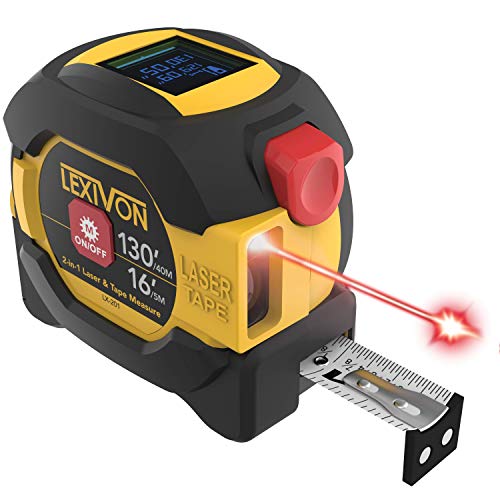
The LEXIVON LX-201 puts a 130ft (40m) laser distance meter and a 16ft (5m) auto-lock steel tape in one body, with a backlit LCD that reads in feet, inches, fractions, meters or millimeters. It’s the pick for anyone deciding between “digital or manual,” because it doesn’t make you choose. It holds a 4.4-star average from more than 3,700 Amazon ratings.
Where the laser side wins: measuring long distances across a room and working solo without hooking a blade onto anything. Where it doesn’t: a laser needs a flat surface to bounce off, and it’s less precise than a physical blade when you’re marking an exact cut line on a board. That’s what the built-in tape is for.
Pros
- Laser and physical tape in one tool
- 130ft laser range covers any room in a house
- Reads in imperial, fractions and metric
- True solo operation for long measurements
Cons
- Laser needs a flat target surface for a reliable reading
- Battery-dependent, unlike a purely mechanical tape
- The 16ft tape is a convenience blade, not a contractor tape
#4 Best Compact Digital – ACPOTEL Digital Tape Measure 16ft with 6 Metric and Imperial Units

Amazon rating: 4.4 stars (1,850+ ratings). Buyers say it makes projects faster, with a clear digital display and long battery life. Accuracy gets mixed feedback.
This 16ft digital tape’s standout feature is its six selectable metric and imperial unit display modes, which makes it a genuinely useful pick for anyone who regularly works across mixed-unit plans – international buyers, hobbyists following metric-spec furniture designs, or anyone tired of doing unit conversion math in their head. It’s a compact tool rather than a heavy-duty contractor tape, so treat it as a precision reader rather than a jobsite workhorse.
Pros
- Six unit display options cover nearly any metric/imperial combination you’d need
- Compact size, easy to carry or store
- Digital display removes guesswork on fine graduations
Cons
- 16ft length limits it to smaller-scale projects
- Not built for heavy contractor use like a Milwaukee or DEWALT
#5 Best Compact Metric – Bosch 5m/16ft Tape Measure with Pencil Clip

Amazon rating: 4.8 stars (1,290+ ratings), one of the highest-rated tapes in this lineup.
Not every job needs a 25ft contractor tape, and this small-form-factor 5m tape is built for exactly that. It carries a dual metric/imperial scale in a case small enough to live in a junk drawer or a bag pocket, making it a sensible pick for household measuring, small DIY projects, and quick furniture or shipping-box checks where a bulky contractor tape is genuinely more than you need.
Pros
- Dual metric/imperial scale in a compact body
- Lightweight and easy to keep on hand around the house
- Inexpensive entry point for casual use
Cons
- 5m (about 16ft) range and light-duty build limit it to household tasks, not job-site work
- Standout is modest, as expected for a compact case
#6 Best Value Contractor Tape – DEWALT Atomic Compact Series 30 ft. Tape Measure
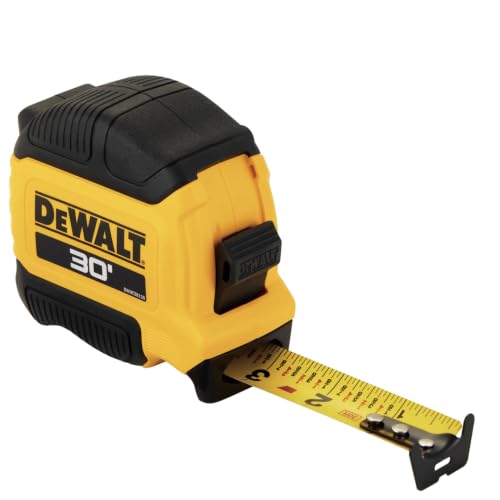
Amazon rating: 4.8 stars (2,970+ ratings). Buyers say it’s very durable and good value, with one joking it feels like it could survive a fall from a 10-story building, and like that it gives you the length without losing portability.
The DEWALT Atomic Compact Series gives you 30ft of reach – more than any other manual tape in this roundup – in a compact-series case built with DEWALT’s standard contractor-grade durability. It’s a solid value pick for anyone who wants extra length for larger rooms or longer runs without stepping up to a premium-priced tape.
Pros
- 30ft length, the longest manual tape in this lineup
- Compact-series body keeps the case manageable despite the extra blade length
- Contractor-grade durability at a value price point
Cons
- Longer blades generally trade off some standout distance compared to shorter tapes
- No magnetic hook or fraction markings
#7 Best Fraction-Marked – CRAFTSMAN 25-Ft Tape Measure with Fraction Markings
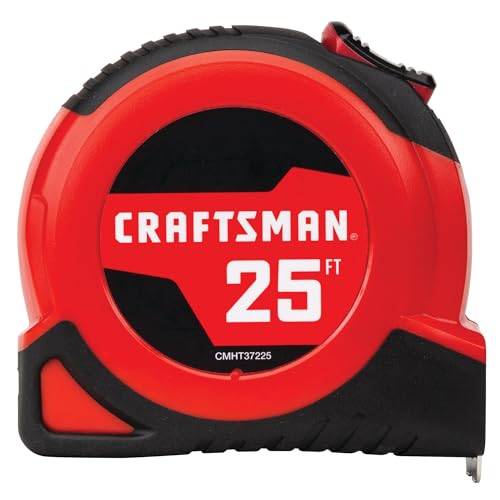
Amazon rating: 4.7 stars (16,300+ ratings), the most-reviewed tape in this roundup. Buyers say it’s good quality and value, easy to read and accurate. Retraction gets mixed comments.
This is the one pick in the roundup built around a single, specific feature: fraction markings printed directly on the blade. Most tape measures make you count hash marks to figure out whether you’re at 3/16in or 5/16in – this CRAFTSMAN prints the fraction right on the blade, which is a genuinely underrated feature for woodworkers and finish carpenters who read fractional measurements constantly and don’t want to do that math by eye every single time. It also has a self-locking, retractable blade, so the fraction printing isn’t the only thing going for it.
Most competitor roundups don’t call this out as a category-defining feature, but if your work involves cabinetry, trim, or finish carpentry where precise fractional reads happen all day, this is worth prioritizing over tapes with a longer blade but no fraction printing.
Pros
- Printed fraction markings save real time for fractional-measurement-heavy work
- Self-locking, retractable blade
- 25ft length is versatile for most trim and finish work
Cons
- The fraction-printing benefit is wasted if you primarily measure in whole inches or metric
- No magnetic hook
#8 Best Precision Magnetic – 25FT Magnetic Tape Measure, Double-Sided 1/32″
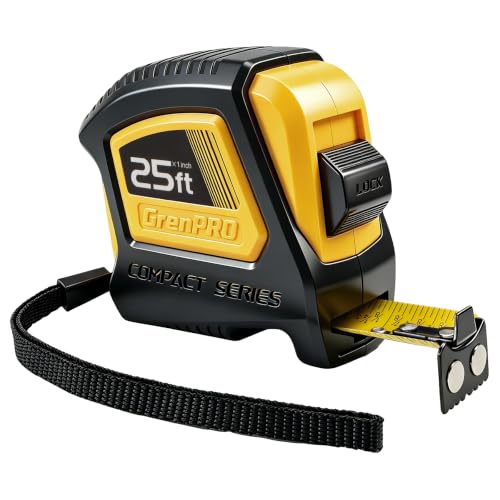
Amazon rating: 4.7 stars (220+ ratings) for this GRENPRO tape. Buyers say it’s good quality, compact and lightweight, with a self-locking blade that stays put.
Standard contractor tapes graduate down to 1/16in. This one goes finer, to 1/32in, which matters if your work is cabinetry or fine woodworking where that extra graduation actually changes your cut. It combines that precision with a double-sided, nylon-coated blade, a magnetic hook, a shock-absorbent case, dual lock, and a belt clip – a well-rounded feature set built around precision work rather than raw job-site toughness.
Pros
- 1/32in graduation – finer than the 1/16in standard on most contractor tapes
- Double-sided, nylon-coated blade resists wear
- Magnetic hook adds hands-free convenience
- Shock-absorbent case and dual lock for added durability
Cons
- Finer graduation is only a real benefit if your work actually calls for 1/32in precision
- Not marketed as a heavy-duty framing tape
#9 Best Classic/Compact – Stanley PowerLock II (BOS33425)

Amazon rating: 4.6 stars (7,500+ ratings). Buyers say it’s well built, accurate and easy to read. The lock gets mixed feedback.
The PowerLock design has been an industry standard for decades, and this is the reliable, no-frills, budget-accessible version of it. If you just want a tape measure that works, holds up over years of casual and occasional pro use, and doesn’t ask you to learn any new features, this is the classic pick. The power-return spring and compact case are exactly what generations of tradespeople and homeowners have relied on.
Pros
- Decades-proven PowerLock design
- Reliable power-return spring
- Compact, easy to carry, budget-friendly
Cons
- No modern extras – no magnetic hook, no fraction printing, no digital display
- Standout and blade width are basic compared to premium contractor tapes
Buyer’s Guide: Manual vs Digital, Metric vs Imperial, Blade Width
Manual vs Digital/Laser
A manual blade still wins for on-the-fly marking and cut lines – you can hook it, extend it, and mark a pencil line in one motion, and it doesn’t care about reflective surfaces or battery charge. Digital and laser tapes win for long single-person distances and for automatic area or volume calculations, where doing the math yourself would slow you down. If you regularly do both – marking boards and estimating room square footage – the LEXIVON’s 2-in-1 design covers both without carrying two tools.
Metric vs Imperial
If you work across US imperial plans and any metric-spec materials or international furniture, always confirm dual-scale before buying. Several products in this roundup – including the 6-unit digital display models – exist specifically to solve this problem, so you’re not stuck converting centimeters to inches by hand mid-project.
Blade Width
Wider blades (1-1/4in and up) have better standout and resist buckling on long unsupported reaches, which is why contractor-grade tapes like the Milwaukee lean wide. Narrower blades (3/4in–1in) are lighter and easier to maneuver into tight spaces like electrical panels or conduit runs, which is exactly where an electrician benefits from a narrower profile over raw standout distance.
Standout
As covered above, standout – not total blade length – determines how far you can extend a tape unsupported before it buckles. Prioritize it if you regularly measure alone on overhead or long-distance work.
Fraction Markings
Worth prioritizing specifically for woodworking and finish trim work, where reading in 1/16in and 1/32in increments happens constantly. The CRAFTSMAN’s printed fractions remove the need to count hash marks by eye on every single measurement.
Magnetic Hook
Genuinely useful for anyone regularly measuring against steel studs, conduit, or ductwork hands-free – not a gimmick, but a real time-saver if your work involves ferrous materials.
Need more layout gear? See my guides to the best marking tools for woodworking, the best stud finders, and my explainer on 2×4 actual size if you’re measuring lumber.
Frequently Asked Questions
What does standout mean on a tape measure?
Standout is the maximum length a tape’s blade can extend horizontally, unsupported, before it buckles under its own weight. It’s different from the total blade length printed on the case, and it matters most for anyone measuring solo – a tape with strong standout holds its shape long enough to get a reading without a second person or a wall to brace it against.
Is a digital tape measure more accurate than a manual one?
For long distances and area or volume calculations, digital and laser tapes are faster and often more consistent for one person working alone. For precise cut-line marking on a board, a physical blade is still the standard – laser tools need a flat, reflective surface and aren’t built for that kind of fine, close-up marking.
What blade width tape measure do I need?
Wider blades (1-1/4in or more) resist buckling over longer standout distances, which is why contractor and framing tapes tend to run wide. Narrower blades (3/4in–1in) are lighter and better suited to tight spaces, like reaching into electrical panels or conduit runs.
Is a fish tape the same as a tape measure?
No. A fish tape is an electrician’s tool used to pull wire through conduit and walls, and it carries no measurement markings at all, despite having a similar reel-based case to a tape measure.
Final Verdict
For most people, the Tajima SS-16BW Sigma Stop is the best overall pick – a reliable, well-built 16ft tape with genuinely useful ergonomic features and enough standout for everyday work. If you’re a contractor, framer, or electrician working solo against steel, the Milwaukee 48-22-0325 earns its place with a magnetic hook and the longest standout in this lineup. And if you regularly need long-distance readings or area calculations without a second pair of hands, the LEXIVON 2-in-1 is the best digital/laser option here, combining a laser measurer with a physical tape in one tool.


