The miter saw handles the majority of crosscuts in any shop, and the biggest real innovation in the category in the last decade is a patented mechanism most buying guides mention as a bullet point without explaining why it actually matters. This guide covers 6 real miter saws across every type and budget, plus the type-and-size framework that actually determines which one you need.
Compound, Dual Bevel, and Sliding – What You Actually Need
Compound saws tilt the blade in one direction (typically left) for bevel cuts in addition to standard miter cuts, the simplest and lightest configuration. Dual bevel saws tilt both left and right, which means you can cut opposing bevel angles, like the two sides of a crown molding corner, without flipping or repositioning the workpiece. This is a genuine time-saver on repetitive angled work, not just a convenience feature. Sliding adds rails (or, on Bosch’s saws, a glide arm) that let the blade move forward and back, dramatically increasing crosscut capacity beyond what the blade diameter alone allows. The rule of thumb that actually matters: sliding is worth it the moment you’re regularly cutting anything wider than your blade’s diameter permits in a single chop, wide baseboard, crown molding run vertically against the fence, or dimensional lumber over a few inches wide.
Bosch’s Glide System vs. Everyone Else’s Rails
This is the part most competitor buying guides underexplain. Every major brand except Bosch uses a pair of tubular steel rails to let the saw head slide forward and back. That system works, but it has a well-documented weakness: the rails are exposed, and over years of use they can develop sag, stickiness, or misalignment, especially in a jobsite environment with dust and debris working into the mechanism. Bosch’s patented Axial-Glide system replaces the rails entirely with an articulating four-bar-linkage arm, similar to a suspension linkage, riding on sealed precision ball bearings. The practical result: the mechanism stays true and smooth over the saw’s life in a way exposed rails generally don’t, and because the arm folds flush against the back of the saw instead of projecting rails backward, the saw needs up to 12 inches less rear clearance, letting it sit flush against a wall. That’s a genuine, checkable space advantage in a small garage or tight jobsite trailer, not just packaging language.
This is a real advantage, not a marketing gimmick, and it’s reflected honestly in the price: a Bosch glide saw costs more than a comparable rail-based saw from another brand. Whether that premium is worth it depends on how much you value long-term mechanical stability and wall clearance versus a lower upfront cost.
Blade Size – 8.5″, 10″, or 12″
7-1/4″ to 8-1/2″: compact and lightweight, ideal for trim carpenters prioritizing portability. Handles baseboard and 2×4 lumber comfortably but has limited crosscut capacity for furniture or cabinetry work.
10″: the sweet spot for most users, wide enough for the large majority of trim, framing, and general shop work without the bulk of a 12-inch saw.
12″: the right call for wide baseboard, crown molding run vertically against the fence, or regular framing lumber work. The trade-off is real: a 12-inch sliding saw is the heaviest and bulkiest of the three sizes, and takes up more room on a stand or in a truck bed.
Quick Comparison
| Product | Blade Size | Slide Mechanism | Bevel | Best For |
|---|---|---|---|---|
| DeWalt DWS779 | 12″ | Rail slide | Dual | Best Overall |
| Bosch GCM12SD | 12″ | Axial-Glide (patented) | Dual | Best Space-Saving / Long-Term Stability |
| Makita LS1019L | 10″ | Rail slide | Dual | Best for Woodworking / Precision |
| Milwaukee M18 FUEL 2739-20 | 12″ | Rail slide | Dual | Best Premium Cordless |
| Ryobi 18V ONE+ HP | 10″ | Rail slide | Single | Best Cordless Budget |
| Ryobi 10″ Corded LED | 10″ | None (compound only) | Single | Best Budget Corded / Beginners |
1. DeWalt DWS779 – Best Overall
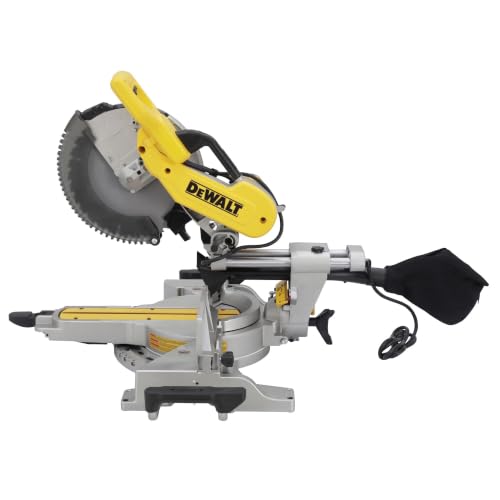
If you’ve been on a job site in the U.S. in the last decade, there’s a real chance you’ve seen this saw. A 15-amp, 3,800 RPM motor with dual horizontal steel rails and linear ball bearings delivers a 2×14-inch crosscut capacity at 90 degrees, and the stainless steel miter detent plate with 10 positive stops makes returning to common angles fast and repeatable. Dual bevel capability (0-48 degrees left and right) covers crown molding and compound work without flipping the workpiece.
Pros: The most widely used and tested saw in this category, with correspondingly wide accessory and parts support; genuine 2×14″ crosscut capacity; 10 positive miter stops with a cam-lock override for fine adjustment; tall sliding fences support tall stock (up to 6-3/4″) for base and crown work.
Cons: Traditional rail system requires roughly a foot of rear clearance when fully extended, a real space consideration Bosch’s glide system avoids; rails can develop play or stickiness over years of heavy use without maintenance.
Best for: Contractors and serious home DIYers who want the most proven, best-supported saw in the category and have the shop space for standard rail clearance.
2. Bosch GCM12SD – Best Space-Saving / Long-Term Stability
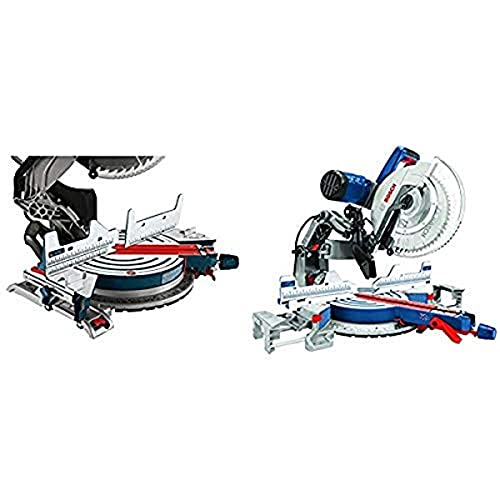
The patented Axial-Glide pick, and the saw to consider if either wall clearance or long-term mechanical stability matters to you specifically. Pre-aligned Squarelock fences hold true throughout the saw’s life, and the sealed-bearing articulating arm delivers a cutting motion independent reviewers consistently describe as smoother than rail-based competitors, with meaningfully less user fatigue during high-volume trim work.
Pros: Patented glide mechanism avoids the rail sag and misalignment that develops over years on competing saws; needs up to 12 inches less rear clearance, can sit flush against a wall; Squarelock fences stay aligned without recalibration; genuinely smoother cutting action per independent long-term reviews.
Cons: Priced higher than a comparable rail-based saw, you’re paying for the exclusive mechanism; heavier than some rail-based competitors due to the cast-aluminum arm assembly.
Best for: Small shop or garage setups where wall clearance matters, and anyone who wants to avoid the long-term rail maintenance issues that come up on traditional sliding saws.
3. Makita LS1019L – Best for Woodworking / Precision

Makita’s reputation for smooth, controlled cutting shows up clearly here. A 15-amp direct-drive motor with soft start delivers consistent power with no belt to slip or replace over time, and the LS1019L holds the most compact footprint in its capacity class, up to 6-5/8 inches of nested crown molding capacity and 4-3/4 inches of baseboard capacity, in a genuinely more portable package than most 12-inch sliders.
Pros: Direct-drive motor eliminates belt slippage as a long-term wear concern; class-leading compact footprint for a 10-inch slider with real capacity; soft-start reduces both breaker trips and startup jolt; electric brake stops the blade quickly after each cut.
Cons: 10-inch blade tops out below a 12-inch saw’s maximum capacity for very wide stock; no dual-bevel-plus-glide combination the way Bosch offers, this is a standard rail system.
Best for: Fine woodworking and cabinetry work where cut quality and a compact, portable footprint matter more than maximum capacity.
4. Milwaukee M18 FUEL 2739-20 – Best Premium Cordless
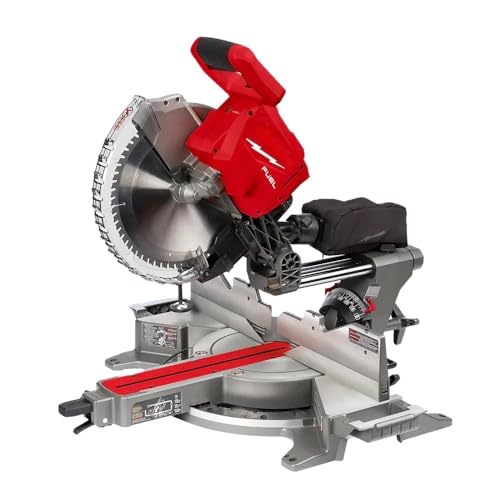
Built for the professional carpenter or remodeler who wants corded-equivalent power without a cord. Milwaukee’s POWERSTATE brushless motor generates the output of a 15-amp corded saw while weighing up to 15% less than leading cordless competitors, and a massive 2×14-inch horizontal capacity with 6-3/4-inch vertical capacity matches what you’d expect from a full-size corded 12-inch saw, not a scaled-down cordless compromise.
Pros: Genuinely matches 15-amp corded cutting capacity in a cordless package; lighter than competing cordless 12-inch sliders; cam-locking miter system for fast, smooth angle adjustments; a built-in light aids alignment accuracy.
Cons: Sold as a bare tool, the high-capacity M18 battery this saw is designed around is a serious additional cost if you’re not already on the platform; premium price reflecting both the cordless engineering and the M18 ecosystem tax.
Best for: Existing Milwaukee M18 platform owners who need a cordless miter saw that doesn’t compromise on cutting capacity versus a corded 12-inch saw.
5. Ryobi 18V ONE+ HP Brushless 10″ Sliding Miter Saw – Best Cordless Budget

The accessible cordless entry point, built around Ryobi’s massive 18V ONE+ platform of 280+ compatible tools. ONE+ HP technology combines a brushless motor with high-performance batteries to deliver genuinely corded-adjacent output, up to 4,100 RPM, and up to 550 cuts per charge on a 4.0Ah battery. A 12-inch sliding crosscut capacity and a 47-degree extended miter range with 9 positive stops cover the large majority of home and light trim work.
Pros: Taps into Ryobi’s enormous existing ONE+ battery ecosystem if you already own compatible tools; brushless motor delivers real corded-adjacent performance; genuinely accessible price for a cordless sliding saw; 3-year manufacturer warranty; compatible with Ryobi’s optional folding QuickSTAND for job-site portability.
Cons: Single bevel only, no dual-bevel option at this tier; battery life under sustained heavy cutting will run shorter than the rated cuts-per-charge figure suggests.
Best for: Existing Ryobi ONE+ tool owners and budget-conscious buyers who want cordless convenience without full corded-saw pricing.
6. Ryobi 10″ Compound Miter Saw with LED – Best Budget Corded / Beginners

The straightforward entry point for anyone starting out. A 14-amp motor delivers up to 5,500 RPM, genuinely capable power for a saw at this price point, and an LED cutline indicator adds real cutting accuracy that many budget saws skip entirely. Miter stops at all the common angles (0, 15, 22.5, 31.6, 45 degrees left and right) cover the cuts a beginner actually needs without a learning curve on an unfamiliar interface.
Pros: Genuinely capable 14-amp motor at an entry-level price; LED cutline indicator aids accuracy, a feature often missing at this price tier; covers all common miter angles with positive stops; simple, low-learning-curve interface suited to a first miter saw.
Cons: No sliding function, crosscut capacity is limited to blade diameter; single bevel only, no dual-bevel time-saving for opposing angles.
Best for: First-time miter saw buyers and occasional-use home projects where full sheet or wide-stock capacity isn’t a regular need.
Warranty Comparison
| Brand | Warranty | What Stands Out |
|---|---|---|
| Ryobi | 3 years | Solid coverage on both the corded and cordless picks in this guide |
| DeWalt | 3 years limited + 1 year free service | Backed by the widest parts and service network of any brand here, relevant given how common this saw is |
| Makita | 3 years (1 year on some cordless components) | Standard, reliable coverage matching the brand’s reputation for build quality |
| Milwaukee | 5 years (tool), 2 years (battery) | Among the longer tool warranties in this guide |
| Bosch | 1 year standard (extendable via registration) | Register promptly to extend past the standard year; confirm current terms before purchase |
Warranty terms change and vary by specific model and registration timing, always confirm current coverage directly with the manufacturer before purchase.
Frequently Asked Questions
Do I need a sliding miter saw or is compound enough?
A standard compound saw only cuts as wide as its blade diameter allows. If you regularly cut wide baseboard, crown molding standing vertically, or dimensional lumber wider than your blade’s reach, a sliding saw is worth the extra size and cost. If you mostly cut narrow trim and studs, a non-sliding compound saw saves real weight and money.
Is single bevel vs. dual bevel worth the upgrade?
A single bevel saw is a perfectly capable starting point and the more affordable, simpler option, you’ll just need to flip the board to cut an opposing bevel angle. Dual bevel is a genuine time-saver specifically on repetitive angled work like crown molding, where cutting both sides of a corner without repositioning the material speeds up the whole job meaningfully.
What size do I need for crown molding?
A 12-inch sliding saw, ideally with dual bevel, is the standard recommendation for crown molding run vertically against the fence, since it needs both the capacity for tall stock and the bevel flexibility for opposing corner angles. A well-equipped 10-inch slider like the Makita in this guide can also handle crown molding nested flat, check your saw’s specific nested vs. vertical capacity figures before assuming either approach works.
Is a cordless miter saw powerful enough for jobsite work?
Modern brushless cordless miter saws from Milwaukee, DeWalt, and Makita are genuinely built to match corded output on most cuts, especially in the 7-1/4 and 10-inch classes, and the Milwaukee pick in this guide specifically markets itself as matching 15-amp corded performance. Battery life under sustained heavy use is the real trade-off to plan around, not raw cutting power.
Bottom Line
Start with blade size and whether you need sliding capacity, that decides most of the saw before you compare brands. From there, decide whether Bosch’s patented glide mechanism’s space-saving and long-term stability advantages are worth its price premium over a standard rail system.
- Best overall: DeWalt DWS779 – the most proven, best-supported saw in the category.
- Best space-saving / long-term stability: Bosch GCM12SD – a patented mechanism that avoids rail wear entirely.
- Best for woodworking: Makita LS1019L – class-leading compact footprint with real precision.
- Best premium cordless: Milwaukee M18 FUEL 2739-20 – genuine corded-equivalent capacity without the cord.
- Best cordless budget: Ryobi 18V ONE+ HP – taps into a massive existing battery platform.
- Best budget corded / beginners: Ryobi 10″ Corded LED – genuinely capable power with an accuracy feature budget saws often skip.
Whichever saw you choose, match blade size and slide capacity to your actual work before comparing brands, and budget for a quality blade upgrade, the stock blade on most saws is adequate but rarely the best choice for fine trim work. If you’re rounding out a full woodworking shop, our guides to table saws, bandsaws, and dust collection cover the rest of the setup.
Crosscuts and angles are covered, but edge profiling and joinery need a router – see our guide to the best wood routers.