Nearly 1 in 5 construction workplace fatalities results from a struck-by injury — a worker hit by a vehicle, piece of equipment, or moving object. High-visibility safety apparel is one of the primary controls for this hazard. But not every vest that looks fluorescent is legally compliant, and not every compliant vest matches the requirements of a specific work environment. A Class 1 vest worn on a roadway construction site isn’t just inadequate — it’s a potential OSHA violation. A $6 economy mesh vest may meet ANSI Class 2 standards adequately; a $40 surveyor vest from the same class provides entirely different utility. The right vest depends on your specific work environment, the traffic exposure, and the tasks being performed.
This guide reviews 12 of the best high visibility safety vests on Amazon in 2026, covering ANSI Class 1, Class 2, and Class 3 options across every use case: everyday construction and roadwork, surveyor and engineer vests with extended pockets, Class 3 sleeved vests for high-speed highway environments, flame-resistant FR vests for utility and electrical workers, women’s-specific fit vests, EMS and public safety vests, economy multi-packs for crew outfitting, and breathable mesh for hot-weather work. Every product reviewed is verified ANSI/ISEA 107-2020 compliant or clearly labelled for its appropriate use.
Jump to: ANSI Classes Explained | Best Class 2 | Best Class 3 | Surveyor Vest | Women’s | FR Vest | Multi-Pack | Buyer’s Guide
⚠ Safety note: Consult your site safety officer or employer to confirm the required ANSI class and type for your specific work environment before purchasing. The ANSI class information in this article reflects ANSI/ISEA 107-2020 standards and OSHA/MUTCD requirements as of 2026.
ANSI/ISEA 107-2020 Explained: Which Class Do You Actually Need?
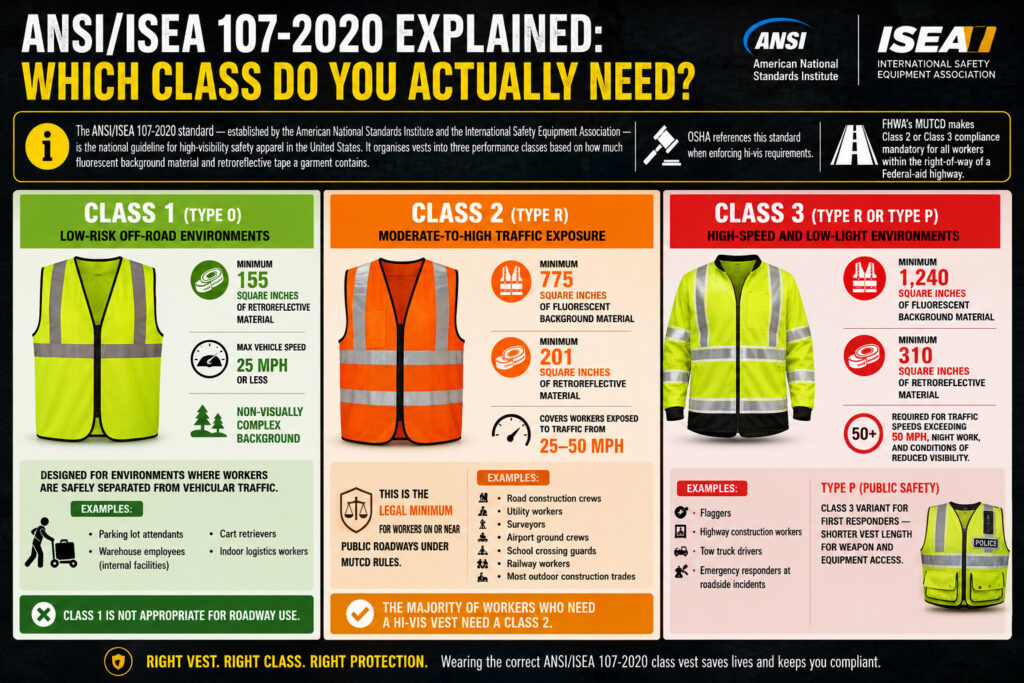
The ANSI/ISEA 107-2020 standard — established by the American National Standards Institute and the International Safety Equipment Association — is the national guideline for high-visibility safety apparel in the United States. It organises vests into three performance classes based on how much fluorescent background material and retroreflective tape a garment contains. OSHA references this standard when enforcing high-visibility requirements, and the FHWA’s Manual on Uniform Traffic Control Devices (MUTCD) makes Class 2 or Class 3 compliance mandatory for all workers within the right-of-way of a Federal-aid highway.
Class 1 (Type O): Low-Risk Off-Road Environments
Minimum 155 square inches of retroreflective material. Designed for environments where workers are safely separated from vehicular traffic — maximum vehicle speed 25 mph and a non-visually complex background. Examples: parking lot attendants, warehouse employees in internal facilities, cart retrievers, indoor logistics workers. Class 1 is NOT appropriate for roadway use.
Class 2 (Type R): Moderate-to-High Traffic Exposure
Minimum 775 square inches of fluorescent background material and 201 square inches of retroreflective material. Covers workers exposed to traffic from 25–50 mph. This is the LEGAL MINIMUM for workers on or near public roadways under MUTCD rules. Examples: road construction crews, utility workers, surveyors, airport ground crews, school crossing guards, railway workers, and most outdoor construction trades. The majority of workers who need a hi-vis vest need a Class 2.
Class 3 (Type R or Type P): High-Speed and Low-Light Environments
Minimum 1,240 square inches of fluorescent background material and 310 square inches of retroreflective material, including reflective coverage on the sleeves or lower body for 360° visibility. Required for traffic speeds exceeding 50 mph, night work, and conditions of reduced visibility. Examples: flaggers, highway construction workers, tow truck drivers, emergency responders at roadside incidents. Type P (public safety) is the Class 3 variant for first responders — shorter vest length for weapon and equipment access.
The 2025 OSHA PPE Fit Requirement
Effective January 13, 2025, OSHA updated its construction industry PPE standard to require that all personal protective equipment — including safety vests — properly fits each individual worker. Employers can no longer distribute one-size-fits-all vests from a shared bin and call it compliant. This directly affects purchasing: employers must stock multiple sizes and, where applicable, women’s-specific cuts.
How to Verify Compliance
Every ANSI/ISEA 107-2020 compliant vest must have a permanently attached label stating: the ANSI/ISEA 107-2020 standard, the Performance Class (1, 2, or 3), the Garment Type (O, R, or P), and care instructions. A vest without this label is not verified compliant, regardless of how it appears on the package.
| Class | Type | Min. Background | Min. Retroreflective | Traffic Speed | Who Needs It |
|---|---|---|---|---|---|
| Class 1 | O | 217 sq in | 155 sq in | ≤25 mph | Warehouse, parking, off-road |
| Class 2 | R | 775 sq in | 201 sq in | 25–50 mph | Road construction, utilities, survey — legal min. for roadways |
| Class 3 | R or P | 1,240 sq in | 310 sq in | 50+ mph / night | Flaggers, highway crews, tow trucks, emergency responders |
Best High Visibility Safety Vests 2026: Quick Comparison
| Product | ANSI Class | Type | Pockets | Closure | Key Feature | Best For |
|---|---|---|---|---|---|---|
| JKSafety 9-Pocket ★ | Class 2 Type R | R | 9 | Zipper | 360° reflective, 2-tier ID pocket | Best Overall |
| Ergodyne GloWear | Class 2 Type R | R | 3 + mic tab | Zipper | 25-wash rated, Ergodyne brand | Best Budget |
| XIAKE 9-Pocket | Class 2 | R | 9 | Zipper | Lightweight mesh, value pricing | Budget 9-Pocket |
| Pioneer Class 3 Sleeved | Class 3 Type R | R | 4 | Zipper | Sleeve reflective strips, tricot | Best Class 3 |
| Women’s 11-Pocket Vest | Class 2 | R | 11 | Zipper | Women’s-specific fit, 11 pockets | Best for Women |
| Oberon FR Hi-Vis Vest | Class 2 + FR | R | Multiple | Zipper | Arc-rated FR + ANSI compliant | Best FR Vest |
| VIEWBRITE EMS Vest | Class 2 | R | Multiple | Zipper | EMS/public safety design | Best EMS Vest |
| PeerBasics 10-Pack | Class 2 | R | 2 | Hook & loop | 10-pack crew value | Best Multi-Pack |
| Radians SV55 Engineer | Class 2 Type R | R | 7+ specialty | Heavy-duty #8 zip | Padded neck, Oxford front, 3M tape | Best Surveyor/Engineer |
| JKSafety BX Series | Class 2 | R | Multiple | Zipper | Updated JKSafety design | Updated JK Pick |
| Surveyor Heavy-Duty Vest | Class 2 | R | Multiple | Zipper | Heavy duty construction, multiple pockets | Heavy-Duty Surveyor |
| Gely 15-Pack | Class 2 | R | Pockets + zip | Zipper | 15-pack crew kit | Largest Crew Pack |
★ = Editor’s top pick. Always verify the ANSI/ISEA 107-2020 compliance label on your vest before use. Prices verified at time of publishing — confirm current pricing on Amazon.
1. JKSafety 9 Pockets Class 2 High Visibility Safety Vest — Best Overall
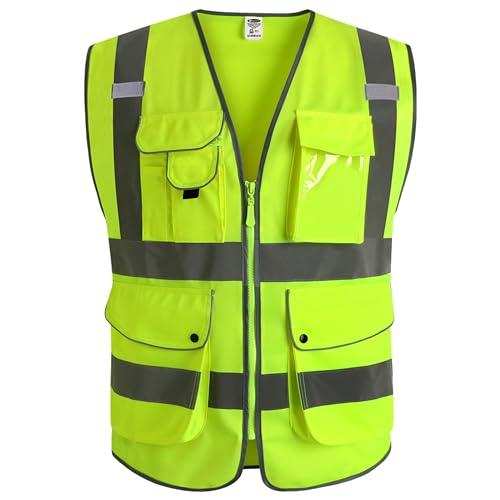
The JKSafety 9-Pocket Class 2 Safety Vest is the best overall high visibility safety vest on Amazon in 2026 — the product that sits at the top of the bestseller list not through a single exceptional feature but through the combination of genuine ANSI/ISEA 107 Class 2 Type R compliance, nine well-designed pockets, 360° retroreflective coverage, and a price-to-utility ratio that no competitor in the class has matched. JKSafety is the dominant brand in the ANSI Class 2 Amazon category, and this specific model has accumulated one of the largest review bases of any safety vest on the platform — a volume that reflects consistent field performance across construction, utilities, roadwork, and security applications.

The vest is constructed from 100% polyester mesh — lightweight and breathable for workers wearing it through an 8-hour shift in outdoor conditions. The 2-inch-wide reflective strips run along the shoulders, chest, waist, and back in a configuration that meets ANSI’s requirement for 360° retroreflection — meaning the vest is visible from the front, both sides, and the rear at night when vehicle headlights illuminate the retroreflective material. The nine pockets are organised specifically for working-day utility: a PVC-transparent ID window pocket (no fumbling to show credentials at a checkpoint), a phone pouch, two large snap-button utility pockets for daily items, pen holders, and additional compartments. For a general construction worker, security officer, or utility worker who needs to carry a phone, ID, pen, radio, and small tools without a separate bag, this pocket layout covers the daily requirement.

Size range runs from Small through 5XL — relevant to the OSHA 2025 PPE fit requirement that mandates properly fitting vests for each individual worker. The vest is machine washable. Available in fluorescent yellow-green and safety orange, both of which meet ANSI’s approved colour specifications. JKSafety also offers custom bulk printing services for employers who need company logos on their crew vests. This is the vest to buy if you need one ANSI Class 2 Type R vest for roadside work, construction, or outdoor utility work and want the best combination of pocket utility and verified compliance at its price point.
Pros: Genuine ANSI/ISEA 107 Class 2 Type R compliance; 9 functional pockets including transparent ID window; 360° retroreflective strip coverage; 100% polyester mesh — lightweight and breathable; machine washable; S–5XL size range; available yellow-green and orange; one of the most-reviewed safety vests on Amazon.
Cons: Mesh fabric less durable than woven for very demanding environments; pocket count reduces background material coverage — verify compliance label for your specific application; hook-and-loop components on pockets may wear over time.
Who it’s for: Construction workers, roadside crew, utility and railway workers, security personnel, airport ground crews, and anyone needing a versatile, compliant Class 2 vest for general outdoor work.
→ Check Current Price on Amazon
2. Ergodyne GloWear Economy Hi-Vis Safety Vest — Best Budget by a Trusted Brand

The Ergodyne GloWear economy safety vest is the budget option from a brand that the professional safety market trusts — and that distinction matters. Ergodyne is one of the most established names in industrial PPE, and their GloWear line is genuinely ANSI/ISEA 107-2020 compliant at a price point that makes equipping a crew economical. For safety managers, site supervisors, and employers who need cost-effective compliant vests without sacrificing the verified ANSI compliance that a random unbranded budget vest may or may not actually provide, the GloWear economy range offers an important quality assurance floor.

The vest is constructed from 3.3 oz polyester mesh — a standard weight for economy Class 2 vests that provides adequate breathability for outdoor use. It features a zipper closure (an improvement over hook-and-loop for workers who put a vest on and remove it dozens of times per shift), one interior pocket, two exterior pockets, and a single mic tab for radio communication — a useful feature for site supervisors and workers who use two-way radios. The 2-inch solid retroreflective tape meets ANSI Class 2 Type R standards. Ergodyne’s published wash rating for this vest is 25 machine washes before the reflective performance should be assessed — a specific, quantified durability standard that most economy vest brands don’t publish.

The 25-wash rating is the most valuable specification in this product’s listing. It gives safety managers a clear replacement schedule: a worker wearing this vest five days a week and washing weekly should consider replacement at approximately six months. Employers who build vest replacement into annual safety budgets can use this figure for cost planning. This level of specification from a manufacturer on an economy vest is unusual and reflects Ergodyne’s professional market focus. For a single-vest purchase on a limited budget from a brand with professional PPE credibility, the Ergodyne GloWear economy vest is the right choice.
Pros: Ergodyne professional brand credibility; ANSI/ISEA 107-2020 Class 2 Type R compliant; published 25-wash durability rating; zipper closure; mic tab for radio users; machine washable; economy price point with brand assurance.
Cons: Fewer pockets than the JKSafety (3 vs 9) — less suited to workers who carry significant equipment; economy fabric weight means shorter service life under heavy daily use; limited size range vs JKSafety.
Who it’s for: Workers who need a reliable, brand-verified Class 2 vest at the lowest possible price from a professional safety brand. Also strong for safety managers who value the published wash rating for replacement scheduling.
→ Check Current Price on Amazon
3. XIAKE 9 Pockets Class 2 High Visibility Reflective Safety Vest — Best Value 9-Pocket
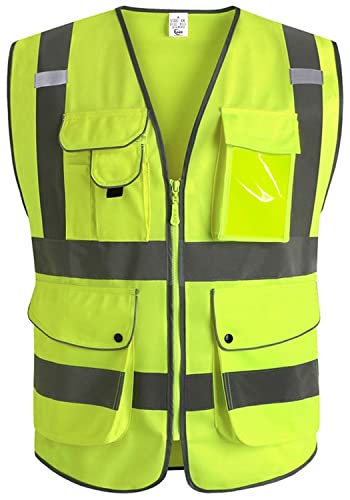
The XIAKE 9-Pocket Class 2 Safety Vest is the value-tier alternative to the JKSafety 9-pocket reviewed above — the same pocket count and similar ANSI Class 2 compliance at a slightly lower price point. For buyers who need 9-pocket utility and ANSI compliance but are purchasing multiples (to keep a spare at the truck, or to outfit a small crew) and want to minimise cost per unit, the XIAKE is the most practical comparison purchase to the JKSafety.

The vest uses 100% polyester mesh construction with 2-inch reflective strips configured for ANSI Class 2 coverage. The 9-pocket layout provides phone pouch, ID window, utility pockets, and pen loops — functionally similar to the JKSafety 9-pocket layout. Zipper closure. Available in fluorescent yellow and orange. The XIAKE has a substantial Amazon review base at 4.5 stars with thousands of ratings — a volume that confirms field performance at the value price point.

The honest comparison to JKSafety: the materials, stitching, and snap-button quality on the XIAKE are comparable — the price difference is marginal. Both are mesh vests at similar weights with similar pocket layouts. If the JKSafety is available at close price, it has a stronger brand track record in the professional market. If the XIAKE is meaningfully cheaper at the time of purchase, it is a legitimate alternative. For buyers comparing both on Amazon at the same time, the primary factors are current price and size availability.
Pros: ANSI Class 2 compliant; 9 functional pockets including ID window; zipper closure; lightweight polyester mesh; strong Amazon review volume; available yellow and orange; competitive value pricing.
Cons: Less brand recognition than JKSafety or Ergodyne in the professional safety market; mesh durability similar to other economy vests — not for the most demanding environments; review the compliance label on arrival.
Who it’s for: Workers who need 9-pocket Class 2 utility at the most economical price, and buyers who want a direct JKSafety alternative for cost comparison or size availability.
→ Check Current Price on Amazon
4. Pioneer Hi-Vis Sleeved Safety Vest — Best ANSI Class 3 Vest
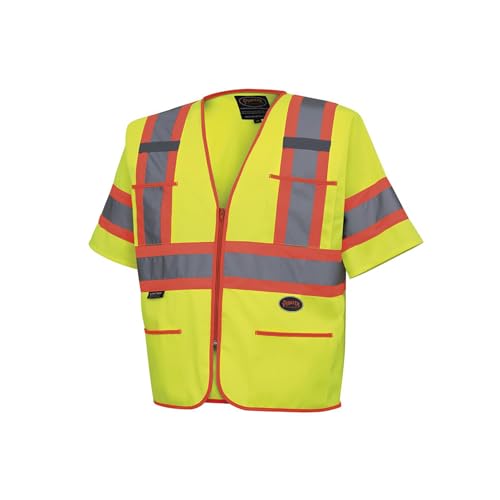
The Pioneer Hi-Vis Sleeved Class 3 Safety Vest is the highest-visibility option in this roundup and the only product reviewed here that meets ANSI Class 3 Type R requirements — the standard mandated for flaggers, highway construction workers at speeds exceeding 50 mph, night road crews, and emergency responders working at roadside incidents. If your work environment requires Class 3, this is not a matter of preference — it is a legal requirement under MUTCD for Federal-aid highway work, and using a Class 2 vest where Class 3 is mandated is both non-compliant and meaningfully less safe.

What makes Class 3 different from Class 2 in practical terms is the sleeve coverage. Where a Class 2 vest covers only the torso, a Class 3 sleeved vest extends retroreflective tape to the sleeves — creating a complete 360° visibility profile that includes the arms. This matters critically for flaggers, who raise their arms repeatedly to direct traffic, and for workers who crouch or bend in positions where the torso coverage of a Class 2 vest may not be visible from all directions. The Pioneer uses breathable tricot polyester fabric for the body — a lightweight, performance fabric that provides comfort during sustained wear over long shifts or in variable weather conditions. Four pockets provide basic equipment storage. Reflective tape runs along the torso AND down the sleeves in the ANSI Class 3 required configuration.

Pioneer Safety has a long-standing presence in the North American workwear market with a specific focus on high-visibility and protective apparel — the brand credibility here is meaningful. Available in fluorescent yellow-green and safety orange. If you are a flagger, a highway construction worker, a tow truck operator working on interstates, a utility worker on high-speed roads, or an emergency responder at roadside incidents, the Pioneer Class 3 sleeved vest is the correct tool. Using a Class 2 vest in these roles is non-compliant. Do not compromise on this classification based on price.
Pros: ANSI Class 3 Type R compliance — highest visibility class; sleeve reflective strips for 360° arm and torso visibility; Pioneer brand quality; breathable tricot polyester; 4 pockets; available yellow-green and orange; correct tool for flaggers, highway crews, and emergency responders.
Cons: Higher price than Class 2 alternatives; sleeves add warmth — less comfortable in high-heat conditions; 4 pockets only — less utility storage than 9-pocket Class 2 options; overkill (and unnecessary) for most warehouse or low-traffic applications.
Who it’s for: Flaggers, highway construction workers, tow truck operators, utility workers on high-speed roads, and emergency responders. Class 3 is mandatory for these roles — not optional.
→ Check Current Price on Amazon
5. Women’s Safety Vest with 11 Pockets and Zipper — Best for Women

OSHA’s January 2025 PPE fit update made explicit what experienced female tradespeople have known for decades: women cannot safely or comfortably wear oversized men’s safety vests sized down. An ill-fitting vest that bunches at the shoulders, extends below the hips, or gaps at the sides does not provide the coverage the ANSI standard requires and creates snag hazards from excess fabric. The Women’s Safety Vest with 11 Pockets is a purpose-built women’s-specific fit vest — not a small version of a men’s cut — with contoured proportions through the shoulders and waist, an appropriate length for women’s torso measurements, and a zipper closure that fits correctly over women’s workwear layers.

Eleven pockets is the highest pocket count in this roundup. For a female construction worker, site manager, or safety officer who carries a phone, radio, ID, notebook, pen, keys, and site documents on-body during a shift, 11 pockets provide the organisation that a 2 or 4-pocket vest simply cannot. The transparent ID window allows credential display without removing the vest. ANSI/ISEA compliant for Class 2 visibility — the appropriate classification for most outdoor construction, roadside, and utility applications. The bright neon yellow-green fluorescent background meets ANSI’s photometric requirements for daytime visibility. Machine washable.

For employers outfitting female crew members under the 2025 OSHA PPE fit requirement, this vest addresses the compliance gap that has historically been met by simply handing women a smaller men’s vest. Providing properly fitting women’s-specific PPE is now a legal obligation, not an accommodation. Stocking this vest alongside standard men’s sizes is the straightforward path to crew-wide compliance. For individual female workers who have never owned a properly fitting safety vest, the difference in comfort over an 8-hour shift — no excess fabric catching on equipment, no pulling at the shoulders, no adjusting throughout the day — is immediately apparent.
Pros: Women’s-specific contoured fit — not re-sized men’s vest; 11 pockets for maximum on-body organisation; ANSI Class 2 compliant; transparent ID window; zipper closure; machine washable; directly addresses OSHA 2025 PPE fit requirement for female workers.
Cons: Women’s sizing range — verify current availability in your size; fluorescent yellow-green only (check listing for colour options); newer brand in this category compared to Ergodyne or JKSafety.
Who it’s for: Women in construction, roadside work, utilities, site management, and security who need a properly fitting ANSI Class 2 vest and maximum pocket utility. Also essential for employers fulfilling the OSHA 2025 PPE fit requirement for female crew members.
→ Check Current Price on Amazon
6. Oberon FR Arc-Rated Hi-Vis Safety Vest — Best Flame-Resistant Vest

The Oberon FR Arc-Rated Hi-Vis Safety Vest addresses a dual compliance requirement that standard hi-vis vests cannot meet: workers who face BOTH a struck-by visibility hazard AND an arc flash or flame exposure hazard need a garment that simultaneously satisfies ANSI/ISEA 107 visibility requirements AND NFPA 70E or NFPA 2112 flame-resistance requirements. A standard polyester mesh hi-vis vest in a flame or arc flash environment is not just non-compliant — polyester melts and bonds to skin under heat exposure, making it actively dangerous in these conditions.

The Oberon FR vest is constructed from flame-resistant fabric with arc-rated protection, high-visibility fluorescent background material, and retroreflective tape — meeting both the visibility standard (ANSI/ISEA 107) and the thermal protection standard (verify the specific arc rating cal/cm² from the product listing for your site’s arc flash hazard analysis). The reflective tape on an FR vest must also be FR-rated — standard retroreflective tape can melt and burn in a flash fire. Oberon Safety is a specialist FR apparel manufacturer with specific expertise in arc-rated personal protective equipment, making them the appropriate brand to source FR hi-vis apparel from rather than a general safety supply brand that adds FR as a secondary specification.

Important care note for FR vests: Flame-resistant properties in treated-fabric FR garments are maintained through laundering to manufacturer-specified instructions. Using incorrect detergents (particularly fabric softeners or bleach-containing products) degrades FR treatment over time. Always wash FR garments to the manufacturer’s care label instructions — the FR rating has a service life that proper care extends and improper care shortens. Oberon provides specific care guidance for their FR garments. Verify the arc rating for your specific electrical hazard category before purchasing — arc ratings are site-specific based on the results of your workplace arc flash hazard analysis.
Pros: Meets both ANSI/ISEA 107 visibility AND NFPA FR requirements; Oberon specialist FR apparel manufacturer; FR-rated retroreflective tape; correct PPE for electrical utility, oil/gas, and arc flash exposed workers with traffic visibility requirements.
Cons: Significantly higher price than standard hi-vis vests; FR care requirements (specific laundering instructions) add maintenance complexity; verify specific arc rating cal/cm² against your site’s hazard assessment before purchasing; unnecessary and over-specified for workers with no flame/arc flash hazard.
Who it’s for: Electrical utility linemen, oil and gas workers, welders and hot work personnel working near traffic, and any worker who requires both ANSI hi-vis compliance AND FR/arc flash protection simultaneously. Consult your site safety officer or arc flash hazard assessment before specifying.
→ Check Current Price on Amazon
7. VIEWBRITE Reflective Class 2 EMS Vest — Best for EMS and Public Safety
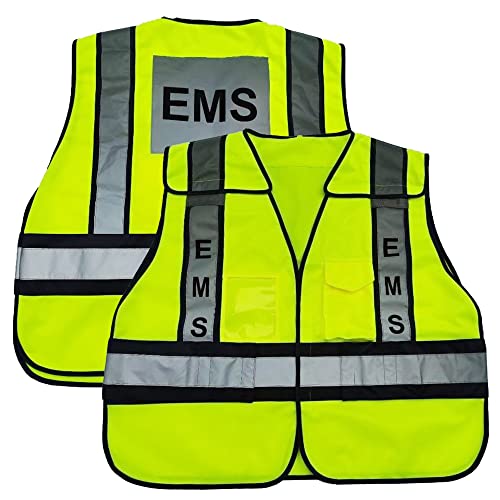
The VIEWBRITE EMS Vest is specifically designed for emergency medical services personnel, public safety workers, and first responders who need high-visibility identification in roadside, incident scene, and triage environments. The lime green colour and EMS-specific design elements distinguish this vest from standard construction hi-vis vests in environments where visual identification of role is as important as raw visibility — paramedics, EMTs, and first responders need to be both seen AND identified as medical personnel in multi-agency incident scenes.

The vest meets ANSI/ISEA Class 2 requirements for the retroreflective and background material coverage needed for roadside incident work. For first responders operating in or adjacent to public road right-of-way, Class 2 is the minimum required under MUTCD — Class 3 Type P (public safety) is the appropriate standard for some first responder roles where higher visibility is required. Verify with your agency’s SOPs which class is required for your specific role. The lime green fluorescent background provides the highest daytime luminescence factor of any ANSI-approved colour — more visible in daylight than safety orange in most lighting conditions.

The multiple pockets provide storage for EMS documentation, gloves, and small equipment. The zipper closure allows rapid donning and doffing at scene — important for medical personnel who may need to add or remove the vest quickly as they move between zones. For paramedics, EMTs, fire EMS personnel, search and rescue workers, and other public safety professionals who need a Class 2 hi-vis vest specifically configured for their field, the VIEWBRITE EMS vest provides the right combination of compliance, identification, and utility.
Pros: Purpose-built for EMS/first responder application; lime green for maximum daytime luminescence; ANSI Class 2 compliant; multiple pockets for field equipment; zipper for rapid donning; specific EMS visual identification function beyond standard construction vest.
Cons: Some first responder roles require Class 3 Type P — verify your agency’s requirements before purchasing; lime green may not match specific agency colour specifications; verify exact class and type against your department’s SOPs.
Who it’s for: Paramedics, EMTs, first responders, search and rescue personnel, and public safety workers who need ANSI Class 2 hi-vis with EMS-specific design for incident scene use. Always consult your agency’s PPE requirements.
→ Check Current Price on Amazon
8. PeerBasics Safety Vest 10-Pack — Best Multi-Pack for Crew Outfitting

The PeerBasics 10-Pack Safety Vest is the practical answer for site safety managers, contractors, and employers who need to outfit an entire crew with ANSI-compliant vests at the lowest per-unit cost. For a 10-person crew requiring Class 2 compliance for a roadway adjacent project, buying a 10-pack at a per-vest cost well below individual vest pricing is the economical approach to fleet PPE purchasing. The PeerBasics pack meets ANSI Class 2 requirements — the critical criterion for any employer who is legally required to provide compliant PPE under OSHA regulations.

The economy hook-and-loop closure is standard for multi-pack construction vests and appropriate for the use case: workers who put on and remove a vest at the start and end of a work zone pass, rather than wearing it on and off repeatedly throughout the day. For workers who frequently add and remove the vest, zipper-closure individual vests (like the JKSafety above) are more practical. Two pockets provide basic storage — adequate for a worker whose primary tools are on a belt rather than in the vest. The fluorescent yellow background and silver retroreflective stripes meet ANSI Class 2 reflective coverage requirements.

Replacement planning for economy multi-pack vests: daily-wear outdoor workers should expect to replace economy mesh vests every 6 to 12 months as fluorescent material fades and retroreflective tape degrades. The 10-pack format supports this replacement cadence economically — when a vest’s reflective tape begins to crack or the fluorescent background fades visibly (test: does it look bright against a known-bright reference?), replace it. Buying a 10-pack annually for a regular crew is often more cost-effective than buying higher-durability individual vests that still need periodic replacement. For the OSHA 2025 fit requirement, ensure multiple sizes are stocked — a 10-pack of one size does not fulfil the requirement to properly fit each individual worker.
Pros: ANSI Class 2 compliant; 10-pack format dramatically reduces per-unit cost; fluorescent yellow with silver reflective stripes; economy hook-and-loop closure; machine washable; practical for crew outfitting and annual replacement budgets.
Cons: Hook-and-loop closure less practical than zipper for frequent on/off; only 2 pockets — limited tool utility; economy fabric means shorter service life than premium individual vests; one-size or limited sizing in pack format — verify the OSHA 2025 fit requirement for your crew.
Who it’s for: Contractors and site safety managers equipping crews at the most economical per-unit cost, employers maintaining annual replacement schedules, and any situation requiring 10 compliant Class 2 vests immediately.
→ Check Current Price on Amazon
9. Radians SV55 Class 2 Heavy Woven Two-Tone Engineer Vest — Best Surveyor and Engineer Vest

The Radians SV55 is the standout surveyor and engineer vest in this roundup — a heavy-duty, multi-pocket Class 2 vest specifically designed for civil engineers, project managers, construction superintendents, site surveyors, and field professionals who carry significantly more equipment in a vest than the average construction worker. Where the JKSafety’s 9 pockets cover daily utility, the Radians SV55’s pocket system is engineered for fieldwork: dedicated slots for upside-down spray paint cans, water bottles, tablet computers, and two-way radio with dual mic tabs.

The two-tone construction is the SV55’s defining feature: a 300D woven Oxford polyester front panel combined with a polyester mesh back. The Oxford front is considerably more durable and load-bearing than mesh — it holds the weight of cargo pockets filled with a tablet, a 16 oz water bottle, and flagging tape without distorting or tearing at the pocket attachments. The padded neck is a design detail that reflects field experience: when cargo pockets are loaded with a tablet, two paint cans, and a water bottle, that weight distributes to the neck strap. The padding distributes that load across more surface area, preventing the neck strap from cutting into the skin after hours of wear. This is the kind of practical design decision that separates a professional-grade product from a generic vest.

3M 8712 silver glass bead retroreflective tape provides Class 2 night visibility — 3M is the benchmark name in retroreflective materials, and specifying 3M tape (rather than generic reflective material) on the SV55 is a meaningful quality indicator. The heavy-duty #8 zipper closure holds securely through a day of bending, climbing, and equipment movement. Dual mic tabs accommodate radio communication at both chest and shoulder. The full pocket specification includes a front flap-covered radio pocket, flap-covered split pencil pocket, lower front cargo pockets with flagging tape grommets, two water bottle/paint can pockets, and two large two-layer inside open pockets. Radians is a professional-grade safety brand — this vest is built for years of field use, not seasonal replacement. For civil engineers, site managers, and surveyors who spend their days moving between the field and site office, the Radians SV55 is the practical professional choice.
Pros: Specialty pocket layout for engineering fieldwork (spray paint, tablet, water bottle, flagging tape); padded neck for load distribution when cargo pockets are full; 300D Oxford woven front — significantly more durable than mesh; 3M 8712 retroreflective tape; dual mic tabs; heavy-duty #8 zipper; two-tone design maintains professional appearance; Class 2 Type R compliant.
Cons: Higher price than basic mesh vests; heavier weight due to Oxford front — less suited as a hot-weather option; more bulk than a simple 9-pocket mesh vest; overkill for workers who don’t carry significant field equipment.
Who it’s for: Civil engineers, site surveyors, project managers, construction superintendents, traffic control supervisors, and field professionals who carry a tablet, radio, water, paint, and documentation on-body during a full working day.
→ Check Current Price on Amazon
10. JKSafety Safety Vest BX Series — Best Updated JKSafety Design
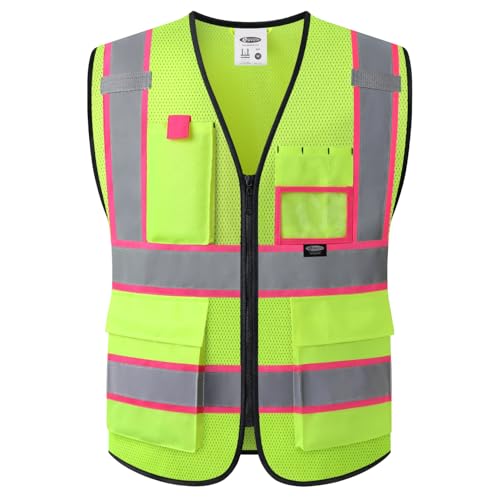
The JKSafety BX Series represents JKSafety’s updated vest design — newer than the flagship 9-pocket model reviewed as the best overall, with a refined pocket layout and updated reflective stripe configuration. For buyers who want JKSafety’s verified brand quality and ANSI Class 2 compliance in an alternative style or layout to the B01LVVF6FB, the BX Series provides a complementary option within the same trusted brand.
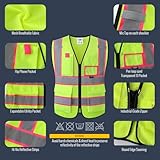
JKSafety maintains the same ANSI/ISEA 107 Class 2 Type R compliance standard across their range. The BX series continues the polyester mesh construction, zipper closure, and reflective strip configuration that has earned JKSafety its position as Amazon’s dominant safety vest brand by review volume. The updated design incorporates feedback from the large user base that the flagship model has accumulated, with refinements to pocket accessibility and closure quality.

For employers who already use JKSafety vests and want to trial the updated BX series design before transitioning their full crew, this is the logical evaluation purchase. For individual buyers who find the B01LVVF6FB unavailable in their size or colour, the BX series provides equivalent compliance and brand quality in an alternative listing. As a newer listing, its Amazon review volume is still building — but JKSafety’s brand-level quality controls are consistent across their product range.
Pros: JKSafety brand quality and ANSI Class 2 Type R compliance; updated design incorporating user feedback; zipper closure; multiple pockets; polyester mesh construction; consistent with JKSafety’s quality standards.
Cons: Newer listing — Amazon review base still developing compared to flagship model; check current sizing and colour availability before purchasing.
Who it’s for: JKSafety brand users who want to evaluate the updated BX Series design, or buyers for whom the flagship JKSafety 9-pocket is unavailable in the required size or colour.
→ Check Current Price on Amazon
11. Surveyor Safety Vest Reflective Heavy-Duty Class 2 — Best Heavy-Duty Surveyor Option

The Heavy-Duty Surveyor Safety Vest (B0B1LNRK1W) is a multi-pocket Class 2 surveyor-style vest positioned as the value alternative to the Radians SV55 for field workers who need surveyor pocket functionality without the premium price of the Radians. It provides a generous pocket count, zipper closure, and the ANSI Class 2 reflective coverage needed for outdoor roadside and construction work, in a surveyor vest format that provides more utility than a standard 9-pocket mesh vest without the Oxford-panel construction cost of the SV55.

Multiple pockets include large exterior cargo pockets suitable for maps, documents, and field notebooks, plus interior compartments for phones and smaller items. The zipper closure secures the vest in windy outdoor conditions. ANSI Class 2 retroreflective tape configuration ensures visibility compliance for roadside and construction environments. For field technicians, utility inspectors, and construction workers who need a more substantial vest than a basic mesh option but who don’t require the specialised engineering-specific pockets (spray paint slots, tablet pockets) of the Radians SV55, this vest covers the middle ground effectively.

The heavy-duty designation reflects a heavier fabric weight than standard economy mesh vests — more durable for sustained outdoor use and less prone to the rapid fading and pocket wear that pure mesh economy vests experience under daily field conditions. This vest is appropriate for workers who wear it five days a week and need it to hold up for more than six months without requiring replacement.
Pros: Surveyor-style pocket layout with multiple large compartments; heavy-duty fabric more durable than economy mesh; zipper closure; ANSI Class 2 compliant; value pricing vs premium surveyor vests like the Radians SV55.
Cons: Less specialised pocket configuration than Radians SV55 (no spray paint/flagging tape grommets); build quality below the SV55’s 300D Oxford front; fewer brand credentials than Radians.
Who it’s for: Field technicians, utility inspectors, and construction workers who need surveyor-style pocket capacity and durable construction at a middle-tier price point.
→ Check Current Price on Amazon
12. Gely 15-Pack Reflective Safety Vests — Best Large Crew Pack

The Gely 15-Pack Reflective Safety Vests is the highest-quantity pack in this roundup — 15 ANSI Class 2 compliant vests with zipper closures and pockets in a single purchase. Where the PeerBasics 10-pack is the right size for smaller crews, the Gely 15-pack serves larger project teams, construction companies with rotating crews, and site safety programs that maintain a stock of compliant vests for site visitors, subcontractors, and temporary workers who arrive on site without their own PPE.
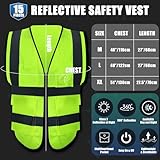
The inclusion of zipper closures across the pack — rather than the hook-and-loop common in most economy multi-packs — is a meaningful upgrade. Zipper closures maintain their function significantly longer than hook-and-loop under daily use: the hook material doesn’t pill or lose grip over repeated openings and closings the way loop-and-hook does. Pockets provide basic storage for the range of workers who will cycle through a site-supply vest on a project. ANSI Class 2 compliance meets the MUTCD and OSHA legal minimum for roadway work.

For site safety programs: maintaining 15 compliant vests as a site-supply inventory means that any visitor, inspector, or subcontractor who arrives without compliant PPE can be equipped immediately and legally. This is standard practice on large construction and infrastructure projects, and the Gely 15-pack provides the most economical per-vest cost with a zipper closure upgrade at this quantity. Verify size options in the pack and confirm the ANSI class labelling on the product listing before ordering for any application where compliance documentation may be required.
Pros: 15-vest pack — largest quantity in this roundup; zipper closures across the pack (upgrade over economy hook-and-loop packs); pockets for basic storage; ANSI Class 2 compliant; strong per-vest economics at 15-unit quantity.
Cons: Verify size distribution in the pack for OSHA 2025 fit compliance — a single-size 15-pack does not fulfil individual-fit requirements for a crew; newer brand in the safety supply market; review compliance label on arrival.
Who it’s for: Large construction crews, site safety programs maintaining a PPE stock for visitors and subcontractors, and any project where 15+ ANSI-compliant vests are needed at the lowest per-unit cost with zipper closure quality.
→ Check Current Price on Amazon
How to Choose the Best High Visibility Safety Vest: Complete Buyer’s Guide
Step 1: Determine the Required ANSI Class for Your Environment
This is the only non-negotiable step. Before considering any other feature, identify which ANSI class is required for your specific work environment. If you work on or near a public roadway: Class 2 is the legal minimum; Class 3 is required for high-speed highways (50+ mph) and night work. If your work is off-road (warehouse, parking lot, private facility): Class 1 may be sufficient, though Class 2 is always acceptable in place of Class 1. When in doubt, choose a higher class — over-specification carries no safety penalty, while under-specification is both non-compliant and less safe. Consult your site safety officer, your employer’s PPE program, or the MUTCD for your specific work category.
Fluorescent Yellow-Green vs Safety Orange
Both colours are ANSI-approved and provide effective visibility. Fluorescent yellow-green (lime) has the highest luminescence factor of any colour visible to the human eye — it appears brighter in most daylight conditions. Safety orange is more visible at dawn, dusk, and in forested environments where the colour contrasts more strongly against green backgrounds. Many employers specify one colour for visual consistency across a crew. When no specification exists, yellow-green is the default choice for maximum daytime visibility.
Mesh vs Solid vs Two-Tone Fabric
100% polyester mesh (JKSafety, Ergodyne economy, XIAKE): maximum breathability, lightest weight, most economical, adequate for most applications — replaces more frequently. Solid fabric: more durable, less breathable, some DOT work specifications require solid fabric for certain applications — check your project spec. Two-tone (Radians SV55): combines woven/Oxford solid front panels for load-bearing with mesh back for breathability — the practical choice for workers carrying significant equipment in vest pockets.
Pocket Count and Configuration
General construction and roadwork: 2–9 pockets covers the typical daily utility (phone, pen, ID). Surveying and engineering: 10+ pockets plus dedicated tablet, radio, and paint pockets needed. EMS and security: ID window, radio pocket, and quick-access pockets for field documentation. Women in construction: 11-pocket women’s-specific vest provides full utility in a properly fitting cut. One-size/economy: 2 pockets is the norm — appropriate for workers whose tools are on a belt rather than in the vest.
Closure Type
Zipper: most secure, most practical for repeated on/off during a workday, maintains function longer than hook-and-loop. Hook-and-loop: faster initial donning, common in economy vests and multi-packs, degrades in gripping function over repeated cycles. For daily professional use: zipper. For occasional or visitor/site-supply use: hook-and-loop is adequate.
The OSHA 2025 PPE Fit Requirement
Effective January 13, 2025, all safety vests must properly fit each individual worker. This means employers must stock an appropriate size range — not just Large and XL — and provide women’s-specific cuts where female workers are present. A vest that doesn’t fit correctly may not maintain the ANSI-required coverage areas on the body, reducing effective compliance even if the vest itself is certified. Always verify sizing against the manufacturer’s size chart before purchasing.
When to Replace a Safety Vest
Replace when: the fluorescent background material has faded visibly (compare to a new vest or a bright fluorescent reference); the retroreflective tape is cracked, peeling, discoloured, or fails to reflect light clearly when illuminated with a flashlight in a dark environment; the vest is torn, stained beyond cleaning, or otherwise damaged. For economy mesh vests worn outdoors daily: inspect at 6 months, plan for replacement by 12 months. For heavier fabric vests (Radians SV55 style): longer service life, but retroreflective tape should still be inspected regularly. No ANSI standard sets a specific wash count expiration — the Ergodyne 25-wash rating is a manufacturer’s durability specification, not an ANSI standard requirement, though it serves as a useful planning benchmark.
For related workwear and tool reviews, see our best tool gifts for dad, DeWalt power tool reviews, and our Carhartt vs Dickies work pants comparison for complementary workwear guidance.
Which Safety Vest Do You Need? Quick Recommendation by Job Type
Road construction worker (highway or road-adjacent): JKSafety 9-Pocket Class 2 for standard roadwork. Pioneer Class 3 Sleeved for high-speed highways (50+ mph) or night work — Class 3 is legally required in these conditions.
Flagger / traffic control: Class 3 is mandatory. Pioneer Class 3 Sleeved Vest. Do not substitute a Class 2 vest in flagging operations.
Civil engineer / surveyor / project manager: Radians SV55 Engineer Vest for the full specialist pocket system. Heavy-Duty Surveyor Vest for a value-tier alternative.
Electrical utility / lineman with arc flash exposure: Oberon FR Arc-Rated Hi-Vis Vest. Standard polyester mesh vests are not appropriate where arc flash or flame hazards exist alongside visibility requirements.
EMS / first responder: VIEWBRITE EMS Vest for Class 2 incident scene work. Verify with your agency whether Class 3 Type P is required for your specific role.
Women in any construction or roadwork role: Women’s 11-Pocket Vest for a properly fitting Class 2 vest that fulfils the OSHA 2025 PPE fit requirement.
Warehouse worker / indoor facilities / parking lot: Class 1 Type O is the minimum standard — though Class 2 is acceptable and provides additional safety margin. Ergodyne GloWear economy or JKSafety 9-Pocket both serve this application.
Contractor outfitting a full crew: Gely 15-Pack for the best per-vest economics at scale. PeerBasics 10-Pack for smaller crews.
Frequently Asked Questions
What ANSI class safety vest do I need?
If you work near a public roadway: Class 2 minimum, Class 3 if traffic exceeds 50 mph or work occurs at night. If you are a flagger: Class 3 is legally required. If your work is off-road (warehouse, parking lot, indoor facility): Class 1 is the minimum standard. When in doubt, use a higher class — there is no safety penalty for exceeding the minimum requirement.
Is a Class 2 safety vest required by OSHA?
For workers within the right-of-way of Federal-aid highways, yes — the FHWA’s MUTCD requires Class 2 or Class 3 high-visibility apparel. OSHA’s 1926.201 references ANSI/ISEA standards for construction work near traffic. OSHA’s General Duty Clause also requires employers to protect workers from struck-by hazards, which includes providing appropriate hi-vis apparel for workers near vehicle traffic.
What is the difference between Class 2 and Class 3 safety vests?
Class 3 requires more fluorescent background material (1,240 sq in vs 775 sq in for Class 2) and more retroreflective material (310 sq in vs 201 sq in). Most importantly, Class 3 requires reflective coverage on the sleeves or lower body — providing 360° visibility including the arms and legs. This makes the worker visible from all angles even when arms are raised, crouching, or in positions where torso-only coverage isn’t visible. Class 3 is required for high-speed highways and night work.
What does ANSI/ISEA 107-2020 mean on a safety vest label?
It means the vest has been designed and tested to meet the 2020 revision of the American National Standard for High-Visibility Safety Apparel — the current benchmark that OSHA and the MUTCD reference for worker visibility compliance. The label should also specify the Performance Class (1, 2, or 3) and the Garment Type (O, R, or P). A vest without this specific label information is not verified compliant under the standard.
When should a high-visibility safety vest be replaced?
Replace when the fluorescent background fades visibly, when retroreflective tape cracks, peels, or fails to reflect light when tested with a flashlight in a dark room, or when the vest is damaged. For economy mesh vests worn outdoors daily: inspect at 6 months, plan replacement by 12 months. Ergodyne’s published 25-wash rating provides a useful planning benchmark for their economy vest line. No ANSI standard sets a specific replacement interval — visual inspection is the required method.
What does the new OSHA 2025 PPE fit requirement mean for safety vests?
Effective January 13, 2025, OSHA requires that all PPE including safety vests properly fit each individual worker. Employers must provide vests in appropriate sizes for each worker rather than distributing one-size-fits-all from a shared bin. Where female workers are present, women’s-specific fit vests must be available. Employers should audit their vest inventory to ensure size range and women’s fit compliance.
Is fluorescent yellow or orange better?
Both are ANSI-approved. Fluorescent yellow-green provides the highest daytime luminescence of any colour visible to the human eye and is the better choice for most daylight environments. Safety orange provides stronger contrast in forested environments or at dawn and dusk. Many employers specify one colour for visual consistency. When no specification exists, yellow-green is the standard choice for maximum daytime visibility.
Can I use a standard hi-vis vest if I work with electrical hazards?
No. Standard polyester mesh safety vests are not appropriate for workers exposed to arc flash or flame hazards. Polyester melts and bonds to skin under heat exposure — this makes a standard mesh vest actively dangerous in electrical utility environments. Workers who need both hi-vis compliance and flame/arc flash protection must use an FR-rated, arc-rated hi-vis vest like the Oberon FR vest reviewed above. Consult your arc flash hazard analysis for the required arc rating.
Our Final Verdict
For the majority of construction, roadwork, and outdoor utility workers who need a reliable, compliant, and practical ANSI Class 2 safety vest, the JKSafety 9-Pocket Class 2 Vest is the best overall choice — verified ANSI/ISEA 107 compliant, 9 well-designed pockets, 360° reflective coverage, and available S–5XL. For high-speed highway work, flagging, or any role where Class 3 is mandated, the Pioneer Class 3 Sleeved Vest is the correct tool — a Class 2 vest is not a substitution. For engineers, surveyors, and field managers who carry significant equipment, the Radians SV55 Engineer Vest provides the specialised pocket system and Oxford-panel durability that general mesh vests can’t match. And for women in any trade role, the Women’s 11-Pocket Vest provides the properly fitting, ANSI-compliant option that OSHA’s 2025 PPE fit rule now requires employers to stock.
High-visibility safety apparel is PPE in the most direct sense — it’s the control that prevents a driver from striking a worker who would otherwise be invisible in their peripheral vision at speed. Buy the right class, verify the compliance label, replace it when the reflective tape degrades, and ensure it fits. The vest that saves a life is the one that was worn correctly, not the cheapest one that happened to be in the van.
This article contains affiliate links. Purchases made through our Amazon links may earn Protguide a small commission at no additional cost to you. All ANSI class information and OSHA requirement statements are based on ANSI/ISEA 107-2020 and OSHA/MUTCD regulations as of 2026 and are provided for general guidance only. Always consult your site safety officer, employer PPE program, and applicable regulations for requirements specific to your work environment.
All products in this article:
JKSafety 9-Pocket Class 2 ·
Ergodyne GloWear Economy ·
XIAKE 9-Pocket Class 2 ·
Pioneer Class 3 Sleeved ·
Women’s 11-Pocket Vest ·
Oberon FR Hi-Vis Vest ·
VIEWBRITE EMS Vest ·
PeerBasics 10-Pack ·
Radians SV55 Engineer ·
JKSafety BX Series ·
Heavy-Duty Surveyor Vest ·
Gely 15-Pack