

Until around 2018, experienced finish carpenters universally chose a compressor and hose over any cordless nailer. The gap in power, reliability, and nail capacity was real — cordless was for convenience, pneumatic was for work. By 2026, brushless motor technology and lithium-ion battery density have closed that gap to near-zero for most trim applications. Modern cordless brad nailers drive 18-gauge brads through oak and maple as consistently as pneumatic, fire 700–1,900 nails per charge, and eliminate the compressor, hose, and power outlet that made pneumatic impractical for remote trim work. The best cordless brad nailers have genuinely replaced pneumatic for trim carpenters, finish carpenters, cabinet installers, and serious DIYers. (Not sure a brad nailer is the right type? Our best nail guns guide matches framing, finish, brad and pin nailers to the job.)
The honest answer to “should I switch from pneumatic to cordless?” for trim work is yes — for baseboards, door casings, window casings, crown moulding, and cabinet face frames, cordless nailers match pneumatic performance in 2026. The exception is production framing where thousands of nails go through daily and multiple operators share one compressor: at that scale, pneumatic economics still win. For everyone else reading this guide, cordless is the right choice.
This guide reviews ten of the best cordless brad nailers on Amazon in 2026, across every budget tier and battery platform — with specific ecosystem guidance so you can identify which nailer runs on the batteries you already own, a nail gauge comparison for buyers who aren’t sure whether they need a brad nailer or a finish nailer, and honest performance assessments drawn from Family Handyman’s March 2026 hands-on testing, Bob Vila’s tested roundup, and Pro Tool Reviews’ professional field evaluation.
Brad Nailer vs. Finish Nailer vs. Pin Nailer — Which Do You Actually Need?
Before comparing specific cordless models, understanding what an 18-gauge brad nailer does — and doesn’t — do clarifies whether it’s the right tool for your project. This is the section most buyer’s guides skip, and it results in thousands of people buying the wrong gauge for their application.
18-Gauge Brad Nailer — What This Article Covers
The 18-gauge brad nailer is the middle-ground trim nailer — thicker than a pin nailer for meaningful holding power, but leaving a smaller hole than a finish nailer so less filler is needed for a finished surface. It is the single most versatile nailer for interior trim work and the correct tool for the majority of residential trim and woodworking applications.
15/16-Gauge Finish Nailer
A heavier nail for thicker trim and structural applications. Best for heavy crown moulding (4″+ profiles), large window sills, door frames that receive regular impact, and stair treads. Leaves a larger hole requiring more filler. If your trim is thick, heavy, or needs strong mechanical hold, a finish nailer is the right choice over a brad nailer.
23-Gauge Pin Nailer
Nearly headless and extremely thin — leaves essentially no visible hole. Very limited holding power: correct for securing small delicate mouldings during glue-up, veneer edge banding, glass bead installation, and fine cabinetry where appearance matters more than holding strength alone.
The practical decision: Delicate trim where hole size is critical → pin nailer. Standard interior trim, baseboards, casings, cabinet face frames, woodworking assembly → 18-gauge brad nailer. Heavy or structural trim, thick mouldings → 15/16-gauge finish nailer. When in doubt, the 18-gauge brad nailer covers 80% of interior trim applications and is the correct starting point for most buyers.
| Gauge | Nail Size Range | Hole Size | Holding Power | Best Applications |
|---|---|---|---|---|
| 18-gauge brad | 5/8″ – 2-1/8″ | Small | Moderate | Baseboards, casings, crown, cabinet face frames, woodworking assembly |
| 15-gauge finish | 1-1/4″ – 2-1/2″ | Medium | High | Heavy crown, door frames, stair treads, structural trim |
| 16-gauge finish | 1″ – 2-1/2″ | Medium-small | Medium-high | Baseboard in hardwood floors, thicker mouldings |
| 23-gauge pin | 5/8″ – 1-3/8″ | Nearly invisible | Low | Delicate mouldings, veneer, glue-up positioning |
Quick Comparison — All 10 Cordless Brad Nailers at a Glance
All models fire 18-gauge brads unless noted. Weight listed with manufacturer-specified battery. Tool-only weights are typically 1–2 lbs lighter.
| Model | Drive System | Nail Range | Battery Platform | Dry-Fire Lockout | Brushless | Best For | Price | Buy |
|---|---|---|---|---|---|---|---|---|
| ★ DeWalt DCN680D1 | Brushless motor | 5/8″ – 2-1/8″ | DeWalt 20V MAX | ✅ Yes | ✅ Yes | Best Overall | ~$199 | View → |
| Milwaukee M18 FUEL 2745-21 | POWERSTATE brushless | 5/8″ – 2-1/8″ | Milwaukee M18 | ✅ Yes | ✅ Yes | Best Professional | ~$329 | View → |
| Ryobi PCN540B ONE+ | AirStrike spring drive | 5/8″ – 2″ | Ryobi 18V ONE+ | ✅ Yes | N/A (spring) | Best Budget | ~$99 | View → |
| Metabo HPT NT1850DE | Brushless motor | 5/8″ – 2-1/8″ | MultiVolt 18V/36V | ✅ Yes | ✅ Yes | Best Compact / Lifetime Warranty | ~$179 | View → |
| Craftsman CMCN618C1 V20 | Brushed motor | 5/8″ – 2″ | Craftsman V20 | ✅ Yes | ❌ No | Best for DIYers | ~$129 | View → |
| Ridgid R09890B 18V | HYPERDRIVE brushless | 5/8″ – 2-1/8″ | Ridgid 18V | ✅ Yes | ✅ Yes | Best Warranty (LSA) | ~$149 | View → |
| Freeman PE20V31618G | Brushless motor | 5/8″ – 2″ | Multi-brand 20V | ✅ Yes | ✅ Yes | Best Value / Multi-battery | ~$109 | View → |
| Milwaukee M12 FUEL 2541 | POWERSTATE brushless | 5/8″ – 1-1/2″ | Milwaukee M12 | ✅ Yes | ✅ Yes | Best Ultra-Compact | ~$199 | View → |
| Makita XNB02Z 18V LXT | Brushless motor | 5/8″ – 2-1/8″ | Makita 18V LXT | ✅ Yes | ✅ Yes | Best for Makita Owners | ~$169 | View → |
| Worx Nitro WX833L | Brushless motor | 5/8″ – 2-1/8″ | Worx 20V PowerShare | ✅ Yes | ✅ Yes | Best for Worx Owners | ~$119 | View → |
The 10 Best Cordless Brad Nailers — Full Reviews
1. DeWalt DCN680D1 20V MAX XR — Best Overall Cordless Brad Nailer ★

The DeWalt DCN680D1 is the benchmark cordless brad nailer in 2026 — the top-tested pick across Family Handyman’s March 2026 hands-on roundup, Bob Vila’s tested review, and Pro Tool Reviews’ professional evaluation. It earns this position not through any single standout feature but through the combination of consistent driving performance in both hard and soft woods, a micro nose design for precision nail placement, two independent release systems (stall and jam), and compatibility with DeWalt’s 20V MAX ecosystem that spans 200+ tools. If you own any DeWalt tools and need a brad nailer, the DCN680D1 is the obvious, clearly correct choice.

| Key Specifications | |
|---|---|
| Gauge | 18-gauge |
| Nail Length Range | 5/8″ – 2-1/8″ |
| Drive System | Brushless motor |
| Battery Platform | DeWalt 20V MAX (200+ compatible tools) |
| Firing Modes | Sequential + Contact (bump fire) |
| Release Systems | Tool-free jam release AND stall release (both) |
| Magazine Capacity | 100 nails |
| Dry-Fire Lockout | Yes |
| Nose Design | Micro nose for precision placement |

What we like:
- Micro nose design is the practical advantage that makes the DeWalt the better tool for tight-space trim work. Standard brad nailer noses have a wider profile that obscures the nail placement point during installation. The DeWalt’s micro nose reduces this obstruction — you can see exactly where the nail is going when installing inside cabinet corners, narrow door casings, or tight built-in shelf openings. For precision finish work, this visibility difference matters.
- Both stall release AND jam release — not just one. A jam occurs when a nail gets physically stuck in the nose mechanism. A stall occurs when the driver blade doesn’t complete its stroke — typically because battery charge is low and the motor lacks power to fully seat the nail. These are different failure modes requiring different release mechanisms. Quality nailers have both. The DeWalt DCN680D1 provides a tool-free jam release lever plus a separate stall release lever — the combination that no-compromise professional trim carpenters look for.
- Consistent performance in testing across wood species. Bob Vila’s team fired 200+ brads into oak, ash, and pine — consistent drive depth across both the hard and soft species that define the range of typical trim work. The brushless motor maintains output across the battery charge cycle, avoiding the power fade that brushed motor nailers show as battery voltage drops.
- DeWalt 20V MAX ecosystem compatibility — the largest compatible power tool ecosystem available. If you own DeWalt drills, saws, or impact drivers, the battery you are already using can run this nailer immediately. For existing DeWalt users, the tool-only price applies and battery cost is effectively zero.
What to know:
- The LED guide lights on the DCN680 shine outward from the nose rather than illuminating the work surface — a minor but noted design limitation from field testers who would prefer downward work-surface illumination. It does not affect performance but is worth noting for buyers who work frequently in low-light environments.
- Kit price (with battery and charger) is higher than some alternatives — for non-DeWalt users buying into the ecosystem fresh, the Milwaukee or Metabo HPT kits may offer better total value. The DeWalt’s strongest value case is for existing 20V MAX owners.
Pros: Best overall tested performance, micro nose for precision, both stall and jam release, 200+ tool ecosystem, consistent in hardwoods
Cons: LED direction less useful for work illumination, premium price for non-DeWalt users
Best for: Most trim carpenters, finish carpenters, and serious DIYers — the best all-around choice across all tested criteria, and the obvious pick for existing DeWalt 20V MAX tool owners.
→ Check Current Price on Amazon
2. Milwaukee M18 FUEL 2745-21 — Best Professional Cordless Brad Nailer
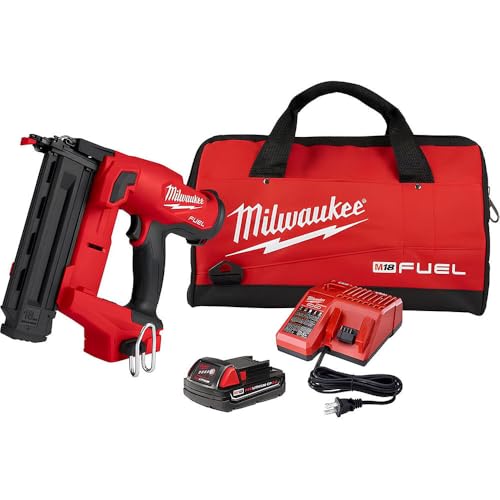
The Milwaukee M18 FUEL is the professional tier choice for contractors and tradespersons who run M18 tools — and Milwaukee brand loyalty in professional electrical, plumbing, and general contracting trades is exceptionally strong for good reason. The M18 FUEL brad nailer is not just a brad nailer that happens to use Milwaukee batteries; it is engineered with Milwaukee’s POWERSTATE brushless motor and REDLINK PLUS electronics that provide measurably better torque consistency in dense hardwoods than the motors found in most alternative nailers. Pro Tool Reviews, whose testing panel are working professionals rather than hobbyist reviewers, named it one of their favourite cordless brad nailers specifically for its reliability in hardwood trim applications.
| Key Specifications | |
|---|---|
| Gauge | 18-gauge |
| Nail Length Range | 5/8″ – 2-1/8″ |
| Motor | POWERSTATE brushless |
| Intelligence System | REDLINK PLUS overload protection |
| Battery Platform | Milwaukee M18 (200+ compatible tools) |
| Firing Modes | Sequential + Contact |
| Dry-Fire Lockout | Yes |
| LED Work Light | Yes |
| Tool-Free | Depth adjustment + jam release |

What we like:
- POWERSTATE brushless motor’s hardwood performance is the professional differentiator. Finish carpenters who work with oak, maple, cherry, and other domestic hardwoods specifically cite the M18 FUEL’s consistency in dense material as its primary advantage over competitors. The POWERSTATE motor maintains consistent drive depth from the first nail to the last on a charge — avoiding the underdrive that affects lower-powered cordless nailers when battery voltage drops below optimal.
- REDLINK PLUS intelligence prevents overload damage. The M18 FUEL’s onboard electronics monitor motor load and temperature, protecting both the motor and the battery from the overload conditions that degrade cheaper nailers over repeated heavy use. This is the professional-grade durability that justifies the price premium for daily-use tools.
- M18 ecosystem compatibility is the economic argument for existing Milwaukee users. A contractor running M18 drills, impact drivers, circular saws, and reciprocating saws can add this brad nailer at tool-only pricing — the battery investment is already made. At professional use volumes, this is a significant cost advantage.
- Bob Vila’s testing designation: “Best Professional” — from a hands-on tested review, not just spec comparison.
What to know:
- Highest price point in this roundup at ~$329 as a kit — justified for professional daily use where reliability in hardwoods matters, but overpriced for occasional DIY trim projects where the DeWalt or Craftsman deliver adequate performance at lower cost.
- M18 batteries are not compatible with M12 tools (Milwaukee’s compact platform) — confirm you own M18 specifically if purchasing the tool-only version.
Pros: Best-in-class hardwood performance, REDLINK PLUS overload protection, 200+ M18 tool ecosystem, professional build quality, LED work light
Cons: Highest kit price in roundup; overkill for occasional DIY use; M18 only (not M12)
Best for: Professional contractors, finish carpenters, and tradespersons who already run Milwaukee M18 tools and need a brad nailer that performs consistently in hardwood trim applications at professional use frequency.
→ Check Current Price on Amazon
3. Ryobi PCN540B ONE+ AirStrike — Best Budget Cordless Brad Nailer

Ryobi’s AirStrike technology is the most significant innovation in budget cordless nailers — and it is fundamentally different from every other nailer in this roundup in a way that matters for performance. Where the DeWalt, Milwaukee, Metabo HPT, and Ridgid all use a brushless electric motor driving a flywheel to drive nails, the Ryobi PCN540B uses a pneumatic spring drive mechanism — a compressed air spring that fires the nail without the brief hesitation that flywheel motor designs produce between trigger pull and nail fire. The firing feel is more immediate and more pneumatic-like than any brushless motor alternative. This is why a Family Handyman tester noted that their father-in-law, a professional flooring installer, uses his Ryobi cordless nailer on nearly every job — the AirStrike firing feel is convincingly close to what professionals expect from their pneumatic tools.
| Key Specifications | |
|---|---|
| Gauge | 18-gauge |
| Nail Length Range | 5/8″ – 2″ (not 2-1/8″) |
| Drive System | AirStrike pneumatic spring drive |
| Nails Per Charge | Up to 1,900 (one of the highest in category) |
| Battery Platform | Ryobi 18V ONE+ (300+ compatible tools) |
| Dry-Fire Lockout | Yes |
| LED Work Light | Yes |
| Tool-Free Depth Adjustment | Yes |
| Weight (with battery) | ~7 lbs |

Understanding AirStrike — the technology explained: Standard brushless motor nailers work by spinning a flywheel to high speed, then releasing a driver blade against the flywheel to drive the nail. This process takes a brief moment — usually 0.3–0.5 seconds — between trigger pull and nail fire. Ryobi’s AirStrike compresses a pneumatic spring mechanism when the trigger is pulled and releases it to fire the nail, similar to how a pneumatic nailer uses compressed air. The result is an essentially immediate firing response — no spin-up delay — and a firing feel that experienced pneumatic users find more natural than brushless motor alternatives. This is the reason the Ryobi AirStrike earned Family Handyman’s “runner-up” designation and professional endorsement despite its budget price positioning.
What we like:
- 1,900 nails per charge is one of the highest ratings in the cordless category — genuinely meaningful for production trim work where a brushless motor nailer at 700–900 nails per charge requires battery management during a long day of baseboard installation. The AirStrike mechanism is more energy-efficient than a flywheel motor for continuous firing, which contributes to this exceptional nail count.
- Ryobi ONE+ is the world’s largest 18V battery platform with 300+ compatible tools — the largest single-brand compatibility network of any cordless system. Most DIY homeowners who own any Ryobi tools already have ONE+ batteries; the PCN540B plugs directly into an existing collection at tool-only pricing.
- At ~$99 tool-only, the Ryobi PCN540B delivers professional-feel firing at the most accessible price point in this roundup. Family Handyman’s March 2026 tested roundup specifically noted the AirStrike as their “runner-up” choice — an endorsement earned through hands-on testing, not just spec reading.
What to know:
- Maximum nail length is 2″, not 2-1/8″ — this limitation rarely matters in practice (most interior trim applications use 1″ to 1-1/2″ nails) but does limit use on the thickest moulding or when driving through thick material into a substrate.
- AirStrike is not a brushless motor — it performs differently in dense hardwoods compared to high-torque brushless alternatives. For consistent driving in very dense exotic hardwoods, the M18 FUEL or DeWalt brushless motors provide more controlled depth adjustment.
Pros: Immediate pneumatic-like firing feel, 1,900 nails per charge, 300+ ONE+ tool ecosystem, lowest price for this performance level, professional field endorsement
Cons: 2″ max nail length (vs 2-1/8″), AirStrike not ideal for very dense hardwoods, slightly heavier than some alternatives
Best for: DIYers and budget-conscious buyers, existing Ryobi ONE+ users, anyone coming from pneumatic who wants a nailer with a familiar firing feel, and production trim work where maximum nails per charge matters.
→ Check Current Price on Amazon
4. Metabo HPT NT1850DE 18V — Best Compact Cordless Brad Nailer with Lifetime Warranty

Metabo HPT (formerly Hitachi Power Tools) occupies a specific niche in the professional nailer market: lightweight, well-engineered tools with a lifetime warranty that no other brand in this category matches. The NT1850DE is among the lightest 18V cordless brad nailers available at approximately 5.2 lbs bare tool weight — a meaningful advantage for finish carpenters who spend significant time on overhead crown moulding installation, where holding a heavier nailer upright for hours creates arm and shoulder fatigue that directly affects work quality. Pro Tool Reviews praised it directly: “Metabo HPT also packs a quality feature set on board. Plus, the pricing is lower than its premium competitors and includes a lifetime warranty that seals the deal.”

| Key Specifications | |
|---|---|
| Gauge | 18-gauge |
| Nail Length Range | 5/8″ – 2-1/8″ |
| Motor | Brushless |
| Battery Platform | MultiVolt 18V AND 36V compatible |
| Bare Tool Weight | ~5.2 lbs (lightest 18V in this roundup) |
| Warranty | LIFETIME Tool Warranty — industry-leading |
| Firing Modes | Sequential + Contact |
| Dry-Fire Lockout | Yes |
| Tool-Free | Depth adjustment + jam release |

What we like:
- Lifetime Tool Warranty is the most unusual purchasing factor in the cordless nailer category. No other nailer in this roundup offers lifetime coverage on the tool body. For a professional finish carpenter who uses a brad nailer daily for 10+ years, the warranty changes the long-term cost equation entirely — one tool purchase, never replaced, repaired or replaced free if it ever fails. At the tool’s price point, the lifetime warranty adds meaningful financial value over a 5–10 year ownership period.
- MultiVolt battery compatibility is uniquely practical. The NT1850DE accepts both standard 18V batteries for lightweight carry and 36V MultiVolt batteries for extended runtime. Switching to a 36V pack approximately doubles firing runtime without changing the tool — relevant for professionals doing all-day production trim installation who need to minimize battery recharges.
- 5.2 lbs bare weight makes a concrete ergonomic difference for overhead work. Crown moulding installation — particularly on vaulted or cathedral ceilings — requires holding the nailer overhead or at awkward angles for extended periods. Every pound difference in nailer weight is noticeable across a full day of overhead trim installation. At 5.2 lbs bare, the Metabo HPT is meaningfully lighter than most 18V alternatives.
What to know:
- MultiVolt batteries are Metabo HPT proprietary — not compatible with other brand platforms. For buyers starting fresh who want the widest battery ecosystem, DeWalt or Milwaukee are better platform investments. The MultiVolt makes the most sense as a second or third nailer for existing Metabo HPT users.
Pros: Lifetime warranty, lightest 18V in this roundup, MultiVolt 18V/36V dual compatibility, professional-grade build, competitive pricing
Cons: MultiVolt not cross-compatible with other brands, smaller ecosystem than DeWalt or Milwaukee
Best for: Professional finish carpenters doing overhead crown moulding work, professionals who value lifetime warranty for long-term cost management, and existing Metabo HPT/Hitachi tool users.
→ Check Current Price on Amazon
5. Craftsman CMCN618C1 V20 20V — Best Cordless Brad Nailer for DIYers
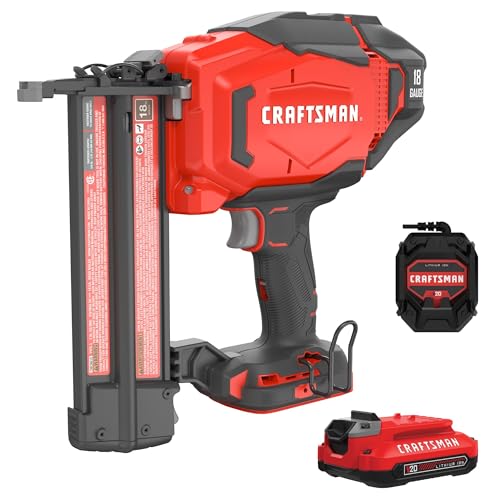
The Craftsman CMCN618C1 is the correct choice for homeowners and DIYers who want a capable cordless brad nailer for room renovation projects, basic woodworking, and occasional trim installation without investing in a professional-tier tool. It occupies the accessible quality tier — serious enough to do real work correctly, priced at a level that makes sense for tasks that arise a few times per year rather than daily. Bob Vila’s hands-on testing team confirmed adequate performance: “After firing more than 200 brads through the tool, we still had plenty of power left” — sufficient battery life for a DIY room’s worth of baseboard or a woodworking assembly project.

| Key Specifications | |
|---|---|
| Gauge | 18-gauge |
| Nail Length Range | 5/8″ – 2″ |
| Motor | Brushed |
| Battery Platform | Craftsman V20 / Stanley / Black+Decker V20 |
| Firing Modes | Sequential + Bump fire |
| Dry-Fire Lockout | Yes |
| LED Work Light | Yes |
| Tool-Free Depth Adjustment | Yes |
| Bob Vila Tested | Yes — hands-on evaluation |

What we like:
- V20 ecosystem extends to Black+Decker and Stanley tools — the Craftsman V20 battery platform is shared with Black+Decker 20V MAX and Stanley FatMax 20V, meaning homeowners who own any of these brands’ tools already have compatible batteries. This cross-brand compatibility is broader than most competitors provide and adds practical value for the large number of homeowners who own a Black+Decker drill or circular saw.
- Bob Vila hands-on tested endorsement from a team that physically fires nails into real materials — not just a spec-sheet review. The 200+ brad test confirming adequate battery life is the relevant validation for the DIY use case this nailer targets.
- Both sequential and bump firing modes at this price point — the presence of contact/bump fire is worth noting since it’s occasionally omitted on budget tools; the Craftsman includes it.
- Tool-free depth adjustment makes it practical for the DIY user switching between different workpiece materials without needing a dedicated adjustment tool.
What to know:
- Brushed motor, not brushless — adequate for occasional DIY use and correctly specified for the Craftsman’s target user. Brushed motors wear faster than brushless over heavy daily use — but for a DIYer firing a few hundred nails per month rather than a few thousand nails per day, the brushed motor’s service life is fully adequate.
- Maximum nail length 2″ (vs 2-1/8″ on the DeWalt and Milwaukee) — a limitation that rarely affects standard interior trim applications but worth noting for buyers who occasionally work with very thick moulding.
DIY use cases this nailer handles well: Installing baseboards in a room renovation, building a floating shelf or bookcase, installing crown moulding for the first time, assembling cabinet boxes, woodworking assembly where screw fasteners are overkill.
Pros: Bob Vila tested, V20/Black+Decker/Stanley cross-compatibility, LED light, both firing modes, accessible price
Cons: Brushed motor (less efficient long-term), 2″ max nail length, heavier than Metabo HPT
Best for: Homeowners and DIYers who want a capable brad nailer for renovation and woodworking projects without professional-tier pricing, especially those who already own Craftsman, Black+Decker, or Stanley V20 tools.
→ Check Current Price on Amazon
6. Ridgid R09890B 18V HYPERDRIVE — Best Warranty Cordless Brad Nailer
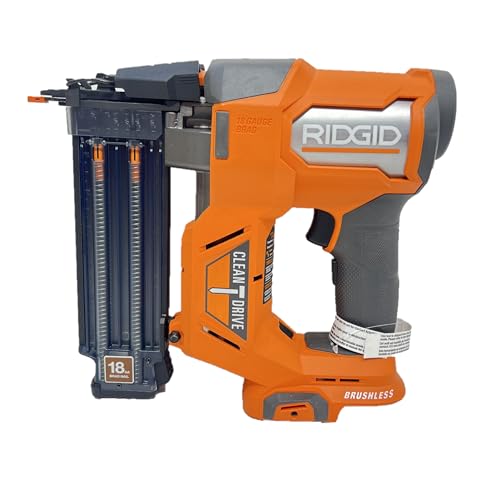
Ridgid’s Lifetime Service Agreement (LSA) is the most aggressive warranty proposition in the power tool industry — and it is the defining reason to choose the R09890B over similarly priced alternatives. Register the tool within 90 days of purchase, and Ridgid will repair or replace it free for the rest of your life. Not a limited warranty. Not a warranty that requires proof of professional use or restricts DIY damage. A genuine lifetime repair-or-replace commitment on the tool itself. Family Handyman’s tested assessment was direct: “If you appreciate longevity in a tool and a company that stands behind their products, this is the best cordless brad nailer for you.” For a buyer who intends to own and use a brad nailer for 10–15 years, the LSA changes the total cost of ownership calculation in Ridgid’s favour regardless of the tool’s purchase price.

| Key Specifications | |
|---|---|
| Gauge | 18-gauge |
| Nail Length Range | 5/8″ – 2-1/8″ |
| Motor | HYPERDRIVE brushless |
| Battery Platform | Ridgid 18V |
| Warranty | Lifetime Service Agreement (register within 90 days) |
| Firing Modes | Sequential + Contact |
| Dry-Fire Lockout | Yes |
| LED Work Light | Yes |
| Tool-Free Depth Adjustment | Yes |

What we like:
- Lifetime Service Agreement is a genuinely unique financial proposition. A brad nailer used weekly for 10 years represents substantial cumulative wear on the drive mechanism, magazine, and nose assembly. Most tools either fail and get replaced (cost: full purchase price again) or get repaired at service center rates. The Ridgid LSA eliminates both outcomes. The registration requirement (within 90 days at RegisterMyRidgid.com) is straightforward — set a calendar reminder the day you unbox it.
- HYPERDRIVE brushless motor provides consistent power output — Ridgid’s proprietary brushless technology specifically engineered for the consistent load requirements of repeated nail driving. Field reports cite consistent depth across battery charge levels as the HYPERDRIVE’s practical advantage.
- Full nail length range (5/8″ to 2-1/8″) matches the professional-tier DeWalt and Milwaukee — no compromise on application range from the warranty pick.
- Family Handyman hands-on tested endorsement from a physically tested roundup — relevant validation for the warranty positioning.
What to know:
- Registration is mandatory for LSA coverage — register at RegisterMyRidgid.com within 90 days of purchase. Missing this window means losing the lifetime coverage and falling back to a standard limited warranty. This is the single most important action to take after purchasing this nailer.
- Ridgid 18V platform is smaller than DeWalt 20V or Milwaukee M18 ecosystems — meaningful for buyers who want to build a comprehensive tool collection around a single battery platform. Ridgid’s lineup is solid for core tools but does not span 200+ items like the major platforms.
Pros: Lifetime Service Agreement (unmatched warranty), HYPERDRIVE brushless motor, full nail range, Family Handyman tested, LED work light
Cons: Registration required within 90 days, smaller ecosystem than DeWalt/Milwaukee, limited availability in some regions
Best for: Long-term minded buyers who want a single brad nailer purchase to last indefinitely, existing Ridgid 18V tool users, and anyone whose purchase decision is significantly influenced by post-purchase warranty security.
→ Check Current Price on Amazon
7. Freeman PE20V31618G 20V — Best Value Multi-Battery Cordless Brad Nailer
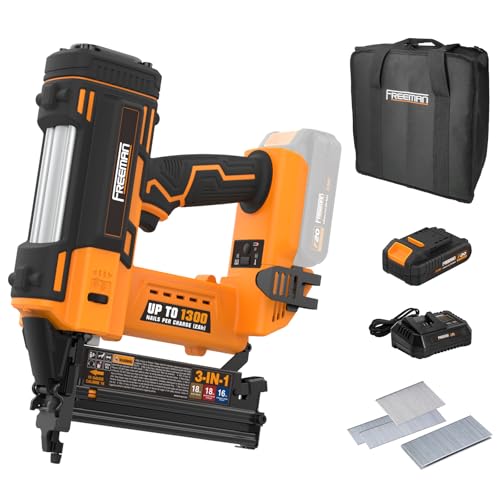
Freeman is a value-brand surprise in the cordless nailer market with a genuinely unusual feature: multi-brand battery compatibility. Where every other nailer in this roundup is locked to a single brand’s battery platform, Freeman designs their tools to accept batteries from multiple 18V/20V brands — meaning a buyer who already owns DeWalt, Milwaukee, Ridgid, or other 18V batteries can often run a Freeman nailer without purchasing new batteries at all. Bob Vila designated the Freeman their “Best Bang for the Buck” pick in a tested cordless brad nailer roundup — an endorsement from hands-on physical testing that positions Freeman as the legitimate budget option for buyers who want acceptable professional-quality performance without the premium-brand price.

| Key Specifications | |
|---|---|
| Gauge | 18-gauge |
| Nail Length Range | 5/8″ – 2″ |
| Motor | Brushless |
| Battery Compatibility | Multi-brand 20V/18V — check listing for specific compatibility |
| Firing Modes | Sequential + Contact |
| Dry-Fire Lockout | Yes |
| Depth Adjustment | Tool-free |
| Bob Vila Award | Best Bang for the Buck — tested |

What we like:
- Multi-brand battery compatibility is the genuinely unique value proposition. For a homeowner who owns a DeWalt drill, a Milwaukee impact driver, and a Ridgid circular saw — all 18V/20V — the Freeman nailer may accept the batteries they already own across all of those platforms. This effectively eliminates battery cost from the purchase equation and makes the Freeman the cheapest real-cost option for buyers with a mixed-brand tool collection.
- Brushless motor at this price point — Freeman includes a brushless motor rather than the brushed motor that many budget nailers use to hit a lower price. The brushless design provides better efficiency and longer tool life than the Craftsman V20 at a comparable price point.
- Bob Vila “Best Bang for the Buck” designation from a tested review is the independent validation that Freeman’s budget positioning doesn’t mean inadequate performance for DIY and occasional professional use.
What to know:
- Verify current battery compatibility against your specific batteries before purchasing — multi-brand compatibility specifications can vary by model variant and can change between production runs. Check the Amazon listing’s battery compatibility details for your specific brand and voltage.
- Build quality and long-term durability are below the DeWalt, Milwaukee, and Metabo HPT professional tier — the Freeman is correctly positioned as occasional to moderate-use, not daily professional production use over years.
- 2″ maximum nail length applies here as with the Craftsman — adequate for most applications.
Pros: Multi-brand battery compatibility (unique), brushless motor, Bob Vila tested best value, lowest real cost for existing multi-brand tool owners
Cons: Lower build durability than premium options, 2″ max nail length, battery compatibility requires verification
Best for: Buyers who already own 18V/20V batteries from multiple brands and want to avoid buying into a new platform; budget buyers who want brushless performance at a value price; Bob Vila’s top pick for cost-conscious buyers.
→ Check Current Price on Amazon
8. Milwaukee M12 FUEL 2541 — Best Ultra-Compact Cordless Brad Nailer
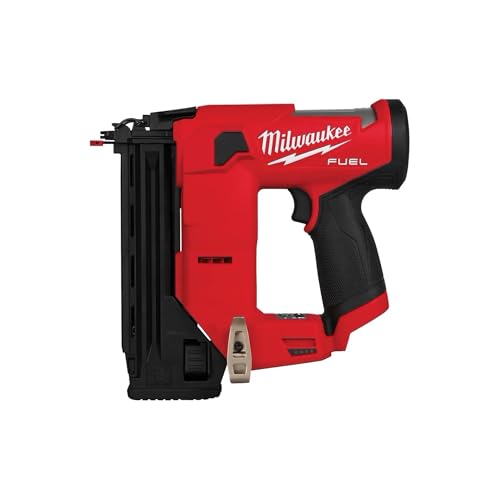
The Milwaukee M12 FUEL 2541 is the outlier in this roundup — the only major cordless brad nailer running on a 12V platform, making it the most compact and lightest professional-grade cordless option available. Pro Tool Reviews named it their #1 compact pick for 18-gauge brad nailers, specifically praising its lightweight design and ease of use. The trade-off is a shorter maximum nail length: the M12 FUEL maxes out at 1-1/2″ rather than the 2-1/8″ of most 18V competitors. Understanding whether that limitation matters for your specific work is the key to knowing if the M12 is right for you.

| Key Specifications | |
|---|---|
| Gauge | 18-gauge |
| Nail Length Range | 5/8″ – 1-1/2″ (shorter than 18V competitors) |
| Motor | POWERSTATE brushless |
| Battery Platform | Milwaukee M12 (100+ compatible tools) |
| Weight | ~5 lbs (lightest with battery in roundup) |
| Firing Modes | Sequential + Contact |
| Dry-Fire Lockout | Yes |
| Pro Tool Reviews | #1 Compact Brad Nailer Pick |

What we like:
- Lightest professional-grade nailer in this roundup at ~5 lbs with battery — the M12 platform’s smaller battery contributes meaningfully to overall tool weight, and for finish carpenters doing extended overhead trim installation, the weight reduction vs. an M18 nailer (typically 6.5–7.5 lbs with battery) is genuinely appreciated across an 8-hour shift.
- POWERSTATE brushless motor at M12 scale — the same motor technology as the professional M18 FUEL, miniaturized for the M12 platform. This means the M12 FUEL drives nails with consistent professional-grade force despite the smaller battery platform.
- For existing M12 users — Milwaukee’s compact M12 platform covers drills, screwdrivers, impact drivers, lights, and more. The M12 brad nailer adds punch-list trim capability to a compact professional kit that already uses M12 batteries.
The 1-1/2″ maximum nail length — does it matter for your work?
- 1-1/2″ is adequate for: most interior trim up to 3/4″ thick (baseboard through 3/4″ material into framing), cabinet face frames, standard door casings and window casings in typical residential construction.
- 1-1/2″ is NOT adequate for: nailing through thick moulding (1″+ material) into substrate, heavy crown moulding profiles, any application requiring nail penetration deeper than 3/4″ into the receiving material behind trim.
- For punch-list trim work and standard interior trim, 1-1/2″ covers the vast majority of applications. For contractors who also occasionally handle thick moulding, a second nailer with 2-1/8″ capability makes more sense.
Pros: Lightest in roundup (~5 lbs), POWERSTATE brushless quality, Pro Tool Reviews #1 compact pick, M12 ecosystem compatibility
Cons: 1-1/2″ max nail length limits thick-trim applications, M12 only (not compatible with M18), smaller platform than M18
Best for: Existing Milwaukee M12 users, finish carpenters and trim contractors who prioritize weight for overhead work, punch-list trim installers where 1-1/2″ nails cover all applications.
→ Check Current Price on Amazon
9. Makita XNB02Z 18V LXT — Best for Makita Tool Owners

The Makita XNB02Z is the natural cordless brad nailer addition for the large global community of Makita 18V LXT tool users. The LXT platform spans 300+ compatible tools — one of the three largest professional cordless platforms available, alongside DeWalt 20V MAX and Milwaukee M18 — meaning most professional carpenters, electricians, and contractors who use Makita tools already own LXT batteries. The XNB02Z applies Makita’s engineering quality to the brad nailer form factor, with a brushless motor, sequential and contact firing modes, and full 5/8″–2-1/8″ nail range. For Makita LXT owners, the battery economics make this the straightforward recommendation without requiring a detailed comparison to DeWalt or Milwaukee alternatives.

| Key Specifications | |
|---|---|
| Gauge | 18-gauge |
| Nail Length Range | 5/8″ – 2-1/8″ |
| Motor | Brushless |
| Battery Platform | Makita 18V LXT (300+ compatible tools) |
| Firing Modes | Sequential + Contact |
| Dry-Fire Lockout | Yes |
| Depth Adjustment | Tool-free |
| Magazine Capacity | 100 nails |
| Platform Size | 300+ LXT tools — professional-grade ecosystem |

What we like:
- Makita 18V LXT is one of the world’s largest professional cordless platforms — 300+ tools covering drills, saws, sanders, grinders, routers, and every trade application. The XNB02Z slots directly into any LXT user’s collection with zero new battery investment.
- Full 5/8″–2-1/8″ nail range matches the professional-tier DeWalt and Milwaukee specifications — no limitation on application range for standard to thick trim installations.
- Brushless motor consistent with Makita’s professional-grade tool standards — the same engineering quality applied to their saws and drills applies here for reliable, durable daily use.
- Tool-free depth adjustment and dry-fire lockout are both present — the full professional feature set without compromise.
What to know:
- For buyers not already in the Makita ecosystem, the DeWalt or Milwaukee provides comparable performance with a platform choice comparison that may favor their existing tool collection. The XNB02Z is most compelling specifically for Makita LXT users where battery cost savings are immediate.
Pros: 300+ LXT ecosystem, full nail range, brushless motor, professional build quality, all key features present
Cons: Less benefit for non-Makita users vs. platform alternatives, older model vs. some newer competitors
Best for: Existing Makita 18V LXT tool owners — the battery compatibility makes this the immediate, most cost-effective choice for Makita professionals adding a brad nailer to their LXT collection.
→ Check Current Price on Amazon
10. Worx Nitro WX833L 20V — Best for Worx Tool Owners

The Worx Nitro WX833L is the Worx PowerShare platform’s brad nailer — the logical addition for homeowners and DIYers who already run Worx 20V tools including their string trimmers, circular saws, drills, and garden tools. The PowerShare platform covers 75+ Worx tools, making it one of the broadest single-brand ecosystems for the combined garden and power tool buyer. The Nitro line within Worx represents their brushless motor tier — a step up from standard Worx tools with improved efficiency and runtime — and at ~$119 the Nitro WX833L delivers brushless performance at a budget-accessible price point for buyers in the Worx ecosystem.

| Key Specifications | |
|---|---|
| Gauge | 18-gauge |
| Nail Length Range | 5/8″ – 2-1/8″ |
| Motor | Brushless (Nitro line) |
| Battery Platform | Worx 20V PowerShare (75+ tools) |
| Firing Modes | Sequential + Contact |
| Dry-Fire Lockout | Yes |
| Platform Type | Combined power + garden tool ecosystem |

What we like:
- Worx 20V PowerShare covers both power tools and garden tools — the same batteries run the Worx string trimmer, hedge trimmer, leaf blower, and outdoor equipment that many homeowners already own. Adding a Worx Nitro brad nailer means the battery that powers outdoor garden tools also powers indoor trim work — a genuinely broad cross-application ecosystem for the home-owner user.
- Brushless motor in the Nitro line — Worx’s premium tier delivers better efficiency and longer runtime than the standard Worx brushed alternatives at a modest price premium.
- Full 5/8″–2-1/8″ nail range — no limitation on application capability for standard to thicker trim work.
- At ~$119 with brushless motor, the Nitro WX833L is among the better-value brushless brad nailers for existing Worx ecosystem owners.
What to know:
- For buyers without existing Worx tools, the DeWalt, Craftsman, or Ridgid provides better platform depth and more established professional reputation. The Worx is most compelling as a platform-extension purchase for existing PowerShare users.
Pros: Brushless (Nitro), full nail range, PowerShare covers garden + power tools, accessible price
Cons: Smaller professional platform vs. DeWalt/Milwaukee/Makita; best for existing Worx users
Best for: Existing Worx PowerShare tool and garden equipment owners who want to extend their battery platform to include indoor trim capability without starting a new battery ecosystem.
→ Check Current Price on Amazon
How to Choose the Best Cordless Brad Nailer — Buyer’s Guide
Should You Switch from Pneumatic to Cordless?
For trim carpenters, cabinet installers, finish woodworkers, and serious DIYers doing interior trim work — yes, switch. Modern brushless cordless brad nailers in 2026 match pneumatic performance for baseboards, door casings, window casings, crown moulding, and cabinet face frames. The freedom to work without a compressor, hose, and power outlet — particularly on upper floors, in finished rooms, and in remote locations — is a genuine productivity and convenience advantage that accumulates across every job.
The remaining pneumatic advantages are specific: production framing where thousands of nails go through a compressor serving multiple operators simultaneously (the economics strongly favour pneumatic at that scale); environments with extreme cold where lithium battery capacity drops significantly; and situations where the compressor is already running for pneumatic spray finishing, air-powered sanding, or other tasks where it serves multiple tools simultaneously. Outside these scenarios, cordless is the right choice for 2026.
Battery Ecosystem — The Most Important Buying Factor
The single most valuable piece of buying guidance for cordless tool buyers is this: buy the nailer that runs on batteries you already own. A DeWalt DCN680D1 for a buyer with DeWalt 20V tools costs only the tool price — no new battery purchase. The same tool for a buyer with no DeWalt tools costs the tool price plus $60–$100 for a battery. Use this decision tree:
- Own DeWalt 20V MAX tools? → DeWalt DCN680D1
- Own Milwaukee M18 tools? → Milwaukee M18 FUEL 2745-21
- Own Milwaukee M12 tools? → Milwaukee M12 FUEL 2541 (note: shorter nail range)
- Own Ryobi 18V ONE+ tools? → Ryobi PCN540B AirStrike
- Own Makita 18V LXT tools? → Makita XNB02Z
- Own Craftsman/Black+Decker V20 tools? → Craftsman CMCN618C1
- Own Ridgid 18V tools? → Ridgid R09890B (and get the lifetime warranty)
- Own Worx 20V PowerShare tools? → Worx Nitro WX833L
- Own batteries from multiple brands? → Freeman PE20V31618G (verify compatibility)
- Starting fresh with no existing platform? → DeWalt DCN680D1 (best long-term ecosystem) or Ryobi PCN540B (best value entry)
Brushless vs. Brushed Motor
Brushless motors provide longer tool life, more consistent power output across a battery charge, better energy efficiency (more nails per charge), and superior performance in hardwoods compared to brushed alternatives. All professional-grade nailers in this roundup are brushless. Budget options (Craftsman V20) use brushed motors — acceptable for occasional DIY use where annual nail counts are modest, but not appropriate for daily professional production use. If you plan to use the nailer multiple times per week or drive significant nail volumes, choose a brushless model.
Firing Modes — Sequential vs. Contact
Sequential (single fire): Pull the trigger once, the nailer fires once. The nose must be lifted and re-placed for each nail. Safer, more precise — the correct mode for delicate trim work where exact nail placement matters and accidental double-fires would damage the surface.
Contact / Bump fire: Hold the trigger and bounce the nose against the surface to fire rapidly. Faster for production work — excellent for running long baseboard runs or attaching multiple shelf supports quickly. Less precise and higher risk of double-fires or accidental fires. All nailers in this roundup include both modes; use sequential for precision finish work and contact for production speed.
Stall Release vs. Jam Release — What’s the Difference?
A nail jam occurs when a nail becomes physically stuck in the nose mechanism — usually from a bent nail or debris in the nose channel. A tool-free jam release lever allows you to open the nose and clear the obstruction without tools.
A stall occurs when the driver blade doesn’t complete its stroke and stops partway through — typically because battery charge is low and the motor lacks the power to fully seat the nail. The nail is partially driven but not seated, and the driver blade is stuck in the extended position. A stall release lever allows you to reset the driver blade without disassembling the tool. The DeWalt DCN680D1 provides both a jam release AND a separate stall release — having both is a quality indicator that the tool is engineered for real-world use conditions, not just lab testing.
Dry-Fire Lockout — Always Required
Dry-fire lockout prevents the nailer from firing when the magazine is empty. Without it, an empty-fire drives the driver blade directly into the workpiece surface — damaging the wood and potentially the nose mechanism. All nailers in this roundup include dry-fire lockout. It is a non-negotiable feature; avoid any budget nailer that omits it.
Nail Length Range and Weight
Most cordless brad nailers accept 5/8″–2-1/8″ nails — this range covers essentially all interior trim applications. The Milwaukee M12 FUEL is limited to 5/8″–1-1/2″, which covers most applications but not thick moulding. For weight: 6–7 lbs with battery is average; the Metabo HPT at 5.2 lbs bare and Milwaukee M12 at ~5 lbs are the weight leaders for overhead crown work.
What Can You Use a Cordless Brad Nailer For?
The 18-gauge cordless brad nailer covers a wide range of interior carpentry and woodworking applications. Understanding what it does — and doesn’t — do well prevents the two most common misapplications.
| Application | 18-Gauge Brad Nailer | Notes |
|---|---|---|
| Baseboards | ✅ Primary use case | 1-1/4″ to 1-1/2″ nails typical |
| Door casings | ✅ Primary use case | 1″ to 1-1/2″ nails |
| Window casings | ✅ Primary use case | 1″ to 1-1/2″ nails |
| Chair rails | ✅ Primary use case | 1-1/4″ to 1-1/2″ nails |
| Crown moulding (light, up to 3″) | ✅ Good choice | 1-1/2″ to 2″ nails; heavier crown use 15-gauge |
| Cabinet face frames | ✅ Good choice | Small head minimizes filler needed |
| Shiplap / wainscoting | ✅ Good choice | 1-1/4″ to 1-1/2″ nails |
| Woodworking assembly / glue-up hold | ✅ Good choice | Holds joints while glue sets |
| Heavy crown moulding (4″+) | ⚠️ Marginal | Consider 15/16-gauge finish nailer |
| Structural framing | ❌ Wrong tool | Use framing nailer |
| Roofing | ❌ Wrong tool | Use roofing nailer |
| Hardwood flooring | ❌ Wrong tool | Use flooring nailer |
Frequently Asked Questions — Cordless Brad Nailers
What is the difference between a brad nailer and a finish nailer?
An 18-gauge brad nailer uses a thinner gauge nail (smaller diameter wire) that leaves a smaller hole in the workpiece, requiring less filler for a finished surface. It provides moderate holding power — correct for most interior trim applications. A 15/16-gauge finish nailer uses a heavier gauge nail for more holding power in thicker, heavier trim applications like large crown moulding, stair treads, and structural trim. Choose a brad nailer for standard interior trim; choose a finish nailer when your trim is heavy, thick, or structurally demanding. When in doubt, the 18-gauge brad nailer covers 80% of typical residential trim work.
Can a cordless brad nailer replace a pneumatic for trim work?
Yes — for most interior trim work in 2026. Modern brushless cordless brad nailers match pneumatic performance for baseboards, casings, crown moulding, cabinet face frames, and woodworking assembly. The exception is production environments where multiple operators share one compressor for thousands of nails per day — at that scale, pneumatic economics still win. For individual trim carpenters, finish carpenters, and DIYers, cordless has reached performance parity while eliminating the compressor, hose, and power outlet requirement.
How many nails per charge does a cordless brad nailer fire?
Performance varies significantly. Ryobi’s AirStrike PCN540B rates up to 1,900 nails per charge — one of the highest in the category due to its pneumatic spring drive efficiency. Most brushless 18V nailers (DeWalt, Milwaukee, Metabo HPT, Ridgid) achieve 700–1,200 nails per charge depending on wood hardness and battery capacity. The Metabo HPT with a 36V MultiVolt battery can approach 2,000+ nails per charge. For a 2Ah battery included in most entry kits, expect 600–800 nails; upgrade to a 4Ah or 5Ah pack for extended production sessions.
What size nails does an 18-gauge brad nailer use?
18-gauge brad nails — specifically 18-gauge wire diameter in lengths from 5/8″ to 2-1/8″ depending on the nailer model. The gauge refers to the nail wire diameter, not the length. Do not confuse 18-gauge brad nails with 18-gauge finish nails (different product, different application). Most trim work uses 1″ to 1-1/2″ length brad nails; 2″ nails are used for thicker trim or when deeper penetration into the substrate is needed.
What is a dry-fire lockout on a brad nailer?
Dry-fire lockout is a mechanism that prevents the nailer from firing when the nail magazine is empty. Without it, an empty-fire drives the metal driver blade directly into the workpiece surface, leaving a visible dent and potentially damaging the nose mechanism. All nailers in this roundup include dry-fire lockout. It is a non-negotiable feature — do not purchase any nailer that lacks it.
What is the best cordless brad nailer for trim work?
The DeWalt DCN680D1 for most users — best overall tested performance, micro nose precision, both stall and jam release, and 20V MAX ecosystem compatibility. The Milwaukee M18 FUEL for existing Milwaukee users and professionals who drive nails in hardwoods daily. The Metabo HPT NT1850DE for weight-conscious professionals who value the lifetime warranty. Match your choice to your existing battery platform first — the ecosystem savings are significant.
Should I buy tool-only or kit?
Tool-only if you already own a compatible battery in adequate capacity (2Ah minimum, 4Ah preferred for production use). Kit if you’re starting fresh or don’t have a matching battery. A 2Ah battery included in most entry kits provides approximately 700–900 nails before recharging — adequate for DIY projects and light trim work. For production trim installation, a 4Ah or 5Ah battery provides noticeably better runtime and reduces mid-job recharges significantly.
How does Ryobi AirStrike work?
AirStrike is a pneumatic spring drive mechanism — not a brushless electric motor. When the trigger is pulled, a compressed air spring releases to drive the nail rather than a flywheel-driven motor. This creates an essentially immediate firing response with no spin-up delay, resulting in a firing feel and consistency closer to a pneumatic nailer than to brushless motor alternatives. The AirStrike mechanism is more energy-efficient for continuous firing, which contributes to the PCN540B’s 1,900 nails per charge rating. For buyers coming from pneumatic who want a familiar firing feel, the Ryobi AirStrike is the closest cordless equivalent.
Final Verdict — Best Cordless Brad Nailer for Every Buyer
The right cordless brad nailer depends primarily on what battery platform you already own — check the ecosystem guide above before making any final decision. For buyers starting fresh: the DeWalt DCN680D1 is the best all-around choice for most trim work, with the Ryobi PCN540B as the best budget entry.
| Best For | Our Pick | Key Reason | Buy on Amazon |
|---|---|---|---|
| Best Overall | DeWalt DCN680D1 20V MAX XR | Top tested pick (FH, Bob Vila, PTR), micro nose, both stall + jam release, 200+ tool ecosystem | Buy Now → |
| Best Professional | Milwaukee M18 FUEL 2745-21 | POWERSTATE brushless hardwood performance, REDLINK PLUS, M18 ecosystem | Buy Now → |
| Best Budget | Ryobi PCN540B ONE+ AirStrike | 1,900 nails/charge, immediate AirStrike firing, 300+ ONE+ tools, best value | Buy Now → |
| Best Compact / Lifetime Warranty | Metabo HPT NT1850DE 18V | 5.2 lbs bare, lifetime warranty, MultiVolt 18V/36V dual platform | Buy Now → |
| Best for DIYers | Craftsman CMCN618C1 V20 | Bob Vila tested, V20/Black+Decker/Stanley cross-compatible, LED, both firing modes | Buy Now → |
| Best Warranty | Ridgid R09890B 18V | Lifetime Service Agreement (register within 90 days), HYPERDRIVE brushless, FH tested | Buy Now → |
| Best Value / Multi-Battery | Freeman PE20V31618G 20V | Bob Vila Best Bang for Buck, multi-brand battery compatibility, brushless motor | Buy Now → |
| Best Ultra-Compact | Milwaukee M12 FUEL 2541 | Lightest in roundup (~5 lbs), POWERSTATE brushless, PTR #1 compact pick | Buy Now → |
| Best for Makita Owners | Makita XNB02Z 18V LXT | 300+ LXT ecosystem, brushless motor, full nail range, Makita professional quality | Buy Now → |
| Best for Worx Owners | Worx Nitro WX833L 20V | Brushless (Nitro), full nail range, PowerShare garden + power tool ecosystem | Buy Now → |
Every nailer in this roundup will drive 18-gauge brads into interior trim correctly. The decision comes down to your battery platform, your use frequency (brushless for daily professional use, brushed for occasional DIY), and the specific factors that matter most for your work — whether that is weight for overhead crown moulding, warranty security for long-term ownership, or firing feel for experienced pneumatic users transitioning to cordless.


