There is no single best nail gun. There is a best nail gun for framing a wall, a different one for hanging baseboard, and a third for tacking thin trim without splitting it. Buy the wrong type and you end up with nails that won’t sink, or nails that blow straight through the work.
This guide sorts the best nail guns of 2026 by the job they do. You get one strong pick for each nail type, pneumatic and cordless options, a budget route, and the one table you need to match a nailer to your project.
Quick picks:
- Best framing nailer (air): Metabo HPT NR90AES1
- Best cordless framing nailer: Metabo HPT NR1890DCA 18V
- Best nail gun for most DIYers: DEWALT DCN680D1 cordless brad nailer kit
- Best budget cordless: RYOBI ONE+ AirStrike P320
- Best trim and baseboard nailer: DEWALT DCN660B 16-gauge
- Best pin nailer: Metabo HPT NP35A
- Best starter kit: BOSTITCH BTFP3KIT 3-tool combo
Jump to: Which Nail Gun Do You Need? | Comparison Table | Reviews | Air vs. Cordless | Trigger Safety | Buying Guide | FAQ
Which Nail Gun Do You Need? Start With the Nail
Nail guns are named after the nail they shoot. The gauge number is the nail’s thickness: the higher the number, the thinner the nail. Pick the nail your project needs, and the nail gun picks itself.
| Nailer Type | Nail | Typical Length | Use It For | Don’t Use It For |
|---|---|---|---|---|
| Framing | Full-size framing nails (about 0.113 to 0.148 in. shank) | 2 to 3-1/2 in. | Wall framing, decks, fences, sheathing, sheds | Trim, furniture, anything visible |
| 15-gauge finish | Thick finish nail, angled strip | 1-1/4 to 2-1/2 in. | Door casing, jambs, thick baseboard, stair parts | Thin moldings (can split them) |
| 16-gauge finish | Finish nail | 1-1/4 to 2-1/2 in. | Baseboard, casing, chair rail, most trim carpentry | Framing, delicate trim |
| 18-gauge brad | Thin brad nail | 5/8 to about 2 in. | Shoe molding, cabinets, crafts, light trim, DIY projects | Heavy trim that needs holding power |
| 23-gauge pin | Headless pin | Up to about 1-3/8 in. on most models | Tiny moldings, veneer, holding glued parts while they dry | Anything structural |
| Roofing | Wide-head coil nail | 7/8 to 1-3/4 in. | Asphalt shingles | Everything else |
Rule of thumb: if you only buy one nail gun for home projects, make it an 18-gauge brad nailer. It handles most DIY trim, crafts and furniture work. Add a 16-gauge finish nailer if you are replacing baseboard or door casing across a whole house, and a framing nailer only if you are building structures.
Best Nail Guns of 2026: Comparison Table
| Nail Gun | Type | Power | Best For | Amazon Rating |
|---|---|---|---|---|
| Metabo HPT NR90AES1 | 21° framing | Air | Best framing nailer overall | 4.7 (2,489) |
| Metabo HPT NR1890DCA | 30° framing | 18V battery | Best cordless framing | 4.4 (49) |
| DEWALT DCN680D1 | 18-ga brad | 20V battery | Best for most DIYers | 4.8 (3,400+) |
| RYOBI P320 | 18-ga brad | 18V battery | Best budget cordless | 4.6 (1,212) |
| Metabo HPT NT50AE2 | 18-ga brad | Air | Best value if you own a compressor | 4.6 (3,600+) |
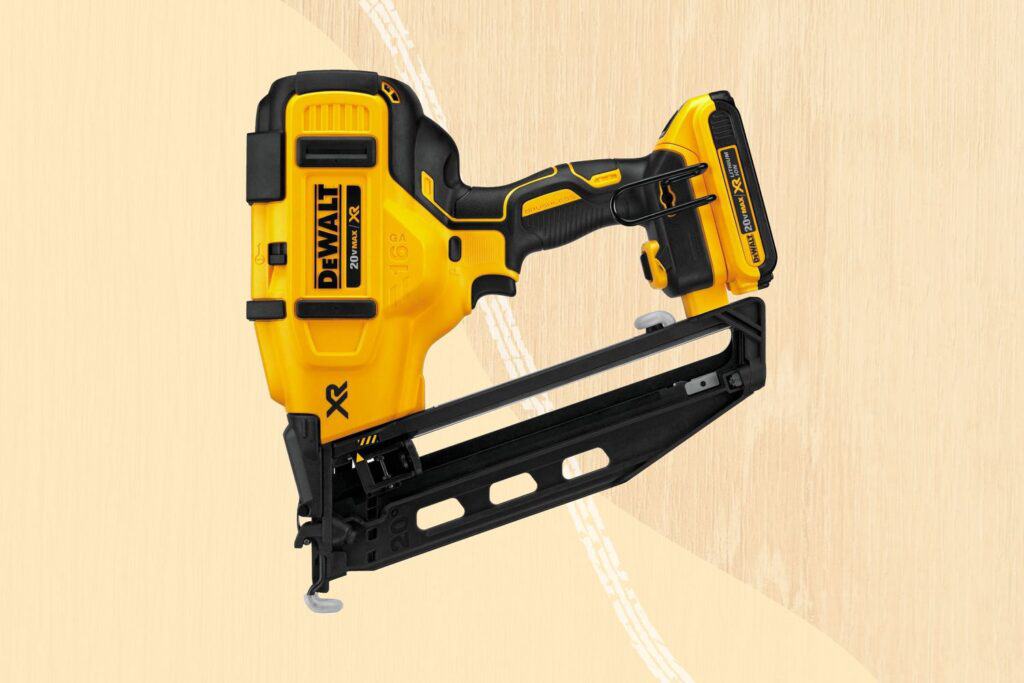
| DEWALT DCN660B | 16-ga angled finish | 20V battery | Best for baseboard and trim | 4.6 (1,900+) |
| Metabo HPT NT65MA4 | 15-ga angled finish | Air | Best for door casing and heavy trim | 4.7 (2,200+) |
| Metabo HPT NP35A | 23-ga pin | Air | Best pin nailer | 4.6 (1,800+) |
| Metabo HPT NV45AB2 | Coil roofing | Air | Best roofing nailer | 4.6 (1,900+) |
| BOSTITCH BTFP3KIT | Brad + finish + stapler + compressor | Air | Best starter kit | 4.7 (5,200+) |
The 10 Best Nail Guns, Reviewed
1. Metabo HPT NR90AES1 – Best Framing Nailer Overall

The NR90AES1 has been the default framing nailer on job sites for years, and it is still the one to beat. It drives 21-degree plastic-collated framing nails from 2 to 3-1/2 inches, which covers wall framing, decks and fences. Pro Tool Reviews calls it “simply the lightest framing nailer” they have used in its class (retrieved 2026-09-29), and that matters on a full day of nailing overhead.
It holds 4.7 stars across 2,489 Amazon ratings at around $159, which is a lot of nailer for the money.

It is a pneumatic tool, so you need a compressor that can keep up with framing. A small pancake compressor will run it for light work, but it will struggle during fast bump-firing. The 21-degree plastic strips also leave small bits of plastic on the deck, which some builders dislike.
Skip this if: you don’t own a decent compressor, or your local building code or lumberyard favors 30-degree paper-tape nails. For more options, see our full guide to the best framing nailers.
Pros:
- Light for a full-size framing nailer
- Drives 2 to 3-1/2 in. nails for all common framing
- Huge rating base at 4.7 stars
- Low price for a pro-grade tool
Cons:
- Needs a compressor with enough air for framing
- Plastic collation leaves debris
Buy it on Amazon today with FREE returns
2. Metabo HPT NR1890DCA 18V – Best Cordless Framing Nailer

If you frame away from a compressor, this is the cordless framing nailer we would buy. Fine Homebuilding tested eight cordless framing nailers in late 2025, including models from Milwaukee, DeWalt, Ridgid, Ryobi, Flex and Senco. They named the 18V Metabo HPT NR1890DCA both best overall and best value, citing “the best balance of all the nailers in the group” and a top rafter hook (retrieved 2026-09-29).
It shoots 30-degree paper-tape framing nails from 2 to 3-1/2 inches and comes as a kit with battery and charger.

The honest drawbacks: it is far more expensive than the pneumatic NR90AES1, and at 4.4 stars across only 49 Amazon ratings, the review base is still small. Cordless framing nailers are also heavier than air nailers because of the battery. If you prefer 21-degree plastic-strip nails, Metabo HPT sells a 21-degree version of its 18V framing nailer (4.4 stars, 647 ratings).
Skip this if: you frame all day, every day. A pneumatic nailer is still lighter and faster for production framing.
Pros:
- Fine Homebuilding’s best overall and best value cordless framing nailer
- No compressor or hose to drag around
- Well balanced with a strong rafter hook
Cons:
- Costs roughly three times the pneumatic NR90AES1
- Heavier than an air framing nailer
- Small Amazon review base so far
Buy it on Amazon today with FREE returns
3. DEWALT DCN680D1 – Best Nail Gun for Most DIYers

If you want one nail gun for trim, shelving, crafts and small repairs, buy an 18-gauge cordless brad nailer, and this is the one most people should get. It drives 18-gauge brads from 5/8 to 2-1/8 inches with no compressor, no hose and no gas cartridge. It holds 4.8 stars across more than 3,400 Amazon ratings.
The D1 kit includes a 20V MAX battery and charger. If you already own DeWalt 20V batteries, the tool-only DCN680B saves money.

The downsides are price and weight. It costs several times more than a pneumatic brad nailer, and the battery makes it nose-heavy compared with an air tool when you are nailing overhead. For a deeper comparison of cordless brad nailers from Milwaukee, Ryobi, Metabo HPT and more, see our best cordless brad nailer guide.
Skip this if: you already own a compressor. The pneumatic Metabo HPT NT50AE2 below does the same job for a fraction of the price.
Pros:
- No compressor or hose
- Drives brads from 5/8 to 2-1/8 in.
- 4.8 stars across 3,400+ ratings
- Runs on the common DeWalt 20V battery platform
Cons:
- Expensive next to a pneumatic brad nailer
- Heavier than an air brad nailer
Buy it on Amazon today with FREE returns
4. RYOBI ONE+ AirStrike P320 – Best Budget Cordless Nail Gun

The P320 is the easiest way into cordless nailing if you already own Ryobi 18V ONE+ batteries. It is an 18-gauge brad nailer that drives 5/8 to 2-inch brads, and it costs well under half the DeWalt as a bare tool. It holds 4.6 stars across 1,212 Amazon ratings.
That makes it a strong pick for weekend projects: shoe molding, picture frames, birdhouses and cabinet backs.

The listing we checked is tool-only, so budget for a battery and charger if you are new to Ryobi. It is also bulkier and slower to cycle than pro cordless brad nailers, so it is not the one for a full day of trim work.
Skip this if: you have no Ryobi batteries and plan to buy only one cordless tool. A kit like the DeWalt DCN680D1 may end up close in price.
Pros:
- Low price as a bare tool
- No compressor needed
- Fits the large Ryobi ONE+ battery platform
Cons:
- Battery and charger sold separately in this listing
- Bulkier and slower than pro models
Buy it on Amazon today with FREE returns
5. Metabo HPT NT50AE2 – Best Value Brad Nailer (If You Own a Compressor)

At around $69, the NT50AE2 is one of the best deals in tools. It is a pneumatic 18-gauge brad nailer that drives 5/8 to 2-inch brads and has adjustable nail depth. It holds 4.6 stars across more than 3,600 Amazon ratings.
If you already have a small compressor, this does the same trim and craft work as a $300 cordless brad nailer, and it is lighter in the hand.

The catch is the air hose. It drags across finished floors, snags on ladders, and means carrying a compressor to every room. For that reason many DIYers without a compressor are better off with a cordless model. Need a compressor? See our guide to the best air compressors for a home garage.
Skip this if: you don’t own a compressor and don’t want one.
Pros:
- Very low price
- Light and easy to handle
- Adjustable nail depth
Cons:
- Needs a compressor and hose
- Hose gets in the way on trim jobs
Buy it on Amazon today with FREE returns
6. DEWALT DCN660B – Best Nail Gun for Baseboard and Trim
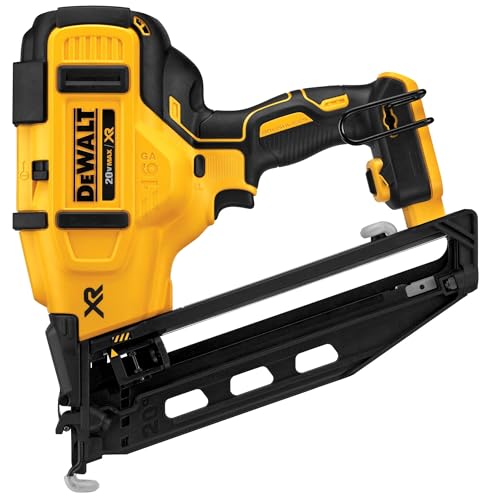
Baseboard and door casing need more holding power than a brad can give. A 16-gauge finish nailer is the right tool, and the DCN660B is the cordless one with the biggest track record: 4.6 stars across more than 1,900 Amazon ratings. It drives 16-gauge angled finish nails from 1-1/4 to 2-1/2 inches.
The angled magazine lets you get the nose into inside corners and tight spots where a straight-magazine nailer won’t fit. If you prefer straight-strip nails, DeWalt also sells the DCN662B straight 16-gauge model (4.7 stars, 332 ratings).

This listing is tool-only, and it is not cheap. Angled 16-gauge nails also cost a little more and are less common in small hardware stores than straight 16-gauge nails. Check that your local store stocks them before you commit.
Skip this if: your trim work is mostly thin moldings and shoe molding. An 18-gauge brad nailer is enough, and less likely to split thin pieces.
Pros:
- Real holding power for baseboard and casing
- Angled magazine reaches tight corners
- Large rating base
Cons:
- Tool-only at this price
- Angled nails are harder to find locally
Buy it on Amazon today with FREE returns
7. Metabo HPT NT65MA4 – Best 15-Gauge Finish Nailer

For door jambs, heavy casing and stair parts, finish carpenters reach for 15-gauge. The thicker nail holds better in heavy stock. The NT65MA4 is the long-running favorite here: 4.7 stars across more than 2,200 Amazon ratings at around $132. It drives angled 15-gauge nails from 1-1/4 to 2-1/2 inches and has selective actuation, so you can switch between single-shot and bump firing.

It is pneumatic, so it has the same hose trade-off as any air nailer. The 15-gauge nail also leaves a bigger hole to fill, which makes it a poor choice for small or painted moldings where a 16- or 18-gauge nail hides better. Metabo HPT also makes a cordless 18V 15-gauge version (NT1865DAA) if you want to cut the hose.
Skip this if: you are only doing baseboard and small trim. A 16-gauge nailer is the more versatile choice.
Pros:
- Strong hold in heavy trim and jambs
- Selective actuation (single or bump fire)
- Excellent value at 4.7 stars
Cons:
- Needs a compressor and hose
- Larger nail holes to fill
Buy it on Amazon today with FREE returns
8. Metabo HPT NP35A – Best Pin Nailer

A 23-gauge pin nailer shoots headless pins so thin the hole almost disappears. It won’t hold much on its own, but it is perfect for tiny moldings, veneer edging and holding glued joints while the glue dries. The NP35A drives pins from 5/8 to 1-3/8 inches and holds 4.6 stars across more than 1,800 Amazon ratings at around $99.

Want it cordless? The DEWALT DCN623B 20V 23-gauge pin nailer holds 4.7 stars across 928 ratings, at more than twice the price as a bare tool.
Skip this if: you need the nail to hold weight. Pins are a clamp, not a fastener. Use glue or a bigger nail.
Pros:
- Nearly invisible holes
- Great for glue-ups and delicate trim
- Low price
Cons:
- Very little holding power alone
- Needs a compressor
Buy it on Amazon today with FREE returns
9. Metabo HPT NV45AB2 – Best Roofing Nailer

Roofing nailers do one job: sink wide-head coil nails through asphalt shingles, fast. The NV45AB2 is the model you see on a lot of roofs, and it holds 4.6 stars across more than 1,900 Amazon ratings. It drives coil roofing nails from 7/8 to 1-3/4 inches.

This is a specialist tool. Unless you are re-roofing a shed or garage yourself, renting a roofing nailer is usually cheaper than buying one. Roofing work also comes with fall risk, so treat it as a job for experienced DIYers only.
Skip this if: you are not doing roofing. It has no other use.
Pros:
- Proven shingle nailer with a big rating base
- Coil magazine holds a lot of nails
Cons:
- Single-purpose tool
- Needs a compressor
Buy it on Amazon today with FREE returns
10. BOSTITCH BTFP3KIT – Best Nail Gun Starter Kit
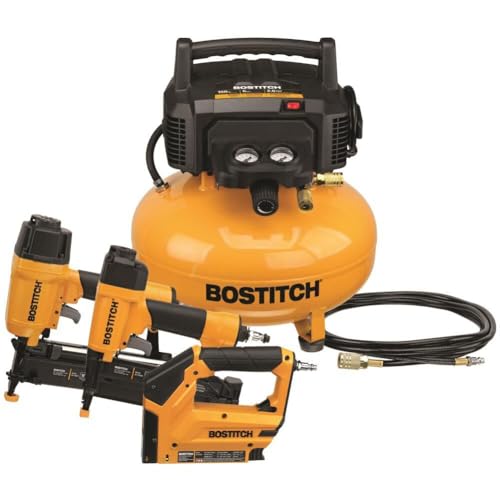
If you are starting from zero, this kit gets you three tools and the compressor to run them: an 18-gauge brad nailer, a 16-gauge finish nailer, a narrow crown stapler, a 6-gallon pancake compressor and a hose. It holds 4.7 stars across more than 5,200 Amazon ratings, one of the largest review bases in the category.
The compressor then does more than nailing. It inflates tires and runs a blow gun too.

It is not a framing kit. A 6-gallon pancake compressor is fine for trim nailers but too small for sustained framing. And like every air kit, you trade convenience for the hose and compressor noise.
Skip this if: you only need one nail gun, or you work mostly away from a power outlet.
Pros:
- Three nailers plus compressor and hose in one box
- Covers brad, finish and staple work
- Very large rating base at 4.7 stars
Cons:
- Compressor too small for framing
- Noisy compared with cordless tools
Buy it on Amazon today with FREE returns
Pneumatic vs. Cordless vs. Gas: Which Power Source?
| Pneumatic (Air) | Cordless (Battery) | Gas / Fuel Cell | |
|---|---|---|---|
| Tool price | Lowest | Highest | High |
| Extra cost | Compressor and hose | Batteries and charger | Fuel cells (ongoing) |
| Weight | Lightest | Heaviest | In between |
| Setup time | Slowest | Instant | Instant |
| Best for | Production work, shop use, tight budgets | Punch lists, trim, DIY, remote sites | Pros who already own a gas system |
Battery nailers have closed most of the gap for trim work. For framing, pneumatic is still lighter and cheaper, which is why the NR90AES1 remains our top framing pick. Gas nailers (such as Paslode’s) are still around, but most buyers are better served by a battery model with no fuel cells to buy.
Can you use a nail gun without a compressor?
Yes. Every cordless nail gun in this guide (DeWalt DCN680D1, Ryobi P320, DeWalt DCN660B, Metabo HPT NR1890DCA) runs on a battery with no compressor or hose. That is why cordless nailers have taken over home DIY. The trade-off is a higher tool price and more weight in your hand.
Contact vs. Sequential Trigger: The Safety Setting That Matters
Most nail guns have two firing modes:
- Sequential (single-shot): press the nose to the work, then pull the trigger. One nail per trigger pull.
- Contact (bump): hold the trigger and bounce the nose to fire. Much faster, and much easier to fire by accident.
The difference is not small. According to OSHA (retrieved 2026-09-29), nail guns cause about 37,000 emergency room visits a year, and the risk of injury is twice as high with a contact trigger as with a sequential trigger. For DIY work, leave your nailer on sequential mode. Wear safety glasses every time, and never carry a nailer with your finger on the trigger.
How to Choose a Nail Gun: Buying Guide
Match the battery platform you already own
If you own DeWalt, Milwaukee, Ryobi or Metabo HPT batteries, buy a bare-tool nailer on the same platform. It is the single biggest way to save money on a cordless nail gun.
Check the collation angle before buying nails
Framing and finish nails come in strips at set angles (for example 21 degree or 30 degree for framing). The nail strips must match the nailer. Buy nails after you pick the tool, not before.
Tool-free depth adjustment
Most modern nailers have it, but check the listing. It lets you set how deep the nail sinks without a wrench, which matters when you switch between softwood and hardwood.
Dry-fire lockout
A dry-fire lockout stops the tool from firing when the magazine is empty. It saves your workpiece from blank dents and tells you when to reload.
Compressor size (for air nailers)
Trim nailers run happily on a small pancake compressor. Framing and roofing nailers need more air, especially when bump-firing. Check the nailer’s air requirement against your compressor before you buy. Our guide to the best portable air compressors covers the numbers.
Frequently Asked Questions
What is the best nail gun for DIY?
An 18-gauge cordless brad nailer. It handles most home trim, crafts, furniture and small repairs without a compressor. The DeWalt DCN680D1 is our top pick, and the Ryobi P320 is the budget choice for Ryobi battery owners.
What brand of nail gun is best?
It depends on the tool type. Metabo HPT (formerly Hitachi) leads for pneumatic framing, finish and pin nailers on value and track record. DeWalt and Milwaukee lead cordless trim nailers, and Metabo HPT won Fine Homebuilding’s 2025 cordless framing nailer test. Buying into the battery platform you already own usually matters more than the badge.
Which type of nail gun is the most powerful?
Framing nailers. They drive the longest and thickest nails, up to 3-1/2 inches, for structural work.
What is the difference between a brad nailer and a finish nailer?
A brad nailer shoots thin 18-gauge brads for light trim and crafts. A finish nailer shoots thicker 15- or 16-gauge nails that hold heavier trim like baseboard and door casing. Brads leave smaller holes; finish nails hold better.
Can a brad nailer be used for baseboard?
For thin baseboard and shoe molding, yes. For tall or thick baseboard, use a 16-gauge finish nailer so the trim stays tight to the wall.
Are cordless nail guns as good as pneumatic?
For trim work, very close. For framing, pneumatic nailers are still lighter, cheaper and faster for all-day production work, though cordless framing nailers like the Metabo HPT NR1890DCA are now strong enough for most jobs.
Do I need a nail gun for framing a shed or deck?
You can hand-nail, but a framing nailer saves hours and your wrist. For a one-off project, renting a framing nailer and compressor is often cheaper than buying.
Bottom Line: Which Nail Gun Should You Buy?
- First nail gun for home projects: DEWALT DCN680D1, or the RYOBI P320 if you own Ryobi batteries
- You already own a compressor: Metabo HPT NT50AE2 brad nailer
- Baseboard and casing: DEWALT DCN660B (cordless) or Metabo HPT NT65MA4 (air)
- Framing: Metabo HPT NR90AES1 (air) or Metabo HPT NR1890DCA (cordless)
- Fine trim and glue-ups: Metabo HPT NP35A pin nailer
- Shingles: Metabo HPT NV45AB2
- Starting from scratch: BOSTITCH BTFP3KIT
For deeper comparisons, see our dedicated guides to the best framing nailers and the best cordless brad nailers.