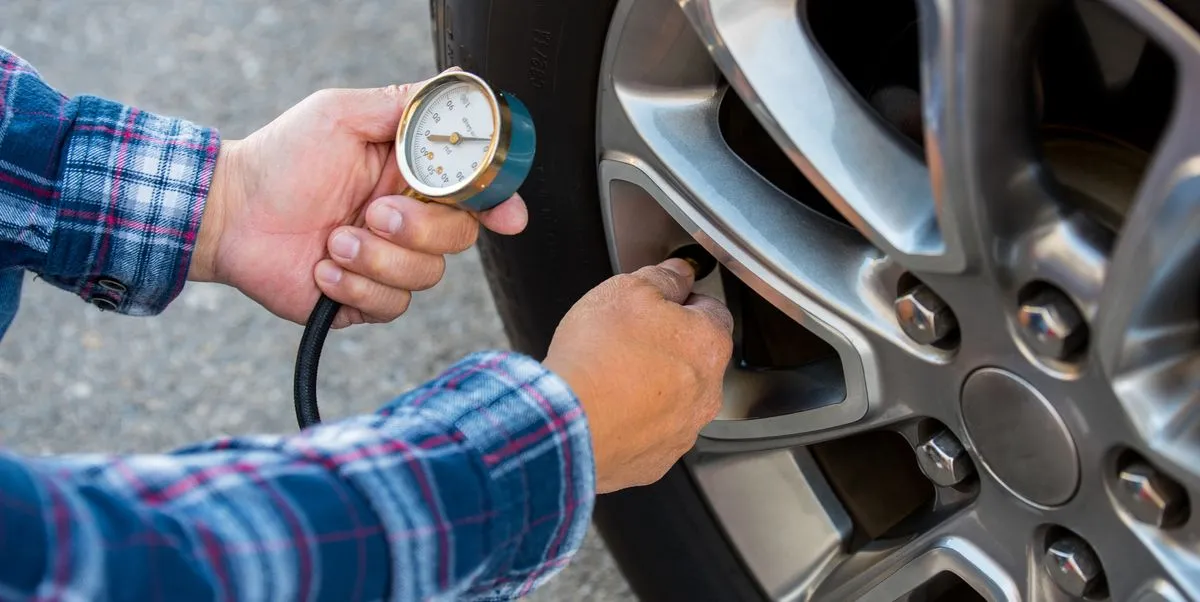
Under-inflated tires reduce fuel efficiency by up to 3% per PSI below the recommended pressure – over a year of daily driving, that’s real money, real tire wear, and real handling degradation. The problem is that most drivers rely entirely on their car’s built-in TPMS light for tire pressure monitoring. That’s a mistake. The TPMS warning light activates only when a tire is approximately 25% below its recommended pressure – on a standard 35 PSI passenger car tire, the light doesn’t trigger until the tire is down to around 26 PSI. By the time that warning appears on your dashboard, you may have been running on low tires for weeks.
A quality tire pressure gauge tells you the actual pressure in your tires, lets you optimise for fuel efficiency and tire longevity, and catches the seasonal pressure drops that TPMS ignores. A good gauge costs less than $30 and lasts decades. This guide reviews the 8 best tire pressure gauges on Amazon in 2026 – digital, dial, and stick types – with accuracy standards explained, a PSI range guide by vehicle type, and specific cold-weather performance notes that no other buyer’s guide properly addresses.
ProTguide is reader-supported. When you buy through links on our site, we may earn an affiliate commission at no extra cost to you. Ratings and specs were checked on Amazon in October 2026.
Digital vs Dial vs Stick Tire Pressure Gauges: Which Is Most Accurate?
The three main gauge types each have genuine advantages – and each has a specific failure mode that the others don’t share. Understanding the difference before buying prevents the most common purchasing mistake in this category (buying a digital gauge and discovering its battery dies in cold weather exactly when you need it).
Digital Gauges
LCD or LED display showing pressure to 0.1-0.5 PSI resolution. Usually the most accurate type at consumer price points: the JACO ElitePro digital gauges are rated to ANSI 2A, ±0.5% of full scale. Units are switchable between PSI, bar, kPa, and kg/cm². Backlighting makes them readable in dark parking garages. The critical limitation: battery-dependent. In sub-freezing temperatures, battery capacity drops rapidly – the exact conditions when tire pressure monitoring is most important. Some digital gauges also list an operating temperature range, so check the manual if you live somewhere very cold. Automatic shutoff can occasionally close before the reading is noted.
Dial (Bourdon Tube) Gauges
Analog needle on a circular face. No battery required. Wide PSI range visible at a single glance. ANSI-certifiable to ±1.5% or ±2%. The Rhino USA and JACO dial gauges carry ANSI B40.1 certifications. The limitation: the Bourdon tube mechanism can be knocked out of calibration by impact or prolonged storage in extreme heat (in a truck toolbox in summer, for example). Don’t drop dial gauges. The large glow-in-the-dark face on models like the Rhino USA makes them the easiest to read in low light without a backlight.
Stick (Pencil/Sliding Scale) Gauges
The classic piston-rod design – no battery, no moving dial mechanism, nothing to break or recalibrate. The Milton S-921 is plated brass with a built-in deflator, and pencil gauges like it can last for decades. The limitation: lower resolution (1 PSI increments on the Milton vs 0.1 PSI on the JACO digital), a narrower range (5-50 PSI on the Milton), and a scale that’s harder to read in dim light.
Accuracy Comparison Summary
| Type | Best Accuracy | Battery Needed | Cold Weather | Resolution |
|---|---|---|---|---|
| Digital (JACO ElitePro) | ±0.5% FS (ANSI 2A) | Yes | Limited in extreme cold | 0.1 PSI |
| Dial (Rhino USA / JACO) | ±1.5% ANSI B40.1 | No | Excellent | 1 PSI |
| Stick (Milton S-921) | 1 PSI increments | No | Excellent | 1 PSI |
What PSI Range Tire Pressure Gauge Do You Actually Need?
Most buyer’s guides list “60 PSI” or “100 PSI” gauge options without explaining which vehicles require which range. Buying a 60 PSI gauge for an RV results in a gauge that literally can’t read the tire pressure. Here’s the practical guide:
| Vehicle Type | Typical Tire PSI | Recommended Gauge Max | Notes |
|---|---|---|---|
| Standard passenger car | 28–36 PSI | 60 PSI | Any gauge in this roundup covers this |
| SUV / minivan | 32–45 PSI | 60 PSI | Check owner’s manual – some load ratings exceed 45 PSI |
| Pickup truck (unloaded) | 35–50 PSI | 60 PSI | Rear axle at max load may exceed 60 PSI |
| Pickup truck (loaded/towing) | 50–80 PSI rear | 100 PSI | Always check loaded vs unloaded spec separately |
| Travel trailer tires | 50–80 PSI | 100 PSI | Trailer tire pressure is separate from tow vehicle |
| Class B/C motorhome | 65–90 PSI | 100 PSI | Check each axle separately – front and rear often differ |
| Class A motorhome | 95–115 PSI | 120 PSI | Must use a high-PSI gauge – standard gauges won’t read |
| Motorcycle | 26–50 PSI | 60 PSI | May need a needle-nose chuck for valve stem access |
| Road bicycle | 80–120 PSI | 150 PSI gauge or pump gauge | Standard tire gauges may not handle this range |
TPMS vs Tire Pressure Gauge: Why Your Dashboard Sensor Isn’t Enough
TPMS (Tire Pressure Monitoring System) has been mandatory on all US vehicles built after September 2007 under NHTSA regulations. Many drivers assume this makes a separate gauge unnecessary. It doesn’t – for two specific reasons.
The 25% threshold problem: TPMS sensors are required to alert when any tire drops to 25% below the vehicle’s recommended cold inflation pressure. On a 35 PSI tire, the light triggers at approximately 26 PSI – meaning your tire can run 9 PSI low for an extended period without any dashboard warning. At 26 PSI on a tire recommended at 35 PSI, you’re experiencing measurably reduced fuel economy, increased tire wear, and degraded handling. The TPMS light tells you there’s a serious problem. A gauge tells you the actual number so you can optimise.
The 1 PSI per 10°F rule: Tire pressure changes by approximately 1 PSI for every 10°F change in ambient temperature. A tire set to 35 PSI in September at 70°F will read approximately 31–32 PSI in January at 30°F – without any air loss whatsoever. That 3–4 PSI drop typically won’t trigger TPMS. Your gauge catches it. Your TPMS doesn’t.
TPMS accuracy: TPMS sensors are directionally accurate but not precision instruments. A common real-world finding: after precisely adjusting all four tires to the same pressure with a quality gauge, one TPMS sensor will typically show 1 PSI different from the other three. Use your TPMS as a low-pressure alarm system; use your gauge for actual inflation decisions.
Critical rule: Always check tire pressure cold – before driving, or after the vehicle has sat for at least 3 hours. Driving heats tires and increases pressure 4–6 PSI above cold readings. The recommended PSI on your door jamb sticker is a cold pressure specification. Inflating to the recommended pressure when tires are hot will leave them under-inflated when cold.
Best Tire Pressure Gauges 2026: Quick Comparison
| Product | Type | PSI Range | Accuracy | Battery | Amazon Rating | Best For |
|---|---|---|---|---|---|---|
| JACO ElitePro Digital 100 PSI | Digital | Up to 100 PSI | ±0.5% FS (ANSI 2A) | Yes | 4.7 (7,100+) | Best Overall |
| Milton S-921 Stick Gauge | Stick | 5-50 PSI | 1 PSI increments | None | 4.6 (5,600+) | Best No-Battery / Most Durable |
| Rhino USA 75 PSI Dial | Dial | 0-75 PSI | ANSI B40.1 | None | 4.6 (5,100+) | Best Dial / Easy-Read |
| AstroAI Digital Inflator with Gauge | Digital inflator | 3-250 PSI | ±0.5% FS (ANSI 2A) | Yes | 4.6 (34,600+) | Best for Filling Up at Home |
| Accutire Digital 5-150 PSI | Digital | 5-150 PSI | Within 0.5 PSI | LR44 | 4.3 (6,600+) | Best Budget Glove Box |
| JACO ElitePro Digital 200 PSI | Digital | Up to 200 PSI | ±0.5% FS (ANSI 2A) | AAA | 4.7 (5,500+) | Best for Trucks & RVs |
| JACO Elite Dial 60 PSI | Dial | 0-60 PSI | ±1.5% (ANSI) | None | 4.6 (4,900+) | Best No-Battery Precision |
| Rhino USA 60 PSI w/ Deflator | Dial | 0-60 PSI | ANSI B40.1 | None | 4.4 (1,500+) | Best for Airing Down |
Top row = my top pick. Always check tire pressure cold (before driving or after 3+ hours of sitting). Use your door jamb sticker pressure – not the tire sidewall max – as your inflation target. Prices verified at time of publishing.
1. JACO ElitePro Digital Tire Pressure Gauge (100 PSI) – Best Overall
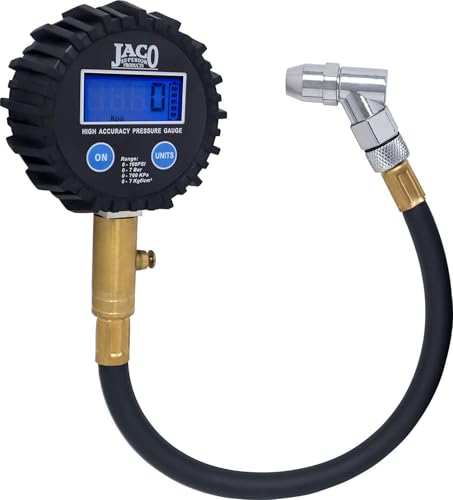
If I could only keep one gauge in the truck, it would be this one. JACO says the ElitePro Digital is calibrated to ANSI 2A standards with dual pressure sensors certified to ±0.50% of full scale. On a 100 PSI gauge that works out to ±0.5 PSI, with a readout resolution of 0.1 PSI. That’s shop-grade accuracy for the price of a tank of gas.

The build is the other reason it’s here. JACO uses solid brass and steel parts inside a shock-resistant protective guard, and a 10″ fully rotating, leak-proof hose so you can reach a valve stem at any angle without kneeling in a puddle. The 100 PSI ceiling also means one gauge covers the family car, the pickup and most trailers.
What buyers say: It has a 4.7-star average from more than 7,100 Amazon ratings. Amazon’s review summary says customers call it the best gauge they’ve owned, like the large, clear digital display, find it accurate, and consider it well worth the money for its solid construction.
Pros: ANSI 2A ±0.5% full-scale accuracy (±0.5 PSI); 0.1 PSI resolution; brass and steel internals with a protective guard; flexible swivel hose; 100 PSI covers cars, trucks and most trailers.
Cons: Needs batteries; costs more than a stick or basic dial gauge; Class A motorhome owners should look at the 200 PSI version below.
Who it’s for: Anyone who wants one accurate gauge for every vehicle in the driveway.
2. Milton S-921 Pencil Tire Pressure Gauge – Best No-Battery, Most Durable

Every mechanic I know has a pencil gauge like this rattling around somewhere, and there’s a reason. The Milton S-921 has no battery to die in January, no screen to crack, and no dial to knock out of calibration. Milton says it’s made in the USA with machined parts and plated brass, and it includes a built-in deflator valve so you can let air out without pulling the gauge off.
It measures 5 to 50 PSI in 1 lb increments (plus 40-350 kPa), which is made for passenger car tires. If you run a truck or trailer above 50 PSI, this isn’t your gauge.
What buyers say: It has a 4.6-star average from more than 5,600 Amazon ratings. Amazon’s review summary says customers find it highly accurate and reliable, with readings comparable to Snap-On gauges, and say it’s well built from quality steel and worth the price.
Pros: No battery ever; plated brass build; built-in deflator; made in the USA; very cheap.
Cons: 5-50 PSI only (passenger cars); 1 PSI increments; harder to read in dim light than a glow dial or backlit screen.
Who it’s for: Cold-climate drivers, emergency kits, and anyone who wants a car gauge they’ll never have to think about.
3. Rhino USA Heavy Duty Dial Tire Pressure Gauge (0-75 PSI) – Best Dial Gauge
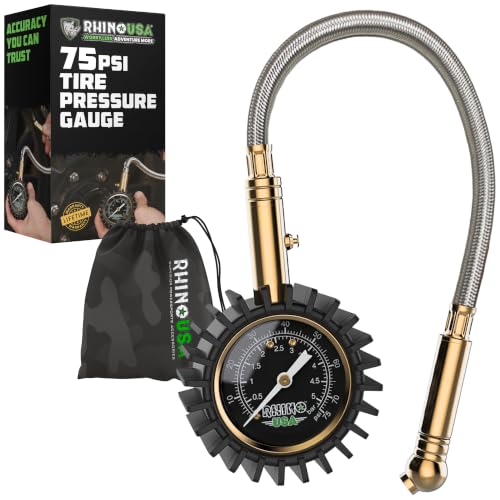
The Rhino USA is the easiest gauge on this list to read in a dark garage, because the 2″ dial glows in the dark. No backlight button, no battery. Rhino says it’s certified to ANSI B40.1 accuracy, with solid brass hardware, a 360-degree swivel and a braided “no-leak” hose. The 0-75 PSI range covers cars, SUVs, light trucks and motorcycles. Rhino USA is a father-and-son business in California and backs it with a lifetime warranty.
What buyers say: It has a 4.6-star average from more than 5,100 Amazon ratings. Amazon’s review summary says customers find it accurate, reading down to 1 PSI, like the easy-to-read dial, and say it’s well built and durable, with one buyer noting it survived being dropped.
Pros: Glow-in-the-dark 2″ dial; no battery; ANSI B40.1; brass swivel and braided hose; lifetime warranty.
Cons: 75 PSI ceiling; like any dial gauge, a hard drop on the face can knock it out of calibration.
Who it’s for: Drivers who prefer analog and check tires in low light.
4. AstroAI Digital Tire Inflator with Gauge (3-250 PSI) – Best for Filling Up at Home
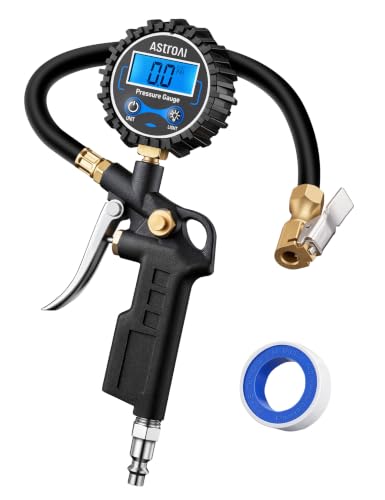
This one is a little different from the rest of the list. The AstroAI is a digital gauge built into a trigger-style inflator that connects to an air compressor hose. Squeeze the trigger to add air, press a button to let air out, and read the pressure on the digital display without swapping tools. If you have a compressor in the garage, this is the fastest way I know to set all four tires.
AstroAI says it’s calibrated to ANSI B40.7 Grade 2A (±0.5% full scale) with 0.1 PSI resolution, and it reads from 3 to 250 PSI in PSI, bar, kPa or kg/cm². With more than 34,600 ratings at 4.6 stars, it’s by far the most-reviewed product in this roundup.
What buyers say: Amazon’s summary says customers find it highly accurate, easy to use and good value, with a clear display. Some report the air chuck not sealing tightly on valve stems, and durability gets mixed feedback.
Pros: Inflate, deflate and measure in one tool; wide 3-250 PSI range; 0.1 PSI resolution; four units.
Cons: Needs an air compressor to inflate; bulkier than a glove-box gauge; some buyers report chuck sealing issues.
Who it’s for: Anyone with a home or shop compressor who wants to fill and check tires in one step. If you need a compressor, see my picks for the best portable air compressors and best digital tire inflators.
5. Accutire Digital Tire Pressure Gauge (5-150 PSI) – Best Budget Glove Box Gauge
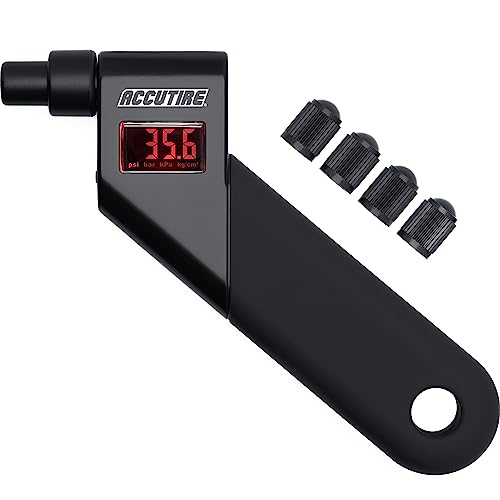
The Accutire is the cheapest digital gauge on this list and the one I’d toss in a glove box and forget about until I need it. It has an angled head and rubber-coated handle, a backlit LCD, and switches between PSI, bar, kPa and kg/cm². Accutire says it’s accurate to within 0.5 PSI and reads from 5 to 150 PSI in 0.5 PSI increments. It runs on replaceable LR44 coin cells, and auto shut-off saves the battery.
What buyers say: It holds a 4.3-star average from more than 6,600 Amazon ratings. Amazon’s summary says customers find it highly accurate and easy to use, with immediate readings and a backlit display that works well in the dark. Durability and reliability get mixed results.
Pros: Low price; backlit LCD; 5-150 PSI range; four units; small enough for any glove box.
Cons: 0.5 PSI increments (coarser than the JACO); mixed long-term durability reports; coin-cell batteries.
Who it’s for: Drivers who want a cheap, decent digital gauge that lives in the car.
6. JACO ElitePro Digital Tire Pressure Gauge (200 PSI) – Best for Trucks and RVs
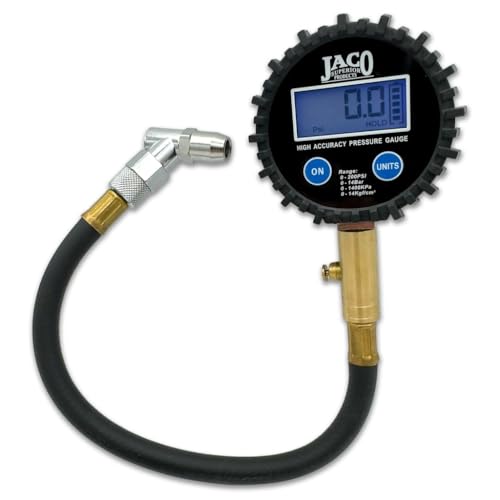
Same idea as my top pick, with twice the range. JACO says this version is calibrated to ANSI 2A standards with dual sensors certified to ±0.50% of full scale, which works out to ±1 PSI on a 200 PSI gauge, and it still reads in 0.1 PSI steps. That range matters if you run a loaded pickup, a travel trailer with ST tires, or a motorhome. Many heavy-duty and RV tires run well above 60 PSI, so check your load and inflation chart and buy a gauge that covers it with room to spare.
What buyers say: It has a 4.7-star average from more than 5,500 Amazon ratings. Amazon’s summary says customers find it highly accurate and easy to read with its blue backlit display, note that it runs on AAA batteries (included), and one buyer says it works well with nitrogen-filled tires. Fit and air leakage get mixed feedback.
Pros: 200 PSI range covers trucks, trailers and motorhomes; ANSI 2A ±0.5% full-scale accuracy; 0.1 PSI resolution; backlit display; AAA batteries.
Cons: ±1 PSI full-scale tolerance is looser than the 100 PSI version in absolute terms; overkill for a car-only household.
Who it’s for: Truck, trailer and RV owners whose tires run above the range of a standard car gauge.
7. JACO Elite Dial Tire Pressure Gauge (60 PSI) – Best No-Battery Precision Dial
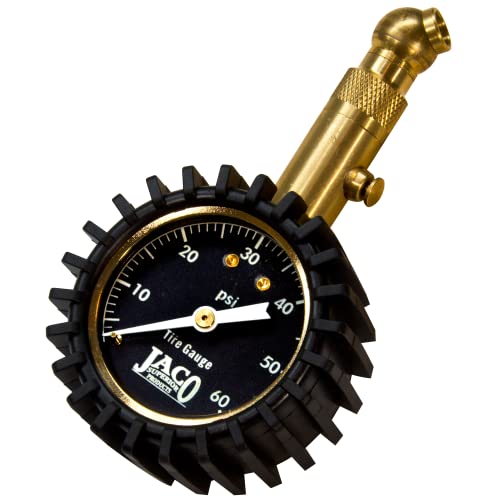
If you like a needle better than a screen, this is the dial gauge I’d buy. JACO says it’s calibrated to ANSI standards at ±1.5%, so on a 60 PSI dial you’re within about 0.9 PSI. It’s heavy-duty brass inside a rubberized, shock-resistant guard, with a 2.25″ brass stem, a built-in bleeder valve and a 360-degree swivel chuck. No batteries, ever.
What buyers say: It has a 4.6-star average from more than 4,900 Amazon ratings. Amazon’s review summary says customers find it high quality with consistent readings and easy-to-read graduations, point out the heavy-duty brass stem, and expect it to last for years.
Pros: No battery; ANSI ±1.5% accuracy; rubberized protective guard; built-in bleeder valve; swivel chuck.
Cons: 60 PSI max; less precise than the JACO digital gauges; any dial gauge can lose calibration if dropped hard on its face.
Who it’s for: Drivers who want a trustworthy analog gauge for cars, SUVs and motorcycles.
8. Rhino USA Heavy Duty Tire Pressure Gauge (0-60 PSI) with Deflator – Best for Airing Down
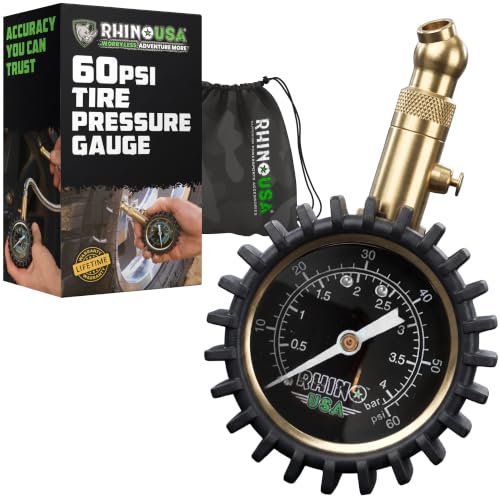
This is the 60 PSI sibling of the Rhino above, with one feature I use a lot: an integrated deflator valve. Rhino pitches it for airing down tires for off-road traction, and it’s just as handy at a gas station when the air machine overshoots. It has the same 2″ glow dial, braided hose, solid brass hardware and 360-degree swivel, and it’s certified to ANSI B40.1.
What buyers say: It has a 4.4-star average from more than 1,500 Amazon ratings. Amazon’s review summary says customers find it a well-made precision instrument with accurate readings from very low to normal pressures, and like that the swivel head and large numbers make it easy to read.
Pros: Built-in deflator; glow dial; no battery; ANSI B40.1; good for airing down off-road.
Cons: 60 PSI max; dial gauges need careful storage.
Who it’s for: Off-roaders and anyone who regularly needs to let air out to hit an exact pressure.
How to Choose the Best Tire Pressure Gauge: Complete Buyer’s Guide
Check Pressure Cold – Always
This is the most important tire maintenance rule regardless of which gauge you own. Always check tire pressure before driving or after the vehicle has sat for at least 3 hours. Driving heats tires and increases internal pressure 4–6 PSI above the cold reading. The pressure specification on your door jamb sticker is a cold inflation pressure. If you inflate to that number when tires are hot, the tires will be under-inflated when cold. Check cold, inflate cold, verify cold – every time.
Door Jamb Sticker vs Tire Sidewall – Which Number to Use
Always use the door jamb sticker pressure, not the tire sidewall. The door jamb number is the vehicle manufacturer’s recommended operating pressure for your specific car, load range, and tire size. The tire sidewall number is the maximum pressure the tire can structurally hold – significantly higher than the operating pressure, and not the correct inflation target. These two numbers are commonly confused, and inflating to the sidewall maximum (often 44–51 PSI) when the door jamb specifies 35 PSI produces an over-inflated tire with reduced traction and a harsher ride.
Choose the Right PSI Range
For passenger cars and SUVs: any 60 PSI gauge covers you. For pickup trucks at maximum payload or towing: 100 PSI. For RVs and motorhomes: 100–120 PSI depending on class. Don’t guess. The 100 PSI JACO ElitePro covers both the passenger car and the loaded truck in a single gauge. If in doubt, buy the higher range.
Digital vs Dial vs Stick Decision Framework
If accuracy is the priority: JACO ElitePro Digital (ANSI 2A). If battery failure is a concern, like a cold climate or an emergency kit: Milton S-921 stick gauge. If you want a big, easy-to-read face with no battery: Rhino USA glow dial. If you want a cheap digital gauge for the glove box: Accutire. If you fill tires from a home compressor: AstroAI inflator gauge. Most households do well with two: a digital gauge in the garage and a stick or dial gauge in the car.
How Often Should You Check Tire Pressure?
Monthly is the standard recommendation – monthly checks take approximately three minutes across four tires and catch the slow leaks, seasonal drops, and inflation problems that TPMS misses. The most practical habit: pick the same day every month (the first of the month, or the first Sunday) and check all four tires before the first drive of that day. Check additionally: before any long road trip; when seasonal temperatures change significantly (autumn and spring are the critical transitions); after any puncture repair; when adding a full load to a truck or trailer.
The 1 PSI Per 10°F Temperature Rule in Practice
A tire inflated to 35 PSI at 70°F will read approximately: 33 PSI at 50°F, 31 PSI at 30°F, 29 PSI at 10°F. None of these drops trigger TPMS (25% below 35 PSI = 26.25 PSI threshold). All of them reduce fuel efficiency and handling. Check pressure at each seasonal temperature transition and adjust accordingly.
Do Tire Pressure Gauges Lose Accuracy Over Time?
Digital gauges maintain accuracy well with normal use. Dial gauges can drift if dropped or stored under sustained compression. Stick gauges rarely lose calibration but the spring mechanism can weaken over many years of daily professional use. Test your gauge annually against a known reference – a gas station gauge, a dealer’s gauge, or a new gauge – and replace if the reading differs by more than 2 PSI. For the JACO ElitePro, the lifetime warranty covers replacement if accuracy degrades. For the Milton S-921, the brass construction means it’s unlikely to need replacement within a normal service life.
For related automotive tool guides, see my picks for the best digital tire inflators, the best portable air compressors and the best automotive multimeters.
Frequently Asked Questions
What is the most accurate tire pressure gauge?
Of the gauges in this roundup, the JACO ElitePro Digital (100 PSI) has the tightest stated accuracy for car and light-truck use: JACO says it’s calibrated to ANSI 2A at ±0.5% of full scale, or ±0.5 PSI. Check the accuracy spec on any gauge before you buy, because “accurate” on a listing means nothing without a number.
Is a digital or dial tire pressure gauge more accurate?
Quality digital gauges usually carry a tighter accuracy rating. The JACO digital gauges are rated ±0.5% of full scale, while the JACO dial is rated ±1.5%. A good ANSI-certified dial gauge is still accurate enough for everyday tire maintenance and never needs a battery.
Why does my tire pressure gauge read differently from my TPMS?
TPMS sensors and hand gauges have separate calibrations and can differ by 1-3 PSI. TPMS is a low-pressure alarm, not a precision instrument. Use your hand gauge for inflation decisions and check both cold for the closest match.
Should I check tire pressure when tires are hot or cold?
Always cold, before driving or after the vehicle has sat for at least 3 hours. Hot tires read several PSI higher. The door jamb pressure is a cold specification.
What PSI range tire pressure gauge do I need?
Passenger car and SUV: 60 PSI covers it. Pickup truck at max payload or towing, travel trailers and Class B/C RVs: 100 PSI. Class A motorhomes: a higher-range gauge like the 200 PSI JACO. When in doubt, buy the next range up.
Do tire pressure gauges lose accuracy over time?
They can. Dial gauges can drift if dropped on the face, and any gauge can wear. Check yours once a year against a known good gauge and replace it if it reads more than 2 PSI off.
Are cheap tire pressure gauges accurate enough?
For everyday passenger car maintenance, a decent budget gauge is usually fine. What matters most is consistency: it should give the same reading twice in a row. For towing, RVs or performance driving, spend a little more on a gauge with a stated ANSI 2A rating.
What is ANSI 2A accuracy for tire gauges?
ANSI grade 2A means the gauge is accurate to ±0.5% of its full-scale range. On a 100 PSI gauge, that’s ±0.5 PSI. On a 200 PSI gauge, it’s ±1 PSI. That’s why a lower-range gauge can be more precise for car tires.
Our Final Verdict
The JACO ElitePro Digital (100 PSI) is the gauge I’d buy for most households: ANSI 2A accuracy, brass and steel build, and enough range for the car and the truck. For RVs and heavy trailers, step up to the JACO ElitePro 200 PSI. If you want a car gauge that never needs a battery, the Milton S-921 is cheap and close to indestructible. And if you have a compressor at home, the AstroAI inflator gauge lets you fill and check in one step.
Check your tire pressure cold, use your door jamb sticker number, and check monthly. The gauge you use matters less than the habit of using it.