
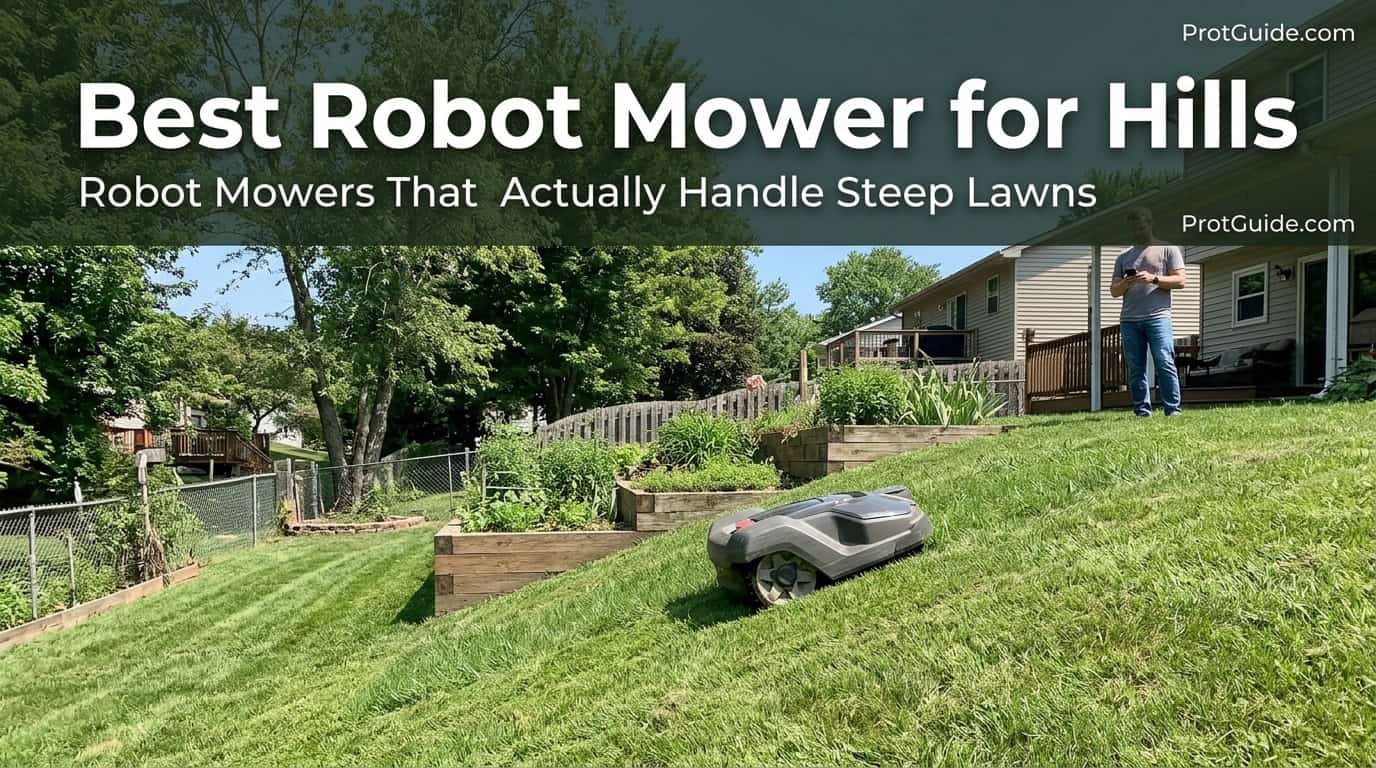
Most robot mower buying guides quote a single slope number – 35°, 40°, 84% – and leave you to figure out what that actually means standing on your own backyard hill. The truth is that slope rating is the single most misunderstood specification in this entire product category, and getting it wrong is the single most common reason a robot mower purchase fails on a hilly property. A mower rated for 38° on a dry, firm test slope will not necessarily behave the same way on your 33° slope after a week of rain, with a few exposed tree roots and a soggy patch near the downspout.
This guide covers nine robot mowers built specifically for sloped and hilly properties in 2026, with the content most competing guides skip entirely: a degree-to-percent-grade conversion table with real-world reference points, a plain-language explanation of what AWD and tracked drivetrains actually do differently, a glossary that untangles RTK, GNSS, VSLAM, and LiDAR into terms you can actually use when comparing specs, and honest guidance on when you don’t need any of this and when even the best robot mower is the wrong tool entirely.
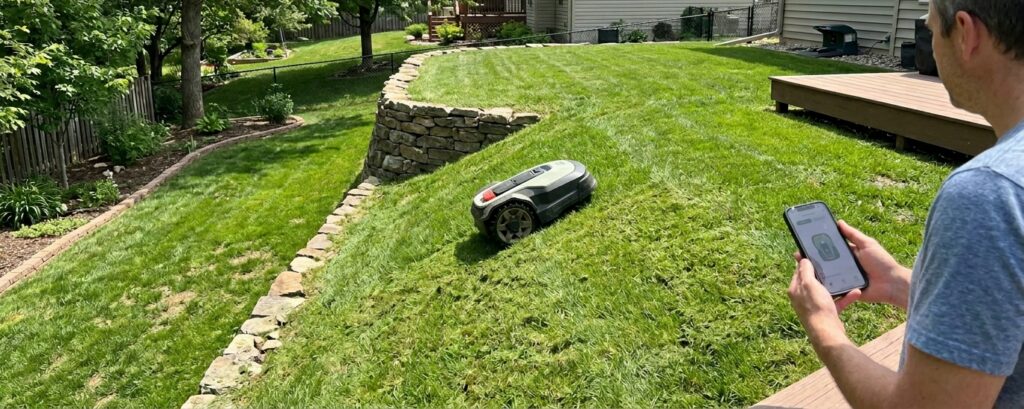
Quick answer: The Mammotion LUBA 3 AWD 5000 is the best overall pick for most genuinely hilly properties – true AWD, 80% slope rating, LiDAR and vision fusion navigation. For the steepest residential slopes beyond what any wheeled mower can climb, the Lymow One Plus and its tracked drivetrain reach a full 100% grade. If your “hill” turns out to be milder than you think once you measure it, the Segway Navimow i110N delivers reliable performance without paying for capability you don’t need.
Quick navigation: Measure Your Slope | Degree-to-Percent Table | AWD vs. Tracked | Navigation Glossary | Obstacle Clearance | Safety on Slopes | Comparison Table | Full Reviews | FAQs
How Steep Is Your Slope, Really? The Measurement Step Everyone Skips
Most homeowners underestimate their own yard’s steepest grade by 10 to 15 degrees. This is not a minor rounding error – it is the single most common reason a robot mower purchase goes wrong on a hilly property. A buyer who eyeballs their slope as “kind of steep, maybe 20 degrees” frequently discovers, once they actually measure it, that the worst section of their bank is closer to 32 or 35 degrees. That gap is the difference between a standard mower and a true AWD model, or between a mid-range AWD model and one of the strongest AWD or tracked options in this guide.
How to measure correctly:
- Download a free clinometer or inclinometer app on your phone – there are several reliable free options for both iOS and Android.
- Lay a straight board flat across the slope rather than placing the phone directly on the grass – turf surface irregularity (bumps, divots, thatch buildup) will give you a false reading if you measure the grass surface itself rather than the underlying grade.
- Place the phone flat against the board and read the angle.
- Measure at the steepest point, not an average impression of the yard. Properties frequently have one short, very steep section – a bank near a retaining wall, the transition at the edge of a terrace – that is far steeper than the “overall” slope feel of the property.
- Measure multiple points across the yard, not just one spot, especially if the terrain varies noticeably between zones.
Do this before reading a single spec sheet. A mower rated for 35° will not perform identically on a 33° slope with wet grass and loose soil as it does on a dry, firm 35° manufacturer test slope – measuring first gives you the realistic number to compare against published ratings, with margin to spare.
Slope Rating Explained – Degrees vs. Percent Grade vs. Real-World Examples
Every manufacturer in this category quotes slope capability as either a degree measurement or a percent grade – and the two numbers describe the same incline using different math. Percent grade is rise over run multiplied by 100; degrees are the angle itself. The formula connecting them is: percent grade = tan(degrees) × 100. The two scales track closely at low angles but diverge significantly as the slope gets steeper – which is exactly why a marketing spec sheet quoting “80%” sounds far more dramatic than “38.6°,” even though they are the identical incline.
| Degrees | Percent Grade | Real-World Comparison | Robot Mower Category |
|---|---|---|---|
| 5° | 8.7% | Gentle driveway slope | Any standard mower |
| 10° | 17.6% | Moderate yard slope | Standard wheeled mowers (most) |
| 15° | 26.8% | Noticeable hill, still easy to walk | Upper limit for many standard/budget mowers |
| 20° | 36.4% | Steep driveway | Entry-level AWD territory begins |
| 24° | 45% | A pronounced backyard slope | YUKA mini 2 / ANTHBOT M5 / MOVA ceiling |
| 27° | 50% | Steep grassy bank | Standard RWD ceiling on some compact models |
| 30° | 57.7% | A ski resort “intermediate” run | Strong AWD required |
| 35° | 70% | A steep black-diamond ski run | Mowrator S1 ceiling |
| 38.6° | 80% | Among the steepest residential banks | Mammotion LUBA 3 AWD ceiling |
| 40° | 84% | A rare residential extreme | Segway Navimow X430 ceiling |
| 45° | 100% | A true 1:1 slope – wheels lose grip entirely | Tracked mowers only (Lymow One Plus) |
Practical buying rule: always check whether a manufacturer’s quoted maximum is for climbing straight up and down a slope, or for traversing it on an angle (cross-slope). Many mowers struggle more on a cross-slope traverse at a lower angle than their quoted maximum climbing angle, because the mower’s weight is unevenly distributed side-to-side rather than front-to-back. If your yard requires mowing across a bank rather than straight up it – which is the case for most real lawns – build in a margin below the quoted maximum rather than treating it as a hard ceiling you can use in every direction.
AWD vs. Tracked vs. RWD – What’s Actually Different Under the Hood

RWD / Standard Drive
Power goes to two wheels only, typically the rear pair. This is adequate for 15–25% grade (roughly 8–14°) – gentle rolling lawns. Standard drive loses traction first on wet grass or any grade above this range, because there is no mechanism to compensate when one of the two driven wheels starts to slip.
AWD (All-Wheel Drive) – the category workhorse for hills
Each wheel is powered independently. When one wheel starts to slip – on wet grass, loose soil, or a steep transition – the system compensates by delivering more torque to the wheels that still have grip. This is the mechanical reason AWD mowers handle roughly twice the grade of a standard drivetrain.
One important distinction worth flagging directly: “true 4WD” – four independently driven and powered wheels – is meaningfully different from AWD marketing language on some systems that are mechanically biased toward two wheels even while branded as all-wheel drive. This distinction is a common source of buyer confusion, and it is worth confirming in a product’s actual specifications rather than assuming “AWD” always means identical mechanical capability across brands.
AWD is the right category for 25–38.6° grades and for properties with a mix of flat and sloped zones. The tradeoff: AWD wheeled mowers are more maneuverable in tight spaces than tracked systems, but they struggle past roughly 38–40° or on genuinely loose footing such as gravel, bare dirt, or deep mulch.
Tracked Systems – the extreme-slope specialist
A continuous tread distributes weight across a much larger ground-contact area than a wheel does – reducing ground pressure by roughly 40% compared to wheeled designs. This is the mechanical reason tracks grip where wheels slip: more surface area in contact with the ground means more available friction, and the tread pattern bites into soft or wet ground rather than rolling over the top of it.
Tracked systems are the right choice for slopes at or beyond the 38–45° range, for wet grass, exposed roots, gravel borders, or any soil that would compact or rut under wheel pressure. The tradeoff: tracked mowers are typically louder when running, sometimes have a lower top travel speed, and can be heavier – a relevant factor if you need to lift or transport the unit.
The Practical Decision Rule
- Yard maxes out under 25°: standard drive or entry AWD is enough – don’t overpay for capability you won’t use.
- Yard has zones in the 25–38° range: AWD is the correct category.
- Yard has any section beyond 38–40°, especially with loose or wet footing: tracked is the only category that will reliably work.
Navigation Technology Glossary – RTK, GNSS, VSLAM, LiDAR, and Why “Fusion” Matters
Every product page in this category throws around RTK, GNSS, VSLAM, and LiDAR as if the reader already knows what each one does. Here is the plain-language version.
GNSS / GPS (Global Navigation Satellite System)
The baseline – satellite positioning, the same family of technology as your phone’s GPS. Accuracy alone is measured in meters, not centimeters, which is too imprecise on its own for the tight boundary lines a mower needs to respect.
RTK (Real-Time Kinematic) Correction
A correction signal – from a base station or a network service – that sharpens GNSS accuracy down to centimeter level. This is what allows wire-free mowers to draw a virtual boundary instead of requiring buried physical wire. The known weakness: the correction signal can be blocked or degraded under heavy tree canopy, which is the most-cited real-world complaint in robot mower owner communities.
VSLAM (Visual Simultaneous Localization and Mapping)
Uses onboard cameras to build a visual map of the property and track the mower’s position relative to landmarks it has previously seen. This functions as a backup and redundancy layer when satellite signal drops out – arguably the single most important reliability concept in this entire category, and one that is rarely explained clearly anywhere else. The weakness alone: VSLAM can struggle with visually repetitive or low-light, featureless terrain without RTK or GNSS data to anchor it.
LiDAR
Laser-based distance and obstacle mapping that builds a precise 3D picture of terrain and obstacles in real time, including in darkness – something camera-only vision cannot do. LiDAR is particularly valuable on sloped terrain because it can detect grade changes and physical obstacles (rocks, roots, drop-offs) that a camera might miss in shadow or low light.
“Fusion” Navigation – RTK + VSLAM, or RTK + VSLAM + LiDAR
The 2026 standard for serious slope-rated mowers is a fusion of multiple navigation systems, each covering the others’ weaknesses. The direct buying rule: single-system navigation – GPS-only, or camera-only – creates real reliability gaps on properties with variable conditions like tree cover or seasonal light changes. Always prefer a fusion system on a genuinely sloped or obstacle-heavy property, because the failure modes of RTK (canopy blockage) and the failure modes of VSLAM (featureless terrain, low light) rarely overlap – when one system is struggling, the other typically is not.
Obstacle-Crossing Height – The Spec That Matters as Much as Slope Rating
Slope rating tells you the maximum angle a mower can climb on a clean, continuous grade. It does not tell you whether the mower can get over a garden hose, an exposed root, a sprinkler head, or the lip where a flower bed meets the lawn. Obstacle-crossing height – commonly 1.4 to 2.8 inches (35–70mm) on slope-rated models – is a separate, equally important specification for any yard with real-world clutter on a slope.
Before buying, walk your slope and note every physical obstruction – irrigation heads, exposed roots, edging, drainage grates – rather than assuming a high slope rating alone guarantees smooth operation across the whole area.
What Happens When a Robot Mower Loses Traction? – Safety on Slopes
Tilt and lift sensors stop blade rotation immediately if a mower is lifted or tips beyond a safe angle – this is a standard safety feature across the category, and it is the actual answer to “is this safe to use on my hill.” AWD and tracked mowers with slip detection typically stop forward motion, attempt a controlled retreat, or send an app alert rather than continuing to push against a loss of grip.
The realistic risk profile: a properly slope-rated mower operating within its rated grade, on appropriate footing, is not a rollaway hazard in the way a ride-on mower can be on a steep grade. The actual danger scenario is using a mower beyond its rated slope, or on loose or wet footing it was never designed for – which is a buying-mistake risk, not an inherent product risk. Never push a mower past its manufacturer-rated maximum slope just because “it seems to handle it fine” on a dry day. Wet grass and seasonal soil changes will eventually expose the gap between what looked fine and what the machine is actually rated for.
Charging Station Placement on a Sloped Yard
Place the charging station at the base of the slope or at a flat midpoint of the property – never partway up a steep grade. This reduces the distance and effort required for the mower to return on a low battery, and minimizes risk if the return-path traction is marginal after rain or heavy dew.
If your yard has multiple separated flat zones connected by a steep section, consider whether the mower genuinely needs to traverse the slope routinely to reach all zones, or whether a layout that minimizes slope-crossing trips makes more practical sense. For wire-free RTK models, station placement also affects signal quality during the initial mapping pass – open sky exposure near the station improves initial calibration accuracy.
Wet Grass and Morning Dew – Why a High Slope Rating Doesn’t Guarantee Grip
Manufacturer slope ratings are typically measured under controlled, dry-condition testing. Real-world performance on wet grass, morning dew, or after rain is meaningfully different. AWD systems with independent per-wheel torque compensate better than RWD on wet grass, but even AWD models see some reduction in effective climbing performance on slick, dew-covered slopes. Tracked systems hold their slope-rating advantage most consistently in wet conditions, because the larger contact area and tread pattern is less dependent on surface friction alone than a wheel is.
Practical scheduling tip: many owners report better results scheduling mowing passes for mid-morning, after dew has burned off, rather than early morning – specifically on sloped sections where the margin between adequate and marginal traction is thinner.
When You Probably Don’t Need an AWD or Tracked Mower
If your steepest measured point is under roughly 20% grade (about 11°), a standard wired or wire-free robot mower will handle it reliably for the 5+ year service life these products are typically designed for, without paying the significant AWD or tracked premium – often $1,000 to $2,000 or more above standard models. This premium is only worth paying when genuinely needed.
One important caveat: if your yard has even one short, steep “problem section” surrounded by otherwise flat terrain – a bank by a retaining wall, a slope down to a drainage area – this is still a case for a slope-rated model. A mower that cannot handle that single section will require manual intervention every single cycle, which defeats much of the purpose of automating your lawn care in the first place.
When a Robot Mower Is the Wrong Tool – Even a Slope-Rated One
Loose footing – gravel, bare dirt, sand, deep mulch beds – defeats traction regardless of slope rating. Both wheels and tracks rely on some degree of consistent surface grip that loose material simply does not provide. Grades beyond the rated maximum of even the best tracked models (typically 45°/100%) are beyond any current consumer robot mower. Slopes behind retaining walls too tall or too narrow for safe robot access are also outside what any wheeled or tracked machine should attempt.
For these specific cases, a string trimmer, a manual brush cutter, or a professional lawn crew for problem sections (commonly $40–$80 per visit) remains the practical answer. Automation has a real ceiling in this category, and being honest about where that ceiling sits will save you from forcing a robot mower into a situation it was never designed to handle.
Quick Comparison – All 9 Robot Mowers for Hills at a Glance
| Model | Slope Rating | Drivetrain | Navigation | Best For | Buy |
|---|---|---|---|---|---|
| ★ Mammotion LUBA 3 AWD 5000 | 80% (38.6°) | True AWD | 360° LiDAR + dual-camera AI vision | Best Overall / Large Hilly Yards | View → |
| Segway Navimow X430 | 84% (40°) | True 4WD + Traction Control | RTK + vision fusion | Best Slope Rating (Wheeled) | View → |
| Mammotion YUKA mini 2 1000H | 45% (24°) | RWD | 360° LiDAR + AI vision (no RTK needed) | Best for Heavy Tree Canopy | View → |
| Husqvarna 435iQ AWD | ~70% (35°) class | AWD, articulated chassis | EPOS / GPS-assisted | Best Premium Build Quality | View → |
| Lymow One Plus | 100% (45°) | Tracked (tank treads) | RTK + VSLAM | Best for Extreme Slopes | View → |
| Mowrator S1 | 75% (~35°) | AWD + manual override | RTK / satellite-guided | Best Hybrid Manual Control | View → |
| Segway Navimow i110N | Moderate (entry/mid) | Standard drive | RTK wire-free | Best for Mild-Moderate Slopes | View → |
| MOVA LiDAX Ultra | 45% (24°) | Standard drive | 360° 3D LiDAR + AI vision (no RTK) | Best Budget LiDAR Pick | View → |
| ANTHBOT M5 | 45% (24°) | Standard drive | Dual vision + full-band RTK | Best Budget Entry-Level | View → |
The 9 Best Robot Mowers for Hills – Full Reviews
1. Mammotion LUBA 3 AWD 5000 – Best Overall ★
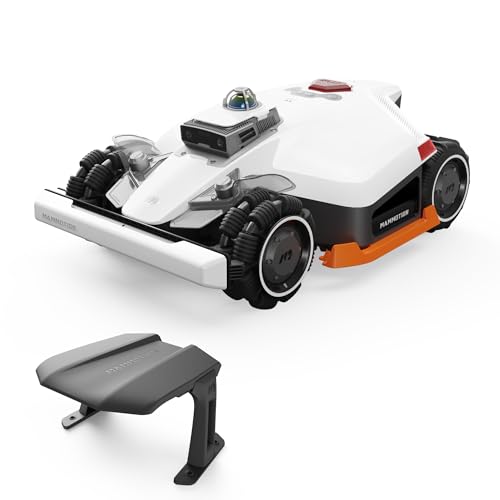
The Mammotion LUBA 3 AWD 5000 is the most capable all-rounder in this roundup for properties with genuine hills and a large coverage area to manage. True all-wheel drive – four independently powered wheels – pushes its climbing capability to an 80% grade (38.6°), among the steepest ratings any wheeled consumer mower offers. The 360° LiDAR plus dual-camera AI vision fusion navigation system is specifically the kind of redundancy this guide’s navigation glossary identifies as the right approach for variable, obstacle-heavy terrain – when tree canopy interferes with satellite positioning, the LiDAR and vision systems continue providing reliable spatial awareness.

| Key Specifications | |
|---|---|
| Slope Rating | 80% grade (38.6°) |
| Drivetrain | True AWD – four independently driven wheels |
| Navigation | 360° LiDAR + dual-camera AI vision fusion |
| Installation | Wire-free |
| Zone Management | Multi-zone scheduling |
| Cutting Height | Adjustable, wide range |

What we like:
- True AWD with four independently driven wheels is the mechanical foundation behind the 80% grade rating – when any single wheel encounters wet grass or loose soil, the other three compensate with additional torque rather than letting the whole mower lose forward progress.
- LiDAR plus dual-camera fusion navigation directly solves the most commonly cited real-world failure mode in this category: RTK signal degradation under heavy tree canopy. With LiDAR providing an independent 3D terrain map, the mower maintains accurate positioning even where satellite-only systems would struggle.
- Wire-free installation avoids the practical problem of burying boundary wire on a slope – wire anchors can wash out or shift with soil erosion on a grade, and trenching on a hillside is meaningfully harder than on flat ground.
- Multi-zone scheduling allows different cutting heights and frequencies for flat sections versus steep banks – useful since hill-climbing draws more power and you may want to schedule slope sections separately from flat lawn areas.
What to know:
- At the flagship end of the price spectrum – this is a serious investment, appropriate for properties where the slope and acreage genuinely justify the capability rather than a marginal hill that a mid-range AWD model would also handle.
Best for: Large properties with genuinely steep sections up to 38.6°, heavy tree canopy that would otherwise degrade satellite navigation, and homeowners who want the most capable all-around wheeled mower available without stepping up to a tracked system.
→ Check Current Price on Amazon
2. Segway Navimow X430 – Best Slope Rating (Wheeled)
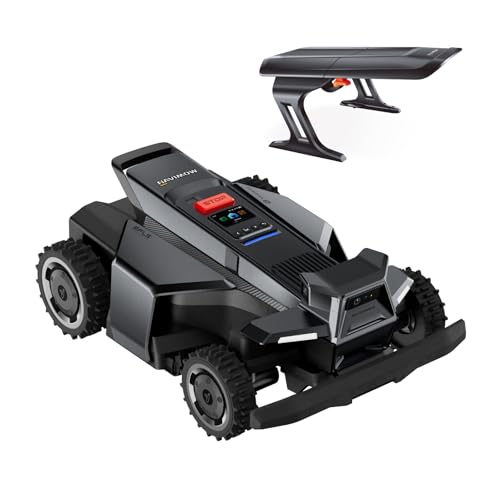
The Segway Navimow X430 currently tops the slope-rating chart among wheeled consumer robot mowers at an 84% grade (40°) – the steepest ceiling of any wheeled model in this roundup, edging out even the Mammotion LUBA 3. It pairs that climbing capability with a patented Traction Control System and true 4WD, designed specifically to maintain grip through the kind of grade transitions and cross-slope traverses that defeat lower-tier AWD systems even within their nominally rated maximum angle.

| Key Specifications | |
|---|---|
| Slope Rating | 84% grade (40°) – highest wheeled rating in this roundup |
| Drivetrain | True 4WD with patented Traction Control System |
| Navigation | RTK + vision fusion |
| Installation | Wire-free |

What we like:
- 84% grade is the single highest wheeled slope rating in this entire roundup – for a property right at the upper edge of what a wheeled mower can realistically handle, the X430’s ceiling provides the most margin of any non-tracked option here.
- The patented Traction Control System is specifically engineered around the cross-slope traverse problem flagged earlier in this guide – many mowers rated for a steep climbing angle still struggle on an angled traverse of the same slope, and a dedicated traction control system is designed to address exactly that gap rather than just the straight-up-and-down case.
- True 4WD – genuine independent power to all four wheels, not a marketing label applied to a mechanically 2WD-biased system.
What to know:
- As a recently launched model in the X-series lineup, available independent long-term reliability data is still developing relative to more established product lines – the underlying 84% grade and true 4WD specifications are nonetheless unmatched among wheeled options reviewed here.
Best for: Properties with the steepest sections that any wheeled (non-tracked) mower can realistically handle, and buyers who specifically need confident performance on cross-slope traverses rather than just straight climbing capability.
→ Check Current Price on Amazon
3. Mammotion YUKA mini 2 1000H – Best for Heavy Tree Canopy and Moderate Slopes
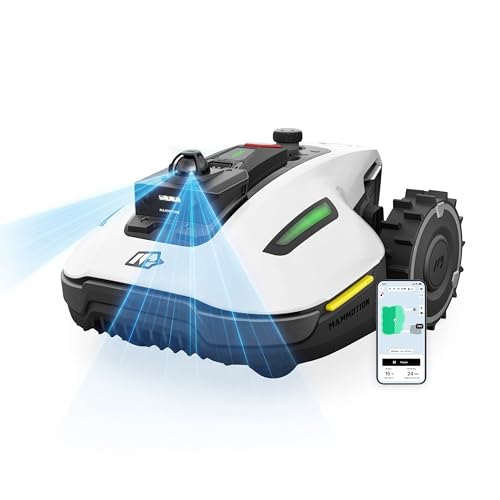
The YUKA mini 2 1000H is not built to compete on raw slope rating – at 45% grade (24°), it is positioned for moderate hills rather than the steepest residential extremes. What it does better than almost anything else in this category is navigate reliably where satellite-based systems struggle: dense tree cover, deep shade, and tight, narrow paths between zones. Its 360° LiDAR plus AI vision fusion builds a genuine 3D point-cloud map of the property and maintains precise detection even in low light or under heavy grass cover – solving the most commonly cited frustration with RTK-only mowers without requiring a clear view of open sky.

| Key Specifications | |
|---|---|
| Slope Rating | 45% grade (24°) |
| Drivetrain | Rear-wheel drive |
| Navigation | 360° LiDAR + AI vision – no RTK/satellite dependency |
| Detection Range | Up to 200 ft diameter, ±6 ft precision class |
| Obstacle Recognition | 300+ object types |
| Narrow Path Navigation | Down to roughly 21.65 inches wide |

What we like:
- LiDAR-first navigation removes RTK signal dependency entirely – for a property with substantial overhanging trees, where RTK-only mowers commonly “snake,” lose signal, or hesitate near tall fences, this is a direct and effective solution rather than a workaround. Independent testing of this navigation approach found it remained “rock-solid” navigating narrow paths and maintaining straight lines without a clear view of the sky.
- Narrow-path navigation down to roughly 21.65 inches means it can move between separated lawn zones – a side yard gate, a narrow strip beside a fence – that would stop a wider or less precisely navigated mower entirely.
- 300+ object recognition with predictive movement avoidance – relevant for yards with kids’ toys, pet items, and irregular garden furniture scattered across sloped sections where a missed obstacle on an incline is more disruptive than on flat ground.
- Lightweight design (in the low 20-lb range) reduces the risk of rutting or compacting soft soil on slopes compared to heavier AWD platforms.
What to know:
- 45% grade (24°) is a real ceiling, not a soft suggestion. This is a moderate-slope specialist, not a steep-hill solution – for any section of your yard beyond roughly 24°, look to the AWD or tracked options in this roundup instead.
- Rear-wheel drive only – no AWD compensation if a wheel slips, which is part of why the slope ceiling sits where it does relative to the AWD models reviewed above.
Best for: Properties with moderate slopes (up to 24°) combined with heavy tree canopy, dense shade, or narrow side-yard pathways where RTK-dependent navigation underperforms and a LiDAR-first system is the better fit.
→ Check Current Price on Amazon
4. Husqvarna 435iQ AWD – Best Premium Build Quality
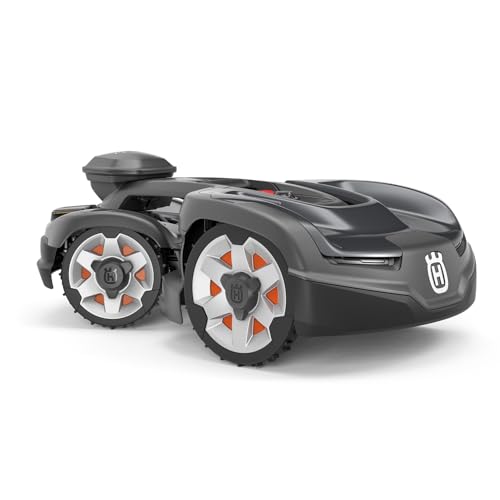
Husqvarna’s Automower line has built its reputation in this category on professional-grade reliability, and the 435iQ AWD extends that reputation into the hill-capable segment with an articulated chassis design and AWD traction that the brand specifically engineers for challenging slopes. The articulated steering and pivoting body geometry – a long-standing Husqvarna design signature – helps maintain consistent ground contact across grade transitions, the exact terrain feature (the point where a slope’s angle changes) that causes wheeled mowers without this flexibility to lose contact and traction momentarily.

| Key Specifications | |
|---|---|
| Drivetrain | AWD with articulated chassis design |
| Navigation | GPS-assisted / EPOS-compatible positioning |
| Brand Heritage | Husqvarna Automower – professional/commercial design lineage |
| Build Focus | Durability and consistent slope performance over time |

What we like:
- Articulated chassis and pivoting body design address a specific failure mode that flat-deck AWD mowers without this flexibility encounter: maintaining wheel-to-ground contact precisely at the point where a slope’s angle changes, rather than just on a single continuous grade. This is the kind of terrain feature most spec sheets do not address, but it is exactly where real yards differ from manufacturer test slopes.
- Husqvarna’s Automower lineage carries a long professional and commercial-grade track record – the brand’s design philosophy in this category prioritizes long-term durability and consistent performance across seasons of repeated slope use, not just peak capability on a single test pass.
- GPS-assisted positioning with route optimization reduces wasted travel time, which matters more on a sloped property where every additional traversal of a steep section adds wear and battery drain compared to flat-ground travel.
What to know:
- Husqvarna’s positioning in this category leans toward build quality and reliability over chasing the absolute highest slope-rating number – confirm the specific slope rating for your model variant against your measured yard grade before purchasing, since the AWD lineup spans multiple capability tiers.
Best for: Buyers who prioritize long-term build quality and consistent performance across grade transitions over chasing the single highest slope-rating number, and properties with varied terrain rather than one uniform steep grade.
→ Check Current Price on Amazon
5. Lymow One Plus – Best for Extreme Slopes ★ (100% Grade)
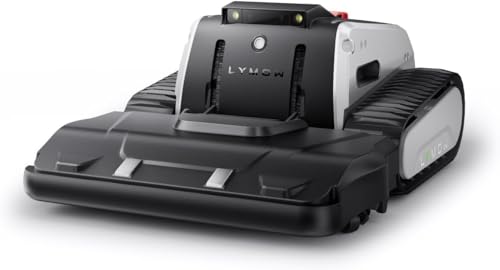
The Lymow One Plus is built like a mini tank for a specific reason – its rugged tracked tread system is the only drivetrain in this roundup rated for a true 100% grade, a full 45-degree slope, the absolute ceiling of what any current consumer robot mower can climb. Where AWD wheeled systems frequently lose traction on wet grass or loose soil, the tracked design distributes weight more effectively across a much larger ground-contact area, maintaining grip on exposed roots, gravel, and surfaces that would defeat any wheeled competitor in this guide.

| Key Specifications | |
|---|---|
| Slope Rating | 100% grade (45°) – the highest in this entire roundup |
| Drivetrain | Tracked tank-style treads |
| Navigation | RTK + VSLAM (wire-free) |
| Blade Material | SK5 high-carbon steel rotary blades |
| Obstacle Crossing | Approximately 2.8 inches (70mm) |
| Water Resistance | IPX6 |
| Frame | Aluminum, reinforced |

What we like:
- 100% grade (45°) is the highest slope rating of any model in this guide – at this angle, the math means rise equals run exactly, and no wheeled mower currently sold reaches this ceiling. For any property with a section this steep, tracked is genuinely the only category that works, not simply the better option.
- Roughly 40% lower ground pressure than wheeled designs due to the continuous tread’s larger ground-contact footprint – this is the specific mechanical reason tracks maintain grip on wet grass, muddy patches, and during cross-slope traverses where wheels are most prone to slip.
- RTK plus VSLAM navigation fusion provides the redundancy this guide’s navigation glossary identifies as essential – if tree cover blocks satellite signal, the visual SLAM system maintains position awareness rather than the mower losing track of where it is mid-pass.
- 2.8-inch (70mm) obstacle-crossing height is among the most generous in this roundup, meaning garden hoses, small branches, and uneven ground transitions are crossed rather than becoming a navigation problem.
What to know:
- Tracked designs run louder than wheeled mowers during operation – a fair tradeoff for the slope capability, but worth knowing if quiet nighttime operation near windows is a priority.
Best for: Properties with genuinely extreme slope sections – 38° and beyond, up to a full 45° – semi-rural estates, multi-level terraced yards, or any bank that has defeated wheeled mowers in the past due to wet grass, exposed roots, or loose gravel.
→ Check Current Price on Amazon
6. Mowrator S1 – Best Hybrid Manual Override
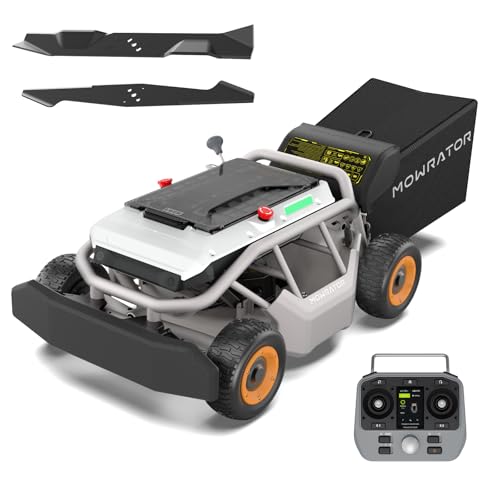
The Mowrator S1 occupies a distinct niche among slope-capable mowers: genuine AWD performance up to a 75% grade, combined with a hybrid control mode that lets the homeowner take manual control for specific tricky sections rather than relying entirely on autonomous path planning. For a property with one or two genuinely awkward spots – an oddly shaped bed transition, a tight corner against a retaining wall – the ability to manually drive the mower through that exact section, then hand control back to autonomous mode, is a practical feature that pure-autonomous competitors do not offer.

| Key Specifications | |
|---|---|
| Slope Rating | 75% grade (~35°) |
| Drivetrain | AWD |
| Control Modes | Autonomous + manual hybrid override |
| Navigation | Satellite-guided / RTK |

What we like:
- Hybrid manual override is a genuinely unique feature in this roundup – for the specific “problem section” scenario flagged earlier in this guide (one tricky spot in an otherwise manageable yard), the ability to drive the mower manually through that section via the app, then return to autonomous operation, solves a real-world edge case that fully autonomous-only competitors cannot address.
- 75% grade AWD capability places the Mowrator S1 solidly in the upper-mid tier of wheeled slope performance – strong enough for the large majority of residential hill scenarios without stepping up to the absolute flagship pricing tier.
- The flexibility to handle difficult terrain manually while still benefiting from autonomous scheduling for the rest of the property is a practical middle ground for homeowners not fully confident that pure autonomy will handle every corner of a complex sloped layout on the first attempt.
What to know:
- Manual override requires active attention and app interaction for the sections where it is used – it is a tool for handling exceptions, not a substitute for confirming the mower’s autonomous capability is sufficient for the bulk of your yard.
Best for: Properties with strong overall AWD-compatible terrain (up to 75% grade) plus one or two specifically awkward sections where homeowners want the option of manual control rather than hoping autonomous path planning handles it correctly every time.
→ Check Current Price on Amazon
7. Segway Navimow i110N – Best for Mild-to-Moderate Slopes

Not every yard that feels like “a hill” actually requires AWD or tracked capability – and the Segway Navimow i110N is the right honest recommendation for properties that, once properly measured using the method described earlier in this guide, turn out to sit in the mild-to-moderate slope range rather than the genuinely steep category. It delivers accurate wire-free mowing with strong connectivity and reliable performance for lawns around an acre in size, at a meaningfully lower price than any AWD or tracked model in this roundup.

| Key Specifications | |
|---|---|
| Drivetrain | Standard drive |
| Navigation | RTK wire-free |
| Recommended Lawn Size | Up to approximately 1 acre |
| Installation | Wire-free guided boundary mapping |

What we like:
- The right honest recommendation for mild-moderate slopes – per the “when you probably don’t need AWD” guidance earlier in this article, if your steepest measured point comes in under roughly 20% grade, a model like this one will reliably handle the work for years without the $1,000+ premium that AWD and tracked models carry.
- Wire-free RTK installation avoids the boundary-wire-on-a-slope problem even for a property with gentle grade changes – soil erosion and shifting can affect wire on any non-flat ground, not just steep banks.
- Strong connectivity and reliable app-based control at a price point that makes sense for a property that does not need flagship slope capability.
What to know:
- Standard drive means this is not the right choice for any genuinely steep section beyond roughly 20–25% grade – measure your yard first using the method in this guide before assuming this tier is sufficient.
Best for: Properties with mild rolling terrain or moderate slopes under roughly 20% grade where AWD or tracked capability would be genuine overkill, and buyers who want to avoid overpaying for slope capability they measured and confirmed they don’t need.
→ Check Current Price on Amazon
8. MOVA LiDAX Ultra – Best Budget LiDAR Pick
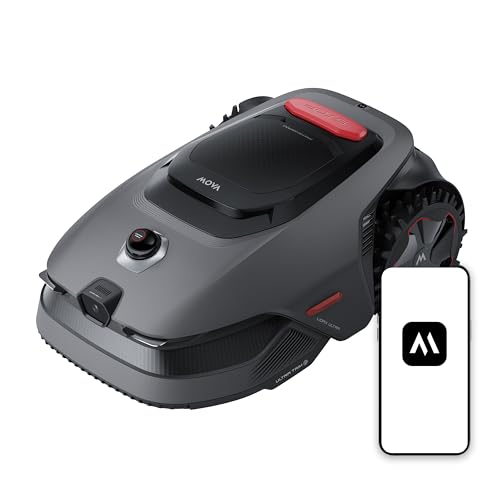
MOVA is a newer entrant in this category without the established track record of Mammotion or Husqvarna, but the LiDAX Ultra makes a compelling case at its price point for properties with moderate hills who want genuine LiDAR-based navigation without paying flagship pricing. At a 45% grade (24°) ceiling with 360° 3D LiDAR plus AI vision and no RTK dependency, it directly targets the same canopy-blocking and signal-degradation problems the flagship LiDAR mowers solve, in a more accessible package for smaller properties.
| Key Specifications | |
|---|---|
| Slope Rating | 45% grade (24°) |
| Drivetrain | Standard drive |
| Navigation | 360° 3D LiDAR + AI vision – no RTK required |
| Zone Management | Multi-zone (up to 150 zones) |
| Connectivity | 4G available |

What we like:
- LiDAR-based navigation without an RTK reference station requirement simplifies installation considerably – no base station siting, no antenna placement concerns, which matters specifically on a sloped property where finding an ideal open-sky location for an RTK base station can itself be a challenge.
- A genuinely high zone count (up to 150) for a budget-tier model allows detailed scheduling control across multiple lawn sections with different slope characteristics or grass types.
- For a small to moderate property where the steepest measured section stays within the 24° ceiling, this offers flagship-style LiDAR navigation technology at a meaningfully lower price than the established brand flagships in this roundup.
What to know:
- As a newer brand, available long-term reliability data is still limited compared to established names – reasonable to consider for moderate-slope properties, but buyers prioritizing maximum brand track record may prefer Mammotion or Husqvarna for otherwise comparable specifications.
- 45% grade ceiling means this is not a fit for the steepest sections covered elsewhere in this guide – confirm your measured slope falls within this range before purchasing.
Best for: Budget-conscious buyers with moderate hills (up to 24°) who want genuine LiDAR navigation technology without RTK base station installation, and smaller properties where the 150-zone management capability is a meaningful organizational advantage.
→ Check Current Price on Amazon
9. ANTHBOT M5 – Best Budget Entry-Level
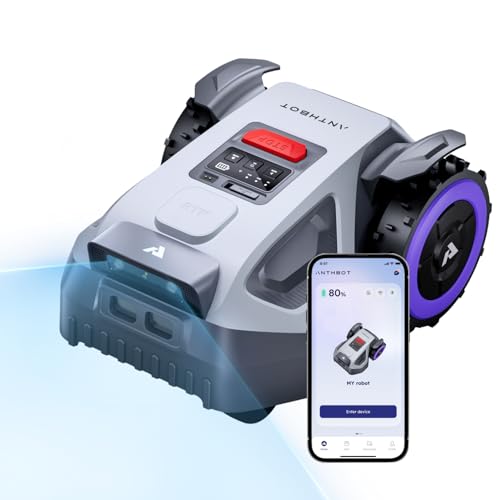
The ANTHBOT M5 is positioned as an accessible entry point for smaller properties with moderate slope sections, pairing dual vision cameras with full-band RTK for a navigation approach that covers both the satellite-precision and visual-redundancy bases at a price below the premium tier in this roundup. At a 45% grade (24°) ceiling, it is calibrated for the same moderate-slope range as several other budget-tier options here, making it a direct option for smaller lawns under roughly an eighth of an acre with a manageable hill rather than an extreme grade.

| Key Specifications | |
|---|---|
| Slope Rating | 45% grade (24°) |
| Drivetrain | Standard drive |
| Navigation | Dual vision + full-band RTK |
| Installation | Wire-free, no perimeter wire |
| Recommended Lawn Size | Approximately 1/8 acre |
| Zone Mapping | Multi-zone |

What we like:
- Dual vision plus full-band RTK provides a basic level of navigation redundancy even at the budget end of this category – when satellite reception is briefly interrupted, the dual-camera vision system provides a fallback rather than the mower simply stopping or drifting off course.
- Wire-free installation at this price point avoids the boundary-wire-on-a-slope problem entirely, which matters even for the more modest grade this model is rated for, since any non-flat ground complicates wire burial and long-term wire stability.
- The compact, small-property focus (roughly 1/8 acre recommended) makes this a sensible fit for a smaller yard with one moderate slope section rather than a sprawling multi-zone hillside estate.
What to know:
- 45% grade is the same moderate ceiling as several other budget options in this guide – for any section of your yard beyond roughly 24°, this is not the right tool, and you should look to the AWD or tracked models reviewed above instead.
Best for: Smaller properties (around 1/8 acre) with a single moderate slope section, and budget-conscious buyers who want wire-free installation and basic navigation redundancy without paying for AWD or tracked capability they don’t need.
→ Check Current Price on Amazon
Maintenance for Slope-Heavy Use – What Changes vs. Flat-Lawn Operation
Blade wear accelerates with frequent grade transitions and uneven cutting-height contact on hilly terrain – inspect and clean blades more frequently than the standard 50-hour interval often cited for flat-lawn use. For tracked systems specifically, clean tread lugs after muddy or wet conditions to maintain grip, and inspect regularly for debris lodged between tread sections. For AWD wheeled models, check tread depth periodically and watch for uneven wear patterns between wheels, which can indicate one drive motor working harder than the others – often a sign the mower is regularly working a slope at or near the edge of its rated capability.
Hill climbing draws meaningfully more power than flat-ground mowing. Expect reduced real-world runtime compared to a manufacturer’s flat-lawn-tested claims, and plan for somewhat faster long-term battery degradation under heavy, repeated slope use. Most 2026 models self-diagnose navigation and drivetrain issues through their companion app – keep firmware updated, particularly for RTK and VSLAM calibration improvements that manufacturers frequently push as software updates rather than hardware changes.
Installation – Wire-Free vs. Wired on a Sloped Property
Burying boundary wire on a steep slope is materially harder and less durable than on flat ground. Wire anchors can wash out or shift with soil erosion on a grade, and trenching on a slope is physically more difficult than on level ground. This is the practical reason nearly every slope-rated 2026 model in this roundup has moved to wire-free RTK, LiDAR, or vision-based navigation – it is not simply a premium convenience feature, it solves a genuine installation problem specific to hilly terrain.
Professional installation and mapping assistance is offered by most brands and is a reasonable add-on cost for a complex, multi-zone sloped property – the initial mapping pass benefits from being done by someone experienced with the specific RTK calibration quirks of hilly terrain. As a direct tip: perform any wire-free initial mapping pass in dry weather, since wet conditions and reduced visibility can affect both RTK signal quality and vision-based mapping accuracy during this critical setup step.
Frequently Asked Questions – Robot Mowers for Hills
What slope can a robot mower handle?
Standard robot mowers handle 15–25% grade (roughly 8–14 degrees). Mid-range AWD models handle 25–50% grade (14–27 degrees). The strongest consumer AWD mowers reach 80–84% grade (about 38–40 degrees), as seen with the Mammotion LUBA 3 and Segway Navimow X430 in this guide. Tracked mowers are the only consumer category that reaches a full 100% grade, or 45 degrees, as with the Lymow One Plus.
What is the difference between AWD and standard robot mowers on hills?
Standard or rear-wheel-drive mowers send power to only one or two wheels, which lose grip first on wet grass or steep grades. All-wheel-drive mowers power every wheel independently, so if one wheel starts to slip the others compensate with more torque, maintaining traction on grades roughly twice as steep as a standard drivetrain can handle.
Do robot mowers work on steep slopes?
Yes, but only models specifically rated for steep slopes. A standard robot mower will lose traction, stall, or trigger a safety stop on grades beyond about 25%. Purpose-built AWD models handle up to roughly 80–84% grade, and tracked models handle up to 100% grade, which is a true 45-degree slope.
How do I measure the slope of my yard?
Use a free clinometer or inclinometer app on your phone. Lay a straight board across the slope rather than placing the phone directly on the grass, since surface irregularity in turf gives a false reading. Measure at the steepest point of the yard, not an average impression, since most homeowners underestimate their actual maximum grade by 10 to 15 degrees.
Is a tracked robot mower better than wheeled for hills?
For slopes beyond about 38–40 degrees, or for wet grass, loose soil, exposed roots, or gravel, a tracked mower grips better because its continuous tread spreads weight across more surface area, lowering ground pressure roughly 40% compared to a wheeled design. For moderate slopes in the 20–35 degree range with firm footing, a wheeled AWD mower is typically more maneuverable and equally reliable.
Can a robot mower mow wet grass on a slope?
AWD mowers handle wet grass on slopes better than standard drivetrains because independent per-wheel torque compensates for individual wheel slip, but even AWD models see reduced effective climbing performance on slick, dew-covered grass. Tracked mowers hold their slope rating most consistently in wet conditions. Scheduling mowing for mid-morning, after dew has burned off, generally produces better results than early morning passes on sloped sections.
Where should I put the charging station on a sloped yard?
Place the charging station at the base of the slope or at a flat midpoint of the property, never partway up a steep grade. This reduces the distance the mower must travel on a low battery and minimizes the chance of a marginal-traction return trip.
What happens if a robot mower tips over or loses traction?
Tilt and lift sensors stop blade rotation immediately if the mower is lifted or tips beyond a safe angle. AWD and tracked mowers with slip detection typically stop forward motion or attempt a controlled retreat rather than continuing to push against a loss of grip. The actual risk comes from using a mower beyond its rated slope or on loose, wet footing it was not designed for, not from normal operation within its rated specifications.
Do I need a wire-free robot mower for a hilly yard?
Wire-free is strongly preferred on hills because burying boundary wire on a steep slope is harder and less durable than on flat ground, since wire anchors can wash out or shift with soil erosion on a grade. This is the main reason nearly every slope-rated 2026 model has moved to wire-free RTK or vision-based navigation.
What is the steepest slope a consumer robot mower can climb?
Among wheeled AWD models, the steepest 2026 consumer ratings reach approximately 84% grade, or 40 degrees, as seen on the Segway Navimow X430 in this guide. Tracked mowers extend this further to a full 100% grade, or 45 degrees, which is the practical ceiling for any current consumer robot mower – reached by the Lymow One Plus.
Final Verdict – Best Robot Mower for Hills by Slope Range
| Best For | Our Pick | Key Reason | Buy on Amazon |
|---|---|---|---|
| Best Overall | Mammotion LUBA 3 AWD 5000 | True AWD, 80% grade, LiDAR + dual-camera fusion navigation | Buy Now → |
| Best Slope Rating (Wheeled) | Segway Navimow X430 | 84% grade ceiling, true 4WD with patented Traction Control | Buy Now → |
| Best for Heavy Tree Canopy | Mammotion YUKA mini 2 1000H | 360° LiDAR navigation with zero RTK dependency for shaded yards | Buy Now → |
| Best Premium Build Quality | Husqvarna 435iQ AWD | Articulated chassis maintains traction across grade transitions | Buy Now → |
| Best for Extreme Slopes (38°+) | Lymow One Plus | 100% grade – the only consumer mower rated for a true 45° slope | Buy Now → |
| Best Hybrid Manual Control | Mowrator S1 | 75% grade AWD plus manual override for awkward problem sections | Buy Now → |
| Best for Mild-Moderate Slopes | Segway Navimow i110N | Reliable wire-free performance without overpaying for AWD you don’t need | Buy Now → |
| Best Budget LiDAR Pick | MOVA LiDAX Ultra | 360° 3D LiDAR navigation, no RTK station needed, 150-zone management | Buy Now → |
| Best Budget Entry-Level | ANTHBOT M5 | Dual vision + full-band RTK, wire-free, accessible price for small lots | Buy Now → |
Before you buy anything in this guide, measure your actual slope with a clinometer app – not your impression of it. Most buying mistakes in this category come from either overpaying for AWD or tracked capability a mild yard never needed, or underbuying a standard-drive mower for a slope that turns out to be steeper than it looked from the porch. Match your measured grade to the table at the top of this guide, factor in tree canopy and wet-grass exposure, and choose the navigation system and drivetrain that actually fits – not just the model with the most impressive marketing number.


