Choosing a robotic pool cleaner today means navigating more than just suction specs and price tags. The cordless segment of this category has grown fast – lighter, cable-free robots that you can drop in and walk away from – but it’s also the segment where two confirmed federal safety recalls have happened in the past 14 months. That doesn’t mean cordless pool robots are unsafe as a category. It means buyers deserve clear, sourced information before they spend $500–$1,300 on one.
This guide covers 8 robotic pool cleaners – predominantly cordless models from established and emerging brands, plus one corded entry for genuine comparison. Every product here has been checked against the official CPSC recall database. We also dedicate a full section to what those recalls actually said, what’s changed in newer hardware design since, and practical charging-safety habits that apply no matter which brand you choose.
Jump to: Battery Safety & Recalls | Corded vs Cordless | Comparison Table | Product Reviews | Buyer’s Guide | FAQ

Cordless Pool Cleaner Battery Safety: What the Recalls Actually Say
Before reviewing any product, it’s worth being direct about this: lithium-ion batteries in certain cordless robotic pool cleaners have been the subject of confirmed recalls issued jointly with the U.S. Consumer Product Safety Commission (CPSC). Here is what the official record says – sourced from CPSC.gov directly, not secondary reporting.
Aiper Seagull Pro (Model No. ZT6001) – recalled March 20, 2025. Approximately 32,660 units sold in the US (plus ~2,530 in Canada) between March 2023 and May 2024, through Amazon, Best Buy, Home Depot, Lowe’s, and Walmart. Aiper determined that when the battery is charged using a large-current adapter, it can overheat, posing a burn and fire hazard. The CPSC received 19 reports of units melting, smoking, or catching fire while charging, resulting in 5 incidents of property damage. No injuries were reported. Aiper’s remedy was a free, full replacement with a different model (Scuba S1), prepaid return shipping included.
Aiper Elite Pro (Model No. GS100) – recalled in August 2023. Approximately 22,000 units sold between January and May 2023. Same underlying hazard: overheating during charging, posing burn and fire risk. CPSC received 17 reports of overheating, including one minor fingertip burn (no medical treatment required). No property damage was reported. Aiper again offered free replacement units.
Wybotics (Wybot) robotic pool vacuums – recalled April 9, 2026. Approximately 5,000 units. Wybotics, in cooperation with CPSC, recalled affected models due to burn and fire hazards, again tracing to overheating during the charging process. Wybotics is offering free replacement WYBOT C2 units with prepaid return shipping.
What this does – and doesn’t – mean for buyers
These are three confirmed recalls, all involving the same underlying failure mode: a lithium-ion battery overheating while charging, in two specific brands (Aiper and Wybot), affecting specific named models with specific date ranges and serial numbers. None of the products recommended in this guide are the recalled Seagull Pro, Elite Pro, or affected Wybot models.
It’s also fair to note: newer-generation hardware in this category has moved toward designs that structurally remove the failure mode behind these recalls. The most direct example is in this very roundup — the current AIPER Scuba V3 charges through a sealed wireless magnetic dock with flat contact pads and no plug-in port on the robot itself, which is a different charging architecture than the plug-in connector design implicated in the Seagull Pro and Elite Pro recalls. That’s a meaningful engineering change, not just a marketing claim, but it’s also worth being honest that this is a relatively young product category — “no recall yet” on a newer model is a shorter track record than it sounds, not a guarantee.
Practical charging safety, regardless of brand
- Use only the manufacturer-supplied charger and cable. Never substitute a third-party or “compatible” charger to save money — this is the specific failure point named in the Aiper recalls.
- Charge on a hard, non-flammable surface (concrete, tile) away from combustible materials — not on a wooden deck, near furniture cushions, or inside an attached structure if you can avoid it.
- Avoid leaving any lithium-ion device charging unattended overnight if you can reasonably avoid it — this is general best practice for any lithium-ion battery product, not specific to pool robots.
- If you already own a cordless pool robot, check your specific model and serial number against CPSC.gov/Recalls directly. Don’t rely solely on secondary blogs or social media for recall status.
- Register your product with the manufacturer when you buy it — this is how companies notify you directly if a recall is issued after your purchase.
This safety information reflects the CPSC record as of publication. Recall status can change — always verify current status directly at CPSC.gov before purchasing or continuing to use any cordless pool cleaner.

Corded vs Cordless Robotic Pool Cleaners: An Honest Comparison
This is the central decision in the category, and it deserves a fair answer rather than a blanket recommendation in either direction.
Power and Suction
Corded models draw continuous AC power and commercial-grade corded units commonly reach 4,000–4,500+ GPH (gallons per hour) of suction, sustained for the entire cleaning cycle. Cordless models run on internal batteries, and while flagship cordless units in 2026 have closed much of that gap — several models in this roundup advertise 4,800–6,800 GPH — independent testers have observed that cordless suction can taper as the battery drains, where corded units run at full power start to finish. This is a real, measurable trade-off, not just marketing language from either side.
Runtime, Convenience, and Automation
Cordless: no cord to manage or untangle, genuinely portable, easy to move between pools or store away — but it requires retrieval and recharging after each cycle (typically 2.5–5 hours of runtime, then 3–5 hours to recharge), and most cordless models can’t run on a fully unattended weekly schedule the way a plugged-in unit can. Corded: unlimited runtime while connected, and many flagship corded models support weekly smart timers that run the whole season without you touching anything — but the power cord needs occasional untangling and can be a literal trip hazard around the pool deck.
Filtration and Debris Capacity
Corded flagship models often use larger multi-media or NanoFiltration cartridge systems built for season-long heavy debris loads. Cordless models vary widely — some of the newer entries in this roundup use 5–6 liter dual-layer filter baskets with optional ultra-fine (3-micron) inserts that rival corded filtration quality, while budget cordless units use smaller fixed baskets that fill faster on heavy-debris days.
Bottom Line
Neither type is universally better. For a large in-ground pool with heavy leaf load and a strong preference for hands-off automation, a corded flagship still has real advantages. For above-ground pools, smaller in-ground pools, or anyone who values not having a cord at all, a quality cordless model — chosen carefully, charged correctly — is a legitimate, capable choice in 2026.

Best Robotic Pool Cleaners 2026: Quick Comparison
| Product | Power Type | GPH Suction | Runtime | Coverage | Best For |
|---|---|---|---|---|---|
| Beatbot AquaSense 2 Ultra ★ | Cordless | 5,500 GPH | ~5 hrs floor/wall | Up to 3,444 sq ft | Best Overall / Complex Pools |
| Beatbot AquaSense 2 | Cordless | 5,500 GPH | ~5 hrs floor/wall | Up to 3,444 sq ft | Best Value Flagship |
| AIPER Scuba V3 | Cordless | 4,800 GPH | ~3 hrs (7 days standby) | Up to 1,600 sq ft | Best AI Navigation Mid-Tier |
| Polaris VRX iQ+ | Corded | High (commercial motor) | Unlimited (plugged in) | In-ground, up to 50 ft | Best Corded / Hands-Off Automation |
| iGarden K-AI Series | Cordless | Up to 5,810 GPH | ~150 min floor | Up to 3,814 sq ft | Best Touchscreen Control |
| Beatbot Sora 30 | Cordless | 6,800 GPH | ~5 hrs | Up to 3,229 sq ft | Best Shallow-Water/Platform Cleaning |
| Pleco Pro (TALOSBO) | Cordless | Up to 4,000 GPH | 210–240 min | Up to 2,691 sq ft | Best Long Runtime Budget |
| Astra Cordless Pool Vacuum | Cordless | 11,160 GPH | 180 min | up to 3,500 sq ft | Budget Entry Pick |
★ = Editor’s top pick. Always charge cordless models using only the manufacturer-supplied charger, and verify your specific unit against current CPSC recalls before and after purchase. Specs sourced from manufacturer listings — verify current Amazon listing details before purchasing, as models update frequently in this category.
1. Beatbot AquaSense 2 Ultra Cordless Robotic Pool Cleaner – Best Overall / Best for Complex Pools
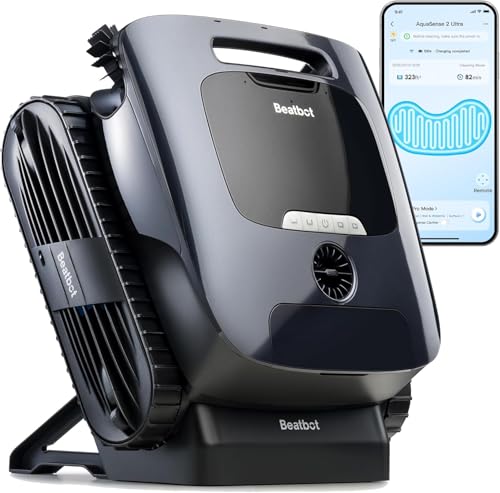
The Beatbot AquaSense 2 Ultra is Beatbot’s flagship cordless cleaner, unveiled at CES 2025, and it earns the top spot in this roundup through genuine breadth: it’s a 5-in-1 cleaner covering floor, walls, waterline, water surface, and water clarification in one cordless unit, with the most sophisticated navigation system of anything reviewed here. Eleven motors generate 5,500 GPH suction, powered by a 13,400mAh battery — the largest battery capacity in this lineup — giving roughly 5 hours of combined floor and wall runtime per charge.

What separates the Ultra from the standard AquaSense 2 (reviewed next) is its HybridSense AI Pool Mapping system: an onboard AI camera with dual time-of-flight sensors, paired with four ultrasonic sensors (two downward-facing), that builds a real-time visual map of your pool — including curved steps, sun ledges, and varying depth platforms down to 13.7 inches — rather than relying purely on motion-sensor path planning. AI Smart Detection actively identifies high-debris zones (clusters of leaves, fruit, organic matter) and spends extra time there rather than following a fixed cleaning pattern. Dual LED headlights allow the AI vision system to keep working after dark, so the robot can run a full cleaning cycle overnight.

The ClearWater clarification system uses a chitosan-based agent (included in the box, refills sold separately) to bind fine particles like algae and silt into larger clumps the filter can actually capture — addressing the cloudy-water problem that suction alone doesn’t solve. Smart water-surface parking means the robot automatically floats to the pool edge and signals via app notification when it’s done, eliminating the “fish it out of the deep end” problem entirely. It charges via a sealed wireless magnetic dock — no plug-in port on the robot — in about 4.5 hours. Independent reviewer consensus on the Ultra is genuinely split: some outlets rate it as an Editors’ Choice-caliber product, citing fully debris-free pools in single cleaning sessions, while others argue the $850+ premium over the standard AquaSense 2 Pro isn’t justified for most pool sizes and that a corded alternative still wins on raw value. Both perspectives have merit — the Ultra’s camera-based debris hunting earns its keep specifically on large, complex, tree-heavy pools; for a straightforward rectangular pool under 3,000 sq ft, the less expensive AquaSense 2 below covers the same core ground.
Pros: 5,500 GPH suction across 5 cleaning modes (floor, wall, waterline, surface, clarification); AI camera-based debris detection and pool mapping; works in pools with multi-level platforms and steps; night cleaning capability; sealed wireless charging dock (no exposed charging port); 3-year full-replacement warranty; no CPSC recall history as of publication.
Cons: Premium price relative to the standard AquaSense 2 Pro, which shares the same suction and battery; heaviest unit in this lineup to lift from the pool; relatively young product category overall, so long-term reliability data is still developing industry-wide.
Who it’s for: Owners of large, complex, or heavily shaded in-ground pools (up to ~3,444 sq ft) who want the most automated, hands-off cordless experience available and are willing to pay for the AI navigation upgrade.
→ Check Current Price on Amazon
2. Beatbot AquaSense 2 Cordless Robotic Pool Vacuum Cleaner – Best Value Flagship
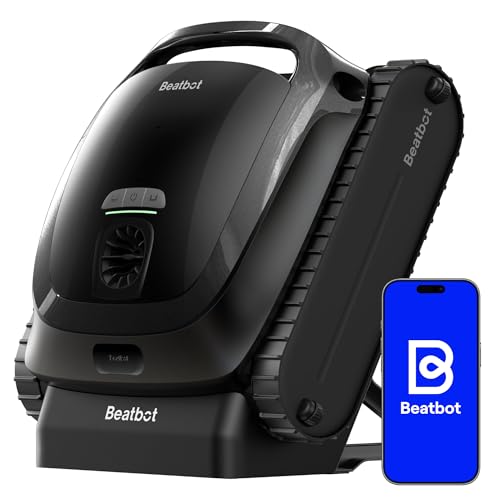
The Beatbot AquaSense 2 is the direct predecessor design that the Ultra builds on, sharing the same core 5,500 GPH suction, same dual-pass waterline scrubbing, and same general engineering platform — minus the AI camera, the side brushes, and the night-cleaning lights. For pools that don’t need camera-guided debris hunting or after-dark operation, the standard AquaSense 2 delivers nearly identical underwater cleaning performance at a meaningfully lower price.

A 200W brushless motor-pump drives suction across the floor, walls, and waterline, with a quad-brush system (extra-long front and rear brushes) providing more scrubbing contact per pass than a standard dual-brush design. The waterline gets scrubbed twice per cycle — a deliberate engineering choice that noticeably improves scum-line removal versus single-pass competitors, particularly in hard-water areas where mineral buildup along the tile line is a recurring problem. Four guide wheels improve cornering in tight, freeform, or kidney-shaped pools where earlier-generation robots tended to get hung up.

Like the Ultra, the AquaSense 2 charges through a sealed wireless magnetic dock — about 4 hours for a full charge — and automatically returns to the surface when the cycle finishes or the battery runs low, so retrieval is a poolside grab rather than a dive. The shell uses an automotive-grade IMR coating designed to resist UV degradation and heat buildup, which matters for a device that spends hours floating in direct sun in climates like Arizona or Florida. Backed by the same 3-year full-replacement warranty as the Ultra.
Pros: 5,500 GPH suction at a lower price than the Ultra; dual-pass waterline scrubbing; automatic surface parking eliminates manual retrieval from depth; UV-resistant coating; sealed wireless charging dock; 3-year full-replacement warranty; no CPSC recall history.
Cons: No AI camera or surface skimming — handles underwater cleaning only, not floating debris; no night-cleaning capability; slightly older sensor suite (16 sensors vs the Ultra’s 27).
Who it’s for: Pool owners who want Beatbot’s flagship underwater cleaning performance without paying for AI camera navigation they may not need — a strong fit for straightforward in-ground or above-ground pools.
→ Check Current Price on Amazon
3. AIPER Scuba V3 AI Vision Cordless Robotic Pool Cleaner – Best AI Navigation in the Mid-Tier
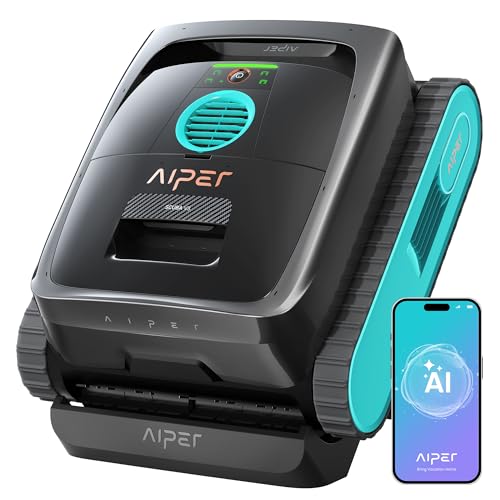
The AIPER Scuba V3 deserves a direct, honest framing given Aiper’s recall history described in the safety section above: this is a structurally different product from the recalled Seagull Pro and Elite Pro. The V3 charges through a sealed wireless dock with flat contact pads — there is no plug-in charging port on the robot itself, which removes the specific failure mode (overheating at a plug-in connector under a large-current adapter) named in both Aiper recalls. It’s also a newer-generation 2026 release, branded by Aiper as their “Cognitive AI” pool cleaner, and it brings genuine AI vision capability to a mid-tier price point under $1,000.

The headline feature is real-time debris detection: an onboard AI camera identifies more than 20 types of debris and directs the robot to clean those areas specifically rather than running a fixed grid pattern across the whole pool — Aiper claims this cuts unnecessary movement and improves cleaning efficiency. VisionPath route planning was trained on data from 200+ real pools, and the system adapts its cleaning plan to your specific pool shape over repeated cycles. AI Navium Mode extends this further into autonomous weekly cleaning: the robot builds a cleaning schedule based on your pool size, recent weather, and cleaning history, and can run for up to 7 days on a single charge in patrol mode. Dual LED headlights enable night operation. JetAssist scrubbing and dual brushes handle the floor-to-waterline cleaning at 4,800 GPH suction, and a MicroMesh multi-layer filter captures fine particulate — independent testers found it captures cloudy silt and fine sand that coarser mesh filters let pass straight through.

At roughly 18 lbs dry weight, it’s one of the lighter units in this roundup to lift from the charging dock — though, like all cordless robots, it’s noticeably heavier once pulled dripping from the pool. One practical limitation worth flagging clearly: once submerged, the robot loses WiFi/Bluetooth connectivity entirely (a physics limitation of water, not a software bug) — to change cleaning modes mid-cycle, you have to retrieve it from the pool first. Aiper backs the Scuba V3 with a standard warranty and offers tiered paid protection plans for extended coverage and faster repairs.
Pros: Genuine AI camera-based debris detection at a sub-$1,000 price point; sealed wireless charging dock — structurally different design from the recalled Aiper models; 7-day standby in patrol mode; night cleaning via dual LED headlights; fine 3-micron filtration option; not subject to any CPSC recall as of publication.
Cons: Aiper’s brand history includes two prior CPSC recalls on older plug-in-charge models — worth weighing as part of your decision even though the V3 itself is unaffected; no underwater app connectivity once submerged; weaker wall/step performance on curved surfaces per independent testing; 4,800 GPH trails the Beatbot flagships’ 5,500–6,800 GPH.
Who it’s for: Buyers who want camera-guided AI cleaning without paying flagship pricing, and who are comfortable with Aiper’s current-generation hardware after reviewing the brand’s recall history in the safety section above.
→ Check Current Price on Amazon
4. Polaris VRX iQ+ Smart Robotic Pool Cleaner — Best Corded Pick

Worth noting upfront: the Polaris VRX iQ+ is a corded model, not cordless — it connects via a 70-foot, double-insulated, tangle-reducing floating cable rather than running on an internal battery. We’re including it deliberately as the corded comparison point in this roundup, because the corded-vs-cordless decision genuinely matters and a fair guide should show both sides rather than only reviewing one.

The VRX iQ+ runs Polaris’s SMART Cycle Cleaning Mode, which learns your specific pool over repeated cycles and calculates the most efficient cleaning time needed to remove debris — rather than running a fixed-duration cycle regardless of how dirty the pool actually is. Because it’s continuously powered, there’s no runtime ceiling: it cleans until the job is done, then stops, full stop, no battery math involved. The iAquaLink app extends this further with enhanced scheduling for recurring automatic cleaning cycles, targeted spot-cleaning for specific problem areas, water temperature monitoring, and remote status checks from anywhere — the kind of fully unattended, season-long automation that cordless models generally can’t match because they require periodic manual retrieval and recharging.

A large, lighted debris canister with a transparent viewing window lets you check fill level without opening the unit — pull the canister, give it a shake, rinse, done. The Tangle Reducing Swivel keeps the 70-foot cable from knotting during operation, addressing the most common practical complaint about corded units. A premium tool-free caddy is included for storage between cleanings. Polaris backs the VRX iQ+ with a 2-year limited warranty.
Pros: No battery, no charging, no runtime limit — genuinely unattended weekly automation via app scheduling; SMART Cycle learns your pool and adjusts cleaning time accordingly; large easy-clean debris canister with viewing window; anti-tangle cable swivel; iAquaLink app adds water temperature monitoring and remote control; no battery-related fire risk inherent to the power design.
Cons: The power cord requires occasional management and isn’t fully “set and forget” the way marketing sometimes implies; less portable than any cordless option — effectively a fixed pool accessory rather than something you’d move between locations; 2-year warranty is shorter than the 3-year terms offered on the Beatbot flagships.
Who it’s for: Owners of larger or higher-maintenance in-ground pools (up to 50 ft) who want truly unattended, season-long automated cleaning and don’t mind managing a power cord to get it.
→ Check Current Price on Amazon
5. iGarden K-AI Series Robotic Pool Cleaner — Best Touchscreen Control
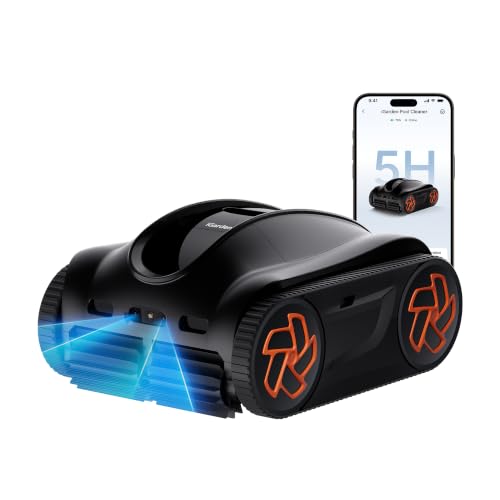
The iGarden K-AI Series stands out in this roundup for a genuinely practical design choice: a waterproof touchscreen built directly into the robot, rather than requiring you to open a phone app for every mode change or schedule adjustment. iGarden, founded in 1999 with a broader outdoor-living product line (pool equipment, robotic mowers, solar panels), engineered a turbine-grade impeller paired with 3 brushless motors to deliver up to 5,810 GPH suction in their K25 model — among the strongest suction figures in this entire roundup.

A Turbo 200% mode activates instant peak suction output specifically for dense debris and stubborn stains, while standard mode runs at roughly 5× greater energy efficiency for everyday maintenance — letting you trade runtime for power on demand rather than running flat-out suction for the entire cycle regardless of need. Dual rubber brushes paired with anti-slip tracks (rather than simple wheels) provide notably stable wall-climbing, an area where wheel-based competitors sometimes struggle on smooth plaster or fiberglass surfaces. Smart S-path navigation adapts cleaning routes in real time, and the AI Timer lets you schedule full-coverage cleaning so the robot runs automatically through the week.

Runtime is mode-dependent: up to 150 minutes for floor-only cleaning, or roughly 75 minutes for complete floor, wall, and waterline coverage — worth noting precisely because that full-coverage runtime is shorter than several other entries in this roundup, which matters most for larger pools that need the full cycle to complete in a single charge. The 4-liter top-load debris basket uses 180-micron mesh, and the unit connects over 2.4GHz WiFi or Bluetooth with lifetime OTA software updates. Rated for in-ground and above-ground pools up to 3,814 sq ft.
Pros: Up to 5,810 GPH suction — among the strongest in this roundup; built-in waterproof touchscreen for app-free control; Turbo 200% mode for on-demand power; anti-slip tracks improve wall-climbing on smooth surfaces; lifetime OTA software updates; no CPSC recall history.
Cons: Full-coverage (floor + wall + waterline) runtime of ~75 minutes is shorter than several competitors, which may require a recharge mid-cycle on larger pools; brand has less long-term track record specifically in robotic pool cleaning compared to legacy pool-equipment manufacturers.
Who it’s for: Buyers who want hands-on physical controls in addition to (or instead of) a phone app, and who prioritize maximum raw suction power for pools with heavier debris loads.
→ Check Current Price on Amazon
6. Beatbot Sora 30 Pool Vacuum Robot — Best for Shallow Water and Platform Cleaning
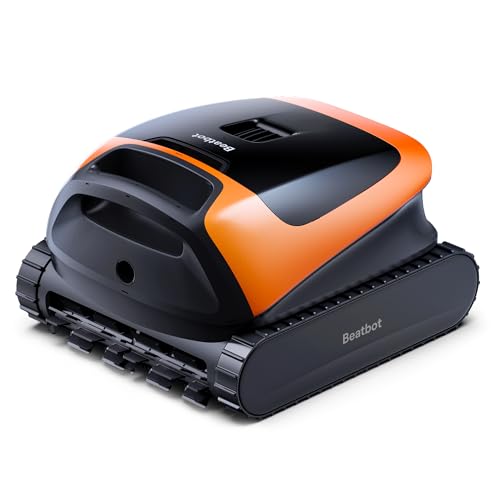
The Beatbot Sora 30 is the iF DESIGN AWARD 2026 winner in Beatbot’s lineup, and its standout practical capability is reaching genuinely shallow zones — as low as 8 inches of water depth — to clean tanning ledges, swim-out steps, and custom shallow platforms that many competing robots simply can’t navigate without getting stuck or beaching themselves. Ultrasonic sensors with real-time obstacle detection let it work confidently in these awkward shallow areas rather than avoiding them.

At 6,800 GPH, the Sora 30 delivers the highest rated suction figure in this entire roundup — Beatbot states this is up to 40% more powerful than competing products in its price range — driven by front-and-back dual brushes that provide wider coverage and tighter cornering than single-brush designs. A massive 5-liter debris basket (rated to hold roughly 650 leaves) means significantly fewer mid-task emptying interruptions on tree-heavy pools, and a swappable 150-micron standard filter can be replaced with an optional 3-micron ultra-fine filter when you need maximum water clarity rather than maximum runtime.

Industry-first floating technology keeps the Sora 30 on the surface using zero power once it’s done — it doesn’t drain battery treading water waiting for retrieval. SmartDrain automatically releases internal water once docked at the edge, turning what’s normally an awkward two-handed lift into a genuinely one-handed task. Both physical buttons on the unit and full app control are supported, so basic operation works even without WiFi. Backed by a 2-year warranty — shorter than the Beatbot flagship AquaSense line’s 3-year coverage, reflecting Sora’s position as the mid-tier line in Beatbot’s catalog.
Pros: 6,800 GPH — the highest suction figure in this roundup; reaches shallow zones down to 8 inches that competitors can’t reach; 5L debris basket dramatically reduces mid-cycle emptying; SmartDrain enables genuinely one-handed retrieval; works via physical buttons without requiring WiFi; no CPSC recall history.
Cons: No surface skimming capability (this is a 4-zone cleaner: floor, walls, waterline, shallow platforms — not a 5-in-1 like the AquaSense 2 Pro/Ultra); 2-year warranty is shorter than Beatbot’s flagship line; runtime drops to ~4.5 hours when cleaning floor, walls, and waterline together versus 5 hours floor-only.
Who it’s for: Pools with tanning ledges, swim-out steps, or other shallow custom features that standard robots struggle with, and tree-heavy pools where debris basket capacity matters more than surface skimming.
→ Check Current Price on Amazon
7. Pleco Pro Cordless Robotic Pool Cleaner (TALOSBO) — Best Long Runtime at a Budget Price
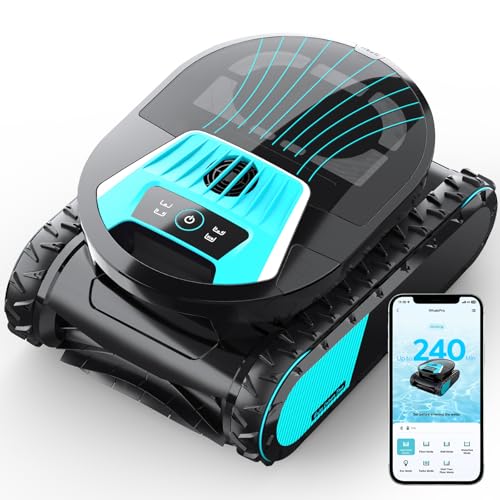
The Pleco Pro, made by TALOSBO, targets the budget-to-mid tier with a specific selling point: extended runtime relative to its price point. Rated for 210–240 minutes (3.5–4 hours) of continuous cleaning on a single charge, it’s positioned for larger in-ground pools up to roughly 2,691 sq ft without needing a mid-cycle recharge — a genuinely useful spec for pools that earlier-generation budget cordless units couldn’t finish in one charge cycle.

Three high-performance brushless motors deliver up to 4,000 GPH suction with AI-driven smart navigation that maps the pool and plans efficient cleaning paths to reduce missed spots and redundant repeat coverage. Seven customizable cleaning modes — Full Pool, Floor Only, Wall Only, Waterline, Wall & Floor, Turbo Flo, and more — give meaningfully more granular control than the typical 3–4 mode budget competitor, letting you target a specific problem area (say, a scummy waterline after a windy week) without running a full cycle. Dual-layer filtration with 6L capacity captures both large debris and fine particles, and the TALOSBO smart app adds remote control plus regular OTA software updates for ongoing feature improvements.

It handles the full range of pool surfaces — floors, slopes, and walls — addressing the design challenges of varied pool geometries rather than a single flat-bottom assumption. TALOSBO is a newer entrant focused specifically on robotic outdoor care products (pool, garden, home maintenance); as with any newer brand, it’s reasonable to weigh that shorter track record alongside the strong spec sheet and apply the same charging-safety practices outlined in our safety section regardless of brand reputation.
Pros: 210–240 minute runtime — among the longest in this roundup, well suited to larger pools without a recharge break; 7 customizable cleaning modes for targeted spot-cleaning; AI route planning reduces redundant coverage; dual-layer 6L filtration; regular OTA updates; accessible price point relative to runtime and feature set.
Cons: 4,000 GPH trails the higher-suction entries in this roundup (Sora 30, AquaSense line, iGarden K25); newer brand with less established long-term reliability track record; verify current Amazon listing specs, as TALOSBO updates this model line frequently.
Who it’s for: Budget-conscious buyers with larger in-ground pools who specifically value long single-charge runtime and granular mode control over maximum raw suction power.
→ Check Current Price on Amazon
8. Astra Cordless Pool Vacuum Robot — Budget Entry Pick
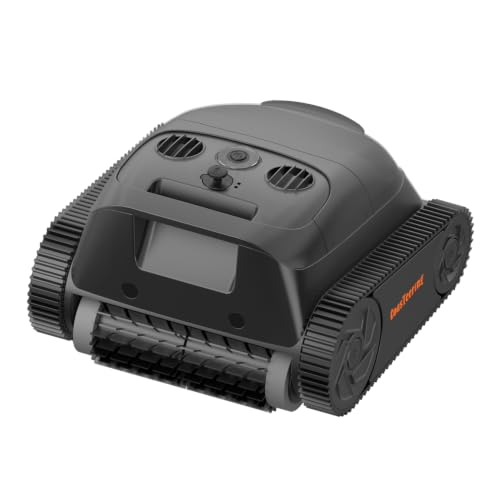
The Astra Cordless Pool Vacuum Robot rounds out this roundup as the most accessible entry point for buyers who want to try cordless robotic pool cleaning without committing to a flagship price tag. As with several other entries in this guide, Astra is a newer brand in a fast-moving, crowded product category where new models and listing updates happen frequently — we’d encourage checking the current Amazon listing closely for the specific suction (GPH), runtime, and pool-size coverage figures at the time of purchase, since budget-tier specs in this category shift often as brands iterate.

What a budget cordless pick like this generally trades away versus the flagship models above: lower peak suction, shorter battery runtime, simpler (often single-layer) filtration, and a shorter or more limited warranty. What it offers in return is a substantially lower upfront cost and the same basic core convenience — no cord, no compressor or pump hookup, drop it in and let it clean. For a smaller above-ground pool, a vacation property used only seasonally, or simply testing whether a robotic cleaner fits your routine before upgrading to a premium model, that trade-off is often a reasonable one.
Given the safety context covered earlier in this guide, we’d apply slightly more scrutiny to any budget cordless pick from a newer or less established brand than we would to a flagship product from a manufacturer with a longer track record. That doesn’t mean avoid it — it means: confirm the charger included is the manufacturer’s own design (not a generic third-party adapter), charge it on a hard non-flammable surface, register the product so you’re notified directly of any future recall, and don’t leave it charging unattended overnight if you can avoid it. These are good habits for any lithium-ion pool robot, but they matter most with newer, less-established brands where the long-term safety track record is still being established.
Pros: Lowest price point in this roundup; genuine cordless convenience for buyers testing the category; suitable for smaller above-ground pools and seasonal/vacation use; no cord management required.
Cons: Newer, less-established brand with limited independent long-term testing; specs should be verified directly on the current Amazon listing before purchase, as budget-tier models in this category update frequently; likely trails flagship models on suction, runtime, and filtration fineness — apply extra charging-safety diligence given the brand’s shorter track record.
Who it’s for: Budget-conscious buyers with smaller or above-ground pools, or anyone wanting to try cordless robotic cleaning at the lowest possible entry cost before considering an upgrade.
→ Check Current Price on Amazon
How to Choose the Best Robotic Pool Cleaner: Buyer’s Guide
Match GPH Suction to Your Pool Size and Debris Load
As a rough guide: 1,200–2,000 GPH is adequate for small above-ground pools with light debris. 4,000–5,000 GPH handles most medium in-ground pools with moderate leaf and sand load. 5,500+ GPH is worth prioritizing for large pools, heavy tree cover, or anyone who wants single-pass cleaning without repeat cycles. Higher GPH generally also means better performance maintaining suction as the filter basket fills.
Pool Surface Compatibility
Confirm the model is rated for your specific pool surface — vinyl, fiberglass, gunite/plaster, and tile all interact differently with brush and wheel/track designs. Most modern robots in this roundup are rated across all common surfaces, but always verify against your specific pool material before buying, especially for delicate vinyl liners.
Filtration Type and Maintenance Frequency
Basket and mesh filters are standard and adequate for most uses. Dual-layer filtration (a coarser outer layer plus a fine inner layer) captures both large debris and fine silt/algae in one pass. Optional ultra-fine (3-micron) filter inserts, offered on several models in this roundup, dramatically improve water clarity but need more frequent rinsing since they clog faster — a worthwhile trade-off for special occasions or persistent cloudy water, not necessarily for everyday use.
Wall and Waterline Climbing
Not every model climbs walls, and waterline scum-line cleaning is a genuinely separate capability from floor cleaning — confirm both are included if you need them, rather than assuming “robotic pool cleaner” automatically means full coverage.
Automation: Cordless Manual Retrieval vs Corded Scheduling
If hands-off, unattended weekly automation matters most to you, a corded model with app scheduling (like the Polaris VRX iQ+) genuinely outperforms cordless on this specific dimension — it can run on a timer with zero involvement from you. If portability and the absence of any cord wins out, cordless requires you to retrieve and recharge after each cycle, but newer models increasingly offset this with automatic surface-parking and one-tap app retrieval.
Warranty and Brand Track Record
Warranty length in this roundup ranges from 2 to 3 years. Established pool-equipment brands (Polaris, and increasingly Beatbot given its growing track record) generally carry more independent long-term reliability data than very new entrants. That’s not a reason to avoid newer brands outright — it’s a reason to read current owner reviews closely and apply extra charging-safety diligence, as covered in our safety section above.
Charging Safety Checklist (Cordless Models Only)
- Use only the manufacturer-supplied charger and dock — never a third-party substitute.
- Charge on a hard, non-flammable surface, away from combustible materials.
- Avoid unattended overnight charging where reasonably possible.
- Register your product with the manufacturer for direct recall notification.
- Check CPSC.gov/Recalls directly — for both new purchases and units you already own.
For more outdoor and home maintenance equipment reviews, see our guides to the best electric pressure washers and best scarifiers for small lawns.
Frequently Asked Questions

Corded or cordless robotic pool cleaner — which is better?
It depends on your priorities, not a universal answer. Corded models deliver sustained higher suction and can run fully unattended on a weekly app schedule, which suits large pools and hands-off owners. Cordless models offer genuine portability and no cord to manage, with 2026-generation flagships closing much of the suction gap — but they require manual retrieval and recharging after each cycle and can’t yet match corded models for fully unattended automation.
Is it safe to charge a cordless pool cleaner?
Generally yes, when you use the manufacturer-supplied charger correctly and follow basic lithium-ion safety practices. That said, confirmed CPSC recalls exist for specific models — the Aiper Seagull Pro, Aiper Elite Pro, and certain Wybot models — all tracing to overheating during charging with the original equipment. None of the products recommended in this guide are those recalled models. Always check your specific model and serial number directly at CPSC.gov/Recalls, use only the supplied charger, and charge on a hard non-flammable surface.
How do I know if my pool cleaner has been recalled?
Visit CPSC.gov/Recalls directly and search by brand or model name, or check your model and serial number against the manufacturer’s own recall page (for example, aiper.com lists recall details for affected Seagull Pro and Elite Pro units). Don’t rely solely on secondary news sites or social media for recall status — go to the official source.
How many GPH does a good robotic pool cleaner need?
For small above-ground pools with light debris, 1,200–2,000 GPH is generally adequate. For medium in-ground pools, 4,000–5,000 GPH handles most moderate debris loads well. For large pools, heavy tree cover, or anyone who wants single-pass cleaning, 5,500+ GPH (several models in this roundup reach 5,500–6,800 GPH) provides meaningfully better performance, especially as the debris basket fills during a cycle.
Do robotic pool cleaners replace my pool pump and filter system?
No. A robotic pool cleaner actively scrubs surfaces and vacuums debris that settles on the floor, walls, and waterline, but your primary pump and filtration system still needs to run to maintain water circulation, chemical balance, and overall filtration. Think of a robotic cleaner as supplementing your existing system, not replacing it.
How long do robotic pool cleaners last?
This varies significantly by usage pattern. Manufacturer guidance for several cordless models in this roundup suggests 5–7 years average lifespan when the robot is removed, rinsed, and stored after each cleaning cycle — versus roughly 1–3 years if left continuously submerged in the pool, since constant exposure to chlorine, salt, and UV accelerates wear on seals and motor housings regardless of brand.
Our Final Verdict
The Beatbot AquaSense 2 Ultra is our top overall pick — genuine AI camera-guided navigation, the broadest cleaning coverage (floor, walls, waterline, surface, and water clarification) of anything in this roundup, and a sealed wireless charging design with no recall history as of publication. For the same core cleaning performance at a meaningfully lower price, the Beatbot AquaSense 2 is the smarter buy for straightforward pools that don’t need camera-guided debris hunting. If hands-off, fully unattended weekly automation matters most, the Polaris VRX iQ+ remains the strongest corded argument in this category. And for buyers specifically weighing Aiper’s history, the AIPER Scuba V3‘s sealed wireless dock represents a genuine, verifiable engineering change from the recalled plug-in models — covered in full in our safety section above.
Whichever model you choose, the most important habit isn’t which brand you pick – it’s using the manufacturer’s own charger, charging on a safe surface, and registering your product so you hear directly from the manufacturer if anything changes.