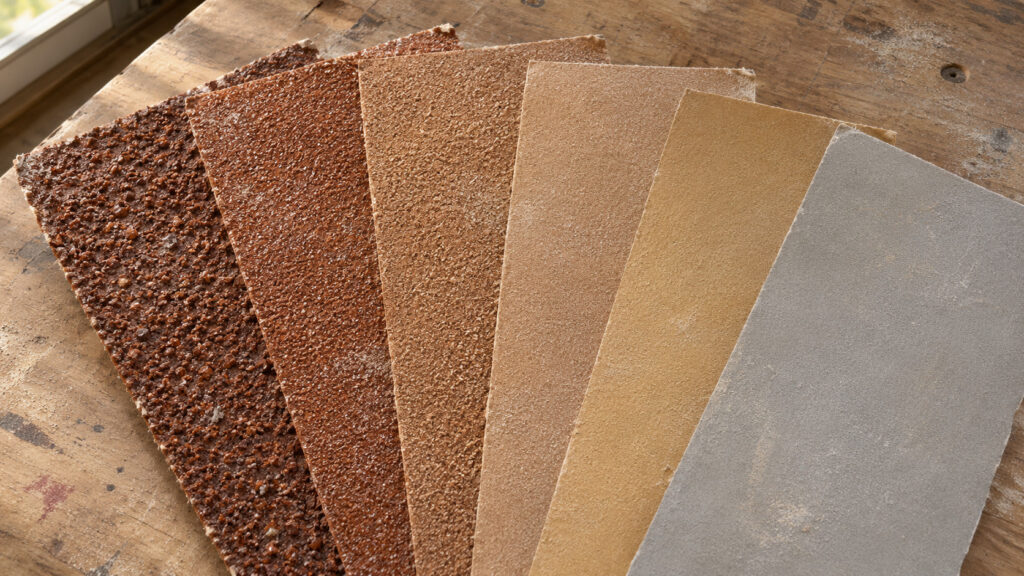
Sandpaper grades are labeled by a grit number. The lower the number, the coarser the paper and the faster it removes material. The higher the number, the finer the scratch it leaves. That is the whole system, but the details trip people up: which grit starts a job, how many steps you can skip, and why a “400” pack from one brand is not the same as a “P400” pack from another.
This guide gives you a grit chart, a grit order for common jobs, and a short list of packs worth buying.
Quick Answer: Which Grit Should You Use?
- Stripping paint or shaping rough wood: 40 to 80 grit.
- General sanding of bare wood: 80 to 120 grit.
- Final sanding before stain or paint: 150 to 220 grit.
- Between coats of finish: 220 grit or finer.
- Wet sanding clear coat or polishing metal: 1000 grit and up.
Sources differ by about one step on these ranges. Treat them as starting points and test on scrap.
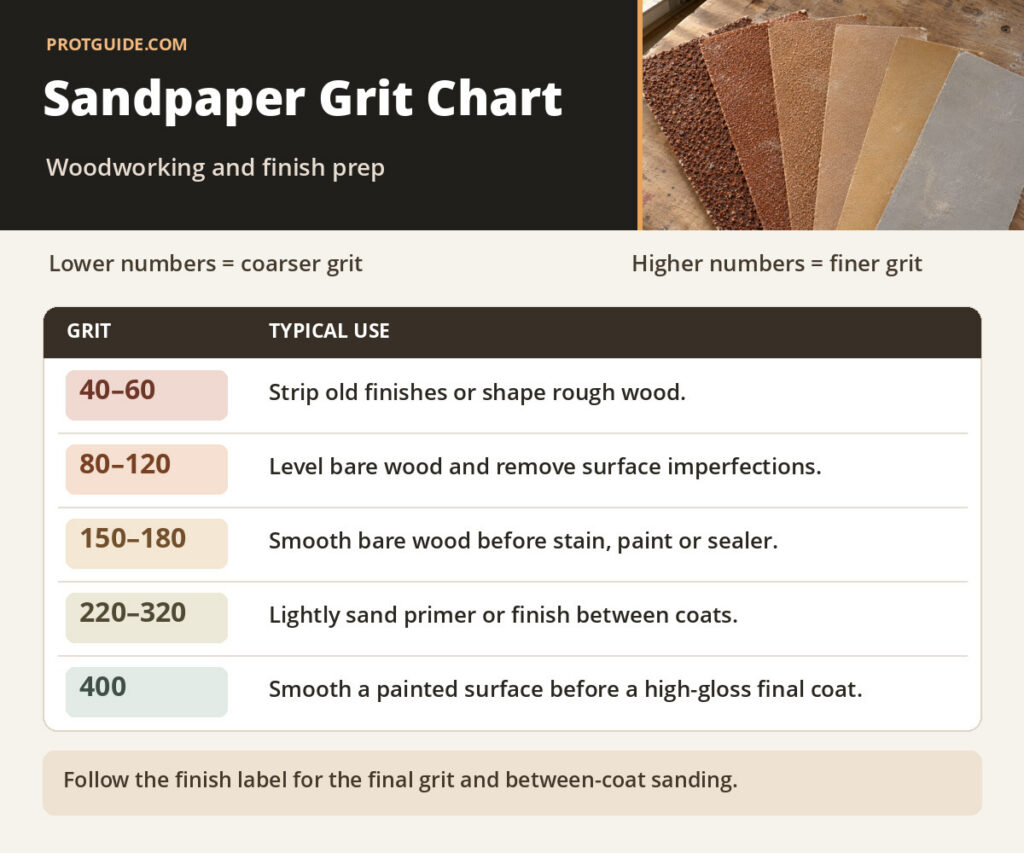
Sandpaper Grit Chart
This chart combines ranges from Benjamin Moore’s sandpaper guide (Benjamin Moore, retrieved 2026-11-11) and Zoro’s grit guide (Zoro, retrieved 2026-11-11). The two do not match exactly, so ranges overlap.
| Grit | Grade | What it does |
|---|---|---|
| 24 to 40 | Extra coarse | Heavy removal, including paint and varnish stripping |
| 40 to 80 | Coarse | Shaping wood, removing old finishes, opening grain, sanding hard metals |
| 80 to 120 | Medium | General sanding and surface prep |
| 100 to 150 | Medium to fine | Dulling a painted surface, sanding laminate, removing pencil marks |
| 150 to 220 | Fine to very fine | Final pass before paint or stain, smoothing between coats |
| 240 to 320 | Extra fine | Final prep and light polishing |
| 400 to 600 | Super fine | Wet sanding and metal polishing |
| 1000 and up | Ultra fine | Polishing clear coat and paint; sold in wet/dry sheets |
Sandpaper Grit by Material

Bare wood
Use about 60 grit for heavy sanding or stripping, and 120 or higher for light smoothing (Benjamin Moore, retrieved 2026-11-11). A common run for furniture is 80 or 120, then 180 or 220. Go with the grain. Going finer than you need slows the job down without helping the finish.
Drywall
Benjamin Moore recommends 100 to 220 grit on drywall and says not to go below 100.
Painted surfaces
To prepare a painted surface for new paint, dull the gloss. Medium grits in the 100 to 150 range do this on a surface with one or two coats. To remove several layers, start in the coarse range.
Metal and rust
Coarse grits take rust and old paint off steel. Benjamin Moore lists 40 to 80 for hard metals, and softer metals such as aluminum are listed in the fine range. A 3M listing for its 40, 80 and 180 assortment recommends those grits for removing paint and rust from metal and fiberglass. If you work on tools, see our guide on removing rust from garden tools.
Clear coat and automotive paint

Very fine wet/dry paper is what you use here. The 3M Wetordry sheets reviewed below come in 1000, 1500, 2000 and 2500 grit, and the listing describes them as made for polishing clear coat. For bare-metal work on cars, start much coarser, in the 40 to 80 range.
How to Step Through Grits
Start with the coarsest grit that does the job, then move to finer grits until the surface is smooth. Coarser paper cuts faster, but it can damage the surface and leave scratches that need a finer pass (Benjamin Moore, retrieved 2026-11-11).
The 3M listings give a simple rule: skip no more than one grit in your sequence. If the usual run is 80, 100, 120, 150, 180, 220, you can leave out every other step, such as 80, 120, 180, then stop. Jumping from 60 straight to 220 can leave scratches the fine paper will not remove.
Example sequences
- Refinishing a wood table: 80, then 120, then 180 or 220, then stain.
- Stripping old paint from a door: 60 or 80, then 120, then 150, then prime.
- Prepping drywall patches: 120, then 180 or 220.
- Rust on a steel part: 60 or 80, then 120, then 220, then wipe and coat.
- Between coats of finish: one light pass at 220, then wipe off the dust.
- Clear coat repair (per the 3M Wetordry listing): 1000, 1500, 2000, 2500, then polish.
These are common patterns, not strict rules. Hardwood, softwood, finishes and sander type all change the answer.
CAMI vs P-Grade: Why Two Grit Numbers Exist
Two scales are in use. US packs use plain numbers under the CAMI system, such as 80 or 120. European and many imported packs use FEPA P-grades, written with a P, such as P80 or P120. If there is a P in front of the number, it is FEPA (Woodbin, retrieved 2026-11-11).
Below about 220, the two scales are close enough that you can treat them as the same. Above that, the numbers drift apart. One example from HowStuffWorks: a 320 CAMI paper is about equal to P400, and 600 CAMI is about equal to P1200 (HowStuffWorks, retrieved 2026-11-11). Fine Woodworking makes the same point, that the finer the grit, the more the grades differ (Fine Woodworking, retrieved 2026-11-11).
What to do about it: keep to one scale for a whole job. Do not mix a CAMI 400 sheet with a P400 sheet and assume they are the same step. Fine-grit sources that publish particle sizes in microns are the safest way to compare.
Sandpaper Types: Aluminum Oxide, Silicon Carbide and More
The listings below point to two mineral types.
- Aluminum oxide: the common mineral on sheets and discs for wood, paint and metal. The 3M, Fandeli, Dura-Gold and disc packs here use it, per their listings.
- Silicon carbide: used on waterproof wet/dry paper. The 3M Wetordry and the 48-piece wet/dry pack are described this way. It is the usual pick for very fine grits and wet sanding.
Wet sanding uses water to carry away debris. The 48-piece pack’s listing says wet sanding reduces scratches and dust. Dry sanding removes material faster but loads the paper faster.
The Best Sandpaper to Buy
We picked packs that cover different jobs, not nine versions of the same paper. Prices are from Amazon search pages on 2026-11-11 and change often.
1. 3M Aluminum Oxide Sandpaper, Assorted 100-150-220 – Best Starter Pack

This is a 5-sheet pack of 9 x 11 inch sheets at $5.45. It rates 4.7 stars across 7,277 ratings, the biggest review base on a name-brand pack here.

The listing says the sheets work by hand, on a sanding block, or cut to size for a power sander. It lists aluminum oxide mineral for paint, wood and metal, and repeats the skip-no-more-than-one-grit advice.
Key specs: 5 sheets; 100, 150 and 220 grit; 9 x 11 in; aluminum oxide.
Pros: Low price; brand name; covers medium to fine, which is the most common range for finishing.
Cons: No coarse grit, so it will not strip paint. Only five sheets.
Not the right fit if: you need to remove old finish. Look at the 60 grit pack below.
2. 3M Sandpaper, 60 Grit, 4 Sheets – Best Coarse Pack for Stripping

When the job is taking material off, you need coarse paper. This 4-sheet pack is $5.49 and rates 4.7 stars across 1,182 ratings.

It uses the same listing copy as the assorted pack: aluminum oxide, usable by hand or on a block, and good for paint, wood and metal.
Key specs: 4 sheets; 60 grit; 9 x 11 in; aluminum oxide.
Pros: Name brand at a low price; matches the 60 grit range used for heavy wood sanding.
Cons: Only four sheets, and coarse paper wears fast on paint.
Not the right fit if: you want more than one grit in the box.
3. Fandeli Multi-Purpose, 80/120/220 Assorted, 25 Sheets – Best Wood Sanding Mix

Fandeli is the pick for a project that needs real volume. The pack costs $18.51 and rates 4.7 stars across 5,952 ratings.
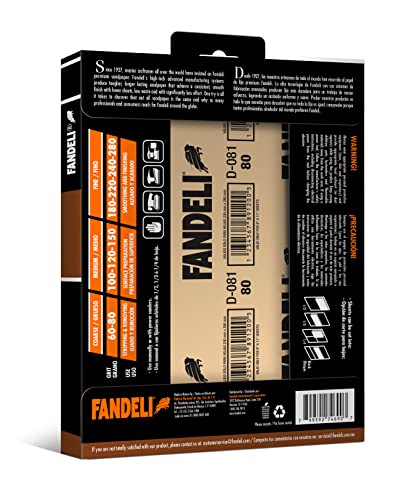
The listing breaks the pack down as 5 sheets of 80 grit, 10 of 120 and 10 of 220, all 9 x 11 inches. It says the paper is aluminum oxide, aimed at wood and metal.
Key specs: 25 sheets; 80 (5), 120 (10), 220 (10); 9 x 11 in; aluminum oxide.
Pros: The 80, 120, 220 spread is a standard sequence for bare wood. Large review base.
Cons: Only five sheets of the coarse grit. It was a sponsored placement in Amazon search.
Not the right fit if: you need 150 or 180 for a smoother step.
4. Fandeli 60 Grit, 25 Sheets – Best Bulk Coarse Pack

If you strip a lot, this bulk 60 grit pack gives you 25 sheets for $18.17. It rates 4.6 stars across 1,187 ratings.

The listing says the 9 x 11 inch sheets are for painted surfaces, bare wood and metal, and that the paper is a heavy-weight type.
Key specs: 25 sheets; 60 grit; 9 x 11 in.
Pros: Lowest cost per coarse sheet in this list.
Cons: Single grit, so you will need finer paper for the next steps. The listing does not name the mineral in the text we read.
Not the right fit if: you do not need 25 sheets of one grit.
5. Dura-Gold Gold Sandpaper, 80/120/150/220/320 – Best Five-Grit Variety Pack
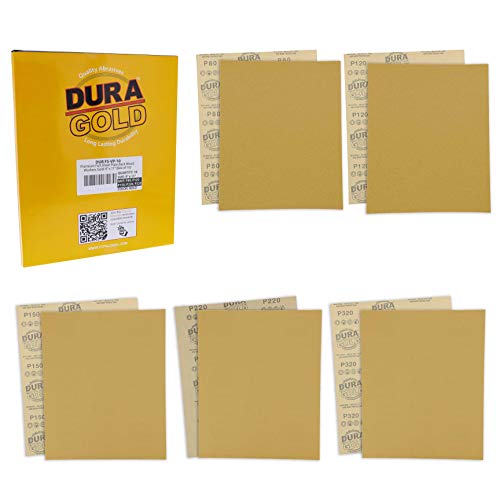
This 10-sheet box has two sheets each of 80, 120, 150, 220 and 320 grit at $11.99. It rates 4.6 stars across 408 ratings.
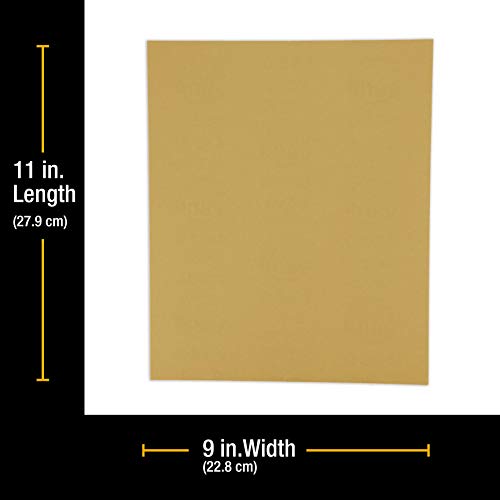
The listing says the paper is made from aluminum oxide fused with zirconia alumina, sized 9 x 11 inches. It mentions use on auto body work, including sanding body filler and feather-edging primer, as well as wood and metal.
Key specs: 10 sheets; 80, 120, 150, 220, 320 (2 each); 9 x 11 in.
Pros: Five steps in a single box, so you can run a full sequence without buying separate packs.
Cons: Two sheets per grit run out fast on a big project. Smaller review base than the 3M and Fandeli packs.
Not the right fit if: you sand large surfaces.
6. 3M Sandpaper 03039, Assorted Grits – Best for Auto Surface and Bare Metal

This is a small 5-sheet pack, 3 2/3 x 9 inches, at $4.96. It rates 4.4 stars across 160 ratings, lower than the other 3M packs.
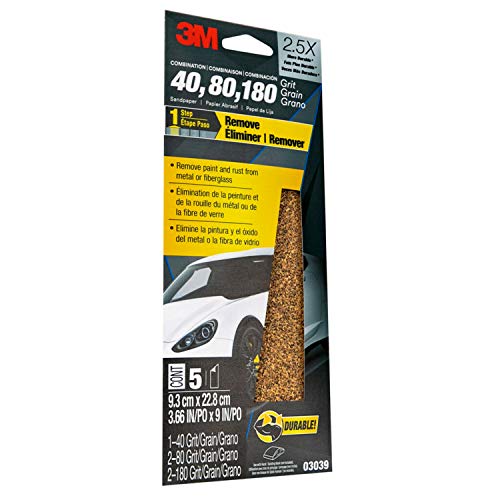
The listing is inconsistent. The title says 40, 80 and 120 grit. The bullet points say one sheet of 40 and two sheets each of 80 and 180. Check the pack photos and the grit labels before you order. The listing recommends the paper for removing paint and rust from metal or fiberglass, and the seller claims it lasts 2.5 times longer than conventional 3M sandpaper, which we could not confirm.
Key specs: 5 sheets; 3 2/3 x 9 in; 40, 80 and either 120 or 180 (listing conflicts).
Pros: Includes a 40 grit sheet, which most packs here lack; cheap.
Cons: Conflicting grit information in the listing; lowest rating of the 3M packs.
Not the right fit if: you need a specific grit set and cannot risk a mismatch.
7. 3M Wetordry Sandpaper 03006, 1000 to 2500 Grit – Best for Clear Coat and Wet Sanding
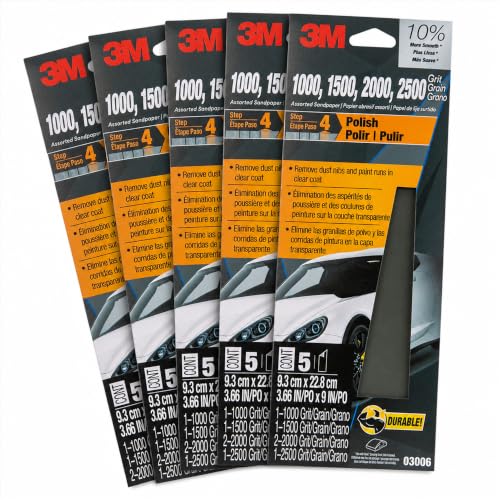
For very fine work, this is the name-brand pack. It has 25 sheets (5 packs of 5) at $19.99 and rates 4.7 stars across 5,301 ratings.
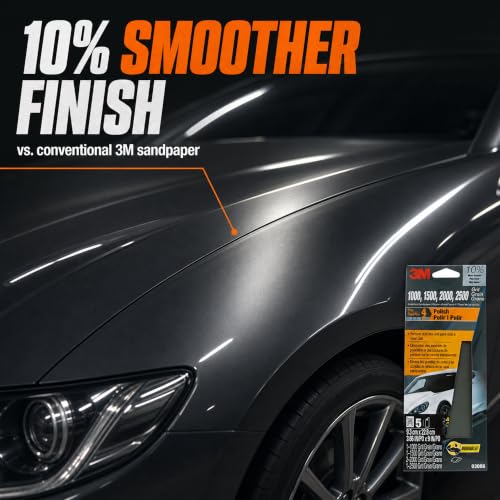
The sheets are 3 2/3 x 9 inches in 1000, 1500, 2000 and 2500 grit. The listing describes self-fracturing silicon carbide, a waterproof backing for wet or dry sanding, and flexible paper that folds for curved panels or runs under a sanding block. The “10% smoother finish” claim compares it to other 3M paper and is the seller’s own figure.
Key specs: 25 sheets; 1000, 1500, 2000, 2500 grit; 3 2/3 x 9 in; silicon carbide; wet or dry.
Pros: A named brand with a big review base; covers the whole polishing range.
Cons: Fine grits only, so it does not cover shaping or stripping.
Not the right fit if: you are sanding wood. These grits are far too fine for bare wood.
8. 48-Piece Wet/Dry Sandpaper, 120 to 5000 Grit – Best Budget Full-Range Wet/Dry Pack

This pack covers a very wide range for $7.27. It rates 4.7 stars across 4,078 ratings, which is a large sample for an unbranded pack.

The listing says it holds three sheets each of 16 grits, from 120 up to 5000, on 9 x 3.6 inch sheets. It names silicon carbide, an anti-static waterproof backing, and grit numbers printed on the back.
Key specs: 48 sheets; 16 grits from 120 to 5000; 9 x 3.6 in; silicon carbide; wet or dry.
Pros: Cheap; every fine step is in the box; grits printed on the back.
Cons: No coarse grit under 120, and the brand is not named in the title we saw. The listing does not say whether the numbers follow CAMI or P-grade, which matters at fine grits.
Not the right fit if: you need to strip or shape.
9. 165-Piece 5-Inch Sanding Disc Assortment – Best for a Random Orbital Sander

If you sand with a power sander, a disc assortment saves cutting sheets. The pack is $19.99 and rates 4.7 stars across 2,794 ratings.

The listing describes 5-inch aluminum oxide discs with 8 dust holes, in both coarse and fine grits. It says the discs fit most 5-inch random orbital sanders. The listing text we pulled gave only part of the grit breakdown, and it does not state the backing type, so check that the discs attach to your sander’s pad.
Key specs: 165 discs; 5 in; 8 holes; aluminum oxide; coarse and fine grits.
Pros: A wide spread of grits; a large review base.
Cons: We could not confirm the exact grit counts or backing from the text we read, and the 8-hole pattern must match your sander. It is an unbranded pack.
Not the right fit if: you hand sand, or your sander uses a different hole pattern.
Which Pack Should You Buy?
| Job | Pack |
|---|---|
| First sandpaper for general home use | 3M 100-150-220 |
| Stripping paint or old varnish | 3M 60 grit or Fandeli 60 grit |
| Bare wood, start to finish | Fandeli 80/120/220 |
| A full sequence from one small box | Dura-Gold 5-grit pack |
| Rust and paint on metal | 3M 03039 (check the grit labels) |
| Clear coat and polishing | 3M Wetordry or the 48-piece wet/dry pack |
| Power sanding with a 5-inch orbital | 165-piece disc set |
How to Sand Better
- Pick the coarsest grit that does the job, not the finest. Starting too fine wastes time.
- Sand with the grain on wood. The 3M listings say this too.
- Let the paper do the cutting. Heavy pressure clogs the paper and leaves deeper scratches.
- Wipe the dust off between grits, so a loose coarse particle does not scratch the finer pass.
- Do not skip more than one grit. If the surface still shows scratches from the last grit, go back a step.
- Change the paper as soon as it stops cutting. A worn sheet burnishes the surface.
Sanding makes fine dust, so protect your eyes and lungs. Our guides to ANSI-rated safety glasses and woodworking dust collection cover that. For tight corners that paper cannot reach, see our detail sander guide, and for small shaping and polishing jobs, our rotary tool picks.
FAQ

What does sandpaper grit mean?
Grit is the size of the abrasive particles on the paper. A low number means large particles and a rough cut. A high number means small particles and a smooth finish.
Is a higher grit number finer?
Yes. 400 grit is much finer than 80 grit.
What is the best all-purpose sandpaper grit?
Medium grits in the 80 to 120 range cover general sanding and surface prep in the charts above. Start coarser if you need to remove material, and finish finer for a smooth surface.
What grit should I use before painting or staining?
The Benjamin Moore chart puts the final pass on wood in the fine range of 180 to 220 and above. For paint, also dull any glossy surface first.
What grit should I use between coats of finish?
Sources point to 220 or finer. Sand lightly, then wipe off the dust before the next coat.
Can I skip grits?
Only a little. 3M’s guidance is to skip no more than one grit in a sequence. Bigger jumps leave scratches that finer paper may not remove.
What is the difference between wet/dry and regular sandpaper?
Wet/dry paper has a waterproof backing, so you can sand with water. The wet/dry packs here use silicon carbide. Regular paper is meant for dry use. The 3M Wetordry and 48-piece listings above describe waterproof backings.
Are P-grade and regular grit numbers the same?
Close at low numbers, different at high numbers. Below about 220 you can treat them as the same. Above that, the scales drift apart, so stick to one scale for a job.
What grit removes paint?
Coarse paper, around 40 to 80, per the Benjamin Moore chart. Many people then follow with a medium grit before priming.
What is the lowest grit sandpaper?
Zoro’s chart lists the extra coarse range as starting at 24.
Can I reuse sandpaper?
You can until it stops cutting. Clogged or worn paper polishes the surface and slows the job. Replace it when it loads up.
Bottom Line
Learn the grit order first, then buy paper to match it.
- General home use: 3M 100-150-220 plus a 60 grit pack for stripping.
- Woodworking and furniture: Fandeli 80/120/220.
- Finishing and clear coat: 3M Wetordry.
- Power sanding: the 165-piece disc set, after checking your sander’s hole pattern.
Use the coarsest grit that works, move up one step at a time, and wipe the dust between steps.