“Hazard tape” means two different products, and picking the wrong one wastes money. One is sticky striped tape that you press onto a floor, step or machine edge. The other is a plain printed ribbon that you string between posts to close off an area. This guide covers both. It has 9 picks from Amazon, sorted by job, plus the color rules, surface prep and removal tips that most buying guides skip.
Quick Picks
- Best budget black and yellow floor tape: SWRT 2 in x 110 ft Hazard Tape
- Best wide tape for walls, pipes and floors: Tapix 3 in x 54 ft Hazard Floor Tape
- Most footage per dollar: Harrier Hardware 2 in x 180 ft PVC Warning Tape
- Best 3-pack for a shop or garage: Blue Summit Supplies 3-Pack Floor Marking Tape
- Best red and white stripe: YEEGRAOU Red and White Hazard Tape
- Best name-brand striped tape: 3M Striped Vinyl Safety Tape 5702
- Best glow-in-the-dark tape for stairs and exits: FindTape Glow in the Dark Egress Hazard Tape
- Best yellow caution ribbon: ATERET Yellow Caution Tape, 3 in x 1,000 ft
- Best red danger ribbon in bulk: Cordova Danger Barricade Tape, 12 Rolls

Comparison Table
Prices and ratings are from Amazon on 2026-11-11 and change often.
| Product | Type | Size | Colors | Price | Rating |
|---|---|---|---|---|---|
| SWRT | Adhesive stripe | 2 in x 110 ft | Black/yellow | $9.59 | 4.3 (735) |
| Tapix | Adhesive stripe | 3 in x 54 ft | Black/yellow | $8.49 | 4.6 (211) |
| Harrier Hardware | Adhesive stripe | 2 in x 180 ft | Black/yellow | $6.99 | 4.3 (76) |
| Blue Summit 3-Pack | Adhesive stripe | 3 rolls, 2 in x 108 ft | Black/yellow | $21.99 | 4.6 (82) |
| YEEGRAOU | Adhesive stripe | 2 in x 108 ft | Red/white | $9.99 | 4.5 (62) |
| 3M 5702 | Adhesive stripe | 1 in x 36 yd | Check listing | $43.06 | 4.4 (41) |
| FindTape Glow | Adhesive, glow | 2 in x 30 ft | Green glow/black | $30.99 | 4.5 (3) |
| ATERET | Barricade ribbon | 3 in x 1,000 ft | Yellow/black text | $8.99 | 4.7 (2,409) |
| Cordova Danger | Barricade ribbon | 12 rolls, 3 in x 1,000 ft | Red | $71.99 | 4.5 (97) |
Which Type Do You Need?
Ask one question: are you marking a surface, or closing off an area?
- Marking a surface: use adhesive hazard tape. It sticks to a floor, stair edge, pipe or machine guard and stays there. Typical jobs are trip hazards, low beams, step-downs, aisle edges and keep-clear zones around equipment.
- Closing off an area: use barricade tape, also called caution tape or danger tape. It is a plain printed ribbon that you tie between posts, cones or railings. It is cheap, fast and temporary, and it comes in rolls of 1,000 feet.
- Lights out: use glow-in-the-dark hazard tape on stair edges and exit paths, so the hazard is still visible in a power cut.
Mixing these up is the common mistake. A ribbon will not stay on a floor, and an adhesive stripe will not stretch across a driveway.
The Best Hazard Tapes
1. SWRT 2 in x 110 ft Black and Yellow Hazard Tape – Best Budget Floor Tape

This is the most-reviewed budget stripe tape in the results, with 735 ratings at 4.3 stars. It costs $9.59 for a 2 inch wide roll that is 110 feet long.

The seller says the adhesive is strong and that the tape stretches to follow curved surfaces and corners. It also claims the tape holds up under forklift traffic. Treat that last point as the seller’s claim, since we cannot verify it. The listing suggests factories, parking spaces and floors as uses.
Key specs: 2 in wide; 110 ft roll; black and yellow stripe; adhesive backing; conforms to curves (per listing).
Pros: Lowest cost per foot among the 2 inch rolls with a large review base; wide enough to read from a distance.
Cons: The listing does not state the thickness or the adhesive type. We have no way to judge how it handles cold, wet or oily floors.
Not the right fit if: you need a name-brand tape for a permanent forklift lane. Look at the 3M tape below.
2. Tapix 3 in x 54 ft Hazard Floor Tape – Best Wide Tape for Walls, Pipes and Floors

Tapix is the pick when you want the tape to be seen from farther away. It is 3 inches wide, and it rates 4.6 stars across 211 ratings at $8.49.

The listing describes pressure-sensitive adhesive that applies to clean, dry surfaces, and says the tape stretches and conforms around curves and corners. It recommends the tape for walls, floors, pipes and equipment. At 54 feet, the roll is short.
Key specs: 3 in wide; 54 ft roll; black and yellow stripe; pressure-sensitive adhesive.
Pros: Good rating on a mid-size review base; the wide stripe is easy to see; suited to vertical surfaces and equipment.
Cons: The shortest roll in this list, so the cost per foot is higher than the 2 inch tapes. You will need several rolls for a long aisle.
Not the right fit if: you are marking a long run of floor. The Harrier roll below gives you more footage.
3. Harrier Hardware 2 in x 180 ft PVC Warning Tape – Most Footage per Dollar

The Harrier roll is 2 inches wide and 60 yards, which is 180 feet, for $6.99. That is the lowest price per foot in the list. It rates 4.3 stars across 76 ratings, so the sample is smaller than the SWRT.
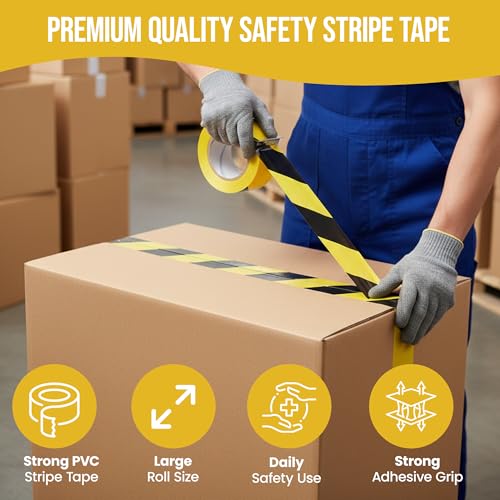
The listing says the tape is PVC, with a strong adhesive backing that bonds to most clean, dry surfaces. It claims the tape stands up to heavy foot traffic and tough weather. We did not find a stated thickness or adhesive type.
Key specs: 2 in wide; 60 yd (180 ft) roll; black and yellow stripe; PVC; adhesive backing.
Pros: Most footage per roll and lowest cost per foot; PVC backing; listing mentions weather resistance.
Cons: Fewer ratings than the SWRT. Weather claims are the seller’s, so test a short piece outdoors before you tape a whole walkway.
Not the right fit if: you want a larger review base before you buy a lot of footage.
4. Blue Summit Supplies 3-Pack Floor Marking Tape – Best 3-Pack for a Shop or Garage

If you are marking a home shop or garage, three rolls cover a lot of ground. The pack has three 2 inch by 108 ft rolls for $21.99 and rates 4.6 stars across 82 ratings.

The listing calls the tape semi-permanent and says it should be applied with pressure to a dry, clean surface. It suggests lining areas of caution, marking warehouse aisles, identifying exits and designating storage locations. It also says you can remove the tape later, which is useful if you rearrange your shop. That removal claim is the seller’s, so check a small spot first.
Key specs: 3 rolls; each 2 in x 108 ft; black and yellow; semi-permanent; heavy-duty flexible tape (per listing).
Pros: Three rolls in one purchase; good rating; designed with changeable layouts in mind.
Cons: Costs more per foot than the SWRT or Harrier. It was shown as a sponsored placement in Amazon search, so compare it with other rolls before you buy.
Not the right fit if: you only need one short run. Buy a single roll.
5. YEEGRAOU 2 in x 108 ft Red and White Hazard Tape – Best Red and White Stripe

Red and white stripes are used for a different message than black and yellow, so a few shops want both. This roll costs $9.99 and rates 4.5 stars across 62 ratings.

The listing describes vinyl with a rubber adhesive that resists oil, solvents and moisture. It stretches to follow curved and uneven surfaces and can be cut to length. One bullet in the listing mentions a black and yellow design even though the product is red and white, which looks like a copy-and-paste error. Check the photos and color option before you order.
Key specs: 2 in x 108 ft; red and white stripe; vinyl with rubber adhesive; oil, solvent and moisture resistant (per listing); stretches to conform.
Pros: Same price as a black and yellow roll; specific material details in the listing; stretches around curves.
Cons: A lesser-known brand with a small review base, and a sloppy listing. Few buyers have posted long-term results.
Not the right fit if: your site has its own color code. Follow that code.
6. 3M Striped Vinyl Safety Tape 5702 – Best Name-Brand Striped Tape
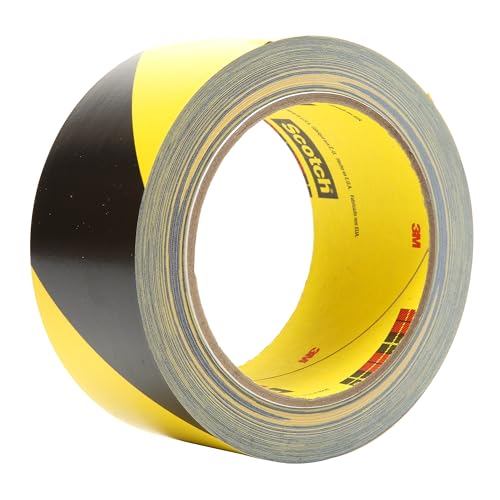
This is the tape to buy if the brand matters to you. It is 3M, 1 inch wide and 36 yards (108 ft) long, and it costs $43.06. It rates 4.4 stars across 41 ratings.
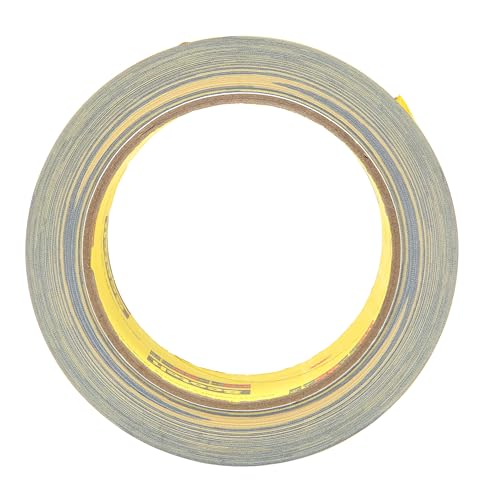
The listing says the color is embedded in the tape construction for abrasion resistance. It says the tape removes cleanly in one piece from many surfaces, stretches to conform to uneven surfaces, and has a rubber adhesive with good solvent resistance. The title does not tell us the stripe colors, so check the option before ordering.
Key specs: 1 in wide; 36 yd (108 ft) roll; striped vinyl; rubber adhesive; color embedded in the tape (per listing).
Pros: Clean, one-piece removal is a real advantage on finished floors; named brand with a documented adhesive and color construction.
Cons: It costs about four and a half times as much per foot as the SWRT, and it is only 1 inch wide. The review count is small.
Not the right fit if: you need a wide stripe on a budget.
7. FindTape Glow in the Dark Egress Hazard Tape – Best for Stairs and Exits

Glow tape solves a different problem: seeing the hazard when the power fails. FindTape’s version has black 45 degree chevrons over a glow-in-the-dark base. It is 2 inches by 30 feet and costs $30.99. It rates 4.5 stars, but on only 3 ratings, so treat the rating as a placeholder.

The listing says the base glows green in the dark, recharges from natural or artificial light, and uses a non-radioactive pigment. It says the glow is brightest right after the lights go out and fades slowly. The adhesive is a permanent solvent acrylic on a flexible PVC backing, and the listing recommends a primer on wood, concrete or stone. It suggests stair edges, egress routes, low beams and ledges.
Key specs: 2 in x 30 ft; photoluminescent base with black chevrons; PVC backing; permanent solvent acrylic adhesive; primer recommended on wood, concrete and stone.
Pros: Keeps stair edges and doorways visible in a blackout; useful in garages and homes as well as warehouses.
Cons: Only 3 ratings. High cost per foot. The adhesive is permanent, so plan the placement before you press it down. The glow fades over time after the lights go out.
Not the right fit if: you need a temporary mark. Use a removable stripe instead.
8. ATERET Yellow Caution Tape, 3 in x 1,000 ft – Best Yellow Caution Ribbon

For roping off an area, ATERET is the best-reviewed option here: 4.7 stars across 2,409 ratings, at $8.99 for one 1,000 foot roll. It is a bright yellow ribbon with bold black text.
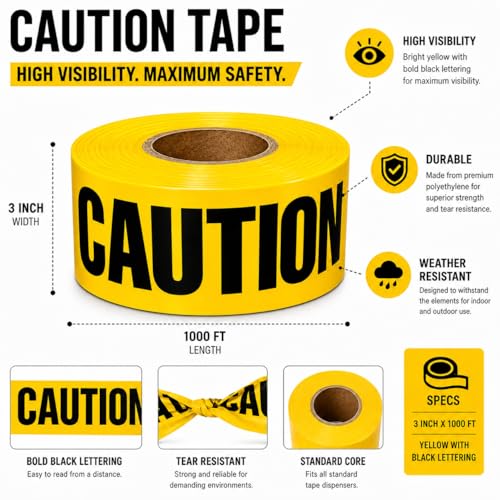
The listing says the tape is 3 inches wide and made of polyethylene, that it is waterproof, and that the printed text does not fade in rain or snow. It also pitches the tape for Halloween decorations, which tells you how common it is. A 12-pack of the same tape is $99.90 on its own listing. That works out to about $8.33 per roll, so the saving over buying single rolls is small. Both listings show the same 2,409 ratings, so they are one product family, not two separate products.
Key specs: 3 in wide; 1,000 ft roll; yellow with black text; polyethylene; waterproof (per listing).
Pros: The largest review base of anything in this list; one roll covers a long perimeter; cheap enough to use once and throw away.
Cons: The listing text we pulled does not say whether it has any adhesive. Barricade ribbon of this type is normally tied off, not stuck down. It warns people. It does not stop them.
Not the right fit if: you need a mark on the floor itself. Use an adhesive stripe.
9. Cordova Danger Barricade Tape, 12 Rolls – Best Red Danger Ribbon in Bulk

Red tape says something different from yellow, and this pack gives you a lot of it. The Cordova pack has 12 rolls, each 3 inches by 1,000 feet, for $71.99 (about $6 per roll). It rates 4.5 stars across 97 ratings.

The listing title identifies it as a Danger barricade tape in red. The product details did not load in the text we pulled, so check the listing for the material, whether it is adhesive, and the printed wording before you order. The pack is built for crews and sites that go through tape often.
Key specs: 12 rolls; 3 in x 1,000 ft each; red; “Danger” barricade tape.
Pros: Lowest cost per roll of any red ribbon in the results; large quantity for a site that uses a lot.
Cons: Twelve rolls is a lot for a homeowner. We could not confirm material details from the listing text.
Not the right fit if: the hazard is only a trip risk or a bump hazard. Red implies serious danger. Use yellow.
What the Colors Mean
OSHA’s safety color rule is short. Under 29 CFR 1910.144, red is the basic color for danger, and yellow is the basic color for designating caution. The standard also says yellow marks physical hazards such as stumbling, tripping and falling (OSHA 1910.144, retrieved 2026-11-11). The standard does not mention tape or stripe patterns, and it does not certify any product.
That matters because many listings say “OSHA compliant”. At most, it means the color follows the rule. It does not mean the tape was tested or approved.
Most suppliers fill in the rest with common practice. Treat the table below as practice, not law, and follow your site’s own color code if it has one.
| Color | Common meaning | Good for |
|---|---|---|
| Yellow, or black and yellow | Caution, physical hazard | Trip hazards, low beams, step edges, equipment zones |
| Red, “Danger” | Serious danger, do not enter | Open excavations, live work areas, hazardous zones |
| Red and white | Often fire equipment or no-go areas (varies by site) | Keeping fire equipment clear |
| Glow green with black | Visible hazard in a power cut | Stair edges and exit routes |
How to Choose Hazard Tape

Pick the width for the viewing distance
Two inches is the usual floor width. Go to 3 inches if people need to see it from across a room or a yard. A 1 inch stripe works for edges, but it is easy to miss.
Decide: temporary or permanent
Adhesive tape ranges from removable to permanent. Listings use words like semi-permanent and permanent, but they rarely give a number. If you may move the line, buy a tape sold as removable and test it in a hidden spot first.
Check the surface
Every adhesive listing above says the same thing: apply to a clean, dry surface. Dust, oil, damp concrete and loose paint are the usual reasons tape lifts. FindTape also recommends a primer on wood, concrete and stone.
Indoors or outdoors
PVC and polyethylene both hold up to water better than paper-style tapes, but outdoor weather, cold and sun are hard on adhesive. If the tape has to survive a winter, test a short piece first.
Do not confuse it with anti-slip tape
Hazard stripes are for visibility. If the floor is slippery, you need a gritty anti-slip tape or a better surface, not just a warning.
How to Apply and Remove Hazard Tape
Applying
- Clean the surface and let it dry. Remove dust, grease and loose particles.
- Measure and cut the length first. A long strip is hard to realign once it sticks.
- Peel back a short section, press it down, and unroll as you go in a straight line.
- Press the whole strip down firmly. Blue Summit’s listing says to apply with pressure.
- Round off sharp corners so edges do not catch and peel.
Removing
Warm the tape with a hair dryer, then peel it slowly at a low angle. If adhesive stays behind, clean it with a solvent that is safe for your floor. Test a small area first. Tape that is labeled for clean, one-piece removal, like the 3M tape above, is easier to take up.
Hazard Tape Is a Warning, Not a Barrier
Barricade tape warns people. It does not stop them, and it will not hold a vehicle or a person back. If the danger is serious, such as an open hole, a live electrical area or overhead work, use cones, rigid barricades or guardrails as well. A tape line is only as good as the people who respect it.
If you are marking zones in a shop or warehouse, our guides on pallet jacks and trucks and heavy-duty extension cords cover two of the most common sources of trip hazards and traffic lanes. If you grind a concrete floor to remove trip edges, see our concrete grinder guide. And for the person doing the work, start with ANSI-rated safety glasses.
FAQ
What is the difference between hazard tape and caution tape?
In everyday use the names overlap. Hazard tape usually means adhesive striped tape that sticks to a surface. Caution tape, barricade tape and danger tape usually mean a plain printed ribbon that you string between posts. Many sellers use the words interchangeably, so check the product photos and size.
What do the tape colors mean?
Under OSHA 1910.144, yellow means caution and marks physical hazards, and red means danger. Other combinations, such as red and white, vary by site and supplier.
Is red or yellow tape more serious?
Red. Yellow warns of a lower-level hazard, while red marks serious danger and means stay out.
Does hazard tape stick to concrete?
It can, if the concrete is clean and dry. The listings we checked all say to apply on a clean, dry surface. Some recommend a primer on concrete, and rough or dusty concrete is the usual cause of failure.
How do you remove hazard tape from a floor?
Warm it with a hair dryer, peel slowly at a low angle, and clean off any residue with a floor-safe solvent after testing a small spot.
Can I use hazard tape outside?
Barricade ribbon works well outdoors for short jobs. The ATERET listing says its tape is waterproof. For adhesive stripes outdoors, weather and temperature are the risk, so test a short piece first.
Is glow-in-the-dark hazard tape required?
We did not find a source that makes it a requirement for homes. It is a useful extra on stair edges and exit routes. Check your local building and fire rules if you manage a commercial space.
Is “OSHA compliant” on a tape listing meaningful?
Not much. OSHA sets color rules but does not approve products. Treat the phrase as a statement about color, not about quality.
Bottom Line
Match the tape to the job.
- Marking a floor on a budget: SWRT for the largest review base, or Harrier for the most footage.
- Shop or garage layout: Blue Summit 3-pack.
- Walls, pipes and machine edges: Tapix 3 inch.
- Finished floors where clean removal matters: 3M 5702.
- Stairs and exits in a blackout: FindTape glow tape, keeping in mind it has very few reviews.
- Roping off an area: ATERET yellow caution ribbon, or Cordova red danger tape when the hazard is serious.
Whatever you buy, clean the surface first, test a short piece, and back up serious hazards with a real barrier.