

Two extension cords can both say “heavy-duty” on the label and perform completely differently once you factor in length. A 12-gauge cord that’s perfectly fine at 25 feet has real voltage drop by the time it reaches 100 feet, and running a table saw or air compressor off the wrong combination doesn’t just underperform, it can trip breakers, strain the tool’s motor, or overheat the cord itself. This guide breaks down 13 real extension cords and, more importantly, how to match gauge to length so “heavy-duty” actually means something for your specific setup.
Gauge and Length Aren’t Separate Specs – Match Them Together
This is the gap most buying guides leave open: gauge (AWG) and length get explained as two independent decisions when they’re really one. Every foot of cord adds electrical resistance, and that resistance eats into the voltage actually reaching your tool. A gauge that’s perfectly adequate at a short distance can leave a tool underpowered at a longer one, even though the cord is rated for the same amperage on the label.

| Cord Length | Light Loads (lamps, small tools) | Power Tools | High-Amp Equipment (table saws, compressors) |
|---|---|---|---|
| Up to 25 ft | 16 AWG | 14 AWG | 12 AWG |
| 50 ft | 14 AWG | 12 AWG | 12 AWG |
| 100 ft | 12 AWG | 12 AWG | 10 AWG |
| 150 ft+ | 12 AWG | 10 AWG | 10 AWG (expect some drop) |
Tip: when in doubt, go thicker (lower AWG number), not longer with a thin cord. A too-thin cord run long distance is one of the most common causes of tools underperforming, motors straining to start, and in worst cases, overheating.
What “Heavy-Duty” Actually Means
The label alone doesn’t tell you much. 16 AWG is light-duty, full stop, regardless of what the packaging says, it’s built for lamps, small fans, and light outdoor décor, not power tools. Real heavy-duty starts at 12 AWG, which handles most drills, saws, and shop vacs comfortably. 10 AWG is the gauge to reach for specifically for high-draw equipment (table saws, air compressors, space heaters, generators) or any run over 100 feet where voltage drop becomes a real factor. One product in this guide, flagged in its own section below, is labeled for outdoor use but is genuinely 16-gauge, worth knowing before you buy it expecting power-tool performance.
Cord Jacket Types – What the Letters Mean
You’ll see codes like SJTW, SJEOW, and SJTOW stamped on these cords. S means it’s a flexible, junior-service cord. J means junior service (standard insulation thickness). T means thermoplastic (vinyl) insulation. W means weather and water-resistant, essential for any outdoor use. O (as in SJTOW or SJEOW) adds oil resistance, useful on job sites where the cord might contact grease, gasoline, or hydraulic fluid. For outdoor use, always look for a “W” in the code, an indoor-only cord’s insulation degrades quickly under sun and moisture exposure even if the amperage math checks out.
Retractable Reels vs. Standard Cords
A reel is genuinely convenient for garages, job sites, or anywhere you’re constantly coiling and uncoiling cord, no more wrestling a tangled loop off the ground. The trade-off is one more mechanical part that can eventually fail (the retraction spring or the internal wiring at the swivel point), and reels are typically heavier and bulkier to store than a simple coiled cord. A standard cord has nothing to break and is easier to inspect end-to-end for damage, but you’re on your own for coiling it neatly. If you value convenience and don’t mind an extra moving part, a reel is worth it; if you want maximum simplicity and reliability, a standard cord wins.
Quick Comparison
| Product | Gauge | Length | Type | Best For |
|---|---|---|---|---|
| Flexzilla Retractable Reel | 12/3 AWG | 60 ft | Retractable Reel | Best Retractable Reel |
| CRAFTSMAN Contractor Reel | 12 AWG | 100 ft | Retractable Reel, 4 Outlets | Best Multi-Outlet Reel |
| DEWALT Lighted 12/3 | 12/3 AWG | 100 ft | Standard, Lighted End | Best Overall 100ft |
| 150ft 10AWG Waterproof | 10 AWG | 150 ft | Standard, Waterproof | Best Long-Run High-Amp |
| HUANCHAIN 500ft | 12 AWG | 500 ft | Standard, Specialty | Best Extreme-Length Specialty |
| 100ft 10/3 Ultra Heavy Duty | 10/3 AWG | 100 ft | Standard | Best Budget 100ft High-Amp |
| GEARit 100ft 10/3 SJEOW | 10 AWG | 100 ft | Standard, Oil-Resistant | Best Oil-Resistant Jacket |
| 150ft 10AWG (Alt.) | 10 AWG | 150 ft | Standard | Best Alternate 150ft Listing |
| CCCEI Individual Switches | 12 AWG | 50 ft | Standard, Switched Outlets | Best Individual Switch Control |
| 100ft 16/3 Waterproof | 16 AWG | 100 ft | Standard, Light-Duty | Light-Duty Exception – Not True Heavy-Duty |
| 50ft 10/3 Ultra Heavy Duty | 10/3 AWG | 50 ft | Standard | Best Overkill Short Run |
| 50ft 12/3 Lighted | 12/3 AWG | 50 ft | Standard, Lighted End | Best Standard 50ft |
| HUANCHAIN 25ft | 12 AWG | 25 ft | Standard, Waterproof | Best Short Run |
Retractable Reels
1. Flexzilla Retractable Extension Cord Reel, 12/3 AWG, 60 ft – Best Retractable Reel

Flexzilla built its reputation on flexible, kink-resistant hoses, and this cord reel carries the same design philosophy over: a 12/3 AWG SJTOW cord, which adds oil resistance on top of standard weather resistance, genuinely useful if the cord ever ends up near a generator, compressor, or greasy job-site tools. The 60-foot length hits a practical middle ground, long enough for most garage and driveway work without the bulk of a 100-foot reel.
Why customers choose this: the SJTOW jacket’s oil resistance and Flexzilla’s reputation for durable, kink-resistant cable stand out versus generic reel competitors.
Pros: Oil-resistant SJTOW jacket, a step up from standard weather-resistant cord; 12-gauge wire handles most power tools comfortably; retractable design keeps 60 feet of cord organized and tangle-free.
Cons: 60 feet is shorter than the 100-foot reels in this guide, won’t reach as far across a large property; retractable mechanism is one more part that can eventually wear out.
Best for: garage and driveway work where 60 feet covers the distance and you want a durable, oil-resistant cord that stores itself.
2. CRAFTSMAN 100 Ft. Contractor Retractable Cord Reel, 4 Outlets – Best Multi-Outlet Reel
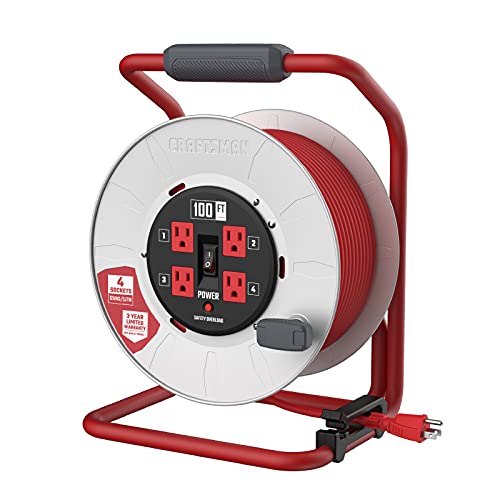
This is genuinely the 12-gauge heavy-duty version of Craftsman’s reel line (a lighter 14-gauge version exists under a different model number, so this ASIN is the one to confirm if heavy-duty matters to you). Rated for 15A/125V/1875W, it includes 4 grounded outlets, a steel drum for durability, and a built-in circuit breaker with overload protection, a real safety feature that shuts the reel down automatically if you exceed the rated load.
Why customers choose this: the combination of 4 outlets and a genuine 12-gauge rating at 100 feet, most competing reels at this price point step down to 14-gauge or offer fewer outlets.
Pros: Genuine 12 AWG at 100 feet, not a lighter-gauge version wearing a heavy-duty label; 4 grounded outlets mean multiple tools without a separate power strip; built-in overload circuit breaker; steel drum construction.
Cons: Heavier and bulkier to store than a standard coiled cord given the steel drum and 4-outlet housing; the retraction mechanism adds a part that can wear with heavy daily use.
Best for: job sites and garages where you need multiple outlets in one spot and want the confidence of a genuine 12-gauge rating, not a lighter-duty version.
Standard Cords
3. DEWALT 100 Foot 12/3 SJTW Lighted Extension Cord – Best Overall 100ft
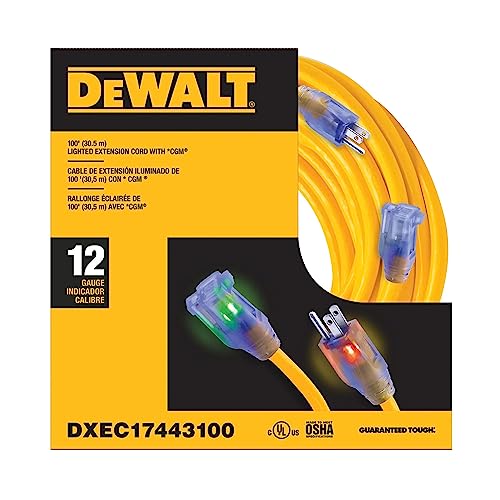
A straightforward, well-built 12/3 SJTW cord at the length most homeowners and light contractors actually need, with a lighted end that makes it easy to confirm the cord is powered without walking to the outlet. DEWALT’s name brings wide retail availability and consistent build quality expectations.
Why customers choose this: the DEWALT name and the lighted-end convenience feature, small but genuinely useful when you’re troubleshooting why a tool isn’t getting power.
Pros: Lighted end confirms power at a glance; 12-gauge handles most power tools at 100 feet; DEWALT brand reliability and wide availability.
Cons: 12-gauge at 100 feet is adequate for standard tools but not the choice for genuinely high-amp equipment like table saws or compressors, step up to 10-gauge for that.
Best for: general contractor and homeowner use at 100 feet, where standard power tools (drills, saws, sanders) are the primary load.
4. 150 Ft 10AWG Outdoor Extension Cord, Waterproof Heavy Duty – Best Long-Run High-Amp
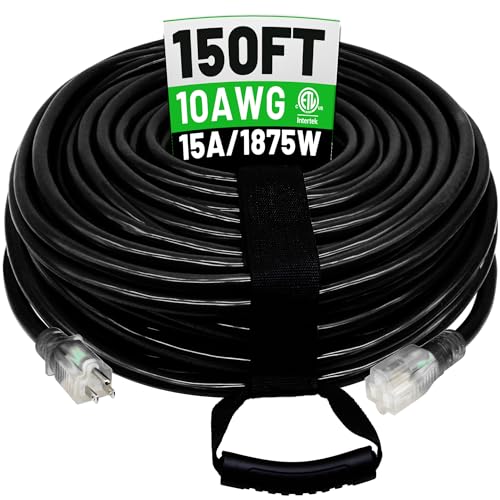
At 150 feet, 10-gauge wire is the right call, not an upgrade, a genuine necessity to keep voltage drop manageable at this distance per the length-and-gauge table above. Waterproof construction suits outdoor and job-site use where the cord will realistically get rained on or dragged through wet grass.
Why customers choose this: few competitors offer a genuinely 10-gauge cord at 150 feet, most stop at 100 feet or step down to a lighter gauge to keep the product cheaper.
Pros: 10-gauge wire is properly sized for a 150-foot run, not undersized the way a 12-gauge cord would be at this length; waterproof for real outdoor use.
Cons: Heavy and bulky at 150 feet of 10-gauge cable, expect real weight to carry and coil; overkill if your actual runs are under 100 feet.
Best for: large properties or job sites where you genuinely need 150 feet of reach and don’t want to sacrifice power delivery to get there.
5. HUANCHAIN 12 Gauge Heavy Duty Extension Cord, 500 FT – Best Extreme-Length Specialty
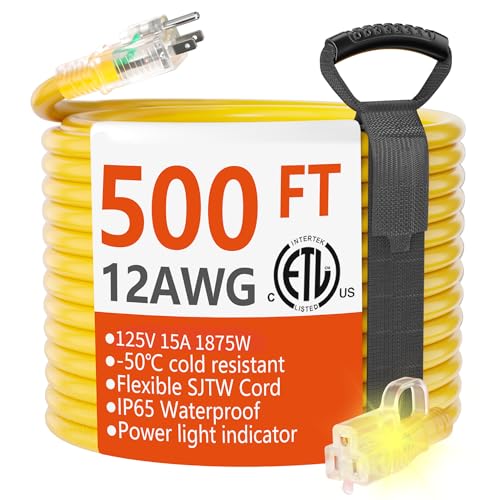
Worth being upfront about this one: at 500 feet, even 12-gauge wire has meaningful voltage drop, this is not a cord to run a table saw at full length. It’s a genuinely useful specialty product for a specific job: reaching a remote shed, powering string lights across a large property, or running low-draw equipment where distance matters more than amperage.
Why customers choose this: there’s very little competition at this length, if you genuinely need 500 feet of reach, options are limited, and this is one of the few that exists.
Pros: Covers distances no other cord in this guide comes close to; still 12-gauge rather than a thinner wire, which helps but doesn’t eliminate voltage drop at this length.
Cons: Real voltage drop at full length means it’s not suited to high-amp tools run at the far end; extremely heavy and bulky to store and transport.
Best for: low-draw applications over extreme distances, remote sheds, string lighting, or similar, not high-amp power tools run at the cord’s full length.
6. 100ft Outdoor/Indoor Extension Cord, 10/3 Gauge Ultra Heavy Duty SJTW – Best Budget 100ft High-Amp
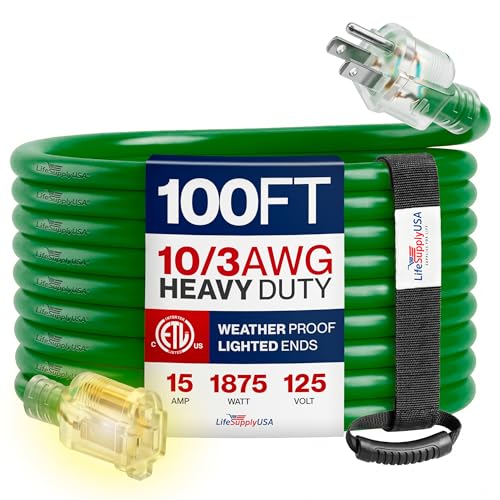
A genuine 10-gauge cord at 100 feet, the gauge the length-matching table above recommends for high-amp equipment at this distance, at a more accessible price than some name-brand alternatives. Indoor/outdoor rated SJTW jacket covers both use cases without needing a separate cord for each.
Why customers choose this: the 10-gauge rating at 100 feet without paying a major brand premium for it.
Pros: Properly sized 10-gauge wire for a 100-foot run with high-amp equipment; works both indoors and outdoors; competitive price for the gauge.
Cons: Less brand recognition than DEWALT or Craftsman, worth checking current buyer feedback; thicker 10-gauge cable is less flexible and heavier to coil than a 12-gauge cord.
Best for: buyers who want genuine 10-gauge capacity at 100 feet without paying for a major tool-brand name on the cord itself.
7. GEARit 100 ft Outdoor Extension Cord, 10/3 Gauge SJEOW – Best Oil-Resistant Jacket
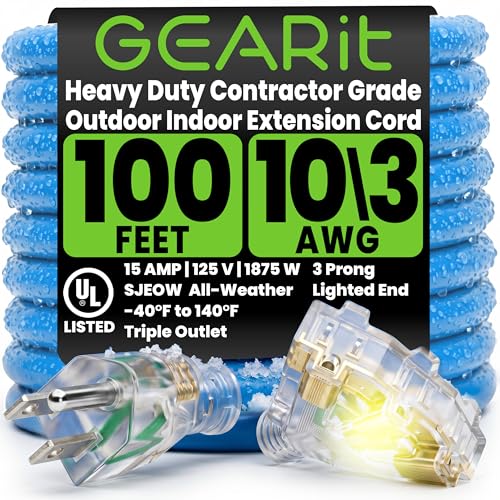
The SJEOW jacket rating adds genuine oil resistance on top of the standard weather resistance most outdoor cords carry, worth prioritizing if this cord will realistically end up near a generator, compressor, or any equipment that leaks oil or fuel on a job site.
Why customers choose this: the oil-resistant jacket is a real, checkable differentiator over the plain SJTW cords elsewhere in this guide, not just marketing language.
Pros: Oil-resistant SJEOW jacket suited to job sites with generators or equipment that leaks fluids; genuine 10-gauge wire at 100 feet.
Cons: No unique convenience features (no lighted end, no reel), a no-frills cord; heavier gauge means less flexibility for tight coiling.
Best for: job sites and generator setups where the cord is likely to contact oil, fuel, or grease, and standard weather resistance alone isn’t enough.
8. 150 Ft 10AWG Outdoor Extension Cord – Best Alternate 150ft Listing

Worth noting upfront: this shares the same core spec, 150 feet, 10AWG, outdoor-rated, as the waterproof 150-foot cord earlier in this guide, and may come from the same manufacturing source under a different listing. It’s included here as a genuine alternative in case stock, price, or shipping timing favors one listing over the other, not as a functionally distinct product.
Why customers choose this: pricing or availability sometimes favors this listing over the other 150-foot option, worth comparing both before ordering.
Pros: Same properly-sized 10-gauge wire for a 150-foot run as the other listing; gives you a second option to compare current pricing.
Cons: Functionally near-identical to the other 150-foot listing in this guide, genuinely confusing to choose between without comparing current price and reviews directly.
Best for: buyers comparing 150-foot 10AWG options directly to find whichever listing has better current pricing or availability.
9. CCCEI 12 Gauge Long Extension Cord, Individual Switches, 50FT – Best Individual Switch Control
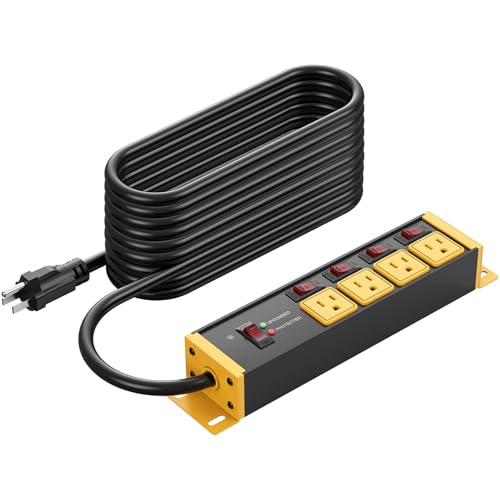
The standout feature here is individual switches at each outlet, letting you power tools on and off independently without unplugging anything, genuinely useful when running multiple tools from one cord and you don’t want to hunt for the right plug every time you need one off. High-visibility yellow jacket is a practical safety touch on a job site.
Why customers choose this: the individual switch control is a real, functional feature most extension cords in this category don’t offer at all.
Pros: Individual outlet switches let you control tools independently without unplugging; high-visibility yellow jacket reduces trip hazard risk on a job site; 12-gauge wire handles most tools at 50 feet.
Cons: 50-foot length limits reach on larger properties; the switch mechanisms are additional moving parts that could wear with heavy daily use.
Best for: multi-tool setups where switching individual outlets on and off without unplugging saves real time and hassle.
10. 100 FT Outdoor Extension Cord, 16/3 Gauge, 10A/1250W – Light-Duty Exception, Not True Heavy-Duty
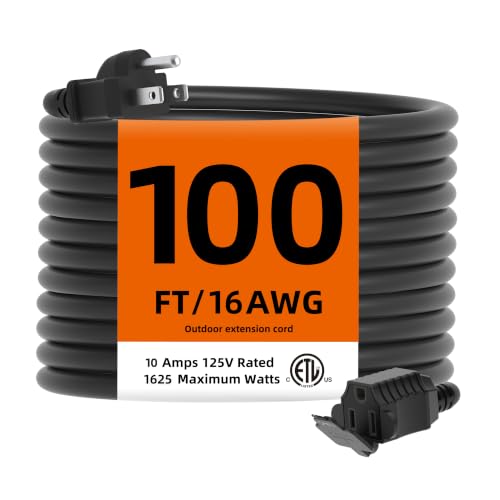
Being direct about this one: 16-gauge wire is light-duty by every electrical standard, regardless of how it’s marketed. At 10A/1250W, it’s suited to lawn and garden equipment, string lights, and small low-draw devices, not power tools, table saws, or anything with a real motor load, especially not at 100 feet where a 16-gauge cord has meaningful voltage drop even for the loads it is rated for.
Why customers choose this: genuinely lightweight and easy to handle for its length, if your actual use case is lawn and garden equipment rather than power tools, the lighter cable is a real advantage to carry and coil.
Pros: Lighter and more flexible to handle than a 10 or 12-gauge cord at the same length; adequate for its actual intended use, lawn and garden equipment and low-draw devices.
Cons: Not suitable for power tools despite appearing in extension cord searches alongside genuinely heavy-duty options; 16-gauge at 100 feet has real voltage drop even for the light loads it’s rated for.
Best for: lawn and garden equipment, string lights, and small low-draw devices only, not power tools or anything with a real motor.
11. 50ft Outdoor/Indoor Extension Cord, 10/3 Gauge Ultra Heavy Duty SJTW – Best Overkill Short Run
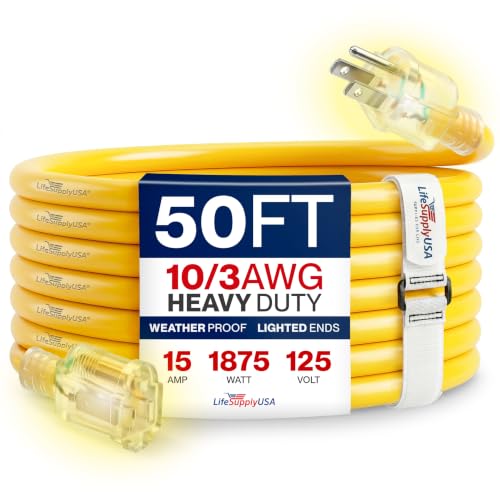
10-gauge wire at just 50 feet is more capacity than most tools need at this distance, but it’s a deliberate choice for anyone running genuinely high-draw equipment (welders, large compressors) over a shorter run and wants maximum headroom rather than cutting it close with 12-gauge.
Why customers choose this: buyers who’ve had a 12-gauge cord underperform in the past and don’t want to repeat the experience, even at a shorter length.
Pros: Maximum headroom for high-draw equipment even at a short 50-foot run; indoor/outdoor SJTW rating covers both use cases.
Cons: Genuinely more cord than most 50-foot use cases need, heavier and less flexible to coil than a 12-gauge cord would be at this length.
Best for: high-draw equipment (welders, large compressors) run at shorter distances, where you want maximum capacity headroom rather than cutting it close.
12. 50 ft 12/3 Outdoor Extension Cord, Waterproof, Lighted Indicator End – Best Standard 50ft

A solid, no-surprises 12-gauge cord at the length most driveway and garage tasks actually call for, with a lighted end for the same at-a-glance power confirmation as the DEWALT pick above. Waterproof construction handles routine outdoor exposure.
Why customers choose this: it covers the most common length and gauge combination for general power tool use without paying for capacity most buyers at 50 feet don’t need.
Pros: 12-gauge is properly matched to 50 feet for most power tools; lighted end confirms power at a glance; waterproof for routine outdoor use.
Cons: Not the choice for genuinely high-amp equipment even at this shorter length, step up to 10-gauge for welders or large compressors.
Best for: general driveway, garage, and yard power tool use at 50 feet, the most common length and gauge combination for typical homeowner needs.
13. HUANCHAIN 12 Gauge Heavy Duty Outdoor Extension Cord, 25 FT, Waterproof – Best Short Run

At 25 feet, even a 12-gauge cord has minimal voltage drop, so this is genuine headroom for close-range power tool use, patio, deck, or garage work where the outlet is nearby. Waterproof construction and a manageable length make it easy to store and less likely to become a tangled mess between uses.
Why customers choose this: the short length is a genuine advantage for close-range work, less cord to manage, coil, and trip over than reaching for a 50 or 100-foot cord out of habit.
Pros: 12-gauge at 25 feet delivers essentially full power with minimal voltage drop; easy to store and coil given the shorter length; waterproof for outdoor use.
Cons: Not enough reach for larger properties or jobs where the outlet is far from the work area.
Best for: close-range power tool use, patios, decks, and garages, where you don’t need extra length and want an easy cord to store and manage.
Common Mistakes
Daisy-chaining multiple cords instead of using one properly-sized cord. Each connection point adds resistance and a potential failure point. If you regularly need more length, invest in one heavy-gauge cord long enough for the job rather than linking two or three together.
Using an indoor-only cord outdoors. Indoor insulation degrades quickly under UV and moisture exposure, creating a hidden shock and fire hazard even if the amp rating looks fine on paper. Always confirm a “W” in the jacket code (SJTW, SJOW, etc.) for any outdoor use.
Ignoring the amp rating printed on the cord. The rating reflects both gauge and length together, don’t assume a cord is safe for a given tool just because it “looks heavy-duty.” Check your tool’s nameplate amperage against the cord’s actual rating.
Running cords under rugs or carpets. This traps heat that the cord can’t dissipate, a genuine, documented fire hazard, on top of creating a trip hazard and damaging the insulation from foot traffic.
Frequently Asked Questions
What gauge extension cord do I need for a table saw?
At up to 50 feet, 12-gauge is generally adequate. Past 50 feet, and especially at 100 feet or more, step up to 10-gauge to keep voltage drop within a safe range for a tool that draws real continuous amperage.
Is 12 gauge or 10 gauge better?
Neither is universally “better,” it depends on length and load. 12-gauge covers most power tools comfortably up to 50-100 feet. 10-gauge is the right call for high-amp equipment or any run over 100 feet. A thicker cord (lower gauge number) is never wrong to use, just bulkier and pricier than necessary if your actual load and distance don’t call for it.
Can I use two extension cords together?
You can, but it’s not ideal. Each connection point adds resistance and a place where the connection can loosen or get wet. If you regularly need more reach than one cord provides, a single properly-gauged longer cord is the safer, more reliable choice.
What does SJTW mean on an extension cord?
S (flexible junior-service cord), J (standard junior-service insulation thickness), T (thermoplastic/vinyl insulation), W (weather and water-resistant). Codes like SJEOW or SJTOW add an O for oil resistance, useful on job sites near generators or equipment that leaks fluids.
How long can an extension cord be before it’s unsafe?
There’s no fixed length limit, but voltage drop increases with every foot, so length has to be matched to gauge. A properly-sized 10-gauge cord can safely run 150 feet or more for moderate loads; the same length in 16-gauge wire would be unsafe for anything beyond the lightest devices.
Bottom Line
Match gauge to both your tool’s amp draw and your actual cord length before comparing anything else, that single decision matters more than brand or price.
- Best retractable reel: Flexzilla Retractable Reel – oil-resistant SJTOW jacket at a practical 60-foot length.
- Best multi-outlet reel: CRAFTSMAN Contractor Reel – genuine 12-gauge with 4 outlets and overload protection.
- Best overall 100ft: DEWALT Lighted 12/3 – reliable brand, lighted end for at-a-glance power confirmation.
- Best long-run high-amp: 150ft 10AWG Waterproof – properly sized for genuine 150-foot reach.
- Best extreme-length specialty: HUANCHAIN 500ft – for low-draw needs over distances nothing else in this guide covers.
- Best budget 100ft high-amp: 100ft 10/3 Ultra Heavy Duty – genuine 10-gauge without the brand premium.
- Best oil-resistant jacket: GEARit 100ft SJEOW – built for job sites near generators and fluids.
- Best individual switch control: CCCEI Individual Switches – control tools independently without unplugging.
- Best overkill short run: 50ft 10/3 Ultra Heavy Duty – maximum headroom for welders and large compressors.
- Best standard 50ft: 50ft 12/3 Lighted – the most common length and gauge combination done right.
- Best short run: HUANCHAIN 25ft – minimal voltage drop for close-range work.
Whichever cord fits your setup, don’t daisy-chain multiple cords, don’t use an indoor cord outside, and check the amp rating against your actual tool before assuming “heavy-duty” on the label means it’s right for the job. If you’re setting up a job site or garage from scratch, our guides to work lights and portable generators cover the rest of your power setup.
An undersized cord can make a corded angle grinder stall under load in a way that looks like a tool problem – see our guide on why an angle grinder keeps stopping under load to rule it out.


