“Tweezers” sounds like a commodity until the wrong pair costs you a component. Tip shape and ESD rating are the two specs that actually determine whether a pair works for your task or fries a circuit board, and most buying guides treat both as an afterthought. This guide breaks down 9 real industrial and precision tweezers, organized by what they’re actually built for.
Quick Comparison: Best Industrial Tweezers (2026)
| Product | Tip Style | ESD-Safe | Material | Best For |
|---|---|---|---|---|
| Knipex 92 69 84 | Blunt trapezoidal | No (non-conductive) | Glass-fiber plastic | Heat/Chemical Resistance |
| General Tools 401XX | Sharp point | No | Hardened stainless | Budget Sharp-Point |
| Knipex 92 78 77 | Round | Yes (~10^5 ohm) | Anti-magnetic stainless | ESD-Safe Precision |
| Wiha 44505 | Flat round | Yes (IEC 61340-5-1 certified) | Vommaloy stainless | Certified ESD-Safe |
| iFixit Precision Set | Pointed/angled/blunt (3-pc) | Yes (coated) | Stainless steel | Multi-Tip Set / Repair Techs |
| Knipex 92 34 37 | Angled pointed | No | Anti-magnetic steel | Alignment/Angled Access |
| General Tools 403 | Blunt serrated | No | Hardened stainless | Blunt/Serrated Grip |
| TOWOT 5-Pack | Mixed (5-pc) | No | Non-magnetic stainless | Budget Multi-Pack |
| HOZAN PP-100 | Straight fine | No | SUS420J2 stainless | Heavy-Duty / Most Rigid |
Tip Shape – Match It to the Job
- Pointed: reaches into small, hard-to-reach areas for precise pick-up. The go-to for individual SMD components.
- Curved/angled: better control at an angle, useful on high-density boards where a straight tip would crowd the work area or a soldering iron.
- Flat: larger gripping surface, ideal for bigger objects where you don’t need needle precision.
- Blunt: reduces the risk of damaging or scratching delicate parts, at the cost of some precision.
- Round: general-purpose, a reasonable default when you’re not sure which specialty tip you need.
- Serrated: adds grip texture to any of the above, useful when the object itself is smooth and prone to slipping.
ESD Safety – What It Actually Means
A person walking across a vinyl floor can generate static electricity up to 35,000 volts. Sensitive components like resistors, capacitors, and semiconductors can fail at under 10 volts. ESD-safe tweezers are made from or coated with a static-dissipative material that limits the peak current at which a discharge occurs, protecting the component from a spark you might not even feel. This matters when you’re handling semiconductors, PCBs, or any static-sensitive device. It matters far less for general mechanical work, jewelry, or craft use, where a standard stainless or plastic tweezer works just fine. Worth knowing: not every tweezer marketed toward electronics is actually ESD-rated. The Knipex 92 69 84 plastic tweezers, for example, are non-magnetic and heat-resistant to 130°C, genuinely useful properties, but Knipex’s own spec sheet lists them as not ESD-tested, despite some third-party listings implying otherwise. Check the manufacturer’s spec sheet, not just the product title, if ESD safety is the deciding factor for you.
Material – Stainless, Plastic, and Everything Between
Stainless steel is the standard for durability and precision, and most stainless tweezers are non-magnetic, which matters when you’re working near sensitive magnetic components. Epoxy or dissipative-coated stainless adds ESD protection on top of stainless’s durability, typically rated for use up to around 120°C. Plastic (glass-fiber or carbon-reinforced) tweezers won’t scratch or mark delicate surfaces and resist acids and high heat, but sacrifice some rigidity and, unless specifically rated, aren’t necessarily ESD-safe.
The 9 Best Industrial Tweezers (2026)
1. Knipex 92 69 84 Plastic Tweezers – Best for Heat/Chemical Resistance
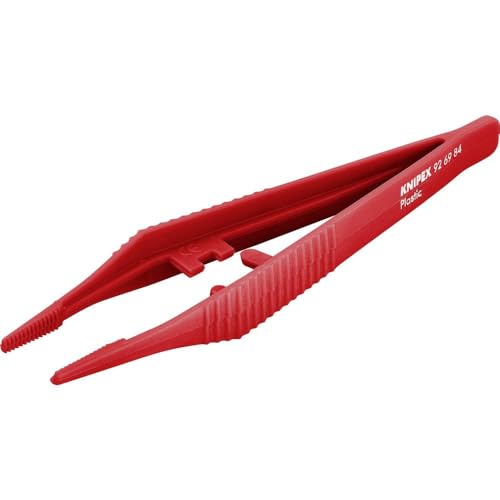
These solid glass-fiber-reinforced plastic tweezers are built for situations where metal tweezers are the wrong tool entirely: handling parts around acids, alkalis, or heat up to 130°C without the risk of scratching a surface or introducing a magnetic field. The blunt trapezoidal tips are 3.5mm wide with knurled gripping surfaces, giving a stable hold on small parts without marring them.
The honest caveat: despite being non-magnetic and heat-resistant, Knipex’s own spec sheet does not list these as ESD-tested. If static protection is your primary requirement, use the 92 78 77 or Wiha 44505 below instead.
Pros: Won’t scratch or mark delicate surfaces; heat-resistant to 130°C; 100% non-magnetic, safe around chemicals and magnetic-sensitive parts.
Cons: Not ESD-tested despite electronics-adjacent marketing; less rigid under firm grip pressure than a metal tweezer.
Best for: handling parts in chemical, high-temperature, or magnetic-sensitive environments where a non-marring, non-metal tweezer is the safer choice.
2. General Tools 401XX Strong Sharp Point Industrial Tweezers – Best Budget Sharp-Point
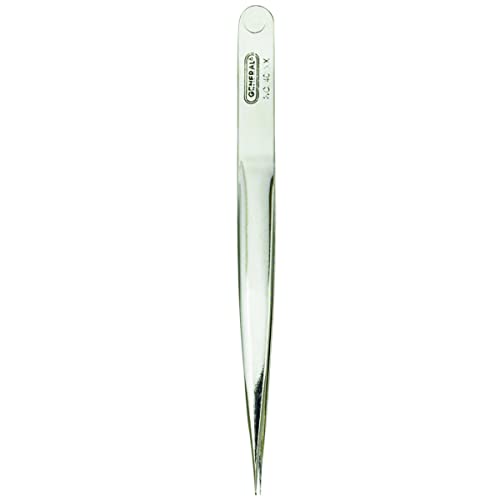
At under $10, the 401XX is the least expensive genuinely useful pair in this guide. Hardened stainless steel construction holds a sharp point well, and it’s a longstanding choice for jewelers, watchmakers, and electronics techs who need a reliable everyday pair without a big investment. Reviewers note General has trimmed some manufacturing polish over the years, but the core tool still performs for the price.
Pros: Under $10; hardened stainless steel holds a sharp point well; a longstanding, trusted design among jewelers and electronics techs.
Cons: No ESD rating; reviewers note manufacturing polish has slipped somewhat over the years compared to older production runs.
Best for: anyone who wants a dependable sharp-point pair as a first tweezer or a cheap backup, without ESD requirements.
3. KNIPEX 92 78 77 ESD Precision Tweezers – Best ESD-Safe Precision
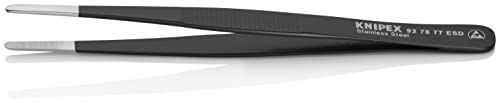
Unlike the plastic Knipex above, these are genuinely ESD-rated: chrome-nickel stainless steel with a non-reflective black ESD coating rated at approximately 10^5 ohm surface resistance. The round, 3.5mm tips and serrated gripping surface give a secure, comfortable hold on small components, and the anti-magnetic construction keeps them safe around sensitive parts.
Pros: Genuine ESD coating rated at approximately 10^5 ohm; fully anti-magnetic; serrated grip gives a secure hold on small components.
Cons: Priced at a premium versus generic ESD tweezers; round tip is less precise than a pointed tip for the finest pick-and-place work.
Best for: PCB work, component placement, and any task where genuine ESD protection is non-negotiable.
4. Wiha 44505 Flat Round Professional Quality ESD Tweezers – Best Certified ESD-Safe
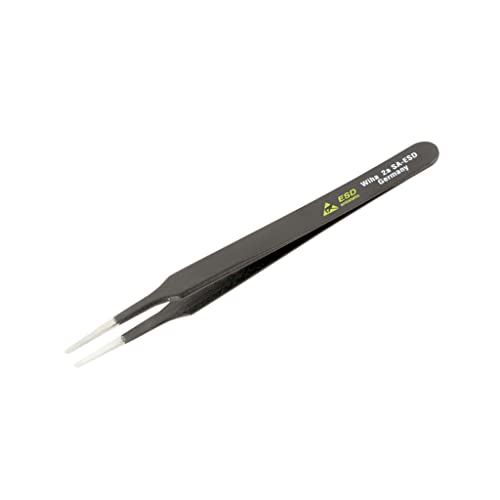
The standout detail here is a real, checkable certification: these meet the IEC 61340-5-1 ESD standard by name, rather than a vague “anti-static” claim. Made from Wiha’s proprietary Vommaloy stainless alloy, they’re anti-magnetic, acid-resistant, and hypoallergenic, with smooth-sided flat round tips and a textured grip.
Pros: Documented IEC 61340-5-1 ESD certification rather than a vague claim; anti-magnetic and acid-resistant; hypoallergenic Vommaloy alloy.
Cons: Priced at a premium for that certification; flat round tip isn’t the best choice for the very finest pick-up work.
Best for: buyers who want a documented, standards-tested ESD rating rather than a manufacturer’s unverified claim.
5. iFixit Precision Tweezers Set – Best Multi-Tip Set / Best for Repair Techs

Rather than committing to one tip shape, this set covers the three you’ll reach for most often: extra-fine pointed for ultimate precision, angled for ergonomic reach, and blunt for heavier handling without damaging parts. All three carry an ESD-protective coating, come with a fabric storage sleeve, and are backed by iFixit’s lifetime warranty, a genuinely useful guarantee for tools that see daily bench use.
Pros: Three genuinely useful tip shapes (pointed, angled, blunt) in one set; ESD-protective coating on all three; iFixit’s lifetime warranty; includes a storage sleeve.
Cons: Costs more upfront than a single pair; none of the three tips is as specialized as a dedicated single-purpose premium pair.
Best for: repair technicians and hobbyists who don’t want to buy tip shapes individually and value having lifetime warranty coverage.
6. Knipex 92 34 37 Precision Tweezers with Centering Pin – Best for Alignment/Angled Access
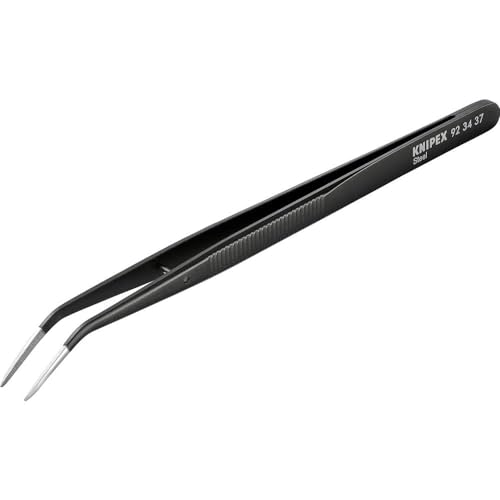
The 25-degree angled, pointed tips make this pair genuinely useful in tight or hard-to-reach spots where a straight tweezer would force an awkward hand angle. Fully anti-magnetic and finished in a non-reflective black lacquer, with fine transverse serration on the gripping surface for secure hold on small parts.
Pros: 25-degree angled tips genuinely solve access problems a straight tweezer can’t; fully anti-magnetic; non-reflective black finish reduces glare under a bench light.
Cons: Not ESD-rated; the angled design is less versatile for straight-on work than a standard pointed pair.
Best for: assembly or repair work where the component you need is tucked behind or beside something else, and a straight tweezer can’t get a clean angle on it.
7. General Tools 403 Blunt Serrated Point Industrial Tweezers – Best Blunt/Serrated Grip
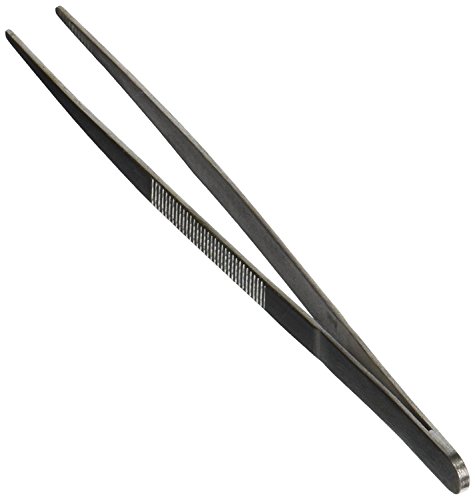
The blunt serrated tip trades ultimate precision for a more forgiving, secure grip, useful when you’re worried about a sharp tip damaging or slipping off a delicate component. Hardened, rust-resistant stainless steel construction at a budget price point, matching its sibling the 401XX above.
Pros: Forgiving blunt serrated grip reduces the risk of damaging delicate parts; hardened, rust-resistant stainless steel; budget-friendly.
Cons: No ESD rating; less precision than a pointed tip for genuinely fine work.
Best for: handling slightly larger or more delicate components where a sharp point risks damage, and you want a firm grip over a needle-fine tip.
8. TOWOT 5 PCS Precision Tweezers Set – Best Budget Multi-Pack

Five different tip styles at a price that undercuts buying a single premium pair, non-magnetic, heat-resistant stainless steel, hand-sharpened, and reasonably well reviewed for the price tier. Not the pair to reach for on ESD-critical work, but a genuinely useful set for general craft, soldering, jewelry, and hobby tasks where you want tip variety without a big investment.
Pros: Five tip styles at a price that undercuts a single premium pair; non-magnetic, heat-resistant stainless steel; hand-sharpened tips.
Cons: Not built for ESD-critical work; individual tweezer quality won’t match a dedicated premium pair.
Best for: hobbyists and general shop use who want several tip shapes on hand without buying premium tweezers one at a time.
9. HOZAN Thick Type Tweezers PP-100 – Best Heavy-Duty / Most Rigid
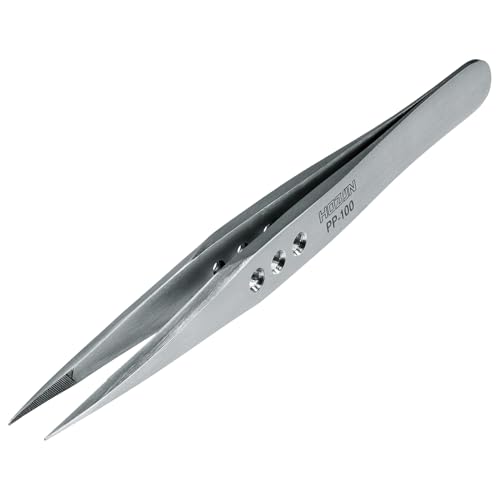
What sets the PP-100 apart is its 2.8mm sheet thickness, meaningfully thicker than the sheet metal used in most tweezers, which means it holds its shape and grip pressure under firm handling instead of flexing. Made from SUS420J2 stainless steel and manufactured in Japan, it’s built for fine mechanical work and delicate assembly where a flimsier tweezer would bend or lose precision over repeated use.
Pros: 2.8mm sheet thickness resists flexing under firm grip pressure; genuinely rigid construction; made in Japan from SUS420J2 stainless.
Cons: Premium price for a single pair; not ESD-rated.
Best for: anyone who’s had a lighter tweezer bend or lose its edge under regular use and wants a genuinely rigid, heavy-duty alternative.
Frequently Asked Questions
What’s the difference between ESD-safe and anti-static?
“Anti-static” is often used loosely and isn’t a regulated term. “ESD-safe” ideally refers to a tool tested against a real standard, like the IEC 61340-5-1 certification the Wiha 44505 carries, which specifies a controlled surface resistance range. When ESD protection genuinely matters, look for a named standard rather than just the words “anti-static” on the packaging.
Do I need ceramic tweezers?
Ceramic tweezers are non-conductive and heat-resistant, useful for very specific tasks like handling coils during firing or work involving intense heat where even plastic would degrade. For general electronics or precision work, a quality stainless or ESD-coated tweezer covers most needs without the added cost and fragility of ceramic.
Are magnetic tweezers a problem?
Yes, for most precision electronics and jewelry work. A magnetic tweezer can attract small ferrous parts unpredictably or interfere with magnetically sensitive components. Most quality stainless steel tweezers, including every stainless option in this guide, are explicitly non-magnetic for this reason.
How do I know which tip shape I need?
Match the shape to the access and precision the task demands: pointed for fine, hard-to-reach work, curved or angled for high-density areas or awkward angles, flat for larger objects, and blunt or serrated when grip security matters more than needle precision. If you’re not sure and do varied work, a multi-tip set like the iFixit or TOWOT options above removes the guesswork.
Bottom Line
The right industrial tweezers come down to two questions: does this task need genuine ESD protection, and what tip shape actually fits the access and precision you need.
- Best for heat/chemical resistance: Knipex 92 69 84 – non-marring plastic construction where metal is the wrong choice.
- Best budget sharp-point: General Tools 401XX – a genuinely useful sharp-point pair for under $10.
- Best ESD-safe precision: KNIPEX 92 78 77 – a real ESD coating with round, comfortable tips.
- Best certified ESD-safe: Wiha 44505 – documented IEC 61340-5-1 certification, not just a marketing claim.
- Best multi-tip set: iFixit Precision Set – three tip shapes, lifetime warranty, built for repair benches.
- Best for alignment/angled access: Knipex 92 34 37 – 25-degree angled tips for tight, hard-to-reach spots.
- Best blunt/serrated grip: General Tools 403 – a forgiving grip for delicate components.
- Best budget multi-pack: TOWOT 5-Pack – five tip styles for general hobby and shop use.
- Best heavy-duty: HOZAN PP-100 – a rigid, thick-gauge pair that won’t flex under firm handling.
If you’re stocking a full electronics bench, our guides to wire strippers and soldering iron kits cover the other two tools you’ll want alongside a good pair of tweezers.