A messy workshop usually doesn’t need more floor space, it needs better use of wall space. But once you decide to move your tools off the bench and onto the wall, you run into the same choice: quick and cheap pegboard, or a modular French cleat wall that can grow with the shop. Both make tools visible and accessible, but they solve different problems, and the right choice depends on tool weight, how often you rearrange, budget, wall type, and how comfortable you are with basic woodworking. Most serious workshops eventually land on a hybrid setup rather than choosing only one system.
Choose a French cleat wall if you need to store heavy tools, custom holders, chargers, cabinets, or bulky workshop gear. Choose pegboard if you want the fastest, cheapest way to organize lightweight hand tools, small accessories, and frequently used items. French cleats take more time to build but offer greater strength and customizability; pegboard is simpler to install but is best kept for lighter loads.
Quick Comparison
| Feature | French Cleat Wall | Pegboard |
|---|---|---|
| Best for | Heavy tools, power tools, cabinets, custom holders, jigs | Lightweight hand tools, measuring tools, small accessories |
| Strength | High when properly built and fastened into studs | Low to medium, depends heavily on board type and mounting |
| Installation difficulty | Medium | Easy |
| Typical setup time | Several hours to a full weekend for a custom wall | Often 1-3 hours for a basic wall |
| Upfront material cost | Moderate | Low for basic hardboard; higher for metal systems |
| Accessory cost | Low if you build holders from scrap wood | Can rise over time with specialty hooks and bins |
| Customization | Very high | Moderate |
| Rearranging tools | Fast once holders are built | Fast for hooks; limited by hole spacing |
| Best for renters | Usually less ideal, requires substantial mounting | Better for a small removable panel |
| Best for heavy tools | Excellent when correctly mounted | Usually not ideal |
| Appearance | Workshop / custom-built look | Clean, familiar, more finished with a metal system |
No universal weight limit applies to either system. Load capacity depends on the board, material thickness, wall structure, fasteners, holder design, and where the studs actually are. Treat any “X pounds per hook” number as specific to that exact product, not a general rule.
What Is a French Cleat Wall?

A French cleat system uses two matching beveled pieces, usually cut around 45 degrees. One cleat attaches to the wall with the bevel facing upward and outward. A matching cleat on the back of a tool holder, shelf, cabinet, or rack hooks over it, gravity locks the holder into place, and the holder can be lifted off and moved to another cleat whenever you want.
Key Benefits
A well-built cleat wall creates a strong load path when the cleats are properly attached into studs, and it’s genuinely easy to build holders for awkward-shaped tools. Holders can be moved without drilling a new hole every time, which makes French cleats great for battery charging stations, drill racks, clamp racks, hand-plane holders, sanding-disc organizers, shelves, and small cabinets. Most of the structure comes from plywood and scrap wood rather than proprietary hooks, and the system can evolve as your tool collection grows.
Honest Limitations
This requires accurate cuts and a reasonably flat mounting surface, a saw or access to pre-cut cleats, and more upfront planning than buying a pegboard panel and a bag of hooks. Every tool needs its own holder, shelf, rack, or mounting block, and the wall can look unfinished unless it’s painted, trimmed, or carefully built. Deep holders also project farther into a narrow garage than a flat pegboard panel does, and it can be genuine overkill for someone who only owns a few screwdrivers and a tape measure.
What Is Pegboard?

Pegboard is a perforated panel, traditionally hardboard, with evenly spaced holes. Metal hooks, baskets, bins, and holders fit into the holes, and it’s mounted with a gap behind the board so the hooks can actually engage. Modern options include hardboard, metal, plastic, and branded metal-panel systems.
Key Benefits
Pegboard is quick and cheap to install, with a low entry cost for basic hardboard and hooks, and it gives excellent visibility for frequently used hand tools. Tool position can change without building a new holder, which makes it a great fit for screwdrivers, pliers, tape measures, utility knives, rulers, drill bits, small squares, scissors, light hammers, paintbrushes, and small hardware bins. It looks tidy in a beginner garage or utility room and is generally easier for renters if you use a modest panel rather than a full wall system.
Honest Limitations
Traditional hardboard can sag under too much load, and hooks can fall out if they’re not locked or if tools get pulled off roughly. Heavy tools can deform the board or pull fasteners out of the wall, hook selection can get more expensive than expected, and hole spacing limits exactly where you can place something. Dust collects in unused holes over time, some oddly shaped tools need multiple hooks or custom holders, and moving a tool around can leave an imperfect-looking layout behind.
French Cleat vs. Pegboard: The Key Differences
Strength and Heavy Tools
This is the comparison that matters most. A well-built French cleat wall can carry much heavier loads because the holder transfers weight across a long cleat and into securely mounted horizontal rails and studs. Pegboard strength varies massively by material and installation, standard thin hardboard should be treated as light-duty storage only. Metal pegboard and reinforced backer systems can hold more, but always follow the manufacturer’s actual load rating.
For heavy tools, don’t choose based on appearance. Choose based on the entire mounting system: wall structure, fasteners, panel thickness, rails, holder design, and manufacturer load rating.
Avoid hanging heavy power tools, large battery chargers, filled cabinets, shop vacuums, generators, or heavy extension-cord reels from ordinary pegboard hooks unless the exact system is rated and installed for that specific load. French cleats generally outperform basic pegboard here because the load is spread along a securely mounted cleat rather than concentrated on individual hooks and holes.
Cost
| Cost Factor | French Cleat Wall | Pegboard |
|---|---|---|
| Base materials | Plywood, screws, finish materials | Panel, spacers/furring strips, screws |
| Tools required | Saw, drill/driver, measuring tools, level | Drill/driver, level, basic cutting if needed |
| Accessories | Often DIY holders from scrap wood | Hooks, locking clips, baskets, bins, brackets |
| Long-term spend | Low if you build holders yourself | Can rise as specialty hooks and organizers add up |
Pegboard is usually cheaper to start. French cleats can be cheaper over time for a workshop owner who already has wood scraps and can build custom holders instead of continually buying accessories.
Installation Time and Skill
A basic pegboard installation is generally quicker: measure, locate studs, install furring strips or spacers, mount the panel, add hooks. A French cleat wall requires more steps: choose plywood, cut consistent bevels, sand, mount rails level and into studs, then build individual holders. Pegboard is better for someone who needs organization today; French cleats are better for someone willing to treat organization as an actual DIY project.
Flexibility and Rearranging
Pegboard is more granular for small tool placement, since hooks move hole by hole. French cleats are more powerful for moving entire holders, shelves, or modules at once. Pegboard lets you move a screwdriver hook in seconds; French cleats let you move an entire drill rack, charging shelf, or small cabinet just as fast.
Tool Visibility and Access
Pegboard makes small tools highly visible and is often better for a grab-it-and-put-it-back hand-tool wall, pliers, screwdrivers, measuring tape, a hex-key holder. French cleats can look cleaner but may hide tools inside racks or boxes, and they’re better for grouping tools by task, a drill station, a router-bit cabinet, battery chargers, a sanding station, a clamp rack.
Appearance
Pegboard looks familiar and finished, especially painted hardboard or powder-coated metal, and fits well in a home utility room or a garage that’s also used for other things. French cleats look workshop-built and can look genuinely premium if painted, edge-banded, or carefully arranged, a good fit for a working woodshop where the look is meant to feel purposeful, not polished.
Dust, Cleaning, and Maintenance
Pegboard holes collect dust in a workshop environment, while French cleat rails leave open horizontal gaps that are usually easier to vacuum or brush out. Both need occasional reorganization. Check pegboard hooks periodically for bending or loose engagement, and check French cleat holders for cracked wood, loose fasteners, and wear at the bevel.
Which Tools Belong on Each System?
| Tool or Item | French Cleat | Pegboard | Best Choice |
|---|---|---|---|
| Screwdrivers | Works | Excellent | Pegboard |
| Pliers | Works | Excellent | Pegboard |
| Tape measure | Works | Excellent | Pegboard |
| Combination squares | Works | Excellent | Pegboard |
| Drill bits | Excellent with a custom rack | Good with bins | Depends on collection size |
| Cordless drills | Excellent | Only with a rated heavy-duty system | French cleat |
| Batteries and chargers | Excellent | Limited | French cleat |
| Circular saw | Excellent with a custom cradle | Not recommended | French cleat |
| Angle grinder | Excellent with a cradle | Not recommended | French cleat |
| Clamps | Excellent with dedicated rack | Limited | French cleat |
| Hammers | Good with holder | Good with strong hook | Either |
| Wrenches | Good with rack | Excellent with holders | Pegboard |
| Sockets | Excellent with trays/rails | Good for small rails | Depends on collection |
| Extension cords | Good with reel holder | Good only if light and supported | French cleat for heavier cords |
| Small hardware bins | Excellent with cleated bins | Good with pegboard bins | Either |
| Small tool cabinet | Excellent | Not recommended | French cleat |
| Hand planes | Excellent | Not recommended on basic hooks | French cleat |
Best Choice by Workshop Type
Beginner Garage Workshop: Pegboard First
Lower entry cost, minimal tools required, fast organization, and it lets you learn which tools you actually use most before committing to a more custom system. Start with one well-mounted pegboard panel above the workbench, and only upgrade the wall behind larger power tools to French cleats once you know how you actually work in the space.
Serious DIY Workshop: Hybrid System
Pegboard keeps light hand tools visible; French cleats manage heavy, expensive, awkward, or evolving tool groups. The combination avoids overbuilding every storage solution. A sensible layout: pegboard above the main bench for screwdrivers, pliers, squares, and marking tools, French cleats on an adjacent wall for chargers, drills, circular saws, sanders, clamps, and shop-made jigs.
Woodworking Shop: French Cleat Wall
Woodworkers can build custom holders easily, tool collections evolve constantly, and clamps, jigs, planes, routers, sanding supplies, and charging stations all benefit from modular racks built from scrap plywood.
Home Mechanic: Pegboard for Hand Tools + French Cleats for Heavy Equipment
Pegboard for wrenches, pliers, screwdrivers, pick tools, funnels, brake tools, and measuring tools. French cleats for a cordless impact wrench rack, a battery charging station, heavy socket trays, and a large breaker bar holder. If you’re building out this exact setup, our guides on impact sockets vs. regular sockets and impact wrench troubleshooting cover the tool side of a home mechanic’s setup.
Renters: Small Pegboard Panel or Freestanding System
A large French cleat wall usually needs many secure mounting points and can mean more wall repairs when you move out. A small pegboard panel, rolling cart, freestanding rack, or workbench-mounted organizer is usually far easier to remove cleanly. Always check your lease terms and wall restrictions first.
Small Shed: Pegboard for Light Tools, French Cleats Only if Framing Is Sound
Don’t assume a shed wall can carry heavy tool storage. Verify you’re fastening into structural framing, not just thin cladding or paneling, before hanging anything heavy.
Can You Use French Cleats and Pegboard Together?
Yes, and in many workshops a hybrid wall is genuinely the most practical answer: pegboard for lightweight hand tools you want visible every day, French cleats for heavier tools, chargers, shelves, and custom storage modules.
| Wall Zone | Storage System | Tools |
|---|---|---|
| Directly above workbench | Pegboard | Screwdrivers, pliers, tape measures, squares, utility knives |
| Side wall near outlet | French cleats | Battery charger shelf, drill rack, impact wrench, spare batteries |
| Lower wall zone | French cleats | Clamps, sanders, circular saw, shop vac accessories |
| Narrow wall strip | Pegboard | Small bins, drill-bit index, hooks, light accessories |
| Near entry door | Pegboard or heavy-duty hooks | Safety glasses, hearing protection, gloves, dust masks |
How to Install Pegboard Correctly
- Measure the available wall space.
- Locate wall studs.
- Choose the panel type: traditional hardboard, metal pegboard, or a rated specialty system.
- Install furring strips or spacers so hooks have clearance behind the board.
- Screw through the board and backing into studs where possible.
- Keep fasteners spaced according to the panel maker’s instructions.
- Install hooks and locking clips if the system uses them.
- Start with lightweight tools first.
- Test each hook and panel section before trusting it with anything valuable.
- Keep heavy power tools off ordinary hardboard pegboard unless the manufacturer specifically rates the system for that load.
How to Build a Basic French Cleat Wall
- Decide where heavy tools and power outlets will be.
- Locate and mark wall studs.
- Use straight, stable plywood suitable for cleats.
- Cut matching bevel strips consistently.
- Sand sharp edges.
- Mount wall cleats level and securely into studs.
- Space cleats based on the holders you plan to make.
- Build a simple first holder: a drill rack, battery shelf, or small tool tray.
- Test the holder gradually with realistic load.
- Add labels or outlines so tools return to the right spot.
There’s no universal plywood thickness, cleat spacing, screw length, or load figure that applies to every wall, real capacity depends on your material, fasteners, stud engagement, holder design, and actual tool weight. When in doubt, build conservatively and test before trusting a holder with an expensive tool.
Tools and Materials Needed
For a Pegboard Installation
Stud finder, tape measure, pencil, level, drill/driver, drill bits, appropriate wall screws, furring strips or mounting spacers, the pegboard panel itself, hooks, and locking clips, bins, or shelves where needed. See our guide to the best cordless drills for home use if you need one for this project.
For a French Cleat Wall
Plywood, a circular saw with a guide (or a table saw or track saw), drill/driver, drill bits, a long level, stud finder, tape measure, clamps, appropriate structural screws for your wall framing, and sandpaper or a sander. See our guide to circular saw blades if you’re cutting your own cleats, and check how stud finders work before you start marking your wall.
Common Mistakes to Avoid
- Hanging heavy power tools from ordinary hardboard pegboard hooks.
- Mounting pegboard flat against the wall without clearance for hooks.
- Fastening only into drywall instead of structural framing where the load requires it.
- Ignoring manufacturer load limits for metal pegboard and specialty systems.
- Treating black, metal, or branded pegboard as automatically heavy-duty without checking its actual rating.
- Building a French cleat wall before deciding where outlets, lights, and tool zones should go.
- Cutting inconsistent French cleat angles.
- Mounting French cleats out of level.
- Using damaged, warped, or weak plywood for load-bearing cleats.
- Building deep French cleat holders that block walkways in a small garage.
- Buying dozens of pegboard accessories before testing a basic layout.
- Ignoring moisture and humidity in garages or sheds that can damage tools and wood-based panels.
Useful Products for Each Setup
1. Wall Control Metal Pegboard Organizer Kit – Best Metal Pegboard System
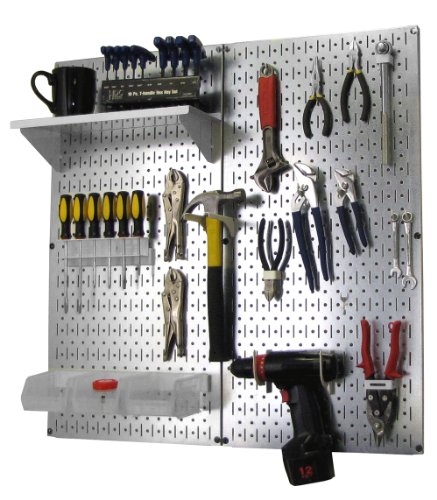
A patented slotted metal design that’s genuinely stronger than conventional hardboard pegboard, installs directly into studs or drywall with no furring strips needed, and includes mounting hardware and accessories in the kit.
Pros: Significantly stronger hook engagement than standard pegboard; installs without separate furring strips; American-made with included hardware.
Cons: Costs more than basic hardboard; still not a substitute for a French cleat wall on genuinely heavy tools.
2. Amazon Basics 48-Piece Metal Pegboard Kit – Best Budget Metal Pegboard

A genuinely lower-cost entry into metal pegboard, rust and scratch-resistant steel panels with mounting hardware, small storage bins, and hooks included, no framework required.
Pros: Meaningfully cheaper than premium metal systems; includes bins and hooks in the kit; easy no-framework installation.
Cons: Not as heavily reinforced as the premium Wall Control system above; better suited to light and medium loads.
3. Wooden French Cleat Garage Organization Kit – Best Pre-Made French Cleat System
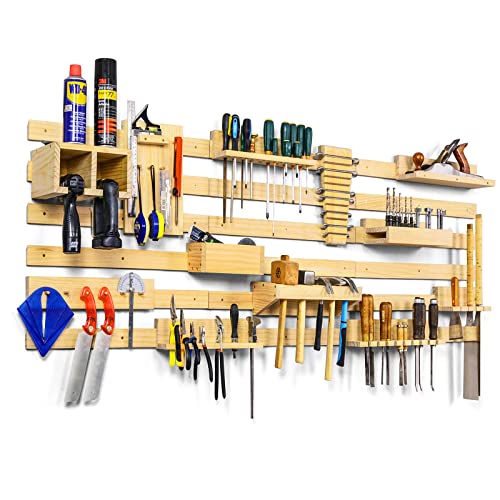
A genuine pre-built French cleat system for readers who want the modularity without cutting their own bevels, 18 wall cleats and 12 tool cleats in solid pine, with the same 45-degree design principle as a fully custom build.
Pros: Skips the cutting and measuring stage entirely; genuinely reconfigurable once mounted; suitable for drills, screwdrivers, hammers, pliers, and more.
Cons: Less customizable for oddly shaped or unusually heavy tools than a fully custom-built holder.
4. ROCKLER Hang-Tight 32-Piece Locking Pegboard Hooks – Best Locking Hook Set
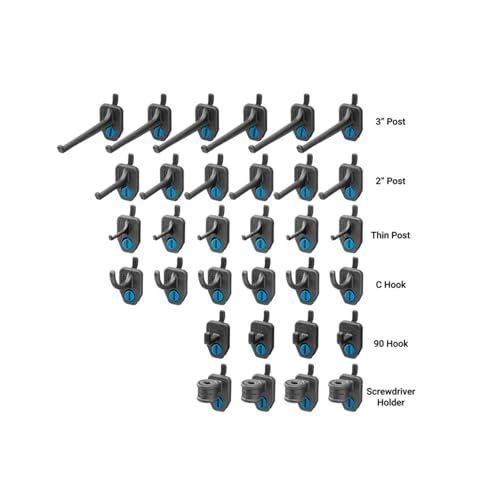
Solves pegboard’s most common complaint directly: hooks lifting out when you remove a tool. A rear notch and plastic screw lock each hook in place after you’ve test-fit its position, and the assortment covers straight hooks, C-hooks, thin post hooks, and screwdriver holders.
Pros: Genuinely locks in place, won’t lift out with the tool; works on both metal and hardboard pegboard; test-fit before locking makes layout planning easy.
Cons: Not compatible with every proprietary metal pegboard system, check compatibility with your specific panel first.
5. Zircon StudSensor e50 – Best Stud Finder for This Project

Finding studs correctly matters more for this project than almost any other home task, since your whole storage system’s real load capacity depends on hitting them. The e50 finds wood and metal stud edges and includes live-wire detection, a genuine safety feature before you start driving screws into an unknown wall.
Pros: Live wire detection adds a real safety margin; over-the-stud indicator prevents a common false-positive mistake; simple, well-established design.
Cons: Basic edge-finding only, no advanced center-finding or multi-material scanning found on pricier models.
6. CCCEI Modular Power Tool Organizer Wall Mount Charging Station – Best Battery Charging Shelf

Designed specifically to mount on a pegboard or wall, with 6 drill holders, an 8-outlet power strip on a 10-foot cord, and side storage for small accessories like bits and screwdrivers. This is exactly the kind of “battery station” the French cleat section above recommends building, pre-made.
Pros: Purpose-built for pegboard mounting; genuinely useful 8-outlet charging capacity; side bin keeps small accessories with the tools they belong to.
Cons: Each shelf tier has a real, modest weight limit, check it against your actual drill and battery count before loading it up.
7. Eva-Dry E-333 Wireless Mini Dehumidifier – Best Moisture Protection

Worth including because both systems in this guide use materials that moisture genuinely damages: hardboard pegboard can warp and swell, and plywood French cleats can weaken at the bevel if a garage or shed stays damp. This unit covers up to 333 cubic feet, needs no batteries or cords to run, and simply gets recharged in an outlet when the silica beads change color.
Pros: No ongoing battery or cord needed during normal use; genuinely protects wood-based storage systems, not just the tools on them; reusable for years.
Cons: Covers a modest 333 cubic feet, a larger garage may need more than one unit or a dedicated dehumidifier.
Frequently Asked Questions
Is a French cleat wall stronger than pegboard?
Usually, yes, when it’s built from suitable material and properly fastened into wall studs. A French cleat spreads the load along the cleat and suits custom holders, shelves, chargers, cabinets, and heavier tools well. Basic hardboard pegboard is better reserved for lightweight hand tools and accessories.
Can pegboard hold power tools?
It depends entirely on the specific pegboard system, mounting method, hook type, and manufacturer load rating. Standard hardboard pegboard is generally not a good choice for heavy power tools, chargers, or cabinets. Use a French cleat wall or a manufacturer-rated heavy-duty system for heavier loads instead.
Is pegboard cheaper than a French cleat wall?
Pegboard is generally cheaper and faster to start, since you can mount a panel and use ready-made hooks immediately. A French cleat wall costs more time and usually needs plywood and a saw, but workshop owners can often build custom holders from offcuts rather than continually buying accessories.
Are French cleats hard to build?
They’re a moderate DIY project. You need consistent angled cuts, level mounting, secure stud attachment, and tool holders that actually match the wall cleats. Pegboard is easier for a first-time organizer, French cleats are a better long-term project for anyone comfortable with basic woodworking.
Is pegboard or French cleat better for a small garage?
Pegboard is usually better for lightweight hand tools in a small garage since it’s thin and fast to install. French cleats are better for heavier power tools, chargers, and custom storage, but the holders can project farther from the wall. A hybrid system often uses the available space most effectively.
Can I use pegboard and French cleats on the same wall?
Yes. Put pegboard above the workbench for lightweight, frequently used hand tools, and use French cleats on an adjacent wall or lower zone for heavier tools, battery stations, shelves, and clamp racks.
Do French cleat walls damage drywall?
Any securely mounted storage system leaves holes when removed. French cleats normally require mounting into wall studs, so a full installation creates more attachment points than a small pegboard panel. Renters should check their lease terms before installing either system permanently.
What angle should a French cleat be?
Many DIY French cleat systems use matching 45-degree bevels. The exact build method, material, fasteners, spacing, and load capacity should suit your specific wall and intended load, follow a verified build plan rather than assuming one design fits every workshop.
Final Verdict
Choose pegboard if you want quick, low-cost storage for light hand tools and small accessories. Choose a French cleat wall if you need to hold heavier tools, chargers, shelves, clamps, or custom storage modules and want to rearrange them as your workshop changes. For most DIY workshops, the best answer is a hybrid: pegboard above the bench for frequently used hand tools, and French cleats for the heavier, bulkier, or more specialized gear.