The common answer to “does a bigger battery make my tool more powerful” is “no, Ah only affects runtime.” That’s half right. Under light use, it’s completely true. Under heavy load, real testing consistently shows it isn’t the whole story, a 5Ah battery genuinely delivers more usable power than a 2Ah battery in the same tool, not just longer life between charges. This works across any 20V/18V-class platform, DeWalt, Milwaukee, Makita, or otherwise, since the underlying battery physics is the same regardless of brand.
What Ah Actually Measures
Amp-hours measure capacity, how much energy the battery can store, not power or voltage. Think of it as fuel tank size rather than engine size. A 5.0Ah battery can theoretically deliver 5 amps for one hour, or 1 amp for five hours, the tank just holds more. Voltage, which is what actually determines a tool’s baseline power, stays identical across Ah ratings within the same battery line. A 2.0Ah and 5.0Ah pack in the same 20V MAX or 18V lineup are both built from cells wired to the same nominal voltage, they just contain different amounts of that voltage’s worth of capacity.

True at Light Loads, Not the Whole Story at Heavy Loads
Here’s the part most explanations skip. Under light to moderate loads, a small screw, a hole in soft wood, the tool draws only what it needs, and both a 2Ah and 5Ah battery supply that current equally well. In this range, Ah genuinely only affects how long you can work before recharging, exactly as the common wisdom claims.
Heavy loads change the picture. A 2.0Ah battery is typically built from a single row of battery cells wired in series to reach the pack’s nominal voltage. A 5.0Ah battery of the same voltage class uses two rows of cells connected in parallel, doubling the capacity while keeping voltage the same. That parallel arrangement matters under heavy current draw: with more cells sharing the load, the pack’s effective internal resistance drops, which means it can sustain a higher discharge current with less voltage sag. A single row of cells physically cannot deliver very high instantaneous current as efficiently as two parallel rows can, so under a genuinely demanding load, rotary hammers, circular saws, high-torque drilling, the smaller battery’s voltage sags more, and the tool’s output drops along with it.
The Real-World Numbers
This isn’t theoretical. Pro Tool Reviews ran a direct comparison using identical Makita 18V LXT 2.0Ah and 5.0Ah batteries in the same drill: the 5.0Ah battery delivered roughly a 25% power boost drilling through untreated 2×4 lumber, and about a 10% boost drilling through five layers of OSB panel, same tool, same bit, same operator, different battery. Separately, a test cutting a 10-inch log with a 12-inch cordless chainsaw found an 8.0Ah battery finished the cut in about 20 seconds versus roughly 23 seconds on a 4.0Ah pack. Under light use, you likely won’t notice a difference between capacities at all. Under real load, the gap shows up consistently across independent tests.
Weight and Size – The Real Trade-Off
More cells means more weight, and the difference is significant enough to matter in daily use. A compact 2.0Ah pack typically weighs close to a pound, while higher-capacity packs (5.0Ah and up) commonly weigh 2 to 3+ pounds depending on the specific line and cell technology. That difference is easy to dismiss on a bench but becomes very real during overhead work, extended one-handed use, or anything in a tight space, a jigsaw, an oscillating tool, or a compact drill used for an hour of ceiling work benefits far more from a lighter battery than from extra capacity it will rarely use at full draw.
Charge Time and Cost Per Ah
Higher-capacity batteries take longer to charge from empty, roughly proportional to the extra capacity, and they cost more, though not always in a strict straight-line ratio. It’s worth comparing current per-Ah pricing directly on whatever platform you’re using rather than assuming a fixed markup, some capacity tiers represent better relative value than others depending on current promotions and lineup positioning.
Match Capacity to the Tool, Not a Blanket Rule

For light, handheld tools, drivers, work lights, jigsaws, oscillating tools, a compact 2.0Ah battery is genuinely the right call. You won’t feel a power difference in this range, and the lighter weight is a real, daily comfort benefit, not a compromise.
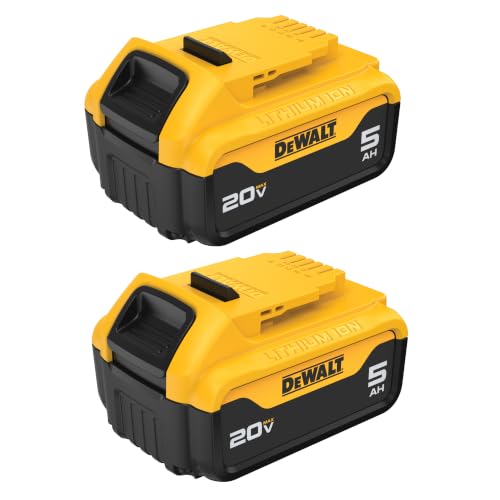
For heavy-draw tools, circular saws, rotary hammers, impact wrenches, or any task that pushes the tool hard for sustained periods, a 5.0Ah battery (or higher) earns its extra weight in genuine performance, not just runtime. If you’re regularly bogging down a tool or feeling it lose steam under load, stepping up in Ah is a legitimate fix, not just a convenience upgrade.
Frequently Asked Questions
Does a bigger battery make my drill more powerful?
Not for light work, driving small screws or drilling in soft material draws the same power regardless of battery capacity. For heavy work, sustained high-torque drilling, large bits, or dense material, a higher-Ah battery genuinely delivers more usable power due to lower internal resistance and less voltage sag under load, confirmed by independent testing showing real percentage gains.
Why does my saw bog down with a small battery but not a big one?
This is the heavy-load scenario directly. A smaller-capacity battery’s single row of cells can’t sustain the same instantaneous current as a larger battery’s parallel cell rows, so voltage sags more under the saw’s demanding draw, and the tool’s output drops along with it. Switching to a higher-Ah battery is a legitimate fix for this specific symptom.
Is it worth buying a 5Ah if I mostly do light work?
Probably not, based purely on performance, you won’t notice a power difference on light tasks. The case for a higher-Ah battery on light-duty work comes down to runtime alone, longer stretches between charges, weighed against the real cost of extra weight and price.
Does higher Ah affect tool compatibility?
No. Amp-hour rating has no bearing on whether a battery physically fits or electrically works in a given tool, that’s determined by voltage and connector, not capacity. Our DeWalt 20V battery compatibility chart covers what actually does and doesn’t determine fit.
Bottom Line
Under light use, Ah is purely a runtime number, buy based on weight and cost. Under heavy, sustained load, higher Ah genuinely delivers more real-world power thanks to lower internal resistance and reduced voltage sag, not just a longer runtime between charges. Match the battery to the tool: light and handheld work favors a compact 2Ah pack, heavy-draw tools earn real performance from stepping up to 5Ah or higher. If you’re still deciding which platform to build a battery collection around in the first place, our guide to DeWalt vs. Milwaukee vs. Makita battery platforms covers that bigger-picture decision.
For a real heavy-draw tool that benefits from a bigger pack, see our DeWalt DCF900B review.