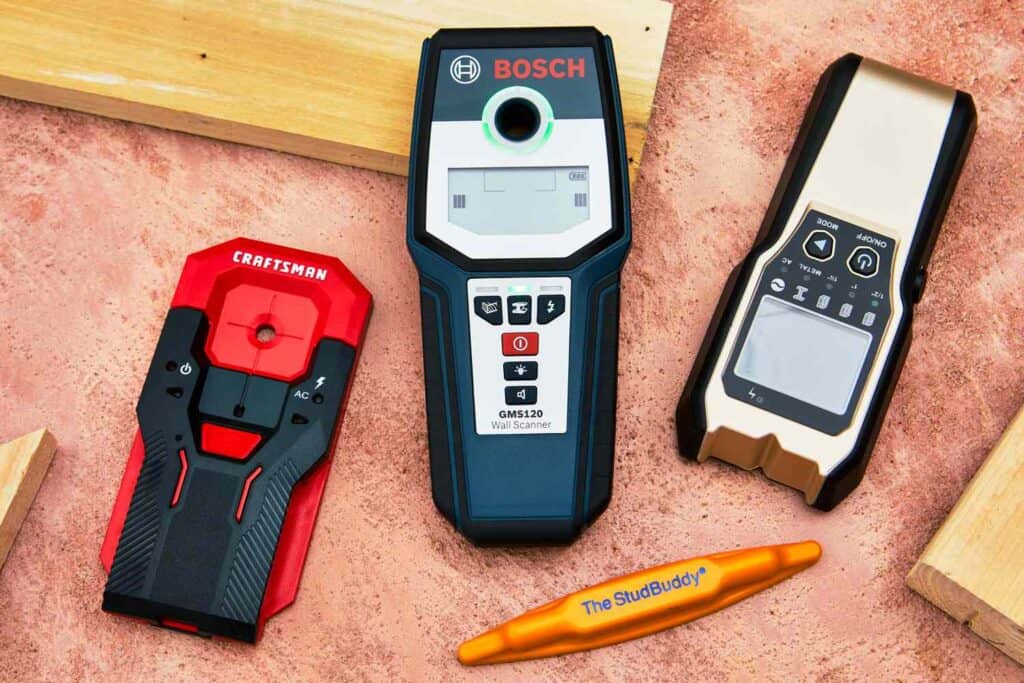
A 65-inch TV on two drywall anchors is a bet you do not want to lose. The best stud finder tells you where the wood is before you drill, and the good ones also warn you about the live wire next to it. The cheap ones find stud edges about half the time and leave you poking test holes.
This guide compares 12 stud finders, from a $10 magnet to a $119 deep-scan sensor that reads through plaster and tile. Every price and spec below was checked against the live Amazon listing on October 7, 2026. Where accuracy claims come from someone else’s testing, we link the source.
Quick answer: The Franklin ProSensor M210 is the best stud finder for most homes: 13 sensors show the whole stud at once, it needs no calibration, and it warns you about live wires. The Franklin M150 does almost the same for $20 less. For $10 and no batteries, the StudBuddy magnet finds the screws in your studs.
Which type do you need? The 10-second version.
- Magnetic ($10): finds the drywall screws in the stud. No batteries, never wrong about metal, but slow and blind to wires.
- Single-sensor electronic ($10 to $40): finds stud edges. Needs calibration and a slow, steady pass.
- Multi-sensor LED array ($40 to $120): a row of sensors shows the full stud width at once. No calibration. The easiest type to trust.
- Wall scanner ($90+): finds wood, metal, copper pipe and live wires. For renovations, not picture hanging.
Best Stud Finders: Quick Picks
| Stud Finder | Best For | Price (Oct 7) | Buy |
|---|---|---|---|
| Franklin ProSensor M210 | Best Overall | $59.97 | Check Price |
| Franklin ProSensor M150 | Best Value | $39.97 | Check Price |
| Franklin ProSensor MAX | Plaster, Tile, Double Drywall | $119 | Check Price |
| Zircon MultiScanner A200 | Best Classic Center-Finder | $39.99 | Check Price |
| Zircon StudSensor A100 | Budget With Wire Warning | $26.30 | Check Price |
| Bosch GMS120-27 | Best Wall Scanner | $89 | Check Price |
| Klein Tools ESF200 | Best for Electricians | $34.98 | Check Price |
| Klein Tools ESF150LL | Best With Laser | $63.99 | Check Price |
| Black+Decker BDL190S | Auto-Leveling Laser Combo | $99.99 | Check Price |
| DeWalt Stud Finder | Best Under $15 | $14.99 | Check Price |
| Craftsman CMHT77633 | Cheapest Electronic | $9.98 | Check Price |
| StudBuddy | Best Magnetic | $9.97 | Check Price |
Spec Comparison
All specs are from the Amazon listings on October 7, 2026. “No” means the listing does not claim the feature.
| Stud Finder | Type | Max Wood Depth | Live Wire Alert | Metal Mode | Calibration |
|---|---|---|---|---|---|
| Franklin M210 | 13-sensor array | 1.7 in | Yes | Finds metal studs | None needed |
| Franklin M150 | 9-sensor array | 1.5 in | Yes (AC warning) | Finds metal studs | None needed |
| Franklin MAX | 13 large sensors | 2.5 in | Not listed | Not listed | None needed |
| Zircon A200 | Electronic, edge + center | 1.5 in (DeepScan) | Yes | Yes | Hold to calibrate |
| Zircon A100 | Electronic, edge | 1.5 in (DeepScan) | Yes | No | Hold to calibrate |
| Bosch GMS120-27 | Wall scanner | Not listed | Yes | Yes, plus copper pipe | Not listed |
| Klein ESF200 | Electronic, LED width | 3/4 in (metal 1.5 in) | Yes (to 2 in) | Yes | Automatic |
| Klein ESF150LL | Electronic + cross-line laser | 1.5 in | Not listed | Finds metal studs | Auto deep scan |
| Black+Decker BDL190S | Stud sensor + line laser | Not listed | Yes | Finds metal studs | Not listed |
| DeWalt | Electronic, center-find | 3/4 in | Yes | Finds metal studs | Constant auto |
| Craftsman CMHT77633 | Electronic, edge | 3/4 in | No | Finds metal studs | Not listed |
| StudBuddy | Magnetic | Finds screw heads | No | Magnet only | None |
Best Multi-Sensor Stud Finders
A multi-sensor stud finder has a row of sensors under a row of LEDs. You set it on the wall, and the LEDs light up over the whole stud. No calibration, no sweeping back and forth to find both edges. This is the type we recommend for most homes.
1. Franklin Sensors ProSensor M210 – Best Overall
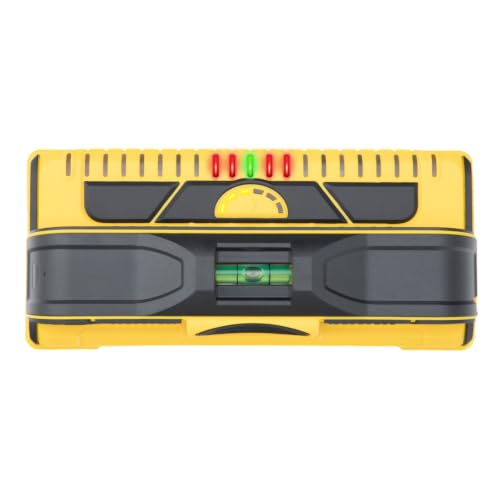
The M210 uses 13 sensors, which is why it shows the full width of a stud and even double studs around windows and doors. The middle LED turns green over the stud center, so you know where to drill. Franklin lists scan depth up to 1.7 inches for wood and metal studs.

It needs no calibration, so you can start scanning anywhere, even directly over a stud. That is the most common way single-sensor finders get confused. It adds live-wire detection, which matters when you are drilling near an outlet or switch. Outdoor Life named it their Best Overall. It was $59.97 on October 7. The Franklin ProSensor T13 ($56) is a close alternative with the same 13-sensor layout.
Skip this if: your walls are old plaster and lath. Look at the Franklin MAX or a magnet instead.
Pros: Shows full stud width; no calibration; live-wire warning; finds double studs.
Cons: Bigger than a pocket stud finder; $60 is a lot for occasional use.
2. Franklin Sensors ProSensor M150 – Best Value
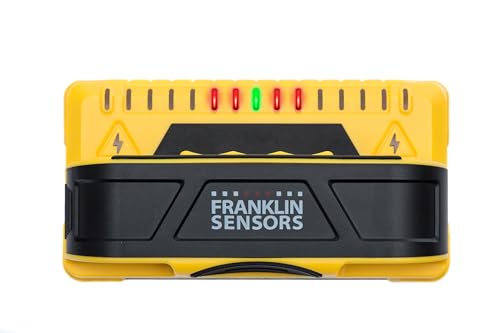
The M150 is the same idea with 9 sensors instead of 13, for $20 less. It still shows the full width of studs and double studs, and the middle LED turns green over the center. Franklin lists deep scan up to 1.5 inches, always on, for wood and metal studs.

It also has an AC wire warning and needs no calibration. At $39.97, it is the stud finder we put on our tool gifts for dad list, and the one we would buy for a typical drywall house.
Skip this if: you need to read through thick tile or double drywall. Its 1.5-inch depth is the limit.
Pros: Multi-sensor accuracy for $40; no calibration; AC warning.
Cons: Narrower scan window than the M210; less depth than the MAX.
3. Franklin Sensors ProSensor MAX – Best for Plaster, Tile and Double Drywall
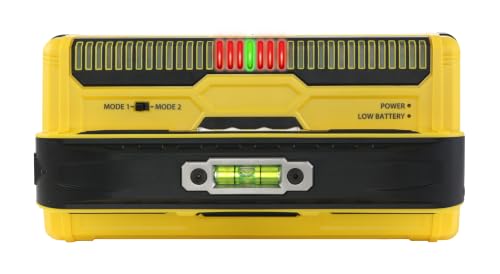
The MAX uses 13 larger sensors to reach 2.5 inches deep. Franklin says it scans through two or more layers of drywall, plaster, OSB, plywood, MDF and large tile. That is the problem list most stud finders cannot handle.
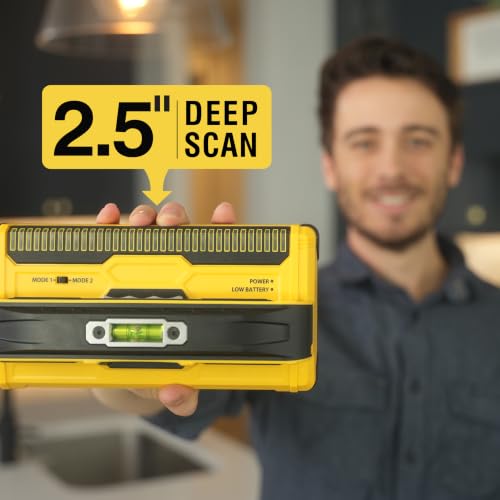
It keeps the full-width LED display and needs no calibration. At $119, it only makes sense if you have one of those wall types: an older house, a basement with doubled drywall, or a tiled bathroom where you are hanging a grab bar.
Skip this if: you have standard 1/2-inch drywall. The M150 does the job for a third of the price.
Pros: 2.5-inch depth; reads plaster, OSB and large tile; no calibration.
Cons: $119; live-wire detection not listed.
Best Traditional Electronic Stud Finders
These use one or two sensors and find stud edges or centers as you slide them. They are cheaper and smaller, but you have to calibrate on a hollow spot and move slowly.
4. Zircon MultiScanner A200 – Best Classic Center-Finder
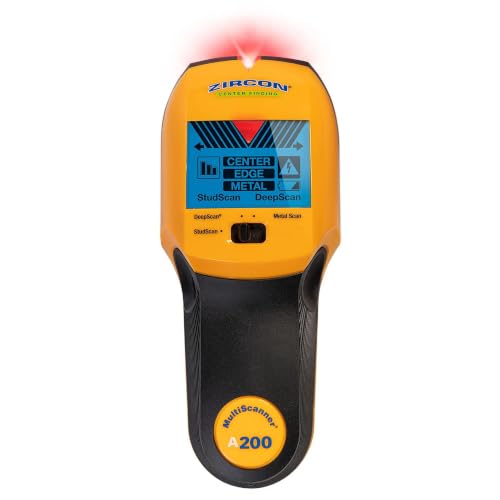
Zircon has made stud finders for decades, and the A200 is its all-rounder. It has three modes: StudScan finds wood or metal stud edges and centers up to 3/4 inch deep, DeepScan reaches 1-1/2 inches, and Metal Scan finds metal before you drill. WireWarning alerts you to live AC wires.
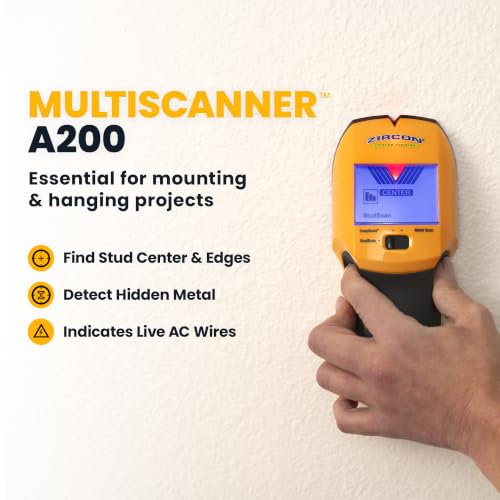
You calibrate by holding it flat and pressing the button until it beeps, then slide slowly. Bob Vila’s testers named it Best Overall and reported marks within 1/16 inch of 16 inches apart. It was $39.99 (20% off) on October 7.
Skip this if: you want to skip calibration. Start it over a stud and it reads wrong.
Pros: Edge and center finding; metal mode; WireWarning; strong third-party accuracy results.
Cons: Needs calibration on a hollow spot; slower than a multi-sensor finder.
5. Zircon StudSensor A100 – Best Budget With Wire Warning

The A100 is the A200 without the metal mode and center finding. It locates wood and metal stud edges to 3/4 inch, or 1-1/2 inches in DeepScan, with WireWarning for live wires. An LCD screen, an audio tone, a SpotLite pointer and a V-groove help you mark the spot.
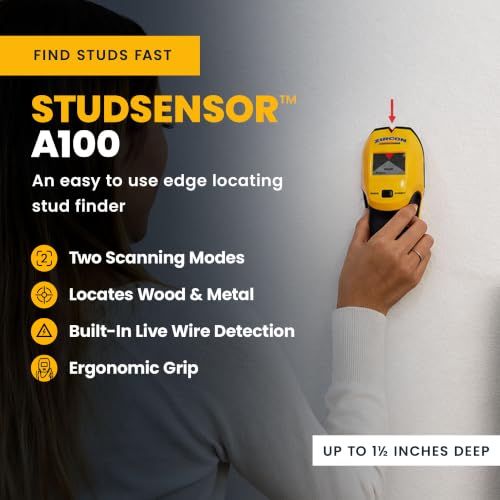
It was $26.30 (29% off) on October 7, the cheapest pick here with live-wire warning and deep scan together. You find one edge, then the other, and mark the middle yourself.
Skip this if: you want the center marked for you. The A100 finds edges.
Pros: Under $30; DeepScan; WireWarning; SpotLite pointer.
Cons: Edge-only; needs calibration.
6. Klein Tools ESF200 – Best for Electricians
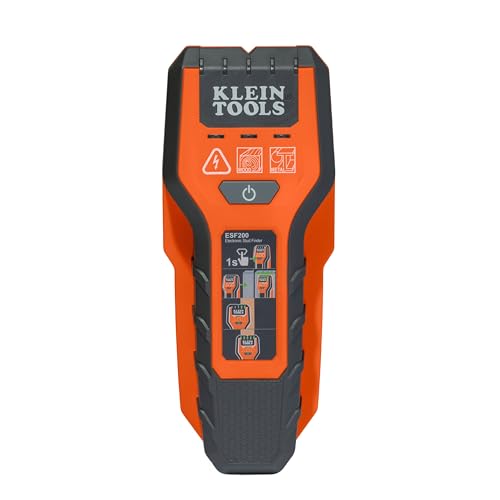
Klein’s ESF200 scans for wood, metal and live AC at the same time, so you never switch modes. It reads wood to 3/4 inch, ferrous metal to 1-1/2 inches and AC voltage up to 2 inches deep. LEDs show the full width and edges of the stud.
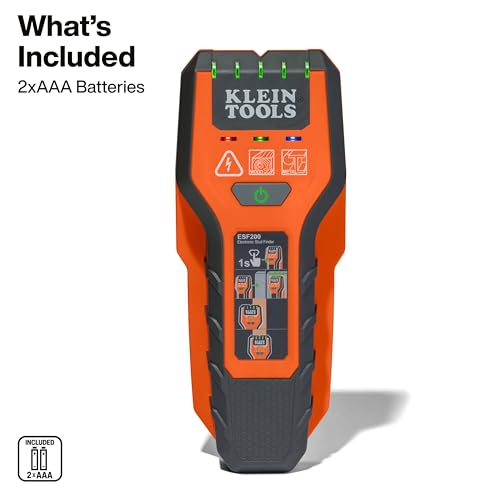
Calibration is automatic, and the backlit power button stays on without holding it down. At $34.98, it is a good fit for electricians cutting in old-work boxes. Pair it with a proper voltage tester before you cut.
Skip this if: you need more than 3/4-inch wood depth.
Pros: Wood, metal and AC at once; deep AC detection; automatic calibration.
Cons: Shallow wood depth.
7. DeWalt Stud Finder – Best Under $15
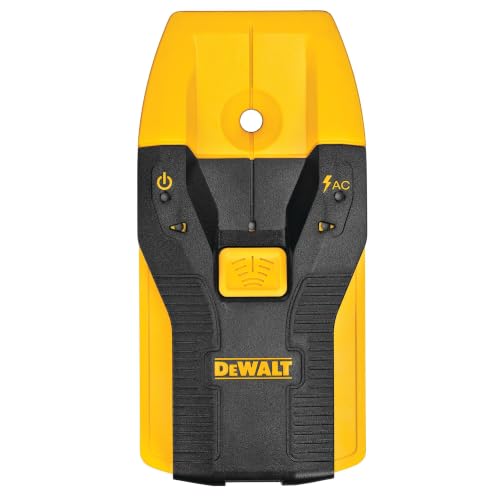
For $14.99, the DeWalt finds the center of wood and metal studs up to 3/4 inch deep, with AC live-wire detection and constant auto-calibration. LED arrows point you toward the stud, and a center channel lets you mark it.
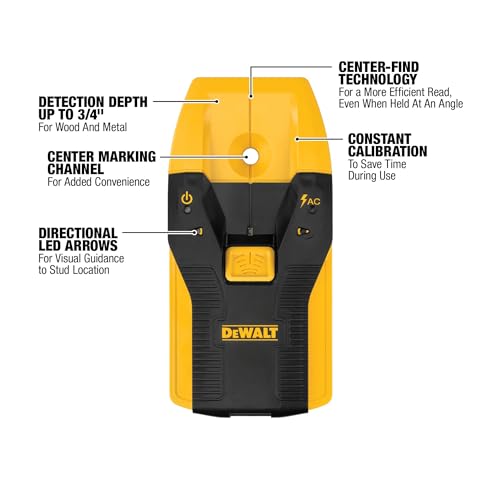
DeWalt is honest about the limits on the listing: it will not detect through concrete, brick, plaster, carpet, foil-faced materials, metal surfaces or ceramic tile, and it does not find plastic pipes. For standard drywall, it is a lot of tool for $15.
Skip this if: you have plaster walls or tile. The listing rules them out.
Pros: Center-find; live-wire detection; auto-calibration; $15.
Cons: 3/4-inch depth; no plaster or tile.
8. Craftsman CMHT77633 – Cheapest Electronic

The Craftsman is a basic edge finder for under $10. It locates wood and metal stud edges through 3/4 inch of drywall and, per the listing, works over wallpaper and fabric-covered walls. The body is shock and water resistant.

There is no live-wire warning and no deep mode. It is a stocking stuffer that beats knocking on the wall, and not much more.
Skip this if: you drill near outlets. No wire warning.
Pros: Under $10; works over wallpaper; tough body.
Cons: Edge-only; no wire detection; 3/4-inch depth.
Best Wall Scanner
9. Bosch GMS120-27 – Best Wall Scanner
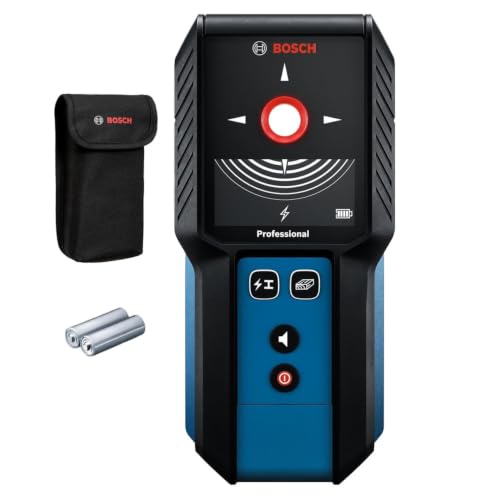
A wall scanner does more than find studs. The Bosch GMS120-27 locates wood studs, metal framing, copper pipes and live AC wiring, and finds the stud center. A color-coded ring turns green for safe and red for a live wire, next to a graphical display.

It has an IP54 dust and water-resistant body with a shock-absorbing rubber case. It was $89 (29% off) on October 7. This is the tool for renovations, where you need to know what pipes and wires sit behind the wall before you cut, not just where the studs are.
Skip this if: you only hang shelves and TVs. A Franklin finder is easier and cheaper.
Pros: Wood, metal, copper pipe and live wire; IP54; center finding.
Cons: $89; more modes to learn.
Best Stud Finders With Lasers
10. Klein Tools ESF150LL – Best With Laser

The ESF150LL is a stud finder and a cross-line laser in one pistol-grip tool. It detects wood and metal studs up to 1-1/2 inches with auto deep scan, then projects horizontal and vertical laser lines up to 15 feet so you can line up a row of frames or shelf brackets.

It has a bubble level, felt pads to protect the wall, and a HOLD mode so you do not have to keep squeezing the trigger. The laser is Class 3R, so keep it out of eyes. It was $63.99 on October 7.
Skip this if: you already own a laser level. Buy a standalone stud finder instead.
Pros: Stud finder plus cross-line laser; 1.5-inch depth; comfortable grip.
Cons: Class 3R laser needs care; live-wire detection not listed.
11. Black+Decker BDL190S BullsEye – Best Auto-Leveling Combo
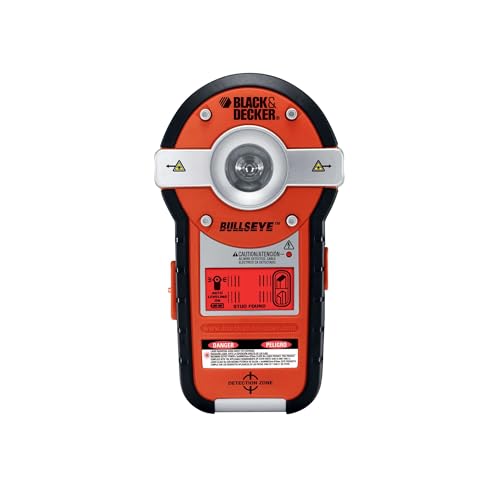
The BDL190S pairs an auto-leveling line laser with a stud sensor that detects wood and metal studs and live AC wires. The laser levels itself, so hanging a gallery wall or a row of cabinets is a one-person job.
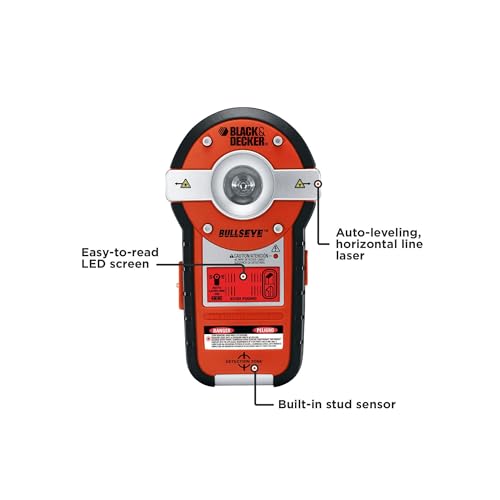
It has an LCD display and a Class 2 laser. Bob Vila and HGTV both picked it as their laser-plus-stud-finder choice. At $99.99 on October 7, it costs more than the Klein, but the self-leveling laser is easier for beginners.
Skip this if: you only need to find studs. You are paying mostly for the laser.
Pros: Auto-leveling laser; live-wire detection; beginner friendly.
Cons: $99.99; stud depth not listed.
Best Magnetic Stud Finder
12. StudBuddy – Best Magnetic
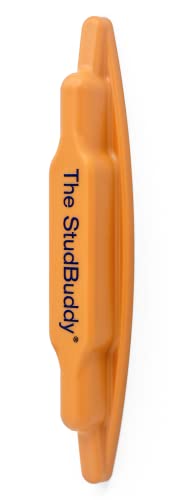
A magnetic stud finder does not look for the stud. It looks for the screws holding the drywall to the stud. StudBuddy uses neodymium magnets, and when it passes over a screw head, it sticks to the wall. No batteries, no calibration, no false readings from density changes.
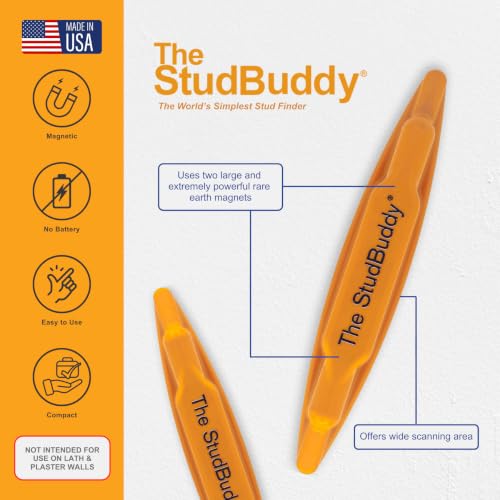
It is made in the USA and costs $9.97. The listing says it is not intended for lath and plaster walls. Our tip: use a magnet to confirm what an electronic finder tells you before you drill a big hole. The C.H. Hanson 03040 is the other well-known magnet, but the Amazon listing we checked was a multi-pack shipped from abroad.
Skip this if: you need to find the stud edges. A magnet finds fasteners, not wood.
Pros: No batteries; cannot be fooled by density; $10; US made.
Cons: Slow to sweep a big wall; no wire detection; not for plaster.
Stud Finders by Wall Type
| Wall | What works | Pick |
|---|---|---|
| Standard 1/2-inch drywall | Any electronic or magnetic finder | Franklin M150, DeWalt, StudBuddy |
| Double drywall or 5/8-inch fire-rated | Deep scan of 1.5 in or more | Franklin M210 or MAX, Zircon A200 DeepScan |
| Plaster and lath | Very deep scan, or a magnet to find lath nails | Franklin MAX; confirm with a test nail |
| Ceramic tile | Deep scan through tile and backer | Franklin MAX |
| Wallpaper or fabric | Electronic finder rated for coverings | Craftsman CMHT77633 |
| Metal studs | Metal mode or a magnet | Zircon A200, Bosch GMS120-27, StudBuddy |
Plaster is the hard case. It is applied by hand, so its thickness varies across the wall, which confuses density sensors. In old houses, find a stud with the scanner, confirm with a magnet or a small finish nail, then drill.
What Needs a Stud and What Doesn’t
- Needs a stud: TV wall mounts, heavy mirrors, upper cabinets, grab bars, loaded shelving, coat racks that get pulled on.
- Anchor is fine: picture frames, small mirrors, curtain rods with good anchors, light decor.
Studs in most US homes sit 16 inches apart, center to center. Newer houses sometimes use 24 inches. Once you find one stud, measure 16 inches to check for the next. A good tape measure with 16-inch marks makes this quick. Then drive the screw with a drill set to a low clutch number; our best cordless drill for home use guide covers that.
Why Stud Finders Give False Readings
- Calibrating over a stud. Single-sensor finders treat wherever you start as “hollow.” Start over a stud and everything reads wrong. Multi-sensor Franklin models avoid this.
- Pipes, wires and blocking. Anything dense reads like a stud. Water-filled pipes can trigger a finder, but dry PEX and PVC often do not.
- Moving too fast or tilting. Keep the tool flat and slide slowly.
- Foil-backed insulation or metallic wallpaper. These block or confuse electronic sensors.
The fix is to cross-check: scan, confirm the next stud 16 inches over, and use a magnet or a small nail before you drill a big hole. For how the different sensors work, read how stud finders work.
How to Use a Stud Finder
- Read the manual for your model’s calibration step.
- For single-sensor finders, place it flat on a spot you think is hollow and hold the button until it is ready.
- Slide slowly and level across the wall. Mark each edge or the center.
- Scan again from the other direction to confirm.
- Check for wires near outlets and switches. Studs often sit beside electrical boxes.
- Confirm with a magnet or a small nail before drilling a large hole.
Frequently Asked Questions
How far apart are wall studs?
Most US walls use 16 inches on center. Some newer homes use 24 inches, and some use 19.2 inches.
Do stud finders work on plaster walls?
Some do, but plaster is the hardest wall type. A deep-scan model like the Franklin ProSensor MAX is your best bet, and you should confirm with a magnet or nail. The DeWalt and StudBuddy listings say they are not for plaster.
Do stud finders work through tile?
Only deep-scan models. Franklin says the ProSensor MAX reads through large tile, up to 2.5 inches total depth.
Can a stud finder detect live wires and pipes?
Many detect live AC wires, including the Franklin M210 and M150, Zircon A100 and A200, Klein ESF200 and DeWalt. The Bosch GMS120-27 also finds copper pipes. Plastic pipes are usually invisible to stud finders.
Magnetic vs electronic stud finder: which is better?
Electronic finders are faster and show the stud itself. Magnetic finders are slower but cannot be fooled by density changes. Many pros carry both and use the magnet to confirm.
Are outlets always on studs?
Often, but not always. Many electrical boxes are nailed to the side of a stud, but old-work boxes can sit anywhere. Use a stud finder with a wire warning near outlets.
Bottom Line
- Best overall: Franklin ProSensor M210
- Best value: Franklin ProSensor M150
- Plaster, tile, double drywall: Franklin ProSensor MAX
- Best classic center-finder: Zircon MultiScanner A200
- Renovation wall scanner: Bosch GMS120-27
- Best with a laser: Klein Tools ESF150LL
- Best $10 stocking stuffers: StudBuddy or Craftsman CMHT77633
A stud finder is one of the best $10 to $60 gifts for anyone who owns a house. See more ideas in our tool gifts for dad guide. Prices were checked on October 7, 2026 and change often around Black Friday.