

A bench grinder is one of the cheapest ways to bring dull, chipped and rusty tools back to life. Mower blades, axes, chisels, drill bits, lathe tools and cold chisels all come off it sharper or cleaner. But the right bench grinder depends on what you put against the wheel. A fast 8-inch grinder that’s great for mower blades can burn the edge off a woodworking chisel in seconds.
Quick answer: for most garages, the DeWalt DW758 8-inch is the best bench grinder. On a tight budget, get the WEN BG4276 6-inch. If you sharpen chisels, plane irons or lathe tools, get a slow-speed grinder like the Rikon 80-805.
Every spec, rating and price below was checked on the live Amazon listing on November 24, 2026. Prices change often, so check the current price before you buy.
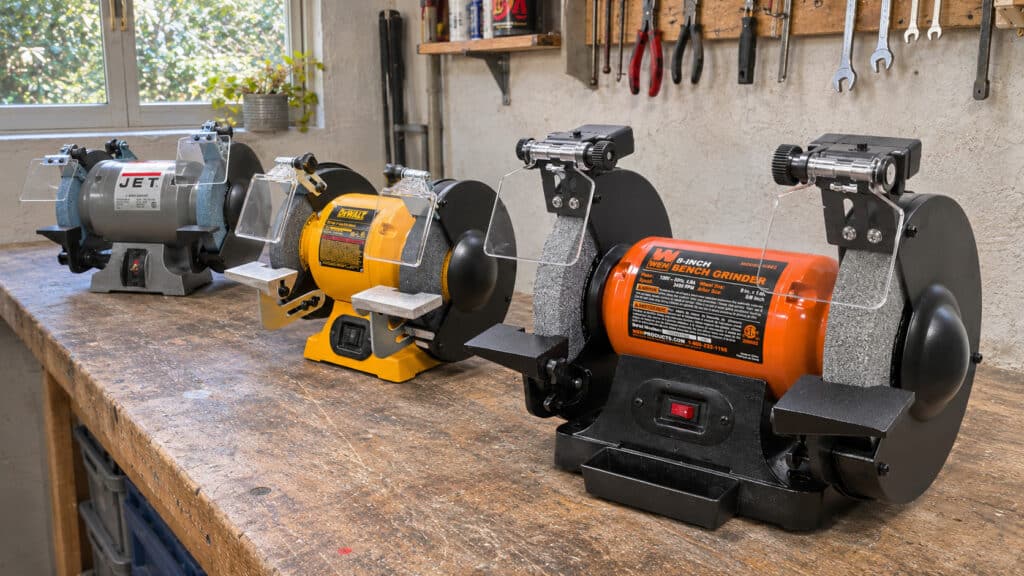
Quick Picks
- Best overall: DeWalt DW758 8″
- Best budget: WEN BG4276 6″
- Best budget 8-inch: WEN BG4282 8″
- Best for sharpening woodworking tools: Rikon 80-805 Slow Speed
- Best for CBN wheels and lathe tools: BUCKTOOL 8″ Low Speed (1-1/2″ wheel)
- Best variable speed: WEN BG4280 8″
- Best shop-grade: JET JBG-8
- Best with a wire wheel: DeWalt DW758 + Wire Wheel Bundle
- Best grinder and belt sander combo: BUCKTOOL 2×42″ Belt + 6″ Grinder
- Best for buffing: BUCKTOOL 8″ Dual Speed with Buffing Wheel
Bench Grinder Comparison Table
| Grinder | Wheels | Speed | Motor | Rating | Price |
|---|---|---|---|---|---|
| DeWalt DW758 | 8″ | 3,600 RPM | 3/4 HP | 4.6 (2,671) | $139.00 |
| WEN BG4276 | 6″ x 3/4″ | 3,450 RPM | 2.1 A | 4.6 (1,807) | $48.70 |
| WEN BG4282 | 8″ x 1″ | 3,450 RPM | 4.8 A | 4.4 (317) | $92.79 |
| Rikon 80-805 | 8″ x 1″ | 1,750 RPM | 1/2 HP | 4.6 (853) | $133.98 |
| BUCKTOOL Low Speed | 8″ x 1″ and 8″ x 1-1/2″ | 1,750 RPM | 3/4 HP rated | 4.6 (328) | $196.80 |
| WEN BG4280 | 8″ | 2,000 to 3,400 RPM | 5 A | 4.2 (425) | $139.51 |
| JET JBG-8 | 8″ | 3,450 RPM | 1/2 HP | 4.7 (404) | $399.00 |
| DeWalt DW758 + Wire Wheel | 8″ stone + 8″ wire | 3,600 RPM | 3/4 HP | 4.8 (131) | $153.01 |
| BUCKTOOL Belt Combo | 6″ wheel + 2×42″ belt | Single speed | 1/3 HP, 3.5 A | 4.5 (1,220) | $206.00 |
| BUCKTOOL Dual Speed | 8″ + buffing wheel | 2 speeds | 1/2 HP | 4.6 (466) | $127.49 |
How to Choose a Bench Grinder
6-Inch or 8-Inch
A 6-inch grinder is smaller, cheaper and fine for occasional touch-ups on drill bits, screwdrivers and garden tools. An 8-inch grinder has a bigger wheel surface, usually a stronger motor, and the wheels last longer. If you sharpen mower blades, axes or anything big, or you grind every week, buy an 8-inch.
High Speed or Slow Speed
This is the decision most buyers get wrong. Standard grinders spin at about 3,450 to 3,600 RPM. That’s great for fast metal removal, rust cleanup and mower blades. But on a thin edge, that speed builds heat fast. If the steel turns blue or straw-colored, you’ve overheated it and softened the temper, and that edge won’t hold.
Slow-speed grinders run at about 1,750 RPM. They remove metal more slowly but stay much cooler, which is why woodworkers and wood turners use them for chisels, plane irons and lathe tools. Variable-speed grinders like the WEN BG4280 let you choose, but they cost more and have more parts to go wrong.
Motor Ratings: Read the Rated Number
Bench grinders are sold by horsepower, amps or both. Compare rated power, not “peak” power. Some listings give a rated figure and a much bigger peak number. The rated figure is what the motor delivers while you’re actually grinding. An induction motor, used on most of the grinders here, runs quieter and lasts longer than a cheap universal motor.
Wheel Width and CBN Wheels
Most 8-inch grinders take 1-inch wide wheels. Many serious sharpeners upgrade to CBN (cubic boron nitride) wheels, which stay flat, run cool and never need dressing. Many of the best CBN wheels are 1-1/2 inches wide, and they won’t fit a grinder built only for 1-inch wheels. If you plan to go the CBN route, check the guard clearance and arbor size first. The BUCKTOOL low-speed grinder below is built for a 1-1/2-inch wheel.
Tool Rests: The Part Most Reviews Ignore
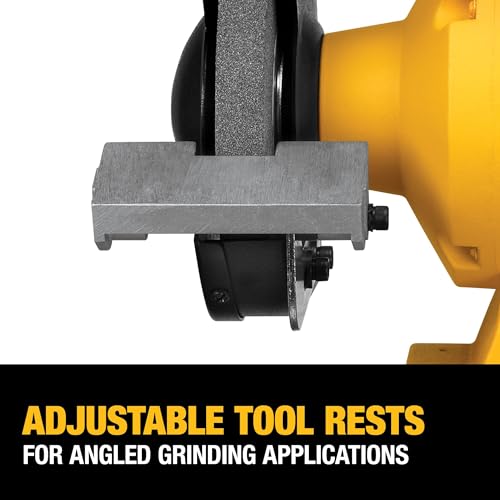
The tool rest is the small platform in front of each wheel. It controls the angle you sharpen at, and on many grinders it’s the weakest part. Small, flexy or hard-to-adjust rests make it hard to hold a consistent angle. Look for cast or machined rests that adjust without tools and lock firmly. If you sharpen woodworking or turning tools a lot, plan on adding a sharpening jig or an aftermarket tool rest system.
Build, Vibration and Extras
A cast-iron base soaks up vibration and keeps the grinder from walking. Even so, bolt it down or mount it on a stand. Useful extras include built-in lights, a quench tray for cooling work, tool-free eye shields and a diamond wheel dresser in the box.
The 10 Best Bench Grinders, Reviewed
1. DeWalt DW758 8-Inch – Best Overall
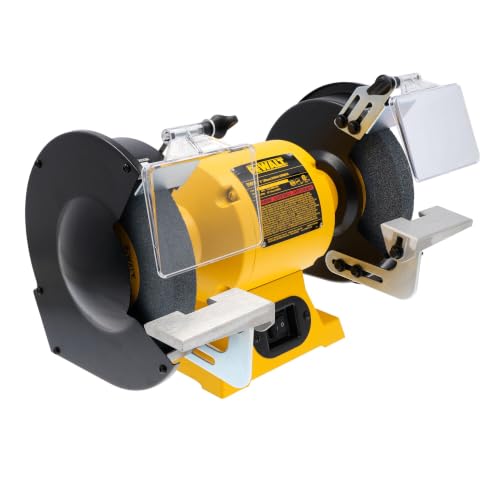
The DW758 is the grinder most people should buy. It has a 3/4 HP induction motor that spins the 8-inch wheels at 3,600 RPM, a cast-iron base and motor housing, and precision-machined aluminum tool rests. The wheels sit 12-1/2 inches apart, which gives you room to work on long parts like mower blades and axe heads.
It has 4.6 stars from more than 2,600 ratings and was $139.00 when I checked, down from a $179 list price. Amazon’s review summary says buyers find it well made for the price and durable enough for rough grinding of heavy material, and one says it works well on knives. Stability and noise get mixed comments: some say it doesn’t bog down, while others say it slides around on the bench. Bolt it down and that problem goes away.
Pros: Strong 3/4 HP induction motor; cast-iron build; machined aluminum tool rests; wide spacing between wheels; huge review base.
Cons: 3,600 RPM is too hot for delicate woodworking edges; needs bolting down; some find it noisy.
Skip it if: you mainly sharpen chisels or lathe tools. Get a slow-speed grinder instead.
If you want a smaller DeWalt, the DW756 6-inch has 4.8 stars from 1,906 ratings, but it was $143.75 when I checked, more than the 8-inch DW758. At that price, the 8-inch is the better buy.
2. WEN BG4276 6-Inch – Best Budget
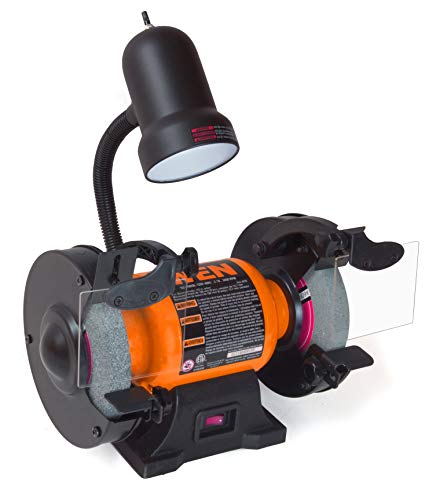
For under $50, the WEN BG4276 gets you a working grinder with a light. A 2.1-amp motor spins 6-by-3/4-inch wheels at up to 3,450 RPM. It comes with a 36-grit and a 60-grit wheel, adjustable eye guards and a flexible work light, plus a two-year warranty.
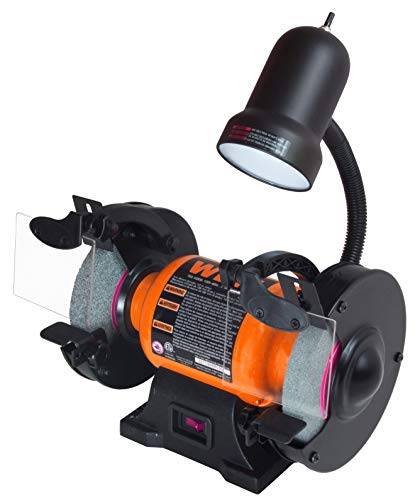
It has 4.6 stars from more than 1,800 ratings and was $48.70 when I checked. Amazon’s review summary says buyers find it works better than expected, runs fairly quietly and is solidly built for the money. Opinions on power are mixed: some are impressed, others say it’s not very powerful.
Pros: Very low price; work light included; two wheels and a two-year warranty; big review base.
Cons: Small 3/4-inch wheels; modest motor bogs down under heavy pressure.
Skip it if: you grind mower blades or heavy steel often. Step up to an 8-inch.
3. WEN BG4282 8-Inch – Best Budget 8-Inch
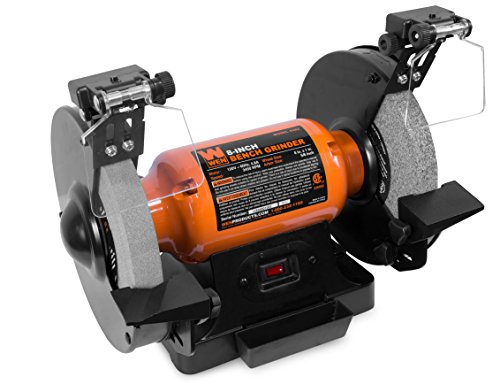
The BG4282 gets you full-size 8-by-1-inch wheels for well under $100. A 4.8-amp motor spins them at up to 3,450 RPM. WEN builds LED lights into the eye guards, adds an onboard quench tray for cooling work, and includes 36-grit and 60-grit wheels, pivoting tool rests and a two-year warranty.
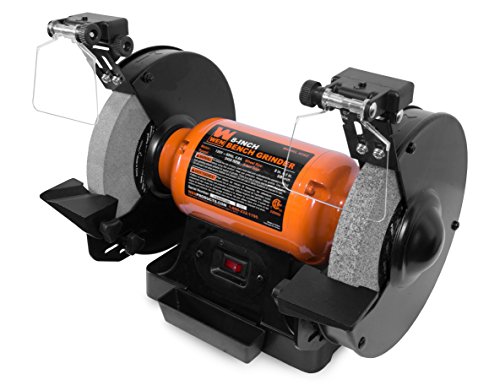
It has 4.4 stars from 317 ratings and was $92.79 when I checked. Amazon’s review summary says buyers find it good value, and one says it performs as well as more expensive models. Vibration is the split: some find it balanced, others say it vibrates badly.
Pros: 8-inch wheels at a budget price; LED lights in the eye guards; quench tray; two-year warranty.
Cons: Mixed vibration reports; not as heavy or smooth as the DeWalt.
Skip it if: you can stretch to the DW758. It’s the more proven machine.
4. Rikon 80-805 8-Inch Slow Speed – Best for Sharpening Woodworking Tools
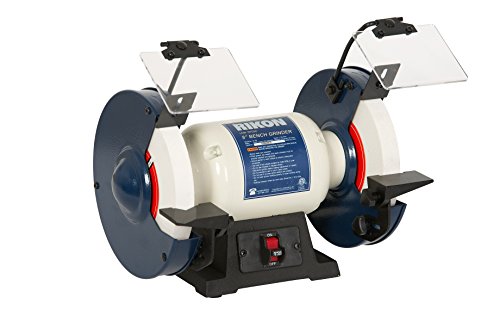
The Rikon is built for sharpening, not hogging off metal. Its 1/2 HP motor runs at 1,750 RPM, about half the speed of a standard grinder, so edges stay cooler. It comes with 8-by-1-inch 60-grit and 120-grit wheels on a 5/8-inch arbor. The left tool rest has a groove for sharpening drill bits, and Rikon includes a diamond wheel dresser and a 5-year warranty.
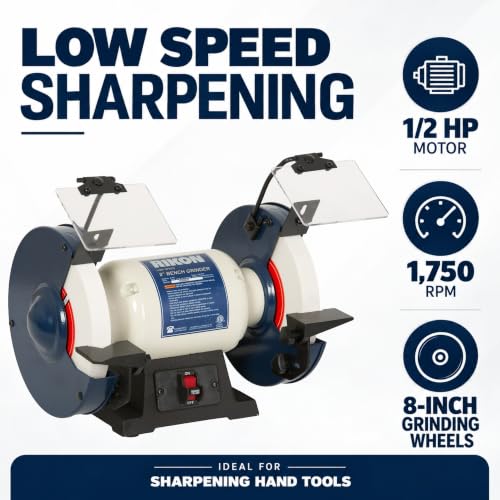
It has 4.6 stars from 853 ratings and was $133.98 when I checked. It’s sold by a third-party seller (Acme Tools) rather than Amazon. Amazon’s review summary says buyers find it a professional-quality sharpening station that works well on lathe tools and axes, runs smoothly and quietly, and gets up to speed quickly. Wheel stability and the stock wheels get mixed reviews, with some buyers reporting wobble.
Pros: Slow 1,750 RPM keeps edges cool; finer 120-grit wheel; diamond dresser included; 5-year warranty.
Cons: Some reports of wheel wobble; slow for heavy metal removal; sold by a third party.
Skip it if: you mostly grind mower blades and rusty hardware. A high-speed grinder is faster.
For a cheaper slow-speed option, the WEN BG4286 8-inch had 4.5 stars from 223 ratings and was $117.26 when I checked.
5. BUCKTOOL 8-Inch Low Speed (1-1/2″ Wheel) – Best for CBN Wheels and Lathe Tools

This BUCKTOOL is a slow-speed grinder built with CBN upgrades in mind. It runs at 1,750 RPM and has one standard 8-by-1-inch 80-grit wheel and one extra-wide 8-by-1-1/2-inch 120-grit wheel. That wide side can take a 1-1/2-inch CBN wheel later. It adds a 3-watt LED with its own switch, a magnifying eye shield, cast aluminum tool rests that adjust from 0 to 45 degrees, and a key safety switch.
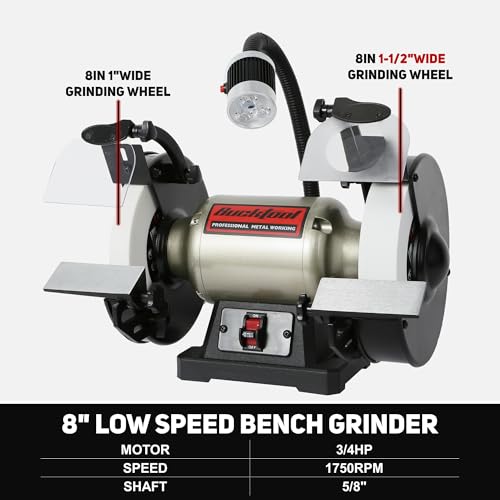
It has 4.6 stars from 328 ratings and was $196.80 when I checked. BUCKTOOL rates the motor at 3/4 HP but also advertises a 1-1/4 HP “peak”. Go by the 3/4 HP figure. Amazon’s review summary says buyers find it well built, smooth and quiet, and effective on high-speed steel lathe tools, and they like the lighting.
Pros: Takes a 1-1/2-inch CBN wheel; slow speed; strong lighting and magnifier; angle-adjustable tool rests.
Cons: Costs more than the Rikon; sold by BUCKTOOL, not Amazon; “peak HP” marketing is misleading.
Skip it if: you’ll never buy a CBN wheel. The Rikon covers basic sharpening for less.
6. WEN BG4280 8-Inch Variable Speed – Best Variable Speed
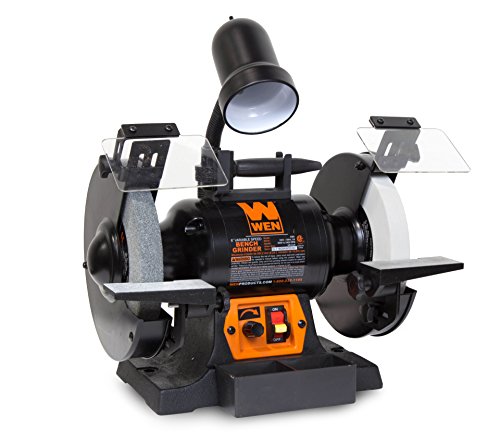
If you do both rough grinding and sharpening, a variable-speed grinder saves buying two machines. The BG4280’s 5-amp motor runs anywhere from 2,000 to 3,400 RPM. Turn it down for cooler, more precise sharpening, and up for fast metal removal. It also has LED lights built into the eye guards and an onboard quench tray.
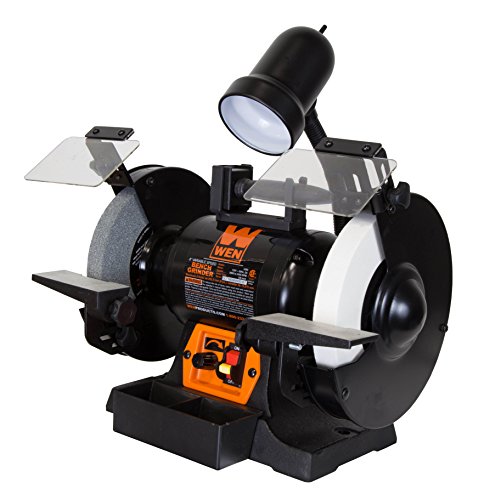
It has 4.2 stars from 425 ratings and was $139.51 when I checked. Amazon’s review summary says buyers like the adjustable speed, the build and the value. Vibration, noise and reliability all get mixed feedback, with some buyers reporting noticeable wobble.
Pros: One grinder for sharpening and grinding; LED lights; quench tray.
Cons: Lowest rating of our picks; mixed reliability and wobble reports; its slowest speed (2,000 RPM) is still faster than a true slow-speed grinder.
Skip it if: sharpening is your main job. A dedicated 1,750 RPM grinder runs cooler.
For a smaller variable-speed option, the WEN BG625V 6-inch had 4.5 stars from 174 ratings and was $123.00 when I checked.
7. JET JBG-8 8-Inch – Best Shop-Grade
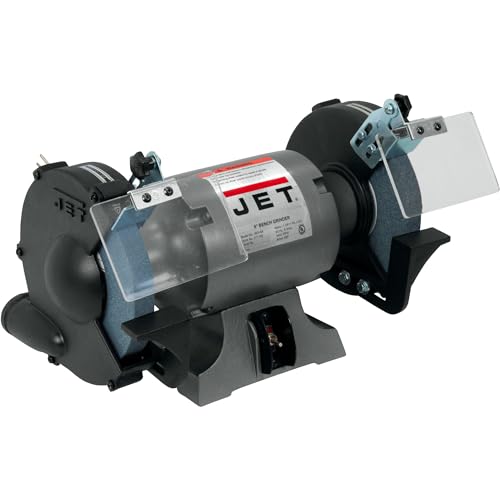
The JET is the grinder for a shop that runs it every day. It has a 1/2 HP motor at 3,450 RPM, totally enclosed, permanently lubricated ball bearings, cast-iron wheel guards with dust vents, one-piece spark guards that adjust quickly, large eye shields and rubber mounts. It comes with 36-grit and 60-grit vitrified wheels and meets CSA safety standards.
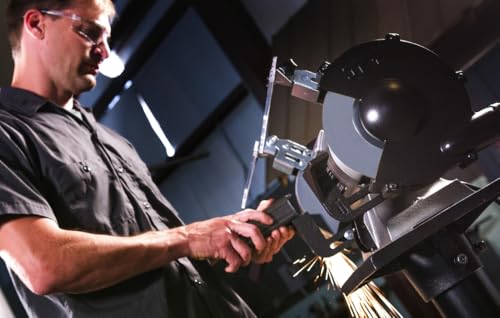
It has 4.7 stars from 404 ratings, the highest rating of the standard grinders here, and was $399.00 when I checked. Amazon’s review summary says buyers find it high quality, smooth running and powerful enough for mower blades, and well ahead of cheaper models. Durability gets some mixed experiences.
Pros: Smooth, sealed bearings; heavy cast-iron guards; high rating; built for daily use.
Cons: Almost three times the price of the DW758; 1/2 HP on paper is less than the DeWalt’s 3/4 HP.
Skip it if: you grind a few times a month. The DW758 does the same jobs for far less.
8. DeWalt DW758 + 8-Inch Wire Wheel Bundle – Best with a Wire Wheel

Plenty of people use a bench grinder more for cleaning than sharpening: stripping rust off bolts, cleaning old garden tools and taking paint off brackets. This bundle pairs our top pick, the DW758, with an 8-inch DeWalt wire wheel. Swap one stone for the wire wheel and you have a grinding wheel on one side and a cleaning wheel on the other.
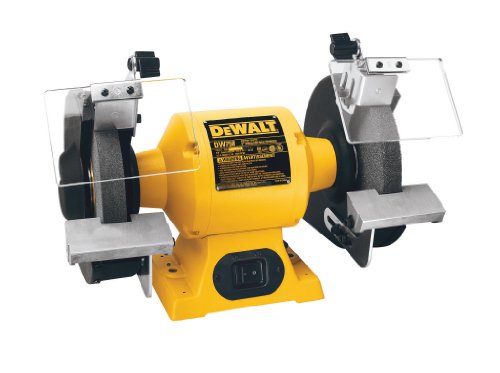
The bundle has 4.8 stars from 131 ratings and was $153.01 when I checked. That’s about $14 more than the grinder alone, which is what the DeWalt 8-inch wire wheel costs on its own (4.7 stars from 2,881 ratings). Buy whichever is cheaper on the day.
Pros: Proven grinder plus a wire wheel for rust and paint; no extra shopping.
Cons: Saves little or nothing over buying separately; same bolt-down advice as the DW758.
Skip it if: you only sharpen.
For rust cleanup ideas, see my guide on how to remove rust from garden tools.
9. BUCKTOOL 2×42″ Belt Sander + 6″ Grinder Combo – Best Grinder and Belt Sander Combo

A belt is better than a wheel for some jobs, especially flat bevels, knife profiles and shaping. This combo puts a 2-by-42-inch belt on one side and a 6-inch, 60-grit grinding wheel on the other. The belt tilts from 0 to 90 degrees, the belt housing swivels from horizontal to vertical, and it has quick-release tension, a tool-free eye shield and an LED light. The motor is a 1/3 HP, 3.5-amp induction motor.
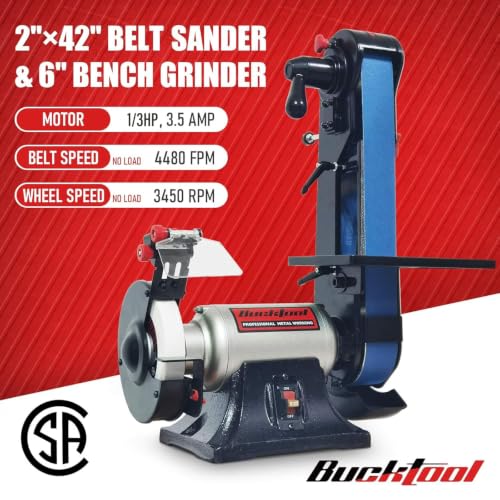
It has 4.5 stars from more than 1,200 ratings and was $206.00 when I checked. Amazon’s review summary says buyers find it works well, especially for knife work, and like the build and power. Durability is mixed, with some reporting failures after a couple of months of weekend use, and the adjustability gets negative comments.
Pros: Belt and wheel in one machine; tilting, swiveling belt; popular with knife makers.
Cons: Small 1/3 HP motor; mixed durability; adjustments can be fiddly.
Skip it if: you need a heavy-duty grinder. The wheel side is a small 6-inch.
10. BUCKTOOL 8″ Dual Speed with Buffing Wheel – Best for Buffing
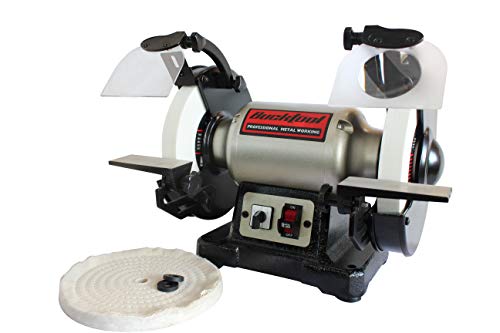
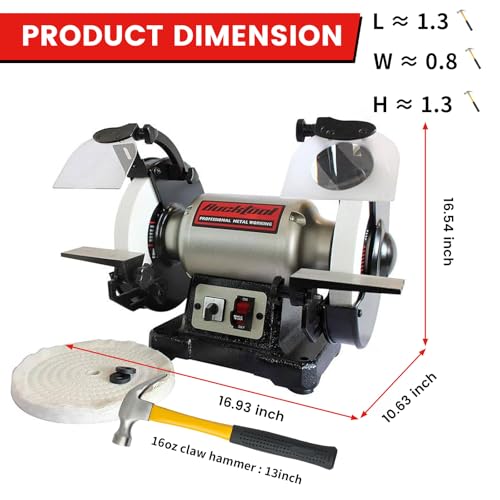
This grinder gives you two speeds instead of a dial. Use low speed for sharpening woodworking edges and high speed for fast metal removal. It ships with 80-grit and 120-grit white aluminum oxide wheels, which run cooler than the gray stones on most budget grinders, plus a buffing wheel for polishing. The cast aluminum tool rests adjust independently, and the cast-iron base has mounting holes.
It has 4.6 stars from 466 ratings and was $127.49 when I checked. Amazon’s review summary says buyers find it works right out of the box and runs smoothly with no wobble or vibration. They like the two speeds for honing, the solid build and the quiet running.
Pros: Two speeds; cooler-running white wheels; buffing wheel included; smooth, quiet running.
Cons: 1/2 HP motor; sold by BUCKTOOL, not Amazon; two fixed speeds, not a full range.
Skip it if: you need heavy, high-speed grinding all day. The DW758 has more power.
Grinding Wheels Explained
- Gray wheels (silicon carbide or brown aluminum oxide): the standard stones on most grinders. Fine for mower blades, hardware and general grinding, but they run hot.
- White aluminum oxide wheels: softer and friable, so they cut cooler. Better for sharpening tool steel.
- CBN wheels: steel wheels coated with cubic boron nitride. They stay flat, run cool and never need dressing. Expensive, but a big upgrade for sharpening high-speed steel.
- Grit: 36 grit is for heavy shaping and rough work. 60 grit is general grinding and mower blades. 80 to 120 grit is for finer sharpening.
- Arbor size: most 8-inch grinders use a 5/8-inch shaft. Check before you buy replacement wheels.
Never grind aluminum, brass, copper or other soft metals on a standard stone wheel. Soft metal clogs the wheel, and a loaded wheel can overheat and fracture. Use a belt sander or a dedicated non-loading wheel instead.
Bench Grinder Safety Setup
- Bolt it down. Screw the grinder to a solid bench or a stand. Several DW758 owners say it slides around otherwise.
- Ring-test new wheels. Hang a new stone wheel on a finger and tap it lightly with a screwdriver handle. A clear ring is good. A dull thud can mean a crack, so don’t mount it.
- Set the tool rest close. Keep the rest about 1/8 inch from the wheel so work can’t get pulled into the gap.
- Set the spark guard. The upper guard (tongue guard) should sit about 1/4 inch from the wheel.
- Stand to the side on start-up. Let the wheels run for a minute before you grind. If a wheel is going to fail, it usually happens at start-up.
- Wear eye and face protection. The eye shields aren’t enough on their own. Wear proper safety glasses, and a face shield for heavy grinding.
- No gloves near a wire wheel. A wire wheel can catch a loose glove and pull your hand in.
How to Sharpen a Mower Blade on a Bench Grinder
- Remove the blade and clamp it or hold it firmly. Mark one end so you reinstall it the right way.
- Rest the blade on the tool rest and match the original bevel angle, usually around 30 degrees.
- Make light, even passes across the wheel. Don’t press hard or hold it in one spot.
- Dip the blade in water or the quench tray every few passes so it doesn’t overheat.
- Take the same number of passes on both ends, then check the balance on a nail or a blade balancer before you reinstall it.
How to Dress a Grinding Wheel
Over time, stone wheels clog, glaze and wear out of round. Dressing exposes fresh grit and makes the wheel flat and true again. With the grinder running, rest a diamond dresser on the tool rest and slide it slowly across the face of the wheel. Take light passes until the face is flat and evenly gray. The Rikon includes a diamond dresser. For other grinders, a basic diamond dresser is a cheap add-on.
Bench Grinder vs. Angle Grinder vs. Belt Sander
| Tool | Best For | Not Great For |
|---|---|---|
| Bench grinder | Sharpening, shaping and cleaning small parts you bring to the tool | Large parts, flat bevels, soft metals |
| Angle grinder | Cutting, grinding welds and working on big or fixed parts | Precise, repeatable sharpening angles |
| Belt sander or grinder | Flat bevels, knife profiles, aluminum and shaping | Heavy rust removal with a wire wheel |
If you need to take the grinder to the work, see my guides to the best angle grinders and best die grinders.
Bench Grinder Accessories Worth Buying
- A stand: a pedestal stand puts the wheel at a comfortable height and keeps the grinder from moving. The Pit Bull Bench Grinder Stand had 4.4 stars from 355 ratings and was $48.89 when I checked. If you’d rather keep it on a bench, see my picks for the best workbench for the garage.
- A wire wheel: for rust, paint and scale. The DeWalt 8-inch crimped wire wheel was $14.01 when I checked.
- A diamond wheel dresser: keeps stone wheels flat and cutting.
- A CBN wheel: the biggest upgrade for sharpening high-speed steel. Match the diameter, width and arbor size to your grinder.
- A sharpening jig: holds chisels and turning tools at a repeatable angle, which matters more than the grinder itself.
FAQ
Is a 6-inch or 8-inch bench grinder better?
For occasional light work, a 6-inch is fine. An 8-inch has more wheel surface, usually more power, and longer-lasting wheels, so it’s the better choice for mower blades, axes and regular use.
Should I buy a slow-speed or high-speed bench grinder?
Buy slow speed (about 1,750 RPM) if you mainly sharpen chisels, plane irons or lathe tools, because it keeps edges cooler. Buy high speed (about 3,450 to 3,600 RPM) for mower blades, rust cleanup and general metal work.
Can you sharpen kitchen knives on a bench grinder?
You can, but it’s easy to overheat and ruin a thin knife edge. Use a slow-speed grinder with a fine white or CBN wheel, very light pressure and frequent cooling. Most people get better results with a whetstone or knife sharpener.
Can you grind aluminum on a bench grinder?
Not on a standard stone wheel. Aluminum and other soft metals clog the wheel, and a clogged wheel can overheat and crack. Use a belt sander or a wheel made for non-ferrous metals.
How do you dress a bench grinder wheel?
With the grinder running, rest a diamond dresser on the tool rest and slide it slowly across the wheel face until it’s flat and evenly gray.
Does a bench grinder need a stand?
It needs to be bolted down. A stand isn’t required if you have a solid bench, but a pedestal stand puts the wheel at a better height and frees up bench space.
What grit should I use for mower blades?
A 36-grit wheel reshapes badly damaged blades quickly. A 60-grit wheel is the best all-round choice for routine sharpening.
Bottom Line
- Most garages: DeWalt DW758.
- Tight budget: WEN BG4276 6″ or WEN BG4282 8″.
- Chisels and plane irons: Rikon 80-805.
- Lathe tools and CBN wheels: BUCKTOOL 8″ Low Speed.
- One grinder for everything: WEN BG4280 Variable Speed.
- Daily shop use: JET JBG-8.
- Rust and paint cleanup: DeWalt DW758 + Wire Wheel.
- Knife making and flat bevels: BUCKTOOL Belt Combo.
- Buffing and polishing: BUCKTOOL Dual Speed.
A bench grinder pairs well with a solid vise for holding work. See my picks for the best bench vises. If you turn wood, my guide to the best lathes covers the other half of the setup, and if you sharpen axes, see the best axes.


