You have a shiny socket set in the garage, a new cordless impact wrench, and a stubborn lug nut to remove. The socket fits the wrench, so it should be fine, right? Not necessarily. The sockets may fit the same square drive, but they are not built for the same force. “Fits” does not mean “safe for impact.” A regular chrome socket can fail suddenly under repeated hammering loads, and that choice affects safety, socket life, fastener access, and work quality. This guide covers the real material, wall thickness, and design differences, when each type is actually safe to use, and whether a home mechanic needs both.
Quick answer: Use impact sockets with any impact wrench, impact driver with a socket adapter, pneumatic impact gun, or powered nutrunner. Use regular chrome sockets with hand ratchets, breaker bars, and torque wrenches. Impact sockets are built to absorb repeated hammering loads; regular chrome sockets are harder and thinner, and can crack or shatter when used on an impact tool.
Quick Comparison
| Feature | Impact Sockets | Regular / Chrome Sockets |
|---|---|---|
| Best used with | Cordless, pneumatic, or electric impact wrenches; impact drivers with suitable adapters | Ratchets, breaker bars, torque wrenches, hand tools |
| Typical material | Chrome-molybdenum alloy steel (Cr-Mo) | Chrome-vanadium alloy steel (Cr-V) |
| Heat treatment goal | Toughness and controlled flexibility under repeated shock loads | Hardness and wear resistance under hand-applied torque |
| Wall thickness | Usually thicker | Usually thinner |
| Finish | Matte black oxide or phosphate | Shiny polished chrome |
| Tight-space access | Less ideal, thicker walls | Better, thinner walls |
| Retention features | Often a cross-hole or retaining-ring groove | Usually a detent ball |
| Use on impact wrench? | Yes | No |
| Use with hand ratchet? | Yes, although bulkier | Yes |
| Best examples | Lug nuts, suspension bolts, rusted fasteners | Interior fasteners, engine-bay work, final torque |
Material and finish vary between brands, but a socket needs to be explicitly labeled impact rated before it goes anywhere near an impact wrench.

What Is an Impact Socket?
An impact socket is a socket rated to handle the rapid hammering or pulsing force an impact tool produces, built for repeated shock loads, not just high steady torque. They are usually black or dark from a phosphate or oxide coating, though color alone doesn’t prove a socket is impact rated. The socket should clearly state “impact,” “impact rated,” or show its rating and drive size.
Do not identify a socket by color alone. Some dark-finished sockets aren’t impact rated, and some impact-rated tools may use a different coating. Read the actual marking.
What Is a Regular Socket?
“Regular socket” usually means a chrome hand socket, intended for ratchets, breaker bars, torque wrenches, and other hand-driven work. Its thinner wall reaches fasteners an impact socket may not fit, and it’s generally the better choice for precise final tightening with a torque wrench. It’s not a safe substitute for an impact-rated socket on any powered impact tool.
Not every regular socket is chrome-vanadium, and not every impact socket is chrome-molybdenum, brands vary. But the practical rule (thicker, tougher, impact-rated versus thinner, harder, hand-driven) holds across the category.

The Important Differences
Material and Heat Treatment
A hand ratchet applies torque smoothly through your hands. An impact wrench applies repeated, high-energy hammer blows. Impact sockets are designed to tolerate those blows; standard hand sockets are not. The key difference isn’t simply “more torque,” it’s cyclic shock loading. Regular sockets are generally optimized for hardness and wear resistance under controlled hand torque; impact sockets are optimized for toughness, absorbing and distributing repeated impacts rather than failing suddenly.
Wall Thickness and Access
Impact sockets have thicker walls for strength under powered impact use. Regular sockets have thinner walls, which is why they reach recessed fasteners and tightly packed engine-bay bolts an impact socket can’t. This is why a complete workshop often benefits from both.
Do not force an oversized impact socket into a tight area. If clearance is the actual problem, that’s a signal to choose a different tool setup, not to reach for a chrome socket on an impact wrench.
Finish and Corrosion Protection
Regular sockets are usually polished chrome, easy to wipe clean and read. Impact sockets are usually black oxide or phosphate finished. Finish is a useful visual clue but doesn’t confirm impact rating on its own. A scratched black coating doesn’t automatically mean a socket is unsafe, inspect for cracks, deformation, and excessive wear instead.
Retention and Drive Connection
Many impact sockets include a cross-hole for a retaining pin and O-ring, or work with friction-ring/hog-ring anvils, reducing the risk of the socket coming loose as the tool vibrates and reverses. Standard sockets usually rely on a detent-ball system built for hand tools. Not every impact socket uses the same retention system, check what your specific tool and socket actually support.
Can You Use Regular Sockets With an Impact Wrench?
No. Do not use regular chrome sockets on an impact wrench, an impact driver with a socket adapter, an air impact gun, or any other powered impact tool. They aren’t designed for repeated impact loading and can crack or shatter.
| What Can Happen | Why It Matters |
|---|---|
| Socket cracks or shatters | Fragments are a serious eye and hand hazard |
| Chrome coating chips or splits | The socket weakens and corrodes faster |
| Fastener becomes damaged | A poor fit or failed socket can round the fastener |
| Socket falls off the anvil | Real risk of injury, lost time, and damaged parts |
| Tool warranty or safety guidance ignored | Manufacturers generally specify impact-rated accessories for impact tools |
Wear ANSI-rated safety glasses when using impact tools. Inspect sockets before every use, and stop using anything with cracks, a distorted drive end, spreading, deep gouges, or damaged retention features. Use the correct drive size, don’t stack unnecessary adapters, and never use an impact wrench for final tightening to an exact torque specification.

Can You Use Impact Sockets With a Ratchet or Torque Wrench?
Yes, with hand ratchets and breaker bars. Impact sockets are safe for hand-driven use, though their thicker walls can be too bulky for tight spots. With a torque wrench, an impact socket is acceptable if it fits properly, but a regular socket often gives better clearance and visibility for precise final assembly.
Use a torque wrench, not an impact wrench, for final torque. A properly fitting six-point socket is usually preferred for high-torque automotive fasteners, and no socket choice compensates for poor torque-wrench technique or skipping the vehicle manufacturer’s spec.
Which Socket Should You Use?
| Job | Best Socket Type | Why |
|---|---|---|
| Removing lug nuts with an impact wrench | Impact socket | Handles repeated impact loads |
| Removing seized suspension bolts | Impact socket | Better suited to heavy shock loads |
| Cordless impact driver with a socket adapter | Impact socket | The tool still delivers impact force |
| Final tightening to factory spec | Regular or impact socket with a torque wrench | The torque wrench, not the socket, controls final torque |
| Tight engine-bay fasteners by hand | Regular socket | Thin wall improves access |
| Interior trim or low-torque assembly | Regular socket | Smaller and easier to maneuver |
| Removing spark plugs by hand | Spark-plug socket and ratchet | Requires the correct dedicated socket and controlled torque |
| Brake caliper bracket bolts with an impact wrench | Impact socket | Powered impact tool requires impact-rated accessories |
| Wheel locks with an impact wrench | Impact-rated wheel-lock socket if approved by its maker | Avoid damaging the lock, follow the maker’s guidance |
Do You Need Both Socket Types?
Beginner DIY homeowner: a basic chrome socket set covers household fixes, furniture, bikes, appliances, and light car work. Add a small impact-socket set only once you own or plan to buy an impact wrench, starting with common automotive sizes rather than every specialty socket at once.
Home mechanic: one complete chrome socket set for ratchet and torque wrench work, one 1/2-inch drive impact-socket set for wheels, brakes, suspension, and stubborn fasteners, plus a deep-impact socket set for lug nuts and recessed fasteners, and impact-rated extensions and adapters.
Professional or serious DIY user: shallow and deep impact sockets, metric and SAE as your equipment requires, 1/4-inch, 3/8-inch, and 1/2-inch drives matched to the work, dedicated thin-wall impact sockets for wheel applications, six-point sockets for stubborn high-torque fasteners, and chrome and impact sets kept separated and labeled.
Choosing an Impact Socket Set
Drive Size
| Drive Size | Best For | Common Examples |
|---|---|---|
| 1/4 inch | Small fasteners, light-duty work | Interior hardware, small brackets |
| 3/8 inch | General automotive and DIY work | Engine-bay fasteners, medium bolts |
| 1/2 inch | High-torque automotive and construction work | Lug nuts, suspension bolts, larger fasteners |
| 3/4 inch and up | Heavy-duty equipment | Trucks, agricultural equipment, industrial work |
1. CASOMAN 1/4″ & 3/8″ Drive Impact Socket Combo, 94-Piece – Best for Casual DIY

Covers both light-duty and general automotive work in one kit, SAE and metric, standard and deep, with a ratchet, extension bars, and a universal joint included. A sensible starting point if you don’t yet know exactly which sizes you’ll need most.
Pros: Two drive sizes in one set; SAE and metric coverage; genuinely complete for a first impact-socket purchase.
Cons: Doesn’t include 1/2-inch drive, the size most lug nut and suspension work actually needs.
2. NEIKO 02448A 1/2″ Drive Master Impact Socket Set, 65-Piece – Best for Home Mechanics

The comprehensive pick: 58 SAE and metric sockets, both deep and shallow, plus extension bars, a 72-tooth quick-release ratchet, a universal joint, and drive adapters. This is the single set that covers wheels, brakes, suspension, and general heavy-duty automotive work without needing a second kit.
Pros: Broad SAE and metric coverage in both depths; genuinely complete accessory kit; the 1/2-inch drive size most home mechanics use most often.
Cons: Heavy (around 30 lbs fully loaded) and bulkier to store than a smaller set.
3. TEKTON SIF92400 1/2″ Drive Deep Thin Wall Impact Flip Socket Set – Best for Tight Wheel Wells

A dedicated lug nut tool, not a general socket set. The flip design covers two sizes per socket, with a steep 60-degree chamfer that slides over lug nuts easily and radiused corners that grip the flats rather than the corners, reducing fastener round-off. Thin walls and extra depth give real clearance around decorative wheel caps that a standard impact socket can’t reach.
Pros: Purpose-built thin-wall design for lug nut wells; flip mechanism covers multiple sizes in one compact tool; radiused corners reduce round-off risk on worn lug nuts.
Cons: Single-purpose, this isn’t a general-use socket set, it only covers lug nut sizes.
4. TEKTON 22-Piece 3/4″ Drive Deep Impact Socket Set with Adapter – Best for Heavy Equipment
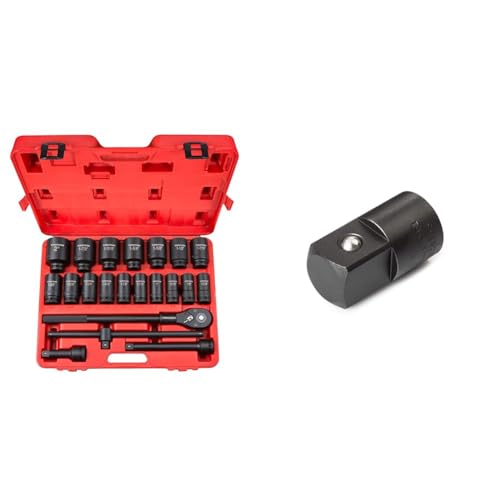
Built for trucks, tractors, and large machinery where 1/2-inch drive isn’t enough torque capacity. Sixteen deep 6-point sockets from 7/8 to 2 inches, plus 5- and 10-inch extension bars, an 18-inch 24-tooth ratchet, an 18-inch sliding T-head breaker bar, and a 1/2-to-3/4-inch impact adapter that lets you drive this set from a 1/2-inch impact tool you may already own.
Pros: Genuinely complete kit, not just sockets, includes breaker bar and adapter; the included adapter means you don’t necessarily need a dedicated 3/4-inch impact tool; wide size range for large fasteners.
Cons: Overkill and unnecessary expense for anyone not working on heavy equipment or large trucks.
5. NEIKO 02461A 3/4″ Drive Impact Socket Set, 8-Piece – Best Budget Heavy-Duty
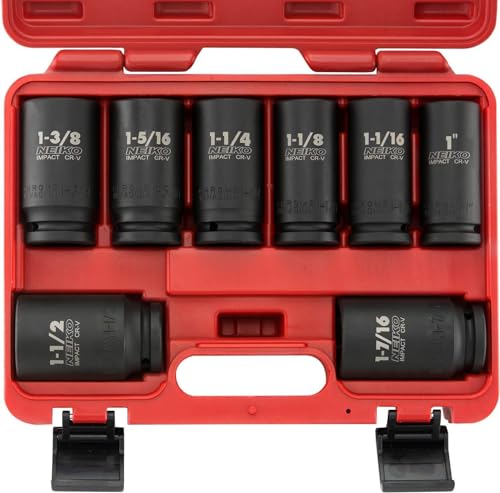
A simpler, less expensive alternative to a full 3/4-inch kit: eight deep/jumbo SAE sockets from 1 to 1-1/2 inches in chrome vanadium steel. If you only occasionally need 3/4-inch capacity and already own the ratchet and extensions to drive it, this covers the sockets alone without paying for a full accessory kit again.
Pros: Meaningfully cheaper than a full 3/4-inch kit with tools included; covers the core large-fastener size range.
Cons: No ratchet, extensions, or adapter included, you need to already own compatible 3/4-inch drive accessories.
6. Neiko 02410A 1/2″ Impact Socket Set with Protective Sleeves – Best for Finished Wheels
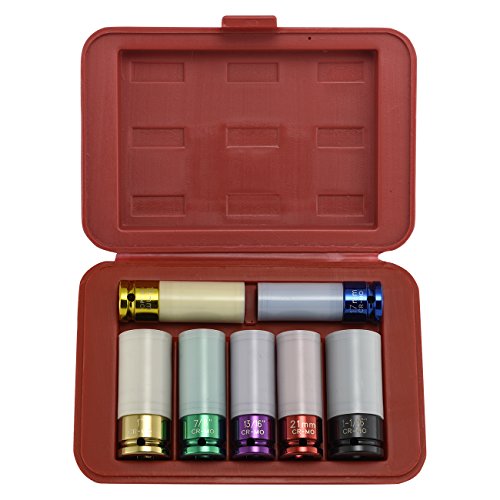
Seven common SAE and metric lug nut sizes with a nylon insert designed to protect the top face of the lug nut’s chrome or paint finish from scarring during impact use.
Pros: Genuinely useful if you’re worried about marring the visible face of a lug nut; correct sizes for common wheel applications.
Cons: Real buyer feedback notes the sleeve only protects the top of the lug nut, the metal socket sides still contact and can scratch a powder-coated or painted lug nut’s sides. If your wheels are freshly refinished, a fully lined socket from a different brand may be worth the extra cost instead.
7. CASOMAN 3-Piece Impact Universal Joint Set (1/4″, 3/8″, 1/2″) – Best Impact-Rated Accessories

Impact-rated universal joints in all three common drive sizes, heat-treated Cr-Mo steel with a corrosion-resistant black phosphate finish. A U-joint that isn’t impact rated is exactly the kind of accessory that can fail under hammering load even when the socket itself is correct, worth checking this alongside your socket set rather than assuming any U-joint on hand is safe to use.
Pros: Covers all three common drive sizes in one set; genuinely impact rated, not a repurposed hand-tool accessory; fills a real gap most socket sets don’t include.
Cons: An accessory, not a socket set, you’ll need sockets separately.
8. CRAFTSMAN CMMT12018 3/8″ Drive Chrome Mechanics Set, 40-Piece – Best Regular Socket Set
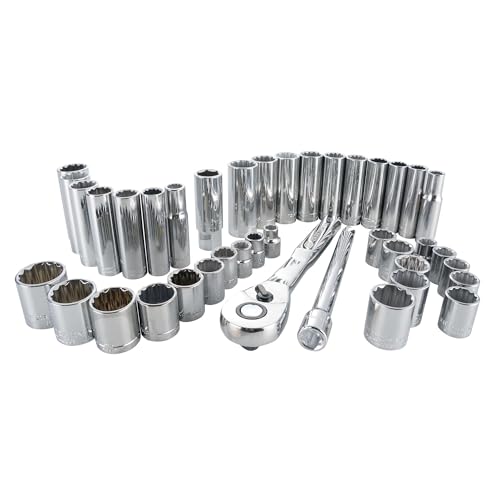
The hand-driven counterpart every impact-socket owner still needs. Full polish chrome finish, 12-point sockets in both standard and deep lengths, SAE and metric, with a 72-tooth ratchet and a blow-mold case sized to fit Craftsman’s metal storage boxes. This is exactly the set to reach for with a ratchet, breaker bar, or torque wrench, never on an impact tool.
Pros: Genuine chrome hand-tool set from an established brand; 12-point design suits precise fastener engagement; case fits standard storage systems.
Cons: 12-point sockets are more prone to rounding a damaged fastener than six-point, less ideal for rusted or worn bolts specifically.
Shallow, Deep, or Both
Shallow impact sockets are more compact and better where clearance is limited. Deep impact sockets are required for lug nuts, long studs, and recessed nuts. For most home mechanics, a set with both shallow and deep metric sockets, starting with 1/2-inch drive, is the best balance.
Six-Point for High Torque
Six-point sockets engage more flat surface area on the fastener and are usually the safer choice for rusted, high-torque, or impact-wrench work. Twelve-point sockets are useful where access or fastener design requires them, but are more likely to slip on a damaged fastener.
Retention and Markings
Look for a clear size marking, an explicit impact rating, laser-etched or stamped identification, pin-hole or friction-ring compatibility if your tool needs it, and whether individual replacement sockets are available if you lose or damage one.
Common Mistakes to Avoid
- Using shiny chrome sockets on a cordless or pneumatic impact wrench.
- Assuming a black finish alone proves a socket is impact rated.
- Using impact sockets for every task, even when a thin-wall chrome socket would give better access.
- Tightening lug nuts exclusively with an impact wrench instead of finishing with a torque wrench.
- Buying a socket set by piece count alone instead of the sizes, drive size, and depth you actually need.
- Using a cracked, rounded, stretched, or visibly damaged socket.
- Stacking multiple adapters and extensions at high torque without checking that each one is impact rated.
- Using a 12-point socket on a damaged six-point fastener when a six-point socket is available.
- Using a metric socket on an SAE fastener, or the reverse, because it “almost fits.”
- Skipping eye protection while using an impact tool.
Final Verdict
Use impact sockets whenever a powered impact tool is turning the fastener. Use regular chrome sockets for ratchets, breaker bars, and torque wrenches, especially where thin-wall access or controlled final tightening matters. If you own an impact wrench and work on wheels, brakes, suspension, or stuck bolts, an impact-socket set isn’t optional, it’s the correct and safer accessory choice.
Frequently Asked Questions
Can I use a regular socket on an impact wrench?
No. Regular chrome sockets are made for hand-driven tools and can crack or shatter under the repeated hammering loads from an impact wrench. Use sockets explicitly labeled impact rated.
Can I use impact sockets with a ratchet?
Yes. Impact sockets are safe with a ratchet, breaker bar, or other hand tools. Their main downside is thicker walls, which can make them harder to fit into tight spaces.
Are impact sockets stronger than regular sockets?
Not in every sense. Impact sockets are generally tougher and better at absorbing repeated shock loads. Regular sockets are often harder and more wear-resistant for controlled hand torque, and their thinner walls give better access.
Why are impact sockets black?
Many use a black oxide or phosphate finish rather than polished chrome. It’s a common finish on impact tools, but color alone doesn’t prove a socket is impact rated, check its markings.
Can I use chrome sockets with an impact driver?
Not if the impact driver is running an impact-rated socket adapter and delivering hammering action. The same rule applies: use an impact-rated socket with any powered impact tool.
Should I use an impact wrench to tighten lug nuts?
Use an impact wrench mainly to remove lug nuts and to run them down loosely. Final tightening should be done with a properly set torque wrench according to the vehicle manufacturer’s specification.
Do I need deep impact sockets for lug nuts?
Often, yes. Deep impact sockets provide clearance for protruding wheel studs and recessed lug nuts. Check your wheel design and lug nut style before buying.
Are six-point impact sockets better than twelve-point sockets?
For high-torque, rusted, or impact-wrench work, six-point sockets are usually preferred, they contact more of the fastener’s flats and are less likely to round a damaged hex fastener. Use twelve-point only when the fastener design specifically requires it.