The number on a wood screw box is the gauge, and it tells you the diameter. The number after the “x” is the length in inches. So a #8 x 1-1/4″ screw is about 0.164 inches thick and 1-1/4 inches long. The wood screw sizes chart below gives you every common gauge from #2 to #18 with the real diameter, a metric equivalent, the pilot and clearance holes to drill, and the driver bit that fits.
Download the free printable PDF chart (one page, letter size, prints well in black and white).
Wood Screw Sizes Chart
| Gauge | Major diameter (in) | Closest fraction | Metric approx. | Pilot hole, hardwood | Pilot hole, softwood | Clearance hole | Phillips bit | Square bit |
|---|---|---|---|---|---|---|---|---|
| #2 | 0.086 | 3/32″ | 2.2 mm | 1/16″ | 1/16″ | 3/32″ | PH1 | SQ0 |
| #3 | 0.099 | 7/64″ | 2.5 mm | 5/64″ | 1/16″ | 7/64″ | PH1 | SQ0 |
| #4 | 0.112 | 7/64″ | 2.8 mm | 5/64″ | 1/16″ | 7/64″ | PH1 | SQ0 |
| #5 | 0.125 | 1/8″ | 3.2 mm | 3/32″ | 5/64″ | 1/8″ | PH2 | SQ1 |
| #6 | 0.138 | 9/64″ | 3.5 mm | 7/64″ | 3/32″ | 9/64″ | PH2 | SQ1 |
| #7 | 0.151 | 5/32″ | 3.8 mm | 7/64″ | 3/32″ | 5/32″ | PH2 | SQ1 |
| #8 | 0.164 | 5/32″ | 4.2 mm | 1/8″ | 7/64″ | 11/64″ | PH2 | SQ2 |
| #9 | 0.177 | 11/64″ | 4.5 mm | 9/64″ | 1/8″ | 3/16″ | PH2 | SQ2 |
| #10 | 0.190 | 3/16″ | 4.8 mm | 9/64″ | 1/8″ | 13/64″ | PH2 or PH3 | SQ2 |
| #12 | 0.216 | 7/32″ | 5.5 mm | 5/32″ | 9/64″ | 7/32″ | PH3 | SQ3 |
| #14 | 0.242 | 1/4″ | 6.1 mm | 11/64″ | 5/32″ | 1/4″ | PH3 | SQ3 |
| #16 | 0.268 | 17/64″ | 6.8 mm | 3/16″ | 11/64″ | 9/32″ | PH3 | – |
| #18 | 0.294 | 19/64″ | 7.5 mm | 7/32″ | 13/64″ | 5/16″ | PH3 | – |
Pilot and clearance sizes match the drilling charts published by McFeely’s and Zoro. Metric values are straight conversions, not metric screw sizes. Always test a pilot hole on a scrap of the same wood before drilling the real piece.
Most woodworking and home projects use three sizes: #6, #8 and #10. If you only stock three boxes, stock those.

How to Read a Wood Screw Size
A label like #8 x 1-1/4″ has two parts:
- #8 is the gauge. Higher numbers mean thicker screws. A #10 is thicker than a #8, and a #8 is thicker than a #6.
- 1-1/4″ is the length. On flat and oval head screws, length is measured from the top of the head to the tip, because the head sits flush with the surface. On pan, round and washer heads, it’s measured from under the head to the tip.
Some boxes add a third number for thread count, like #8-18 x 1-1/4″. The 18 is threads per inch. Modern construction screws often skip it and just say “coarse” or “fine.”
Metric screws are labeled differently. A 4 x 40 mm screw is 4 mm thick and 40 mm long. That’s close to a #8 x 1-1/2″, but not identical, so don’t mix them in a hinge that came with one or the other.
Wood Screw Gauge to Diameter (the Formula)
You don’t need to memorize the chart. The major diameter (measured across the outside of the threads) follows a simple formula:
Diameter in inches = 0.060 + (0.013 x gauge)
For a #8: 0.060 + (0.013 x 8) = 0.164 inches. Each step up in gauge adds about 0.013 inches, which is roughly 1/3 of a millimeter. That’s why a #8 and a #9 look almost the same in your hand, but a #6 and a #10 are clearly different.

Wood Screw Lengths and the 2/3 Rule
Pick a length that puts at least two thirds of the screw into the bottom piece (the one you’re screwing into). Joining a 3/4″ board to a thick post? A 2″ screw puts 1-1/4″ into the post, which passes. A 1-1/4″ screw only puts 1/2″ in, which is too little to hold under load.
Also make sure the screw is short enough not to poke through the back face. On 3/4″ plywood joined to 3/4″ plywood, 1-1/4″ is the usual pick.
| Gauge | Common lengths | Typical use |
|---|---|---|
| #4 | 3/8″ to 3/4″ | Small hinges, hardware, crafts |
| #6 | 1/2″ to 2″ | Cabinet hinges, drawer slides, light trim, drywall |
| #8 | 1/2″ to 3″ | General woodworking, furniture, shelving, decking |
| #10 | 3/4″ to 4″ | Cabinets to studs, ledgers, heavier framing, door hinges |
| #12 and up | 1″ to 6″ | Heavy structural work, gate hardware, timber |
Pilot Hole Chart: Hardwood vs Softwood
A pilot hole gives the screw’s core a path so the threads can bite without splitting the wood. In hardwood like oak, maple or hickory, drill the larger size from the chart. Dense wood doesn’t compress, so a tight pilot snaps screws or strips heads. In softwood like pine, cedar or fir, the smaller size works because the fibers squeeze around the threads.
A quick check that works without the chart: hold the drill bit in front of the screw. You should see the threads sticking out on both sides of the bit, but not the solid core of the screw. If the core peeks out, the bit is too small for hardwood.
Can you skip the pilot hole? With modern construction screws that have a cutting tip (like GRK or SPAX), you can often skip it in softwood. Woodcraft notes the same for extruded-thread screws in softwood and plywood. Near the end of a board, in hardwood, or with traditional tapered wood screws, drill a pilot every time. A split board costs more than the minute it takes.
If your screws keep stripping or snapping, the pilot hole is the first thing to check. Our guide on how to remove a stripped screw covers the cleanup.
Clearance Holes, Countersinks and Counterbores
When you join two boards, the screw should spin freely in the top board and grip only in the bottom board. That’s what pulls the joint tight. Drill a clearance hole (the size in the chart) through the top board only, then the pilot hole into the bottom board.
A countersink is a cone-shaped recess that lets a flat head screw sit flush. A counterbore is a straight-sided hole that sinks the head below the surface so you can cover it with a wood plug.
The fastest way to do all three in one step is a combination countersink bit. It drills the pilot, the clearance and the countersink at once. The DEWALT DW2535 set covers #6, #8 and #10, the three sizes most people use.
Drive Types and Bit Sizes

A bit that’s one size too small is the most common reason screw heads strip. Match the bit to the screw:
- Phillips: PH1 for #2 to #4, PH2 for #5 to #10, and PH3 for #12 and up. Some #10 wood screws take a PH3, so if a PH2 wobbles in the recess, try a PH3.
- Square (Robertson): SQ0 for #2 to #4, SQ1 for #5 to #7, SQ2 for #8 to #10, and SQ3 for #12 and #14. Square drive cams out far less than Phillips.
- Torx (star): the size changes with head style. Typical sizes are T15 for #6, T20 for #8, T25 for #10 and T27 for #12 on pan and washer heads. Flat heads often take one size smaller. Construction screw brands vary, so use the bit that comes in the box.
- Slotted: mostly found on brass and decorative screws now. Fit the blade to the full width of the slot.
For more on each drive, see our Phillips screwdriver guide and Torx screwdriver guide.
Head Types
- Flat head: sits flush in a countersink. The standard choice for furniture, cabinets and joinery.
- Oval head: countersunk with a slightly domed top. Used on hinges and visible hardware where it should look finished.
- Round and pan head: sit on top of the surface. Used for fastening thin metal or hardware to wood without a countersink.
- Washer head: a wide built-in washer for clamping force. Common on cabinet installation screws and ledger screws.
- Bugle head: curved under the head so it doesn’t tear drywall paper. Drywall and many deck screws use it.
- Trim head: a very small head that’s easy to hide with filler. Used on trim and finish work.
Thread Types
Coarse thread screws have fewer, deeper threads. They grip better in softwood, plywood and particleboard. Fine thread screws work better in hardwood and MDF, where coarse threads can split dense fibers.
Traditional wood screws have a partial thread with a smooth shank under the head. That smooth section spins in the top board and helps pull the joint tight. Most modern screws are fully threaded, which is why a clearance hole in the top board matters even more with them.
Materials and Coatings
- Zinc plated (bright or yellow): indoor use only. Rusts outdoors.
- Black phosphate: drywall and indoor work. Low corrosion resistance.
- Ceramic or epoxy coated: deck and exterior screws. Most are rated for pressure-treated lumber, but check the box for ACQ compatibility.
- Stainless steel (304 or 316): best for cedar, redwood and coastal areas. 316 handles salt air better than 304. Softer than hardened steel, so pilot holes matter more.
- Brass: decorative hardware and boat trim. Soft, so drive a steel screw first to cut the threads, then swap in the brass one.
Which Screw Size for Which Job
| Job | Typical screw |
|---|---|
| Cabinet hinges and drawer slides | #6 x 5/8″ or the screws supplied with the hardware |
| Joining 3/4″ plywood or boards | #8 x 1-1/4″ flat head |
| Attaching a 3/4″ board to a 2×4 | #8 x 2″ |
| Hanging wall cabinets into studs | #10 x 3″ washer head cabinet screws |
| Deck boards to joists | #8 to #10 x 2-1/2″ exterior deck screws |
| Drywall to wood studs | #6 x 1-1/4″ coarse thread (1/2″ drywall) |
| Exterior door hinges | #10 or #12 x 3″ into the framing (at least one per hinge) |
| Pocket hole joints in 3/4″ stock | 1-1/4″ pocket screws, coarse for softwood, fine for hardwood |
Tools That Make Screw Sizing Easier
You don’t need much. These are the tools that save the most guesswork, with Amazon ratings checked in November 2026.
DEWALT Countersink Drill Bit Set #6, #8, #10 (DW2535)
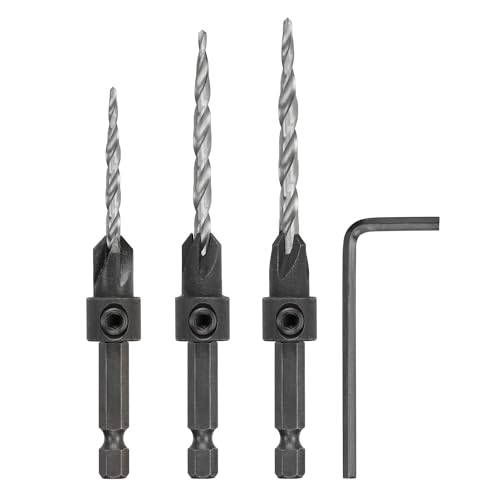
Three combination bits matched to the three screw sizes most people actually use. Each one drills the pilot, the clearance and the countersink in one pass. It’s the most reviewed countersink set we found, at 4.5 stars across 3,400+ ratings. The trade-off is that you’re locked into three sizes. If you work with #4 or #12 screws, you’ll need another bit.
W.L. Fuller Countersinks with Taper Point Drills (Set of 3)

Fuller’s tapered drills match the taper of traditional wood screws, so the pilot hole follows the screw’s shape instead of being a straight bore. That gives better grip in hardwood and less splitting near board ends. It’s the furniture maker’s choice, and the price reflects it: $71.99 for three sizes, compared with $24.97 for the DEWALT set. It rates 4.6 stars, but across only 66 ratings.
DKIBBITH 7-Piece Countersink and Counterbore Set

A budget set at $9.99 that covers more sizes than the DEWALT. Its 3-in-1 design does pilot, countersink and counterbore. It rates 4.5 stars across 781 ratings. Expect a budget bit to dull faster than DEWALT or Fuller in hardwood. For occasional home projects in pine and plywood, that matters less.
Screw Thread Gauge, SAE and Metric, with Drill and Tap Chart

For the junk drawer full of loose screws with no box. It covers #0 to 3/4″ and metric sizes, and it includes a drill and tap size chart. At $9.99 with 4.6 stars across 2,800+ ratings, it’s a cheap way to stop guessing whether a screw is a #8 or a #10.
1000-Piece Wood Screw Assortment Kit

A sorted case of Phillips flat head wood screws for the shop. It rates 4.8 stars across 198 ratings at $24.98. Check the listing for the exact gauges and lengths included before you count on it for a specific job. Assortment kits lean toward short lengths.
GRK R4 #9 x 2-1/2″ Multi-Purpose Screws (100 pcs)
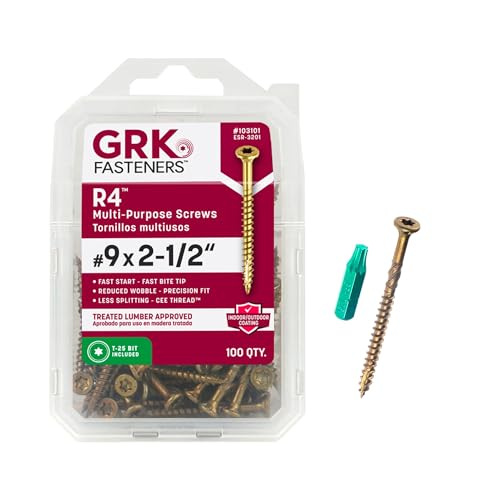
For outdoor and structural work where you want a self-drilling tip and a coated finish. A #9 R4 sits between a #8 and #10 on the chart above, and it’s a common size for decks, fences and framing repairs. It rates 4.8 stars across 933 ratings at $15.98 for 100.
For driving all of these, a good impact driver makes a big difference. Our best impact drivers guide matches picks to your battery platform, and our best cordless drill for home use guide covers drilling the pilot holes.
How to Avoid Stripped and Snapped Screws
- Use the right bit size from the chart. A worn bit strips heads just as fast as the wrong size.
- Drill the larger pilot size in hardwood. Most snapped screws in oak are a pilot hole problem, not a screw problem.
- Lower the clutch setting on your drill, or use the lowest impact mode, for small screws and soft brass.
- Keep the driver in line with the screw. Driving at an angle is the fastest way to cam out a Phillips head.
If a screw does break off, our best screw extractor sets guide covers the tools that get it out.
FAQ
What is the diameter of a #8 wood screw?
About 0.164 inches (4.2 mm) across the threads. That’s just over 5/32″.
What size pilot hole for a #8 wood screw?
1/8″ in hardwood and 7/64″ in softwood. Use an 11/64″ clearance hole in the top board when joining two pieces.
What drill bit size for a #10 screw?
9/64″ pilot in hardwood, 1/8″ in softwood, and a 13/64″ clearance hole.
Is a #10 screw bigger than a #8?
Yes. Higher gauge numbers are thicker. A #10 is about 0.190″ across, compared with 0.164″ for a #8.
What do the numbers on a wood screw mean?
In “#8 x 1-1/4”, the #8 is the gauge (diameter) and the 1-1/4 is the length in inches. A third number, like #8-18, is the threads per inch.
What is the most common wood screw size?
#8 is the most common all-round size, usually in 1-1/4″ to 2″ lengths. #6 and #10 are the next most common.
Do I need a pilot hole for wood screws?
In hardwood, near board ends, and with traditional tapered screws, yes. Modern self-drilling construction screws can often skip it in softwood and plywood.
What is a #8 screw in mm?
About 4.2 mm. The nearest metric screw is 4 mm, which is close but not a direct swap.
Print the Chart
Keep a copy on the shop wall or in your drill case. Download the wood screw sizes chart (PDF).