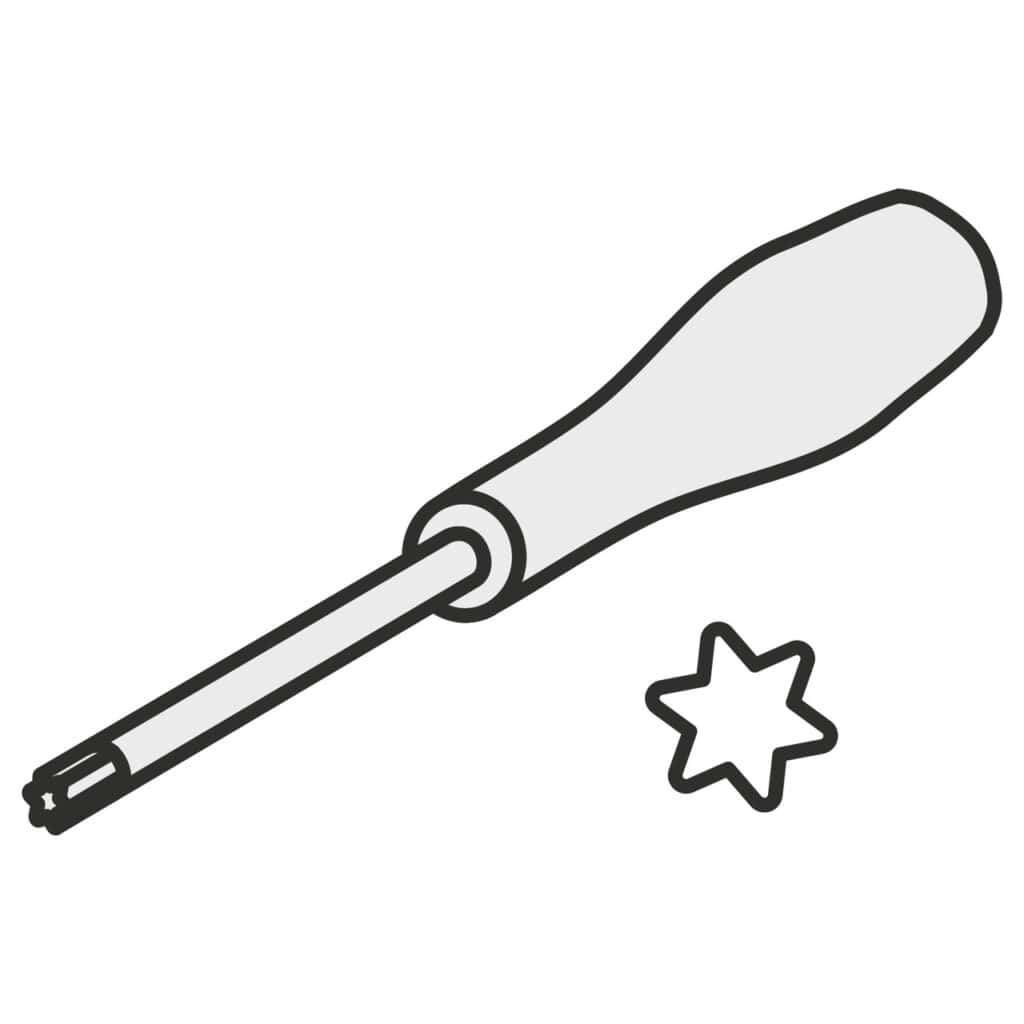
In the world of fastening and assembly, the Torx screwdriver is one of the most important tools a professional or serious DIYer can own — and one of the most misunderstood. Pick up a device made in the last twenty years and there’s a strong chance Torx screws are holding it together, from the brake disc rotors on your car to the fan assembly inside your laptop. Yet many tool users still reach for a Phillips driver and wonder why the screw won’t budge, or worse, strips on the first attempt.
This guide covers everything you need to know about Torx screwdrivers in 2026: what they are, all the distinct types (including several that most guides never mention), the complete size chart with real dimensions, how to identify which Torx variant you’re looking at, how to use them correctly, and how to choose and maintain a set that will last years.
Quick Reference Summary
| Topic | Key Details |
|---|---|
| What it is | Six-point star-shaped drive (hexalobular internal), ISO 10664 |
| Original inventor | Camcar Textron, developed 1967 (now Acument Global Technologies) |
| Generic name | “Star bit” or “star drive”; officially “hexalobular internal” per ISO 10664 |
| Size range | T1 through T100 (internal); E4 through E24 (external) |
| Main variants | Standard, Security (Tamper-Resistant), Torx Plus, External Torx, T-Handle, Precision, Torx ttap |
| Key advantages | No cam-out, higher torque transfer, longer tool and fastener life |
| Most common sizes | T8, T10, T15, T20, T25, T27, T30, T40 |
| Common applications | Automotive, electronics, bicycles, hard drives, appliances, construction |
What Is a Torx Screwdriver?
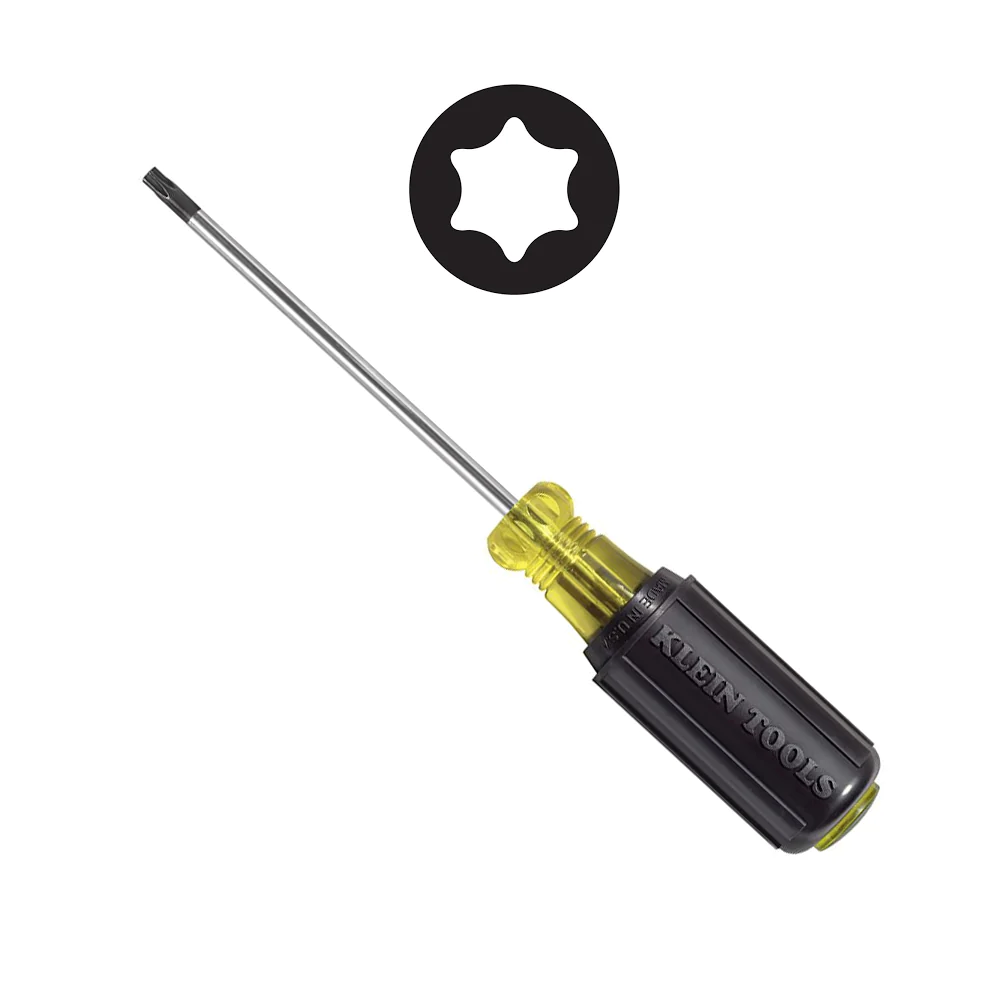
The Torx screwdriver is a specialized tool featuring a six-point star-shaped tip, designed to engage a matching six-lobe recess cut into a fastener head. The star geometry creates a fundamentally different interaction between tool and screw compared to Phillips or slotted designs — instead of wedge-shaped surfaces that push the tool out of the recess under load (the mechanism behind “cam-out”), the Torx lobes contact the screw walls with near-vertical surfaces that transfer force directly into rotation.
The result: significantly more torque can be applied without the tool slipping out, without damaging the screw head, and without damaging the driver tip. This is not a marginal improvement — it’s a fundamental mechanical advantage that makes Torx the dominant fastener drive in modern precision manufacturing.
“Torx” is a registered trademark originally owned by Camcar Textron and now managed by Acument Global Technologies (which acquired the brand in 2006 when Textron Fastening Systems was sold to Platinum Equity, and was itself later sold to Fontana Gruppo in 2014). The underlying drive geometry is an open standard, codified by the International Organization for Standardization as ISO 10664 under the name “hexalobular internal.” In everyday workshop language it’s often called a star bit or star drive.
A Brief History
The Torx drive was developed in 1967 by Camcar Textron engineer Bernard F. Reiland, with U.S. Patent 3,584,667 filed on March 21, 1967. The initial motivation was improving on Phillips and slotted fasteners for high-torque manufacturing environments — specifically to support the increasingly automated screwdrivers used on assembly lines, where consistent torque delivery without cam-out risk was essential. The design was adopted widely in automotive manufacturing first, then spread to electronics, aerospace, and consumer products.
When the original Torx patents began expiring around 1990, Camcar Textron responded by developing Torx Plus — an improved drive geometry with more squared-off lobes that provides even higher torque transfer with less wear. This is why you may encounter Torx Plus screws in modern high-precision devices even though standard Torx is still by far the more common variant.
How the Six-Point Design Works
The six symmetrical lobes of a Torx bit create 12 effective contact points with the screw recess (six lobes, each with two walls). Compare this to a Phillips head’s four narrow wedge-shaped arms — the Torx geometry distributes applied force much more evenly across a larger contact area. This is why a properly sized Torx bit can drive a fastener to significantly higher torque without the bit “riding up” and ejecting the way a Phillips bit does under the same load.
The deep, vertical wall engagement also means the bit doesn’t need to be held with downward pressure to stay in the recess — a significant ergonomic advantage in overhead or awkward-angle work where maintaining constant downward force on a Phillips driver is tiring and imprecise.
Types of Torx Screwdrivers and Variants
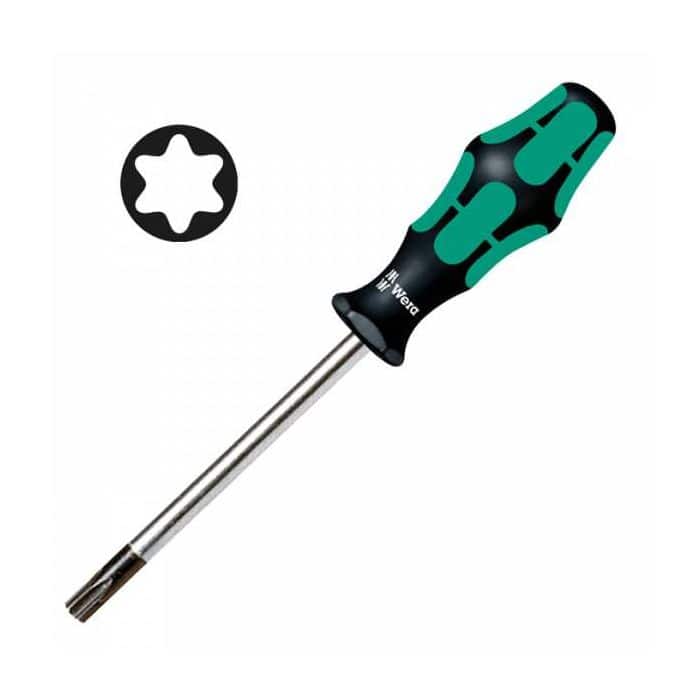
This is where most Torx guides fall significantly short. There are far more variants in the Torx family than the simple “standard vs. security” split most articles describe. Understanding each type prevents buying the wrong tool and ensures you can identify what you’re looking at when you encounter an unfamiliar fastener.
1. Standard Torx (Internal Torx)
The original and most common type. The bit inserts into a star-shaped recess in the screw head — this is the “internal” Torx design. Available in the full size range from T1 to T100. This is what most people mean when they say “Torx screwdriver,” and it’s what you’ll find in virtually every Torx set sold on Amazon.
2. Security Torx (Tamper-Resistant Torx / Pin-in Torx)
Security Torx — also called tamper-resistant Torx, tamper-proof Torx, Pin Torx, 6-lobe pin Torx, Torx TR, or Torx with pin — uses the same six-point star recess as standard Torx but adds a small cylindrical pin in the center of the screw head recess. A standard Torx driver cannot engage the screw because the central post prevents the bit from seating. Only a security Torx driver — which has a corresponding hollow center — can drive or remove these fasteners.
Security Torx screws are widely used in consumer electronics (gaming consoles, smartphones, printers), automotive interiors, and public fixtures where manufacturers want to limit casual disassembly. The notation for security Torx uses “TR” after the size — a T25 security driver is a T25TR.
Most commonly needed security sizes: T8, T10, T15, T20, T25, T27, T30.
3. Torx Plus (IP / EP)
Torx Plus is a distinct design introduced in 1990 to improve on standard Torx when the original patents were approaching expiry. The lobe geometry is modified to be more square in profile — the walls are more perpendicular, creating a larger, flatter contact surface between bit and screw. This enables even higher torque application with less wear on both bit and fastener, and also reduces the rocking/wobble that can occur with standard Torx in worn or loose-fitting bits.
Critical compatibility note: A standard Torx driver will fit into a Torx Plus screw recess (the star profile is compatible in one direction) — but a Torx Plus driver will not fit into a standard Torx screw recess. If you attempt to use a standard Torx bit in a Torx Plus application under high torque, you’ll damage the screw recess over time. Torx Plus uses its own size designations using IP (Internal Plus) and EP (External Plus) notation — e.g., 15IP, 20IP — and these do not correspond numerically to T-size designations.
Torx Plus is found in high-precision aerospace, automotive (particularly European manufacturers), and medical device applications.
4. External Torx (E-Torx / Inverted Torx)
External Torx — also called E-Torx or inverted Torx — is the reverse of standard internal Torx. Instead of a recess in the fastener head, the fastener head itself is shaped like a Torx bit, and the tool is a socket or wrench that fits over it. This design is used on bolt heads and nuts rather than screws, and is common in automotive applications — suspension components, transmission components, and drivetrain fasteners frequently use external Torx.
Important: External Torx uses an entirely separate size numbering system using “E” designations (E4, E5, E6, E7, E8, E10, E12, E14, E16, E18, E20, E24). These E-numbers do not correspond to T-numbers. For example, an E8 external Torx is equivalent in overall size to a T40 internal Torx — but they are completely different tools serving completely different fasteners. You need a socket set or nut driver with E-series Torx profiles for these, not a standard screwdriver.
5. Torx ttap (T-Star Plus)
Torx ttap is a proprietary variant developed in 2006 and licensed by Acument Intellectual Properties. It adds a second recess system that creates what’s branded as “Frixion Fit” engagement — the bit sticks in the screw head without magnets or additional holding mechanisms, designed to minimize wobble during driving. Standard Torx drivers can be used with Torx ttap screws (backward compatible), but Torx ttap-specific drivers cannot fit standard Torx screws.
T-Star Plus is a similar concept introduced in 2005 by German manufacturer Altenloh, Brinck & Co under the SPAX brand — you’ll encounter this on higher-end construction screws.
6. AudiTorx (Break-Away Torx)
AudiTorx is a specialized tamper-proof fastener where a Torx drive is integrated into a convex bolt head that is designed to snap off when a specific engineered torque is reached, leaving a smooth, rivet-like head that cannot be removed with any conventional tool. This one-time installation fastener is used primarily in railroad infrastructure and in applications where a permanent fastening must be guaranteed. It has no consumer tool application but is worth knowing if you encounter it in industrial contexts.
7. T-Handle Torx
T-handle Torx screwdrivers use a perpendicular T-shaped handle rather than the conventional inline grip. This design allows two-handed operation — one hand on each side of the T — which multiplies the rotational force you can apply dramatically compared to a standard handle. T-handle Torx tools are widely used in bicycle maintenance (where Torx is increasingly replacing hex/Allen for pedal, brake, and component fasteners), in motorcycle work, and in industrial assembly applications that require consistently high torque without a power tool.
8. Precision Torx
Precision Torx drivers use thin, pen-style handles and very small bit tips (typically T1 through T10) for fine, controlled work in tight spaces — laptop disassembly, smartphone repair, watch and camera servicing, and any application where a standard screwdriver grip would be too large to hold without obscuring visibility. These typically have a rotating cap at the top of the handle that allows the palm to rest on the cap and spin the shaft with finger and thumb only, enabling very fine torque control without wrist rotation.
9. Torx Socket Screwdrivers
Torx socket drivers combine a Torx bit with a socket-wrench-style interface, allowing the bit to be used with a ratchet, breaker bar, or torque wrench. This is the highest-torque Torx driving format and is essential in automotive and heavy machinery applications where torque specification is critical and hand-driver torque is insufficient. These are typically used in T-sizes from T40 upward in the internal range and across the full E-series external Torx range.
10. Torx Screwdriver Bits (Interchangeable)
Rather than dedicated fixed-handle screwdrivers, interchangeable Torx bits are 1/4-inch hex shank inserts that fit into multi-bit screwdriver handles, electric screwdrivers, and drill chucks. These are the most versatile and economical format for users who need multiple Torx sizes — one quality handle plus a set of bits covers more ground than multiple dedicated drivers.
Standard vs. impact-rated bits: Standard Torx insert bits are made for manual and electric screwdrivers. They should not be used in impact drivers — the cyclic hammer-and-rotate action of an impact driver generates shock forces that fracture standard bits at the tip. Impact-rated Torx bits are made from harder steel alloys and include a torsion zone — a deliberately narrowed section of the shaft that flexes slightly under impact loading, absorbing shock that would otherwise crack the tip. Always use impact-rated bits exclusively in impact drivers.
Complete Torx Size Chart
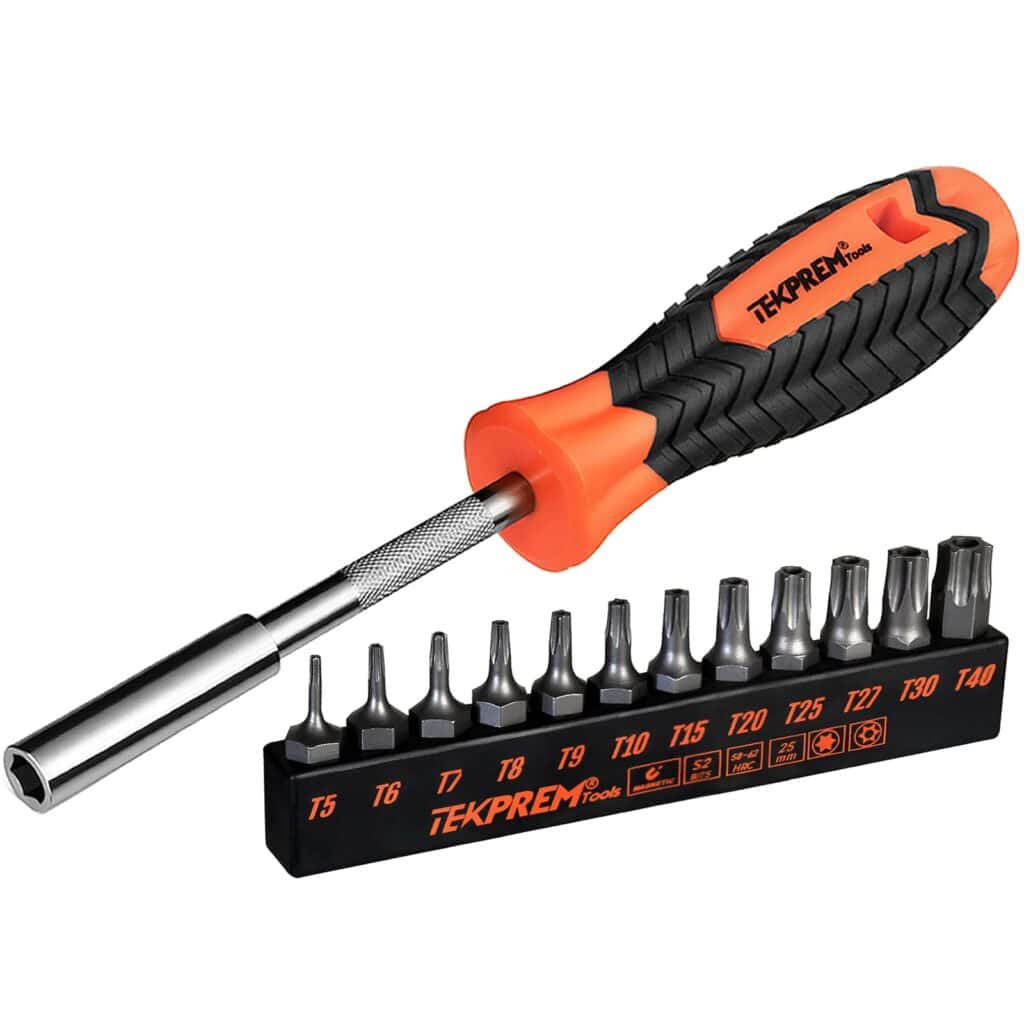
The T-number in Torx sizing refers to the point-to-point diameter across the star — the dimension measured from the tip of one lobe to the tip of the opposite lobe. Larger T-numbers = larger diameters = larger fasteners and higher torque capacity.
Internal Torx Sizes — Standard Dimensions
| Torx Size | Point-to-Point Diameter | Max Torque Range | Typical Applications |
|---|---|---|---|
| T1 | 0.81mm | 0.02–0.03 Nm | Micro-electronics, hearing aids |
| T2 | 0.93mm | 0.07–0.09 Nm | Small electronics |
| T3 | 1.10mm | 0.14–0.18 Nm | Computer components |
| T4 | 1.28mm | 0.22–0.29 Nm | Electronics, small appliances |
| T5 | 1.42mm | 0.35–0.45 Nm | Smartphones, laptops, tablets, game controllers |
| T6 | 1.70mm | 0.55–0.70 Nm | Electronics, small mechanics |
| T7 | 1.99mm | 0.8–1.1 Nm | Electronics |
| T8 | 2.31mm | 1.5–2.0 Nm | Hard drives, game consoles (Xbox), small appliances |
| T9 | 2.50mm | 2.0–2.5 Nm | Electronics, battery assemblies |
| T10 | 2.74mm | 3.0–4.0 Nm | Automotive interior trim, electronics, home appliances |
| T15 | 3.27mm | 6.0–8.0 Nm | Automotive body panels, bicycles (disc brakes), appliances |
| T20 | 3.86mm | 9.5–12 Nm | General automotive, power tools, outdoor equipment |
| T25 | 4.43mm | 14–19 Nm | Automotive, furniture (flat-pack), HVAC components |
| T27 | 4.99mm | 20–27 Nm | Automotive, heavy appliances |
| T30 | 5.52mm | 28–38 Nm | Construction, automotive structural components |
| T40 | 6.75mm | 45–65 Nm | Heavy automotive, engine components |
| T45 | 7.93mm | 65–90 Nm | Industrial machinery |
| T50 | 8.83mm | 90–130 Nm | Heavy machinery, agricultural equipment |
| T55 | 9.00mm | 120–160 Nm | Heavy industrial, some truck lug nuts |
| T60–T100 | 10mm+ | High industrial torque | Earthmoving equipment, heavy industrial machinery |
Note: Torx sizing is universal — there is no SAE vs. metric split. A T25 bit is a T25 bit regardless of country of origin or tool manufacturer.
External Torx Sizes (E-Series)
| External Torx Size | Common Applications |
|---|---|
| E4, E5, E6 | Small automotive fasteners, precision applications |
| E7, E8 | Automotive body components, ABS sensors |
| E10, E12 | Automotive suspension components, brake calipers |
| E14, E16 | Drivetrain fasteners, heavy automotive components |
| E18, E20, E24 | Large automotive, truck, and industrial bolt heads |
Reminder: E-series external Torx sizes do not correspond numerically to T-series internal Torx sizes. E8 is not related to T8.
How to Identify Your Torx Size Without a Size Chart
If you don’t know the size of a Torx fastener you’re working with, here are three practical identification methods:
- Test-fit method: start with a size that looks approximately right and test-fit bits from the set. A correct-size Torx bit seats completely in the recess with zero wobble or play in any direction. Too small = the bit seats but wobbles. Too large = the bit won’t enter the recess.
- Caliper measurement: measure the point-to-point diameter of the star recess with a digital caliper and match it to the size chart above.
- Reference by device: most electronics have documented Torx sizes in their iFixit teardown guides — searching “[device model] screwdriver size” gives you the exact sizes needed for most consumer electronics within seconds.
Advantages of Torx Screwdrivers
No Cam-Out
Cam-out — the mechanism where a Phillips or slotted driver pops up and out of a screw recess under load — is by design in those systems (Phillips was intentionally designed to cam out to prevent overtightening on assembly lines). Torx was specifically engineered to eliminate cam-out. The vertical walls of the Torx lobes prevent the outward force component that causes Phillips drivers to eject. Under high torque, a Torx bit stays seated until the fastener itself reaches its failure torque — it doesn’t slip out and gouge the surrounding surface or injure the user’s hand.
Higher Torque Transmission
The Torx design allows significantly more torque to be applied to a fastener of equivalent size compared to Phillips, slotted, or standard hex drives. This is why Torx has become the dominant fastener drive in automotive assembly, bicycle component manufacturing, and precision electronics — applications where consistent, high torque in a compact fastener is the design requirement.
Longer Tool and Fastener Life
Because Torx bits stay properly seated under load, there’s no metal-on-metal abrasion between a slipping bit and screw head. Both the bit and the fastener head maintain their geometry far longer than equivalent Phillips or slotted combinations under the same workload. A quality chrome-vanadium Torx bit used correctly will outlast multiple equivalent Phillips bits in the same application volume.
Improved Safety
A bit that doesn’t cam out is a bit that doesn’t suddenly redirect the screwdriver across a circuit board, a painted surface, or your knuckles. In precision electronics work, this matters enormously — a single cam-out event on a Phillips screw can scratch a motherboard trace or LCD panel in ways that are expensive or impossible to repair.
No SAE/Metric Distinction
Unlike most fastener categories, Torx sizes are universal — a T25 is a T25 globally. You don’t need separate SAE and metric Torx sets, which simplifies purchasing and reduces the number of tools you need to carry.
Common Applications by Industry
Consumer Electronics
Torx fasteners are found throughout modern consumer electronics — typically in the smaller sizes. Smartphones use T3, T4, and T5 screws internally. Laptops and tablets commonly use T5 and T8. Hard disk drives use T8 almost universally. Gaming consoles are a common encounter — Xbox controllers and consoles use T8 and T10 security Torx extensively, which is why a T8 security (tamper-resistant) bit is one of the first specialty bits to own if you ever repair consoles yourself.
Automotive
The automotive industry is the largest user of Torx fasteners by volume. Body panel fasteners, interior trim clips, seat components, and dashboard assemblies typically use T20–T30. Brake system components (including disc brake caliper bolts and rotor fasteners on bicycles) commonly use T25 and T30. Engine accessories, oil pan bolts, and drivetrain components use larger sizes including T40 and above. European vehicles (particularly German manufacturers) have a strong preference for Torx over Phillips or Robertson throughout the vehicle — BMW, Mercedes, Audi, and Volkswagen use Torx extensively at virtually every access point on modern models.
Bicycles
Modern road and mountain bikes have moved heavily toward Torx fasteners, particularly for components where precise, consistent torque matters: disc brake rotor mounting bolts (typically T25), derailleur pivot bolts, brake lever clamp bolts, and handlebar stem bolts. A T25 and T30 are the two sizes that cover the majority of modern bicycle component fasteners. Shimano and SRAM both specify Torx widely across their groupset components.
Appliances and HVAC
Washing machines, dryers, dishwashers, and refrigerators use Torx internally for main assembly fasteners — manufacturers prefer Torx because it reduces stripped screws on factory assembly lines. HVAC systems use Torx on panel access covers and component mounting. T15, T20, and T25 cover most appliance repair needs.
Construction
Torx drive construction screws (decking screws, structural screws, and specialty fasteners like SPAX) have become widely used in professional framing and decking applications. T20 and T25 drive SPAX screws, which are increasingly used as an alternative to traditional hex-head structural screws for interior framing and subfloor work. T30 handles larger structural fasteners.
Aerospace
Torx Plus (the improved 1990 variant) dominates aerospace fastener specifications where consistent, repeatable torque at lightweight fastener sizes is critical. The improved lobe geometry of Torx Plus provides more predictable torque-to-clamp-force relationships than standard Torx, which matters in safety-critical structural assemblies.
How to Use a Torx Screwdriver Correctly
Choose the Correct Size
This is the most critical step. A Torx bit that is one size too small will engage the screw recess partially but will rock and wobble — driving with it will round the lobe corners of both the bit and the screw, eventually making both unusable. A correct-fit Torx bit seats completely in the recess with no play in any rotational direction. Test-fit before applying torque, every time you’re unsure of the size.
Seat the Bit Fully Before Turning
Push the bit firmly into the screw recess so it’s fully seated before beginning rotation. A partially seated Torx bit riding on the top edges of the lobes rather than the full depth of the recess will cam out — one of the few situations where Torx can fail is when the bit isn’t properly engaged.
Maintain Axial Alignment
Keep the screwdriver or bit holder perpendicular to the fastener head throughout the drive stroke. Angling the driver causes uneven lobe contact that concentrates force on fewer surfaces, accelerating wear and increasing the chance of lobe damage. In awkward access situations where you can’t achieve a straight-on angle, use a flexible extension shaft or ball-end Torx bit rather than forcing an angled approach.
Match Speed to Application
For precision work on electronics or soft-material fasteners, use slow, deliberate rotation with controlled hand pressure. For construction and automotive applications with power tools, use appropriate speed settings for the material — high speed with low initial torque for driving screws into wood; lower speed with higher torque for automotive fasteners. Always use impact-rated Torx bits in impact drivers.
Avoid Overtightening
Torx’s excellent torque transmission is a feature and a responsibility — you can overtighten fasteners more easily than with Phillips because there’s no cam-out to limit torque. On delicate electronics, use a precision driver with a light touch. On automotive components with published torque specifications, use a torque wrench or torque-limiting driver to hit the correct spec rather than “tight enough by feel.”
Identifying Security vs. Standard Torx
Before driving a screw you’re unfamiliar with, look at the center of the recess. A standard Torx recess has a smooth, open star-shaped cavity. A security Torx (tamper-resistant) has a small cylindrical pin standing up from the center of the recess. Attempting to drive a security Torx with a standard bit will result in the bit bottoming out on the pin without engaging the lobes — it will feel like you’re on the wrong size. Use the appropriately hollow-centered security bit for these fasteners.
Selecting the Right Torx Screwdriver Set
What Size Range Do You Need?
For most users, an 8–10 piece set covering T8 through T40 handles 90% of real-world Torx applications across automotive, appliances, and general repair. If your work involves electronics and smartphone or console repair, add a precision set covering T3 through T10 (or T15). If you work on European vehicles extensively, ensure your set includes T27, T40, and T45 — sizes that are less common in general sets but frequently needed on German cars. For E-series (external Torx) automotive work, buy a dedicated E-series socket set separately.
Security Torx Coverage
If you repair gaming consoles, work on automotive interiors, or deal with public infrastructure fixtures, you’ll need security (tamper-resistant) Torx bits. The most commonly needed security sizes are T8, T10, T15, T20, T25, T27, and T30. Many good general Torx sets now include both standard and security bits in one case.
Material Quality
Look for bits made from S2 steel or chrome-vanadium (CRV) steel with a hardness rating of 58–62 HRC. This hardness range provides the right balance of toughness (resistance to fracture under impact) and hardness (resistance to tip deformation under high torque). Softer bits round off quickly in heavy use; overly hard bits are brittle and can fracture in impact applications. Black oxide coating adds corrosion resistance.
For impact driver use, look specifically for impact-rated bits with a visible torsion zone (the narrowed section in the middle of the bit shaft). Standard CRV insert bits will fracture in impact drivers.
Handle Ergonomics
For fixed-handle Torx screwdrivers, look for tri-lobe or multi-zone rubber grips that provide both rotational grip (for torque delivery) and axial grip (for maintaining pressure on the fastener). Soft-grip materials are more comfortable in extended use than hard plastic. A larger handle diameter increases the moment arm and allows more torque — but precision work benefits from a slimmer, lighter handle for tactile feedback.
Magnetic Tips
Magnetized bit tips hold fasteners on the tip during placement — an enormous practical advantage when working in positions where dropping a small screw means it’s lost or potentially damaging if it falls into electronics. Most quality Torx driver sets now include magnetized tips as standard. Exception: for work on sensitive electronics where magnetic fields can damage components (certain older storage media, some precision sensors), use non-magnetized bits or demagnetized bits specifically.
Recommended Brands (2026)
Three brands consistently lead independent quality assessments for Torx tools in the professional market:
- Wera: German manufacturer known for Kraftform ergonomic handles and excellent bit quality; their Torx sets are widely used by professional technicians
- Wiha: German brand with comprehensive Torx coverage from T1 through large sizes; strong in precision electronics applications
- Tekton: US-available brand offering excellent value-to-quality ratio for professional-grade Torx sets; good impact-rated bit selection
For occasional DIY use, any set with S2 or CRV steel bits from a recognizable brand

- Wera Kraftform Plus 367/6 Torx Set – six Torx drivers with Kraftform handles and a storage rack. Rated 4.8 stars across 1,000+ Amazon ratings.
- Wiha 36291 Torx Set, 6-Piece – cushion-grip handles, a good match for electronics and appliance work. Rated 4.8 stars across 520+ ratings.
- TEKTON Torx Bit Socket Set, 12-Piece (SHB91103) – Torx bit sockets for a ratchet, the better choice for automotive fasteners. Rated 4.8 stars across 370+ ratings.
Ratings checked on Amazon on September 29, 2026.
Torx Screwdriver Maintenance
Cleaning
Clean Torx bits and drivers after each use, particularly after work involving lubricants, thread locker compounds, or corrosive chemicals. A clean rag wipe is sufficient for most applications. For dried-on compounds (Loctite, grease, paint), a brass wire brush (which won’t scratch the steel) removes residue without damaging the bit geometry. Avoid leaving bits in cleaning solvents for extended periods — some solvents can attack bit coatings and affect handle materials.
Inspection
Before using a Torx bit on any precision fastener, inspect the lobe tips visually. Worn tips show rounding or flattening of the lobe corners — these bits will not seat properly and will damage fastener recesses under load. Replace worn bits immediately rather than trying to squeeze more use out of them; the cost of a replacement bit is always less than the cost of a stripped fastener that needs extraction.
Storage
Store Torx bits and drivers in a dry environment away from salt air and humidity exposure. The original indexed case or roll keeps bits organized by size and prevents tips from contacting each other (which can cause micro-chipping of hardened tip surfaces). Avoid loose storage in a tool drawer where bits rattle against each other — this accelerates surface damage to tip geometry over time.
When to Replace
Replace Torx bits when:
- The lobe tips show visible rounding, flattening, or chipping
- The bit wobbles or exhibits play in the screw recess even at the correct size
- The bit slips under torque that the same fastener previously accepted without slipping
- There is visible cracking or fracture anywhere in the shaft (particularly in impact-rated bits that have seen heavy use)
Torx vs. Other Drive Systems
| Drive Type | Cam-Out Risk | Torque Capacity | Tamper Resistance | Common In |
|---|---|---|---|---|
| Torx | Very low | Very high | High (security variant) | Automotive, electronics, bicycles, appliances |
| Phillips | Designed in | Moderate | None | General consumer products, construction |
| Slotted (Flat) | High | Low | None | Electrical, legacy applications |
| Hex (Allen) | Low | High | Low | Furniture (flat-pack), bicycles, machinery |
| Robertson (Square) | Very low | High | Low | Canadian construction, some woodworking |
| Pentalobe | Low | Moderate | High | Apple products exclusively |
The Pentalobe drive used on Apple iPhones, MacBooks, and AirPods is frequently confused with Torx — both are star-shaped profiles. However, Pentalobe uses five lobes (not six) with a different geometry specifically designed to be incompatible with Torx tools. A Torx bit will not engage a Pentalobe screw, and attempting to force it will damage the recess. Apple repair kits and specialized sets for Apple products include the correct Pentalobe drivers alongside Torx sizes needed for other internal fasteners.
Frequently Asked Questions
Can I use a Torx screwdriver on a Pentalobe screw (Apple devices)?
No. Pentalobe and Torx look similar but use different five-lobe vs. six-lobe geometries that are incompatible. Using a Torx bit on a Pentalobe screw will damage the recess. You need a dedicated Pentalobe driver for Apple products (typically P2 for iPhones and P5 for MacBooks).
Can I use a standard Torx bit on a Security (Tamper-Resistant) Torx screw?
No. The security pin in the center of the screw recess prevents a standard bit from seating. You’ll need a hollow-centered security Torx bit (TR-size notation, e.g., T25TR or T25H) to engage and drive these fasteners.
What’s the difference between Torx and Torx Plus?
Torx Plus (introduced 1990) has a modified lobe geometry that’s more squared-off, allowing higher torque with less wear. A standard Torx driver fits Torx Plus recesses but is not optimal for high-torque use. A Torx Plus driver will not fit standard Torx screws. Check what type of fastener you’re working with before buying bits.
Are Torx and Star bits the same thing?
Effectively yes, with a trademark distinction. “Torx” is a registered trademark; “star bit” or “star drive” is the generic term for the same six-lobe drive profile. The ISO standard name is “hexalobular internal” (ISO 10664). All three terms refer to the same geometry.
What Torx size does Xbox use?
Xbox controllers primarily use T8 security (tamper-resistant) Torx. Xbox console internal components use various sizes including T8 and T10 security. A T8 security (T8H or T8TR) bit is the essential size for Xbox controller disassembly and repair.
What Torx sizes do I need for a car?
For most passenger vehicles, a set covering T15, T20, T25, T27, T30, and T40 handles the majority of accessible interior and exterior fasteners. For engine work and suspension on European vehicles (particularly German brands), add T45 and T50. For drivetrain and bolt-head fasteners, you’ll also need an E-series external Torx socket set covering E8 through E18.
Can Torx bits be used in an impact driver?
Only impact-rated Torx bits should be used in impact drivers. Standard CRV Torx bits will fracture under the cyclic shock loading of an impact driver. Impact-rated bits are made from different steel alloys and include a torsion zone that absorbs impact energy. They are marked “impact” or show the torsion zone as a visible narrowed section in the middle of the shaft.
How do I remove a stripped Torx screw?
If the Torx recess has been damaged (typically from using an incorrectly sized or worn bit), several extraction methods apply: a slightly larger Torx size sometimes grips the remaining lobe material; a rubber band placed over the recess provides additional grip friction for a marginally stripped screw; a screw extractor kit (left-hand drill bit or dedicated extraction bits) bites into the stripped head; or in worst cases, cutting a flat slot with a rotary tool and using a slotted driver provides enough grip to turn the fastener out.
Quick-Reference: Which Torx Size for What?
| Application | Typical Torx Sizes Needed |
|---|---|
| Smartphones (general) | T3, T4, T5 |
| Laptops and tablets | T5, T8 |
| Hard disk drives | T8 |
| Xbox controllers / consoles | T8 Security (T8TR) |
| PlayStation consoles | T8, T9 Security |
| Home appliances (general) | T15, T20, T25 |
| Automotive interior / trim | T15, T20, T25, T27, T30 |
| Automotive engine components | T40, T45, T50 |
| Bicycle disc brakes (rotors) | T25 |
| Bicycle components (general) | T25, T30 |
| European vehicles (general) | T20, T25, T27, T30, T40, T45 |
| Construction / structural screws (SPAX) | T20, T25, T30 |
| Automotive suspension bolts | E10, E12, E14 (External Torx) |
Armed with this information, you can approach any Torx fastener with confidence — knowing not just which bit size to reach for, but which variant of Torx you’re dealing with, whether it’s standard or security, internal or external, and what driver format gives you the best torque and control for the job at hand.